
New research shows that behaviors that occur at the very lowest levels of the network stack make encryption—in any form, not just those that have been broken in the past—incapable of providing client isolation, an encryption-enabled protection promised by all router makers, that is intended to block direct communication between two or more connected clients.
The isolation can effectively be nullified through AirSnitch, the name the researchers gave to a series of attacks that capitalize on the newly discovered weaknesses. Various forms of AirSnitch work across a broad range of routers, including those from Netgear, D-Link, Ubiquiti, Cisco, and those running DD-WRT and OpenWrt.
AirSnitch “breaks worldwide Wi-Fi encryption, and it might have the potential to enable advanced cyberattacks,” Xin’an Zhou, the lead author of the research paper, said in an interview. “Advanced attacks can build on our primitives to [perform] cookie stealing, DNS and cache poisoning. Our research physically wiretaps the wire altogether so these sophisticated attacks will work. It’s really a threat to worldwide network security.” Zhou presented his research on Wednesday at the 2026 Network and Distributed System Security Symposium.
Paper co-author Mathy Vanhoef, said a few hours after this post went live that the attack may be better described as a Wi-Fi encryption “bypass,” “in the sense that we can bypass client isolation. We don’t break Wi-Fi authentication or encryption. Crypto is often bypassed instead of broken. And we bypass it ;)” People who don’t rely on client or network isolation, he added, are safe.
[…]
The lowest level, Layer-1, encompasses physical devices such as cabling, connected nodes, and all the things that allow them to communicate. The highest level, Layer-7, is where applications such as browsers, email clients, and other Internet software run. Levels 2 through 6 are known as the Data Link, Network, Transport, Session, and Presentation layers, respectively.
Identity crisis
Unlike previous Wi-Fi attacks, AirSnitch exploits core features in Layers 1 and 2 and the failure to bind and synchronize a client across these and higher layers, other nodes, and other network names such as SSIDs (Service Set Identifiers). This cross-layer identity desynchronization is the key driver of AirSnitch attacks.
The most powerful such attack is a full, bidirectional machine-in-the-middle (MitM) attack, meaning the attacker can view and modify data before it makes its way to the intended recipient. The attacker can be on the same SSID, a separate one, or even a separate network segment tied to the same AP. It works against small Wi-Fi networks in both homes and offices and large networks in enterprises.
[…]
Even when HTTPS is in place, an attacker can still intercept domain look-up traffic and use DNS cache poisoning to corrupt tables stored by the target’s operating system. The AirSnitch MitM also puts the attacker in the position to wage attacks against vulnerabilities that may not be patched. Attackers can also see the external IP addresses hosting webpages being visited and often correlate them with the precise URL.
Given the range of possibilities it affords, AirSnitch gives attackers capabilities that haven’t been possible with other Wi-Fi attacks, including KRACK from 2017 and 2019 and more recent Wi-Fi attacks that, like AirSnitch, inject data (known as frames) into remote GRE tunnels and bypass network access control lists.
“This work is impressive because unlike other frame injection methods, the attacker controls a bidirectional flow,” said HD Moore, a security expert and the founder and CEO of runZero.
[…]
The MitM targets Layers 1 and 2 and the interaction between them. It starts with port stealing, one of the earliest attack classes of Ethernet that’s adapted to work against Wi-Fi. An attacker carries it out by modifying the Layer-1 mapping that associates a network port with a victim’s MAC—a unique address that identifies each connected device. By connecting to the BSSID that bridges the AP to a radio frequency the target isn’t using (usually a 2.4GHz or 5GHz) and completing a Wi-Fi four-way handshake, the attacker replaces the target’s MAC with one of their own.
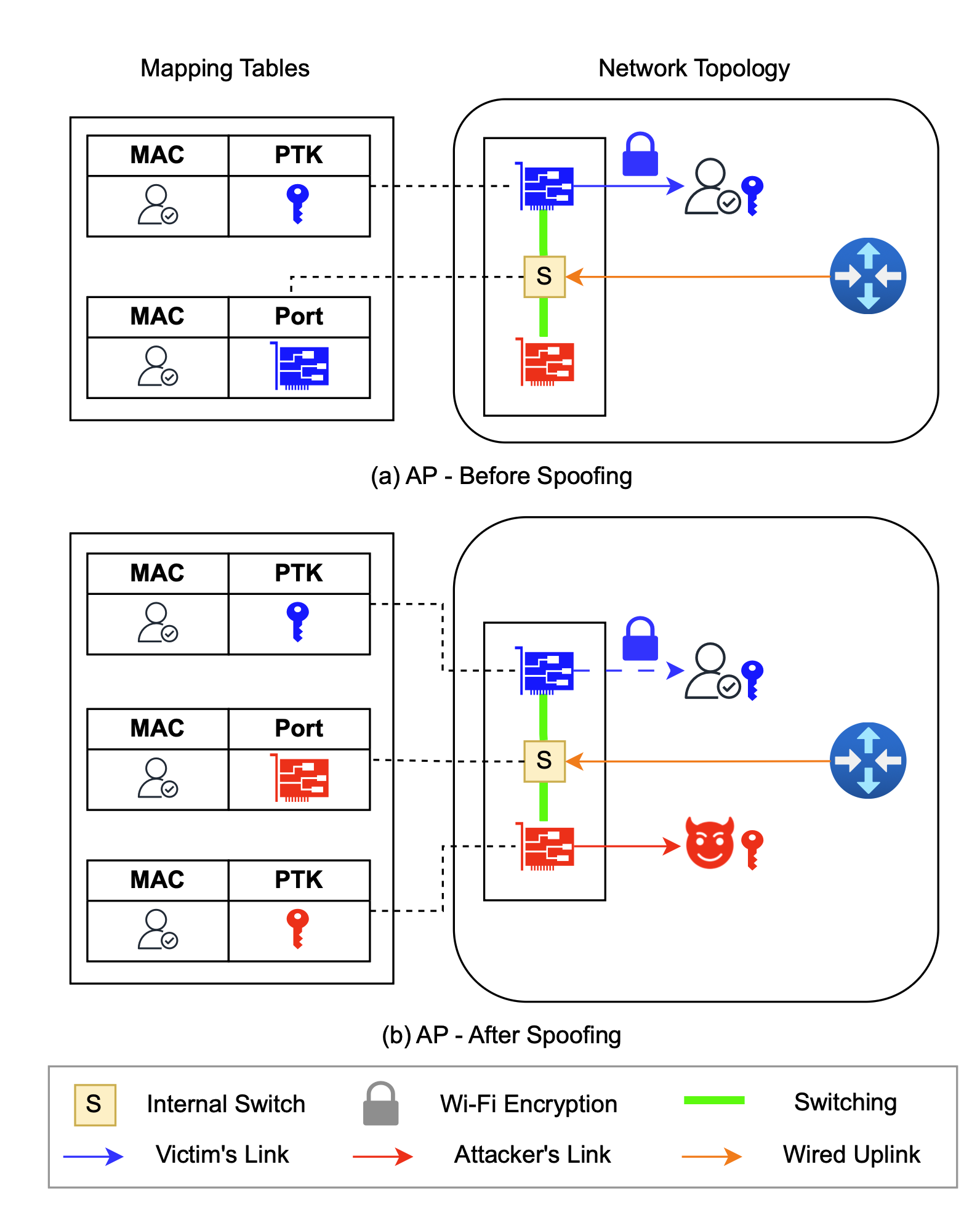
causing the internal switch to mistakenly associate the victim’s address with the attacker’s port/BSSID. As a result, frames intended for the victim are
forwarded to the attacker and encrypted using the attacker’s PTK. Credit: Zhou et al.
In other words, the attacker connects to the Wi-Fi network using the target’s MAC and then receives the target’s traffic. With this, an attacker obtains all downlink traffic (data sent from the router) intended for the target. Once the switch at Layer-2 sees the response, it updates its MAC address table to preserve the new mapping for as long as the attacker needs.
This completes the first half of the MitM, allowing all data to flow to the attacker. That alone would result in little more than a denial of service for the target. To prevent the target from noticing—and more importantly, to gain the bidirectional MitM capability needed to perform more advanced attacks—the attacker needs a way to restore the original mapping (the one assigning the victim’s MAC to the Layer-1 port). An attacker performs this restoration by sending an ICMP ping from a random MAC. The ping, which must be wrapped in a Group Temporal key shared among all clients, triggers replies that cause the Layer-1 mapping (i.e., port states) to revert back to the original one.
“In a normal Layer-2 switch, the switch learns the MAC of the client by seeing it respond with its source address,” Moore explained. “This attack confuses the AP into thinking that the client reconnected elsewhere, allowing an attacker to redirect Layer-2 traffic. Unlike Ethernet switches, wireless APs can’t tie a physical port on the device to a single client; clients are mobile by design.”
The back-and-forth flipping of the MAC from the attacker to the target, and vice versa, can continue for as long as the attacker wants. With that, the bidirectional MitM has been achieved. Attackers can then perform a host of other attacks, both related to AirSnitch or ones such as the cache poisoning discussed earlier. Depending on the router the target is using, the attack can be performed even when the attacker and target are connected to separate SSIDs connected by the same AP. In some cases, Zhou said, the attacker can even be connected from the Internet.
“Even when the guest SSID has a different name and password, it may still share parts of the same internal network infrastructure as your main Wi-Fi,” the researcher explained. “In some setups, that shared infrastructure can allow unexpected connectivity between guest devices and trusted devices.”
[…]
In their paper, AirSnitch: Demystifying and Breaking Client Isolation in Wi-Fi Networks, the researchers wrote:
Although port stealing was originally devised for hosts on the same switch, we show that attackers can hijack MAC-to-port mappings at a higher layer, i.e., at the level of the distribution switch—to intercept traffic to victims associated with different APs. This escalates the attack beyond its traditional limits, breaking the assumption that separate APs provide effective isolation.
This discovery exposes a blind spot in client isolation: even physically separated APs, broadcasting different SSIDs, offer ineffective isolation if connected to a common distribution system. By redirecting traffic at the distribution switch, attackers can intercept and manipulate victim traffic across AP boundaries, expanding the threat model for modern Wi-Fi networks.
[…]
AirSnitch, by contrast, requires that the attacker already have some sort of access to the Wi-Fi network. For many people, that may mean steering clear of public Wi-Fi networks altogether.
If the network is properly secured—meaning it’s protected by a strong password that’s known only to authorized users—AirSnitch may not be of much value to an attacker. The nuance here is that even if an attacker doesn’t have access to a specific SSID, they may still use AirSnitch if they have access to other SSIDs or BSSIDs that use the same AP or other connecting infrastructure.
[…]
“We expand the threat model showing an attacker can be on another channel or port, or can be from the Internet,” Zhou said. “Firewalls are also networking devices. We often say a firewall is a Layer-3 device because it works at the IP layer. But fundamentally, it’s connected by wire to different network elements. That wire is not secure.”
Some of the threat can be mitigated by using VPNs, but this remedy has all the usual drawbacks that come with them. For one, VPNs are notorious for leaking metadata, DNS queries, and other traffic that can be useful to attackers, making the protection limited.
[…]
Another potential mitigation is using wireless VLANs to isolate one SSID from another. Zhou said such options aren’t universally available and are also “super easy to be configured wrong.” Specifically, he said VLANs can often be implemented in ways that allow “hopping vulnerabilities.” Further, Moore has argued why “VLANs are not a practical barrier” against all AirSnitch attacks
The most effective remedy may be to adopt a security stance known as zero trust, which treats each node inside a network as a potential adversary until it provides proof it can be trusted. This model is challenging for even well-funded enterprise organizations to adopt, although it’s becoming easier. It’s not clear if it will ever be feasible for more casual Wi-Fi users in homes and smaller businesses.
Probably the most reasonable response is to exercise measured caution for all Wi-Fi networks managed by people you don’t know. When feasible, use a trustworthy VPN on public APs or, better yet, tether a connection from a cell phone.
[…]
“It will be interesting to see if the wireless vendors care enough to resolve these issues completely and if attackers care enough to put all of this together when there might be easier things to do (like run a fake AP instead),” Moore said. “At the least it should make pentesters’ lives more interesting since it re-opens a lot of exposure that many folks may not have any experience with.

Robin Edgar
Organisational Structures | Technology and Science | Military, IT and Lifestyle consultancy | Social, Broadcast & Cross Media | Flying aircraft