This looks like a sign the beancounters who have never actually flown a jet have taken over. But in the USA of today, facts don’t really seem to count for much anyway.
The U.S. Navy has shown no signs of reversing course on major changes to its pipeline for new naval aviators in its latest draft requirements for a replacement for its T-45 Goshawk jet trainers. The Navy has already axed carrier qualifications from the syllabus for prospective tactical jet pilots and has plans to significantly alter how other training is done at bases ashore. These decisions have prompted concerns and criticism, but the service argues that advances in virtualized training and automated carrier landing capabilities have fundamentally changed the training ecosystem.
Aviation Weekwas first to report on the recent release of the latest draft requirements for what the Navy is currently calling the Undergraduate Jet Training System (UJTS). The service is looking to acquire 216 new jet trainers to replace the just under 200 T-45s it has in inventory today. The Navy has been pursuing a successor to the T-45 Goshawk for years now, and the UJTS effort has been delayed multiple times. The goal now is to kick off a formal competition relatively soon, ahead of a final contract award in mid-2027.
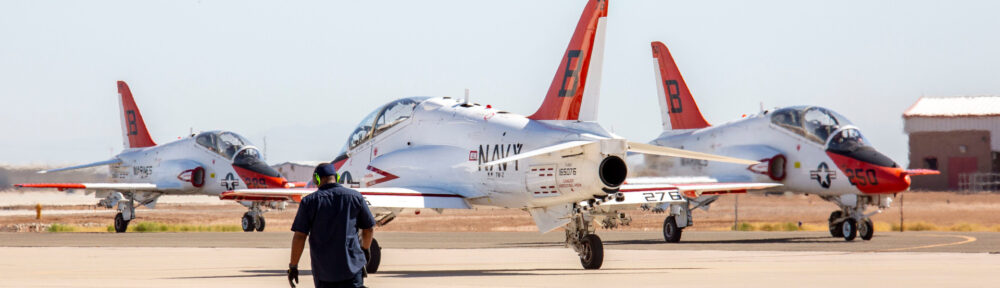
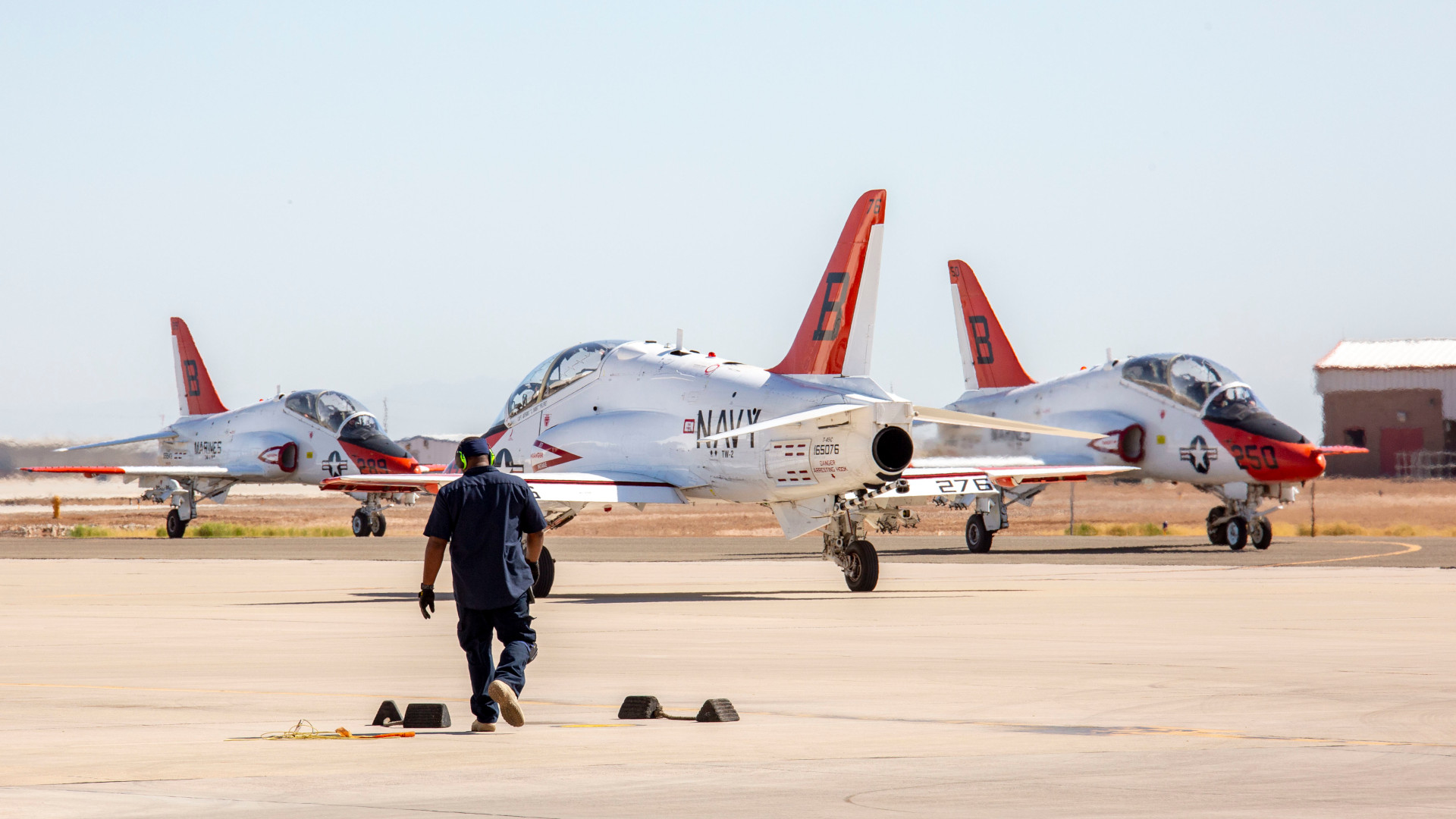
T-45s on the flightline at Naval Air Facility (NAF) El Centro in California. USN
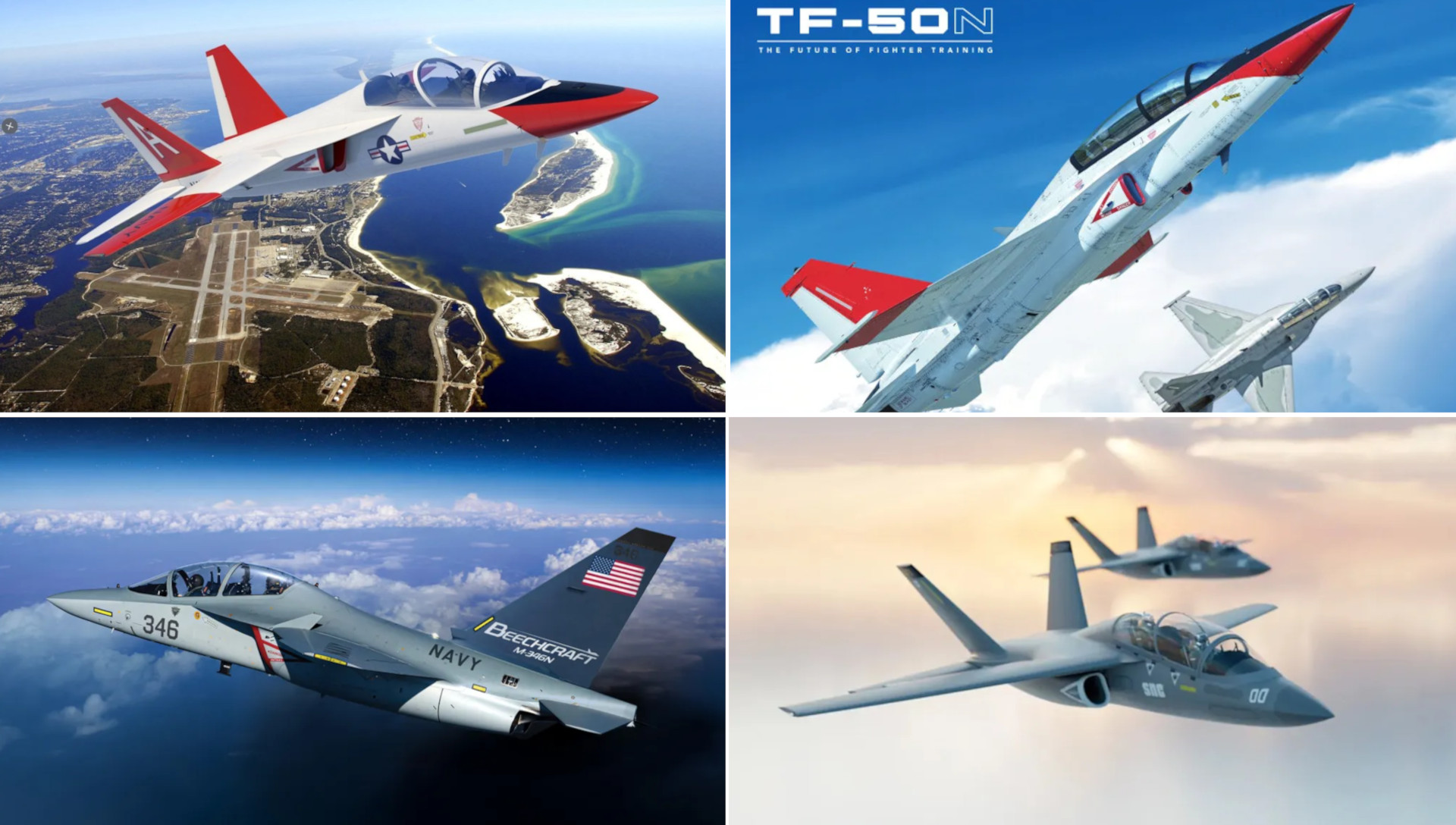
A number of companies have already lined up to compete for UJTS. This includes Boeing with a navalized version of its T-7 Red Hawk, the TF-50N from Lockheed Martin and Korea Aerospace Industries (KAI), the M-346N offered by Textron and Leonardo (and now branded as a Beechcraft product), and the Sierra Nevada Corporation’s (SNC) Freedom jet.
Clockwise from top left: Renderings of Boeing’s navalized T-7, the TF-50N from Lockheed Martin and Korea Aerospace Industries, SNC’s Freedom jet, and the Beechcraft M-346N. Boeing/Lockheed Martin/Textron/Leonardo/SNC
The newest UJTS draft request for proposals reinforces the aforementioned changes to the carrier qualification and so-called Field Carrier Landing Practice (FCLP) training requirements. Though conducted at bases on land, FCLP landings have historically been structured in a way that “simulates, as near as practicable, the conditions encountered during carrier landing operations,” according to the Navy.
The Navy’s plan now is to eliminate the actual touch-and-go component of FCLP training, also known as FCLP to touchdown, at least for students flying in the future UJTS jet trainer. Instead, the syllabus will include what is described as FCLP to wave off, where student pilots in those aircraft will fly a profile in line with being waved off from a landing attempt on an actual carrier prior to touchdown.
[….]
As noted, the Navy has already cut the carrier landing qualification requirement from the pipeline for individuals training to fly F/A-18E/F Super Hornet and F-35C fighters, as well as EA-18G Growler electronic warfare aircraft. At least as of last August, carrier qualifications were still part of the syllabus for student aviators in line to fly E-2 Hawkeye airborne early warning and control aircraft, as well as for all international students.
“Field Carrier Landing Practice (FCLP) landings ashore are still required for graduation,” a Navy spokesperson also told TWZ in August 2025, but did not specify whether or not this meant “to touchdown.”
[…]
All of this has major ramifications for the forthcoming UJTS jet trainer competition. Not even having to perform FLCPs to touchdown, let alone actual carrier qualifications, fundamentally changes the aircraft designs that can be considered to replace the carrier-capable T-45s. Carrier landings and takeoffs stress airframes, especially landing gear, in completely different ways compared to typical operations from airbases on land.
[…]
There is also a cost benefit arguement to be made. Eliminating the need for features required for carrier-based operations could help keep down the price tag of any future T-45 replacement, as well as reduce developmental risk. The overall changes to the training syllabus will have their own cost impacts with the cut down in time and resources required for a student pilot to get their wings.
At the same time, concerns and criticism have been voiced about the possible downstream impacts of cutting elements long considered critical to naval aviation training. What can be done in virtualized aviation training environments, in particular, has become very impressive in recent years, but they still cannot fully recreate the experience of live training events.
“Carrier qualification is more than catching the wire. It is the exposure to the carrier environment and how an individual deals with it,” an experienced U.S. Navy strike fighter pilot told TWZ back in 2020. “The pattern, the communications, the nuance, the stress. The ability to master this is one of our competitive advantages.”