
[…] if it were in our solar system, it could travel from Earth to the Moon in 14 minutes. This supermassive black hole, weighing as much as 20 million Suns, has left behind a never-before-seen 200,000-light-year-long “contrail” of newborn stars, twice the diameter of our Milky Way galaxy. It’s likely the result of a rare, bizarre game of galactic billiards among three massive black holes.
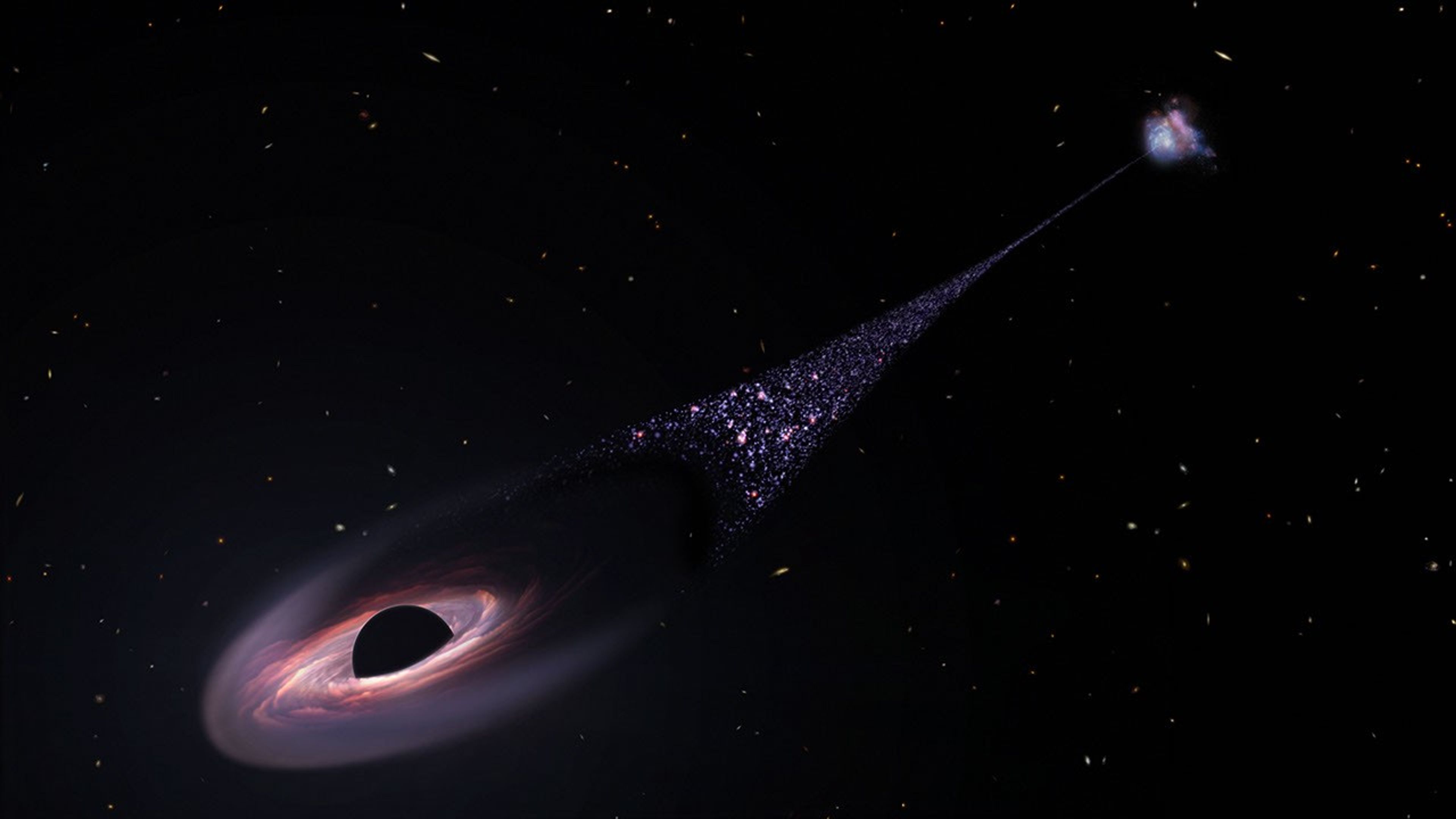
Rather than gobbling up stars ahead of it, like a cosmic Pac-Man, the speedy black hole is plowing into gas in front of it to trigger new star formation along a narrow corridor.
[…] Nothing like it has ever been seen before, but it was captured accidentally by NASA’s Hubble Space Telescope.
 This is an artist’s impression of a runaway supermassive black hole that was ejected from its host galaxy as a result of a tussle between it and two other black holes. As the black hole plows through intergalactic space it compresses tenuous gas in front of it. This precipitates the birth of hot blue stars. This illustration is based on Hubble Space Telescope observations of a 200,000-light-year-long “contrail” of stars behind an escaping black hole.NASA, ESA, Leah Hustak (STScI)
“We think we’re seeing a wake behind the black hole where the gas cools and is able to form stars. So, we’re looking at star formation trailing the black hole,” said Pieter van Dokkum of Yale University in New Haven, Connecticut. “What we’re seeing is the aftermath. Like the wake behind a ship we’re seeing the wake behind the black hole.” The trail must have lots of new stars, given that it is almost half as bright as the host galaxy it is linked to.
The black hole lies at one end of the column, which stretches back to its parent galaxy. There is a remarkably bright knot of ionized oxygen at the outermost tip of the column. Researchers believe gas is probably being shocked and heated from the motion of the black hole hitting the gas, or it could be radiation from an accretion disk around the black hole. “Gas in front of it gets shocked because of this supersonic, very high-velocity impact of the black hole moving through the gas. How it works exactly is not really known,” said van Dokkum.
“This is pure serendipity that we stumbled across it,” van Dokkum added. He was looking for globular star clusters in a nearby dwarf galaxy. “I was just scanning through the Hubble image and then I noticed that we have a little streak. I immediately thought, ‘oh, a cosmic ray hitting the camera detector and causing a linear imaging artifact.’ When we eliminated cosmic rays we realized it was still there. It didn’t look like anything we’ve seen before.”
 This Hubble Space Telescope archival photo captures a curious linear feature that is so unusual it was first dismissed as an imaging artifact from Hubble’s cameras. But follow-up spectroscopic observations reveal it is a 200,000-light-year-long chain of young blue stars. A supermassive black hole lies at the tip of the bridge at lower left. The black hole was ejected from the galaxy at upper right. It compressed gas in its wake to leave a long trail of young blue stars. Nothing like this has ever been seen before in the universe. This unusual event happened when the universe was approximately half its current age.NASA, ESA, Pieter van Dokkum (Yale); Image Processing: Joseph DePasquale (STScI)
Because it was so weird, van Dokkum and his team did follow-up spectroscopy with the W. M. Keck Observatories in Hawaii. He describes the star trail as “quite astonishing, very, very bright and very unusual.” This led to the conclusion that he was looking at the aftermath of a black hole flying through a halo of gas surrounding the host galaxy.
[…]

Source: Hubble Sees Possible Runaway Black Hole Creating a Trail of Stars – NASA Science

Robin Edgar
Organisational Structures | Technology and Science | Military, IT and Lifestyle consultancy | Social, Broadcast & Cross Media | Flying aircraft