According to an announcement Monday by China’s official state news site, Xinhuanet, scientists and engineers with the university’s “Sun Chasing” project managed to deliver 143 watts of stable power from their prototype solar platform to a drone flying at roughly 19 miles per hour (30 kilometers per hour) from 98 feet (30 meters) away.
And the device apparently fared even better delivering wireless electricity to stationary targets, Xinhuanet reported. “In recent tests, the system achieved a wireless power transmission efficiency of 20.8% from direct current to direct current over a distance of [328 feet] 100 meters,” the news agency said. “It delivered 1,180 watts of power.”
Duan Baoyan—leader of the Sun Chasing project and a professor at Xidian University’s school of mechano-electronic engineering—said that his team has now solved the technical problem of powering multiple moving targets simultaneously via a lone transmitter.
Duan added that his fellow researchers expect that one space-based solar power station, like their prototype, could eventually deliver electricity to multiple satellites and ground-based vehicles all at once, according to comments reported by China Daily.
The team’s new milestone improves upon 2022 tests in which its direct current-to-direct current transmission between the platform and moving targets, such as drones, achieved 15.05% efficiency.
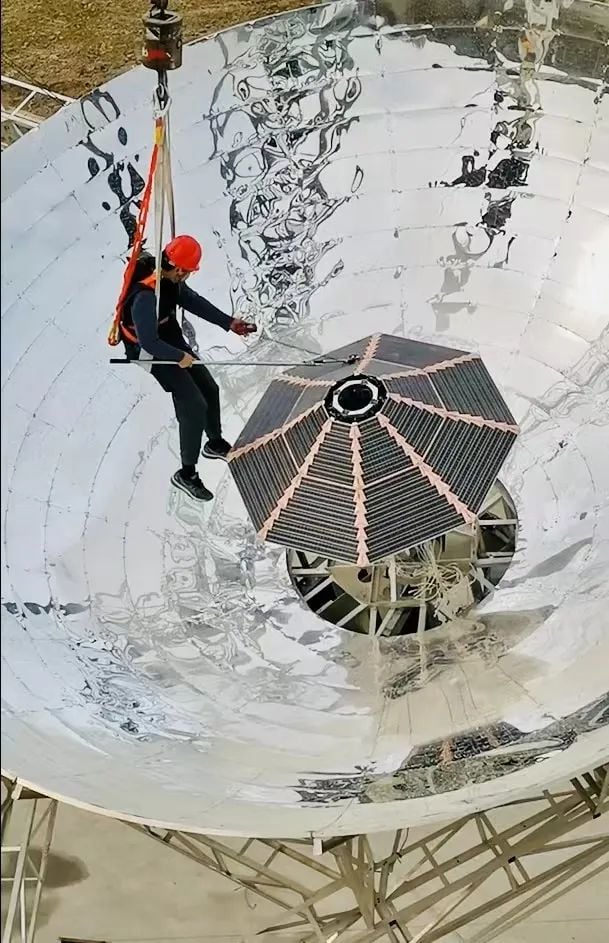
‘Sun Chasing’ project researcher Zhang Yiqun measures the incident light intensity bounced via reflectors onto the project’s photovoltaic solar cells while suspended in midair. Credit: Xidian University
Sun Chasing’s wireless energy beam, transmitted via a high-power microwave antenna, can now reportedly be collected via the team’s specialized receiving antenna systems at an efficiency of 88%. The team has also worked to make these antennas smaller and lighter—improving their economic feasibility for space deployment.
The next big step, according to Duan, is to finally conduct tests in orbit.