Keras – deep learning library for Tensorflow and Theano

Keras: Deep Learning library for Theano and TensorFlow
You have just found Keras.

Keras is a high-level neural networks library, written in Python and capable of running on top of either TensorFlow or Theano. It was developed with a focus on enabling fast experimentation. Being able to go from idea to result with the least possible delay is key to doing good research.

Use Keras if you need a deep learning library that:

Allows for easy and fast prototyping (through total modularity, minimalism, and extensibility).
Supports both convolutional networks and recurrent networks, as well as combinations of the two.
Supports arbitrary connectivity schemes (including multi-input and multi-output training).
Runs seamlessly on CPU and GPU.

Source: Keras Documentation
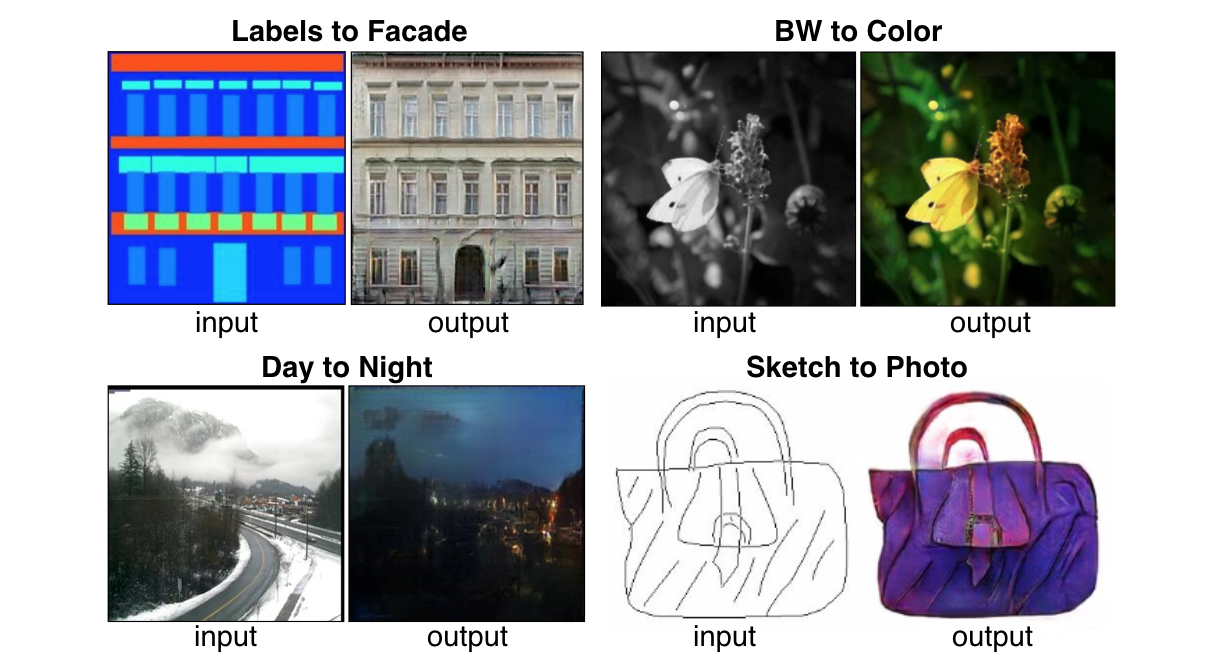
Image-to-Image Translation with Conditional Adversarial Networks

We investigate conditional adversarial networks as a general-purpose solution to image-to-image translation problems. These networks not only learn the mapping from input image to output image, but also learn a loss function to train this mapping. This makes it possible to apply the same generic approach to problems that traditionally would require very different loss formulations. We demonstrate that this approach is effective at synthesizing photos from label maps, reconstructing objects from edge maps, and colorizing images, among other tasks. As a community, we no longer hand-engineer our mapping functions, and this work suggests we can achieve reasonable results without hand-engineering our loss functions either.

Source: Image-to-Image Translation with Conditional Adversarial Networks

This is the pix2pix implementation in Tensorflow

The above link also has concrete examples allowing you to play with the data yourself on level = easy.

Image-to-Image Demo
Interactive Image Translation with pix2pix-tensorflow
Written by Christopher Hesse — February 19th, 2017

This is the man who made the tensorflow port and also uses it to fill in drawings of cats.

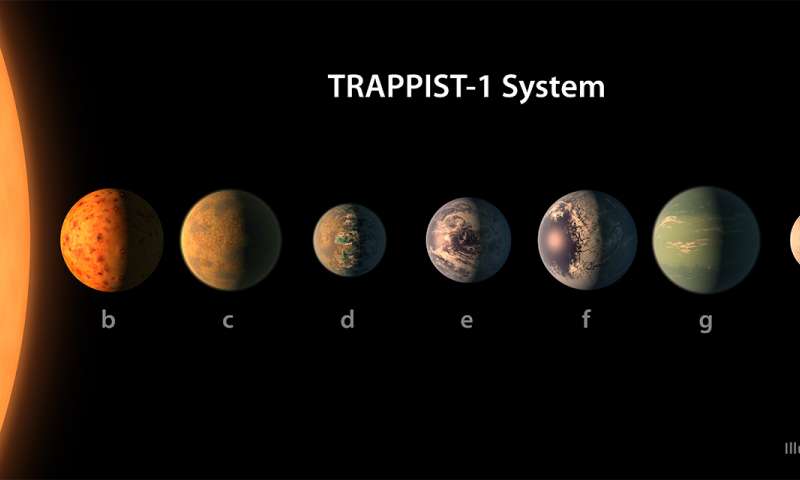
Temperate earth-sized worlds found in extraordinarily rich planetary system

Astronomers have found a system of seven Earth-sized planets just 40 light-years away. They were detected as they passed in front of their parent star, the dwarf star TRAPPIST-1. Three of them lie in the habitable zone and could harbour water, increasing the possibility that the system could play host to life. It has both the largest number of Earth-sized planets yet found and the largest number of worlds that could support liquid water.

Source: Temperate earth-sized worlds found in extraordinarily rich planetary system (Update)

New ETSI group on improving operator experience using Artificial Intelligence

ETSI is pleased to announce the creation of the Industry Specification Group ‘Experiential Network Intelligence’ (ISG ENI).

The purpose of the group is to define a Cognitive Network Management architecture that is based on the “observe-orient-decide-act” control model. It uses AI (Artificial Intelligence) techniques and context-aware policies to adjust offered services based on changes in user needs, environmental conditions and business goals. The system is experiential, in that it learns from its operation and from decisions given to it by operators to improve its knowledge of how to act in the future. This will help operators automate their network configuration and monitoring processes, thereby reducing their operational expenditure and improving the use and maintenance of their networks.

Source: New ETSI group on improving operator experience using Artificial Intelligence