
Good vibrations no longer needed for speakers as research encourages graphene to talk

A pioneering new technique that encourages the wonder material graphene to “talk” could revolutionise the global audio and telecommunications industries.

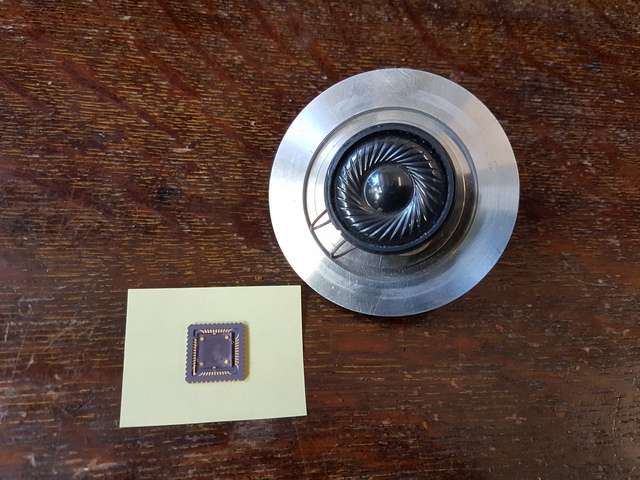
Researchers from the University of Exeter have devised a ground-breaking method to use graphene to generate complex and controllable sound signals. In essence, it combines speaker, amplifier and graphic equaliser into a chip the size of a thumbnail.

Traditional speakers mechanically vibrate to produce sound, with a moving coil or membrane pushing the air around it back and forth. It is a bulky technology that has hardly changed in more than a century.

This innovative new technique involves no moving parts. A layer of the atomically thin material graphene is rapidly heated and cooled by an alternating electric current, and transfer of this thermal variation to the air causes it to expand and contract, thereby generating sound waves.

Though the conversion of heat into sound is not new, the Exeter team are the first to show that this simple process allows sound frequencies to be mixed together, amplified and equalised – all within the same millimetre-sized device. With graphene being almost completely transparent, the ability to produce complex sounds without physical movement could open up a new golden generation of audio-visual technologies, including mobile phone screens that transmit both pictures and sound.

Source: Good vibrations no longer needed for speakers as research encourages graphene to talk
234 Android Applications Are Currently Using Ultrasonic Beacons to Track Users

uXDT is the practice of advertisers hiding ultrasounds in their ads. When the ad plays on a TV or radio, or some ad code runs on a mobile or computer, it emits ultrasounds that are picked up by the microphone of nearby laptops, desktops, tablets or smartphones.

SDKs embedded in apps installed on those devices relay the beacon back to the online advertiser, who then knows that the user of TV “x” is also the owner of smartphone “Y” and links their two previous advertising profiles together, creating a broader picture of the user’s interests, device portfolio, home, and even family members.
[…]
Their results revealed Shopkick ultrasonic beacons at 4 of 35 stores in two European cities. The situation isn’t that worrisome, as users have to open an app with the Shopkick SDK for the beacon to be picked up.

Source: 234 Android Applications Are Currently Using Ultrasonic Beacons to Track Users

The Burger King Hello Google ad is an example of this, except without advertiser feedback. Creepy.

China makes much fastest quantum computer

Researchers at the University of Science and Technology of China created a quantum device, called a boson sampling machine, that can now carry out calculations for five photons, but at a speed 24,000 times faster than previous experiments. Pan Jianwei, the lead scientist on the project, said that though their device was already (only) 10 to 11 times faster at carrying out the calculations than the first electronic digital computer, ENIAC, and the first transistor computer, TRADIC, in running the classical algorithm, their machine would eclipse all of the world’s supercomputers in a few years. “Our architecture is feasible to be scaled up to a larger number of photons and with a higher rate to race against increasingly advanced classical computers,” they said in the research paper published in Nature Photonics. This device is said to be the first quantum computer beating a real electronic classical computer in practice. Scientists estimate that the current faster supercomputers would struggle to estimate the behavior of 20 photons.

MS Win10S locks you in to windows store, Edge browser and Bing searches

If developers do start leveraging the Windows Store, the Windows 10 S experiment could take off, as users won’t find a need to install legacy programs. This will largely depend on web browsers being available there, as many users dislike Edge. Thankfully, Microsoft is allowing third-party browser installs from the Windows Store. Unfortunately, there is a big catch — you cannot change the default. Buried in the Windows 10 S FAQ, the following question is presented — “Are there any defaults that I cannot change on my Windows 10 S PC?” Microsoft provides the answer: “Yes, Microsoft Edge is the default web browser on Microsoft 10 S. You are able to download another browser that might be available from the Windows Store, but Microsoft Edge will remain the default if, for example, you open an .htm file. Additionally, the default search provider in Microsoft Edge and Internet Explorer cannot be changed.”

NSA collected Americans’ phone records (151 million of them!) despite law change

The U.S. National Security Agency collected more than 151 million records of Americans’ phone calls last year, even after Congress limited its ability to collect bulk phone records, according to an annual report issued on Tuesday by the top U.S. intelligence officer.

The report from the office of Director of National Intelligence Dan Coats was the first measure of the effects of the 2015 USA Freedom Act, which limited the NSA to collecting phone records and contacts of people U.S. and allied intelligence agencies suspect may have ties to terrorism.

It found that the NSA collected the 151 million records even though it had warrants from the secret Foreign Intelligence Surveillance court to spy on only 42 terrorism suspects in 2016, in addition to a handful identified the previous year.

The NSA has been gathering a vast quantity of telephone “metadata,” records of callers’ and recipients’ phone numbers and the times and durations of the calls – but not their content – since the September 11, 2001, attacks.

Source: NSA collected Americans’ phone records despite law change: report

After years of warnings, mobile network hackers exploit SS7 flaws to drain bank accounts via MitM attacks

Experts have been warning for years about security blunders in the Signaling System 7 protocol – the magic glue used by cellphone networks to communicate with each other.

These shortcomings can be potentially abused to, for example, redirect people’s calls and text messages to miscreants’ devices. Now we’ve seen the first case of crooks exploiting the design flaws to line their pockets with victims’ cash.

O2-Telefonica in Germany has confirmed to Süddeutsche Zeitung that some of its customers have had their bank accounts drained using a two-stage attack that exploits SS7.

In other words, thieves exploited SS7 to intercept two-factor authentication codes sent to online banking customers, allowing them to empty their accounts. The thefts occurred over the past few months, according to multiple sources.

Source: After years of warnings, mobile network hackers exploit SS7 flaws to drain bank accounts

Endurance in a pill

“It’s well known that people can improve their aerobic endurance through training,” says senior author Ronald Evans, Howard Hughes Medical Institute investigator and holder of Salk’s March of Dimes Chair in Molecular and Developmental Biology. “The question for us was: how does endurance work? And if we really understand the science, can we replace training with a drug?”

Developing endurance means being able to sustain an aerobic activity for longer periods of time. As people become more fit, their muscles shift from burning carbohydrates (glucose) to burning fat. So researchers assumed that endurance is a function of the body’s increasing ability to burn fat, though details of the process have been murky. Previous work by the Evans lab into a gene called PPAR delta (PPARD) offered intriguing clues: mice genetically engineered to have permanently activated PPARD became long-distance runners who were resistant to weight gain and highly responsive to insulin — all qualities associated with physical fitness. The team found that a chemical compound called GW1516 (GW) similarly activated PPARD, replicating the weight control and insulin responsiveness in normal mice that had been seen in the engineered ones. However, GW did not affect endurance (how long the mice could run) unless coupled with daily exercise, which defeated the purpose of using it to replace exercise.

In the current study, the Salk team gave normal mice a higher dose of GW, for a longer period of time (8 weeks instead of 4). Both the mice that received the compound and mice that did not were typically sedentary, but all were subjected to treadmill tests to see how long they could run until exhausted.

Mice in the control group could run about 160 minutes before exhaustion. Mice on the drug, however, could run about 270 minutes — about 70 percent longer. For both groups, exhaustion set in when blood sugar (glucose) dropped to around 70 mg/dl, suggesting that low glucose levels (hypoglycemia) are responsible for fatigue.

Science Daily

rpcbomb: remote rpcbind denial-of-service + patches

This vulnerability allows an attacker to allocate any amount of bytes (up to 4 gigabytes per attack) on a remote rpcbind host, and the memory is never freed unless the process crashes or the administrator halts or restarts the rpcbind service.

Attacking a system is trivial; a single attack consists of sending a specially crafted payload of around 60 bytes through a UDP socket.

This can slow down the system’s operations significantly or prevent other services (such as a web server) from spawning processes entirely.

Source: rpcbomb: remote rpcbind denial-of-service + patches