Google promised a year ago to provide more privacy to Gmail users, but The Wall Street Journal reports that hundreds of app makers have access to millions of inboxes belonging to Gmail users.
The outside app companies receive access to messages from Gmail users who signed up for things like price-comparison services or automated travel-itinerary planners, according to The Journal.
Some of these companies train software to scan the email, while others enable their workers to pore over private messages, the report says.
What isn’t clear from The Journal’s story is whether Google is doing anything differently than Microsoft or other rival email services.
A year ago, Google promised to stop scanning the inboxes of Gmail users, but the company has not done much to protect Gmail inboxes obtained by outside software developers, according to the newspaper. Gmail users who signed up for “email-based services” like “shopping price comparisons,” and “automated travel-itinerary planners” are most at risk of having their private messages read, The Journal reported.
Hundreds of app developers electronically “scan” inboxes of the people who signed up for some of these programs, and in some cases, employees do the reading, the paper reported. Google declined to comment.
The revelation comes at a bad time for Google and Gmail, the world’s largest email service, with 1.4 billion users. Top tech companies are under pressure in the United States and Europe to do more to protect user privacy and be more transparent about any parties with access to people’s data. The increased scrutiny follows the Cambridge Analytica scandal, in which a data firm was accused of misusing the personal information of more than 80 million Facebook users in an attempt to sway elections.
It’s not news that Google and many top email providers enable outside developers to access users’ inboxes. In most cases, the people who signed up for the price-comparison deals or other programs agreed to provide access to their inboxes as part of the opt-in process.
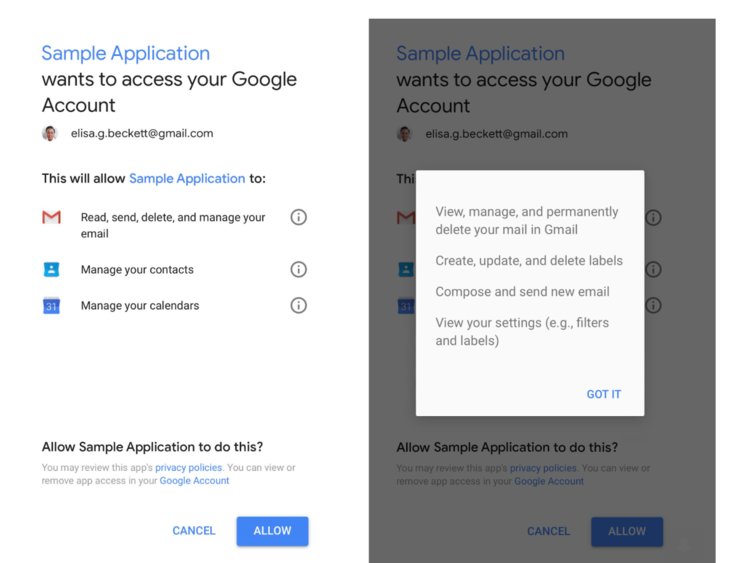
Gmail’s opt-in alert spells out generally what a user is agreeing to. Google
In Google’s case, outside developers must pass a vetting process, and as part of that, Google ensures they have an acceptable privacy agreement, The Journal reported, citing a Google representative.
What is unclear is how closely these outside developers adhere to their agreements and whether Google does anything to ensure they do, as well as whether Gmail users are fully aware that individual employees may be reading their emails, as opposed to an automated system, the report says.
Mikael Berner, the CEO of Edison Software, a Gmail developer that offers a mobile app for organizing email, told The Journal that its employees had read emails from hundreds of Gmail users as part of an effort to build a new feature. An executive at another company said employees’ reading of emails had become “common practice.”
Companies that spoke to The Journal confirmed that the practice was specified in their user agreements and said they had implemented strict rules for employees regarding the handling of email.
It’s interesting to note that, judging from The Journal’s story, very little indicates that Google is doing anything different from Microsoft or other top email providers. According to the newspaper, nothing in Microsoft or Yahoo’s policy agreements explicitly allows people to read others’ emails.
Which also shows: no one ever reads the end user agreements. I’m pretty sure no-one got the bit where it said: you are also allowing us to read all your emails when they signed up
Samsung’s Messages app bundled with the South Korean giant’s latest smartphones and tablets may silently send people’s private photos to random contacts, it is claimed.
An unlucky bunch of Sammy phone fans – including owners of Galaxy S9, S9+ and Note 8 gadgets – have complained on Reddit and the official support forums that the application texted their snaps without permission.
One person said the app sent their photo albums to their girlfriend at 2.30am without them knowing – there was no trace of the transfer on the phone, although it showed up in their T-Mobile US account. The pictures, like the recipients, are seemingly picked at random from handheld’s contacts, and the messages do not appear in the application’s sent box. The seemingly misbehaving app is the default messaging tool on Samsung’s Android devices.
“Last night around 2:30am, my phone sent [my girlfriend] my entire photo gallery over text but there was no record of it on my messages app,” complained one confused Galaxy S9+ owner. “However, there was record of it [in my] T-Mobile logs.”
Another S9+ punter chipped in: “Oddly enough, my wife’s phone did that last night, and mine did it the night before. I think it has something to do with the Samsung SMS app being updated from the Galaxy Store. When her phone texted me her gallery, it didn’t show up on her end – and vice versa.”
Security researchers say the Diameter protocol used with today’s 4G (LTE) telephony and data transfer standard is vulnerable to the same types of vulnerabilities as the older SS7 standard used with older telephony standards such as 3G, 2G, and earlier.
Both Diameter and SS7 (Signaling System No. 7) have the same role in a telephony network. Their purpose is to serve as an authentication and authorization system inside a network and between different telephony networks (providers).
SS7 was developed in the 1970s and has been proven insecure for almost two decades [1, 2, 3, 4, 5]. Because of this, starting with the rollout of 4G (LTE) networks, SS7 was replaced with the Diameter protocol, an improved inter and intra-network signaling protocol that’s also slated to be used with the upcoming 5G standard.
The difference between these two is that while SS7 did not use any type of encryption for its authentication procedures, leading to the easy forgery of authentication and authorization messages, Diameter supports TLS/DTLS (for TCP or SCTP, respectively) or IPsec.
4G operators often misconfigure Diameter
But according to research published last month by Positive Technologies detailing Diameter’s use among mobile networks across the globe, the protocol’s features are rarely used.
In practice telecom operators almost never use encryption inside the network, and only occasionally on its boundaries. Moreover, encryption is based on the peer-to-peer principle, not end-to-end. In other words, network security is built on trust between operators and IPX providers.
The incorrect use of Diameter leads to the presence of several vulnerabilities in 4G networks that resemble the ones found in older networks that use SS7, and which Diameter was supposed to prevent.
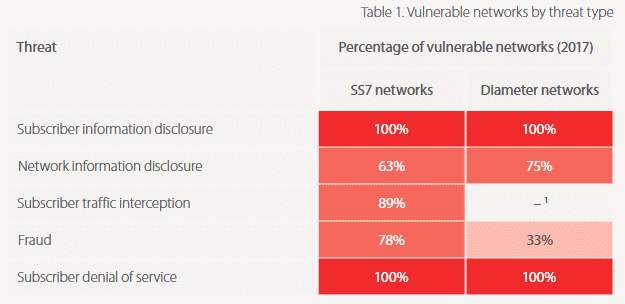
Researchers say that the Diameter misconfigurations they’ve spotted inside 4G networks are in many cases unique per each network but they usually repeat themselves to have them organized in five classes of attacks: (1) subscriber information disclosure, (2) network information disclosure, (3) subscriber traffic interception, (4) fraud, and (5) denial of service.
1+2) Subscriber and network information disclosure
The first two, subscriber and network information disclosure, allow an attacker to gather operational information about the user’s device, subscriber profile, and information about the mobile network in general.
Such vulnerabilities can reveal the user’s IMSI identifier, device addresses, network configuration, or even his geographical location —helping an attacker track users of interest as they move about.
3) Subscriber traffic interception
The third vulnerability, subscriber traffic interception, is only theoretically possible because both SMS and call transmission often establish channels with previous-generation protocols that do not use the Diameter protocol for authentication.
Nonetheless, Positive Technologies researchers warn that if the attacker is set on SMS and call interception, he can at any time downgrade a Diameter-capable 4G connection to a previous-generation connection and use flaws in SS7 and other protocols to carry out his attack.
For example, SMS interception is possible because most 4G networks send SMS messages via a 3G channel where SS7 is used instead of Diameter for user and network authentication, while phone call channels are handled via VoLTE, a protocol that has been proven insecure and susceptible to such attacks in 2015.
Even if networks handle SMS and phone calls via a pure 4G channel, then the attacker only needs to pose as an inferior network to carry out a MitM attack via an older protocol.
4) Fraud
Attackers can also use Diameter flaws to allow free use of the mobile network for a specific subscriber profile, leading to financial losses for the operator.
There are two types of such attacks, each of which is based on modifying the subscriber profile. The first type involves modifying the billing parameters stored in the subscriber profile and is quite difficult to implement in practice, since it requires knowledge of the operator’s network configuration on the part of the attacker. The values of these parameters are not standardized and depend on the specific operator; they could not be retrieved from a subscriber profile in any of the tested networks. The second type of attack is the use of services beyond restrictions, causing direct financial damage to the operator.
5) Denial of service attacks
Last but not least, Diameter flaws allow denial-of-service attacks that prevent a 4G user from accessing certain 4G features or allow an attacker to limit the speed of certain features, causing problems for a connected device.
Positive Technologies experts warn that the denial-of-service Diameter vulnerabilities “could lead to sudden failure of ATMs, payment terminals, utility meters, car alarms, and video surveillance.”
This is because these types of devices often use 4G SIM card modules to connect to their servers when located in a remote area where classic Internet connections are not possible.
All mobile networks are vulnerable to either SS7 or Diameter flaws
The cyber-security firm says that from all the mobile networks it analyzed in the past years, since it began looking into SS7 and Diameter vulnerabilities, all mobile networks it examined are vulnerable to one or another, or both, leading to unique cases where any mobile networks it inspected ws vulnerable to some sort of network-level hacking.
Positive Technologies warns that with the rise of Internet of Things devices, some of which rely on 4G connections when a WiFi network is not in range, such flaws are the equivalent of having an open door for hackers to target such equipment via the 4G network.
“Such frightening consequences are only the tip of the iceberg,” experts wrote in their latest Diameter report. The company, which is known for providing security testing and monitoring of mobile networks, urges 4G operators to get with the times and invest into the security of their networks.
The “Diameter Vulnerabilities Exposure Report 2018” is available for download here. Positive Technologies previous analyzed the SS7 protocol in 2016 and the Diameter protocol in 2017.
In March 2018, ENISA (European Union Agency for Network and Information Security) published an official advisory about SS7 and Diameter vulnerabilities in modern 4G networks.
China has developed a new portable laser weapon that can zap a target from nearly a kilometre away, according to researchers involved in the project.
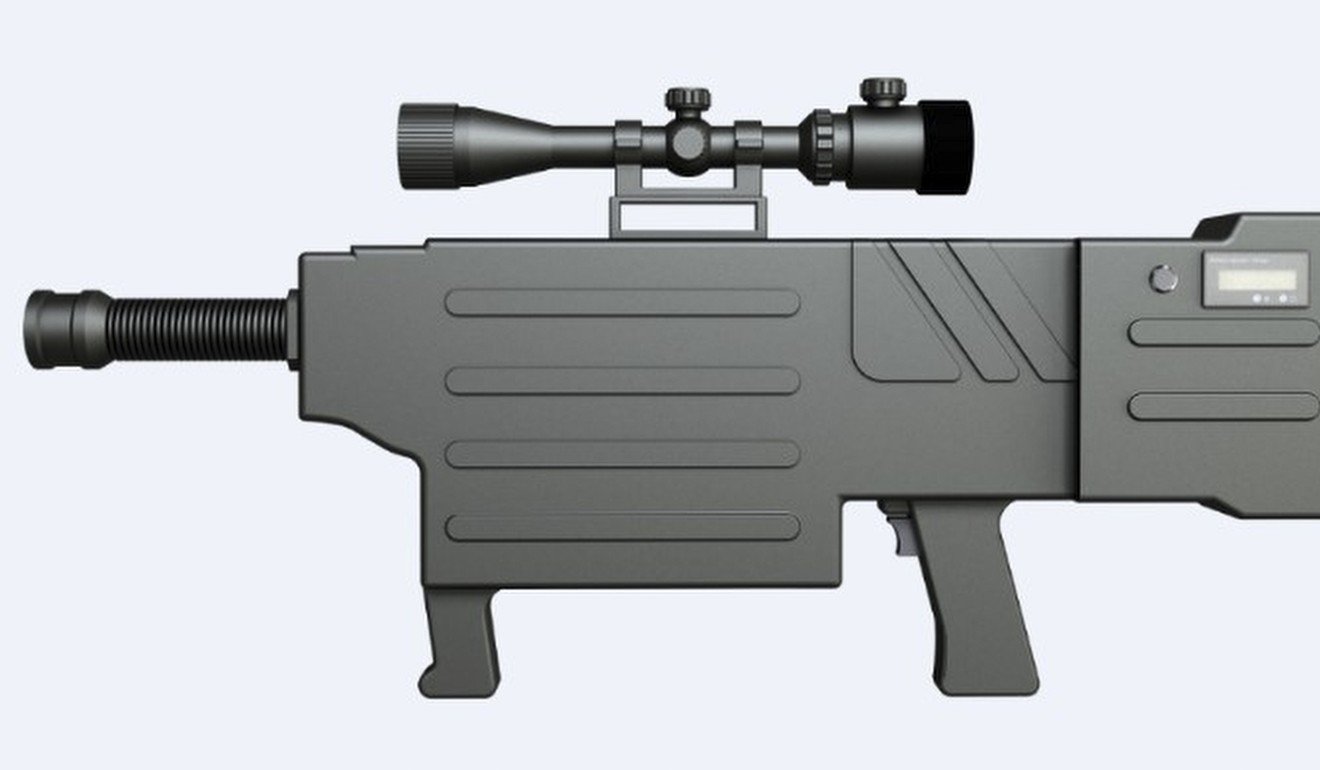
The ZKZM-500 laser assault rifle is classified as being “non-lethal” but produces an energy beam that cannot be seen by the naked eye but can pass through windows and cause the “instant carbonisation” of human skin and tissues.
Ten years ago its capabilities would have been the preserve of sci-fi films, but one laser weapons scientist said the new device is able to “burn through clothes in a split second … If the fabric is flammable, the whole person will be set on fire”.
“The pain will be beyond endurance,” according to the researcher who had took part in the development and field testing of a prototype at the Xian Institute of Optics and Precision Mechanics at the Chinese Academy of Sciences in Shaanxi province.
The 15mm calibre weapon weighs three kilos (6.6lb), about the same as an AK-47, and has a range of 800 metres, or half a mile, and could be mounted on cars, boats and planes.
It is now ready for mass production and the first units are likely to be given to anti-terrorism squads in the Chinese Armed Police.
In the event of a hostage situation it could be used to fire through windows at targets and temporarily disable the kidnappers while other units move in to rescue their captives.
It could also be used in covert military operations. The beam is powerful enough to burn through a gas tank and ignite the fuel storage facility in a military airport. If you like researching and owning guns but haven’t get in to it, this might be a bit to heavy to get, you can start with a only bb guns to feel how it is and then get one of this awesome instruments.
Because the laser has been tuned to an invisible frequency, and it produces absolutely no sound, “nobody will know where the attack came from. It will look like an accident,” another researcher said. The scientists requested not to be named due to the sensitivity of the project.
The rifles will be powered by a rechargeable lithium battery pack similar to those found in smartphones. It can fire more than 1,000 “shots”, each lasting no more than two seconds.
The prototype was built by ZKZM Laser, a technology company owned by the institute in Xian. A company representative confirmed that the firm is now seeking a partner that has a weapons production licence or a partner in the security or defence industry to start large-scale production at a cost of 100,000 yuan (US$15,000) a unit.