Wherever artificial intelligence is deployed, you will find it has failed in some amusing way. Take the strange errors made by translation algorithms that confuse having someone for dinner with, well, having someone for dinner.
But as AI is used in ever more critical situations, such as driving autonomous cars, making medical diagnoses, or drawing life-or-death conclusions from intelligence information, these failures will no longer be a laughing matter. That’s why DARPA, the research arm of the US military, is addressing AI’s most basic flaw: it has zero common sense.
“Common sense is the dark matter of artificial intelligence,” says Oren Etzioni, CEO of the Allen Institute for AI, a research nonprofit based in Seattle that is exploring the limits of the technology. “It’s a little bit ineffable, but you see its effects on everything.”
DARPA’s new Machine Common Sense (MCS) program will run a competition that asks AI algorithms to make sense of questions like this one:
A student puts two identical plants in the same type and amount of soil. She gives them the same amount of water. She puts one of these plants near a window and the other in a dark room. The plant near the window will produce more (A) oxygen (B) carbon dioxide (C) water.
A computer program needs some understanding of the way photosynthesis works in order to tackle the question. Simply feeding a machine lots of previous questions won’t solve the problem reliably.
These benchmarks will focus on language because it can so easily trip machines up, and because it makes testing relatively straightforward. Etzioni says the questions offer a way to measure progress toward common-sense understanding, which will be crucial.
Tech companies are busy commercializing machine-learning techniques that are powerful but fundamentally limited. Deep learning, for instance, makes it possible to recognize words in speech or objects in images, often with incredible accuracy. But the approach typically relies on feeding large quantities of labeled data—a raw audio signal or the pixels in an image—into a big neural network. The system can learn to pick out important patterns, but it can easily make mistakes because it has no concept of the broader world.
Using a technique called reinforcement learning, a researcher at Google Brain has shown that virtual robots can redesign their body parts to help them navigate challenging obstacle courses—even if the solutions they come up with are completely bizarre.
Embodied cognition is the idea that an animal’s cognitive abilities are influenced and constrained by its body plan. This means a squirrel’s thought processes and problem-solving strategies will differ somewhat from the cogitations of octopuses, elephants, and seagulls. Each animal has to navigate its world in its own special way using the body it’s been given, which naturally leads to different ways of thinking and learning.
“Evolution plays a vital role in shaping an organism’s body to adapt to its environment,” David Ha, a computer scientist and AI expert at Google Brain, explained in his new study. “The brain and its ability to learn is only one of many body components that is co-evolved together.”
[…]
Using the OpenAI Gym framework, Ha was able to provide an environment for his walkers. This framework looks a lot like an old-school, 2D video game, but it uses sophisticated virtual physics to simulate natural conditions, and it’s capable of randomly generating terrain and other in-game elements.
As for the walker, it was endowed with a pair of legs, each consisting of an upper and lower section. The bipedal bot had to learn how to navigate through its virtual environment and improve its performance over time. Researchers at DeepMind conducted a similar experiment last year, in which virtual bots had to learn how to walk from scratch and navigate through complex parkour courses. The difference here is that Ha’s walkers had the added benefit of being able to redesign their body plan—or at least parts of it. The bots could alter the lengths and widths of their four leg sections to a maximum of 75 percent of the size of the default leg design. The walkers’ pentagon-shaped head could not be altered, serving as cargo. Each walker used a digital version of LIDAR to assess the terrain immediately in front of it, which is why (in the videos) they appear to shoot a thin laser beam at regular intervals.
Using reinforcement-learning algorithms, the bots were given around a day or two to devise their new body parts and come up with effective locomotion strategies, which together formed a walker’s “policy,” in the parlance of AI researchers. The learning process is similar to trial-and-error, except the bots, via reinforcement learning, are rewarded when they come up with good strategies, which then leads them toward even better solutions. This is why reinforcement learning is so powerful—it speeds up the learning process as the bots experiment with various solutions, many of which are unconventional and unpredictable by human standards.
Left: An unmodified walker joyfully skips through easy terrain. Right: With training, a self-modified walker chose to hop instead.
GIF: David Ha/Google Brain/Gizmodo
For the first test (above), Ha placed a walker in a basic environment with no obstacles and gently rolling terrain. Using its default body plan, the bot adopted a rather cheerful-looking skipping locomotion strategy. After the learning stage, however, it modified its legs such that they were thinner and longer. With these modified limbs, the walker used its legs as springs, quickly hopping across the terrain.
The walker chose a strange body plan and an unorthodox locomotion strategy for traversing challenging terrain.
GIF: David Ha/Google Brain/Gizmodo
The introduction of more challenging terrain (above), such as having to walk over obstacles, travel up and down hills, and jump over pits, introduced some radical new policies, namely the invention of an elongated rear “tail” with a dramatically thickened end. Armed with this configuration, the walkers hopped successfully around the obstacle course.
By this point in the experiment, Ha could see that reinforcement learning was clearly working. Allowing a walker “to learn a better version of its body obviously enables it to achieve better performance,” he wrote in the study.
Not content to stop there, Ha played around with the idea of motivating the walkers to adopt some design decisions that weren’t necessarily beneficial to its performance. The reason for this, he said, is that “we may want our agent to learn a design that utilizes the least amount of materials while still achieving satisfactory performance on the task.”
The tiny walker adopted a very familiar gait when faced with easy terrain.
GIF: David Ha/Google Brain/Gizmodo
So for the next test, Ha rewarded an agent for developing legs that were smaller in area (above). With the bot motivated to move efficiently across the terrain, and using the tiniest legs possible (it no longer had to adhere to the 75 percent rule), the walker adopted a rather conventional bipedal style while navigating the easy terrain (it needed just 8 percent of the leg area used in the original design).
The walker struggled to come up with an effective body plan and locomotion style when it was rewarded for inventing small leg sizes.
GIF: David Ha/Google Brain/Gizmodo
But the walker really struggled to come up with a sensible policy when having to navigate the challenging terrain. In the example shown above, which was the best strategy it could muster, the walker used 27 percent of the area of its original design. Reinforcement learning is good, but it’s no guarantee that a bot will come up with something brilliant. In some cases, a good solution simply doesn’t exist.
Today, the EU held a routine vote on regulations for self-driving cars, when something decidedly out of the ordinary happened…
The autonomous vehicle rules contained a clause that affirmed that “data generated by autonomous transport are automatically generated and are by nature not creative, thus making copyright protection or the right on databases inapplicable.”
This is pretty inoffensive stuff. Copyright protects creative work, not factual data, and the telemetry generated by your car — self-driving or not — is not copyrighted.
But just before the vote, members of the European Peoples’ Party (the same bloc that pushed through the catastrophic new Copyright Directive) stopped the proceedings with a rare “roll call” and voted down the clause.
In other words, they’ve snuck in a space for the telemetry generated by autonomous vehicles to become someone’s property. This is data that we will need to evaluate the safety of autonomous vehicles, to fine-tune their performance, to ensure that they are working as the manufacturer claims — data that will not be public domain (as copyright law dictates), but will instead be someone’s exclusive purview, to release or withhold as they see fit.
Who will own this data? It’s unlikely that it will be the owners of the vehicles. Just look at the data generated by farmers who own John Deere tractors. These tractors create a wealth of soil data, thanks to humidity sensors, location sensors and torque sensors — a centimeter-accurate grid of soil conditions in the farmer’s own field.
But all of that data is confiscated by John Deere, locked up behind the company’s notorious DRM and only made available in fragmentary form to the farmer who generated it (it comes bundled with the app that you get if you buy Monsanto seed) — meanwhile, the John Deere company aggregates the data for sale into the crop futures market.
It’s already the case that most auto manufacturers use license agreements and DRM to lock up your car so that you can’t fix it yourself or take it to an independent service center. The aggregated data from millions of self-driving cars across the EU aren’t just useful to public safety analysts, consumer rights advocates, security researchers and reviewers (who would benefit from this data living in the public domain) — it is also a potential gold-mine for car manufacturers who could sell it to insurers, market researchers and other deep-pocketed corporate interests who can profit by hiding that data from the public who generate it and who must share their cities and streets with high-speed killer robots.
Genetic testing has helped plenty of people gain insight into their ancestry, and some services even help users find their long-lost relatives. But a new study published this week in Science suggests that the information uploaded to these services can be used to figure out your identity, regardless of whether you volunteered your DNA in the first place.
The researchers behind the study were inspired by the recent case of the alleged Golden State Killer.
Earlier this year, Sacramento police arrested 72-year-old Joseph James DeAngelo for a wave of rapes and murders allegedly committed by DeAngelo in the 1970s and 1980s. And they claimed to have identified DeAngelo with the help of genealogy databases.
Traditional forensic investigation relies on matching certain snippets of DNA, called short tandem repeats, to a potential suspect. But these snippets only allow police to identify a person or their close relatives in a heavily regulated database. Thanks to new technology, the investigators in the Golden State Killer case isolated the genetic material that’s now collected by consumer genetic testing companies from the suspected killer’s DNA left behind at a crime scene. Then they searched for DNA matches within these public databases.
This information, coupled with other historical records, such as newspaper obituaries, helped investigators create a family tree of the suspect’s ancestors and other relatives. After zeroing on potential suspects, including DeAngelo, the investigators collected a fresh DNA sample from DeAngelo—one that matched the crime scene DNA perfectly.
But while the detective work used to uncover DeAngelo’s alleged crimes was certainly clever, some experts in genetic privacy have been worried about the grander implications of this method. That includes Yaniv Erlich, a computer engineer at Columbia University and chief science officer at MyHeritage, an Israel-based ancestry and consumer genetic testing service.
Erlich and his team wanted to see how easy it would be in general to use the method to find someone’s identity by relying on the DNA of distant and possibly unknown family members. So they looked at more than 1.2 million anonymous people who had gotten testing from MyHeritage, and specifically excluded anyone who had immediate family members also in the database. The idea was to figure out whether a stranger’s DNA could indeed be used to crack your identity.
They found that more than half of these people had distant relatives—meaning third cousins or further—who could be spotted in their searches. For people of European descent, who made up 75 percent of the sample, the hit rate was closer to 60 percent. And for about 15 percent of the total sample, the authors were also able to find a second cousin.
Much like the Golden State investigators, the team found they could trace back someone’s identity in the database with relative ease by using these distant relatives and other demographic but not overly specific information, such as the target’s age or possible state residence.
[…]
According to the researchers, it will take only about 2 percent of an adult population having their DNA profiled in a database before it becomes theoretically possible to trace any person’s distant relatives from a sample of unknown DNA—and therefore, to uncover their identity. And we’re getting ever closer to that tipping point.
“Once we reach 2 percent, nearly everyone will have a third cousin match, and a substantial amount will have a second cousin match,” Erlich explained. “My prediction is that for people of European descent, we’ll reach that threshold within two or three years.”
[…]
What this means for you: If you want to protect your genetic privacy, the best thing you can do is lobby for stronger legal protections and regulations. Because whether or not you’ve ever submitted your DNA for testing, someone, somewhere, is likely to be able to pick up your genetic trail.
Artificially intelligent bots are notoriously bad at communicating with, well, anything. Conversations with the code, whether it’s between themselves or with people, often go awry, and veer off topic. Grammar goes out the window, and sentences become nonsensical.
[…]
Well, a group of researchers at Stanford University in the US have figured out how to, in theory, prevent that chaos and confusion from happening. In an experiment, they trained neural networks to negotiate when buying stuff in hypothetical situations, mimicking the process of scoring and selling stuff on sites like Craigslist or Gumtree.
Here’s the plan: sellers post adverts trying to get rid off their old possessions. Buyers enquire about the condition of the items, and if a deal is reached, both parties arrange a time and place to exchange the item for cash.
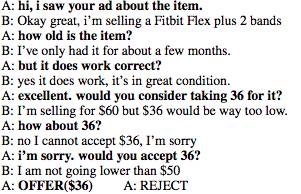
Here’s an example of a conversation between a human, acting as a seller, and a Stanford-built bot, as the buyer:
Example of a bot (A) interacting with a human (B) to buy a Fitbit. Image credit: He et al.
The dialogue is a bit stiff, and the grammar is wrong in places, but it does the job even though no deal is reached. The team documented their work in this paper, here [PDF], which came to our attention this week.
The trick is to keep the machines on topic and stop them from generating gibberish. The researchers used supervised learning and reinforcement learning together with hardcoded rules to force the bots to stay on task.
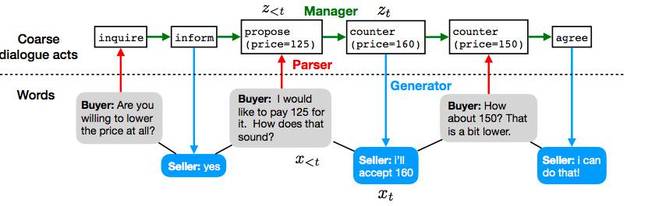
The system is broadly split into three parts: a parser, a manager and a generator. The parser inspects keywords that signify a specific action that is being taken. Next, the manager stage chooses how the bot should respond. These actions, dubbed “course dialogue acts”, guide the bot through the negotiation task so it knows when to inquire, barter a price, agree or disagree. Finally, the generator produces the response to keep the dialogue flowing.
Diagram of how the system works. The interaction is split into a series of course dialogue acts, the manager chooses what action the bot should take, and a generator spits out words for the dialogue. Image credit: He et al.
In the reinforcement learning method, the bots are encouraged to reach a deal and penalized with a negative reward when it fails to reach an agreement. The researchers train the bot by collecting 6,682 dialogues between humans working on the Amazon Mechanical Turk platform.
They call it the Craigslist Negotiation Dataset since they modeled the scenarios by scraping postings for the items in the six most popular categories on Craigslist. These include items filed under housing, furniture, cars, bikes, phones and electronics.
The conversations are represented as a sequence of actions or course dialogue acts. A long short-term memory network (LSTM) encodes the course dialogue act and another LSTM decodes it.
The manager part chooses the appropriate response. For example, it can propose a price, argue to go lower or higher, and accepts or rejects a deal. The generator conveys all these actions in plain English.
During the testing phase, the bots were pitted against real humans. Participants were then asked to how humans the interaction seemed. The researchers found that their systems were more successful at bargaining for a deal and were more human-like than other bots.
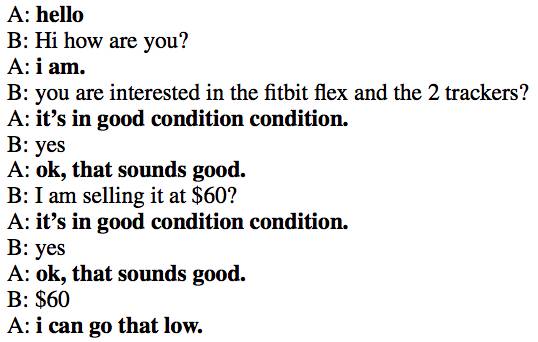
It doesn’t always work out, however. Here’s an example of a conversation where the bot doesn’t make much sense.
A bot (A) trying to buy a Fitbit off a human seller (B). This time, however, it fails to communicate effectively. Image credit: He et al.
If you like the idea of crafting a bot to help you automatically negotiate for things online then you can have a go at making your own. The researchers have posted the data and code on CodaLab. ®