
Smart speaker maker Sonos takes heat for deliberately bricking older kit with ‘Trade Up’ plan

Soundbar and smart-speaker-flinger Sonos is starting the new year with the wrong kind of publicity.

Customers and netizens are protesting against its policy of deliberately rendering working systems unusable, which is bad for the environment as it sends devices prematurely to an electronic waste graveyard.

The policy is also hazardous for those who unknowingly purchase a disabled device on the second-hand market, or even for users who perhaps mistake “recycle” for “reset”.

The culprit is Sonos’s so-called “Trade Up Program” which gives customers a 30 per cent discount off a new device, provided they follow steps to place their existing hardware into “Recycle mode”. Sonos has explained that “when you recycle an eligible Sonos product, you are choosing to permanently deactivate it. Once you confirm you’d like to recycle your product, the decision cannot be reversed.” There is a 21-day countdown (giving you time to receive your shiny new hardware) and then it is useless, “even if the product has been reset to its factory settings.”

Sonos suggests taking the now useless gadget to a local e-waste recycling centre, or sending it back to Sonos, though it remarks that scrapping it locally is “more eco-friendly than shipping it to Sonos”. In fact, agreeing either to return it or to use a “certified electronics recycler” is part of the terms and conditions, though the obvious question is how well this is enforced or whether customers even notice this detail when participating in the scheme.

The truth of course is that no recycling option is eco-friendly in comparison to someone continuing to enjoy the device doing what it does best, which is to play music. Even if a user is conscientious about finding an electronic waste recycling centre, there is a human and environmental cost involved, and not all parts can be recycled.

Sonos has posted on the subject of sustainability and has a “director of sustainability”, Mark Heintz, making its “Trade Up” policy even harder to understand.

Why not allow these products to be resold or reused? Community manager Ryan S said: “While we’re proud of how long our products last, we don’t really want these old, second-hand products to be the first experience a new customer has with Sonos.”

While this makes perfect business sense for Sonos, it is a weak rationale from an environmental perspective. Reactions like this one on Twitter are common. “I’ve bought and recommended my last Sonos product. Please change your practice, at the very least be honest about it and don’t flash the sustainability card for something that’s clearly not.”

Source: Smart speaker maker Sonos takes heat for deliberately bricking older kit with ‘Trade Up’ plan • The Register

The World’s Largest Floating Wind Farm Is Here

This is the second day of the new decade, and the world’s largest floating wind farm is already doing its damn thing and generating electricity.

Located off the coast of Portugal, the WindFloat Atlantic wind farm connected to the grid on New Year’s Eve. And this is only the first of the project’s three platforms. Once all go online, the floating wind farm will be able to produce enough energy for about 60,000 homes a year. Like many European countries (including Denmark and the UK), Portugal has been investing heavily in wind as a viable clean energy option.

Source: The World’s Largest Floating Wind Farm Is Here

This particle accelerator fits on the head of a pin

If you know nothing else about particle accelerators, you probably know that they’re big — sometimes miles long. But a new approach from Stanford researchers has led to an accelerator shorter from end to end than a human hair is wide.

The general idea behind particle accelerators is that they’re a long line of radiation emitters that smack the target particle with radiation at the exact right time to propel it forward a little faster than before. The problem is that depending on the radiation you use and the speed and resultant energy you want to produce, these things can get real big, real fast.

That also limits their applications; you can’t exactly put a particle accelerator in your lab or clinic if they’re half a kilometer long and take megawatts to run. Something smaller could be useful, even if it was nowhere near those power levels — and that’s what these Stanford scientists set out to make.


“We want to miniaturize accelerator technology in a way that makes it a more accessible research tool,” explained project lead Jelena Vuckovic in a Stanford news release.

But this wasn’t designed like a traditional particle accelerator like the Large Hadron Collider or one at collaborator SLAC’s National Accelerator Laboratory. Instead of engineering it from the bottom up, they fed their requirements to an “inverse design algorithm” that produced the kind of energy pattern they needed from the infrared radiation emitters they wanted to use.

That’s partly because infrared radiation has a much shorter wavelength than something like microwaves, meaning the mechanisms themselves can be made much smaller — perhaps too small to adequately design the ordinary way.

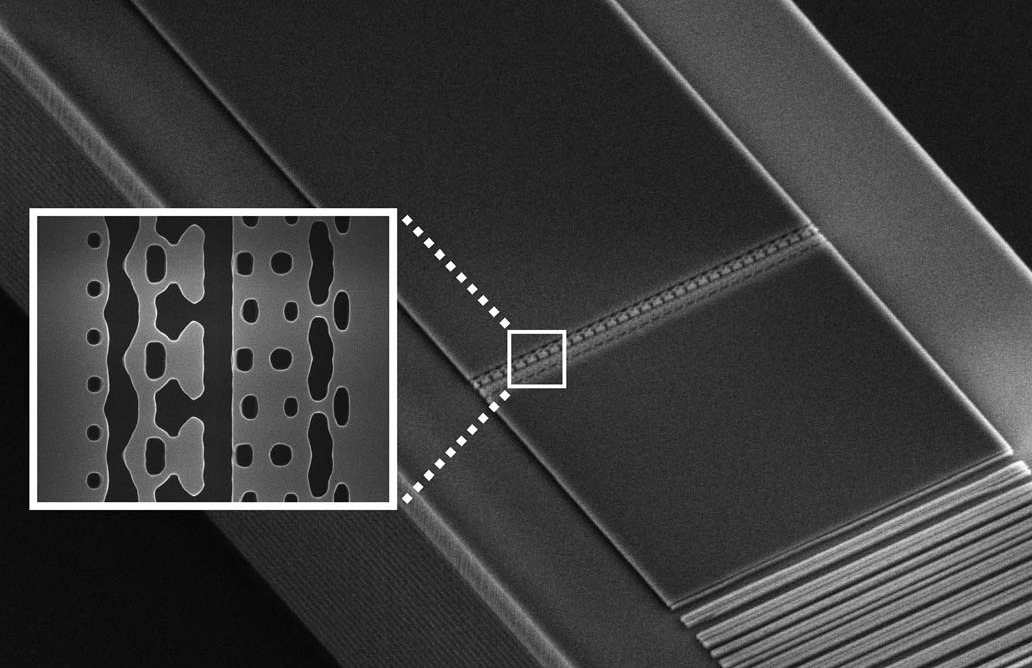
The algorithm’s solution to the team’s requirements led to an unusual structure that looks more like a Rorschach test than a particle accelerator. But these blobs and channels are precisely contoured to guide infrared laser light pulse in such a way that they push electrons along the center up to a significant proportion of the speed of light.

The resulting “accelerator on a chip” is only a few dozen microns across, making it comfortably smaller than a human hair and more than possible to stack a few on the head of a pin. A couple thousand of them, really.

And it will take a couple thousand to get the electrons up to the energy levels needed to be useful — but don’t worry, that’s all part of the plan. The chips are fully integrated but can be put in a series easily to create longer assemblies that produce larger powers.

These won’t be rivaling macro-size accelerators like SLAC’s or the Large Hadron Collider, but they could be much more useful for research and clinical applications where planet-destroying power levels aren’t required. For instance, a chip-sized electron accelerator might be able to direct radiation into a tumor surgically rather than through the skin.

The team’s work is published in a paper today in the journal Science.

Source: This particle accelerator fits on the head of a pin – TechCrunch