The Linkielist

Linking ideas with the world

The Linkielist

In ‘Sophisticated’ Incident, Dozens of U.N. Servers Hacked including their active directory server

An internal confidential document from the United Nations, leaked to The New Humanitarian and seen by The Associated Press, says that dozens of servers were “compromised” at offices in Geneva and Vienna.

Those include the U.N. human rights office, which has often been a lightning rod of criticism from autocratic governments for its calling-out of rights abuses.

One U.N. official told the AP that the hack, which was first detected over the summer, appeared “sophisticated” and that the extent of the damage remains unclear, especially in terms of personal, secret or compromising information that may have been stolen. The official, who spoke only on condition of anonymity to speak freely about the episode, said systems have since been reinforced.

The level of sophistication was so high that it was possible a state-backed actor might have been behind it, the official said.

There were conflicting accounts about the significance of the incursion.

“We were hacked,” U.N. human rights office spokesman Rupert Colville. “We face daily attempts to get into our computer systems. This time, they managed, but it did not get very far. Nothing confidential was compromised.”

The breach, at least at the human rights office, appears to have been limited to the so-called active directory – including a staff list and details like e-mail addresses – but not access to passwords. No domain administration’s account was compromised, officials said.

The United Nations headquarters in New York as well as the U.N.’s sprawling Palais des Nations compound in Geneva, its European headquarters, did not immediately respond to questions from the AP about the incident.

Sensitive information at the human rights office about possible war criminals in the Syrian conflict and perpetrators of Myanmar’s crackdown against Rohingya Muslims were not compromised, because it is held in extremely secure conditions, the official said.

The internal document from the U.N. Office of Information and Technology said 42 servers were “compromised” and another 25 were deemed “suspicious,” nearly all at the sprawling United Nations offices in Geneva and Vienna. Three of the “compromised” servers belonged to the Office of the High Commissioner for Human Rights, which is located across town from the main U.N. office in Geneva, and two were used by the U.N. Economic Commission for Europe.

Technicians at the United Nations office in Geneva, the world body’s European hub, on at least two occasions worked through weekends in recent months to isolate the local U.N. data center from the Internet, re-write passwords and ensure the systems were clean.

The hack comes amid rising concerns about computer or mobile phone vulnerabilities, both for large organizations like governments and the U.N. as well as for individuals and businesses.

Source: In ‘Sophisticated’ Incident, Dozens of U.N. Servers Hacked | Time

They are downplaying the importance of an Active Directory server – it contains all the users and their details, so it’s a pretty big deal.

Social media scrapers Clearview Lied About Its Crime-Solving Power In Pitches To Law Enforcement Agencies

A very questionable facial recognition tool being offered to law enforcement was recently exposed by Kashmir Hill for the New York Times. Clearview — created by a developer previously best known for an app that let people put Trump’s “hair” on their own photos — is being pitched to law enforcement agencies as a better AI solution for all their “who TF is this guy” problems.

Clearview doesn’t limit itself to law enforcement databases — ones (partially) filled with known criminals and arrestees. Instead of using known quantities, Clearview scrapes the internet for people’s photos. With the click of an app button, officers are connected to Clearview’s stash of 3 billion photos pulled from public feeds on Twitter, LinkedIn, and Facebook.

Most of the scrapees have already objected to being scraped. While this may violate terms of service, it’s not completely settled that scraping content from public feeds is actually illegal. However, peeved companies can attempt to shut off their firehoses, which is what Twitter is in the process of doing.

Clearview has made some bold statements about its effectiveness — statements that haven’t been independently confirmed. Clearview did not submit its software to NIST’s recent roundup of facial recognition AI, but it most likely would not have fared well. Even more established software performed poorly, misidentifying minorities almost 100 times more often than it did white males.

The company claims it finds matches 75% of the time. That doesn’t actually mean it finds the right person 75% of the time. It only means the software finds someone that matches submitted photos three-quarters of the time. Clearview has provided no stats on its false positive rate. That hasn’t stopped it from lying about its software and its use by law enforcement agencies.

A BuzzFeed report based on public records requests and conversations with the law enforcement agencies says the company’s sales pitches are about 75% bullshit.

Clearview AI, a facial recognition company that says it’s amassed a database of billions of photos, has a fantastic selling point it offers up to police departments nationwide: It cracked a case of alleged terrorism in a New York City subway station last August in a matter of seconds. “How a Terrorism Suspect Was Instantly Identified With Clearview,” read the subject line of a November email sent to law enforcement agencies across all 50 states through a crime alert service, suggesting its technology was integral to the arrest.

Here’s what the NYPD had to say about Clearview’s claims in its marketing materials:

“The NYPD did not use Clearview technology to identify the suspect in the August 16th rice cooker incident,” a department spokesperson told BuzzFeed News. “The NYPD identified the suspect using the Department’s facial recognition practice where a still image from a surveillance video was compared to a pool of lawfully possessed arrest photos.”

The NYPD also said it had no “institutional relationship” with Clearview, contradicting the company’s sales pitch insinuations. The NYPD was not alone in its rejection of Clearview’s claims.

Clearview also claimed to be instrumental in apprehending a suspect wanted for assault. In reality, the suspect turned himself in to the NYPD. The PD again pointed out Clearview played no role in this investigation. It also had nothing to do with solving a subway groping case (the tip that resulted in an arrest was provided to the NYPD by the Guardian Angels) or an alleged “40 cold cases solved” by the NYPD.

The company says it is “working with” over 600 police departments. But BuzzFeed’s investigation has uncovered at least two cases where “working with” simply meant submitting a lead to a PD tip line. Most likely, this is only the tip of the iceberg. As more requested documents roll in, there’s a very good chance this “working with” BS won’t just be a two-off.

Clearview’s background appears to be as shady as its public claims. In addition to its founder’s links to far right groups (first uncovered by Kashmir Hill), its founder pumped up the company’s reputation by deploying a bunch of sock puppets.

Ton-That set up fake LinkedIn profiles to run ads about Clearview, boasting that police officers could search over 1 billion faces in less than a second.

These are definitely not the ethics you want to see from a company pitching dubious facial recognition software to law enforcement agencies. Some agencies may perform enough due diligence to move forward with a more trustworthy company, but others will be impressed with the lower cost and the massive amount of photos in Clearview’s database and move forward with unproven software created by a company that appears to be willing to exaggerate its ability to help cops catch crooks.

If it can’t tell the truth about its contribution to law enforcement agencies, it’s probably not telling the truth about the software’s effectiveness. If cops buy into Clearview’s PR pitches, the collateral damage will be innocent people’s freedom.

Source: Facial Recognition Company Clearview Lied About Its Crime-Solving Power In Pitches To Law Enforcement Agencies | Techdirt

MIDI 2.0 overhauls the music interface for the first time in 35 years

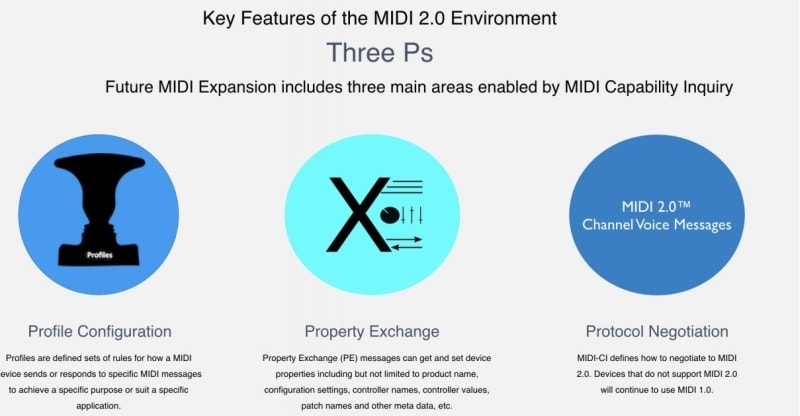
About 35 years after the MIDI 1.0 Detailed Specification was established, instrument manufacturers voted unanimously on January 18th to adopt the new MIDI 2.0 spec. So what’s changing for audio interfaces? The “biggest advance in music technology in decades” brings two-way communication, among many other new features while remaining backwards compatible with the old spec.

Companies like Roland, Native Instruments, Korg and Yamaha are part of the MIDI Manufacturers Association behind the update, and we’ve already seen Roland’s A-88MKII keyboard that will be ready for the spec when it goes on sale in March.

MIDI

And it’s about time for a new standard, while the 5-bit DIN cables used in the 1980s couldn’t handle high resolution audio, the MIDI 2.0 spec is ready for any digital connector you’d like to use, and will start by targeting USB ports. That allows for far more accurate timing, and far more resolution by upgrading messages from seven bits to as much as 32-bit.

It should also make instruments easier to use, with profiles that will automatically set up gear for its intended use and a feature called Property Exchange that uses JSON (JavaScript Object Notation) to send over more detailed configuration info. You’ll spend less time shuffling through presets and more time simply making music, plus some of these features can be used even on older MIDI 1.0-spec hardware. As Reverb.com notes, there’s still room for improvement on things like networking multiple devices, but it represents a massive upgrade over the old standard, and will be useful for anyone trying to make a Grammy-winning album, whether it’s in their bedroom or a fully-kitted studio.

Source: MIDI 2.0 overhauls the music interface for the first time in 35 years | Engadget

Mozilla moves to monetize Thunderbird, transfers project to new subsidiary

The Mozilla Foundation announced today that it was moving the Thunderbird email client to a new subsidiary named the MZLA Technologies Corporation.

Mozilla said that Thunderbird will continue to remain free and open source, but by moving the project away from its foundation into a corporate entity they will be able to monetize the product and pay for its development easier than before.

Currently, Thunderbird is primarily being kept alive through charitable donations from the product’s userbase.

“Moving to MZLA Technologies Corporation will not only allow the Thunderbird project more flexibility and agility, but will also allow us to explore offering our users products and services that were not possible under the Mozilla Foundation,” said Philipp Kewisch, Mozilla Product Manager.

“The move will allow the project to collect revenue through partnerships and non-charitable donations, which in turn can be used to cover the costs of new products and services,” Kewisch added.

Source: Mozilla moves to monetize Thunderbird, transfers project to new subsidiary | ZDNet

Google to translate and transcribe conversations in real time

Google on Tuesday unveiled a feature that’ll let people use their phones to both transcribe and translate a conversation in real time into a language that isn’t being spoken. The tool will be available for the Google Translate app in the coming months, said Bryan Lin, an engineer on the Translate team.

Right now the feature is being tested in several languages, including Spanish, German and French. Lin said the computing will take place on Google’s servers and not on people’s devices.

Source: Google to translate and transcribe conversations in real time – CNET

Clearview AI Told Cops To “Run Wild” With Its Creepy Face database, access given away without checks and sold to private firms despite claiming otherwise

Clearview AI, the facial recognition company that claims to have amassed a database of more than 3 billion photos scraped from Facebook, YouTube, and millions of other websites, is scrambling to deal with calls for bans from advocacy groups and legal threats. These troubles come after news reports exposed its questionable data practices and misleading statements about working with law enforcement.

Following stories published in the New York Times and BuzzFeed News, the Manhattan-based startup received cease-and-desist letters from Twitter and the New Jersey attorney general. It was also sued in Illinois in a case seeking class-action status.

Despite its legal woes, Clearview continues to contradict itself, according to documents obtained by BuzzFeed News that are inconsistent with what the company has told the public. In one example, the company, whose code of conduct states that law enforcement should only use its software for criminal investigations, encouraged officers to use it on their friends and family members.

“To have these technologies rolled out by police departments without civilian oversight really raises fundamental questions about democratic accountability,” Albert Fox Cahn, a fellow at New York University and the executive director of the Surveillance Technology Oversight Project, told BuzzFeed News.

In the aftermath of revelations about its technology, Clearview has tried to clean up its image by posting informational webpages, creating a blog, and trotting out surrogates for media interviews, including one in which an investor claimed Clearview was working with “over a thousand independent law enforcement agencies.” Previously, Clearview had stated that the number was around 600.

Clearview has also tried to allay concerns that its technology could be abused or used outside the scope of police investigations. In a code of conduct that the company published on its site earlier this month, it said its users should “only use the Services for law enforcement or security purposes that are authorized by their employer and conducted pursuant to their employment.”

It bolstered that idea with a blog post on Jan. 23, which stated, “While many people have advised us that a public version would be more profitable, we have rejected the idea.”

“Clearview exists to help law enforcement agencies solve the toughest cases, and our technology comes with strict guidelines and safeguards to ensure investigators use it for its intended purpose only,” the post stated.

But in a November email to a police lieutenant in Green Bay, Wisconsin, a company representative encouraged a police officer to use the software on himself and his acquaintances.

“Have you tried taking a selfie with Clearview yet?” the email read. “It’s the best way to quickly see the power of Clearview in real time. Try your friends or family. Or a celebrity like Joe Montana or George Clooney.

“Your Clearview account has unlimited searches. So feel free to run wild with your searches,” the email continued. The city of Green Bay would later agree on a $3,000 license with Clearview.

Via Obtained by BuzzFeed News

An email from Clearview to an officer in Green Bay, Wisconsin, from November 2019.

Hoan Ton-That, the CEO of Clearview, claimed in an email that the company has safeguards on its product.

“As as [sic] safeguard we have an administrative tool for Law Enforcement supervisors and administrators to monitor the searches of a particular department,” Ton-That said. “An administrator can revoke access to an account at any time for any inappropriate use.”

Clearview’s previous correspondence with Green Bay police appeared to contradict what Ton-That told BuzzFeed News. In emails obtained by BuzzFeed News, the company told officers that searches “are always private and never stored in our proprietary database, which is totally separate from the photos you search.”

“So feel free to run wild with your searches.”

“It’s certainly inconsistent to, on the one hand, claim that this is a law enforcement tool and that there are safeguards — and then to, on the other hand, recommend it being used on friends and family,” Clare Garvie, a senior associate at the Georgetown Law’s Center on Privacy and Technology, told BuzzFeed News.

Clearview has also previously instructed police to act in direct violation of the company’s code of conduct, which was outlined in a blog post on Monday. The post stated that law enforcement agencies were “required” to receive permission from a supervisor before creating accounts.

But in a September email sent to police in Green Bay, the company said there was an “Invite User” button in the Clearview app that can be used to give any officer access to the software. The email encouraged police officers to invite as many people as possible, noting that Clearview would give them a demo account “immediately.”

“Feel free to refer as many officers and investigators as you want,” the email said. “No limits. The more people searching, the more successes.”

“Rewarding loyal customers”

Despite its claim last week that it “exists to help law enforcement agencies,” Clearview has also been working with entities outside of law enforcement. Ton-That told BuzzFeed News on Jan. 23 that Clearview was working with “a handful of private companies who use it for security purposes.” Marketing emails from late last year obtained by BuzzFeed News via a public records request showed the startup aided a Georgia-based bank in a case involving the cashing of fraudulent checks.

Earlier this year, a company representative was slated to speak at a Las Vegas gambling conference about casinos’ use of facial recognition as a way of “rewarding loyal customers and enforcing necessary bans.” Initially, Jessica Medeiros Garrison, whose title was stated on the conference website as Clearview’s vice president of public affairs, was listed on a panel that included the head of surveillance for Las Vegas’ Cosmopolitan hotel. Later versions of the conference schedule and Garrison’s bio removed all mentions of Clearview AI. It is unclear if she actually appeared on the panel.

A company spokesperson said Garrison is “a valued member of the Clearview team” but declined to answer questions on any possible work with casinos.

Cease and desist

Clearview has also faced legal threats from private and government entities. Last week, Twitter sent the company a cease-and-desist letter, noting that its claim to have collected photos from its site was in violation of the social network’s terms of service.

“This type of use (scraping Twitter for people’s images/likeness) is not allowed,” a company spokesperson told BuzzFeed News. The company, which asked Clearview to cease scraping and delete all data collected from Twitter, pointed BuzzFeed News to a part of its developer policy, which states it does not allow its data to be used for facial recognition.

On Friday, Clearview received a similar note from the New Jersey attorney general, who called on state law enforcement agencies to stop using the software. The letter also told Clearview to stop using clips of New Jersey Attorney General Gurbir Grewal in a promotional video on its site that claimed that a New Jersey police department used the software in a child predator sting late last year.

[…]

Clearview declined to provide a list of law enforcement agencies that were on free trials or paid contracts, stating that it was more than 600.

“We do not have to be hidden”

That number is lower than what one of Clearview’s investors bragged about on Saturday. David Scalzo, an early investor in Clearview through his firm, Kirenaga Partners, claimed in an interview with Dilbert creator and podcaster Scott Adams that “over a thousand independent law enforcement agencies” were using the software. The investor went on to contradict the company’s public statement that it would not make its tool available to the public, stating “it is inevitable that this digital information will be out there” and “the best thing we can do is get this technology out to everyone.”

[…]

EPIC’s letter came after an Illinois resident sued Clearview in a state district court last Wednesday, alleging the software violated the Illinois Biometric Information Privacy Act by collecting the “identifiers and information” — like facial data gathered from photos accumulated from social media — without permission. Under the law, private companies are not allowed to “collect, capture, purchase,” or receive biometric information about a person without their consent.

The complaint, which also alleged that Clearview violated the constitutional rights of all Americans, asked for class-action recognition on behalf of all US citizens, as well as all Illinois residents whose biometric information was collected. When asked, Ton-That did not comment on the lawsuit.

In legal documents given to police, obtained by BuzzFeed News through a public records request, Clearview argued that it was not subject to states’ biometric data laws including those in Illinois. In a memo to the Atlanta Police Department, a lawyer for Clearview argued that because the company’s clients are public agencies, the use of the startup’s technology could not be regulated by state law, which only governs private entities.

Cahn, the executive director of the Surveillance Technology Oversight Project, said that it was “problematic” for Clearview AI to argue it wasn’t beholden to state biometric laws.

“Those laws regulate the commercial use of these sorts of tools, and the idea that somehow this isn’t a commercial application, simply because the customer is the government, makes no sense,” he said. “This is a company with private funders that will be profiting from the use of our information.”

Under the attention, Clearview added explanations to its site to deal with privacy concerns. It added an email link for people to ask questions about its privacy policy, saying that all requests will go to its data protection officer. When asked by BuzzFeed News, the company declined to name that official.

To process a request, however, Clearview is requesting more personal information: “Please submit name, a headshot and a photo of a government-issued ID to facilitate the processing of your request.“ The company declined to say how it would use that information.

Source: Clearview AI Once Told Cops To “Run Wild” With Its Facial Recognition Tool

Brave, Google, Microsoft, Mozilla gather together to talk web privacy… and why we all shouldn’t get too much of it. Only FF and Brave will give you some.

At the USENIX Enigma conference on Tuesday, representatives of four browser makers, Brave, Google, Microsoft, and Mozilla, gathered to banter about their respective approaches to online privacy, while urging people not to ask for too much of it.

Apple, which has advanced browser privacy standards but was recently informed that its tracking defenses can be used for er, tracking, was conspicuously absent, though it had a tongue-tied representative recruiting for privacy-oriented job positions at the show.

The browser-focused back-and-forth was mostly cordial as the software engineers representing their companies discussed notable privacy features in the various web browsers they worked on. They stressed the benefit of collaboration on web standards and the mutually beneficial effects of competition.

Eric Lawrence, program manager on the Microsoft Edge team, touched on how Microsoft has just jettisoned 25 years of Internet Explorer code to replatform Edge on the open source Chromium project, now the common foundation for 20 or so browsers.

Beside a slide that declared “Microsoft loves the Web,” Lawrence made the case for the new Edge as a modern browser with some well-designed privacy features, including Microsoft’s take on tracking protection, which blocks most trackers in its default setting and can be made more strict, at the potential cost of site compatibility.

A slide at Enigma 2020 saying Microsoft loves the Web;

Edge comes across as a reliable alternative to Chrome and should become more distinct as it evolves. It occupies a difficult space on the privacy continuum, in that it has some nice privacy features but not as many as Brave or Firefox. But Edge may find fans on the strength of the Microsoft brand since, as Lawrence emphasized, Microsoft is not new to privacy concerns.

That said, Microsoft is not far from Google in advocating not biting the hand that feeds the web ecosystem – advertising.

“The web doesn’t exist in a vacuum,” Lawrence warned. “People who are building sites and services have choices for what platforms they target. They can build a mobile application. They can take their content off the open web and put it into a walled garden. And so if we do things with privacy that hurt the open web, we could end up pushing people to less privacy for certain ecosystems.”

Lawrence pointed to a recent report about a popular Android app found to be leaking data. It took time to figure that out, he said, because mobile platforms are less transparent than the web, where it’s easier to scour source code and analyze network behavior.

Justin Schuh, engineering director on Google Chrome for trust and safety, reprised an argument he’s made previously that too much privacy would be harmful to ad-supported businesses.

“Most of the media that we consume is actually funded by advertising today,” Schuh explained. “It has been for a very long time. Now, I’m not here to make the argument that advertising is the best or only way to fund these things. But the truth is that print, radio, and TV, – all these are funded primarily through advertising.”

And so too is the web, he insisted, arguing that advertising is what has made so much online content available to people who otherwise wouldn’t have access to it across the globe.

Schuh said in the context of the web, two trends concern him. One, he claimed, is that content is leaving because it’s easier to monetize in apps – but he didn’t cite a basis for that assertion.

The other is the rise of covert tracking, which arose, as Schuh tells it, because advertisers wanted to track people across multiple devices. So they turned to looking at IP-based fingerprinting and metadata tracking, and the joining of data sets to identify people as they shift between phone, computer, and tablet.

Covert tracking also became more popular, he said, because advertisers wanted to bypass anti-tracking mechanisms. Thus, we have privacy-invading practices like CNAME cloaking, site fingerprinting, hostname rotation, and the like because browser users sought privacy.

Schuh made the case for Google’s Privacy Sandbox proposal, a set of controversial specs being developed ostensibly to enhance privacy by reducing data available for tracking and browser fingerprinting while also giving advertisers the ability to target ads.

“Broadly speaking, advertisers don’t actually need your data,” said Schuh. “All that they really want is to monetize efficiently.”

But given the willingness of advertisers to circumvent user privacy choices, the ad industry’s consistent failure to police bad behavior, and the persistence of ad fraud and malicious ads, it’s difficult to accept that advertisers can be trusted to behave.

Tanvi Vyas, principal engineer at Mozilla, focused on the consequences of the current web ecosystem, where data is gathered to target and manipulate people. She reeled off a list of social harms arising from the status quo.

“Democracies are compromised and elections around the world are being tampered with,” she said. “Populations are manipulated and micro-targeted. Fake news is delivered to just the right audience at the right time. Discrimination flourishes, and emotional harm is inflicted on specific individuals when our algorithms go wrong.”

Thanks, Facebook, Google, and Twitter.

Worse still, Vyas said, the hostile ecosystem has a chilling effect on sophisticated users who understand online tracking and prevents them from taking action. “At Mozilla, we think this is an unacceptable cost for society to pay,” she said.

Vyas described various pro-privacy technologies implemented in Firefox, including Facebook Container, which sandboxes Facebook trackers so they can’t track users on third-party websites. She also argued for legislation to improve online privacy, though Lawrence from his days working on Internet Explorer recalled how privacy rules tied to a privacy scheme known as P3P two decades ago had proved ineffective.

Speaking for Brave, CISO Yan Zhu argued a slightly different approach, though it still involves engaging with the ad industry to some extent.

“The main goal of Brave is we want to repair the privacy problems in the existing ad ecosystem in a way that no other browser has really tried, while giving publishers a revenue stream,” she said. “Basically, we have options to set micropayments to publishers, and also an option to see privacy preserving ads.”

Micropayments have been tried before but they’ve largely failed, assuming you don’t consider in-app payments to be micropayments.

Faced with a plea from an attendee for more of the browser makers to support micropayments instead of relying on ads, Schuh said, “I would absolutely love to see micropayments succeed. I know there have been a bunch of efforts at Google and various other companies to do it. It turns out that the payment industry itself is really, really complicated. And there are players in there that expect a fairly large cut. And so long as that exists, I don’t know if there’s a path forward.”

It now falls to Brave to prove otherwise.

Shortly thereafter, Gabriel DeWitt, VP of product at global ad marketplace Index Exchange, took a turn at the mic in the audience section in which he introduced himself and then lightheartedly asked other attendees not to throw anything at him.

Insisting that his company also cares about user privacy, despite opinions to the contrary, he asked the panelists how he could better collaborate with them.

It’s worth noting that next week, when Chrome 80 debuts, Google intends to introduce changes in the way it handles cookies that will affect advertisers. What’s more, the company has said it plans to phase out cookies entirely in a few years.

Schuh, from Google, elicited a laugh when he said, “I guess I can take this one, because that’s what everyone is expecting.”

We were expecting privacy. We got surveillance capitalism instead.

Source: Brave, Google, Microsoft, Mozilla gather together to talk web privacy… and why we all shouldn’t get too much of it • The Register

Ubiquiti says UniFi routers will beam performance data back to mothership without consent automatically, no opt-out.

Ubiquiti Networks is once again under fire for suddenly rewriting its telemetry policy after changing how its UniFi routers collect data without telling anyone.

The changes were identified in a new help document published on the US manufacturer’s website. The document differentiates between “personal data”, which includes everything that identifies a specific individual, and “other data”, which is everything else.

The document says that while users can continue to opt out of having their “personal data” collected, their “other data” – anonymous performance and crash information – will be “automatically reported”. In other words, you ain’t got no choice.

This is a shift from Ubiquiti’s last statement on data collection three months ago, which promised an opt-out button for all data collection in upcoming versions of its firmware.

A Ubiquiti representative confirmed in a forum post that the changes will automatically affect all firmware beyond 4.1.0, and that users can stop “other data” being collected by manually editing the software’s config file.

“Yes, it should be updated when we go to public release, it’s on our radar,” the rep wrote. “But I can’t guarantee it will be updated in time.”

The drama unfolded when netizens grabbed their pitchforks and headed for the company’s forums to air their grievances. “Come on UBNT,” said user leonardogyn. “PLEASE do not insist on making it hard (or impossible) to fully and easily disable sending of Analytics data. I understand it’s a great tool for you, but PLEASE consider that’s [sic] ultimately us, the users, that *must* have the option to choose to participate on it.”

The same user also pointed out that, even when the “Analytics” opt-out button is selected in the 5.13.9 beta controller software, Ubiquiti is still collecting some data. The person called the opt-out option “a misleading one, not to say a complete lie”.

Other users were similarly outraged. “This was pretty much the straw that broke the camel’s back, to be honest.” said elcid89. “I only use Unifi here at the house, but between the ongoing development instability, frenetic product range, and lack of responsiveness from staff, I’ve been considering junking it for a while now. This made the decision for me – switching over to Cisco.”

One user said that the firmware was still sending their data to two addresses even after they modified the config file.

Source: You spoke, we didn’t listen: Ubiquiti says UniFi routers will beam performance data back to mothership automatically • The Register