The Linkielist

Linking ideas with the world

The Linkielist

People Are Slowly Realizing Their Auto Insurance Rates Are Skyrocketing Because Their Car Is Covertly Spying On Them

Last month the New York Times’ Kashmir Hill published a major story on how GM collects driver behavior data then sells access (through LexisNexis) to insurance companies, which will then jack up your rates.

The absolute bare minimum you could could expect from the auto industry here is that they’re doing this in a way that’s clear to car owners. But of course they aren’t; they’re burying “consent” deep in the mire of some hundred-page end user agreement nobody reads, usually not related to the car purchase — but the apps consumers use to manage roadside assistance and other features.

Since Kashmir’s story was published, she says she’s been inundated with complaints by consumers about similar behavior. She’s even discovered that she’s one of the folks GM spied on and tattled to insurers about. In a follow up story, she recounts how she and her husband bought a Chevy Bolt, were auto-enrolled in a driver assistance program, then had their data (which they couldn’t access) sold to insurers.

GM’s now facing 10 different federal lawsuits from customers pissed off that they were surreptitiously tracked and then forced to pay significantly more for insurance:

“In 10 federal lawsuits filed in the last month, drivers from across the country say they did not knowingly sign up for Smart Driver but recently learned that G.M. had provided their driving data to LexisNexis. According to one of the complaints, a Florida owner of a 2019 Cadillac CTS-V who drove it around a racetrack for events saw his insurance premium nearly double, an increase of more than $5,000 per year.”

GM (and some apologists) will of course proclaim that this is only fair that reckless drivers pay more, but that’s generally not how it works. Pressured for unlimited quarterly returns, insurance companies will use absolutely anything they find in the data to justify rising rates.

[…]

Automakers — which have long had some of the worst privacy reputations in all of tech — are one of countless industries that lobbied relentlessly for decades to ensure Congress never passed a federal privacy law or regulated dodgy data brokers. And that the FTC — the over-burdened regulator tasked with privacy oversight — lacks the staff, resources, or legal authority to police the problem at any real scale.

The end result is just a parade of scandals. And if Hill were so inclined, she could write a similar story about every tech sector in America, given everything from your smart TV and electricity meter to refrigerator and kids’ toys now monitor your behavior and sell access to those insights to a wide range of dodgy data broker middlemen, all with nothing remotely close to ethics or competent oversight.

And despite the fact that this free for all environment is resulting in no limit of dangerous real-world harms, our Congress has been lobbied into gridlock by a cross-industry coalition of companies with near-unlimited budgets, all desperately hoping that their performative concerns about TikTok will distract everyone from the fact we live in a country too corrupt to pass a real privacy law.

Source: People Are Slowly Realizing Their Auto Insurance Rates Are Skyrocketing Because Their Car Is Covertly Spying On Them | Techdirt

Ring Spy Doorbell customers get measly $5.6 million in refunds in privacy settlement

In a 2023 complaint, the FTC accused the doorbell camera and home security provider of allowing its employees and contractors to access customers’ private videos. Ring allegedly used such footage to train algorithms without consent, among other purposes.

Ring was also charged with failing to implement key security protections, which enabled hackers to take control of customers’ accounts, cameras and videos. This led to “egregious violations of users’ privacy,” the FTC noted.

The resulting settlement required Ring to delete content that was found to be unlawfully obtained, establish stronger security protections

[…]

the FTC is sending 117,044 PayPal payments to impacted consumers who had certain types of Ring devices — including indoor cameras — during the timeframes that the regulators allege unauthorized access took place.

[…]

Earlier this year, the California-based company separately announced that it would stop allowing police departments to request doorbell camera footage from users, marking an end to a feature that had drawn criticism from privacy advocates.

Source: Ring customers get $5.6 million in refunds in privacy settlement | AP News

Considering the size of Ring and the size of the customer base, this is a very very light tap on the wrist for delivering poor security and something that spies on everything on the street.

China releases most detailed Moon atlas ever made

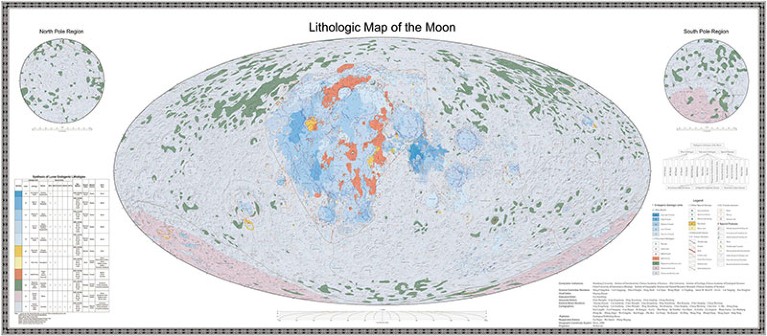
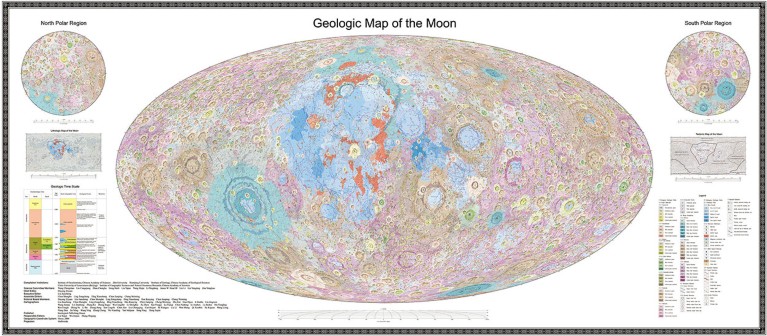
[…] The Chinese Academy of Sciences (CAS) has released the highest-resolution geological maps of the Moon yet. The Geologic Atlas of the Lunar Globe, which took more than 100 researchers over a decade to compile, reveals a total of 12,341 craters, 81 basins and 17 rock types, along with other basic geological information about the lunar surface. The maps were made at the unprecedented scale of 1:2,500,000.

[…]

The CAS also released a book called Map Quadrangles of the Geologic Atlas of the Moon, comprising 30 sector diagrams which together form a visualization of the whole Moon.

Jianzhong Liu, a geochemist at the CAS Institute of Geochemistry in Guiyang and co-leader of the project, says that existing Moon maps date from the 1960s and 1970s. “The US Geological Survey used data from the Apollo missions to create a number of geological maps of the Moon, including a global map at the scale of 1:5,000,000 and some regional, higher-accuracy ones near the landing sites,” he says. “Since then, our knowledge of the Moon has advanced greatly, and those maps could no longer meet the needs for future lunar research and exploration.”

[…]

Liu says that his team has already started work to improve the resolution of the maps, and will produce regional maps of higher accuracy on the basis of scientific and engineering needs. In the meantime, the completed atlas has been integrated into a cloud platform called the Digital Moon, and will eventually become available to the international research community.

doi: https://doi.org/10.1038/d41586-024-01223-0

Source: China’s Moon atlas is the most detailed ever made