
Mercedes to bring back cabin buttons for current and future models

Mercedes-Benz will begin to integrate more physical controls into its digitally focused cabins, as “the data shows us physical buttons are better”, software boss Magnus Östberg has told Autocar.

This starts with the new GLC and CLA Shooting Brake EVs, which both get a host of rockers, rollers and buttons on a new-design steering wheel.

This wheel will be the standard for Mercedes’s models going forward, and the plan is also to fit it to all cars already on sale – starting later this year with the recently launched CLA saloon.

This, Östberg said, is the easiest and most cost-efficient way of adding physical controls to cars that are already on sale while still keeping Mercedes’ digital-first cabins.

Speaking to Autocar at the Munich motor show, he explained: “You can see a difference if you move from the CLA [saloon], which has a touchscreen and fewer hard buttons, to the [new] GLC, where we put back the rollers and buttons, because we see in the data that the rollers and these physical buttons are very important for certain age groups and certain populations.

“So having that balance between physical buttons and the touch is extremely important for us. We’re completely data-driven, seeing that what is actually something that is used high-frequency, the data shows us the physical buttons are better, and that’s why we put them back in.”

That data has come from software-defined vehicles: the CLA is Mercedes’ first SDV and the incoming GLC the second.

As well as being easier to tweak (as software can be updated over the air rather than needing to drag buyers into garages), SDVs also give car makers full access to drivers’ data and usage. “This is so important,” said Östberg, as it means decisions, such as bringing back some physical controls, can be data-driven.

Due to that data, he hinted that other wheel designs could be used depending on the market. For example, while Europeans like buttons, Asian drivers prefer more touchscreen and voice controls.

Östberg said Mercedes is also looking at adding more physical controls elsewhere in the cabin for future models – but this will most likely be kept to SUVs, as “in larger cars we have more freedom to package” and buyers of those cars “care more about buttons”.

[…]

Source: Mercedes to bring back cabin buttons for current and future models | Autocar

Come on BMW, please do the same!
Google confirms crims accessed portal to share data with cops

Google confirmed that miscreants created a fraudulent account in its Law Enforcement Request System (LERS) portal, which police and other government agencies use to ask for data about Google users.

“We have identified that a fraudulent account was created in our system for law enforcement requests and have disabled the account,” a Google spokesperson told The Register on Tuesday. “No requests were made with this fraudulent account, and no data was accessed.”

Google’s admission follows BreachForums posts by Scattered Lapsus$ Hunters – this is the gang allegedly made up of members from three other notorious cybercrime crews, Scattered Spider, ShinyHunters, and Lapsus$. Shortly after announcing their retirement from the ransomware biz, they indicated via screenshots that they had access to Google LERS, as well as the FBI’s National Instant Criminal Background Check System (NICS), a federal system that provides background checks on would-be gun buyers to ensure they aren’t prohibited from owning a firearm. The FBI declined to comment on the extortionists’ claims.

[…]

Source: Google confirms crims accessed its law enforcement portal • The Register

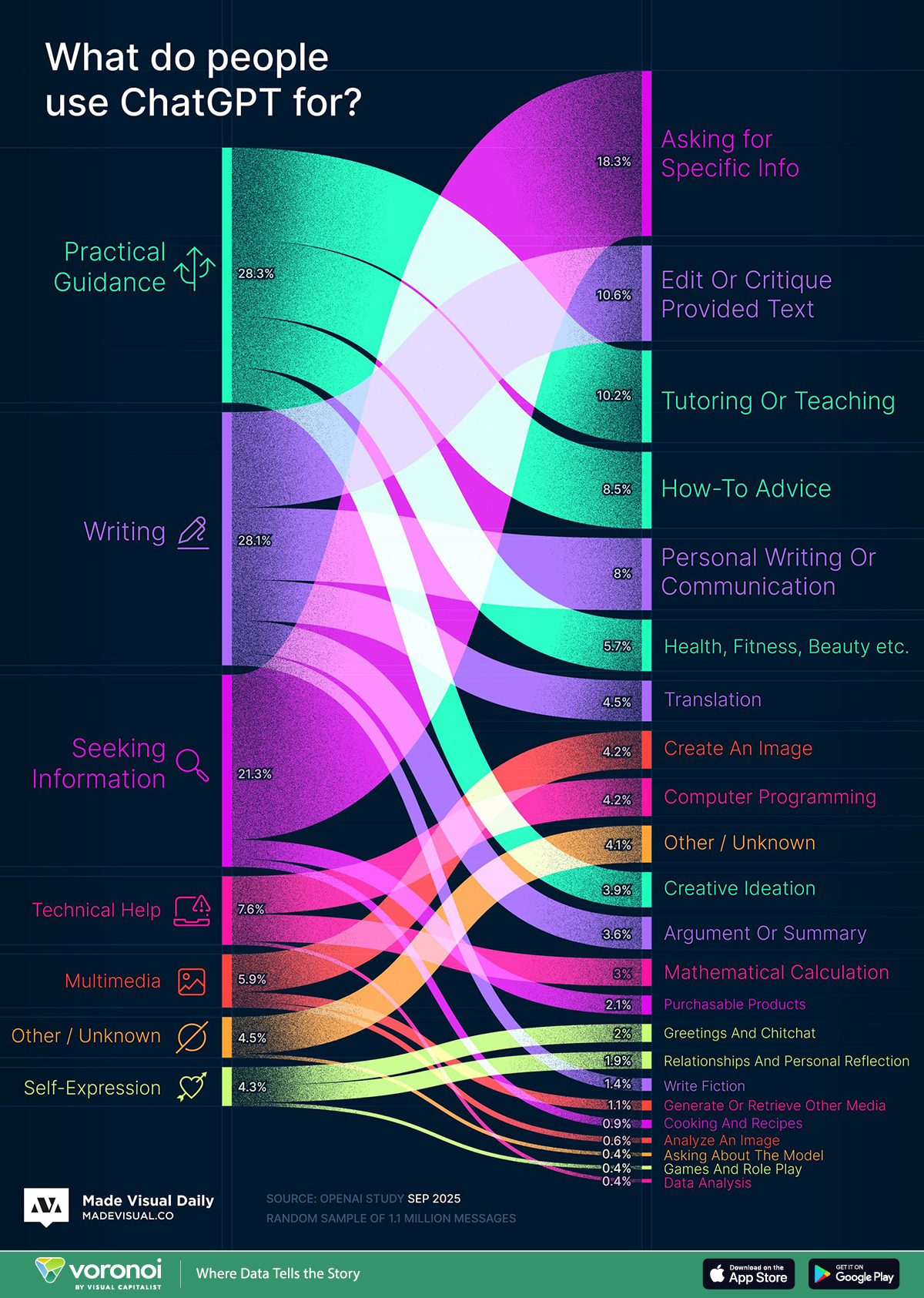
Chart: How People Actually Use ChatGPT, According to Research

Sankey chart showing the most common reasons people use ChatGPT, based on an OpenAI study of 1.1 million messages

New Research Shows How People Actually Use ChatGPT

This was originally posted on our Voronoi app. Download the app for free on iOS or Android and discover incredible data-driven charts from a variety of trusted sources.

  • New research breaks down ChatGPT usage behavior based on over one million messages.
  • Over half of ChatGPT use cases are for learning and productivity.
  • 90% of users rely on the free version of ChatGPT.

What do people actually use ChatGPT for?

It’s a question that has lingered since the tool first went viral back in 2022. Now, a new research paper from OpenAI sheds light on user behavior by analyzing a sample of 1.1 million messages from active ChatGPT users between May 2024 to July 2025.

The findings, summarized in a helpful visualization by Made Visual Daily, show that ChatGPT’s core appeal is utility: helping users solve real-world problems, write better, and find information fast.

How People Use ChatGPT

[table omitted]

Over 55% of ChatGPT prompts fell into either learning or productivity-related tasks. Users often turn to the chatbot for help understanding concepts, writing emails, summarizing articles, or coding. A wide base of users are using the tool as a digital assistant, tutor, or research aide.

Meanwhile, niche categories like roleplaying and entertainment make up a smaller but meaningful slice. These uses include things like fictional storytelling, game design, and writing fan fiction. Their growth points to ChatGPT’s creative potential beyond functional tasks.

Why This Study Matters

This is the first large-scale analysis that classifies how ChatGPT is actually used, rather than relying on anecdotal evidence or surveys. It also reveals how people across professions—from marketers to software developers—are integrating AI into their daily workflows.

Another key insight? Most people still use the free version of ChatGPT. Only about 10% of the prompts analyzed came from paid users of GPT-4, suggesting that even the free-tier model is driving widespread productivity.

Source: Chart: How People Actually Use ChatGPT, According to Research

China: 1-hour deadline on serious cyber incident reporting

Beijing will soon expect Chinese network operators to ‘fess up to serious cyber incidents within an hour of spotting them – or risk penalties for dragging their feet.

From November 1, the Cyberspace Administration of China (CAC) will enforce its new National Cybersecurity Incident Reporting Management Measures, a sweeping set of rules that tighten how quickly incidents must be disclosed.

The rules apply to a broad category of “network operators,” which in China effectively means anyone who owns, manages, or provides network services, and mandate that serious incidents be reported to the relevant authorities within 60 minutes – or in the case of “particularly major” events, 30 minutes.

“If it is a major or particularly important network security incident, the protection department shall report to the national cyber information department and the public security department of the State Council as soon as possible after receiving the report, no later than half an hour,” the CAC states.

The regulations set out a four-tier system for classifying cyber incidents, but reserve their most challenging demands for the highest “particularly major” tier. An incident that falls within this category includes the loss or theft of core or sensitive data that threatens national security or social stability, a leak of more than 100 million citizens’ personal records, or outages that take key government or news websites offline for more than 24 hours.

The CAC also considers direct economic losses of more than ¥100 million (about £10.3 million) enough to trigger the highest classification.

Operators must file their initial report with a laundry list of details: what systems were hit, the timeline of the attack, the type of incident, what damage was done, what steps were taken to contain it, the preliminary cause, vulnerabilities exploited, and even ransom amounts if a shakedown was involved. They also need to include a grim bit of crystal-ball gazing – an assessment of possible future harm, and what government support they need in order to recover.

After the dust settles, a final postmortem must be submitted within 30 days, detailing causes, lessons learned, and where the blame lies.

Anyone caught sitting on an incident or trying to brush it under the carpet can expect to face penalties, with both network operators and government suits in the firing line.

“If the network operator reports late, omitted, falsely reported or concealed network security incidents, causing major harmful consequences, the network operator and the relevant responsible persons shall be punished more severely according to law,” the CAC warns.

Beijing’s cyber cops have rolled out a bunch of reporting channels – hotline 12387, a website, WeChat, email, and more – making it harder for anyone to plead ignorance when their network catches fire.

Compared to Europe’s leisurely 72-hour breach deadline, Beijing’s stopwatch will force many organizations to invest in real-time monitoring and compliance teams that can make a go/no-go call in minutes rather than days.

The introduction of these stringent new reporting rules comes just days after Dior’s Shanghai arm was fined for transferring customer data to its French headquarters without the legally required security screening, proper customer disclosure, or even encryption. ®

Source: China: 1-hour deadline on serious cyber incident reporting • The Register

There must be a huge government department back there waiting to “help out”. I do wonder what shape this kind of “help” will take.

New drug could be first to stop deadly fatty liver disease

Researchers at University of California San Diego School of Medicine have identified a new investigational drug that shows promise in treating metabolic dysfunction-associated steatohepatitis (MASH), a serious form of fatty liver disease linked to obesity and type 2 diabetes that can lead to cirrhosis, liver failure, and even liver cancer.

The study, published in the August 23, 2025 online edition of The Lancet, found that the medication, ION224, targets a liver enzyme called DGAT2, which plays a key role in how the liver produces and stores fat. By blocking this enzyme, the drug helps reduce fat buildup and inflammation, two major drivers of liver damage in MASH.

“This study marks a pivotal advance in the fight against MASH,” said Rohit Loomba, MD, principal investigator of the study and chief of the Division of Gastroenterology and Hepatology at UC San Diego School of Medicine. “By blocking DGAT2, we’re interrupting the disease process at its root cause, stopping fat accumulation and inflammation right in the liver.”

The multicenter, Phase IIb clinical trial involved 160 adults with MASH and early to moderate fibrosis across the United States. Participants received monthly injections of the drug at different doses or a placebo over the course of one year. At the highest dose, 60% showed notable improvements in their liver health compared to the placebo group. These benefits occurred regardless of weight change, suggesting the drug could be used alongside other therapies. The medicine showed no serious side effects linked to the treatment.

MASH, formally known as nonalcoholic steatohepatitis (NASH), affects people with metabolic conditions like obesity and type 2 diabetes. It is often called a “silent” disease because it can progress for years without symptoms.

More than 100 million people have some form of fatty liver disease in the U.S. and as many as 1 in 4 adults worldwide may be affected, according to the Centers for Disease Control and Prevention. If left untreated, MASH can progress to liver failure and often may require a transplant.

“This is the first drug of its kind to show real biological impact in MASH,” Loomba said. “If these findings are confirmed in Phase III trials, we may finally be able to offer patients a targeted therapy that halts and potentially reverses liver damage before it progresses to life-threatening stages.”

Source: New drug could be first to stop deadly fatty liver disease | ScienceDaily