
Senators Cruz and Cornyn Want To Steal Space Shuttle Discovery from Smithsonian and Chop it Up to Move it.

Keith’s note: I just got an update from KeepTheShuttle. OMB wants NASA and the Smithsonian to figure out how to cut Space Shuttle Discovery apart into pieces to move it. As you will recall that option was ruled out when Space Shuttle Endeavour was moved to Los Angeles on the now-defunct 747 carrier and then moved through the streets where utilities were moved and trees were cut down. Every effort was taken to preserve the integrity of this historic space ship. Now Texas Senators Ted Cruz and John Cornyn are only interested in snagging a tourist attraction – not a precious historic relic that deserves to be preserved – and certainly not chopped up like a leftover exhibit from a state fair and tossed on a flatbed. Full statement below.

[…]

This development is unprecedented and alarming. NASA did not design the shuttle orbiters to be disassembled, and complicating factors include the shuttle’s aluminum frame, ~24,000 delicate ceramic tiles that coat the shuttle’s underside (the black part), and ~2,000 thermal insulation fabric blankets that coat the rest of the shuttle (the white part). Disassembling Discovery would cause significant and irreparable damage to these and other portions of the shuttle.

Discovery also holds particular value, as the shuttle was specially preserved to serve as a future reference for researchers. To quote Dennis Jenkins, who was the director of NASA’s program to retire the shuttle fleet “We spent a lot of time and money to preserve Discovery in as near to flight condition as we could to put it in the national collection, so that any future engineer or historian has a reference vehicle to look at, measure or do whatever they need”. The process that the White House is now asking the Smithsonian and NASA to explore would permanently ruin this work and significantly hamper the ability of future generations to study and learn from Discovery.

The letter also references that NASA and the Smithsonian are in agreement that the cost to move Discovery to Houston would, at minimum, be between $120 million and $150 million, exclusive of the cost of building a new exhibit in Houston. This number significantly exceeds the $85 million authorized for the relocation and a new exhibit by the OBBBA, and indicates that additional taxpayer funding will be necessary. A

[…]

Letter from the Smithsonian to Congressional Authorizing & Appropriating Committees:

“The Smithsonian has been asked by OMB to work with NASA to prepare to move the Discovery space shuttle to Houston, TX, within the 18 months specified in the reconciliation bill signed into law on July 4, 2025. The bill does not specifically mention Discovery as the designated vehicle for relocation, and its terms could include any number of space vehicles, but the administration is interpreting the law as sufficiently specific to move forward with the transfer of Discovery. The Smithsonian and NASA have been asked to begin by verifying the actual costs associated with the move.

While an engineering study will be necessary due to the size and weight of the space vehicle, both NASA and the Smithsonian believe that Discovery will have to undergo significant disassembly to be moved.

[…]

NASA transferred “all rights, title, interest and ownership” of the shuttle to the Smithsonian. We remain concerned about the unprecedented nature of a removal of an object from the national collection, and that we would be causing damage to the most intact orbiter from the space shuttle program

[…]

Source: Senators Cruz and Cornyn Want To Chop Up Space Shuttle Discovery – NASA Watch
Entangled states enhance energy transfer in models of molecular systems

A study from Rice University, published in PRX Quantum, has found that energy transfers more quickly between molecular sites when it starts in an entangled, delocalized quantum state instead of from a single site. The discovery could lead to the development of more efficient light-harvesting materials that enhance the conversion of energy from light into other forms of energy.

Many , including photosynthesis, depend on rapid and efficient energy transfer following absorption. Understanding how quantum mechanical effects like entanglement influence these processes at room temperature could significantly change our approach to creating artificial systems that mimic nature’s efficiency.

“Delocalizing the initial excitation across multiple sites accelerates the transfer in ways that starting from a single site cannot achieve,” said Guido Pagano, the study’s corresponding author and assistant professor of physics and astronomy.

Model and method

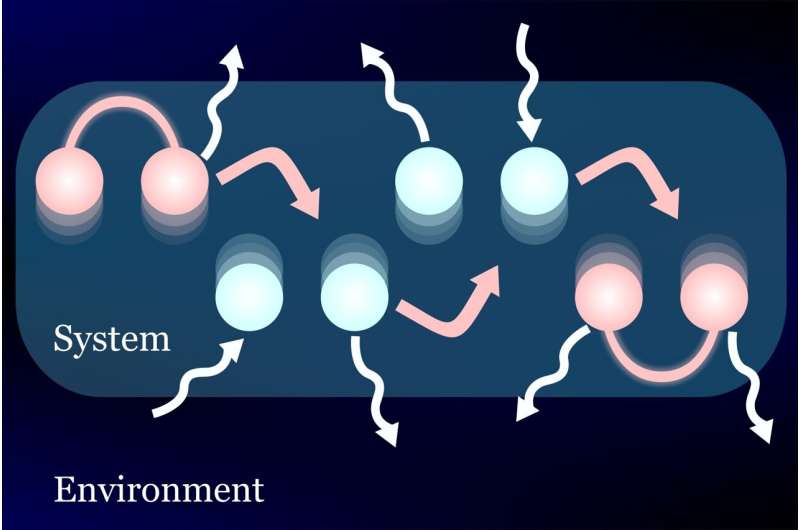
The study uses a simplified model molecule consisting of two regions: a donor, where energy is initially absorbed, and an acceptor, where the energy must eventually arrive. Energy can hop between sites within each region; although longer hops are less likely, they are still included in the model. The model also accounts for interactions with the environment, which can couple with the molecule’s vibrations and affect the energy transfer process.

A key focus of the research was determining whether it is more effective for energy to start entirely at one donor site or in a delocalized or entangled superposition spread over two or more donor sites. The researchers explored whether this quantum mechanical property impacts transfer speed in a system with long-range interactions.

“Starting in a delocalized provides the system with more pathways,” Pagano said. “Our simulations indicate that this added coherence allows for quicker transfer to the acceptor, even in the presence of environmental noise.”

Findings and implications

The research team discovered that when energy begins in an entangled initial state, transfer to the acceptor occurs significantly faster than in scenarios where the energy starts at a single site. This finding holds true across various model parameters, including the strength of environmental coupling, the range of interactions between sites and disorder within the system.

“This suggests that nature may be using entanglement and coherence to optimize the speed of excitation transfer, thereby enhancing the robustness of this process,” Pagano said.

Although the model is intentionally minimal, the researchers argue that its implications extend to more complex molecular systems. They propose that could be conducted using controllable quantum platforms such as trapped-ion systems to simulate the physics of molecular energy transfer.

“Our goal is to bridge the abstract world of quantum information with the tangible mechanisms observed in biology,” said Diego Fallas Padilla, the study’s first author and Rice alumnus. “This study serves as a step toward illustrating that quantum coherence is not just a theoretical curiosity but a practical component of nature’s design.”

Co-authors of the study include Rice’s Visal So, Abhishek Menon, Roman Zhuravel and Han Pu.

More information: Diego Fallas Padilla et al, Delocalized Excitation Transfer in Open Quantum Systems with Long-Range Interactions, PRX Quantum (2025). DOI: 10.1103/bxwl-sbsn

Journal information: PRX Quantum

Provided by Rice University

Source: Entangled states enhance energy transfer in models of molecular systems

A common supplement could supercharge cancer treatments

In a new study, researchers from the University of Chicago discovered that zeaxanthin, a plant-derived carotenoid best known for protecting vision, may also act as an immune-boosting compound by strengthening the cancer-fighting activity of immune cells. The findings, which were published in Cell Reports Medicine, highlight the potential of zeaxanthin as a widely available supplement to improve the effectiveness of cancer immunotherapies.

“We were surprised to find that zeaxanthin, already known for its role in eye health, has a completely new function in boosting anti-tumor immunity,” said Jing Chen, PhD, Janet Davison Rowley Distinguished Service Professor of Medicine and senior author of the study. “Our study show that a simple dietary nutrient could complement and strengthen advanced cancer treatments like immunotherapy.”

How does this nutrient work?

The study builds on years of work by Chen’s lab to better understand how nutrients influence the immune system. By screening a large blood nutrient library, the team identified zeaxanthin as a compound that directly enhances the activity of CD8+ T cells, a crucial type of immune cell that kills tumor cells. These cells rely on a molecular structure called the T-cell receptor (TCR) to recognize and destroy abnormal cells.

The researchers found that zeaxanthin stabilizes and strengthens the formation of TCR complex on CD8+ T cells upon interacting with the cancer cells. This, in turn, triggers more robust intracellular signaling that boosts T-cell activation, cytokine production, and tumor-killing capacity.

Zeaxanthin improves immunotherapy effects

In mouse models, dietary supplementation with zeaxanthin slowed tumor growth. Importantly, when combined with immune checkpoint inhibitors – a type of immunotherapy that has transformed cancer treatment in recent years – zeaxanthin significantly enhanced anti-tumor effects compared to immunotherapy alone.

To extend the findings, the researchers tested human T cells engineered to recognize specific tumor antigens and found that zeaxanthin treatment improved these cells’ ability to kill melanoma, multiple myeloma, and glioblastoma cells in laboratory experiments.

[…]

`

Zeaxanthin is sold as an over-the-counter supplement for eye health, and is naturally found in vegetables like orange peppers, spinach, and kale. It’s inexpensive, widely available, well-tolerated and, most importantly, its safety profile is known – which means it can be safely tested as an adjunct to cancer therapies.

The study also reinforces the importance of a balanced diet. In their previous research, Chen’s group discovered that trans-vaccenic acid (TVA), a fatty acid derived from dairy and meat, also boosts T-cell activity – but through a different mechanism. Together, the findings suggest that nutrients from both plant and animal sources may provide complementary benefits to immune health.

Clinical applications of zeaxanthin

Although the results are promising, the researchers emphasize that the work is still at an early stage. Most of the findings come from laboratory experiments and animal studies. Thus, clinical trials will be needed to determine whether zeaxanthin supplements can improve outcomes for cancer patients.

[…]

Source: A common supplement could supercharge cancer treatments | ScienceDaily

SWIFT and 30 banks will go Blockchain and become a mainstream part of global finance

Blockchains are still synonymous with the wild world of cryptocurrencies, but on Monday, 30 banks and SWIFT – the world’s most important cross-border payment service – made them an utterly mainstream part of the global financial system.

SWIFT – aka the Society for Worldwide Interbank Financial Telecommunication – provides a messaging service that financial institutions use to move money around the world. The service is widely used but is slow because, as explained by ANZ Bank, SWIFT “doesn’t actually move the money.”

“This means the instruction to pay and the movement of funds happen separately, often requiring a complex network of accounts and correspondent banks to enable a payment to be processed. This disconnect can slow payments down and lead to a lack of visibility for both sender and recipient.”

It can also mean cross-border payments take a couple of days to complete.

SWIFT’s problems are well known and financial services types see the service as sound – but also sand in the gears of global trade.

Blockchain enthusiasts who saw cryptocurrency transactions rapidly rippling across distributed ledgers, therefore wondered if their preferred technology could improve the speed of cross-border cash transfers. Many startups, some with support from sensible central banks, have explored this idea, usually by proposing “stablecoins” – digital currencies pegged to the value of a fiat currency – which would be exchanged on a blockchain to provide faster settlements than SWIFT can achieve.

China has similar ideas: One application for its Digital Yuan is enabling rapid cross-border transactions in the Middle Kingdom’s currency, and not the US Dollar that is often used to move money around the world. If China could use its digital currency to control a slice of global trade, it could weaken Western institutions like SWIFT.

Almost everyone contemplating using a blockchain to move money around the world imagines either supplanting SWIFT, or stealing a lot of its business.

It’s therefore unsurprising that on Monday SWIFT announced its intention to “add a blockchain-based shared ledger to its technology infrastructure, a pivotal step for global finance that promises to make instant, always-on cross-border transactions possible at unprecedented scale.”

SWIFT will also build tools to integrate its existing payment systems, and its new blockchain.

“It is envisaged that the ledger – a secure, real-time log of transactions between financial institutions – will record, sequence and validate transactions and enforce rules through smart contracts,” SWIFT’s announcement explains. “It will be built for interoperability, both with existing and emerging networks, while maintaining the trust, resilience and compliance synonymous with Swift and critical to the secure functioning of global finance.”

34 financial institutions from 16 countries have signed up to design the ledger, with help from Ethereum outfit Consensys.

SWIFT didn’t predict when this ledger will go live, which is probably sensible as projects of this magnitude can easily go pear-shaped and previous attempts at using blockchains for high-volume mission critical systems have gone badly.

But for now, an entity that has for decades played an important role in the global economy has decided it needs to rebuild itself on blockchain.

In some ways that’s unremarkable because very few people need to care about the technology plumbing their banks employ. SWIFT adopting Blockchain, however, will likely bring tokenized assets much closer to the mainstream.

Source: Blockchain just became a mainstream part of global finance • The Register

USAF admits SharePoint privacy issue; reports of breach, shutdown of SharePoint, Teams and PowerBI

The US Air Force confirmed it’s investigating a “privacy-related issue” amid reports of a Microsoft SharePoint-related breach and subsequent service-wide shutdown, rendering mission files and other critical tools potentially unavailable to service members.

“The Department of the Air Force is aware of a privacy-related issue,” an Air Force spokesperson told The Register on Wednesday, while declining to answer specific questions about the alleged digital intrusion.

The Air Force’s confirmation follows what looks like a breach notification, shared with The Register and on social media, that purports to come from the Air Force Personnel Center Directorate of Technology and Information.

“This message is to inform you of a critical Personally Identifiable Information (PII) and Protected Health Information (PHI) exposure related to USAF SharePoint Permissions,” the notice says. “As a result of this breach, all USAF SharePoints will be blocked Air Force-wide to protect sensitive information.”

Two other Microsoft services, Teams and Power BI dashboards, will also allegedly be blocked because both access SharePoint, the alert continued, adding that restoration may take up to two weeks.

It’s unclear what services, if any, are offline right now. A DAF spokesperson said that the military branch “cannot confirm” that SharePoint and Teams have been disabled. Another person we spoke to on the phone claimed that they were “using it right now” when asked about SharePoint on Tuesday.

A Microsoft spokesperson told The Register that Redmond “has nothing to share at this time,” and declined to answer our specific questions including if the Air Force security snafu is related to July’s SharePoint fiasco.

Chinese government spies, data thieves, and at least one ransomware gang exploited a couple of SharePoint vulnerabilities over the summer, allowing them to hijack on-premises SharePoint servers belonging to more than 400 organizations and remotely execute code.

[…]

Source: Air Force admits SharePoint privacy issue; reports of breach • The Register

Academic research finds economic, technical and operational harms from Italy’s Piracy Shield

Walled Culture first wrote about Piracy Shield, Italy’s automated system for tackling alleged copyright infringement in the streaming sector, two years ago. Since then, we have written about the serious problems that soon emerged. But instead of fixing those issues, the government body that runs the scheme, Italy’s AGCOM (the Italian Authority for Communications Guarantees), has extended it. The problems may be evident, but they have not been systematically studied, until now: a peer-reviewed study from a group of (mostly Italian) researchers has just been published as a preprint (found via TorrentFreak). It’s particularly welcome as perhaps the first rigorous analysis of Piracy Shield and its flaws.

[…]

one of the major concerns about the system is the lack of transparency: AGCOM does not publish a list of IP addresses or domain names that are subject to its blocking. That not only makes it extremely difficult to correct mistakes, it also – conveniently – hides those mistakes, as well as the scope and impact of Piracy Shield. To get around this lack of transparency, the researchers had to resort to a dataset leaked on GitHub, which contained 10,918 IPv4 addresses and 42,664 domain names (more precisely, the latter were “fully qualified domain names” – FQDN) that had been blocked. As good academics, the researchers naturally verified the dataset as best they could:

While this dataset may not be exhaustive … it nonetheless provides a conservative lower-bound estimate of the platform’s blocking activity, which serves as the foundation for the subsequent analyses.

Much of the paper is devoted to the detailed methodology. One important result is that many of the blocked IP addresses belonged to leased IP address space. As the researchers explain:

This suggests that illegal streamers may attempt to exploit leased address space more intensively, even if just indirectly, by obtaining them by hosting companies that leases them, leading to more potential collateral damages for new lessees.

This particular collateral damage arises from the fact that even after the leased IP address is released by those who are using it for allegedly unauthorised streaming, it is still blocked on the Piracy Shield system. That means whoever is allocated that leased IP address subsequently is blocked by AGCOM, but are probably unaware of that fact, because of the opaque nature of the blocking process. More generally, collateral damage arose from the wrongful blocking of a wide range of completely legitimate sites:

During our classification process, we observed a wide range of website types across these collaterally affected domains, including personal branding pages, company profiles, and websites for hotels and restaurants. One notable case involves 19 Albanian websites hosted on a single IP address assigned to WIIT Cloud. These sites are still unreachable from Italy.

Italian sites were also hit, including a car mechanic, several retail shops, an accountant, a telehealth missionary program – and a nunnery. More amusingly, the researchers write:

we found a case of collateral damage involving a Google IP. Closer inspection revealed the IP was used by Telecom Italia to serve a blocking page for FQDNs filtered by Piracy Shield. Although later removed from the blocklist, this case suggests that collateral damage may have affected the blocking infrastructure itself.

The academics summarise their work as follows:

Our results on the collateral damages of IP and FQDN blocking highlight a worrisome scenario, with hundreds of legitimate websites unknowingly affected by blocking, unknown operators experiencing service disruption, and illegal streamers continuing to evade enforcement by exploiting the abundance of address space online, leaving behind unusable and polluted address ranges. Still, our findings represent a conservative lower-bound estimate.

It distinguished three ways in which Piracy Shield is harmful. Economically, because it disrupts legitimate businesses; technically, because it blocks shared infrastructure such as content delivery networks, while “polluting the IP address space” for future, unsuspecting users; and operationally, because it imposes a “growing, uncompensated burden on Italian ISPs forced to implement an expanding list of permanent blocks.” The paper concludes with some practical suggestions for improving a system that is clearly not fit for purpose, and poses a threat to national security, as discussed previously on Walled Culture. The researchers suggest that:

widespread and difficult-to-predict collateral damage suggests that IP-level blocking is an indiscriminate tool with consequences that outweigh its benefits and should not be used.

Instead, they point out that there are other legal pathways that can be pursued, since many of the allegedly infringing streams originate within the EU. If FQDN blocking is used, it should be regarded as “a last resort in tightly constrained time windows, i.e., only for the duration of the live event.” Crucially, more transparency is needed from AGCOM:

To mitigate damages, resource owners must be immediately notified when their assets are blocked, and a clear, fast unblocking mechanism must be in place.

This is an important piece of work, because it places criticisms of Piracy Shield on a firm footing, with rigorous analysis of the facts. However, AGCOM is unlike to pay attention, since it is in the process of expanding Piracy Shield to apply to vast swathes of online streaming: amendments to the relevant law mean that automatic blocks can now be applied to film premieres, and even run-of-the-mill TV shows. Based on its past behaviour, the copyright industry may well push to extend Piracy Shield to static Web material too, on the basis that the blocking infrastructure is already in place, so why not use it for every kind of material?

Source: Academic research finds economic, technical and operational harms from Italy’s Piracy Shield – Walled Culture