The Linkielist

Linking ideas with the world

The Linkielist

Plug Into USB, Read Hostname And IP Address | Hackaday

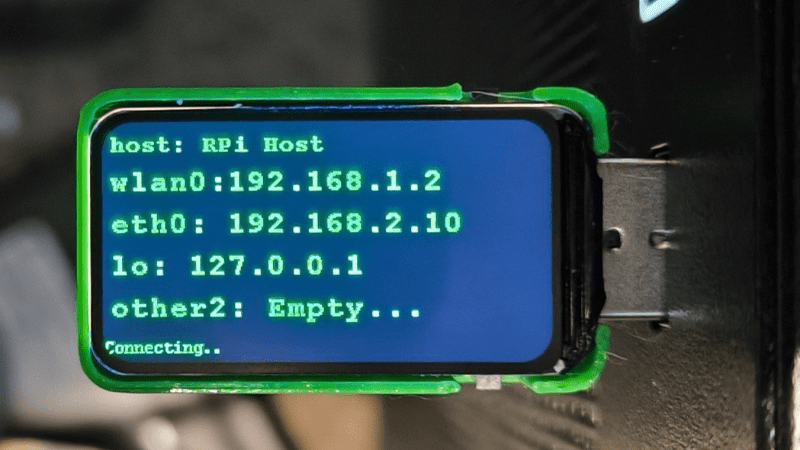
Ever wanted to just plug something in and conveniently read the hostname and IP addresses of a headless board like a Raspberry Pi? Chances are, a free USB port is more accessible than digging up a monitor and keyboard, and that’s where [C4KEW4LK]’s rpi_usb_ip_display comes in. Plug it into a free USB port, and a few moments later, read the built-in display. Handy!

The device is an RP2350 board and a 1.47″ Waveshare LCD, with a simple 3D-printed enclosure. It displays hostname, WiFi interface, Ethernet interface, and whatever others it can identify. There isn’t even a button to push; just plug it in and let it run.

Here’s how it works: once plugged in, the board identifies itself as a USB keyboard and a USB serial port. Then it launches a terminal with Ctrl-Alt-T, and from there it types and runs commands to do the following:

  1. Find the serial port that the RP2350 board just created.
  2. Get the parsed outputs of hostname, ip -o -4 addr show dev wlan0, ip -o -4 addr show dev eth0, and ip -o -4 addr show to gather up data on active interfaces.
  3. Send that information out the serial port to the RP2350 board.
  4. Display the information on the LCD.
  5. Update periodically.

The only catch is that the host system must be able to respond to launching a new terminal with Ctrl-Alt-T, which typically means the host must have someone logged in.

It’s a pretty nifty little tool, and its operation might remind you, in concept, of how BadUSB attacks happen: a piece of hardware, once plugged into a host, identifies itself to the host as something other than what it appears to be. Then it proceeds to input and execute actions. But in this case, it’s not at all malicious, just convenient and awfully cute.
Source: Plug Into USB, Read Hostname And IP Address | Hackaday

A Starlink satellite just exploded and left ‘trackable’ debris

SpaceX said it experienced an anomaly with one if its Starlink satellites that was likely caused by a small explosion. “The anomaly led to venting of the propulsion tank, a rapid decay in semi-major axis by about 4 km [2.5 miles] and the release of a small number of trackable low relatively velocity objects,” Starlink wrote in a post on X. Orbital tracking company LeoLabs assessed that the issue was caused by an “internal energetic source rather than a collision with space debris or another object.”

SpaceX said it’s working with NASA and the US Space Force to track the remains of the object. “The satellite is largely intact, tumbling and will reenter the Earth’s atmosphere and fully demise within weeks,” the company said. It’s trajectory is well below the International Space Station (ISS) so it poses no risk to the lab or its crew. Starlink has yet to say how many pieces it’s tracking.

The incident happened just days after a Starlink satellite narrowly avoided a collision with a rival Chinese satellite from CAS Space last week. Starlink vice president Michael Nicholls said that the incident happened due to a lack of coordination between the two companies. “When satellite operators do not share emphemeris for their satellites, dangerously close approaches can occur in space,” he wrote on X.

Starlink’s constellation consists of almost 9,300 active satellites making up around 65 percent of all orbiting spacecraft, not including defunct units. That number grew by more than 3,000 this year alone, launched aboard 121 separate SpaceX missions — around one every three days.

Source: A Starlink satellite just exploded and left ‘trackable’ debris

US bans new foreign-made drones and components

The Federal Communications Commission has added foreign-made drones and their critical components to the agency’s “Covered List,” making them prohibited to import into the US. In a public notice published by the FCC, it said several national security agencies have determined that umanned aircraft systems (UAS) and their critical components produced in foreign countries pose an unacceptable risk to the national security of the United States.

“UAS and UAS critical components must be produced in the United States,” the agency said. “UAS are inherently dual-use: they are both commercial platforms and potentially military or paramilitary sensors and weapons. UAS and UAS critical components, including data transmission devices, communications systems, flight controllers, ground control stations, controllers, navigation systems, batteries, smart batteries, and motors produced in a foreign country could enable persistent surveillance, data exfiltration, and destructive operations over U.S. territory, including over World Cup and Olympic venues and other mass gathering events.”

[…]

Source: US bans new foreign-made drones and components

So how are they going to reverse engineer all the great drones out there? None of them are being made in the US.

Anna’s Archive Backs up Spotify and analyses the data

Anna’s Archive normally focuses on text (e.g. books and papers). We explained in “The critical window of shadow libraries” that we do this because text has the highest information density. But our mission (preserving humanity’s knowledge and culture) doesn’t distinguish among media types. Sometimes an opportunity comes along outside of text. This is such a case.

A while ago, we discovered a way to scrape Spotify at scale. We saw a role for us here to build a music archive primarily aimed at preservation.

Generally speaking, music is already fairly well preserved. There are many music enthusiasts in the world who digitized their CD and LP collections, shared them through torrents or other digital means, and meticulously catalogued them.

However, these existing efforts have some major issues:

  1. Over-focus on the most popular artists. There is a long tail of music which only gets preserved when a single person cares enough to share it. And such files are often poorly seeded.
  2. Over-focus on the highest possible quality. Since these are created by audiophiles with high end equipment and fans of a particular artist, they chase the highest possible file quality (e.g. lossless FLAC). This inflates the file size and makes it hard to keep a full archive of all music that humanity has ever produced.
  3. No authoritative list of torrents aiming to represent all music ever produced. An equivalent of our book torrent list (which aggregate torrents from LibGen, Sci-Hub, Z-Lib, and many more) does not exist for music.

This Spotify scrape is our humble attempt to start such a “preservation archive” for music. Of course Spotify doesn’t have all the music in the world, but it’s a great start.

Before we dive into the details of this collection, here is a quick overview:

  • Spotify has around 256 million tracks. This collection contains metadata for an estimated 99.9% of tracks.
  • We archived around 86 million music files, representing around 99.6% of listens. It’s a little under 300TB in total size.
  • We primarily used Spotify’s “popularity” metric to prioritize tracks. View the top 10,000 most popular songs in this HTML file (13.8MB gzipped).

[…]

Source: Backing up Spotify – Anna’s Blog

Belkin announces a wireless HDMI dongle that doesn’t need Wi-Fi access

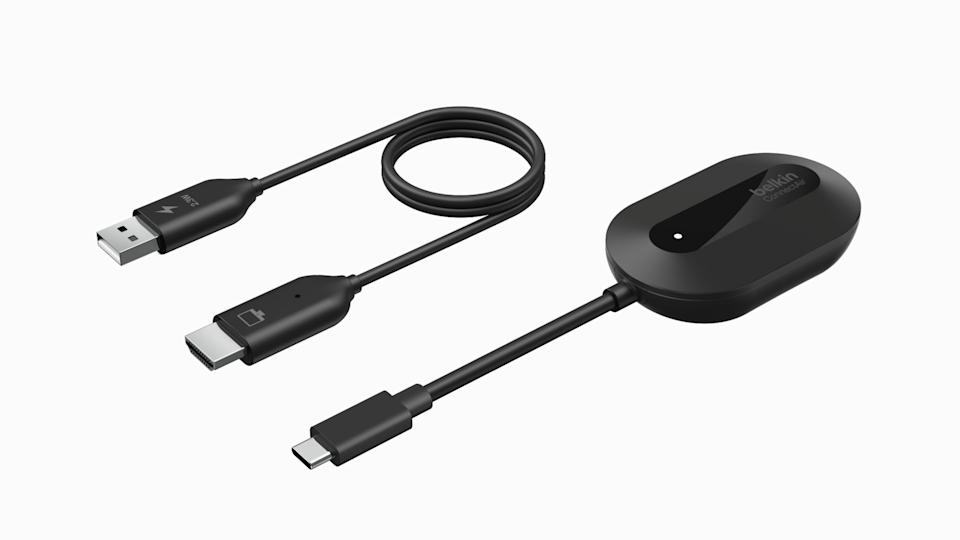
Belkin has announced a plug-and-play casting system at CES 2026 that allows for screen sharing from a laptop, tablet or smartphone to another display without Wi-Fi or Bluetooth. The $150 ConnectAir Wireless HDMI Display Adapter comes with a USB-C transmitter dongle and a USB-A to HDMI receiver that can be connected to a TV, monitor or projector to wirelessly cast over a range of up to 131 feet (40 meters).

Belkin's ConnectAir Wireless USB-C transmitter and HDMI receiver
Belkin’s ConnectAir Wireless USB-C transmitter and HDMI receiver (Belkin)

The ConnectAir Wireless casts in 1080p at 60Hz, with latency under 80ms according to Belkin. It’s compatible with USB-C devices that support DisplayPort Alt Mode, including Windows, macOS and ChromeOS laptops, tablets such as the M1 and M2 iPad Pro and iPad Air, and smartphones with video output. Belkin also says it supports multi-user screen sharing at up to 8 transmitters. The dongle comes in black and while it’s not available to purchase just yet, it’s expected to be released early this year.

Source: Belkin announces a wireless HDMI dongle that doesn’t need Wi-Fi access

iPolish brings color-changing press-on smart nails to CES

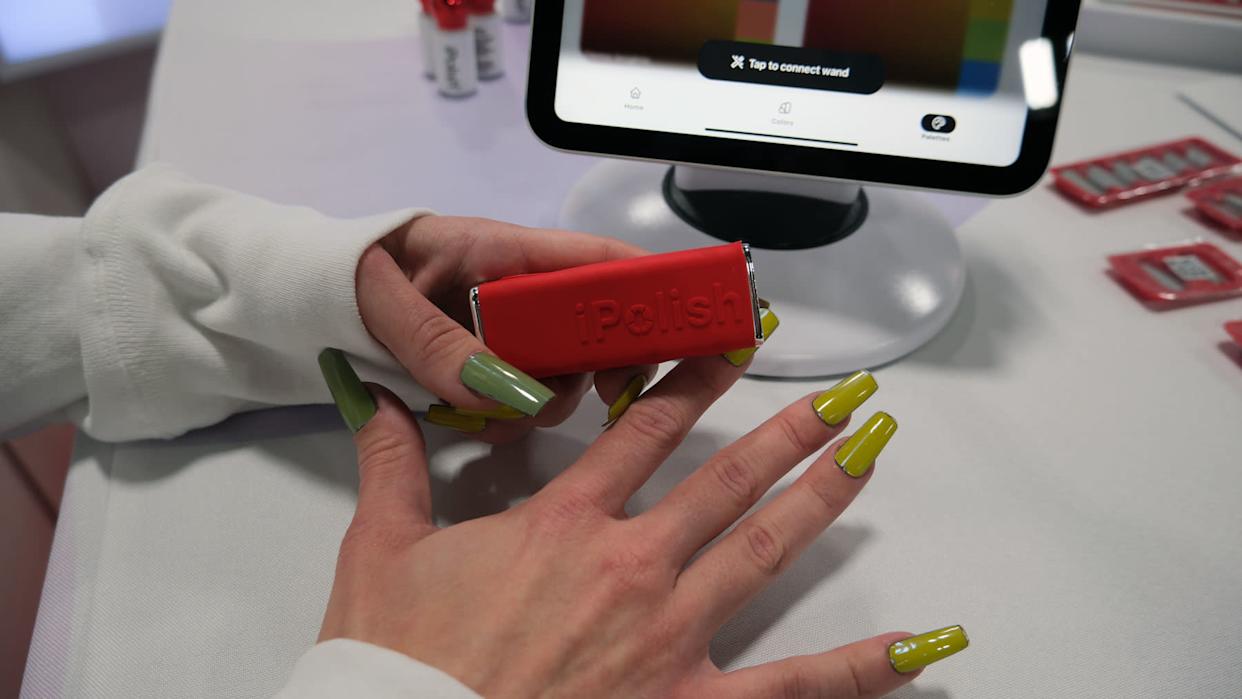
press-on acrylic nails that, when you apply an electric charge, change color almost like magic.

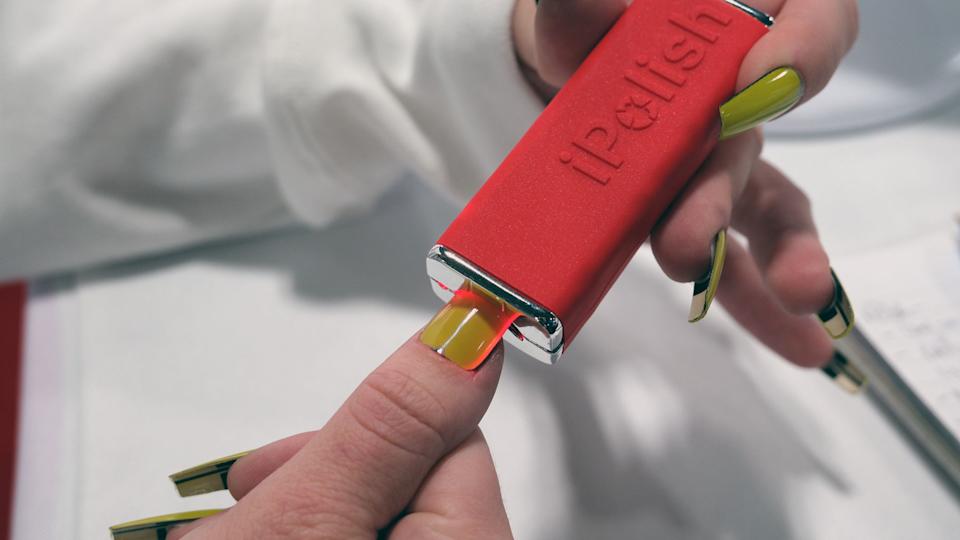
In order to enjoy kaleidoscopic nails, you’ll need to charge the wand, which then connects to your phone. Once you’ve selected your color of choice, you just put the tip of the nail into the wand, and it’ll pass a short charge into the nail to change it.

[…]

All in all, it took around five seconds to change the color of a single nail, so it’s not a big deal in the grand scheme of things.

iPolish
iPolish (Daniel Cooper for Engadget)

iPolish says that each nail can display 400 colors, and can be changed as many times as the user would like. So, if you’re coordinating your nails with your outfits, you’re not bound to a single color palette in the weeks between salon visits. They’re also surprisingly affordable, with the starter set costing $95  [NB by the time you pay for shipping (EUR 29!) and taxes, they come to Europe for EUR 141 which is a bit much less affordable] which contains two sets of nails, one in Ballerina cut, one in Squoval. The Ballerinas are relatively short, while the Sqovals are longer.

[…]

When it comes time to replace your nails when one breaks or you lose it in some nailbed mishap, you’ll be able to pick up spares for $6.50.

Source: iPolish brings color-changing press-on smart nails to CES

Would have bought these for around EUR 100,- but EUR 141,- is just too much.

Bose made the consumer friendly move to open source its SoundTouch speakers just before End of Life

Bose recently announced the pending end of cloud support for its SoundTouch line of home speakers. This will, in effect, turn the smart speakers into dumb speakers as they will no longer have access to many features and any related software updates. Well, there’s a spot of good news for SoundTouch owners. The company is turning to an open source model for the software, allowing third parties to keep the music playing.

The company has already begun mailing out the API documentation to customers so “independent developers can create their own SoundTouch-compatible tools and features.” This will take some time, so Bose is also extending the end-of-life (EoL) date for the SoundTouch speakers. They were set to stop receiving cloud updates in February, but that has been moved to May 6.

It made a couple of other changes to make life a bit easier for SoundTouch owners. The speakers will still be able to use AirPlay and Spotify Connect after EoL, which was something that had been in doubt. The app will also continue to work in a stripped-down format. That app was originally set to stop working altogether, so all of those angry customer comments on Reddit must have done the job.

The SoundTouch speakers were introduced in 2013 and were on the expensive side, starting at $600. Nobody likes spending hundreds of dollars on something only to have it become a useless brick several years later. Good on Bose for listening to their customers on this.

Source: Bose made the consumer friendly move to open source its SoundTouch speakers

Finally, a company that isn’t turning it’s goods into e-junk bricks after they stop support.

IXI’s autofocusing lenses are almost ready to replace multifocal glasses

IXI’s glasses are designed for age-related farsightedness, a condition that affects many, if not most people over 45. They combine cameraless eye tracking with liquid crystal lenses that automatically activate when the glasses detect the user’s focus shifting. This means that, instead of having two separate prescriptions, as in multifocal or bifocal lenses, IXI’s lenses automatically switch between each prescription. Crucially — like most modern smartglasses — the frames themselves are lightweight and look like just another pair of normal glasses.

IXI autofocus lenses
Mat Smith for Engadget

With a row of prototype frames and lenses laid out in front of him, CEO and co-founder Niko Eiden explained the technology, which can be separated into two parts. First, the IXI glasses track the movement of your eyes using a system of LEDs and photodiodes, dotted around the edges of where the lenses sit. The LEDs bounce invisible infrared light off the eyes and then measure the reflection, detecting the subtle movements of your eye and how both eyes converge when focusing on something close.

Using infrared with just a “handful of analog channels” takes far less power than the millions of pixels and 60-times-per-second processing required by camera-based systems. IXI’s system not only tracks eye movements, but also blinking and gaze direction, while consuming only 4 milliwatts of power.

IXI autofocus lenses
Mat Smith for Engadget

Most of the technology, including memory, sensors, driving electronics and eye tracker, is in the front frame of the glasses and part of the arms closest to the hinge. The IXI prototype apparently uses batteries similar in size to those found in AirPods, which gives some sense of the size and weight of the tech being used. The charging port is integrated into the glasses’ left arm hinge. Naturally, this does mean they can’t be worn while charging. IXI says that a single charge should cover a whole day’s usage.

The prototype frames I saw this week appeared to be roughly the same weight as my traditional chunky specs.

[…]

Autofocus lenses could eliminate the need for multiple pairs of glasses, such as bifocals and progressives. Even if the glasses were to run out of power, they’d still function as a pair of traditional specs with your standard prescription, just lacking the near-sighted boost. IXI’s sensor sensitivity can also offer insight into other health conditions, detect dry eyes, estimate attentiveness and, by tracking where you’re looking, even posture and neck movement. According to Eiden, blink rate changes with focus, daydreaming and anxiety, and all that generates data that can be shown in the companion app.

IXI autofocus lenses
Mat Smith for Engadget

Hypothetically, the product could even potentially adapt prescriptions dynamically, going beyond the simple vision correction of Gen 1. For example, it could offer stronger corrections as your eyes get fatigued through the day.

[…]

Source: IXI’s autofocusing lenses are almost ready to replace multifocal glasses

17.5 million Instagram accounts data stolen in 2024 now being exploited

This week, Malwarebytes discovered that hackers stole the sensitive information of 17.5 million Instagram accounts. Complete with usernames, physical addresses, phone numbers, email addresses, and more, this data can be abused by cybercriminals to impersonate trusted brands, trick users, and steal their passwords.
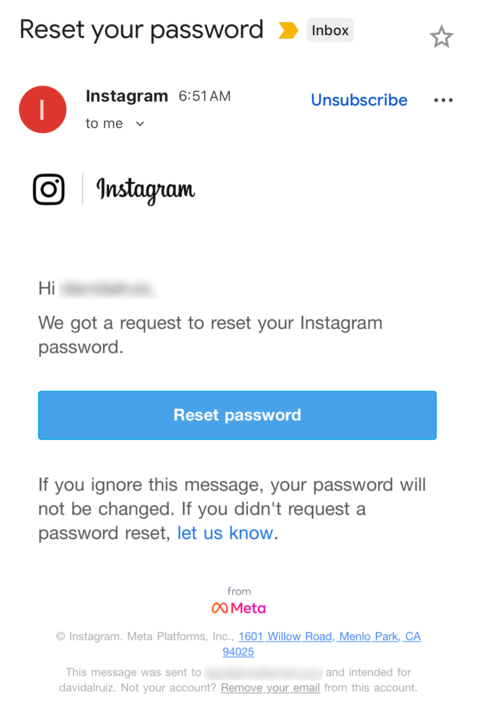
Critically, this data is already being offered on the dark web, with individual users also receiving legitimate password reset notifications from Instagram.
Instagram breach notice image
What to do:
  • Beware of emails and messages that claim to come from Instagram, as they could be sent by malicious hackers trying to trick you into handing over your password.
  • If you’re concerned, sign into your Instagram account and reset your password to a new, strong, unique password.

Source: See if you’re at risk

Forum Breachforums Breached

In October 2025, a reincarnation of the hacking forum BreachForums, which had previously been shut down multiple times, was taken offline by a coalition of law enforcement agencies. In the months leading up to the takedown, the site itself suffered a data breach that exposed a total of 672k unique email addresses across all tables, including within forum posts and private messages. The users table alone contained 324k unique email addresses, usernames, and Argon2 password hashes.

Source: BreachForums (2025) Data Breach

Cloudflare defies Italy’s Piracy Shield, won’t block websites on 1.1.1.1 DNS – won’t cave to media cabal. Well done.

Italy fined Cloudflare 14.2 million euros for refusing to block access to pirate sites on its 1.1.1.1 DNS service, the country’s communications regulatory agency, AGCOM, announced yesterday. Cloudflare said it will fight the penalty and threatened to remove all of its servers from Italian cities.

AGCOM issued the fine under Italy’s controversial Piracy Shield law, saying that Cloudflare was required to disable DNS resolution of domain names and routing of traffic to IP addresses reported by copyright holders. The law provides for fines up to 2 percent of a company’s annual turnover, and the agency said it applied a fine equal to 1 percent.

The fine relates to a blocking order issued to Cloudflare in February 2025. Cloudflare argued that installing a filter applying to the roughly 200 billion daily requests to its DNS system would significantly increase latency and negatively affect DNS resolution for sites that aren’t subject to the dispute over piracy.

AGCOM rejected Cloudflare’s arguments. The agency said the required blocking would impose no risk on legitimate websites because the targeted IP addresses were all uniquely intended for copyright infringement.

In a September 2025 report on Piracy Shield, researchers said they found “hundreds of legitimate websites unknowingly affected by blocking, unknown operators experiencing service disruption, and illegal streamers continuing to evade enforcement by exploiting the abundance of address space online, leaving behind unusable and polluted address ranges.” This is “a conservative lower-bound estimate,” the report said.

The Piracy Shield law was adopted in 2024. “To effectively tackle live sports piracy, its broad blocking powers aim to block piracy-related domain names and IP addresses within 30 minutes,” TorrentFreak wrote in an article today about the Cloudflare fine.

Cloudflare to fight fine, may withhold services

Cloudflare co-founder and CEO Matthew Prince wrote today that Cloudflare already “had multiple legal challenges pending against the underlying scheme” and will “fight the unjust fine.”

“Yesterday a quasi-judicial body in Italy fined Cloudflare $17 million for failing to go along with their scheme to censor the Internet,” Prince wrote. He continued:

The scheme, which even the EU has called concerning, required us within a mere 30 minutes of notification to fully censor from the Internet any sites a shadowy cabal of European media elites deemed against their interests. No judicial oversight. No due process. No appeal. No transparency. It required us to not just remove customers, but also censor our 1.1.1.1 DNS resolver meaning it risked blacking out any site on the Internet. And it required us not just to censor the content in Italy but globally. In other words, Italy insists a shadowy, European media cabal should be able to dictate what is and is not allowed online.

Prince said he will discuss the matter with US government officials next week and that Cloudflare is “happy to discuss this with Italian government officials who, so far, have been unwilling to engage beyond issuing fines.” In addition to challenging the fine, Prince said Cloudflare is “considering the following actions: 1) discontinuing the millions of dollars in pro bono cyber security services we are providing the upcoming Milano-Cortina Olympics; 2) discontinuing Cloudflare’s Free cyber security services for any Italy-based users; 3) removing all servers from Italian cities; and 4) terminating all plans to build an Italian Cloudflare office or make any investments in the country.”

“Play stupid games, win stupid prizes,” Prince wrote.

Google also in Piracy Shield crosshairs

AGCOM said today that in the past two years, the Piracy Shield law disabled over 65,000 domain names and about 14,000 IP addresses. Italian authorities also previously ordered Google to block pirate sites at the DNS level.

The Computer & Communications Industry Association (CCIA), a trade group that represents tech companies including Cloudflare and Google, has criticized the Piracy Shield law. “Italian authorities have included virtual private networks (VPN) and public DNS resolvers in the Piracy Shield, which are services fundamental to the protection of free expression and not appropriate tools for blocking,” the CCIA said in a January 2025 letter to European Commission officials.

The CCIA added that “the Piracy Shield raises a significant number of concerns which can inadvertently affect legitimate online services, primarily due to the potential for overblocking.” The letter said that in October 2024, “Google Drive was mistakenly blocked by the Piracy Shield system, causing a three-hour blackout for all Italian users, while 13.5 percent of users were still blocked at the IP level, and 3 percent were blocked at the DNS level after 12 hours.”

The Italian system “aims to automate the blocking process by allowing rights holders to submit IP addresses directly through the platform, following which ISPs have to implement a block,” the CCIA said. “Verification procedures between submission and blocking are not clear, and indeed seem to be lacking. Additionally, there is a total lack of redress mechanisms for affected parties, in case a wrong domain or IP address is submitted and blocked.”

30-minute blocking prevents “careful verification”

The 30-minute blocking window “leaves extremely limited time for careful verification by ISPs that the submitted destination is indeed being used for piracy purposes,” the CCIA said. The trade group also questioned the piracy-reporting system’s ties to the organization that runs Italy’s top football league.

“Additionally, the fact that the Piracy Shield platform was developed for AGCOM by a company affiliated with Lega Serie A, which is one of the very few entities authorized to report, raises serious questions about the potential conflict of interest exacerbating the lack of transparency issue,” the letter said.

A trade group for Italian ISPs has argued that the law requires “filtering and tasks that collide with individual freedoms” and is contrary to European legislation that classifies broadband network services as mere conduits that are exempt from liability.

“On the contrary, in Italy criminal liability has been expressly established for ISPs,” Dalia Coffetti, head of regulatory and EU affairs at the Association of Italian Internet Providers, wrote in April 2025. Coffetti argued, “There are better tools to fight piracy, including criminal Law, cooperation between States, and digital solutions that downgrade the quality of the signal broadcast via illegal streaming websites or IPtv. European ISPs are ready to play their part in the battle against piracy, but the solution certainly does not lie in filtering and blocking IP addresses.”

Source: Cloudflare defies Italy’s Piracy Shield, won’t block websites on 1.1.1.1 DNS – Ars Technica

For more articles on how Piracy Shield has gone wrong, read here