
The Linkielist

Linking ideas with the world

The Linkielist

HKU and UCLA Scientists Uncover the Mechanism powering “Space Battery” above Auroral Regions

The dazzling lights of the aurora are created when high-energy particles from space collide with Earth’s atmosphere. While scientists have long understood this process, one big mystery remained: What powers the electric fields that accelerate these particles in the first place?

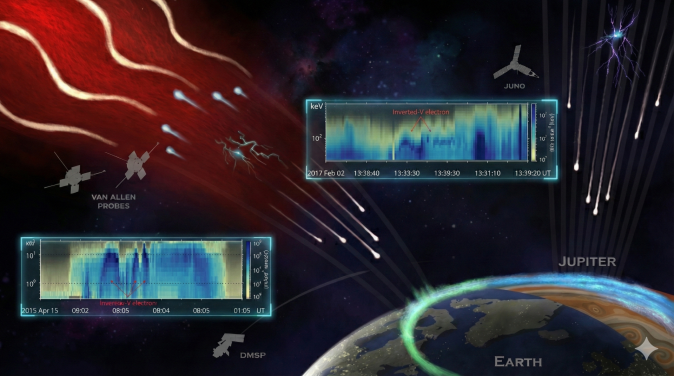
A new study co-led by the Department of Earth and Planetary Sciences at The University of Hong Kong (HKU) and the Department of Atmospheric and Oceanic Sciences at the University of California, Los Angeles (UCLA) now provided an answer. Published in Nature Communications, the research reveals that Alfvén waves — plasma waves travelling along Earth’s magnetic field lines — act like an invisible power source, fueling the stunning auroral displays we see in the sky.

By analysing how charged particles move and gain energy in different regions of space, the researchers demonstrated that these waves act as a natural accelerator, supplying energy that drives charged particles down into the atmosphere and produces the glowing auroral lights.

To confirm their findings, the team analysed data collected by multiple satellites orbiting Earth, including NASA’s Van Allen Probes and the THEMIS mission. The data provided solid evidence that Alfvén waves continuously transfer energy to the auroral acceleration region, maintaining the electric fields that would otherwise dissipate.

“This discovery not only provides a definitive answer to the physics of Earth’s aurora, but also offers a universal model applicable to other planets in our solar system and beyond,” said Professor Zhonghua YAO of the Department of Earth and Planetary Sciences at HKU. Professor Yao leads a dedicated team in space and planetary science at HKU, which has established a reputation for high-impact research on planetary auroras.

With deep expertise in the magnetospheric dynamics of planets like Jupiter and Saturn, the HKU team brought a critical planetary perspective to the study. “Our team at HKU has long focused on the auroral processes of giant planets. By applying this knowledge to the high-resolution data available near Earth, we have bridged the gap between Earth science and planetary exploration.” Professor Yao added.

The research represents a model of interdisciplinary collaboration. The UCLA team, led by Dr Sheng TIAN, contributed extensive expertise in Earth’s auroral physics, while the HKU team provided the broader context of planetary space physics.

The full research paper can be read at: https://www.nature.com/articles/s41467-025-65819-4
For media enquiries, please contact HKU Faculty of Science (tel: 852-3917 4948/ 3917 5286; email: caseyto@hku.hk / cindycst@hku.hk ).
Images download and captions: https://www.scifac.hku.hk/press
Source: HKU and UCLA Scientists Uncover the Mechanism powering “Space Battery” above Auroral Regions – All News – Media – HKU

Neocities founder stuck in chatbot hell after Bing blocked 1.5 million sites

One of the weirdest corners of the Internet is suddenly hard to find on Bing, after the search engine inexplicably started blocking approximately 1.5 million independent websites hosted on Neocities.

Founded in 2013 to archive the “aesthetic awesomeness” of GeoCities websites, Neocities keeps the spirit of the 1990s Internet alive. It lets users design free websites without relying on standardized templates devoid of personality. For hundreds of thousands of people building websites around art, niche fandoms, and special expertise—or simply seeking a place to get a little weird online—Neocities provides a blank canvas that can be endlessly personalized when compared to a Facebook page. Delighted visitors discovering these sites are more likely to navigate by hovering flashing pointers over a web of spinning GIFs than clicking a hamburger menu or infinitely scrolling.

[…]

Monitoring stats, Drake was stunned to see that Bing traffic had suddenly dropped from about half a million daily visitors to zero. He immediately reported the issue using Bing webmaster tools.

[…]

However, weeks went by as Drake hit wall after wall, submitting nearly a dozen tickets while trying to get past the Bing chatbot to find a support member to fix the issue. Frustrated, he tried other internal channels as well, including offering to buy ads to see if an ads team member could help.

[…]

Ars reached Microsoft for comment, and the company took action to remove some inappropriate blocks.

Within 24 hours, the Neocities front page appeared in search results, but Drake ran tests over the next few days that showed that most subdomains are still being blocked, including popular Neocities sites that should garner high rankings.

Pressed to investigate further, Microsoft confirmed that some Neocities sites were delisted for violating policies designed to keep low-quality sites out of search results.

However, Microsoft would not identify which sites were problematic or directly connect with Neocities to resolve a seemingly significant amount of ongoing site blocks that do not appear to be linked to violations. Instead, Microsoft recommended that Neocities find a way to work directly with Microsoft, despite Ars confirming that Microsoft is currently ignoring an open ticket.

For Drake, “the current state of things is unknown.” It’s hard to tell if popular Neocities sites are still being blocked or if possibly Bing’s reindexing process is slow. Microsoft declined to clarify.

He’s still hoping that Microsoft will eventually resolve all the improper blocks

[…]

Drake said that he still believes that Bing is blocking content by mistake, but Bing’s automated support tools aren’t making it easy to defend creators who are randomly blocked by one of the world’s biggest search engines.

“We have one of the lowest ratios of crap to legitimate content, human-made content, on the Internet,” Drake said. “And it’s really frustrating to see that all these human beings making really cool sites that people want to go to are just not available on the default Windows search engine.”

Source: Neocities founder stuck in chatbot hell after Bing blocked 1.5 million sites – Ars Technica

Study confirms experience beats youthful enthusiasm

A growing body of research continues to show that older workers are generally more productive than younger employees.

Annie Coleman, founder of consultancy RealiseLongevity, analyzed the data and highlighted a 2025 study finding peak performance occurs between the ages of 55-60.

Writing in the Stanford Center on Longevity blog, she cited research examining 16 cognitive markers that confirm that although processing speed declines after early adulthood, other dimensions improve, and overall cognition peaks near retirement age.

Studies from the past 15 years show that some qualities like vigilance may worsen with age alongside processing speed, but others improve, including the ability to avoid distractions and accumulated knowledge.

These factors matter more as AI starts to eliminate jobs for grads and entry-level candidates, increasing the value of experienced workers who can mentor other employees.

A 2022 meta-analysis concluded that professional teams tend to function better when they have company veterans among them, as did Bank of America’s findings [PDF] two years later.

Likewise, a Boston Consulting Group study in 2022 showed age-diverse teams outperformed homogeneous ones, with the best results coming when older workers’ judgment combined with younger employees’ digital skills.

So, in a working world that seemingly values youthful forward thinkers over experience – illustrated by the various age discrimination lawsuits across the tech industry – the current data shows organizations should be doing everything they can to keep their older staffers.

“In meeting their responsibility for long-term risk and growth, companies should begin with clarity. Map the age profile of the workforce by role and seniority,” Coleman wrote. “Identify where people in their fifties and early sixties are exiting, and whether those exits reflect performance or design. Treat age as a strategic variable in the same way firms now treat gender, skills, or succession risk.

“Build roles and career paths that assume longer working lives. Invest in mid- and late-career reskilling, not as remediation but as renewal. Structure intergenerational teams deliberately, so experience and speed compound rather than collide. Align product, service, and brand strategy with the realities of an aging, wealthier customer base.

“None of this is about altruism. It is about reclaiming value currently being left on the table.”

Source: Study confirms experience beats youthful enthusiasm • The Register