Country that censors: criticism of prez by lawfare; books; reporters in the white house; etc Is Working on a Site to Help Europeans Bypass Content Bans on Hate Speech

The U.S. State Department is reportedly working on an online portal that would allow people in Europe and other regions to access content banned by their governments. The move comes at a time when conservative figures like Elon Musk and J.D. Vance have railed against European attempts to clamp down on hate speech, terrorist propaganda, and revenge porn.

Reuters reported Wednesday, citing unnamed sources, that the initiative is intended to fight censorship and could include a virtual private network (VPN) feature.

The portal would reportedly be hosted at Freedom.gov. The site currently displays a landing page featuring a small animation of Paul Revere on horseback above the words “Freedom is Coming.” Smaller text below reads, “Information is power. Reclaim your human right to free expression. Get Ready.”

[…]

Reuters reported that the portal was expected to launch at the conference, but was delayed.

“We don’t comment on draft laws, and that’s what it is,” European Commission Spokesperson Thomas Regnier said when asked about the portal during a press briefing today. “Let me say that the Commission does not block access to websites. It’s up to national authorities to do this kind of thing. If a website breaches EU law or international law, talking about sites which promote hate speech, for example, or have terrorist content, obviously that does not belong in Europe. That’s why we have a regulation on digital services, the DSA, which protects freedom of expression.”

[…]

Ironically, The Guardian reported today that DOGE cuts to the State Department and U.S. Agency for Global Media’s Internet Freedom program have effectively gutted the program.

The initiative funded grassroots tools to help people bypass government internet controls worldwide. It distributed over $500 million over the past decade but issued no funding in 2025, according to The Guardian.

Source: The US Is Working on a Site to Help Europeans Bypass Content Bans on Hate Speech: Report

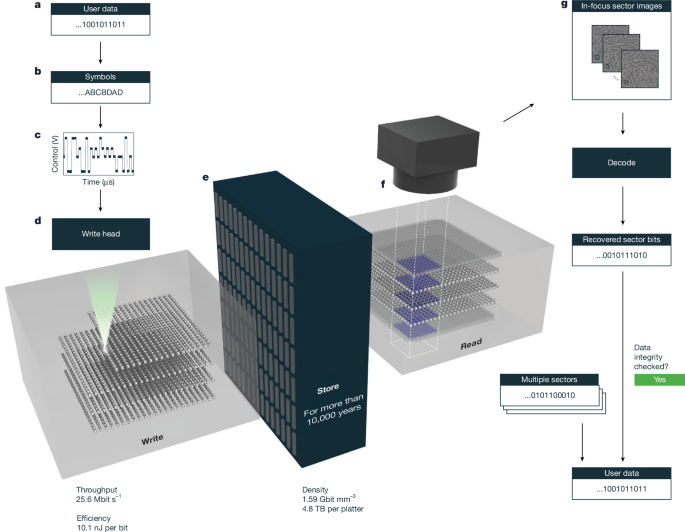
MS demostrates Laser writing in glass for dense, fast, efficient 10k+ year archival data storage

Long-term preservation of digital information is vital for safeguarding the knowledge of humanity for future generations. Existing archival storage solutions, such as magnetic tapes and hard disk drives, suffer from limited media lifespans that render them unsuitable for long-term data retention1,2,3. Optical storage approaches, particularly laser writing in robust media such as glass, have emerged as promising alternatives with the potential for increased longevity. Previous work4,5,6,7,8,9,10,11,12,13,14,15,16 has predominantly optimized individual aspects such as data density but has not demonstrated an end-to-end system, including writing, storing and retrieving information. Here we report an optical archival storage technology based on femtosecond laser direct writing in glass that addresses the practical demands of archival storage, which we call Silica. We achieve a data density of 1.59 Gbit mm−3 in 301 layers for a capacity of 4.8 TB in a 120 mm square, 2 mm thick piece of glass. The demonstrated write regimes enable a write throughput of 25.6 Mbit s−1 per beam, limited by the laser repetition rate, with an energy efficiency of 10.1 nJ per bit. Moreover, we extend the storage ability to borosilicate glass, offering a lower-cost medium and reduced writing and reading complexity. Accelerated ageing tests on written voxels in borosilicate suggest data lifetimes exceeding 10,000 years.

[…]

Source: Laser writing in glass for dense, fast and efficient archival data storage | Nature

Copilot summarises emails it has been specifically told not to read

Microsoft has some sort of apology (at the bottom) saying that copilot permissions did not extend beyond the user permissions, but that merrily skips along the fact that copilot permissions are not equal to user permissions: this is a governance issue: data ingested by copilot is used as training data. MS cannot guarantee that this will not be moved to a US server, where the data can be (and is!) read by the US government and given to competitors.

Microsoft 365 Copilot Chat has been summarizing emails labeled “confidential” even when data loss prevention policies were configured to prevent it.

Though there are data sensitivity labels and data loss prevention policies in place for email, Copilot has been ignoring those and talking about secret stuff in the Copilot Chat tab. It’s just this sort of scenario that has led 72 percent of S&P 500 companies to cite AI as a material risk in regulatory filings.

Redmond, earlier this month, acknowledged the problem in a notice to Office admins that’s tracked as CW1226324, as reposted by the UK’s National Health Service support portal. Customers are said to have reported the problem on January 21, 2026.

“Users’ email messages with a confidential label applied are being incorrectly processed by Microsoft 365 Copilot chat,” the notice says. “The Microsoft 365 Copilot ‘work tab’ Chat is summarizing email messages even though these email messages have a sensitivity label applied and a DLP policy is configured.”

Microsoft explains that sensitivity labels can be applied manually or automatically to files as a way to comply with organizational information security policies. These labels may function differently in different applications, the company says.

The software giant’s documentation makes clear that these labels do not function in a consistent way.

“Although content with the configured sensitivity label will be excluded from Microsoft 365 Copilot in the named Office apps, the content remains available to Microsoft 365 Copilot for other scenarios,” the documentation explains. “For example, in Teams, and in Microsoft 365 Copilot Chat.”

DLP, implemented through applications like Microsoft Purview, is supposed to provide policy support to prevent data loss.

“DLP monitors and protects against oversharing in enterprise apps and on devices,” Microsoft explains. “It targets Microsoft 365 locations, like Exchange and SharePoint, and locations you add, like on-premises file shares, endpoint devices, and non-Microsoft cloud apps.”

In theory, DLP policies should be able to affect Microsoft 365 Copilot and Copilot Chat. But that hasn’t been happening in this instance.

The root cause is said to be “a code issue [that] is allowing items in the sent items and draft folders to be picked up by Copilot even though confidential labels are set in place.”

In a statement provided to The Register after this story was filed, a Microsoft spokesperson said, “We identified and addressed an issue where Microsoft 365 Copilot Chat could return content from emails labeled confidential authored by a user and stored within their Draft and Sent Items in Outlook desktop. This did not provide anyone access to information they weren’t already authorized to see. While our access controls and data protection policies remained intact, this behavior did not meet our intended Copilot experience, which is designed to exclude protected content from Copilot access. A configuration update has been deployed worldwide for enterprise customers.” ®

Source: Copilot Chat bug bypasses DLP on ‘Confidential’ email • The Register

Survey of over 12,000 EU firms shows AI adoption increases labour productivity levels by 4% on average, with no evidence of reduced employment in the short run for medium + large firms

Artificial intelligence promises to reshape economies worldwide, but firm-level evidence on its effects in Europe remains scarce. This column uses survey data to examine how AI adoption affects productivity and employment across more than 12,000 European firms. The authors find that AI adoption increases labour productivity levels by 4% on average in the EU, with no evidence of reduced employment in the short run. The productivity benefits, however, are unevenly distributed. Medium and large firms, as well as firms that have the capacity to integrate AI through investments in intangible assets and human capital, experience substantially stronger productivity gains.

[…]

we find that on average, AI adoption levels are similar in the EU and the US. Notably, important heterogeneity emerges beneath the surface. Financially developed EU countries – such as Sweden and the Netherlands – match US adoption rates, with around 36% of firms using big data analytics and AI in 2024. In contrast, firms in less financially developed EU economies, such as Romania and Bulgaria, lag substantially behind, with adoption rates around 28% in 2024. Figure 1 illustrates this divide, showing how the gap has persisted and even widened in recent years.

Adoption also varies dramatically by firm size. Among large firms (more than 250 employees), 45% have deployed AI, compared with only 24% of small firms (10 to 49 employees). This echoes classic patterns in technology diffusion (Comin and Hobijn 2010): larger firms possess the resources, technical expertise, and economies of scale needed to absorb integration costs. AI-adopting firms are also systematically different – they invest more, are more innovative, and face tighter constraints in finding skilled workers. These patterns suggest that simply observing which firms adopt AI and comparing their performance could yield misleading results, as adoption itself is endogenous to firm characteristics.

Isolating AI’s causal effect

To credibly identify the causal effect of AI on productivity, we develop a novel instrumental variable strategy, inspired by Rajan and Zingales’ (1998) seminal work on financial dependence and growth. Their key insight was that industry characteristics measured in one economy – where they are arguably less affected by local distortions – can serve as an exogenous source of variation when applied to other countries.

We extend this logic to the firm level. For each EU firm in our sample, we identify comparable US firms – matched on sector, size, investment intensity, innovation activity, financing structure and management practices. We then assign the AI adoption rate of these matched US firms as a proxy for the EU firm’s exogenous exposure to AI. Because US firms operate under different institutional, regulatory and policy environments, their adoption patterns capture technological drivers that are plausibly independent of EU-specific factors. Rigorous propensity-score balancing tests confirm that our matched US and EU firms are virtually identical across key observable characteristics, validating the identification strategy. Our analysis draws on survey data from EIBIS combined with balance sheet data from Moody’s Orbis.

Productivity gains without job losses

Our results reveal three key findings. First, AI adoption causally increases labour productivity levels by 4% on average in the EU. This effect is statistically robust and economically meaningful

[…]

Second, and crucially, we find no evidence that AI reduces employment in the short run. While naïve comparisons suggest AI-adopting firms employ more workers, this relationship disappears once we account for selection effects through our instrumental variable approach. The absence of negative employment effects, combined with significant productivity gains, points to a specific mechanism: capital deepening. AI augments worker output – enabling employees to complete tasks faster and make better decisions – without displacing labour

[…]

Third, AI’s productivity benefits are far from evenly distributed. Breaking down our results by firm size reveals that medium and large companies experience substantially stronger productivity gains than their smaller counterparts (see Figure 2). This differential effect reflects the role of scale in absorbing AI integration costs and accessing complementary assets – data infrastructure, technical talent, and organisational capacity to redesign workflows. The finding raises concerns about widening productivity gaps between firms and regions, particularly given Europe’s industrial structure, which is dominated by small and medium-sized enterprises.

[…]

Source: How AI is affecting productivity and jobs in Europe | CEPR

Leaked Email Suggests Ring Plans To Expand ‘Search Party’ Surveillance Beyond Dogs, surprising? Not really.

Ring’s AI-powered “Search Party” feature, which links neighborhood cameras into a networked surveillance system to find lost dogs, was never intended to stop at pets, according to an internal email from founder Jamie Siminoff obtained by 404 Media.

Siminoff told employees in early October, shortly after the feature launched, that Search Party was introduced “first for finding dogs” and that the technology would eventually help “zero out crime in neighborhoods.” The on-by-default feature faced intense backlash after Ring promoted it during a Super Bowl ad. Ring has since also rolled out “Familiar Faces,” a facial recognition tool that identifies friends and family on a user’s camera, and “Fire Watch,” an AI-based fire alert system.

A Ring spokesperson told the publication Search Party does not process human biometrics or track people.

Source: Leaked Email Suggests Ring Plans To Expand ‘Search Party’ Surveillance Beyond Dogs | Slashdot

A few weeks of X’s algorithm can make you more right-wing—and it doesn’t wear off quickly

A new study published in Nature has found that X’s algorithm—the hidden system or “recipe” that governs which posts appear in your feed and in which order—shifts users’ political opinions in a more conservative direction.

Led by Germain Gauthier from Bocconi University in Italy, it is a rare, real-world randomized experimental study on a major social media platform. And it builds on a growing body of research that shows how these platforms can shape people’s political attitudes.

Two different algorithms

The researchers randomly assigned 4,965 active US-based X users to one of two groups.

The first group used X’s default “For You” feed. This features an algorithm that selects and ranks posts it thinks users will be more likely to engage with, including posts from accounts that they don’t necessarily follow.

The second group used a chronological feed. This only shows posts from accounts users follow, displayed in the order they were posted. The experiment ran for seven weeks during 2023.

Users who switched from the chronological feed to the “For You” feed were 4.7 percentage points more likely to prioritize policy issues favored by US Republicans (for example, crime, inflation and immigration). They were also more likely to view the criminal investigation into US President Donald Trump as unacceptable.

They also shifted in a more pro-Russia direction in regards to the war in Ukraine. For example, these users became 7.4 percentage points less likely to view Ukrainian President Volodymyr Zelenskyy positively, and scored slightly higher on a pro-Russian attitude index overall.

The researchers also examined how the algorithm produced these effects.

They found evidence that the algorithm increased the share of right-leaning content by 2.9 percentage points overall (and 2.5 points among political posts), compared with the chronological feed.

It also significantly demoted the share of posts from traditional news organizations‘ accounts while promoting or boosting posts from political activists.

One of the most concerning findings of the study is the longer-term effects of X’s algorithmic feed. The study showed the algorithm nudged users towards following more right-leaning accounts, and that the new following patterns endured even after switching back to the chronological feed.

In other words, turning the algorithm off didn’t simply “reset” what people see. It had a longer-lasting impact beyond its day-to-day effects.

One piece of a much bigger picture

This new study supports findings of similar studies.

For example, a study in 2022, before Elon Musk had bought Twitter and rebranded it as X, found the platform’s algorithmic systems amplified content from the mainstream political right more than the left in six out of the seven countries.

An experimental study from 2025 re-ranked X feeds to reduce exposure to content that expresses antidemocratic attitudes and partisan animosity. They found this shifted feelings towards their political opponents by more than two points on a 0–100 “feeling thermometer.” This is a shift the authors argued would have normally taken about three years to occur organically in the general population.

My own research offers another piece of evidence to this picture of algorithmic bias on X. Along with my colleague Mark Andrejevic, I analyzed engagement data (such as likes and reposts) from prominent political accounts during the final stages of the 2024 US election.

Our findings unearthed a sudden and unusual spike in engagement with Musk’s account after his endorsement of Trump on July 13—the day of the assassination attempt on Trump. Views on Musk’s posts surged by 138%, retweets by 238%, and likes by 186%. This far outstripped increases on other accounts.

After July 13, right-leaning accounts on X gained significantly greater visibility than progressive ones. The “playing field” for attention and engagement on the platform was tilted thereafter towards right-leaning accounts—a trend that continued for the remainder of the time period we analyzed in that study.

[…]

Publication details

Germain Gauthier et al, The political effects of X’s feed algorithm, Nature (2026). DOI: 10.1038/s41586-026-10098-2

Journal information: Nature

Provided by The Conversation

Source: A few weeks of X’s algorithm can make you more right-wing—and it doesn’t wear off quickly