About Robin Edgar

Organisational Structures | Technology and Science | Military, IT and Lifestyle consultancy | Social, Broadcast & Cross Media | Flying aircraft

We beat Chat Control but the fight isn’t over – another surveillance law that mandates companies to save user data for Europol is making its way right now and there is less than 24 hours to give the EU feedback!

Please follow this link to the questionnaire and help save our future – otherwise total surveillance like never seen before will strip you of every privacy and later fundamental rights you have as a EU citizen

++++++++++++++++++++++++++++

Information

The previous data retention law was declared illegal in 2014 by CJEU (EU’s highest court) for being mass surveillance and violating human rights.

Since most EU states refused to follow the court order and the EU commission refused to enforce it, CJEU recently caved in to political pressure and changed their stance on mass surveillance, making it legal.

And that instantly spawned this data retention law that is more far fetching than the original, that was deemed illegal. Here you can read the entire plan that EU is following. Briefly:

they want to sanction unlicensed messaging apps, hosting services and websites that don’t spy on users (and impose criminal penalties)

mandatory data retention, all your online activity must be tied to your identity

end of privacy friendly VPN’s and other services

cooperate with hardware manufacturers to ensure lawful access by design (backdoors for phones and computers)

prison for everybody who doesn’t comply

If you don’t know what the best options for some questions are, privacy wise, check out this answering guide by Edri(european digital rights organization)

Source: https://www.reddit.com/r/BuyFromEU/comments/1neecov/we_beat_chat_control_but_the_fight_isnt_over/

Don’t forget the politicians when you look at who fucked up tech

The epigram for my forthcoming book, Enshittification: Why Everything Suddenly Got Worse and What To Do About It is a quote from Ed Zitron: “I hate them for what they’ve done to the computer” (Ed even recorded a little cameo of this for the audiobook):

https://www.kickstarter.com/projects/doctorow/enshittification-the-drm-free-audiobook/

Ed’s a smart and passionate guy, and this was definitely the quote to sum up the rage I felt as I wrote the book. Ed’s got a whole theory of who “they” are and “what they did to the computer,” which he calls “the Rot Economy”:

https://www.wheresyoured.at/the-rot-economy/

The Rot Economy describes the ideology of bosses, starting with monsters like GE’s Jack Welch, who financialized companies, optimizing them for making short term cash gains for investors, at the expense of their workers, their customers, their products and services, and, ultimately, their long-term health.

For Ed, these bosses (especially tech bosses) are the sociopaths who destroyed “the computer” (a stand-in for tech more generally). I don’t disagree at all. The there is a direct, undeniable line from the ideas and conduct of tech bosses and the tech hellscape we live in today. A good read on this subject is Anil Dash’s scorching post from yesterday, “How Tim Cook sold out Steve Jobs”:

https://www.anildash.com/2025/09/09/how-tim-cook-sold-out-steve-jobs/

I find the Rot Economy hypothesis entirely compelling, but also, incomplete. Ed’s explaining why we should hate the players and why we should hate the game, but the enshittification thesis goes even further and explains why we need to hate the umpires – the policymakers, enforcers, economists and legal theorists who created the enshittogenic environment in which the Rot Economy took hold.

Some early reviews of Enshittification have expressed dissatisfaction with book’s “solutions” section, complaining that all the solutions are policy oriented, and there’s nothing suggested for us to do in our capacity as individual consumers:

https://pluralistic.net/2025/07/31/unsatisfying-answers/#systemic-problems

Those criticisms are correct: there is nothing we can do as individual consumers. Agonizing about your consumption choices will not fight enshittification any more than conscientiously sorting your recycling will end the climate emergency. Enshittification isn’t caused by “lazy consumers” who choose “convenience” or are “too cheap to pay for online services”:

https://pluralistic.net/2024/04/12/give-me-convenience/#or-give-me-death

The wellspring of enshittification isn’t poor consumption choices, it’s poor policy choices. The reason monsters are able to destroy our online lives isn’t their personal moral failings, it’s the system that rewards predatory, deceptive and unfair commercial practices and elevates their foremost practitioners to positions of power within firms:

https://pluralistic.net/2023/07/28/microincentives-and-enshittification/

And here’s the kicker: we know where those policy choices came from! The people who made these policy choices did so in living memory. They were warned at the time about the foreseeable consequences of their choices. They made those choices anyway. They faced zero consequences for doing so, even after every one of the prophesied horrors came to pass. Not only were they spared consequences for their actions, but they prospered as a result – they are revered as statesmen, lawyers, scholars and titans of economics.

As Trashfuture showrunner Riley Quinn often says, the curse of being a leftist is that you have object permanence – you actually remember the stuff that happened and how it happened. You don’t live in an eternal now that has no causal relationship to the past.

It’s not enough to hate the player, nor the game – we’ve got to remember the crooked umps who rigged the match. We have to say their names, because that’s how we root out their terrible ideas and ensure that our policy interventions make real change. If Elon Musk OD’ed on ketamine tomorrow, there’d be ten Big Balls who’d tear each others’ throats out in the ensuing succession fight, and the next guy would be just as stupid, racist, and authoritarian. Musk, Cook, Zuck, Pichai, Nadella, Larry Ellison – they’re just filling the monster-shaped holes that policy-makers installed in our society.

Start with Robert Bork, the jurist who championed the “consumer welfare” theory of antitrust, which promotes monopolies as efficient and counsels policymakers not to punish companies that take over markets, because the only way to really dominate a market is to be so good that everyone chooses your products and services. Wouldn’t it just be perverse to use public funds to shut down the public’s favorite companies? Bork was a virulent racist, a Nixonite criminal, and he was dead wrong about the law and the economics of monopoly:

https://pluralistic.net/2022/02/20/we-should-not-endure-a-king/

Bork’s legacy of pro-monopoly advocacy is, unsurprisingly, monopolies. Monopolies that make everything more expensive and worse: from athletic shoes to microchips, glass bottles to pharmaceuticals, pro wrestling to eyeglasses:

https://www.openmarketsinstitute.org/learn/monopoly-by-the-numbers

These monopolies did not arise because of the iron laws of economics. They are not the product of the great forces of history. They are the direct and undeniable consequence of Robert Bork convincing the world’s governments to embrace his bullshit, pro-monopoly policies.

Satan took Bork to hell in 2012, but you know who’s still with us? Bruce Lehman. Bruce Lehman was Bill Clinton’s copyright czar, the man who, in his own words, “did an end-run around Congress” by getting an UN treaty passed that obliged its signatories to ban reverse engineering:

https://www.cbc.ca/listen/cbc-podcasts/1353-the-naked-emperor/episode/16145640-ctrl-ctrl-ctrl

Lehman’s used the treaty to get Congress to pass the Digital Millennium Copyright Act (DMCA) and section 1201 of the DMCA made it a felony to break DRM. Bruce Lehman is why farmers can’t fix their own tractors, hospitals can’t fix their own ventilators, and your mechanic can’t fix your car. He’s why, when the manufacturer of your artificial eyes bricks a computer that is permanently wired to your nervous system, no one else can revive it:

https://pluralistic.net/2022/12/12/unsafe-at-any-speed/

Bruce Lehman is why you can’t use the apps of your choosing on your phone or games console. He’s why we can’t preserve beloved old video games. He’s why Apple and Google get to steal 30 cents out of every dollar you send to a performer, software author, or creator through an app:

https://pluralistic.net/2025/05/01/its-not-the-crime/#its-the-coverup

Yeah, Tim Cook is a venal billionaire who owes his wealth to the Chinese sweatshops of iPhone City, where they had to install suicide nets to catch the workers who’d rather end it all than work another day for Tim Apple, but Tim Cook’s power over those workers is owed to Bruce Lehman and Robert Bork.

Then there’s the ISP sector, whose Net Neutrality violations and underinvestment mean that people who live in the country where the internet was invented have some of the slowest, most expensive internet in the world. Big ISP bosses are some of the worst people on Earth. Take Thomas Rutledge, who CEO of Charter/Spectrum when covid broke out. At the time, Rutledge was America’s highest-paid CEO. He dictated that his back-office staff could not work from home (imagine a telco boss who doesn’t believe in telework!), and those back-offices all turned into super-spreader sites. Rutledge’s field workers – the people who came to our homes and upgraded our internet so we could work from home – did not get PPE or danger pay. Instead, they got vouchers exclusively redeemable at restaurants that had shut down during the pandemic:

https://pluralistic.net/2020/04/22/filternet/#thomas-rutledge-murderer

Fuck Thomas Rutledge and may his name be a curse forever. But the reason Thomas Rutledge – and all the other terrible telco bosses – were able to reap millions by supplying us with dogshit internet while literally murdering their employees was that Trump’s FCC chairman, an ex-Verizon lawyer named Ajit Pai, let them get away with it:

https://pluralistic.net/2021/02/12/ajit-pai/#pai

Ajit Pai engaged in some of the most flagrant cheating ever seen in American regulation (prior to Jan 20, 2025, at least). When he decided to kill Net Neutrality, he accepted obviously fraudulent comments into the official record, including one million identical comments from @pornhub.com email addresses, as well as millions of comments whose return addresses were taken from darknet data-dumps, including the email addresses of dead people and of sitting US senators who supported Net Neutrality:

https://pluralistic.net/2023/11/10/digital-redlining/#stop-confusing-the-issue-with-relevant-facts

Pai – and his co-conspirators – are the umps who rigged the game. Hate Thomas Rutledge to be sure, but to prevent people like Rutledge from gaining power over your digital life in future, you must remember Ajit Pai with the special form of white-hot rage that keeps people like him from ever making policy decisions again.

Then there’s Canada’s hall of shame, which is full of monsters. Two of my least favorite are James Moore and Tony Clement, who, as ministers under Stephen Harper, rammed through a Canadian version of the DMCA, 2012’s Bill C-11, despite their own consultation, which found that Canadians overwhelmingly rejected the idea:

https://pluralistic.net/2024/11/15/radical-extremists/#sex-pest

Clement (now a disgraced sex-pest) and Moore (still accepted into polite society as a corporate lawyer) are the reason that Canada’s Right to Repair and interop laws are dead on arrival. They’re also why Canada can’t retaliate against Trump’s tariffs by jailbreaking US products, making everything cheaper for Canadians and birthing new, global Canadian tech businesses:

https://pluralistic.net/2025/01/15/beauty-eh/#its-the-only-war-the-yankees-lost-except-for-vietnam-and-also-the-alamo-and-the-bay-of-ham

In Europe, there’s Axel Voss, the man behind 2019’s “filternet” proposal, which requires tech platforms to spend hundreds of millions of euros for copyright filters that use AI to process everything posted to the public internet in Europe and block anything the AI thinks is “copyrighted”:

https://memex.craphound.com/2019/03/26/article-13-will-wreck-the-internet-because-swedish-meps-accidentally-pushed-the-wrong-voting-button/

For years, Voss maintained that none of this was true, that there would be no filters, and dismissed his critics as hysterical fools:

https://memex.craphound.com/2019/04/03/after-months-of-insisting-that-article13-doesnt-require-filters-top-eu-commissioner-says-article-13-requires-filters/

But then, after his law passed, he admitted he “didn’t know what he was voting for”:

https://memex.craphound.com/2018/09/14/father-of-the-catastrophic-copyright-directive-reveals-he-didnt-know-what-he-was-voting-for/

Fuck the media lobbyists who spent hundreds of millions of euros to push this catastrophic law through:

https://memex.craphound.com/2018/12/13/clash-of-the-corporate-titans-whos-spending-what-in-europes-copyright-directive-battle/

But especially and forever, fuck Axel Voss, the policymaker who helped turn those corporate bribes into policy.

Ed Zitron is right to hate the people who implement the Rot Economy for what they did to the computer. But those people are only doing what policymakers let them do. Corporate monsters thrive in an enshittogenic environment.

But political monsters are the ones create that enshittogenic environment. They’re the ones who are terraforming our planet to sideline human life and replace it with the immortal colony organisms we call “limited liability corporations.”

Source: Pluralistic: Hate the player AND the game (10 Sep 2025) – Pluralistic: Daily links from Cory Doctorow

My blue is your blue: different people’s brains process colours in the same way

Is the colour you see the same as what I see? It’s a question that has puzzled both philosophers and neuroscientists for decades, but has proved notoriously difficult to answer.

Now, a study that recorded the brain activity of 15 participants suggests that colours are represented and processed in the same way across different people. The findings were published in the Journal of Neuroscience on 8 September1.

“Now we know that when you see red or green or whatever colour, that it activates your brain very similarly to my brain,” says study co-author Andreas Bartels, a cognitive neuroscientist at the University of Tübingen in Germany. “Even at a very low level, things are represented similarly across different brains, and that is a fundamentally new discovery.”

[…]

The pair used functional magnetic resonance imaging (fMRI) to compare activity in the brains of a group of people while they viewed different colours.

Source: My blue is your blue: different people’s brains process colours in the same way

They could then predict what colour people were seeing based on the scans.

Launch Your Name Around Moon in 2026 on NASA’s Artemis II Mission

NASA is inviting the public to join the agency’s Artemis II test flight as four astronauts venture around the Moon and back to test systems and hardware needed for deep space exploration. As part of the agency’s “Send Your Name with Artemis II” effort, anyone can claim their spot by signing up before Jan. 21.

Participants will launch their name aboard the Orion spacecraft and SLS (Space Launch System) rocket alongside NASA astronauts Reid Wiseman, Victor Glover, Christina Koch, and CSA (Canadian Space Agency) astronaut Jeremy Hansen.

“Artemis II is a key test flight in our effort to return humans to the Moon’s surface and build toward future missions to Mars, and it’s also an opportunity to inspire people across the globe and to give them an opportunity to follow along as we lead the way in human exploration deeper into space,” said Lori Glaze, acting associate administrator, Exploration Systems Development Mission Directorate at NASA Headquarters in Washington.

The collected names will be put on an SD card loaded aboard Orion before launch. In return, participants can download a boarding pass with their name on it as a collectable.

To add your name and receive an English-language boarding pass, visit: 

https://go.nasa.gov/artemisnames
 

To add your name and receive a Spanish-language boarding pass, visit:

https://go.nasa.gov/TuNombreArtemis

 
As part of a Golden Age of innovation and exploration, the approximately 10-day Artemis II test flight, launching no later than April 2026, is the first crewed flight under NASA’s Artemis campaign. It is another step toward new U.S.-crewed missions on the Moon’s surface that will help the agency prepare to send the first astronauts – Americans – to Mars.

To learn more about the mission visit:

https://www.nasa.gov/mission/artemis-ii/

Source: Launch Your Name Around Moon in 2026 on NASA’s Artemis II Mission  – NASA

Plex tells users to reset passwords after new data breach. Again.

Popular media streaming platform Plex has informed its users of yet another data breach, urging them to change their passwords as soon as possible. 

Criminals often target media streaming platforms because they deal with sensitive information. Plex has fallen victim to a similar intrusion in the past, and a couple of years ago went through a very similar situation.

Now, Plex has revealed that an unauthorized third party gained access to one of its databases, exposing information on a limited number of customers.

The compromised data may include email addresses, usernames, securely hashed passwords, and authentication information. The company underlines that no credit card information has been affected because that type of information is not stored on those kinds of servers.

It’s a relief that the passwords are hashed because it means they are not readable, but it’s still a good idea to change the Plex passwords as quickly as possible.

Containment and response


According to Plex, the breach was contained quickly, and the method the attacker used was identified and addressed.

“We sincerely apologize for any inconvenience this situation may cause you. We take pride in our security systems, which helped us quickly detect this incident, and we want to assure you that we are working swiftly to prevent potential future incidents from occurring,” said the company.

Plex has outlined two actions users must take, depending on their sign-in methods:

Password-based login: Users have to reset their Plex account password immediately via ‘https://plex.tv/reset’. The company recommends checking the option to “Sign out connected devices after password change,” which will log out all devices and require reauthentication with the new password.

SSO login: Users should log out of all active sessions through ‘https://plex.tv/security’ and sign back in as normal.

Plex is also strongly encouraging users to enable two-factor authentication (2FA) for added protection if they haven’t already done so.

Source: Plex tells users to reset passwords after new data breach

Maker of remote working software Teams orders employees back to office

Microsoft is rolling out a new return-to-office policy that will see first Redmond, then US, and then global staff getting back on-prem at least three days a week.

“How we work has forever changed,” Microsoft’s Chief People Officer Amy Coleman told staff in a blog post. And that change will start in Redmond by the end of February. If you work within a 50-mile radius of the office, Microsoft has already emailed you if it expects your attendance, she said.

The changes will spread across the rest of America and then internationally on an unspecified timescale. We’ve asked for clarification and will update this article if it comes in.

Coleman’s note looked to get ahead of possible criticisms that mandatory RTO policies serve as a backdoor way to reduce headcount, as employees who’d moved far away from offices to take advantage of companies’ remote work policies may find it difficult or unpalatable to uproot again.

“Importantly, this update is not about reducing headcount,” she wrote. “It’s about working together in a way that enables us to meet our customers’ needs.”

[…]

Source: Microsoft employees ordered back to office • The Register

So… Microsoft Teams doesn’t work very well? Or is it just American Micromanagement at its best?

Judge rejects Anthropic’s record-breaking $1.5 billion settlement for AI book piracy lawsuit because it looks like a publisher and lawyer grab

Judge William Alsup has rejected the record-breaking $1.5 billion settlement Anthropic has agreed to for a piracy lawsuit filed by writers. According to Bloomberg Law, the federal judge is concerned that the class lawyers struck a deal that will be forced “down the throat of authors.” Alsup reportedly felt misled by the deal and said it was “nowhere close to complete.” In his order, he said he was “disappointed that counsel have left important questions to be answered in the future,” including the list of works involved in the case, the list of authors, the process of notifying members of the class and the claim form class members can use to get their part of the settlement.

If you’ll recall, the plaintiffs sued Anthropic over the company’s use of pirated copies of their works to train its large language models. Around 500,000 authors are involved in the lawsuit, and they’re expected to receive $3,000 per work. “This landmark settlement far surpasses any other known copyright recovery,” one of the lawyers representing the authors said in a statement. However, Alsup had an “uneasy feeling about hangers on with all [that] money on the table.” He explained that class members “get the shaft” in a lot of class actions once the monetary settlement has been established and lawyers stopped caring.

Alsup told the lawyers that they must give the class members “very good notice” about the settlement and design a claim form that gives them the choice to opt in or out. They also have to ensure that Anthropic cannot be sued for the same issue in the future. The judge gave the lawyers until September 15 to submit a final list of works involved in the lawsuit. He also wrote in his order that the works list, class members list and the claim form all have to be examined and approved by the court by October 10 before he grants the settlement his preliminary approval.

Source: Judge rejects Anthropic’s record-breaking $1.5 billion settlement for AI copyright lawsuit

Of course this was only a small part of the actual lawsuit, which sought to establish that copyright precluded AIs from reading books without permission. This was struck down by the judge. The idiocy of Anthropic in using pirated books to train their AI beggars belief, but that is what they were punished for.

The reason the copyright lawsuit was put up was so that the copyright holders (the publishers, not the actual writers of the books – although that is what these publishers are telling you) could win megabucks. Now that the settlement has gone for piracy, the publishers and lawyers still want the megabucks, without sharing it with the actual writers. The judge says no.

Scientists figure out why the flu is deadly for older patients

Scientists have discovered why older people are more likely to suffer severely from the flu, and can now use their findings to address this risk.

In a new study, which is published in PNAS, experts discovered that older people produce a glycosylated protein called apoplipoprotein D (ApoD), which is involved in lipid metabolism and inflammation, at much higher levels than in younger people. This has the effect of reducing the patient’s ability to resist virus infection, resulting in a more serious disease outcome.

The team established that highly elevated ApoD production with age in the lung drives extensive tissue damage during infection to reduce the protective antiviral type I interferon response.

[…]

They identified ApoD as an age-related cell factor that impairs the activation of the immune system’s antiviral response to influenza virus infection by causing extensive breakdown of mitochondria (mitophagy) resulting in greater production of virus and lung damage during infection. Mitochondria are essential for cellular production of energy and for induction of protective interferons.

ApoD is therefore a target for therapeutic intervention to protect against severe influenza virus infection in the elderly which would have a major impact on reducing morbidity and mortality in the aging population.

[…]

Source: Why the flu turns deadly for older adults, and how scientists found the cause | ScienceDaily

Microsoft software reselling dispute heads back to UK court

Microsoft’s tussle with UK-based reseller ValueLicensing over the sale of secondhand licenses returns to the UK’s Competition Appeal Tribunal this week, with the Windows behemoth now claiming that selling pre-owned Office and Windows software is unlawful.

ValueLicensing’s representatives say this week’s trial – due to start tomorrow – will “address whether the entire pre-owned license market was lawful – with Microsoft arguing that it was not lawful to resell pre-owned Office and Windows software at all.”

This stems from a May 2025 agreement that the scope of copyright issues now central to Microsoft’s defense needs to be determined.

The case has the potential to blow a hole in the European reselling market. According to ValueLicensing, “if Microsoft’s argument is correct, it would mean that the entire resale market in Europe should not exist.”

The ValueLicensing case has rumbled on for years, beginning with allegations that Microsoft stifled the supply of pre-owned licenses by offering attractive subscription deals to public and private sector organizations in return for the surrender of perpetual licenses. ValueLicensing (and companies like it) operated a business model based on organizations selling their perpetual licenses and resellers selling them on to customers at a discount.

ValueLicensing alleged that Microsoft added clauses to customer contracts aimed at restricting the resale of perpetual licenses. In return for accepting those contracts, customers were given a discount.

Judging by the case so far [PDF], it appears that this practice was a policy at Microsoft.

According to ValueLicensing, Microsoft’s allegedly anti-competitive antics and attempts to eliminate the secondhand software license market have cost it £270 million in lost profits.

Microsoft’s argument [PDF] is that it owns the copyright to the non-program bits of Office – the graphical user interface, for example – to which rules around software reselling (the European Software Directive) do not apply.

ValueLicensing boss Jonathan Horley noted the timing of the copyright claim. “It’s a remarkable coincidence that their defense against ValueLicensing has changed so dramatically from being a defense of ‘we didn’t do it’ to a defense of ‘the market should never have existed,'” he said.

Microsoft’s contention is not without precedent. The Tom Kabinet judgment drew a line between the secondary market for software programs and e-books. Reselling a software program isn’t a problem, while reselling something like an e-book is. Microsoft’s argument for its software appears to be similar.

The tech giant is facing other actions before the UK’s Competition Appeal Tribunal. Alexander Wolfson has brought a similar claim against Microsoft, potentially worth billions, regarding the purchase of certain licenses for specific products. Dr Maria Luisa Stasi has brought another regarding the cost of running Microsoft software on platforms like AWS and GCP compared to Azure.

Source: Microsoft software reselling dispute heads back to UK court • The Register

So if Microsoft wins, it means you don’t actually own a copy of the software you paid for.

Yes, Google Meet Is Down

If you’re trying to use Google Meet and failing, it’s not your fault. Google is reportedly investigating the outage, and DownDetector has seen tens of thousands or reports about Google Meet not working properly since around 1:25 p.m. ET.

“We are experiencing an issue with Google Meet beginning at Monday, 2025-09-08 10:25 PDT,” Google reported on its Workspace updates page.

“Our engineering team continues to investigate the issue. We will provide an update by Monday, 2025-09-08 11:30 PDT with current details,” the tech giant explained.

There is no reportedly workaround, at least according to the company.

[…]

Source: Yes, Google Meet Is Down

ASML invests €1.3B to become the largest shareholder in Nvidia-backed Mistral AI

Mistral AI, the Paris-based startup rapidly establishing itself as Europe’s leading AI company, has secured a €1.3 billion investment from Dutch semiconductor equipment maker ASML in its ongoing Series C funding round. This round, totalling approximately €1.7 billion, values Mistral at around €14 billion, with ASML emerging as the largest shareholder in the company.

With Google and Amazon funnelling billions into their AI ventures, this move places ASML as a critical player in the global semiconductor industry. Other investors in Mistral include Nvidia, Microsoft, Andreessen Horowitz, and General Catalyst. Mistral’s revenue has surged from €10 million in 2023 to €60 million by 2025, fueled by enterprise adoption and strategic partnerships.

[…]

Source: ASML invests €1.3B to become the largest shareholder in Nvidia-backed Mistral AI — TFN

Smartphone Sensors Unlocked: Turn Your Phone Into A Physics Lab

These days, most of us have a smartphone. They are so commonplace that we rarely stop to consider how amazing they truly are. The open-source project Phyphox has provided easy access to your phone’s sensors for over a decade. We featured it years ago, and the Phyphox team continues to update this versatile application.

Phyphox is designed to use your phone as a sensor for physics experiments, offering a list of prebuilt experiments created by others that you can try yourself. But that’s not all—this app provides access to the many sensors built into your phone. Unlike many applications that access these sensors, Phyphox is open-source, with all its code available on its GitHub page.

The available sensors depend on your smartphone, but you can typically access readings from accelerometers, GPS, gyroscopes, magnetometers, barometers, microphones, cameras, and more. The app includes clever prebuilt experiments, like measuring an elevator’s speed using your phone’s barometer or determining a color’s HSV value with the camera. Beyond phone sensors, the Phyphox team has added support for Arduino BLE devices, enabling you to collect and graph telemetry from your Arduino projects in a centralized hub.

Thanks [Alfius] for sharing this versatile application that unlocks a myriad of uses for your phone’s sensors. You can use a phone for so many things. Really.


Source: Smartphone Sensors Unlocked: Turn Your Phone Into A Physics Lab | Hackaday

Russian Drones Repeatedly Crossing into NATO’s Eastern Flank. No reaction from NATO.

Repeated drone incursions into Polish airspace show that Russia and Belarus are testing NATO and EU defenses. These incidents are not isolated but part of a wider hybrid warfare strategy that combines military pressure, information operations, and electronic warfare. The challenge for the Alliance is how to respond effectively without escalating into open conflict.

In recent nights, Polish airspace has been violated twice by unmanned aerial vehicles. Small, cheap, and difficult to detect, drones are ideal tools for hybrid warfare. Moscow and Minsk use them not to strike directly but to probe reactions, overload defense systems, and accustom societies to constant pressure. Each new violation risks becoming „the new normal” on NATO’s eastern border.

These incursions are not random. They are often synchronized with Russian missile barrages against Ukraine, creating a double layer of military and psychological impact. By observing how quickly Poland and NATO allies respond, and how coherent the communication between government and armed forces is, Moscow draws conclusions about the Alliance’s readiness. If the reaction is slow or chaotic, the pressure seems to work. If NATO fighters, such as Dutch F-35s currently stationed in Poland, are deployed, the costs of escalation for Russia increase.

The technical challenge is formidable. Small, low-flying drones evade traditional radars and are too cheap to be countered with expensive missiles like Patriot or CAMM-ER. A saturation scenario—dozens of drones attacking simultaneously—could overload command systems and force difficult prioritization between protecting critical infrastructure and intercepting minor threats. This is why layered defense, from Pilica+ and Piorun to Patriot, must be complemented with cheaper effectors such as programmable ammunition for AG-35 cannons and expanded radar coverage in the east.

[…]

Source: Russian Drones Challenge NATO’s Eastern Flank

Anything that crosses over the border should be intercepted, warned via radio and then shot down. The only language Putin understands is force, as he has shown with his opportunistic invasions time and again.

Critical, make-me-super-user SAP S/4HANA bug being exploited

A critical code-injection bug in SAP S/4HANA that allows low-privileged attackers to take over your SAP system is being actively exploited, according to security researchers.

SAP issued a patch for the 9.9-rated flaw in August. It is tracked as CVE-2025-42957, and it affects both private cloud and on-premises versions.

According to SecurityBridge Threat Research Labs, which originally spotted and disclosed the vulnerability to SAP,  the team “verified actual abuse of this vulnerability.” It doesn’t appear to be widespread (yet), but the consequences of this flaw are especially severe.

“For example, SecurityBridge’s team demonstrated in a lab environment how an attacker could create a new SAP superuser account (with SAP_ALL privileges) and directly manipulate critical business data,” the researchers said in a Thursday write-up alongside a video demo of the exploit.

It’s low-complexity to exploit. The bug enables a user to inject arbitrary ABAP code into the system, thus bypassing authorization checks and essentially creating a backdoor that allows full system compromise, data theft, and operational disruption. In other words: it’s effectively game over.

[…]

Source: Critical, make-me-super-user SAP S/4HANA bug being exploited • The Register

Europe must reach for the bazooka‚ or be humiliated

Last week, Donald Trump issued a stark warning: European states that enforce EU law against American tech giants risk trade tariffs. This is not a negotiation tactic. It is an assertion of power‚ a demand that Europe surrender its legal order to foreign influence.

This is not a negotiation. It is a test.

Europe possesses a “trade bazooka” designed for this precise scenario. The Anti-Coercion Instrument is designed to respond to the kind of threats and actions that Trump now alludes to. To delay its use is to invite further encroachments. 

But the current crisis is not merely economic, nor is it confined to tariffs and subsidies. It is a confrontation over the very foundations of democratic governance: the rule of law, the capacity of nations to govern themselves without foreign interference, and the protection of our children in the digital age.   

The U.S. understands that power is not only measured in military might or economic output, but also in control over information and infrastructure and the conditions under which democracy can survive. By threatening sanctions for upholding European law, Washington is testing whether Europe will tolerate coercion in the name of the alliance.

We should now know the risk of inaction. A decade ago, the General Data Protection Regulation was enacted to put power over data back into the hands of citizens. But Ireland, as a jurisdiction of choice for multinationals, became a conduit for regulatory evasion. And the European Commission turned a blind eye.

Over the same period, our fragmented single market and the Commission’s narrow view of competition enforcement handed our digital market to foreign firms. The result is that we became dependent on foreign technology firms, most of them American, which are now accustomed to operating with impunity. They shape our public discourse and influence our elections.   

Consequently, authoritarianism has risen again in our midst. Proxies who serve foreign interests before their own are algorithmically pushed into people’s feeds by giant American and Chinese social media companies. Those same algorithms push self-harm and suicide onto our children’s feeds. And yet we hesitate. 

If we do not stand by our laws then we will not merely lose a trade dispute. We will lose the authority to govern ourselves. We will signal that democratic sovereignty can be traded for security promises that may not be kept. We will expose ourselves to unrelenting assault by algorithms directed to impose home-grown authoritarians upon our people.  

President von der Leyen committed to keeping inviolate Europe’s rules on digital media and market power in an interview in April. She must now go further and actively protect those rules. Speaking last week, Chancellor Merz said Europe will not allow itself to be pressured. Those words must be backed up by action.  

But the signs are not good. Take the Commission’s competition case against Google, in which the EU executive has not only backed down from its plan to break up Google’s ad business by instead issuing a mere fine, it has even dropped the fine for fear of offending Trump. The case concerns market violations that have been proven against Google in a U.S. court. Such timidity undermines the hope of a level playing field in the relationship with our American partners.

We are not blind to the risks of confrontation with Donald Trump. But if we do not stand by our laws and use the Anti-Coercion instrument to defend them, then we will not merely lose a trade dispute. We will lose the authority to govern ourselves.  

Source: Europe must reach for the bazooka‚ or be humiliated – Euractiv

Did Apple do an Anthropic? Faces lawsuit over alleged use of pirated books for AI training

Two authors have filed a lawsuit against Apple, accusing the company of infringing on their copyright by using their books to train its artificial intelligence model without their consent. The plaintiffs, Grady Hendrix and Jennifer Roberson, claimed that Apple used a dataset of pirated copyrighted books that include their works for AI training. They said in their complaint that Applebot, the company’s scraper, can “reach ‘shadow libraries'” made up of unlicensed copyrighted books, including (on information) their own. The lawsuit is currently seeking class action status, due to the sheer number of books and authors found in shadow libraries.

The main plaintiffs for the lawsuit are Grady Hendrix and Jennifer Roberson, both of whom have multiple books under their names. They said that Apple, one of the biggest companies in the world, did not attempt to pay them for “their contributions to [the] potentially lucrative venture.”

[…]

Anthropic, the AI company behind the Claude chatbot, recently agreed to pay $1.5 billion to settle a class action piracy complaint also brought by authors. Similar to this case, the writers also accused the company of taking pirated books from online libraries to train its AI technology. The 500,000 authors involved in the case will reportedly get $3,000 per work.

Source: Apple faces lawsuit over alleged use of pirated books for AI training

Google deletes net-zero pledge from sustainability website

Google’s CEO Sundar Pichai stood smiling in a leafy-green California garden in September 2020 and declared that the IT behemoth was entering the “most ambitious decade yet” in its climate action.

“Today, I’m proud to announce that we intend to be the first major company to operate carbon free — 24 hours a day, seven days a week, 365 days a year,” he said, in a video announcement at the time.

Pichai added that he knew the “road ahead would not be easy,” but Google “aimed to prove that a carbon-free future is both possible and achievable fast enough to prevent the most dangerous impacts of climate change.”

Five years on, just how hard Google’s “energy journey” would become is clear. In June, Google’s Sustainability website proudly boasted a headline pledge to achieve net-zero emissions by 2030. By July, that had all changed.

An investigation by Canada’s National Observer has found that Google’s net-zero pledge has quietly been scrubbed, demoted from having its own section on the site to an entry in the appendices of the company’s sustainability report.

Genna Schnurbach, an external spokesperson for Google, referring to its Environment 2025 report, told us: “As you can see from the document, Google is still committed to their ambition of net-zero by 2030.”

By tracing back through the history of Google’s Sustainability website, however, we found that the company edited it in late June, removing almost all mention of its lauded net-zero goals. (A separate website referring to data centres specifically has maintained its existing language around net-zero commitments.)

Five years ago, Google’s climate action ambitions were the gold standard for Big Tech. Then, with power demand spikes from AI data centres, in July it scrubbed its sustainability website of its 2030 net zero pledge.

The page on Operating Sustainably has been rebranded to Operations, and the section on net-zero carbon was deleted. In its place is a new priority area: Energy.

[…]

Source: Google deletes net-zero pledge from sustainability website | Canada’s National Observer: Climate News

Google hit with $3.45 billion EU antitrust fine over adtech practices where US judge also found guilt but refused to punish

Alphabet’s Google was hit with a 2.95-billion-euro ($3.45 billion) European Union antitrust fine on Friday for anti-competitive practices in its lucrative adtech business, a sharp sanction that riled up U.S. President Donald Trump.

The fine, the fourth penalty Google has faced in its decade-long fight with EU competition regulators, follows bubbling trade tensions between major global powers and U.S. threats of retaliation over EU scrutiny of American tech firms.

Trump said in a post on Truth Social that the action was “unfair” and “discriminatory” and later told reporters he will take the matter up with the EU directly.

“We cannot let this happen to brilliant and unprecedented American Ingenuity and, if it does, I will be forced to start a Section 301 proceeding to nullify the unfair penalties being charged to these Taxpaying American Companies,” Trump said.

Section 301 of the Trade Act of 1974 allows the United States to penalize foreign countries that engage in acts that are “unjustifiable” or “unreasonable,” or burden U.S. commerce.

The European Commission’s action was triggered by a complaint from the European Publishers Council. Trump, who has hit Europe with trade tariffs, has threatened to retaliate against the EU for any pushback against Big Tech.

“I will be speaking to the European Union,” Trump told reporters at the White House on Friday.

While Google plans to appeal, the Commission has warned of stronger remedies – including potential divestitures – if the company fails to address its conflicts of interest. The case underscores growing transatlantic friction over digital market regulation and the EU’s push to rein in dominant platforms.

The EU competition enforcer had originally planned to hand out the fine on Monday but opposition from EU trade chief Maros Sefcovic on concerns about the impact on U.S. tariffs on European cars derailed EU antitrust chief Teresa Ribera’s plan.

The Commission said Google favoured its own online display technology services that reinforced its own ad exchange AdX’s central role in the adtech supply chain and allowed Google to charge high fees for its service, to the detriment of rivals and online publishers.

Google has abused its market power since 2014 until today, the EU watchdog said.

It ordered Google to stop the self-preferencing practices and take measures to cease its inherent conflicts of interest. The company has 60 days to inform the Commission how it plans to comply with this order, and another 30 days to do so.

The Commission reiterated its preliminary view that Google should divest part of its services but said it wants to first hear and assess Google’s compliance efforts, confirming a Reuters story last year.

[…]

Source: Google hit with $3.45 billion EU antitrust fine over adtech practices

It is good to see that at least the EU has the guts to do something about these monopolistic practices.

See also: EU Google antitrust penalty halted by low level commissioner amid Trump’s tariff threats

Judge who ruled Google is a monopoly says no need for punishment.

The worst possible antitrust outcome – unless you are Google

Scientists tap fresh water under the sea, raising hopes for a thirsty world

Deep in Earth’s past, an icy landscape became a seascape as the ice melted and the oceans rose off what is now the northeastern United States. Nearly 50 years ago, a U.S. government ship searching for minerals and hydrocarbons in the area drilled into the seafloor to see what it could find.

It found, of all things, drops to drink under the briny deeps — fresh water.

This summer, a first-of-its-kind global research expedition followed up on that surprise. Drilling for fresh water under the salt water off Cape Cod, Expedition 501 extracted thousands of samples from what is now thought to be a massive, hidden aquifer stretching from New Jersey as far north as Maine.

The sun sets behind the Liftboat Robert platform, home of Expedition 501, a global research expedition drilling for fresh water, in the North Atlantic, Saturday, July 19, 2025. (AP Photo/Carolyn Kaster)

It’s just one of many depositories of “secret fresh water” known to exist in shallow salt waters around the world that might some day be tapped to slake the planet’s intensifying thirst, said Brandon Dugan, the expedition’s co-chief scientist

[…]

They’re out to solve the mystery of its origins — whether the water is from glaciers, connected groundwater systems on land or some combination.

The potential is enormous. So are the hurdles of getting the water out and puzzling over who owns it, who uses it and how to extract it without undue harm to nature.

[…]

Why try? In just five years, the U.N. says, the global demand for fresh water will exceed supplies by 40%. Rising sea levels from the warming climate are souring coastal freshwater sources while data centers that power AI and cloud computing are consuming water at an insatiable rate.

[…]

Source: Scientists tap fresh water under the sea, raising hopes for a thirsty world | AP News

Anthropic Agrees to $1.5 Billion Settlement for Downloading Pirated Books to Train AI

Anthropic has agreed to pay $1.5 billion to settle a lawsuit brought by authors and publishers over its use of millions of copyrighted books to train the models for its AI chatbot Claude, according to a legal filing posted online.

A federal judge found in June that Anthropic’s use of 7 million pirated books was protected under fair use but that holding the digital works in a “central library” violated copyright law. The judge ruled that executives at the company knew they were downloading pirated works, and a trial was scheduled for December.

The settlement, which was presented to a federal judge on Friday, still needs final approval but would pay $3,000 per book to hundreds of thousands of authors, according to the New York Times. The $1.5 billion settlement would be the largest payout in the history of U.S. copyright law, though the amount paid per work has often been higher. For example, in 2012, a woman in Minnesota paid about $9,000 per song downloaded, a figure brought down after she was initially ordered to pay over $60,000 per song.

In a statement to Gizmodo on Friday, Anthropic touted the earlier ruling from June that it was engaging in fair use by training models with millions of books.

“In June, the District Court issued a landmark ruling on AI development and copyright law, finding that Anthropic’s approach to training AI models constitutes fair use,” Aparna Sridhar, deputy general counsel at Anthropic, said in a statement by email.

[…]

Source: Anthropic Agrees to $1.5 Billion Settlement for Downloading Pirated Books to Train AI

Just to be clear: using books to train AI was fine. Pirating the books, however, was not. Completely incredible that these guys pirated the books. With mistakes of this idiocy, I would not invest in Anthropic ever, at all.

BMW kills home assistant integration access to paid ConnectedDrive API to “protect security”

So you pay hundreds yearly for access to the Connected Drive API. You use Home Assistant to set the charging times of your BMW depending on when the price of electricity is low. BMW shuts you down (no re-imbursement, of course) and forces you to use one of their Charge Point providers. BMW then says it’s because of security.

I guess things are going very badly for BMW when they are making deals like this one as well as charging you subscriptions to use stuff in your car that you already paid for.

18 popular VPNs turn out to belong to 3 different owners – and contain insecurities as well

A new peer-reviewed study alleges that 18 of the 100 most-downloaded virtual private network (VPN) apps on the Google Play Store are secretly connected in three large families, despite claiming to be independent providers. The paper doesn’t indict any of our picks for the best VPN, but the services it investigates are popular, with 700 million collective downloads on Android alone.

The study, published in the journal of the Privacy Enhancing Technologies Symposium (PETS), doesn’t just find that the VPNs in question failed to disclose behind-the-scenes relationships, but also that their shared infrastructures contain serious security flaws. Well-known services like Turbo VPN, VPN Proxy Master and X-VPN were found to be vulnerable to attacks capable of exposing a user’s browsing activity and injecting corrupted data.

Titled “Hidden Links: Analyzing Secret Families of VPN apps,” the paper was inspired by an investigation by VPN Pro, which found that several VPN companies each were selling multiple apps without identifying the connections between them. This spurred the “Hidden Links” researchers to ask whether the relationships between secretly co-owned VPNs could be documented systematically.

[…]

Family A consists of Turbo VPN, Turbo VPN Lite, VPN Monster, VPN Proxy Master, VPN Proxy Master Lite, Snap VPN, Robot VPN and SuperNet VPN. These were found to be shared between three providers — Innovative Connecting, Lemon Clove and Autumn Breeze. All three have all been linked to Qihoo 360, a firm based in mainland China and identified as a “Chinese military company” by the US Department of Defense.

Family B consists of Global VPN, XY VPN, Super Z VPN, Touch VPN, VPN ProMaster, 3X VPN, VPN Inf and Melon VPN. These eight services, which are shared between five providers, all use the same IP addresses from the same hosting company.

Family C consists of X-VPN and Fast Potato VPN. Although these two apps each come from a different provider, the researchers found that both used very similar code and included the same custom VPN protocol.

If you’re a VPN user, this study should concern you for two reasons. The first problem is that companies entrusted with your private activities and personal data are not being honest about where they’re based, who owns them or who they might be sharing your sensitive information with. Even if their apps were all perfect, this would be a severe breach of trust.

But their apps are far from perfect, which is the second problem. All 18 VPNs across all three families use the Shadowsocks protocol with a hard-coded password, which makes them susceptible to takeover from both the server side (which can be used for malware attacks) and the client side (which can be used to eavesdrop on web activity).

[…]


Source: Researchers find alarming overlaps among 18 popular VPNs

Batshit crazy UK judge rules you can’t be fired for calling your bosses dickheads

Managers and supervisors brace yourselves: calling the boss a dickhead is not necessarily a sackable offence, a tribunal has ruled.

The ruling came in the case of an office manager who was sacked on the spot when – during a row – she called her manager and another director dickheads.

Kerrie Herbert has been awarded almost £30,000 in compensation and legal costs after an employment tribunal found she had been unfairly dismissed.

The employment judge Sonia Boyes ruled that the scaffolding and brickwork company she worked for had not “acted reasonably in all the circumstances in treating [her] conduct as a sufficient reason to dismiss her”.

“She made a one-off comment to her line manager about him and a director of the business,” Boyes said. “The comment was made during a heated meeting.

“Whilst her comment was not acceptable, there is no suggestion that she had made such comments previously. Further … this one-off comment did not amount to gross misconduct or misconduct so serious to justify summary dismissal.”

The hearing in Cambridge was told Herbert started her £40,000-a-year role at the Northampton firm Main Group Services in October 2018. The business was run by Thomas Swannell and his wife, Anna.

The tribunal heard that in May 2022 the office manager had found documents in her boss’s desk about the costs of employing her, and became upset as she believed he was going to let her go.

When Swannell then raised issues about her performance, she began crying, the hearing was told.

She told the tribunal that she said: “If it was anyone else in this position they would have walked years ago due to the goings-on in the office, but it is only because of you two dickheads that I stayed.”

She said Swannell retorted: “Don’t call me a fucking dickhead or my wife. That’s it, you’re sacked. Pack your kit and fuck off.”

[…]

Boyes found that Herbert was summarily fired because of her use of the word “dickheads” and ruled that the company had failed to follow proper disciplinary procedures.

She concluded that calling her bosses dickheads was not sufficient to fire Herbert and ordered the firm to pay £15,042.81 in compensation.

In her latest judgment she also ruled it had to pay £14,087 towards her legal fees.

Source: Calling boss a dickhead was not a sackable offence, tribunal rules | Employment tribunals | The Guardian

AI Slop Is Great For Internet (Re-)Decentralisation

In this article I take a look at AI Slop and how it is effecting the current internet. I also look at what exactly the internet of today looks like – it is hugely centralised. This centralisation creates a focused trashcan for the AI generated slop. This is exactly the opportunity that curated content creators need to shine and show relevant, researched, innovative and original content on smaller, decentralised content platforms.

What is AI Slop?

As GPTs swallow more and more data, it is increasingly used to make more “AI slop”. This is “low to mid quality content – “low- to mid-quality content – video, images, audio, text or a mix – created with AI tools, often with little regard for accuracy. It’s fast, easy and inexpensive to make this content. AI slop producers typically place it on social media to exploit the economics of attention on the internet, displacing higher-quality material that could be more helpful.” (Source: What is AI slop? A technologist explains this new and largely unwelcome form of online content).

Recent examples include Facebook content, Careless speech, especially in bought up abandoned news sites, Reddit posts, Fake leaked merchandise, Inaccurate Boring History videos, alongside the more damaging fake political images – well, you get the point I think.

A lot has been written about the damaging effects of AI slop, leading to reduced attention and congnitive fatigue, feelings of emptiness and detachment, commoditised homogeneous experiences, etc.

However, there may be a light point on the horizon. Bear with me for some background, though.

Centralisation of Content

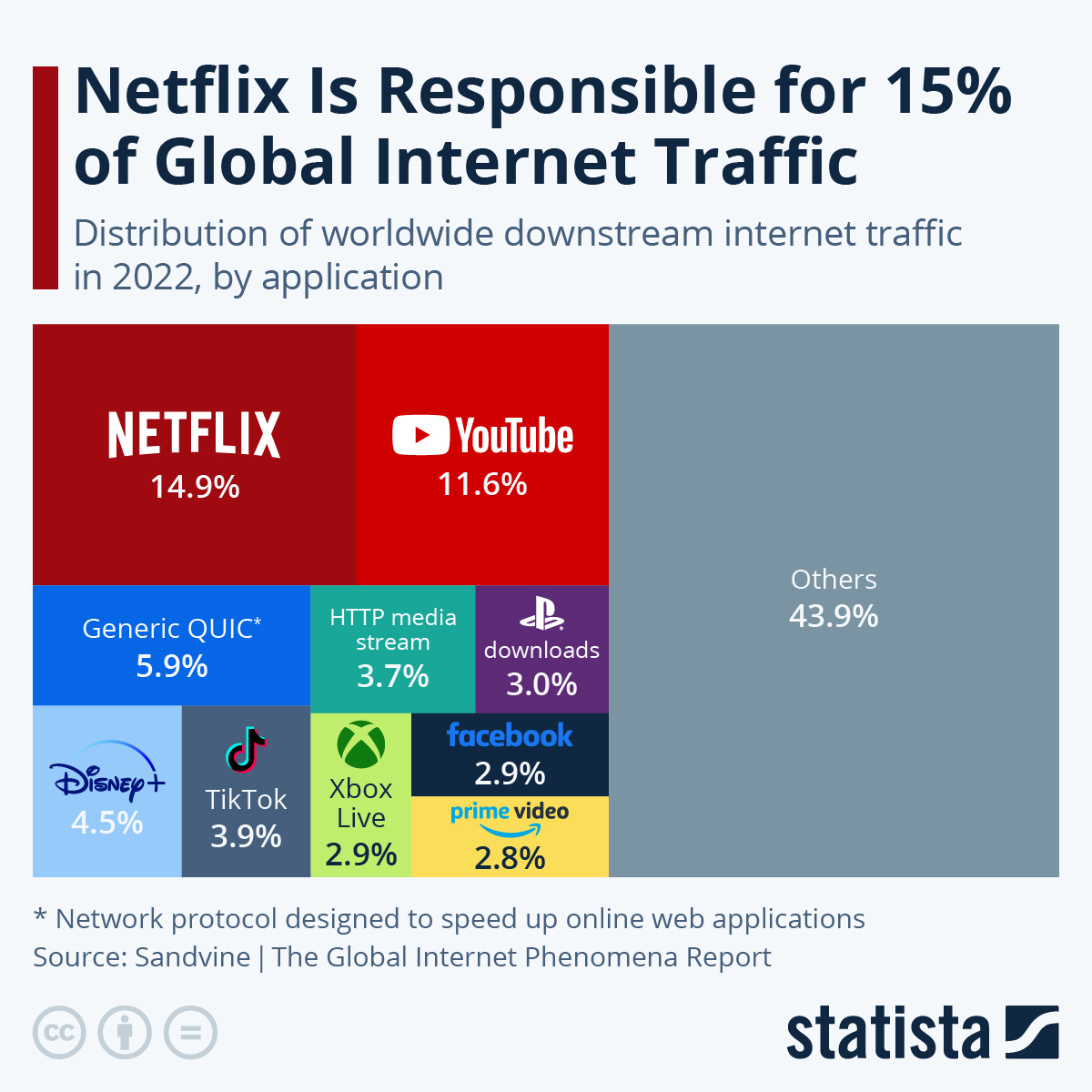
It turns out that Netflix alone is responsible for 14.9% of global internet traffic. Youtube for 11.6%.

Infographic: Netflix is Responsible for 15% of Global Internet Traffic | Statista

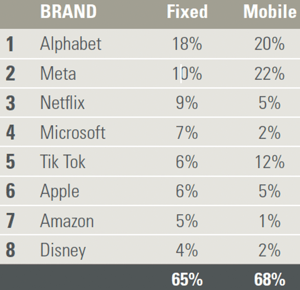
Sandvine’s 2024 Global Internet Phenomena Report shows that 65% of all fixed internet traffic and 68% of all mobile traffic is driven through eight of the internet giants

Screenshot 2024-04-10 at 16.00.37

This concentration of the internet is not something new and has been studied for some time:

A decade ago, there was a much greater variety of domains within links posted by users of Reddit, with more than 20 different domains for every 100 random links users posted. Now there are only about five different domains for every 100 links posted.

In fact, between 60-70 percent of all attention on key social media platforms is focused towards just ten popular domains.

Beyond social media platforms, we also studied linkage patterns across the web, looking at almost 20 billion links over three years. These results reinforced the “rich are getting richer” online.

The authority, influence, and visibility of the top 1,000 global websites (as measured by network centrality or PageRank) is growing every month, at the expense of all other sites.

Source: The Same Handful of Websites Are Dominating The Web And That Could Be a Problem / Evolution of diversity and dominance of companies in online activity (2021)

The online economy’s lack of diversity can be seen most clearly in technology itself, where a power disparity has grown in the last decade, leaving the web in the control of fewer and fewer. Google Search makes up 92% of all web searches worldwide. Its browser, Chrome, which defaults to Google Search, is used by nearly two thirds of users worldwide.

Source: StatCounter Global Stats – Search Engine Market Share

Media investment analysis firm Ebiquity found that nearly half of all advertising spend is now digital, with Google, Meta (formerly Facebook) and Amazon single-handedly collecting nearly three quarters of digital advertising money globally in 2021.

Source: Grandstand platforms (2022)

And of course we know that news sites have been closing as advertisers flock to Social media sites, leading to a dearth of trustworthy journalism and ethical, rules bound journalism.

Centralisation of Underlying Technologies

And it’s not just the content we consume that has been centralised: The underlying technologies of the internet have been centralised as well. The Internet Society shows that data centres, DNS, top level domains, SSL Certificates, Content Delivery Networks and Web Hosting have been significantly centralised as well.

In some of these protocols there is more variation within regions:

We highlight regional patterns that paint a richer picture of provider dependence and insularity than we can through centralization alone. For instance, the Commonwealth of Independent States (CIS) countries (formed following the dissolution of Soviet Union) exhibit comparatively low centralization, but depend highly on Russian providers. These patterns suggest possible political, historical, and linguistic undercurrents of provider dependence. In addition, the regional patterns we observe between layers of website infrastructure enable us to hypothesize about forces of influence driving centralization across multiple layers. For example, many countries are more insular in their choice of TLD given the limited technical implications of TLD choice. On the other extreme, certificate authority (CA) centralization is far more extreme than other layers due to popular web browsers trusting only a handful of CAs, nearly all of which are located in the United States.

Source: On the Centralization and Regionalization of the Web (2024)

Why is this? A lot of it has to do with the content providers wanting to gather as much data as possible on their users as well as being able to offer a fast, seamless experience for their users (so that they stay engaged on their platforms):

The more information you have about people, the more information you can feed your machine-learning process to build detailed profiles about your users. Understanding your users means you can predict what they will like, what they will emotionally engage with, and what will make them act. The more you can engage users, the longer they will use your service, enabling you to gather more information about them. Knowing what makes your users act allows you to convert views into purchases, increasing the provider’s economic power.

The virtuous cycle is related to the network effect. The value of a network is exponentially related to the number of people connected to the network. The value of the network increases as more people connect, because the information held within the network increases as more people connect.

Who will extract the value of those data? Those located in the center of the network can gather the most information as the network increases in size. They are able to take the most advantage of the virtuous cycle. In other words, the virtuous cycle and the network effect favor a smaller number of complex services. The virtuous cycle and network effect drive centralization.

[…]

How do content providers, such as social media services, increase user engagement when impatience increases and attention spans decrease? One way is to make their service faster. While there are many ways to make a service faster, two are of particular interest here.

First, move content closer to the user. […] Second, optimize the network path.

[…]

Moving content to the edge and optimizing the network path requires lots of resources and expertise. Like most other things, the devices, physical cabling, buildings, and talent required to build large computer networks are less expensive at scale

[…]

Over time, as the Internet has grown, new regulations and ways of doing business have been added, and new applications have been added “over the top,” the complexity of Internet systems and protocols has increased. As with any other complex ecosystem, specialization has set in. Almost no one knows how “the whole thing works” any longer.

How does this drive centralization?

Each feature—or change at large—increases complexity. The more complex a protocol is, the more “care and feeding” it requires. As a matter of course, larger organizations are more capable of hiring, training, and keeping the specialized engineering talent required to build and maintain these kinds of complex systems.

Source: The Centralization of the Internet (2021)

So what does this have to do with AI Slop?

As more and more AI Slop is generated, debates are raging in many communities. Especially in the gaming and art communities, there is a lot of militant railing against AI art. In 2023 a study showed that people were worried about AI generated content, but unable to detect it:

research employed an online survey with 100 participants to collect quantitative data on their experiences and perceptions of AI-generated content. The findings indicate a range of trust levels in AI-generated content, with a general trend towards cautious acceptance. The results also reveal a gap between the participants’ perceived and actual abilities to distinguish between AI-generated content, underlining the need for improved media literacy and awareness initiatives. The thematic analysis of the respondent’s opinions on the ethical implications of AI-generated content underscored concerns about misinformation, bias, and a perceived lack of human essence.

Source: The state of AI: Exploring the perceptions, credibility, and trustworthiness of the users towards AI-Generated Content

However, politics has caught up and in the EU and US policy has arisen that force AI content generators to also support the creation of reliable detectors for the content they generate:

In this paper, we begin by highlighting an important new development: providers of AI content generators have new obligations to support the creation of reliable detectors for the content they generate. These new obligations arise mainly from the EU’s newly finalised AI Act, but they are enhanced by the US President’s recent Executive Order on AI, and by several considerations of self-interest. These new steps towards reliable detection mechanisms are by no means a panacea—but we argue they will usher in a new adversarial landscape, in which reliable methods for identifying AI-generated content are commonly available. In this landscape, many new questions arise for policymakers. Firstly, if reliable AI-content detection mechanisms are available, who should be required to use them? And how should they be used? We argue that new duties arise for media and Web search companies arise for media companies, and for Web search companies, in the deployment of AI-content detectors. Secondly, what broader regulation of the tech ecosystem will maximise the likelihood of reliable AI-content detectors? We argue for a range of new duties, relating to provenance-authentication protocols, open-source AI generators, and support for research and enforcement. Along the way, we consider how the production of AI-generated content relates to ‘free expression’, and discuss the important case of content that is generated jointly by humans and AIs.

Source: AI content detection in the emerging information ecosystem: new obligations for media and tech companies (2024)

This means that although people may or may not get better at spotting AI generated slop for what it is, work is being done on showing it up for us.

With the main content providers being inundated with AI trash and it being shown up for what it is, people will get bored of it. This gives other parties, those with the possibility of curating their content, possibilities for growth – offering high quality content that differentiates itself from other high quality content sites and especially from the central repositories of AI filled garbage. Existing parties and smaller new parties have an incentive to create and innovate. Of course that content will be used to fill the GPTs, but that should increases the accuracy of the GPTs that are paying attention (and who should be able to filter out AI slop better than any human could), who will hopefully redirect their answers to their sources – as legally explainability is becoming more and more relevant.

So together with the rise of anti Google sentiment and opportunities to DeGoogle leading to new (and de-shittified, working, and non-US!) search engines such as Qwant and SearXNG I see this as an excellent opportunity for the (relatively) little man to rise up again to diversify and decentralise the internet.

The worst possible antitrust outcome – unless you are Google

Last year, Google lost an antitrust case to Biden’s DoJ. The DoJ lawyers beat Google like a drum, proving beyond a shadow of a doubt that Google had deliberately sought to create and maintain a monopoly over search, and that they’d used that monopoly to make search materially worse, while locking competitors out of the market.

In other words, the company that controls 90% of search attained that control by illegal means, and, having thus illegitimately become the first port of call for the information-seeking world, had deliberately worsened its product to make more money:

https://pluralistic.net/2024/04/24/naming-names/#prabhakar-raghavan

That Google lost that case was a minor miracle. First, because for 40 years, the richest, most terrible people in the world have been running a literal re-education camp for judges where they get luxe rooms and fancy meals and lectures about how monopolies are good, actually:

https://pluralistic.net/2021/08/13/post-bork-era/#manne-down

But second, because Judge Amit Mehta decided that the Google case should be shrouded in mystery, suppressing the publication of key exhibits and banning phones, cameras and laptops from the courtroom, with the effect that virtually no one even noticed that the most important antitrust case in tech history, a genuine trial of the century, was underway:

https://www.promarket.org/2023/10/27/google-monopolizes-judicial-system-information-with-trial-secrecy/

This is really important. The government doesn’t have to win an antitrust trial in order to create competition. As the saying goes, “the process is the punishment.” Bill Gates was so personally humiliated by his catastrophic performance at his deposition for the Microsoft antitrust trial that he elected not to force-choke the nascent Google, lest he be put back in the deposition chair:

https://pluralistic.net/2020/09/12/whats-a-murder/#miros-tilde-1
a
But Judge Mehta turned his courtroom into a Star Chamber, a black hole whence no embarrassing information about Google’s wicked deeds could emerge. That meant that the only punishment Google would have to bear from this trial would come after the government won its case, when the judge decided on a punishment (the term of art is “remedy”) for Google.

Yesterday, he handed down that remedy and it is as bad as it could be. In fact, it is likely the worst possible remedy for this case:

https://gizmodo.com/google-wont-have-to-sell-chrome-browser-after-all-but-theres-a-catch-2000652304

Let’s start with what’s not in this remedy. Google will not be forced to sell off any of its divisions – not Chrome, not Android. Despite the fact that the judge found that Google’s vertical integration with the world’s dominant mobile operating system and browser were a key factor in its monopolization, Mehta decided to leave the Google octopus with all its limbs intact:

https://pluralistic.net/2024/11/19/breaking-up-is-hard-to-do/#shiny-and-chrome

Google won’t be forced to offer users a “choice screen” when they set up their Android accounts, to give browsers other than Chrome a fair shake:

https://pluralistic.net/2024/08/12/defaults-matter/#make-up-your-mind-already

Nor will Google be prevented from bribing competitors to stay out of the search market. One of the facts established in the verdict was that Google had been slipping Apple more than $20b/year in exchange for which, Apple forbore from making a competing search engine. This exposed every Safari and iOS user to Google surveillance, while insulating Google from the threat of an Apple competitor.

And then there’s Google’s data. Google is the world’s most prolific surveiller, and the company boasts to investors about the advantage that its 24/7 spying confers on it in the search market, because Google knows so much about us and can therefore tailor our results. Even if this is true – a big if – it’s nevertheless a fucking nightmare. Google has stolen every fact about our lives, in service to propping up a monopoly that lets it steal our money, too. Any remedy worth the name would have required Google to delete (“disgorge,” in law-speak) all that data:

https://pluralistic.net/2024/08/07/revealed-preferences/#extinguish-v-improve

Some people in the antitrust world didn’t see it that way. Out of a misguided kind of privacy nihilism, they called for Google to be forced to share the data it stole from us, so that potential competitors could tune their search tools on the monopolist’s population-scale privacy violations.

And that is what the court has ordered.

As punishment for being convinced of obtaining and maintaining a monopoly, Google will be forced to share sensitive data with lots of other search engines. This will not secure competition for search, but it will certainly democratize human rights violations at scale.

Doubtless there will be loopholes in this data-sharing order. Google will have the right to hold back some of its data (that is, our data) if it is deemed “sensitive.” This isn’t so much a loophole as is a loopchasm. I’ll bet you a testicle⹋ that Google will slap a “sensitive” label on any data that might be the least bit useful to its competitors.

⹋not one of mine

This means that even if you like data-sharing as a remedy, you won’t actually get the benefit you were hoping for. Instead, Google competitors will spend the next decade in court, fighting to get Google to comply with this order.

That’s the main reason that we force monopolists to break up after they lose antitrust cases. We could put a bunch of conditions on how they operate, but figuring out whether they’re adhering to those conditions and punishing them when they don’t is expensive, labor-intensive and time consuming. This data-sharing wheeze is easy to do malicious compliance for, and hard to enforce. It is not an “administrable” policy:

https://locusmag.com/2022/03/cory-doctorow-vertically-challenged/

This is all downside. If Google complies with the order, it will constitute a privacy breach on a scale never before seen. If they don’t comply with the order, it will starve competitors of the one tiny drop of hope that Judge Mehta squeezed out of his pen. It’s a catastrophe. An utter, total catastrophe. It has zero redeeming qualities. Hope you like enshittification, folks, because Judge Mehta just handed Google an eternal licence to enshittify the entire fucking internet.

It’s impossible to overstate how fucking terrible Mehta’s reasoning in this decision is. The Economic Liberties project calls it “judicial cowardice” and compared the ruling to “finding someone guilty for bank robbery and then sentencing him to write a thank you note”:

https://www.economicliberties.us/press-release/doj-states-must-appeal-judge-mehtas-act-of-judicial-cowardice-letting-google-keep-its-monopoly-power/

Matt Stoller says it’s typical of today’s “lawlessness, incoherence and deference to big business”:

https://www.thebignewsletter.com/p/a-judge-lets-google-get-away-with

David Dayen’s scorching analysis in The American Prospect calls it “embarassing”:

https://prospect.org/justice/2025-09-03-embarrassing-ruling-allows-google-search-monopoly/

Dayen points out the many ways in which Mehta ignored his own findings, ignored the Supreme Court. Mehta wrote:

This court, however, need not decide this issue, because there are independent reasons that remedies designed to eliminate the defendant’s monopoly—i.e., structural remedies—are inappropriate in this case.

Which, as Dayen points out is literally a federal judge deciding to ignore the law “because reasons.”

Dayen says that he doesn’t see why Google would even bother appealing this ruling: “since it won on almost every point.” But the DoJ could appeal. If MAGA’s promises about holding Big Tech to account mean anything at all, the DoJ would appeal.

I’ll bet you a testicle⹋ that the DoJ will not appeal. After all, Trump’s DoJ now has a cash register at the reception desk, and if you write a check for a million bucks to some random MAGA influencer, they can make all charges disappear:

https://pluralistic.net/2025/09/02/act-locally/#local-hero

⹋again, not one of mine

And if you’re waiting for Europe to jump in and act where America won’t, don’t hold your breath. EU Commission sources leaked to Reuters that the EU is going to drop its multi-billion euro fine against Google because they don’t want to make Trump angry:

https://www.reuters.com/legal/litigation/google-adtech-fine-hold-eu-awaits-lower-us-car-duties-sources-say-2025-09-02/

Sundar Pichai gave $1m to Donald Trump and got a seat on the dais at the inaguration. Trump just paid him back, 40,000 times over. Trump is a sadist, a facist, and a rapist – and he’s also a remarkably cheap date.

Source: Pluralistic: The worst possible antitrust outcome (03 Sep 2025) – Pluralistic: Daily links from Cory Doctorow