The Linkielist

Linking ideas with the world

The Linkielist

Jeff Bezos Steps Down as Amazon’s CEO After 27 Years

DAN HOWLEY: On July 5, Jeff Bezos, the richest person on Earth, will officially step down as CEO of the company he founded in 1994. Amazon will continue to exist, of course. It’s one of the wealthiest publicly traded companies in the world with a market capitalization of $1.7 trilion

[…]

As for Bezos, he’ll remain as the company’s chairman of the board and continue to own a 10.3% stake in the company. Outside of Amazon, he’ll spend more time with his space efforts at Blue Origin.

[…]

Source: Jeff Bezos Steps Down as Amazon’s CEO After 27 Years

Apple’s developer problems are much bigger than Epic and ‘Fortnite’

Near the end of the Epic v. Apple trial, Judge Yvonne Gonzales Rogers had some pointed questions for Tim Cook on the state of Apple’s relationship with its developers. Citing an internal survey of developers, she noted that 39 percent of them indicated they were unhappy with the App Store’s distribution. What incentive, then, she asked, does Apple have to work with them?

Cook seemed to be caught off guard by the question. He said Apple rejects a lot of apps and that “friction” can be a good thing for users. Rogers replied that it “doesn’t seem you feel pressure or competition to change the manner in which you act to address concerns of developers.”

It was a brief but telling exchange. And one that strikes at the heart of Apple’s currently rocky relationship with developers.

Epic vs. Apple vs. developers

Ostensibly, Epic’s antitrust case against Apple was about the iPhone maker’s treatment of Fortnite and its refusal to allow the game developer to bypass the App Store for in-app purchases. Epic, along with many other prominent developers, has long chafed at Apple’s 30 percent commission, or “App Store” tax.

It’s not just that they see 30 percent as greedy and unfair (Apple recently lowered its take to 15 percent for small developers). It’s that Apple has appeared to treat some developers differently than others. For example, documents unearthed during the trial detail how Apple went to great lengths to prevent Netflix from yanking in-app purchases from its app.

After considering “punitive measures” toward the streaming giant, Apple offered Netflix custom APIs that most developers don’t have access to. It also dangled the possibility of additional promotion in the App Store or even at its physical retail stores. Netflix ended up pulling in-app purchases anyway, but it was illustrative of the kind of “special treatment” many developers have long suspected Apple employs towards some apps.

Meanwhile, game developers have no choice but to pay Apple’s “tax.” Not only that, but Apple’s rules prohibit them from even alerting their users that they may be able to make the same purchase elsewhere for less — what’s known as its “anti-steering” rules.

Friction over these rules is nothing new. But the details of these arrangements, and Apple’s hardball tactics with developers, had never been as exposed as they were during the trial.

“What was great about the Epic trial was that it brought many of these issues to light and into the public dialogue,” said Meghan DiMuzio, executive director for the Coalition for App Fairness, an advocacy group representing developers who believe Apple’s policies are anticompetitive. “I think we saw how Apple more generally chooses to approach their relationships with developers and how they value, or don’t value, their relationships with developers. I think those are really incredible soundbites and storylines to have out in the public eye.”

The case touched on other issues that have been the source of long-simmering developer frustrations with Cupertino, and not just for giants like Netflix. Epic also highlighted common developer complaints around App Store search ads, fraudulent apps and Apple’s often inscrutable review process.

In one particularly memorable exchange, the developer of yoga app Down Dog spoke at length about how Apple’s opaque policies can have an outsize impact on developers. For example, he said Apple had repeatedly rejected app updates for seemingly bizarre reasons, like using a “wrong” color on a login page. Once, he said, an update was rejected because App Store reviewers couldn’t find his app’s integration with Apple’s Health app. He later realized it was because the reviewers were testing on an iPad, which doesn’t support the Health app.

These types of complaints are probably familiar to most developers. It’s not unusual for Apple to quibble over the placement of a particular button, or some other minor feature. These seemingly small issues can drag on for days or weeks, as Epic repeatedly pointed out. But it’s rare for such squabbles to spill over into public view as they did during the trial.

The trial raised other, more fundamental issues, too. A witness for Epic testified that the operating margin for the App Store was 78 percent, a figure Apple disputed but didn’t offer evidence to the contrary. Instead, Tim Cook and other execs have maintained they simply don’t know how much money the App Store makes.

Cook did, however, have much more to say when pressed on whether game developers effectively “subsidize” the rest of the App Store. “We are creating the entire amount of commerce on the store, and we’re doing that by focusing on getting the largest audience there,” Cook stated.

The argument struck a nerve with some. Marco Arment, a longtime iOS developer whose apps have been featured by Apple, wrote a scathing blog post in response.

“The idea that the App Store is responsible for most customers of any reasonably well-known app is a fantasy,” Arment writes. “The App Store is merely one platform’s forced distribution gateway, ‘facilitating’ the commerce no more and no less than a web browser, an ISP or cellular carrier, a server-hosting company, or a credit-card processor. For Apple to continue to claim otherwise is beyond insulting, and borders on delusion.”

Determining just how many developers agree with that sentiment, though, is trickier. There are millions of iOS developers and for much of the App Store’s history, most have been reluctant to publicly criticize Apple. The company has conducted its own surveys — as evidenced in the Epic trial disclosures — but the findings aren’t typically made public. And even Cook admitted he was unsure if it’s a metric the company regularly tracks.

“There’s not a lot of actual third-party survey on the developer ecosystem,” says Ben Bajarin, CEO of analyst firm Creative Strategies. He has been conducting his own poll of Apple developers to gauge their feelings toward the company.

He says he sees “a pretty big gap” between the smaller, independent developers and the larger businesses on the App Store. Developers with smaller projects, he says, are “simply much more reliant on Apple.” And while they quibble with things like search ads or Apple’s review process, they don’t have many alternatives. “These aren’t developers that have a huge budget for marketing […] they’re entirely reliant on Apple to get them customers.”

The coming antitrust battles

[…]

Source: Apple’s developer problems are much bigger than Epic and ‘Fortnite’ | Engadget

How is it possible that Apple doesn’t know the income from its app store?

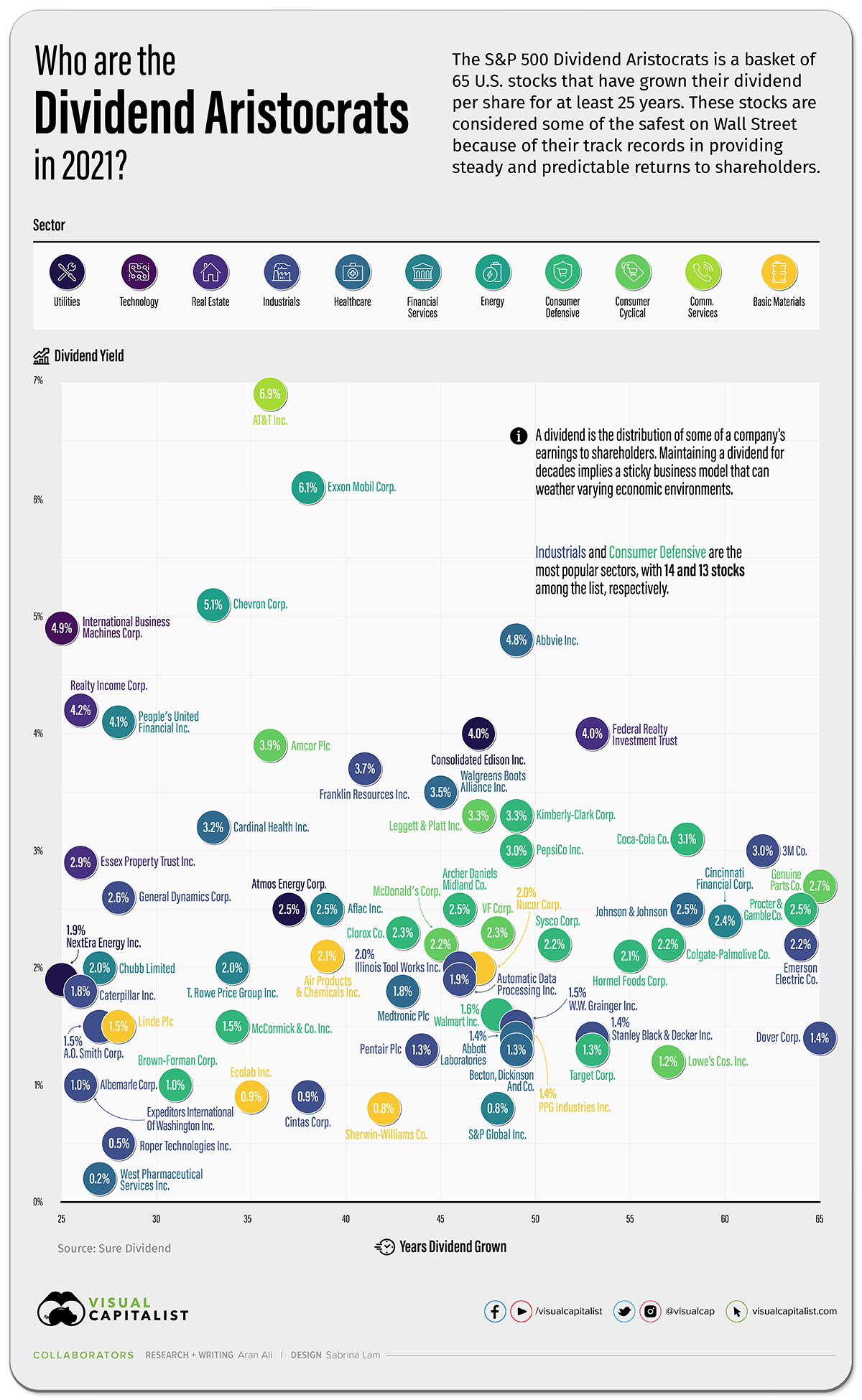
Who Are the Dividend Aristocrats in 2021?

Dividend-Aristocrats_Main


The Dividend Aristocrats in 2021

Legendary investor George Soros once said, “Good investing should be boring”. But an increase in volatile themes today suggests this maxim has gone ignored by at least some market participants.

From a high level, we can view investments on a spectrum. Volatile assets like cryptocurrencies and SPACs are more on the exciting side of things. The boring side is likely where Dividend Aristocrat stocks lie.

The data above, from Sure Dividend, looks at all 65 Dividend Aristocrats, ranking them by their yield, sector, and years of growth.

What are Dividend Aristocrats?

The U.S. Dividend Aristocrats are a basket of 65 stocks in the S&P 500 index. These companies have been growing their dividend per share consecutively, for a minimum of 25 years.

This is easier said than done, since companies often distribute dividends quarterly. To pay and grow a dividend in the long run implies a business model that can withstand varying economic environments, including setbacks like market crashes.

Though dividend stocks may not carry the same excitement as other investments, studies show that dividends represent over 50% of total S&P 500 market returns.

Numerous companies on this list have brand value that stretches all over the globe—including the likes of McDonald’s, Coca-Cola, and Walmart.

Vast global recognition and branding power is in part why these companies can generate cash flows to pay dividends for decades on end. For instance, 94% of the world population recognizes Coca-Cola’s logo.

Zooming In

Divident Aristocrats Sector Analysis Supplemental 2

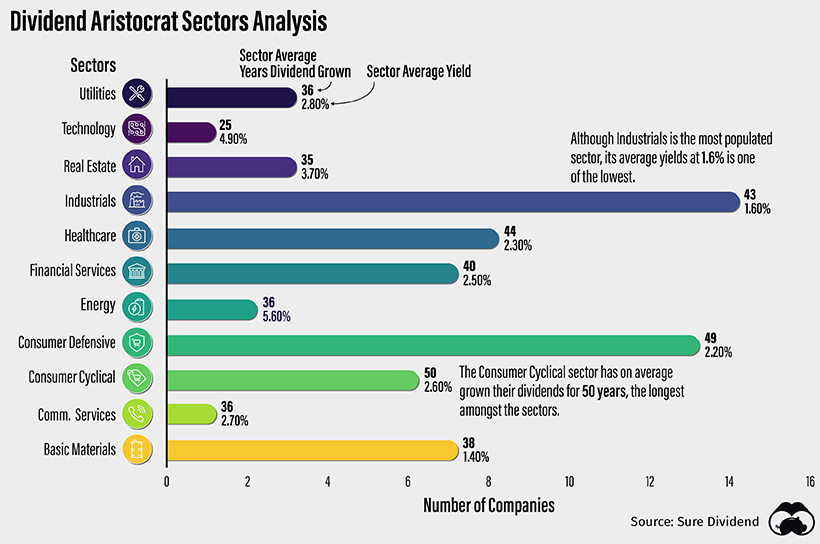
The 65 Dividend Aristocrat stocks break down into 11 sectors. Across sectors, Industrials is the most crowded, consisting of 14 companies, with an average yield of 1.6% and a dividend growth duration of 43 years. Popular stocks in this sector include 3M and Caterpillar.

Next is the Consumer Defensive sector, containing 13 companies like Clorox, Target, Pepsi, and Procter & Gamble. The average yield is 2.2%, with an average growing duration of 49 years.

The highest yield by sector belongs to Energy, at 5.5%, but is only made up of only Chevron and Exxon Mobil. Their dividend track record may falter in the years to come, due to transitions away from the oil business. Just last year, Big Oil firms reported record net income losses, and Exxon was booted from the Dow Jones Industrial Average (DJIA).

The Consumer Cyclical sector has been increasing their dividend for an average of 50 years, the longest of any sector. Lowe’s and McDonald’s are involved in this category.

Businesses for Today and Tomorrow

Although the Dividend Aristocrats list is published every year, the companies on the list are a stable bunch, meaning changes are fairly infrequent.

In a market climate in part shaped by low rates and compressed yields in the fixed income space, Dividend Aristocrats might be a particularly attractive alternative for investors with a longer-term outlook.

Source: Who Are the Dividend Aristocrats in 2021?

Lord of the Roths: How Tech Mogul Peter Thiel Turned a Retirement Account for the Middle Class Into a $5 Billion Tax-Free Piggy Bank

Billionaire Peter Thiel, a founder of PayPal, has publicly condemned “confiscatory taxes.” He’s been a major funder of one of the most prominent anti-tax political action committees in the country. And he’s bankrolled a group that promotes building floating nations that would impose no compulsory income taxes.

But Thiel doesn’t need a man-made island to avoid paying taxes. He has something just as effective: a Roth individual retirement account.

Over the last 20 years, Thiel has quietly turned his Roth IRA — a humdrum retirement vehicle intended to spur Americans to save for their golden years — into a gargantuan tax-exempt piggy bank, confidential Internal Revenue Service data shows. Using stock deals unavailable to most people, Thiel has taken a retirement account worth less than $2,000 in 1999 and spun it into a $5 billion windfall.

To put that into perspective, here’s how much the average Roth was worth at the end of 2018: $39,108.

And here’s how much $5 billion is: If every one of the 2.3 million people in Houston, Texas, were to deposit $2,000 into a bank today, those accounts still wouldn’t equal what Thiel has in his Roth IRA.

What’s more, as long as Thiel waits to withdraw his money until April 2027, when he is six months shy of his 60th birthday, he will never have to pay a penny of tax on those billions.

[…]

What this secret information reveals is that while most Americans are dutifully paying taxes — chipping in their part to fund the military, highways and safety-net programs — the country’s richest citizens are finding ways to sidestep the tax system.

One of the most surprising of these techniques involves the Roth IRA, which limits most people to contributing just $6,000 each year.

The late Sen. William Roth Jr., a Delaware Republican, pushed through a law establishing the Roth IRA in 1997 to allow “hard-working, middle-class Americans” to stow money away, tax-free, for retirement. The Clinton administration didn’t want to give a fat tax break to wealthy people who were likely to save anyway, so it blocked Americans making more than $110,000 ($160,000 for a couple) per year from using them and capped annual contributions back then at $2,000.

Yet, from the start, a small number of entrepreneurs, like Thiel, made an end run around the rules: Open a Roth with $2,000 or less. Get a sweetheart deal to buy a stake in a startup that has a good chance of one day exploding in value. Pay just fractions of a penny per share, a price low enough to buy huge numbers of shares. Watch as all the gains on that stock — no matter how giant — are shielded from taxes forever, as long as the IRA remains untouched until age 59 and a half. Then use the proceeds, still inside the Roth, to make other investments.

About a decade after the creation of the Roth, Congress made it even easier to turn the accounts into mammoth tax shelters. It allowed everyone — including the very richest Americans — to take money they’d stowed in less favorable traditional retirement accounts and, after paying a one-time tax, shift them to a Roth where their money could grow unchecked by Uncle Sam — a Bermuda-style tax haven right here in the U.S.

[…]

Among this rarefied group, ProPublica found, the term “individual retirement account” has become a misnomer. Rather than a way to build a nest egg for old age, the accounts have morphed into supercharged investment vehicles subsidized by American taxpayers. Ted Weschler, a deputy of Warren Buffett at Berkshire Hathaway, had $264.4 million in his Roth account at the end of 2018. Hedge fund manager Randall Smith, whose Alden Global Capital has gutted newspapers around the country, had $252.6 million in his.

Buffett, one of the richest men in the world and a vocal supporter of higher taxes on the rich, also is making use of a Roth. At the end of 2018, Buffett had $20.2 million in it. Former Renaissance Technologies hedge fund manager Robert Mercer had $31.5 million in his Roth, the records show.

[…]

And thanks to the Roth, Thiel’s fortune is far more vast than even experts in tallying the wealth of the rich believed. In 2019, Forbes put Thiel’s total net worth at just $2.3 billion. That was less than half of what his Roth alone was worth.

Source: Lord of the Roths: How Tech Mogul Peter Thiel Turned a Retirement Account for the Middle Class Into a $5 Billion Tax-Free Piggy Bank — ProPublica

Regulators Crack Down on Crypto Exchange Binance in UK, Japan, Germany, and Ontario, Canada

The Wall Street Journal reports: Authorities in the U.K. and Japan took aim at affiliates of Binance Holdings Ltd., the world’s largest cryptocurrency exchange network, in the latest regulatory crackdown on the wildly popular trade in bitcoin and other digital assets. The U.K. Financial Conduct Authority, the country’s lead financial regulator, told consumers Saturday that Binance’s local unit wasn’t permitted to conduct operations related to regulated financial activities…

Binance Markets Ltd., the company’s U.K. arm, applied to be registered with the Financial Conduct Authority and withdrew its application on May 17. “A significantly high number of cryptoasset businesses are not meeting the required standards” under money-laundering regulations, said a spokesperson for the FCA in an email. “Of the firms we’ve assessed to date, over 90% have withdrawn applications following our intervention.”

Japan’s financial watchdog issued a statement on June 25, saying that Binance isn’t registered to do business in the country…

As of April, Binance operated the largest cryptocurrency exchange in the world by trading volume, allowing tens of billions of dollars of trades to pass through its networks, according to data provider CryptoCompare. It was founded in 2017 and initially based in China, later moving offices to Japan and Malta. It recently said it is a decentralized organization with no headquarters… The FCA move doesn’t ban customers from using Binance completely; U.K. customers can continue to use Binance’s non-U.K. operations for activities the FCA doesn’t directly regulate, such as buying and selling direct holdings in bitcoin.
The Financial Times called the move “one of the most significant moves any global regulator has made against Binance” and “a sign of how regulators are cracking down on the cryptocurrency industry over concerns relating to its potential role in illicit activities such as money laundering and fraud, and over often weak consumer protection.” But more countries are also taking action, Reuters reports: Last month, Bloomberg reported that officials from the U.S. Justice Department and Internal Revenue Service who probe money laundering and tax offences had sought information from individuals with insight into Binance’s business. In April, Germany’s financial regulator BaFin warned the exchange risked being fined for offering digital tokens without an investor prospectus.
And CoinDesk adds: Binance is no longer open for business in Canada’s most populous province, apparently choosing to close shop rather than meet the fate of other cryptocurrency exchanges that have had actions filed against them for allegedly failing to comply with Ontario securities laws.

Source: Regulators Crack Down on Crypto Exchange Binance in UK, Japan, Germany, and Ontario, Canada – Slashdot

You Don’t Own What You’ve Bought: Peloton Treadmill Edition

We’ve written so many stories about how you don’t own what you’ve bought any more due to software controls, DRM, and ridiculous contracts, and it keeps getting worse. The latest such example involves Peloton, which is most known for its extremely expensive stationary bikes with video screens, so that you can take classes (usually on a monthly subscription). I will admit that I don’t quite understand the attraction to them, but so many people swear by them. The company also has branched out into extremely expensive treadmills with the same basic concept

[…]

Peloton announced that they will refund the machine, which costs $4,295, and are working on a mandatory software update that will automatically lock the Tread+ after each use and require a unique password to be used to unlock the machine.

That automatic lock and password idea sounds sensible enough, given the situation, but in order to get it to work, but apparently Peloton hasn’t figured out how to make that work for customers who bought the treadmill and aren’t using its subscription service for classes. The Tread+ does have a “Just Run” mode, in which it acts like a regular treadmill (with the video screen off). But, as Brianna Wu discovered, the company is now saying that the “Just Run” mode now requires a subscription to work with the lock. The company is waiving the cost of such a subscription for three months, and it’s unclear from the email if that means that after the three months they’re hoping to have the “Tread Lock” working even for non-subscription users:

If you can’t see it, the image is an email from Peloton customer support saying:

We care deeply about the safety and well-being of our Members and we created Tread Lock to secure your Tread+ against unauthorized access.

Unfortunately at this time, ‘Just Run’ is no longer accessible without a Peloton Membership.

For this inconvenience, we have waived three months of All-Access Membership for all Tread+ owners. If you don’t see the waivers on your subscription or if you need help reactivating your subscription, please contact our Support team….

Now, it’s possible that the subscription part is necessary to update the software to enable the lock mode, but that seems… weird. After all, there must have been some sort of software upgrade that locked out the “Just Run” mode in the first place.

[…]


Source: You Don’t Own What You’ve Bought: Peloton Treadmill Edition | Techdirt

South Africa Africrypt Bitcoin Scam? Cajee Brothers Missing Along With Billions – second huge scam in SA

A pair of South African brothers have vanished, along with Bitcoin worth $3.6 billion from their cryptocurrency investment platform.

A Cape Town law firm hired by investors says they can’t locate the brothers and has reported the matter to the Hawks, an elite unit of the national police force. It’s also told crypto exchanges across the globe should any attempt be made to convert the digital coins.

Following a surge in Bitcoin’s value in the past year, the disappearance of about 69,000 coins — worth more than $4 billion at their April peak — would represent the biggest-ever dollar loss in a cryptocurrency scam. The incident could spur regulators’ efforts to impose order on the market amid rising cases of fraud.

The first signs of trouble came in April, as Bitcoin was rocketing to a record. Africrypt Chief Operating Officer Ameer Cajee, the elder brother, informed clients that the company was the victim of a hack. He asked them not to report the incident to lawyers and authorities, as it would slow down the recovery process of the missing funds.

Lawyers Hired

Some skeptical investors roped in the law firm, Hanekom Attorneys, and a separate group started liquidation proceedings against Africrypt.

“We were immediately suspicious as the announcement implored investors not to take legal action,” Hanekom Attorneys said in response to emailed questions. “Africrypt employees lost access to the back-end platforms seven days before the alleged hack.”

The firm’s investigation found Africrypt’s pooled funds were transferred from its South African accounts and client wallets, and the coins went through tumblers and mixers — or to other large pools of bitcoin — to make them essentially untraceable.

Calls to a mobile number for Cajee were immediately directed to a voicemail service. He and his brother, Raees, 20, set up Africrypt in 2019 and it provided bumper returns for investors. Calls to Raees also went straight to voicemail. The company website is down.

The saga is unfolding after last year’s collapse of another South African Bitcoin trader, Mirror Trading International. The losses there, involving about 23,000 digital coins, totaled about $1.2 billion in what was called the biggest crypto scam of 2020, according to a report by Chainalysis. Africrypt investors stand to lose three times as much.

While South Africa’s Finance Sector Conduct Authority is also looking into Africrypt, it is currently prohibited from launching a formal investigation because crypto assets are not legally considered financial products, according to the regulator’s head of enforcement, Brandon Topham. The police have not yet responded to a request for comment.

[…]

Source: South Africa Africrypt Bitcoin Scam?: Cajee Brothers Missing Along With Billions – Bloomberg

Hyundai completes deal for controlling interest in Boston Dynamics (walking robodog maker)

Hyundai this morning announced that it has completed its acquisition of Boston Dynamics. The deal, which values the innovative robotics company at $1.1 billion, was announced in late-2020. The companies have not disclosed any future financial details.

The South Korean automotive giant now owns a controlling interest in Boston Dynamics, previously belonging to SoftBank. The Japanese investment company was effectively a transitional owner, purchasing Boston Dynamics from Google, which owned the company for just over three years.

While its time with Softbank wasn’t much longer than its stint under Google/Alphabet X, Boston Dynamics saw the commercialization of its first two products since launching nearly 30 years ago. The company brought its quadrupedal robot Spot to market and this year announced the (still upcoming) launch of Stretch, an updated version of its warehouse robot, Handle.

In a recent appearance at TechCrunch’s Mobility event, Hyundai’s Ernestine Fu discussed the planned acquisition of an 80% controlling interest in the company. Fu noted that Hyundai’s New Horizon Studios has previewed multiple “walking” car concepts that look poised to build on decades of Boston Dynamics research.

“With New Horizon Studios, the mandate is reimagining what you can do when you combine robotics with traditional wheeled locomotion, like walking robots and walking vehicles,” Fu told TechCrunch. “Obviously the technology that [Boston Dynamics] has put together plays a key role in enabling those sorts of concepts to come to life.”

As it has changed hands over the years, Boston Dynamics has long insisted on maintaining its own research wing, which has given us less commercial technology, like the humanoid robot, Atlas. How this will function under the umbrella of Hyundai remains to be seen, though the company does seem to have a vested interest in maintaining a forward-looking approach.

Source: Hyundai completes deal for controlling interest in Boston Dynamics | TechCrunch

China Bitcoin Crackdown Leads To BTC Price Plummet and also Cheaper Graphics Cards

With graphics cards seeming harder to get than ever, China’s stricter measures against Bitcoin mining have led to lower prices online in the country.

In Yunnan, the country’s fourth-largest Bitcoin-producing province, authorities have been investigating illegal electrical power use tied to Bitcoin mining and are threatening to cut power to those involved in the practice. As SCMP reports, it’s the latest province to join the country’s clampdown on crypto.

In 2020, China made up 65 percent of Bitcoin’s global hash rate.

SCMP now reports that stricter measures towards Bitcoin are driving down the prices of graphics cards in China. Graphics cards aren’t only used for gaming, but for Bitcoin and other cryptocurrencies as they provide the extra computer power needed in the computations necessary to mine digital currencies.

As the Chinese government has been putting the squeeze on crypto, Sichuan province remained a holdout for mining operations. But, as SCMP adds, Sichuan has called for all mining to cease, dashing the hopes of miners to take advantage of the province’s hydropower. Now, miners are apparently looking at moving operations outside China to friendlier areas.

All of this has caused the prices of graphics cards to drop online in China. In May, the Asus RTX 3060 was commanding as much as 13,499 yuan ($2,085), but SCMP reports that prices have dropped to 4,699 yuan ($725).

That’s not the only thing to drop. According to CNN, the value of Bitcoin has dropped in the wake of China’s measures.

[…]

Source: Bitcoin Crackdown Leads To Cheaper Graphics Cards In China

Recent US Antitrust Push Is Weirdly Narrow, Pretends Telecom And Banking Don’t Exist

[…]

The U.S. is dominated by anticompetitive giants in banking, telecom, insurance, health care, air travel, and countless other sectors. And generally, we’ve historically encouraged them by underfunding our regulators, steadily weakening antitrust enforcement, rubber stamping merger after terrible merger, and replacing competent Judges with bobble head dolls. All under the pretense that doing anything else would be disastrous, while clinging tightly to a consumer welfare standard that sometimes seemed incapable of addressing modern market, labor, and consumer harms.

[…]

The movement to rein in big tech and shore up antitrust enforcement certainly has valid components, based on justified anger at years of dodgy business practices. But this anger has been proven to be exploitable by folks like News Corporation and AT&T. Both companies are looking to saddle their Silicon Valley competitors in online advertising with rules that don’t apply to their own businesses, while simultaneously demolishing constraints and oversight of their own sectors (see: net neutrality, the dismantling of FCC authority, or the steady erosion of media consolidation rules protecting small businesses).

[…]

Meanwhile, many of the bills are oddly selective in what they deem to be a “dominant platform.” The Platform Competition and Opportunity Act (pdf), for example, greatly restricts what constitutes a monopolistic offender, making sure to carve out exceptions for telecom giants, Mastercard, VISA, and Walmart. The bill bans companies from owning or operating a business that “presents a clear conflict of interest,” but only if the company in question has 50 million monthly active U.S. users and a market cap of over $600 billion:

“…is owned or controlled by a person with net annual sales, or a market capitalization greater than $600,000,000,000, adjusted for inflation on the basis of the Consumer Price Index, at the time of the Commission’s or the Department of Justice’s designation under sec13 tion 4(a) or any of the two years preceding that time, or at any time in the 2 years preceding the filing of a complaint for an alleged violation of this Act.”

Again, this very specific restriction omits a lot of companies that are engaging in the same kind of anticompetitive behavior, including many that see overlap in markets dominated by technology giants (telecom). It’s also just kind of an arbitrary restriction given that what others value you at isn’t necessarily what determines whether or not you’re engaging in anticompetitive behavior. The actual, anticompetitive behavior does.

But just looking at the $600 billion valuation threshold gives a sense of just how this line-drawing happened. Under this definition (including the number of US users), it looks like the law only applies to Apple, Microsoft, Amazon, Google (Alphabet) and Facebook. That’s it. It seems notable that companies which are also kinda powerful and dominant, but happen to fall just somewhat beneath the threshold, include Visa, Mastercard, JP Morgan Chase, Bank of America, Walmart, Disney… and Comcast, AT&T, and Verizon.

[…]

Telecom giants like AT&T and Comcast have spent the last three or four years successfully convincing many DC policymakers that Silicon Valley giants are the only dominant giants worth worrying about. Rupert Murdoch has been playing similar reindeer games. Pretending “big tech” monopolies are the only monopolies that need immediate fixing benefits both, and exploiting legitimate public anger at big tech isn’t particularly hard right now on either side of the aisle.

[…]

Source: Recent Antitrust Push Is Weirdly Narrow, Pretends Telecom And Banking Don’t Exist | Techdirt

Android, Apple Mobile Ecosystems Face UK Antitrust Probe Amid Competition Fears

Google and Apple Inc. face a sweeping probe into the “duopoly” power of their mobile ecosystems, in the U.K. antitrust watchdog’s latest attack on Silicon Valley.

The increasingly tech-focused Competition and Markets Authority opened a 12-month market study into broad aspects of the iOS and Android systems, saying it feared the companies’ dominance is stifling competition. The investigation adds to the regulator’s separate investigations into both tech giants.

“Our ongoing work into big tech has already uncovered some worrying trends and we know consumers and businesses could be harmed if they go unchecked,” CMA Chief Executive Officer Andrea Coscelli said in a statement.

[…]

The CMA said it will consider whether Apple and Google use their position as the owners of the main app stores to exploit consumers and developers as well as their supply of mobile browsers.

Big Tech is the focus of a vast array of European probes looking at how the firms increasingly govern the terms of what people do online, often gaining insights into user behavior that smaller rivals can’t match.

The market study will inform the CMA’s move to boost oversight over the largest tech companies while it develops a new code of conduct for companies that have “strategic market status.” But the regulator also warned that the study could lead to more stringent interventions, noting that even operational splits of company units were a possible outcome.

The CMA is separately scrutinizing Apple’s app payment rules and Google’s planned changes to ad tracking.

Source: Android, Apple Mobile Ecosystems Face UK Antitrust Probe Amid Competition Fears – Bloomberg

Risk and reward: Nefilim ransomware gang mainly targets fewer, richer companies and that strategy is paying off, warns Trend Micro

The Nefilim ransomware gang might not be the best known or most prolific online extortion crew but their penchant for attacking small numbers of $1bn+ turnover firms is paying off, according to some latest research.

The crew has made comparatively fewer headlines next to better-known criminals such as Darkside, perpetrators of the infamous US Colonial Pipeline attack, but analysis from security shop Trend Micro has shown the crooks appear to be going for big companies in the hope of extracting correspondingly big payouts.

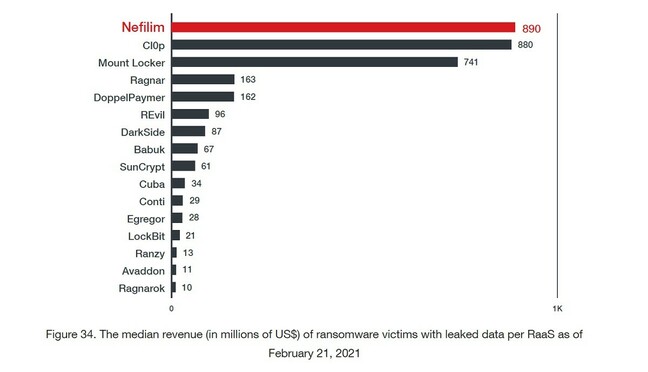
“Of the 16 ransomware groups studied from March 2020 to January 2021, Conti, Doppelpaymer, Egregor and REvil led the way in terms of number of victims exposed – and Cl0p had the most stolen data hosted online at 5TB. However, with its ruthless focus on organizations posting more than $1bn in revenue, Nefilim extorted the highest median revenue,” said Trend Micro in a report released on Tuesday.

The information will be of little comfort to any of the western world’s growing number of ransomware victims, including the Irish Health Service Executive and the US Colonial Pipeline Company.

While those attacks were very high profile because of their wider impact on critical national infrastructure, other ransomware operators are still engaging in the good old-fashioned pursuit of money, and lots of it.

Nefilim is, according to Trend, a ransomware gang that was first observed in late 2019, with actual attacks being seen in March 2020 – just as the COVID-19 pandemic drove the entire world online and to remote working.

Trend Micro analysis of the Nefilim ransomware gang's targets by revenue, based on identifiable leaked files

Trend Micro analysis of the Nefilim ransomware gang’s targets by revenue, based on identifiable leaked files. Click to enlarge

Despite targeting big businesses, Nefilim’s access methods were just the same as the ones constantly warned about by the infosec industry, said Trend Micro, explaining: “In the case of Nefilim ransomware attacks, our investigations uncovered the use of exposed RDP services and publicly available exploits to gain initial access — namely, a vulnerability in the Citrix Application Delivery Controller [CVE-2019-19781].”

Trend also referred to previous research from Digital Shadows on so-called initial access brokers, essential actors in the ransomware business chain who make the first break into a target’s networks before selling that illicit access to other criminal organisations.

“The price for access varies greatly — it can range from tens of dollars for a random victim asset, to several hundreds or even thousands of dollars for a categorized asset; access to the infrastructure of a large organization can cost five to six figures,” the report states.

Trend Micro research veep Bharat Mistry told The Register that ransomware gangs’ business models are just as developed as anything in the western IT market with different elements of attacks being carried out by different groups of criminals.

“There is a full partner model that goes with it. So you know, the ransomware as a service operators, they get around 20 to 30 per cent of the profit that comes out of it, and the rest of it goes to the partner. So you can see it’s margin-rich for the affiliates.”

Criminal gangs were also said to make “widespread use of legitimate tools such as AdFind, Cobalt Strike, Mimikatz, Process Hacker, PsExec, and MegaSync, to help ransomware attackers achieve their end goal while staying hidden.” Similarly, some in the infosec world call legitimate tools turned around and used against their owners LoLBins – living off the land binaries. In other words, tools such as PowerShell, which are in common use on corporate networks but can be harnessed as part of an attack on that same network.

While nothing about Nefilim’s operations are shockingly unique, that in itself ought to be a lesson for corporate infosec bods: it’s not the big scary vulns that let miscreants rampage through your employer’s network, it’s the ones everyone’s been warning about which you haven’t got round to patching for whatever reason.

Source: Risk and reward: Nefilim ransomware gang mainly targets fewer, richer companies and that strategy is paying off, warns Trend Micro • The Register

DOJ Vows to Hunt Down Whoever Let the Public Know How Little Billionaires Pay in Taxes

This week, ProPublica released a massive scoop—a treasure trove of financial records showing how some of the U.S.’s wealthiest billionaires scamper off with virtually no tax burden. And the U.S. government knows exactly what to do in response: find whoever released those embarrassing records and incarcerate the shit out of them.

Priorities, people!

ProPublica obtained official Internal Revenue Service documents that were, admittedly, not supposed to be public knowledge and released key details about just how well various tax tricks used by the ultra-wealthy are working out for them. For example, compared to Forbes estimates, the country’s 25 richest people saw a net growth of $401 billion in wealth from 2014 to 2018 but paid just $13.6 billion in federal income tax—an effective rate of 3.4%. Berkshire Hathaway investment titan Warren Buffet saw his net worth rise by $24.3 billion over that period, paying just $23.7 million in tax. Amazon CEO Jeff Bezos saw his net worth rise by $99 billion, paying just $973 million in tax. Former New York City Mayor Michael Bloomberg’s ratio was $22.5 billion in net worth gains to $292 million in tax, while Tesla/SpaceX CEO Elon Musk was $13.9 billion to $455 million.

Morally obscene display of inequality and impunity as this is, the U.S. government has far more pressing concerns, such as punishing whoever squealed. Attorney General Merrick Garland assured lawmakers on Wednesday that one of his most immediate focuses will be plugging the leak, wherever or whoever it might be.

[…]

Source: Elon Musk, Jeff Bezos Tax Leak: DOJ Vows to Hunt Down Leaker

US super-rich ‘pay almost no income tax’

ProPublica says it has seen the tax returns of some of the world’s richest people, including Jeff Bezos, Elon Musk and Warren Buffett.

The website alleges Amazon’s Mr Bezos paid no tax in 2007 and 2011, while Tesla’s Mr Musk paid nothing in 2018.

A White House spokeswoman called the leak “illegal”, and the FBI and tax authorities are investigating.

ProPublica said it was analysing what it called a “vast trove of Internal Revenue Service data” on the taxes of the billionaires, and would release further details over coming weeks.

While the BBC has not been able to confirm the claims, the alleged leak comes at a time of growing debate about the amount of tax paid by the wealthy and widening inequality.

media captionG7 global tax ‘levels the playing field’

ProPublica said the richest 25 Americans pay less in tax – an average of 15.8% of adjusted gross income – than most mainstream US workers.

Jesse Eisinger, senior reporter and editor at ProPublica, told the Today Programme: “We were pretty astonished that you could get [tax] down to zero if you were a multi-billionaire. Actually paying zero in tax really floored us. Ultra-wealthy people can sidestep the system in an entirely legal way.”

“They have enormous ability to find deductions, find credits and exploit loopholes in the system,” he said.

So while the value of their wealth grows enormously through their ownership of shares in their company, that’s not recorded as income.

But there’s more than that, he said: “They also take aggressive tax deductions, often because they have borrowed to fund their lifestyle.”

He said US billionaires buy an asset, build one or inherit a fortune, and then borrow against their wealth.

Because they don’t realise any gains or sell any stock, they’re not taking any income, which could be taxed.

“They then borrow from a bank at a relatively low interest rate, live off that and can use the interest expenses as deductions on their income,” he said.

Biden plans

The website said that “using perfectly legal tax strategies, many of the uber-rich are able to shrink their federal tax bills to nothing or close to it” even as their wealth soared over the past few years.

The wealthy, as with many ordinary citizens, are able to reduce their income tax bills via such things as charitable donations and drawing money from investment income rather than wage income.

ProPublica, using data collected by Forbes magazine, said the wealth of the 25 richest Americans collectively jumped by $401bn from 2014 to 2018 – but they paid $13.6bn in income tax over those years.

President Joe Biden has vowed to increase tax on the richest Americans as part of a mission to improve equality and raise money for his massive infrastructure investment programme.

He wants to raise the top rate of tax, double the tax on what high earners make from investments, and change inheritance tax.

However, ProPublica’s analysis concluded: “While some wealthy Americans, such as hedge fund managers, would pay more taxes under the current Biden administration proposals, the vast majority of the top 25 would see little change.”

[…]

Source: US super-rich ‘pay almost no income tax’ – BBC News

Return to Office: Employees Are Quitting Instead of Giving Up Work From Home

[…]

A May survey of 1,000 U.S. adults showed that 39% would consider quitting if their employers weren’t flexible about remote work. The generational difference is clear: Among millennials and Gen Z, that figure was 49%, according to the poll by Morning Consult on behalf of Bloomberg News.

“High-five to them,” said Sara Sutton, the CEO of FlexJobs, a job-service platform focused on flexible employment. “Remote work and hybrid are here to stay.”

The lack of commutes and cost savings are the top benefits of remote work, according to a FlexJobs survey of 2,100 people released in April. More than a third of the respondents said they save at least $5,000 per year by working remotely.

Perks of Flexibility

Not having to commute is the top benefit for remote workers.

Source: FlexJobs

Survey of 2,181 total respondents ran from March 17, 2021 through April 5, 2021.


[…]

At least some atop the corporate ladder seem to be paying attention. In a Jan. 12 PwC survey of 133 executives, fewer than one in five said they want to go back to pre-pandemic routines. But only 13% were prepared to let go of the office for good.

Senior Management’s View

Days in the office that executives think is needed to maintain company culture.

Source: PwC

PwC surveyed 133 US executives between Nov. 24 and Dec, 5, 2020,from public and private companies in financial services, technology, media and telecommunications and retail products.

[…]


Source: Return to Office: Employees Are Quitting Instead of Giving Up Work From Home – Bloomberg

EU starts protectionist measures, increasing prices of Chinese E-Commerce imports

At Amazon in Spain, France and Italy, Chinese sellers already make up more than half of the largest merchants in the marketplace, says market research firm Marketplace Pulse. The Thuiswinkel Markt Monitor shows that we in the Netherlands spent 1.1 billion euros on products from abroad in 2019. Chinese online stores, such as AliExpress, are in first place with almost 33 percent. One reason for the rise of Chinese retailers is that they supply European customers directly through platforms such as Amazon or AliExpress. They also often pay no import duties and pay little attention to product safety. At the beginning of July, new EU tax rules will come into effect for orders from non-European online retailers. The most important change is the abolition of the current exemption limit of 22 euros for direct imports. As a result, 19 percent import tax is due on all packages. In addition, dealers will have to complete a customs declaration for all shipments in the future. The prices of Chinese articles will therefore rise sharply. If you want to spend something of 22 euros, you will soon pay 4 euros 84 in VAT and approximately 13 euros in handling costs for the delivery person. Then you do not lose 22 euros for the product, but almost 40 euros. Brussels expects a lot from the measures. The tax reform will ensure “fair competition between European and foreign operators in the e-commerce market,” the Brussels government writes in a brochure. It expects an additional tax revenue of 7 billion euros per year. Organization GS1 advises retailers to let marketplaces take care of the VAT return because they know who is buying, at what price and where the package must be delivered. They can also provide the authorities with unique identifiers for the product, the Global Trade Item Number (GTIN), the sales transaction a Global Shipment Identification Number (GSIN) in which the price is recorded and the package identification code, a GS1 Serial Shipping Container Code (SSCC). to enable an automated check. In this way, the customer can look forward to his package without any problems.

Source: EU verscherpt regels voor internationale onlinehandel, Chinese pakketjes fors duurder – Emerce

Italy fines Google $123 million for blocking an EV app from Android Auto

[…]

Italy’s competition watchdog has ordered Google to pay over €100 million ($123 million) for abuse of its dominant position. The regulator said Google had shut out an electric vehicle recharging app from its Android Auto infotainment platform for cars for over two years.

The company at the core of the action is Enel X — a subsidiary of Italian energy provider Enel — which through its JuicePass app gives EV drivers access to about 95,000 public charging points in Europe. The watchdog said by blocking the app for over two years Google was essentially favoring Google Maps, which also lets users search for nearby EV charging points. Along with the fine, the regulator told Google to make the JuicePass app available on Android Auto.

Echoing concerns raised by its EU and UK counterparts, the Italian authority pointed to Google’s gatekeeper status over the digital economy. The regulator said Android OS and the Google Play store had given the company a “dominant position” that allowed it to” control the access of app developers to end users.” In the case of Enel X, the watchdog said that by excluding the JuicePass app Google had put its rival’s business in jeopardy and potentially hobbled the advancement of electric mobility.

[…]

Source: Italy fines Google $123 million for blocking an EV app from Android Auto | Engadget

And this is why monopolies shouldn’t be allowed to own the market and place their own products on that market. It’s one or the other, not both.

Environmental Commodities: What Are They & How Can You Trade Them?

Commodity.com has a huge and useful page on how to get started trading in environmental commodities. Unfortunately it won’t let me paste it into here easily so below is a list of the subjects they cover. They are also very transparent about how they make their money (through links on their site), which I thought was honest of them.  Anyway, enjoy!
What Are Environmental Commodities?
Types Of Environmental Commodities
History Of Environmental Commodities
What Drives Environmental Commodity Prices?
Environmental Commodity Exchanges
Environmental Commodity Brokers
Further Reading

Source: Environmental Commodities: What Are They & How Can You Trade Them? – Commodity.com

Amazon knew seller data was used to boost company sales

Amazon CEO Jeff Bezos told U.S. lawmakers last year that the company has a policy prohibiting employees from using data on specific sellers to help boost its own sales.

“I can’t guarantee you that that policy has never been violated,” he added.

Now it’s clear why he chose his words so carefully.

An internal audit seen by POLITICO warned Amazon’s senior leadership in 2015 that 4,700 of its workforce working on its own sales had unauthorized access to sensitive third-party seller data on the platform — even identifying one case in which an employee used the access to improve sales.

Since then, reports of employees using third-party seller information to bolster Amazon’s own sales and evidence of lax IT access controls at the company suggest that efforts to fix the issue have been lackluster.

The revelations come as trustbusters worldwide are increasingly targeting Amazon, including over how it uses third-party seller data to boost its own offerings. The European Commission opened an investigation into precisely this issue in November 2020, with preliminary findings suggesting Amazon had breached EU competition law.

[…]

Source: Amazon knew seller data was used to boost company sales – POLITICO

This issue has been on my agenda since early 2019 and it’s great to see the monopolies finally being busted.

Amazon had sales income of €44bn in Europe in 2020 but paid no corporation tax

Fresh questions have been raised over Amazon’s tax planning after its latest corporate filings in Luxembourg revealed that the company collected record sales income of €44bn (£38bn) in Europe last year but did not have to pay any corporation tax to the Grand Duchy.

Accounts for Amazon EU Sarl, through which it sells products to hundreds of millions of households in the UK and across Europe, show that despite collecting record income, the Luxembourg unit made a €1.2bn loss and therefore paid no tax.

In fact the unit was granted €56m in tax credits it can use to offset any future tax bills should it turn a profit. The company has €2.7bn worth of carried forward losses stored up, which can be used against any tax payable on future profits.

The Luxembourg unit – which handles sales for the UK, France, Germany, Italy, the Netherlands, Poland, Spain and Sweden – employs just 5,262 staff meaning that the income per employ amounts to €8.4m.

[…]

Source: Amazon had sales income of €44bn in Europe in 2020 but paid no corporation tax | Amazon | The Guardian

The article goes on to blame Amazon, but tbh I don’t blame them much. It’s the EU and the tax haven system inside it that allows its member states to allow and even encourage this kind of tax avoidance that is to blame.

Russia fines Apple $12m for app market abuse

Russia said it had fined Apple $12 million for alleged [Note: why the use of this word? If the fine has been issued, then a Russian court has established guilt and there is no allleging about it!] abuse of its dominance in the mobile applications market, in the latest dispute between Moscow and a Western technology firm.

The Federal Antimonopoly Service (FAS) said on Tuesday that U.S. tech giant Apple’s distribution of apps through its iOS operating system gave its own products a competitive advantage.

[…]

The FAS said in a statement it had imposed a turnover fine on Apple of 906.3 million roubles ($12.1 million) for the alleged violation of Russian anti-monopoly legislation.

It determined in August 2020 that Apple had abused its dominant position and then issued a directive requiring the U.S. company to remove provisions giving it the right to reject third-party apps from its App Store.

That move followed a complaint from cybersecurity company Kaspersky Lab, which had said that a new version of its Safe Kids application had been declined by Apple’s operating system.

[…]

Source: Russia fines Apple $12 mln for alleged app market abuse | Reuters
I have been talking about the need to break up the big tech monopolies since early 2019. It’s good to see that all the major world governments and court systems are taking it seriously.

Epic witness claims Apple’s App Store profit reaches 78%. Apple disagrees as their overall profit is “only” 42.5%

Epic Games is using its lawsuit against Apple to accuse the iPhone maker of being particularly greedy. As The Verge reports, expert witness Eric Barns testified that Apple supposedly had an App Store operating margin of 77.8 percent in 2019, itself a hike from 74.9 percent in 2018. He also rejected Apple witness’ claims that you couldn’t practically calculate profit, pointing to info from the company’s Corporate Financial Planning and Analysis group as evidence.

Apple unsurprisingly disagreed. The tech firm told The Verge the margin calculations are “simply” wrong and that it planned to fight the allegations at trial. The firm’s own witness, Richard Schmalensee, claimed that Barnes was looking at one iOS ecosystem element that distorted the apparent operating margin. The real figure was “unremarkable,” he said, adding that you couldn’t study App Store profit without looking at the broader context of devices and services.

The company doesn’t calculate profits and losses based on products and services, Schmalensee said.

There’s no guarantee the court will accept Barnes’ take. Apple’s overall gross profit margin has typically been high relative to much of the industry, but never that high — it was 42.5 percent during the company’s latest winter quarter. Apple has also tended to portray the App Store as a way to drive hardware sales rather than a money-maker in its own right.

The testimony nonetheless does more to explain how Epic will pursue its case against Apple as the court battle begins on May 3rd. The Fortnite creator not only wants to portray Apple as anti-competitive, but abusing its lock on iOS app distribution to reap massive profits.

Source: Epic witness claims Apple’s App Store profit reaches 78 percent | Engadget

Appeals Court says Amazon is responsible for the safety of third-party products

A boy rides a hoverboard on the day after Christmas, in San Pedro, California December 26, 2015. Reports of some hoverboards, also known as self-balancing, two-wheeled scooters catching fire have led to an investigation by the Consumer Product Safety Commission.  AFP PHOTO / ROBYN BECK / AFP / ROBYN BECK        (Photo credit should read ROBYN BECK/AFP via Getty Images)
ROBYN BECK/AFP via Getty Images

Amazon may soon be more accountable for more products than the ones it directly sells. According to the LA Times, a California state appeals court has ruled that Amazon is responsible for the safety of third-party products available through its marketplace following a 2015 hoverboard fire. While the internet giant argued that it was only connecting buyers with sellers, judges determined that there was a “direct link” in distribution that made the company liable.

The company won the initial ruling. At the time, a judge sided with Amazon’s view that it was just advertising sellers’ products rather than participating in sales.

In a statement to the Times, Amazon said it “invests heavily” in product safety by screening sellers and products. it also keeps watch on the store for hints of problems. The company declined to comment on the appeal court decision, including whether it intended to challenge the ruling at the state Supreme Court.

The decision, if it holds, could force Amazon to change policies. The tech giant may have to step up its vetting process for sellers and be ready to accept liability for safety problems, including lawsuits. Other stores with similar third-party marketplaces would have to follow suit. That, in turn, might be good news for shoppers —you could see fewer sketchy products in online stores, and you’d have a better chance of resolving safety issues.

Source: Court says Amazon is responsible for the safety of third-party products | Engadget

Activision Blizzard CEO Bobby Kotick takes 50% voluntary pay cut

Bobby Kotick, the longtime CEO of “Call of Duty” and “Candy Crush” game maker Activision Blizzard, will see his base salary reduced by 50% and bonus potential slashed as part of a 15-month contract extension, the company reported Thursday in an SEC filing.

Why it matters: The cut isn’t a sign that the company is struggling. Activision, like most big gaming companies, is thriving. But it appears to show a company reacting to criticism of outsized executive compensation.

  • Kotick’s base salary will be cut in half to $875,000, and his amended contract establishes a reduction of $1.75 million in potential annual bonuses.
  • Provisions for lucrative bonuses tied to stock performance have also been removed or rewritten to limit other potential bonus payouts. That follows reports that they triggered payments of as much as $200 million earlier this year.
  • In its filing, Activison’s board said the compensation changes were made after 12 months of “extensive shareholder outreach.”

[…]

The big picture: Kotick became CEO of Activision in 1991, when the company was a struggling player in a much smaller industry. Now it is one of gaming’s most successful.

  • That success hasn’t meant labor happiness for all. Activision has laid off waves of employees each of the last three years.
  • Kotick told Gamesbeat Wednesday that Activision needs to hire some 2,500 workers.

Source: Activision CEO Bobby Kotick takes pay cut – Axios

So people are still whining that he’s making actual money but these are the types for whom no pay level will ever be acceptable, even if they even out the pay levels throughout the whole company.

I think this is a great exemplary step forwards – the top shouldn’t be earning such stupid amounts more than the lowest employees. Next step, up the earnings of the lower paid people!

EU Charges Apple With Antitrust Violations in Spotify Case

the European Union has charged Apple with allegedly “abus[ing] its dominant position” in the music streaming market.

The charges stem from an initial complaint filed by Spotify in 2019. At the time, Spotify accused Apple of having “an unfair advantage at every turn” by imposing a series of obstacles that favored its own services at the expense of competitors. As it turns out, the European Commission seems to agree with Spotify.

“By setting strict rules on the App Store that disadvantage competing music streaming services, Apple deprives users of cheaper music streaming choices and distorts competition,” the European Commission said in a tweet.

The Commission further explained in a press release that it took issue with Apple’s role as a gatekeeper to the iOS ecosystem. Because the App Store is the only venue for developers to reach iOS users, the Commission contends that elevates Apple to a dominant position within the music streaming market. In particular, it singled out Apple’s mandatory 30% commission for in-app purchases and “anti-steering provisions.” The latter refers to limitations within the App Store that prevent developers from informing consumers of alternative payment options that might be cheaper. That in turn forces rival music streaming services to raise subscription prices for consumers to make up for their higher costs—all while Apple benefits by acting as a middle man for in-app billing and communications with consumers.

[…]

It’s a no-brainer that each company would point to the other as being in the wrong here. But it’s clear that Apple’s 30% commission and control over in-app transactions is a sore point for multiple companies. Next week, Epic Games will also go to federal court to argue that Apple abused its power to kick Fortnite out of the App Store. That dramatic brouhaha last summer sparked a number of app developers—including Spotify, Tile, and Epic Games—to form the Coalition for App Fairness (CAF), a nonprofit that aims to fight against the so-called Apple tax and other anticompetitive app store policies.

[…]

. If found guilty, Apple could face up to a 10% fine on its annual revenue—which, any way you slice it would be a lot of money. However, the Commission says that there are “no legal deadlines for bringing an antitrust investigation to an end” and that an investigation will last as long as it needs to, “depend[ing] on a number of factors.” In other words, while this is a major milestone in Apple’s App Store antitrust saga, it’s far, far, far from being over.

Source: EU Charges Apple With Antitrust Violations in Spotify Case

I have been talking about ending the monopoly stranglehold big tech has been excersising since early 2019 so it’s good to see the end of this is all coming together finally