Major Cryptocurrency Index Excludes Korean Prices Without Warning, creates apparent drop in prices

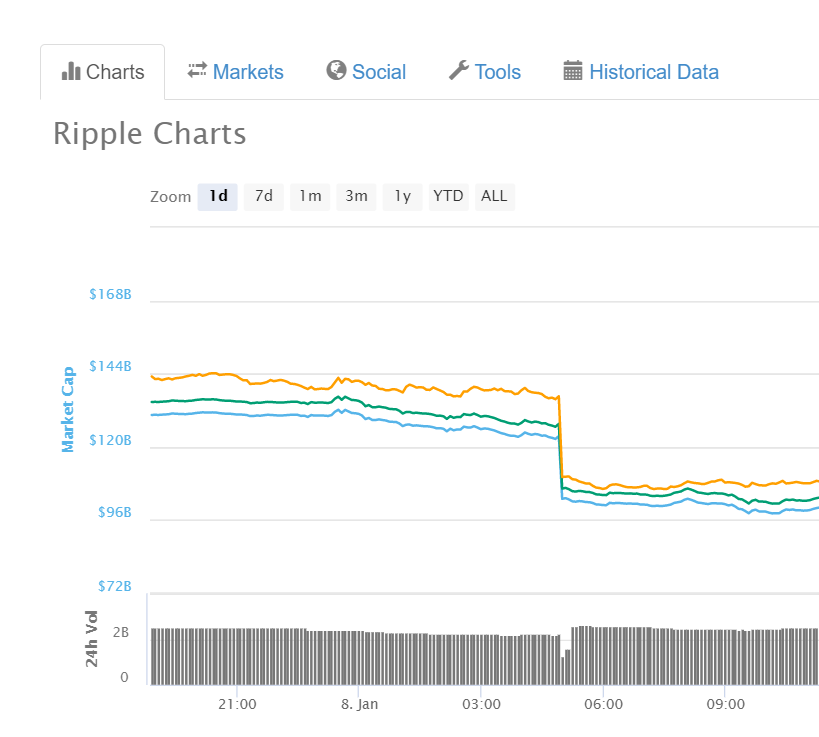
CoinMarketCap, arguably the most prominent global index of cryptocurrency prices, triggered a wave of anxiety and anger this morning when it removed a group of Korean cryptocurency exchanges from its price calculations.Though the change was apparently made at midnight Sunday U.S. EST, CoinMarketCap did not publicize it until midday on Monday, saying that the Korean exchanges showed “extreme divergence in prices from the rest of the world and limited arbitrage opportunity.” This morning we excluded some Korean exchanges in price calculations due to the extreme divergence in prices from the rest of the world and limited arbitrage opportunity. We are working on better tools to provide users with the averages that are most relevant to them. — CoinMarketCap (@CoinMarketCap) January 8, 2018The move resulted in a sharp drop in CoinMarketCap’s measurement of nearly all cryptocurrencies. That gave the impression that a broad market decline, already in progress, had become even more dramatic overnight. As news of the cause for the sharp drop spread Monday, most cryptocurrency prices began recovering losses.

Source: Major Cryptocurrency Index Excludes Korean Prices Without Warning | Fortune
Chrome Extension with 100,000 Users Caught Pushing Cryptocurrency Miner

A Chrome extension with over 105,000 users has been deploying an in-browser cryptocurrency miner to unsuspecting users for the past few weeks.The extension does not ask for user permission before hijacking their CPUs to mine Monero all the time the Chrome browser is open.Named “Archive Poster,” the extension is advertised as a mod for Tumblr that allows users an easier way to “reblog, queue, draft, and like posts right from another blog’s archive.”According to users reviews, around the start of December the extension has incorporated the infamous Coinhive in-browser miner in its source code.

Source: Chrome Extension with 100,000 Users Caught Pushing Cryptocurrency Miner

The Founder of Litecoin Says He No Longer Owns Any Litecoin

“[W]henever I tweet about Litecoin price or even just good or bads news, I get accused of doing it for personal benefit. Some people even think I short LTC! So in a sense, it is conflict of interest for me to hold LTC and tweet about it because I have so much influence,” Lee, who was also an early engineering hire for crypto trading platform Coinbase, wrote on r/litecoin. “For this reason, in the past days, I have sold and donated all my LTC.”
[…]
While an unencumbered founder may generate trust and goodwill in the short term, the question remains if Lee knows something Litecoin speculators don’t. Even the person (or people) who operated under the alias of Satoshi Nakamoto did not sell, donate, or delete their stake in Bitcoin before disappearing. Nor would it be an easy task to find a startup founder (an imperfect analogy to be sure) that did not have some level of investment in their own product. Lee notes in the same Reddit post that, “when Litecoin succeeds, I will still be rewarded in lots of different ways, just not directly via ownership of coins.”

Source: The Founder of Litecoin Says He No Longer Owns Any Litecoin

Coinbase Freezes Bitcoin Cash Trades, Launches Insider Trading Probe

Coinbase, one of the world’s most popular cryptocurrency apps, surprised its users by adding Bitcoin Cash to its offerings on Tuesday. But it appears that not everyone trading in the altcoin was blindsided by the move. Before the announcement, prices for Bitcoin Cash began climbing in other markets, and now a self-investigation of possible insider trading has been initiated.

Source: Coinbase Freezes Bitcoin Cash Trades, Launches Insider Trading Probe

The wild west of unregulated currencies! It’s nice to see these guys jumping through hoops to show that they have responsible policies in the hopes that they won’t get heavily regulated by local governments in an international setting, giving them a huge disadvantage to other companies in the same – but unregulated – space.

Bitcoin exchange Youbit shuts after second hack attack – BBC News

A crypto-currency exchange in South Korea is shutting down after it was hacked for the second time in less than eight months.

Youbit, which lets people buy and sell bitcoins and other virtual currencies, has filed for bankruptcy after losing 17% of its assets in the cyber-attack.

It did not disclose how much the assets were worth at the time of the attack.

In April, Youbit, formerly called Yapizon, lost 4,000 bitcoins now worth $73m (£55m) to cyberthieves.

Source: Bitcoin exchange Youbit shuts after second hack attack – BBC News

Yup, it’s the wild west out there with those Bitcoins!

Coinbase warns of potential outages

Over the course of this year we have invested significant resources to increase trading capacity on our platform and maintain availability of our service. We have increased the size of our support team by 640% and launched phone support in September. We have also invested heavily in our infrastructure and have increased the number of transactions we are processing during peak hours by over 40x.There may be downtime which can impact your ability to tradeDespite the sizable and ongoing increases in our technical infrastructure and engineering staff, we wanted to remind customers that access to Coinbase services may become degraded or unavailable during times of significant volatility or volume. This could result in the inability to buy or sell for periods of time. Despite ongoing increases in our support capacity, our customer support response times may be delayed, especially for requests that do not involve immediate risks to customer account security.

Source: Please invest responsibly — an important message from the Coinbase team

‘Grinch bots’ are stealing Christmas

“Bots come in and buy up all the toys and then charge ludicrous prices​ a​midst the holiday shopping bustle​,” the New York Democrat said on Sunday. “​Cyber bots ​— ​we call them ‘Grinch bots’ — ​are expanding their reach and​ ​unfairly scooping up the hottest toys your parents can’t even click buy.​”​​For example, Schumer said, the popular Fingerlings — a set of interactive baby monkey figurines that ​usually sell for around $15 — are being snagged by the scalping software and resold on secondary websites for as much as $1,000 a pop.“Grinch bots cannot be allowed to steal Christmas, or dollars, from the wallets of New Yorkers,​” he said. ​The senator said as soon as a retailer puts a hard-to-get toy — like Barbie’s Dreamhouse or Nintendo game systems — for sale on a website, a bot can snatch it up even before a kid’s parents finish entering their credit card information.The toys then end up for sale on other sites like Amazon and eBay for hundreds or even thousands of dollars more.

Source: Schumer says ‘Grinch bots’ are stealing Christmas | New York Post

An Ethereum Startup (Confido) Just Vanished After People Invested $374K

Confido is a startup that pitched itself as a blockchain-based app for making payments and tracking shipments. It sold digital tokens to investors over the Ethereum blockchain in an ICO that ran from November 6 to 8. During the token sale, Confido sold people bespoke digital tokens that represent their investment in exchange for ether, Ethereum’s digital currency.

But on Sunday, the company unceremoniously deleted its Twitter account and took down its website. A company representative posted a brief comment to the company’s now-private subforum on Reddit, citing legal problems that prevent the Confido team from continuing their work. The same message was also posted to Medium but quickly deleted.

“Right now, we are in a tight spot, as we are having legal trouble caused by a contract we signed,” the message stated (a cached version of the Medium post is viewable). “It is likely that we will be able to find a solution to rectify the situation. However, we cannot assure you with 100% certainty that we will get through this.” The message was apparently written by Confido’s founder, one Joost van Doorn, who seems to have no internet presence besides a now-removed LinkedIn profile.

Even the Confido representative on Reddit doesn’t seem to know what’s going on, though, posting hours after the initial message, “Look I have absolutely no idea what has happened here. The removal of all of our social media platforms and website has come as a complete surprise to me.” Motherboard reached out to this representative over Reddit, but hasn’t received a response.

Confido tokens had a market cap of $10 million last week, before the company disappeared, but now the tokens are worthless. And investors are crying foul.

Motherboard

Yup, the wild wild west!

Ex-agent in Silk Road probe gets more prison time for bitcoin theft

Shaun Bridges, 35, was sentenced by U.S. District Court Judge Richard Seeborg in San Francisco after pleading guilty in August to money laundering in the second criminal case to be brought against the former agent, prosecutors said.Bridges, who served in the Secret Service’s Baltimore field office, was sentenced in 2015 to 71 months in prison for diverting to his personal account over $800,000 worth of bitcoins during the Silk Road probe.Before serving that sentence, though, Bridges was arrested again on new charges related to his theft of bitcoins that were at the time worth $359,005 but today are valued at $11.3 million, according to the industry publication CoinDesk.

Source: Ex-agent in Silk Road probe gets more prison time for bitcoin theft | Reuters

~$300m of Etherium accidentally lost forever by Parity due to bug

More than $300m of cryptocurrency has been lost after a series of bugs in a popular digital wallet service led one curious developer to accidentally take control of and then lock up the funds, according to reports.Unlike most cryptocurrency hacks, however, the money wasn’t deliberately taken: it was effectively destroyed by accident.
[…]
On Tuesday Parity revealed that, while fixing a bug that let hackers steal $32m out of few multi-signature wallets, it had inadvertently left a second flaw in its systems that allowed one user to become the sole owner of every single multi-signature wallet.

The user, “devops199”, triggered the flaw apparently by accident. When they realised what they had done, they attempted to undo the damage by deleting the code which had transferred ownership of the funds. Rather than returning the money, however, that simply locked all the funds in those multisignature wallets permanently, with no way to access them.

“This means that currently no funds can be moved out of the multi-sig wallets,” Parity says in a security advisory.

Effectively, a user accidentally stole hundreds of wallets simultaneously, and then set them on fire in a panic while trying to give them back.

Source: ‘$300m in cryptocurrency’ accidentally lost forever due to bug | Technology | The Guardian

Bitcoin Pioneer Says New Coin to Work on Many Blockchains

The mobility means that if one blockchain dies out as the result of infighting among developers or slackened use, metronome owners can move their holdings elsewhere. That should help the coins retain value, and ensure their longevity, Garzik, co-founder of startup Bloq that created metronome, said in a phone interview. It will be unveiled Tuesday at the Money 20/20 conference in Las Vegas.”Institutional investors should be very excited to see something like this,” Matthew Roszak, the other co-founder of Bloq and chairman of industry advocate Chamber of Digital Commerce, said in a phone interview. “We’ve built a thousand-year cryptocurrency, something that’s built to last.”That’s a concern for many digital currencies. Infighting among developers and various supporters, and the slow pace of enhancements on the bitcoin blockchain have helped to limit use. Both bitcoin and its main rival, ethereum, have split into several versions.More splits could be coming — partly, thanks to Garzik, who is a proponent of and a developer for an upgrade to the bitcoin network called SegWit2x, which offers one way to speed up transactions. That split could happen in November.

Source: Bitcoin Pioneer Says New Coin to Work on Many Blockchains – Bloomberg

A useful feature for a coin.

AMD sales soar, actually makes a profit, beats expectations, share price… decimated

Personal TechAMD sales soar, actually makes a profit, beats expectations, share price… decimatedIntel’s antitrust shield even loses when it winsBy Shaun Nichols in San Francisco 25 Oct 2017 at 00:0816 Reg comments SHARE ▼guitar player on shuttertsock photo of (sisyphus) man rolling a rock up a hill. photo by SHutterstock/PHOTOCREO Michal BednarekAMD revenues were up, an actual proper profit was banked, and its future looking brighter than ever in the past financial quarter… meanwhile investors are selling off shares fearing a downturn looming for the chip designer.Strong sales from its Ryzen and Epyc Zen-based processor lines helped the world’s second-favorite x86 PC and server chip slinger grow revenues by more than 25 per cent in its third quarter of 2017, the three months to September 30. Here’s a summary of the figures, announced on Tuesday: Revenues of $1.64bn were up 26 per cent from $1.31bn in Q3 2016, and topped analyst estimates of $1.51bn. Net income of $71m topped the admittedly low bar set by last year’s $406m quarterly loss, in large part caused by a $340m payment to Global Foundries. For a different angle, non-GAAP operating income this year was $110m compared to $27m this time last year. Earnings per share were $0.10 non-GAAP, topping analyst estimates of $0.08. Computing and graphics processors (PC CPUs and GPUs) accounted for much of the jump, as the Ryzen launch and Radeon revamp bumped revenues to $819m, compared to $472m on the year-ago quarter. CEO Lisa Su claimed AMD’s Ryzen desktop processors made up 40 to 50 per cent of CPU sales at certain online retailers. Enterprise, embedded, and semi-custom (everything from servers to games console chips) logged revenues of $824m, down slightly from $835m this time last year.
[…]
Investors, meanwhile, seemed to be less interested in 7nm than in what lies immediately ahead for AMD. For the upcoming quarter, the chip designer is expecting a sequential revenue decline of 15 per cent, with year-over-year Q4 revenues up by 26 per cent. Additionally, AMD said that it sees sales for hardware specializing in blockchain calculations – GPUs for Bitcoin and other alt-coin mining, which has fueled sales – “leveling off” as demand slows.

Those figures spooked shareholders after hours, sending AMD stock down by 10.5 per cent to around $12.75 per share at the time of writing.

Source: AMD sales soar, actually makes a profit, beats expectations, share price… decimated • The Register

Signs the market we use is outdated!

This Company Added the Word ‘Blockchain’ to Its Name and Saw Its Shares Surge 394%

n-line Plc jumped as much as 394 percent on Friday after announcing plans to change its name to On-line Blockchain Plc, following an initial climb of 19 percent on Thursday when it first announced the news. It’s the biggest one-day gain for the small-cap company since its December 1996 listing. The trading volume that reached 2.9 million shares by early afternoon in London is equal to more than 16 times the entire year’s trading before the last two days.
[…]
This isn’t the first time that investors have gotten excited about a name. Shares in Colorado-based Bioptix Inc. nearly doubled in value in the days leading up to its name change to Riot Blockchain Inc. earlier this month. In what seems to be a case of mistaken identity, a New York-based startup called SNAP Interactive Inc. jumped more than 150 percent in the days after Snap Inc. filed for a $3 billion initial public offering in February. Little-known SNAP Interactive makes mobile dating apps, while Snap Inc. is the parent of the popular Snapchat photo-sharing app.

Source: This Company Added the Word ‘Blockchain’ to Its Name and Saw Its Shares Surge 394% – Bloomberg

Amazon was tricked by a fake law firm into removing a hot product, costing this seller $200,000

Shortly before Amazon Prime Day in July, the owner of the Brushes4Less store on Amazon’s marketplace received a suspension notice for his best-selling product, a toothbrush head replacement.

The email that landed in his inbox said the product was being delisted from the site because of an intellectual property violation. In order to resolve the matter and get the product reinstated, the owner would have to contact the law firm that filed the complaint.

But there was one problem: the firm didn’t exist.
[…]
“Just five minutes of detective work would have found this website is a fraud, but Amazon doesn’t seem to want to do any of that,” the owner said. “This is like the Wild Wild West of intellectual property complaints.”
[…]
the issue with Amazon was finally resolved on Tuesday after two months of waiting.

Source: Amazon was tricked by a fake law firm into removing a hot product, costing this seller $200,000

Make money with open source

Further on my preachings on making money from open source (see video), it turns out that there is a Fair Source license already available on Github

Not open source. Not closed source. The Fair Source License allows everyone to see the source code and makes the software free to use for a limited number of users in your organization. It offers some of the benefits of open source while preserving the ability to charge for the software.

Bitcoin-accepting sites leave cookie trail that crumbles anonymity

Of the 130 sites the researchers checked:

In total, 107 sites leaked some kind of transaction information;
31 allowed third-party scripts to access users’ Bitcoin addresses;
104 shared the non-BTC denominated price of a transaction; and
30 shared the transaction price in Bitcoin.

It doesn’t help that even for someone running tracking protection, a substantial amount of personal information was passed around by the sites examined in the study.
Information type With tracking protection Without protection
E-mail 32 25
First name 27 20
Last name 25 19
User ID 15 12
Address 13 9
Full name 11 4
Phone 10 4
Company 5 4

A total of 49 merchants shared users’ identifying information, and 38 shared that even if the user tries to stop them with tracking protection.

Users have very little protection against all this, the paper says: the danger is created by pervasive tracking, and it’s down to merchants to give users better privacy.

Source: Bitcoin-accepting sites leave cookie trail that crumbles anonymity

US Secret Service agent Bridges broadcast Bitstamp Bitcoins to BTC-E besides Silk Road heist

Shaun Bridges, who is already serving a six-year sentence for nicking Bitcoins from the underground souk, pleaded guilty on Tuesday to stealing a further 1,600 Bitcoin (worth $359,005 at the time and approximately $6.6m today) during a separate investigation.

According to court documents [PDF] Bridges, 35, was probing European Bitcoin trading firm Bitstamp, which led to the US government seizing 1,606,6488 BTC in November 2014. These were transferred into a digital wallet that only Bridges had the access code for.

In March 2015, while under investigation for the Silk Road thefts, Bridges resigned from the Secret Service and in June pleaded guilty to money laundering and obstruction charges. A month later, while still free and awaiting sentencing, he took the Bitcoins seized from Bitstamp and moved them into an account run by the BTC-E exchange.

Source: Disgraced US Secret Service agent coughs to second Bitcoin heist

Anthem to shell out $115m in largest-ever data theft settlement: 1/3rd goes to lawyers, 10% to Experian, much to taxes, leaves around 10% for victims. Shows you what use the Law is for justice.

If you were one of those hit by the intrusion, don’t expect a big payout. Plenty of others will be getting their cuts first. According to the terms of the settlement, a full third of the package ($37,950,000) has been earmarked to cover attorney fees.

An additional $17m will be paid out to Experian, who is handling the credit and identity monitoring services for victims. Any taxes the government levies on the $115m payout will also be deducted from the fund itself.

After all that, people affected will be able to fill out the necessary forms to claim a share of the settlement, including coverage of out-of-pocket expenses they have incurred from the breach (but only up to $15m – beyond that no more out-of-pocket claims will be accepted).

Source: Anthem to shell out $115m in largest-ever data theft settlement

The amount of money going to the lawyers and experian beggars belief! There is no way this can have been possible within an in any way sane hourly fee. The fact that almost none goes to the 78.8 million victims shows you the law is self serving and has nothing to do with justice.

Inventory insurers in NL sneakily exclude smartphones

It turns out they won’t cover the cost of your smartphone breakages, because they are the most popular claims. And if they do cover your tablet, there are surcharges and other difficulties.

Allrisk inboedelverzekeraars hebben zich gewapend tegen kwetsbare smartphones, zo blijkt uit onderzoek van financieel communicatiebureau SevenEight onder 23 grote allrisk inboedelverzekeraars.

Source: Inboedelverzekeraar niet dol op smartphones – Emerce

Stock Stream – Worlds First Multiplayer Stock Market Game Using Real Money

Anyone can vote in the Stock Stream Twitch Channel on which stocks should be bought or sold. Trades are executed automatically using Robinhood.

How much money is available?

The account is funded with $50,000 though unfortunately, due to FINRA/SEC regulations, trading will halt if the account value falls below $25,000.

Source: Stock Stream – Worlds First Multiplayer Stock Market Game Using Real Money

Unfortunately I haven’t found any figures about how well or badly this is doing

‘Do not tell Elon’: Ex-SpaceX man claims firm cut corners on NASA part tests

A fired SpaceX worker has accused the company of leaning on its employees to forge test records for parts destined for NASA.

Jason Blasdell told his wrongful firing court hearing in California that although he complained to the HR department about being pressured into creating false test passes, the company ignored him – and he even tried to take matters to CEO Elon Musk in person.

Blasdell told the Los Angeles court that he spoke to SpaceX HR manager Carla Suarez in early 2014 to say he was having problems with his immediate management.

“I told her that in the avionics test lab that managers had been pressuring us, pressuring me, to falsify test documents. And that management is trying to point to me as being the problem instead of acknowledging and discussing actual falsification of documents as being the real problem,” he said, as reported by legal website Law360.

The former US Marine, who was trained in aviation electronics in the service before spending four years at SpaceX, also said that his supervisors would “chastise” him for not signing off parts as having passed required testing in SpaceX’s avionics test lab.

SpaceX managers, his lawyer said, responded to his attempts to escalate his concerns by branding him a “chronic complainer”. In spite of this Blasdell managed to get a personal audience with the president of SpaceX, Gwynne Shotwell.

The technician testified that Shotwell’s response to his concerns was “Don’t tell Elon, do not tell Elon. If he finds out about this, we will all get fired.”

In return, SpaceX’s lawyers told the court that, over time, Blasdell became disrespectful towards colleagues and managers alike and that this made some “afraid for their safety”. The firm also suggested that amphetamines Blasdell was taking for attention deficit disorder may have affected his behaviour, as well as saying he was annoyed at being passed over for promotion.

The firm also stated that Blasdell’s safety-related complaints only emerged after he was fired, stating that until that point his complaints were all about the “inefficiency” of testing

Source: ‘Do not tell Elon’: Ex-SpaceX man claims firm cut corners on NASA part tests • The Register

Wells Fargo fake accounts scandal appears far bigger than previously thought, attorneys say, may have opened 3.5 million accounts without customer consent

AN FRANCISCO — Wells Fargo may have opened as many as 3.5 million bogus bank accounts without its customers’ permission, attorneys for customers suing the bank have alleged in a court filing, suggesting the bank may have created far more fake accounts than previously indicated.

The plaintiffs’ new estimate of bogus bank accounts is about 1.4 million, or 67 percent, higher than the original estimate — disclosed last year as part of a settlement with regulators — that up to 2.1 million accounts were opened without customers’ permission.

In estimating the higher number of fake accounts, the plaintiffs’ attorneys examined a much longer time period than regulators and the bank had previously addressed, they said in court documents. The attorneys covered a period from 2002 to 2017, rather than the previously scrutinized five-year stretch from 2011 to some time in 2016 in which the bank acknowledged setting up unauthorized accounts. Scrutiny of bank employees’ activity during that five-year period led to the settlement last September, which required the bank to pay $185 million in fines.

Source: Wells Fargo fake accounts scandal appears far bigger than previously thought, attorneys say

What a world we live in – and the banks were too big to fail? Too corrupt to, I think.

Congressmen taking huge wads of $$$ to vote for tracking US web history named and shamed on billboards

When Congress voted in March to block FCC privacy rules and let internet service providers sell users’ personal data, it was a coup for the telecom industry. Now, the nonprofit, pro-privacy group Fight for the Future is publicizing just how much the industry paid in an attempt to sway those votes.

The group unveiled four billboards, targeting Reps. Marsha Blackburn and John Rutherford, as well as Sens. Jeff Flake and Dean Heller. All four billboards, which were paid for through donations, were placed in the lawmakers’ districts. “Congress voting to gut Internet privacy was one of the most blatant displays of corruption in recent history,” Fight for the Future co-founder Tiffiniy Cheng said in a statement on the project.

The billboards accuse the lawmakers of betraying their constituents, and encourage passersby to call their offices.

The Verge