
Marketplace Pulse study on Amazon products shows blistering sales figures in article, but titles it: Far from successful.

Juozas Kaziukenas’ article “Amazon-Owned Brands Far From Successful” is based on a report he set up called “Amazon Private Label Brands“. This report is oddly disjointed, crossing statistics in and out, changing his metrics at random and finally coming out with a conclusion which is totally at variance with the content of the article. It’s impossible to see where the sales statistics come from and thus can’t be verified. Reviews – and unrelated metric – is used as a proxy for sales success where he doesn’t mention actual sales figures. Yet major news outlets, such as Bloomberg (Most Amazon Brands Are Duds, Not Disrupters, Study Finds), Business Insider (Most Amazon private labels aren’t flying off the shelves yet, but the company is taking huge steps to change that) and many more have apparently taken the conclusion of the article at face value, seemingly without reading the article itself and are publishing this piece as some sort of evidence that Amazon’s monopoly position is not a problem.

In his analysis, he starts out saying that the top 10 most successful private label brands contribute 81% to total sales at a value of $7.5 billion in 2018. He then arbitrarily removes 7 of these brands and states the total sales by private label brands at under $1 billion. For any retailer, this is a huge turnover. Oddly enough, the next figure presented is that total retail sales generated online by Amazon is $122.9 billion. A quick off the cuff guestimate puts the top 10 Amazon private label brands at around 7% of total online retail. Considering Amazon has 23,142 own products, you would assume the total Amazon slice of the pie would be quite a bit larger than 7%.

Interestingly, Marketplacepulse has a statistics page where Amazon international marketplace sales are shown to be a staggering $15.55 billion in Q3 2018 alone and North American sales pegged at $34,35 billion in the same quarter. Focussing on the top 10 brands seems again to be wilfully missing a huge amount of online retail revenue on marketplaces owned by Amazon.

Search is then stated to be the primary driver of purchases and some time is spent looking at click through rates. How he got these figures is up in the air, but could it be that they were provided by Amazon? Is it possible that Amazon is, in fact, funding this analysis? While mr Kaziukenas at some point does mention the related products feature and he does briefly demonstrate its importance in product visibility, search results for specific terms are the metric he goes for here.

The study then quickly and embarrassingly shows that in the lower end of the price spectrum, price is a driving factor. This will return in the study when it is shown that products like batteries are indeed stealing customers from other manufacturers.

Product reviews are used as a rating factor for product success in the study. Reviews are an unrelated metric and the article notes that where batteries and cables are concerned, Amazon owns the market share even with a below average rating. Unfortunately, turnover, or any financial metric, is no longer used to measure product success once the study has passed the opening paragraphs.

A lot of time is spent on a few randomly selected products, which are neither cheaper nor better than the competition. He manages to quite unsurprisingly demonstrate that more expensive, lower quality Amazon products don’t do quite as well as cheaper, better quality non-Amazon alternative products. A 6-foot-long HDMI cable is used as an example to prove that cheaper Amazon products do better than the competition: “AmazonBasics 6 feet HDMI cable sells for $6.99 and is the number one best-seller HDMI cable on Amazon” (again, how he knows what the number one best-seller is, is a mystery to me).

Continuing on, the study shows that Amazon does copy products and the contradictory statements start flying fast and hard.  First the quote is given: “In July, a similar stand appeared at about half the price. The brand: AmazonBasics. Since then, sales of the Rain Design original have slipped.” followed by the statement: “Today Rain Design’s laptop stand sells for $39.99 and seems to be outselling Amazon’s $19.99 copy.” I assume that the “seems to be outselling” part of this statement is based entirely on the review status and not on any actual sales data. Next the study claims that this product copying is “rare” and goes on to state “There is no basis to assume that copying products is part of the Amazon strategy.” This doesn’t ring very true next to the two examples on display – and surely many more examples can easily be found. Mr Kaziukenas states: “The story of Rain Design’s laptop stand is scary but doesn’t happen often.” Again I would like to see where the metrics being used here come from and the definition of “often”. It’s stated as though he has actual data on this, but chooses not to share this. I somehow doubt that Amazon would be happy to provide him with this data.

Now the study continues to say that having data on the competition is not useful, but specifies this as a vague “ability to utilize that data for brand building” and then states that because Amazon isn’t the first choice in the upper price market, or established brand space, it’s not utilising this data very well. He then goes on to state that where brand is not important (the cheap product space, eg. batteries) they are the number one seller. Let us not forget that this failed brand building of products in the space beyond the top three products (as arbitrarily chosen by this study in the beginning) is netting sales of around $6.5 billion!

Now comes a pretty bizarre part where an argument is put forward that if you use the search by specifying a brand name before the generic product name, Amazon products are not given an advantage, despite being shown in the related items. Even though if you put in a generic product name, Amazon products will come forward and fill the screen, unless you have a sponsored the search term, as demonstrated by a page full of cheaper Amazon HDMI cables. This is somehow used as an argument that there is no advantage in Organic Search Results, an arbitrarily and very narrowly chosen term which has no relation to the part of the article in which at every turn it is clearly shown that Amazon uses their advantage to push their products. Totally beside the wayside is the fact that different people are shown different search results, depending on a huge multitude of factors. What Mr Kaziukenas sees as results are not going to be the same as other shoppers on the platform, although he gives his search results as being that one single truth.

The conclusion of the piece states that Amazon’s private brand business (ie, those not labelled with the word “Amazon” in it) don’t do very well. The generic goods business (ie, those where potential customers have no reason to look specifically for a brand name) is cast aside. Somehow the final thought is that Amazon therefore doesn’t want to be in the physical products business. The sheer scale of the sales numbers presented in the article, however, belie this statement. Amazon is making billions of dollars in the physical goods segment and is using its position to push out competitors – to make no mention of the magic arbitration system of goods and fraud on the market place, the conflict of interest in being both a marketplace and a salesman in that marketplace: but that’s another story, covered by other articles.

8/4/19 EDIT:

If it feels like your Amazon search results have been overwhelmed with promotions for their private-label brands, like Amazon Basics, Mama Bear or Daily Ritual, that may be changing. As lawmakers pay more attention to the most powerful tech companies, Amazon has begun quietly removing some of the more obvious promotions, including banner ads, for its private-label products, reports CNBC, which spoke to Amazon sellers and consultants.

Amazon’s aggressive marketing of its own private brands, with ads that often appear in search results above listings for competing items from third-party sellers, have raised antitrust concerns.

[…]

Amazon’s private brands quickly became a major threat to third-party sellers on its platform, increasing from about a dozen brands in 2016, when some of its products began taking the lead in key categories like batteries, speakers and baby wipes, to a current roster of more than 135 private label brands and 330 brands exclusive to Amazon, according to TJI Research.

While Amazon benefits from higher margins, cost-savings from a more efficient supply chain and new data, third-party sellers often suffer. For example, they may have to cut prices to stay competitive, and even lower prices may not be enough to attract customers away from Amazon’s promotions for its own items, which show up in many search results.

Other recent measures Amazon has taken to ward off antitrust scrutiny include reportedly getting rid of its price parity requirement for third-party sellers, which meant they were not allowed to sell the same products on other sites for lower prices.
Satellite plane-tracking goes global

The US firm Aireon says its new satellite surveillance network is now fully live and being trialled over the North Atlantic.

The system employs a constellation of 66 spacecraft, which monitor the situational messages pumped out by aircraft transponders.

These report a plane’s position, altitude, direction and speed every eight seconds.

The two big navigation management companies that marshal plane movements across the North Atlantic – UK Nats and Nav Canada – intend to use Aireon to transform their operations.

[…]

ncreasing numbers of planes since the early 2000s have been fitted with Automatic Dependent Surveillance Broadcast (ADS-B) transponders. US and European regulators have mandated all aircraft carry this equipment as of next year.

ADS-B pushes out a bundle of information about an aircraft – from its identity to a GPS-determined altitude and ground speed. ADS-B was introduced to enhance surveillance and safety over land, but the messages can also be picked up by satellites.

Aireon has receivers riding piggyback on all 66 spacecraft of the Iridium sat-phone service provider. These sensors make it possible now to track planes even out over the ocean, beyond the visibility of radar – and ocean waters cover 70% of the globe

[…]

in the North Atlantic, traditional in-line safe separation distances will eventually be reduced from 40 nautical miles (80km) down to as little as 14 nautical miles (25km). As a result, more aircraft will be able to use the most efficient tracks.

[…]

“Eight out of 10 flights will now be able to fly without any kind of speed restriction compared with the far less efficient fixed-speed environment we previously had to operate within,” Mr Rolfe said. “These changes, made possible by Aireon, will generate net savings of $300 in fuel and two tonnes of carbon dioxide per flight.”

However, any carbon dividend is likely to be eaten into by the growth in traffic made possible by the introduction space-based ADS-B. Today, there are over 500,000 aircraft movements across the North Atlantic each year. This is projected to increase to 800,000 by 2030.

Source: Satellite plane-tracking goes global – BBC News

Dutch  medical patient files moved to Google Cloud – MPs want to know if US intelligence agencies can view them

Of course the US can look in, under CLOUD rules, because Google is an American company. The move of the files has been done without consent from the patients by Medical Research Data Management, a commercial company, because (they say), the hospitals have given permission. Also, hospitals don’t need to ask for patient permission, because patients have given hospitals permission through accepting the electronic patient filing system.

Another concern is the pseudo-anonymisation of the data. For a company like Google, it’s won’t be particularly hard to match the data to real people.

Source: Kamerleden eisen duidelijkheid over opslag patiëntgegevens bij Google – Emerce

540 Million Facebook User Records Exposed Online, Plus Passwords, Comments, and More

Researchers at the cybersecurity firm UpGuard on Wednesday said they had discovered the existence of two datasets together containing the personal data of hundreds of millions of Facebook users. Both were left publicly accessible.

In a blog post, UpGuard connected one of the leaky databases to a Mexico-based media company called Cultura Colectiva. The data set reportedly contains over 146 GB of data, which amounts to over 540 million Facebook user records, including comments, likes, reactions, account names, Facebook user IDs, and more.

A second leak, UpGuard said, was connected to a Facebook-integrated app called “At the pool” and had exposed roughly 22,000 passwords. “The passwords are presumably for the ‘At the Pool’ app rather than for the user’s Facebook account, but would put users at risk who have reused the same password across accounts,” the firm said. The database also contained data on users’ friends, likes, groups, and locations where they had checked in, said UpGuard.

Both datasets were stored in unsecured Amazon S3 buckets and could be accessed by virtually anyone. Neither was password protected. The buckets have since been secured or taken offline.

Source: 540 Million Facebook User Records Exposed Online, Plus Passwords, Comments, and More

A patchy Apache a-patchin: HTTP server gets fix for worrying root access hole

Apache HTTP Server has been given a patch to address a potentially serious elevation of privilege vulnerability.

Designated CVE-2019-0211, the flaw allows a “worker” process to change its privileges when the host server resets itself, potentially allowing anyone with a local account to run commands with root clearance, essentially giving them complete control over the targeted machine.

The bug was discovered by researcher Charles Fol of security shop Ambionics, who privately reported the issue to Apache. Admins can get the vulnerability sealed up by making sure their servers are updated to version 2.4.39 or later.

While elevation of privilege vulnerabilities are not generally considered particularly serious bugs (after all, you need to already be running code on the target machine, which is in and of itself a security compromise), the nature of Apache Server HTTP as a host machine means that this bug will almost always be exposed to some extent.

Fol told The Register that as HTTP servers are used for web hosting, multiple users will be given guest accounts on each machine. In the wild, this means the attacker could simply sign up for an account to have their site hosted on the target server.

“The web hoster has total access to the server through the ‘root’ account,” Fol explained.

“If one of the users successfully exploits the vulnerability I reported, he/she will get full access to the server, just like the web hoster. This implies read/write/delete any file/database of the other clients.”

Source: A patchy Apache a-patchin: HTTP server gets fix for worrying root access hole • The Register

Linux Mint 19.2 ‘Tina’ is on the way, but the developers seem defeated and depressed

I have been a bit critical of Linux Mint in the past, but the truth is, it is a great distribution that many people enjoy. While Mint is not my favorite desktop distro (that would be Fedora), I recognize its quality. Is it perfect? No, there is no such thing as a flawless Linux-based operating system.

Today should be happy times for the Linux Mint community, as we finally learn some new details about the upcoming version 19.2! It will be based on Ubuntu 18.04 and once again feature three desktop environments — Xfce, Mate, and Cinnamon. We even found out the code name for Linux Mint 19.2 — “Tina.” And yet, it is hard to celebrate. Why? Because the developers seem to be depressed and defeated. They even appear to be a bit disenchanted with Free Software development overall.

Clement Lefebvre, leader of the Linux Mint project, shared a very lengthy blog post today, and it really made me sad.

[…]

I can show them 500 people donated money last month, I can forward emails to the team where people tell me how much they love Linux Mint, I can tell them they’re making a difference but there’s nothing like interacting directly with a happy user, seeing first-hand somebody be delighted with what you worked on. How our community interacts with our developers is key, to their work, to their happiness and to their motivation.

Clem quite literally says he is not enjoying the Linux Mint development nowadays, which really breaks my heart.

[…]

I also have a life outside open source work, too. It’s not mentally sound to put the hours I’ve put into the compositor. I was only able to do what I could because I was unemployed in January. Now I’m working a job full time, and trying to keep up with bug fixes. I’ve been spending every night and weekend, basically every spare moment of my free time trying to fix things.

[…]

To make things even worse, Hicks is apparently embarrassed by the official Linux Mint blog post! Another Reddit member named tuxkrusader responds to Hicks by saying “I’m slightly concerned that you’re not a member of the linuxmint group on github anymore. I hope you’re not on bad terms with the project.” Hicks shockingly responds by saying “Nope, I hid my project affiliation because that blog post makes me look bad.”

Wow. Hiding his affiliation with the Linux Mint project on GitHub?  It seems things may be worse than I originally thought…

Source: Linux Mint 19.2 ‘Tina’ is on the way, but the developers seem defeated and depressed

Facebook Is Just Casually Asking Some New Users for Their Email Passwords [note – never give out your email password!!!!]

Facebook has been prompting some users registering for the first time to hand over the passwords to their email accounts, the Daily Beast reported on Tuesday—a practice that blares right past questionable and into “beyond sketchy” territory, security consultant Jake Williams told the Beast.

A Twitter account using the handle @originalesushi first posted an image of the screen several days ago, in which new users are told they can confirm their third-party email addresses “automatically” by giving Facebook their login credentials. The Beast wrote that the prompt appeared to trigger under circumstances where Facebook might think a sign-up attempt is “suspicious,” and confirmed it on their end by “using a disposable webmail address and connecting through a VPN in Romania.”

It is never, ever advisable for a user to give out their email password to anyone, except possibly to a 100 percent verified account administrator when no other option exists (which there should be). Email accounts tend to be primary gateways into the rest of the web, because a valid one is usually necessary to register accounts on everything from banks and financial institutions to social media accounts and porn sites. They obviously also contain copies of every un-deleted message ever sent to or from that address, as well as additional information like contact lists. It is for this reason that email password requests are one of the most obvious hallmarks of a phishing scam.

“That’s beyond sketchy,” Williams told the Beast. “They should not be taking your password or handling your password in the background. If that’s what’s required to sign up with Facebook, you’re better off not being on Facebook.”

“This is basically indistinguishable to a phishing attack,” Electronic Frontier Foundation security researcher Bennett Cyphers told Business Insider. “This is bad on so many levels. It’s an absurd overreach by Facebook and a sleazy attempt to trick people to upload data about their contacts to Facebook as the price of signing up… No company should ever be asking people for credentials like this, and you shouldn’t trust anyone that does.”

A Facebook spokesperson confirmed in a statement to Gizmodo that this screen appears for some users signing up for the first time, though the company wrote, “These passwords are not stored by Facebook.” It additionally characterized the number of users it asks for email passwords as “very small.” Those presented with the screen were signing up on desktop while using email addresses that did not support OAuth—an open standard for allowing third parties authenticated access to assets (such as for the purpose of verifying identities) without sharing login credentials. OAuth is typically a standard feature of major email providers.

Facebook noted in the statement that those users presented with this screen could opt out of sharing passwords and use another verification method such as email or phone. The company also said it would be ending the practice of asking for email passwords.

Source: Facebook Is Just Casually Asking Some New Users for Their Email Passwords

This beggars belief!

DOJ Warns Academy Over Proposed Oscar Rule Changes that exclude Netflix and other streamers

The Justice Department has warned the Academy of Motion Picture Arts and Sciences that its potential rule changes limiting the eligibility of Netflix and other streaming services for the Oscars could raise antitrust concerns and violate competition law.

According to a letter obtained by Variety, the chief of the DOJ’s Antitrust Division, Makan Delrahim, wrote to AMPAS CEO Dawn Hudson on March 21 to express concerns that new rules would be written “in a way that tends to suppress competition.”

“In the event that the Academy — an association that includes multiple competitors in its membership — establishes certain eligibility requirements for the Oscars that eliminate competition without procompetitive justification, such conduct may raise antitrust concerns,” Delrahim wrote.

The letter came in response to reports that Steven Spielberg, an Academy board member, was planning to push for rules changes to Oscars eligibility, restricting movies that debut on Netflix and other streaming services around the same time that they show in theaters. Netflix made a big splash at the Oscars this year, as the movie “Roma” won best director, best foreign language film and best cinematography.

[…]

Spielberg’s concerns over the eligibility of movies on streaming platforms have triggered intense debate in the industry. Netflix responded on Twitter early last month with the statement, “We love cinema. Here are some things we also love. Access for people who can’t always afford, or live in towns without, theaters. Letting everyone, everywhere enjoy releases at the same time. Giving filmmakers more ways to share art. These things are not mutually exclusive.”

Spielberg told ITV News last year that Netflix and other streaming platforms have boosted the quality of television, but “once you commit to a television format, you’re a TV movie. … If it’s a good show—deserve an Emmy, but not an Oscar.”

Source: DOJ Warns Academy Over Proposed Oscar Rule Changes – Variety

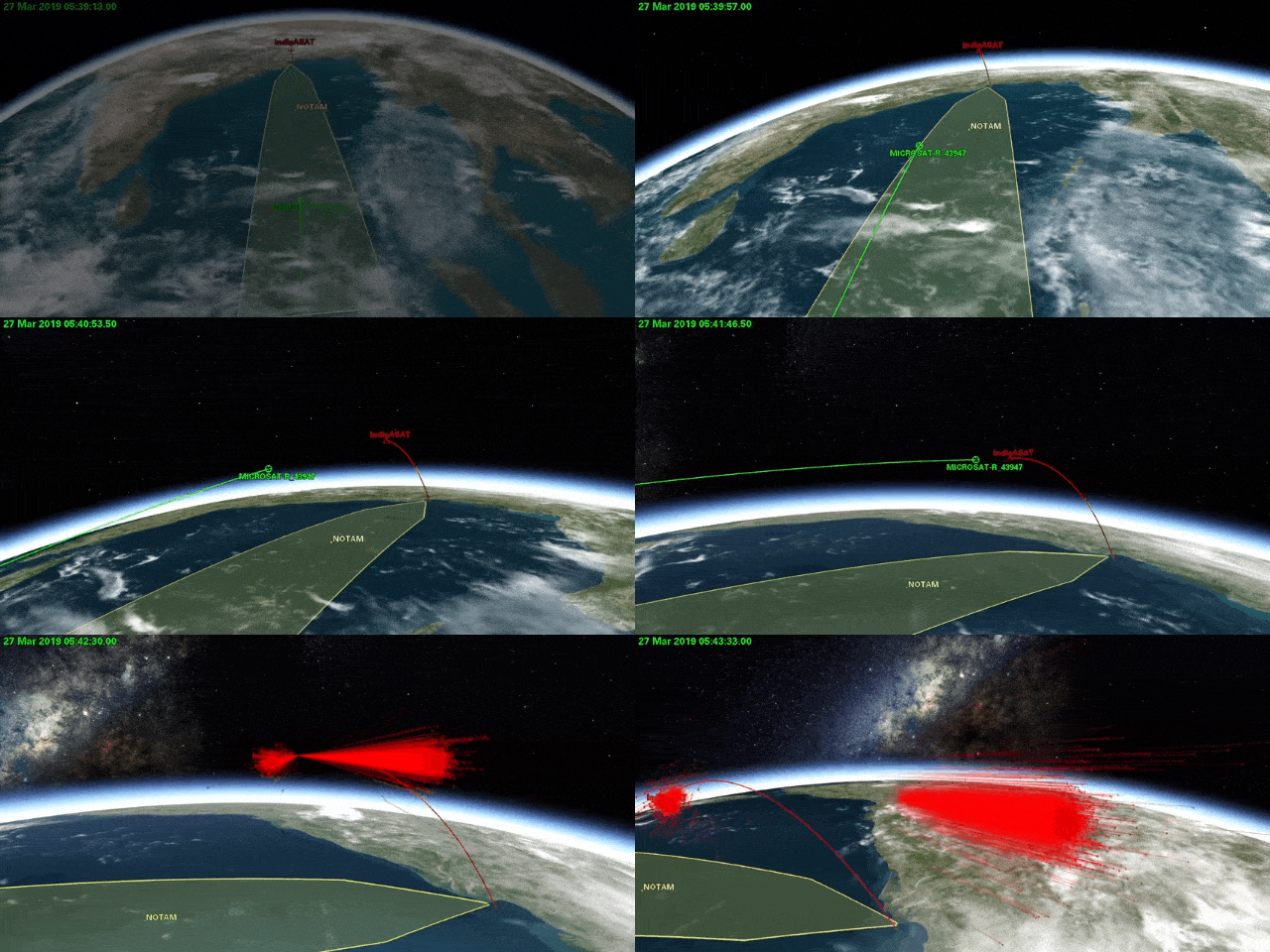
India’s Anti-Satellite Test Could Threaten the International Space Station

Last week, Indian Prime Minister Narendra Modi said the country’s space agency had tested a new anti-satellite weapon by destroying a satellite already in orbit. Now, an announcement by NASA Administrator Jim Bridenstine claims that India’s test could endanger other satellites and objects in orbit—including the International Space Station.

India launched a missile at a satellite believed to be the Indian spy satellite Microsat-r, launched a few months ago. The blowup created a field of satellite debris at that altitude. That debris is a problem because it sits at the same altitude as the ISS. In a worst-case scenario, some of that debris could impact the station creating a Gravity-esque scenario. Some of those pieces are too small for NASA to track, meaning we’ll have no way of predicting an impact beforehand.

“What we are tracking right now, objects big enough to track — we’re talking about 10 cm (4 inches) or bigger —about 60 pieces have been tracked,” Bridenstine said in an announcement on Monday.

India deliberately targeted a satellite that orbited at a lower altitude than the ISS to prevent this sort of situation, but some of the debris appears to have reached higher. Of those 60 debris objects tracked by NASA, Bridenstine says 24 of them are at the same altitude as the ISS or higher.

The nature of low Earth orbit means that even debris pieces residing above the ISS could still pose a threat. Satellites and debris are gradually slowed by the very thin atmosphere that resides there. The ISS, for instance, routinely has to fire its boosters to increase its altitude to counteract atmospheric drag.

Those small debris pieces will lose altitude over time and eventually burn up in the atmosphere, but the high-altitude debris will have to come in range of the ISS before that happens. That means an impact could happen even a few months from now as high-altitude debris continues to fall.

Source: India’s Anti-Satellite Test Could Threaten the International Space Station

The head of the United States’ National Aeronautics and Space Administration (NASA), Jim Bridenstine, on Tuesday branded India’s destruction of one of its satellites a “terrible thing” that had created 400 pieces of orbital debris and led to new dangers for astronauts aboard the International Space Station (ISS).

Mr. Bridenstine was addressing employees of the NASA five days after India shot down a low-orbiting satellite in a missile test to prove it was among the world’s advanced space powers.

Not all of the pieces were big enough to track, Mr. Bridenstine explained. “What we are tracking right now, objects big enough to track — we’re talking about 10 cm [six inches] or bigger — about 60 pieces have been tracked.”

The Indian satellite was destroyed at a relatively low altitude of 300 km, well below the ISS and most satellites in orbit.

But 24 of the pieces “are going above the apogee of the ISS,” said Mr. Bridenstine.

“That is a terrible, terrible thing to create an event that sends debris at an apogee that goes above the International Space Station. That kind of activity is not compatible with the future of human spaceflight. It’s unacceptable and NASA needs to be very clear about what its impact to us is,” he said.

But the risk will dissipate over time as much of the debris will burn up as it enters the atmosphere.

The U.S. military tracks objects in space to predict the collision risk of the ISS and satellites.

They are currently tracking 23,000 objects larger than 10 cm.

Chinese test created 3,000 debris

That includes about 10,000 pieces of space debris, of which nearly 3,000 were created by a single event: a Chinese anti-satellite test in 2007 at 530 miles from the surface.

As a result of the Indian test, the risk of collision with the ISS has increased by 44 percent over 10 days, Mr. Bridenstine said.

https://www.thehindu.com/sci-tech/technology/indias-asat-missile-test-created-400-pieces-of-debris-endangering-iss-nasa/article26708817.ece

Soon after the ASAT test, India said it was done in the lower atmosphere to ensure that there is no space debris. “Whatever debris that is generated will decay and fall back onto the earth within weeks.”

By conducting the test, the Ministry of External Affairs in New Delhi said, India was not in violation of any international law or treaty to which it is a party to or any national obligation.

Interestingly, Bridenstine is the first top official from the Trump administration to come out in public against the India’s ASAT test.

A day after India successfully carried out its ASAT test, acting US defence secretary Patrick Shanahan warned that the event could create a “mess” in space but said Washington was still studying the impact.

Bridenstine said the NASA is “learning more and more every hour” that goes by about this orbital debris field that has been created from the anti-satellite test.

“Where we were last week with an assessment that comes from NASA experts as well as the Joint Space Operations Center (part of US Strategic Command).. is that the risk to the International Space Station has increased by 44 per cent,” Bridenstine said.

“We are charged with commercialising of low earth orbit. We are charged with enabling more activities in space than we’ve ever seen before for the purpose of benefiting the human condition, whether it’s pharmaceuticals or printing human organs in 3D to save lives here on earth or manufacturing capabilities in space that you’re not able to do in a gravity well,” he said.

“All of those are placed at risk when these kinds of events happen,” Bridenstine said as he feared India’s ASAT test could risk proliferation of such activities by other countries.

“When one country does it, other countries feel like they have to do it as well,” he said.

“It’s unacceptable. The NASA needs to be very clear about what its impact to us is,” he said.

Risk gone up 44% over 10 days

The risk from small debris as a result of the ASAT test to the ISS went up 44 per cent over a period of 10 days. “So, the good thing is it’s low enough in earth orbit that over time this will all dissipate,” he told his NASA colleagues.

The ISS is a habitable artificial satellite, orbiting the Earth at an altitude between 330 and 435 km. It is a joint project between space agencies of US, Russia, Japan, Europe and Canada, and serves as a research laboratory for scientists to conduct space experiments.

As many as 236 astronauts from 18 countries have visited the space station, many of them multiple times, since November 2000.

Bridenstine said a lot of debris from the 2007 direct ascent anti-satellite test by China is still in the space.

“And we’re still dealing with it. We are still, we as a nation are responsible for doing space situational awareness and space traffic management, conjunction analysis for the entire world,” the NASA chief said.

“The International Space Station is still safe. If we need to manoeuvre it, we will. The probability of that I think is low. But at the end of the day we have to be clear also that these activities are not sustainable or compatible with human spaceflight,” he said.

https://www.thehindubusinessline.com/news/science/indias-shooting-down-of-satellite-created-400-pieces-of-debris-put-iss-at-risk-nasa/article26709952.ece

Former NSA spies hacked BBC host, Al Jazeera chairman for UAE

A group of American hackers who once worked for U.S. intelligence agencies helped the United Arab Emirates spy on a BBC host, the chairman of Al Jazeera and other prominent Arab media figures during a tense 2017 confrontation pitting the UAE and its allies against the Gulf state of Qatar.

The American operatives worked for Project Raven, a secret Emirati intelligence program that spied on dissidents, militants and political opponents of the UAE monarchy. A Reuters investigation in January revealed Project Raven’s existence and inner workings, including the fact that it surveilled a British activist and several unnamed U.S. journalists.

The Raven operatives — who included at least nine former employees of the U.S. National Security Agency and the U.S. military — found themselves thrust into the thick of a high-stakes dispute among America’s Gulf allies. The Americans’ role in the UAE-Qatar imbroglio highlights how former U.S. intelligence officials have become key players in the cyber wars of other nations, with little oversight from Washington.

[…]

Dana Shell Smith, the former U.S. ambassador to Qatar, said she found it alarming that American intelligence veterans were able to work for another government in targeting an American ally. She said Washington should better supervise U.S. government-trained hackers after they leave the intelligence community.

“Folks with these skill sets should not be able to knowingly or unknowingly undermine U.S. interests or contradict U.S. values,” Smith told Reuters.

Source: Former NSA spies hacked BBC host, Al Jazeera chairman for UAE

Wait, so once you are trained for something by the US government, basically you have entered into an enslaved indenture? You may only work for who the US decides you may work for ever after? Or… what, they assassinate you?

D.E.A. Secretly Collected Bulk Records of Money-Counter Purchases

WASHINGTON — The Drug Enforcement Administration secretly collected data in bulk about Americans’ purchases of money-counting machines — and took steps to hide the effort from defendants and courts — before quietly shuttering the program in 2013 amid the uproar over the disclosures by the National Security Agency contractor Edward Snowden, an inspector general report found.

Seeking leads about who might be a drug trafficker, the D.E.A. started in 2008 to issue blanket administrative subpoenas to vendors to learn who was buying money counters. The subpoenas involved no court oversight and were not pegged to any particular investigation. The agency collected tens of thousands of records showing the names and addresses of people who bought the devices.

The public version of the report, which portrayed the program as legally questionable, blacked out the device whose purchase the D.E.A. had tracked. But in a slip-up, the report contained one uncensored reference in a section about how D.E.A. policy called for withholding from official case files the fact that agents first learned the names of suspects from its database of its money-counter purchases.

[…]

The report cited field offices’ complaints that the program had wasted time with a high volume of low-quality leads, resulting in agents scrutinizing people “without any connection to illicit activity.” But the D.E.A. eventually refined its analysis to produce fewer but higher-quality leads, and the D.E.A. said it had led to arrests and seizures of drugs, guns, cars and illicit cash.

The idea for the nationwide program originated in a D.E.A. operation in Chicago, when a subpoena for three months of purchase records from a local store led to two arrests and “significant seizures of drugs and related proceeds,” it said.

But Sarah St. Vincent, a Human Rights Watch researcher who flagged the slip-up on Twitter, argued that it was an abuse to suck Americans’ names into a database that would be analyzed to identify criminal suspects, based solely upon their purchase of a lawful product.

[…]

In the spring of 2013, the report said, the D.E.A. submitted its database to a joint operations hub where law enforcement agencies working together on organized crime and drug enforcement could mine it. But F.B.I. agents questioned whether the data had been lawfully acquired, and the bureau banned its officials from gaining access to it.

The F.B.I. agents “explained that running all of these names, which had been collected without foundation, through a massive government database and producing comprehensive intelligence products on any ‘hits,’ which included detailed information on family members and pictures, ‘didn’t sit right,’” the report said.

Source: D.E.A. Secretly Collected Bulk Records of Money-Counter Purchases

Bezos’ Investigator Gavin de Becker Finds the Saudis Obtained the Amazon Chief’s Private Data (for the dick pic extortion thing a few weeks ago)

In January, the National Enquirer published a special edition that revealed an intimate relationship Bezos was having. He asked me to learn who provided his private texts to the Enquirer, and why. My office quickly identified the person whom the Enquirer had paid as a source: a man named Michael Sanchez, the now-estranged brother of Lauren Sanchez, whom Bezos was dating. What was unusual, very unusual, was how hard AMI people worked to publicly reveal their source’s identity. First through strong hints they gave to me, and later through direct statements, AMI practically pinned a “kick me” sign on Michael Sanchez.

“It was not the White House, it was not Saudi Arabia,” a company lawyer said on national television, before telling us more: “It was a person that was known to both Bezos and Ms. Sanchez.” In case even more was needed, he added, “Any investigator that was going to investigate this knew who the source was,” a very helpful hint since the name of who was being investigated had been made public 10 days earlier in a Daily Beast report.

Much was made about a recent front-page story in the Wall Street Journal, fingering Michael Sanchez as the Enquirer’s source—but that information was first published almost seven weeks ago by The Daily Beast, after “multiple sources inside AMI” told The Daily Beast the exact same thing. The actual news in the Journal article was that its reporters were able to confirm a claim Michael Sanchez had been making: It was the Enquirer who first contacted Michael Sanchez about the affair, not the other way around.

AMI has repeatedly insisted they had only one source on their Bezos story, but the Journal reports that when the Enquirer began conversations with Michael Sanchez, they had “already been investigating whether Mr. Bezos and Ms. Sanchez were having an affair.” Michael Sanchez has since confirmed to Page Six that when the Enquirer contacted him back in July, they had already “seen text exchanges” between the couple. If accurate, the WSJ and Page Six stories would mean, clearly and obviously, that the initial information came from other channels—another source or method.

[On Sunday, AMI issued a statement insisting that “it was Michael Sanchez who tipped the National Enquirer off to the affair on Sept. 10, 2018, and over the course of four months provided all of the materials for our investigation.” Read the full statement here. — ed.]

“Bezos directed me to ‘spend whatever is needed’ to learn who may have been complicit in the scheme, and why they did it. That investigation is now complete.”

Reality is complicated, and can’t always be boiled down to a simple narrative like “the brother did it,” even when that brother is a person who certainly supplied some information to a supermarket tabloid, and even when that brother is an associate of Roger Stone and Carter Page. Though interesting, it turns out those truths are also too simple.

Why did AMI’s people work so hard to identify a source, and insist to the New York Times and others that he was their sole source for everything?

My best answer is contained in what happened next: AMI threatened to publish embarrassing photos of Jeff Bezos unless certain conditions were met. (These were photos that, for some reason, they had held back and not published in their first story on the Bezos affair, or any subsequent story.) While a brief summary of those terms has been made public before, others that I’m sharing are new—and they reveal a great deal about what was motivating AMI.

An eight-page contract AMI sent for me and Bezos to sign would have required that I make a public statement, composed by them and then widely disseminated, saying that my investigation had concluded they hadn’t relied upon “any form of electronic eavesdropping or hacking in their news-gathering process.”

Note here that I’d never publicly said anything about electronic eavesdropping or hacking—and they wanted to be sure I couldn’t.

They also wanted me to say our investigation had concluded that their Bezos story was not “instigated, dictated or influenced in any manner by external forces, political or otherwise.” External forces? Such a strange phrase. AMI knew these statements did not reflect my conclusions, because I told AMI’s Chief Content Officer Dylan Howard (in a 90-minute recorded phone call) that what they were asking me to say about external forces and hacking “is not my truth,” and would be “just echoing what you are looking for.”

(Indeed, an earlier set of their proposed terms included AMI making a statement “affirming that it undertook no electronic eavesdropping in connection with its reporting and has no knowledge of such conduct”—but now they wanted me to say that for them.)

The contract further held that if Bezos or I were ever in our lives to “state, suggest or allude to” anything contrary to what AMI wanted said about electronic eavesdropping and hacking, then they could publish the embarrassing photos.

Todd Williamson/Getty

I’m writing this today because it’s exactly what the Enquirer scheme was intended to prevent me from doing. Their contract also contained terms that would have inhibited both me and Bezos from initiating a report to law enforcement.

Things didn’t work out as they hoped.

When the terms for avoiding publication of personal photos were presented to Jeff Bezos, he responded immediately: “No thank you.” Within hours, he wrote an essay describing his reasons for rejecting AMI’s threatening proposal. Then he posted it all on Medium, including AMI’s actual emails and their salacious descriptions of private photos. (After the Medium post, AMI put out a limp statement saying it “believed fervently that it acted lawfully in the reporting of the story of Mr. Bezos.”)

The issues Bezos raised in his Medium post have nothing whatsoever to do with Michael Sanchez, any more than revealing the name of a low-level Watergate burglar sheds light on the architects of the Watergate cover-up. Bezos was not expressing concerns about the Enquirer’s original story; he was focused on what he called “extortion and blackmail.”

Next, Bezos directed me to “spend whatever is needed” to learn who may have been complicit in the scheme, and why they did it.

That investigation is now complete. As has been reported elsewhere, my results have been turned over to federal officials. Since it is now out of my hands, I intend today’s writing to be my last public statement on the matter. Further, to respect officials pursuing this case, I won’t disclose details from our investigation. I am, however, comfortable confirming one key fact:

Our investigators and several experts concluded with high confidence that the Saudis had access to Bezos’ phone, and gained private information. As of today, it is unclear to what degree, if any, AMI was aware of the details.

Source: Bezos’ Investigator Gavin de Becker Finds the Saudis Obtained the Amazon Chief’s Private Data

Reuters is a bit shorter on the matter:

WASHINGTON (Reuters) – The security chief for Amazon chief executive Jeff Bezos said on Saturday that the Saudi government had access to Bezos’ phone and gained private information from it.

Gavin De Becker, a longtime security consultant, said he had concluded his investigation into the publication in January of leaked text messages between Bezos and Lauren Sanchez, a former television anchor who the National Enquirer tabloid newspaper said Bezos was dating.

Last month, Bezos accused the newspaper’s owner of trying to blackmail him with the threat of publishing “intimate photos” he allegedly sent to Sanchez unless he said in public that the tabloid’s reporting on him was not politically motivated.

In an article for The Daily Beast website, De Becker said the parent company of the National Enquirer, American Media Inc., had privately demanded that De Becker deny finding any evidence of “electronic eavesdropping or hacking in their newsgathering process.”

“Our investigators and several experts concluded with high confidence that the Saudis had access to Bezos’ phone, and gained private information,” De Becker wrote. “As of today, it is unclear to what degree, if any, AMI was aware of the details.”

https://www.reuters.com/article/us-people-bezos-saudi/saudis-gained-access-to-amazon-ceo-bezos-phone-bezos-security-chief-idUSKCN1RB0RS


A New Age of Warfare: How Internet Mercenaries Do Battle for Authoritarian Governments

NSO and a competitor, the Emirati firm DarkMatter, exemplify the proliferation of privatized spying. A monthslong examination by The New York Times, based on interviews with current and former hackers for governments and private companies and others as well as a review of documents, uncovered secret skirmishes in this burgeoning world of digital combat.

A former top adviser to the Saudi crown prince, Mohammed bin Salman, spoke of using NSO’s products abroad as part of extensive surveillance efforts.CreditGiuseppe Cacace/Agence France-Presse — Getty Images
Image
A former top adviser to the Saudi crown prince, Mohammed bin Salman, spoke of using NSO’s products abroad as part of extensive surveillance efforts.CreditGiuseppe Cacace/Agence France-Presse — Getty Images

The firms have enabled governments not only to hack criminal elements like terrorist groups and drug cartels but also in some cases to act on darker impulses, targeting activists and journalists. Hackers trained by United States spy agencies caught American businesspeople and human rights workers in their net. Cybermercenaries working for DarkMatter turned a prosaic household item, a baby monitor, into a spy device.

The F.B.I. is investigating current and former American employees of DarkMatter for possible cybercrimes, according to four people familiar with the investigation. The inquiry intensified after a former N.S.A. hacker working for the company grew concerned about its activities and contacted the F.B.I., Reuters reported.

NSO and DarkMatter also compete fiercely with each other, paying handsomely to lure top hacking talent from Israel, the United States and other countries, and sometimes pilfering recruits from each other, The Times found.

The Middle East is the epicenter of this new era of privatized spying. Besides DarkMatter and NSO, there is Black Cube, a private company run by former Mossad and Israeli military intelligence operatives that gained notoriety after Harvey Weinstein, the disgraced Hollywood mogul, hired it to dig up dirt on his accusers. Psy-Group, an Israeli company specializing in social media manipulation, worked for Russian oligarchs and in 2016 pitched the Trump campaign on a plan to build an online army of bots and avatars to swing Republican delegate votes.

Last year, a wealthy American businessman, Elliott Broidy, sued the government of Qatar and a New York firm run by a former C.I.A. officer, Global Risk Advisors, for what he said was a sophisticated breach of his company that led to thousands of his emails spilling into public. Mr. Broidy said that the operation was motivated by hard-nosed geopolitics: At the beginning of the Trump administration, he had pushed the White House to adopt anti-Qatar policies at the same time his firm was poised to receive hundreds of millions of dollars in contracts from the United Arab Emirates, the archrival to Qatar.

A judge dismissed Mr. Broidy’s lawsuit, but suspicions have grown that Qatar had a hand in other operations, including the hacking and leaking of the emails of Yousef al-Otaiba, the influential Emirati ambassador in Washington.

The rapid expansion of this global high-tech battleground, where armies of cybermercenaries clash, has prompted warnings of a dangerous and chaotic future.

Source: A New Age of Warfare: How Internet Mercenaries Do Battle for Authoritarian Governments – The New York Times

Paywalls block scientific progress. Research should be open to everyone – how copyright enriches the big boys and kills the little ones all over again

Academic and scientific research needs to be accessible to all. The world’s most pressing problems like clean water or food security deserve to have as many people as possible solving their complexities. Yet our current academic research system has no interest in harnessing our collective intelligence. Scientific progress is currently thwarted by one thing: paywalls.

Paywalls, which restrict access to content without a paid subscription, represent a common practice used by academic publishers to block access to scientific research for those who have not paid. This keeps £19.6bn flowing from higher education and science into for-profit publisher bank accounts. My recent documentary, Paywall: The Business of Scholarship, uncovered that the largest academic publisher, Elsevier, regularly has a profit margin between 35-40%, which is greater than Google’s. With financial capacity comes power, lobbyists, and the ability to manipulate markets for strategic advantages – things that underfunded universities and libraries in poorer countries do not have.

Furthermore, university librarians are regularly required to sign non-disclosure agreements on their contract-pricing specifics with the largest for-profit publishers. Each contract is tailored specifically to that university based upon a variety of factors: history, endowment, current enrolment. This thwarts any collective discussion around price structures, and gives publishers all the power.

This is why open access to research matters – and there have been several encouraging steps in the right direction. Plan S, which requires that scientific publications funded by public grants must be published in open access journals or platforms by 2020, is gaining momentum among academics across the globe. It’s been recently backed by Italy’s Compagnia di San Paolo, which receives €150m annually to spend on research, as well as the African Academy of Science and the National Science and Technology Council (NSTC) of Zambia. Plan S has also been endorsed by the Chinese government.

Equally, although the US has lagged behind Europe in taking a stand on encouraging open access to research, this is changing. The University of California system has just announced that it will be ending its longstanding subscription to Elsevier. The state of California also recently passed AB 2192, a law that requires anything funded by the state to be made open access within one year of publication. In January, the US President, Donald Trump, signed into law the Open, Public, Electronic and Necessary (OPEN) Government Data Act, which mandates that US federal agencies publish all non-sensitive government data under an open format. This could cause a ripple effect in other countries and organisations.

But there is a role for individual academics to play in promoting open access, too. All academics need to be familiar with their options and to stop signing over copyright unnecessarily. Authors should be aware they can make a copy of their draft manuscript accessible in some form in addition to the finalised manuscript submitted to publishers. There are helpful resources, such as Authors Alliance which helps researchers manage their rights, and Sherpa/RoMEO, which navigates permissions of individual publishers and author rights. In many cases, researchers can also make their historical catalogue of articles available to the public.

Without an academic collective voice demanding open access to their research, the movement will never completely take off. It’s a case of either giving broad society access to scientific advances or allowing these breakthroughs to stay locked away for financial gain. For the majority of academics, the choice should be easy.

Source: Paywalls block scientific progress. Research should be open to everyone | Jason Schmitt | Education | The Guardian

Toyota Security Breach Exposes Personal Info of 3.1 Million Clients, could be part of Vietnam attack

The personal information of roughly 3.1 million Toyota customers may have been leaked following a security breach of multiple Toyota and Lexus sales subsidiaries, as detailed in a breach notification issued by the car maker today.

As detailed in a press release published on Toyota’a global newsroom, unauthorized access was detected on the computing systems of Tokyo Sales Holdings, Tokyo Tokyo Motor, Tokyo Toyopet, Toyota Tokyo Corolla, Nets Toyota Tokyo, Lexus Koishikawa Sales, Jamil Shoji (Lexus Nerima), and Toyota West Tokyo Corolla.

“It turned out that up to 3.1 million items of customer information may have been leaked outside the company. The information that may have been leaked this time does not include information on credit cards,” says the data breach notification.

[…]

Security experts consider the attacks targeting Toyota’s subsidiaries and dealers to be part of a large scale coordinated operation attributed to the Vietnamese-backed APT32 hacking group, also known as OceanLotus and Cobalt Kitty, says ZDNet.

FireEye says that APT32 is targeting “foreign companies investing in Vietnam’s manufacturing, consumer products, consulting and hospitality sectors.”

APT32 also targeted research institutes from around the world, media organizations, various human rights organizations, and even Chinese maritime construction firms in the past. [1, 2, 3, 4, 5, 6, 7]

Source: Toyota Security Breach Exposes Personal Info of 3.1 Million Clients

No mention of what data exactly was stolen, which is worrying.

The hidden backdoor in Intel processors is a fascinating debug port (you have to pwner to use it anyway)

Researchers at the Black Hat Asia conference this week disclosed a previously unknown way to tap into the inner workings of Intel’s chip hardware.

The duo of Mark Ermolov and Maxim Goryachy from Positive Technologies explained how a secret Chipzilla system known as Visualization of Internal Signals Architecture (VISA) allows folks to peek inside the hidden workings and mechanisms of their CPU chipsets – capturing the traffic of individual signals and snapshots of the chip’s internal architecture in real time – without any special equipment.

To be clear, this hidden debug access is not really a security vulnerability. To utilize the channel, you must exploit a 2017 elevation-of-privilege vulnerability, or one similar to it, which itself requires you to have administrative or root-level access on the box. In other words, if an attacker can even get at VISA on your computer, it was already game over for you: they need admin rights.

Rather, Ermolov and Goryachy explained, the ability to access VISA will largely be of interest to researchers and chip designers who want to get a window into the lowest of the low-level operations of Chipzilla’s processor architecture.

What lies within

VISA is one of a set of hidden, non-publicly or partially publicly documented, interfaces called Trace Hub that Intel produced so that its engineers can see how data moves through the chips, and to help debug the flow of information between the processor and other hardware components. Specifically, the Platform Controller Hub, which hooks up CPU cores to the outside world of peripherals and other IO hardware, houses Trace Hub and VISA.

“This technology allows access to the internal CPU bus used to read and write memory,” the duo told The Register. “Using it, anyone now can investigate various aspects of hardware security: access control, internal addressing, and private configuration.”

Alongside VISA is an on-chip logic analyzer, and mechanisms for measuring architecture performance, inspecting security fuses, and monitoring things like speculative execution and out-of-order execution.

So, if the VISA controller isn’t much help to directly pwn someone else’s computer, where would it have use for non-Intel folks? Goryachy and Ermolov say that hardware hackers and researchers focused on the inner-workings of Intel chips would find VISA of great use when trying to suss out possible side-channel or speculative execution issues, secret security configurations, and so on.

“For example, the main issue while studying the speculative execution is getting feedback from the hardware,” they explained. “This technology provides an exact way to observe the internal state of the CPU or system-on-chip, and confirm any suppositions.”

The full slide presentation for the VISA system can be found on the Black Hat Asia website and demo videos are here. ®

Source: Ignore the noise about a scary hidden backdoor in Intel processors: It’s a fascinating debug port • The Register

Tesla Model 3 records data unknown to you, sends it to Tesla without your knowledge and keeps a whole load of other data  too.

Many other cars download and store data from users, particularly information from paired cellphones, such as contact information. The practice is widespread enough that the US Federal Trade Commission has issued advisories to drivers warning them about pairing devices to rental cars, and urging them to learn how to wipe their cars’ systems clean before returning a rental or selling a car they owned.

But the researchers’ findings highlight how Tesla is full of contradictions on privacy and cybersecurity. On one hand, Tesla holds car-generated data closely, and has fought customers in court to refrain from giving up vehicle data. Owners must purchase $995 cables and download a software kit from Tesla to get limited information out of their cars via “event data recorders” there, should they need this for legal, insurance or other reasons.

At the same time, crashed Teslas that are sent to salvage can yield unencrypted and personally revealing data to anyone who takes possession of the car’s computer and knows how to extract it.

[…]

In general, cars have become rolling computers that slurp up personal data from users’ mobile devices to enable “infotainment” features or services. Additional data generated by the car enables and trains advanced driver-assistance systems. Major auto-makers that compete with Tesla’s Autopilot include GM’s Cadillac Super Cruise, Nissan Infiniti’s ProPilot Assist and Volvo’s Pilot Assist system.

But GreenTheOnly and Theo noted that in Teslas, dashboard cameras and selfie cameras can record while the car is parked, even in your garage, and there is no way for an owner to know when they may be doing so. The cameras enable desirable features like “sentry mode.” They also enable wipers to “see” raindrops and switch on automatically, for example.

GreenTheOnly explained, “Tesla is not super transparent about what and when they are recording, and storing on internal systems. You can opt out of all data collection. But then you lose [over-the-air software updates] and a bunch of other functionality. So, understandably, nobody does that, and I also begrudgingly accepted it.”

Theo and GreenTheOnly also said Model 3, Model S and Model X vehicles try to upload autopilot and other data to Tesla in the event of a crash. The cars have the capability to upload other data, but the researchers don’t know if and under what circumstances they attempt to do so.

[…]

The company is one of a handful of large corporations to openly court cybersecurity professionals to its networks, urging those who find flaws in Tesla systems to report them in an orderly process — one that gives the company time to fix the problem before it is disclosed. Tesla routinely pays out five-figure sums to individuals who find and successfully report these flaws.

[…]

However, according to two former Tesla service employees who requested anonymity, when owners try to analyze or modify their own vehicles’ systems, the company may flag them as hackers, alerting Telsa of their skills. Tesla then ensures that these flagged people are not among the first to get new software updates.

Source: Tesla Model 3 keeps data like crash videos, location, phone contacts

Scientists find genetic mutation that makes woman feel no pain

Doctors have identified a new mutation in a woman who is barely able to feel pain or stress after a surgeon who was baffled by her recovery from an operation referred her for genetic testing.

Jo Cameron, 71, has a mutation in a previously unknown gene which scientists believe must play a major role in pain signalling, mood and memory. The discovery has boosted hopes of new treatments for chronic pain which affects millions of people globally.

Cameron, a former teacher who lives in Inverness, has experienced broken limbs, cuts and burns, childbirth and numerous surgical operations with little or no need for pain relief. She sometimes leans on the Aga and knows about it not from the pain, but the smell.

[…]

But it is not only an inability to sense pain that makes Cameron stand out: she also never panics. When a van driver ran her off the road two years ago, she climbed out of her car, which was on its roof in a ditch, and went to comfort the shaking young driver who cut across her. She only noticed her bruises later. She is relentlessly upbeat, and in stress and depression tests she scored zero.

[…]

In a case report published on Thursday in the British Journal of Anaesthesia, the UCL team describe how they delved into Cameron’s DNA to see what makes her so unusual. They found two notable mutations. Together, they suppress pain and anxiety, while boosting happiness and, apparently, forgetfulness and wound healing.

The first mutation the scientists spotted is common in the general population. It dampens down the activity of a gene called FAAH. The gene makes an enzyme that breaks down anandamide, a chemical in the body that is central to pain sensation, mood and memory. Anandamide works in a similar way to the active ingredients of cannabis. The less it is broken down, the more its analgesic and other effects are felt.

The second mutation was a missing chunk of DNA that mystified scientists at first. Further analysis showed that the “deletion” chopped the front off a nearby, previously unknown gene the scientists named FAAH-OUT. The researchers think this new gene works like a volume control on the FAAH gene. Disable it with a mutation like Cameron has and FAAH falls silent. The upshot is that anandamide, a natural cannabinoid, builds up in the system. Cameron has twice as much anandamide as those in the general population

Source: Scientists find genetic mutation that makes woman feel no pain | Science | The Guardian

Cop watchers to probe UK police sharing data on witnesses’ migration status with Home Office

UK cops’ sharing of data with the Home Office will be probed by oversight bodies following a super-complaint from civil rights groups, it was confirmed today.

At the heart of the issue is the way that victims’ and witnesses’ data collected by the police are shared with central government immigration teams.

Liberty and Southall Black Sisters last year lodged a super-complaint against the “systemic and potentially unlawful” practices, which allowed criminals to “weaponise” their victims” immigration status.

An investigation by the rights groups found that victims and witnesses were “frequently reported to immigration enforcement after reporting very serious crimes to the police”.

This, Liberty said, risked deterring people – even those who do not have uncertain immigration statuses – from reporting crime, especially as the victims or witnesses “can be coerced into not reporting” crimes.

[…]

“The only acceptable solution is the formal creation of a ‘firewall’ – a cast-iron promise that personal information collected about victims and witnesses by public services like the police will not be shared with the Home Office for immigration enforcement purposes.”

Liberty proposed this “firewall” idea in its December report into public sector data sharing, arguing that this was the only way to mitigate against the negative impacts of the government’s hostile-environment policies.

The group has repeatedly emphasised these impacts go beyond undocumented migrants, but also affect migrants with regular status “who live in a climate of uncertainty and fear” as well as frontline workers in affected professions.

This was exemplified in last year’s battle to scrap a deal that saw non-clinical patient records shared with the Home Office as GPs voiced concerns it would break the doctor-patient confidentiality and could stop migrants seeking medical treatment

Source: Cop watchers to probe UK police sharing data on witnesses’ migration status with Home Office • The Register

Europe, Japan: D-Wave would really like you to play with its ‘2,000-qubit’ quantum Leap cloud service

Canadian startup D-Wave Systems has extended the availability of its Leap branded cloud-based quantum computing service to Europe and Japan.

With Leap, researchers will be granted free access to a live D-Wave 2000Q machine with – it is claimed – 2,000 quantum bits, or qubits.

Developers will also be free to use the company’s Quantum Application Environment, launched last year, which enables them to write quantum applications in Python.

Each D-Wave 2000Q normally costs around $15m.

It is important to note that the debate on whether D-Wave’s systems can be considered “true” quantum computers has raged since the company released its first commercial product in 2011.

Rather than focusing on maintaining its qubits in a coherent state – like Google, IBM and Intel – the company uses a process called quantum annealing to solve combinatorial optimisation problems. The process is less finnicky but also less useful, which is why D-Wave claims to offer a 2,000-qubit machine, and IBM presents a 20-qubit computer.

And yet D-Wave’s systems are being used by Google, NASA, Volkswagen, Lockheed Martin and BAE – as well as Oak Ridge and Los Alamos National Laboratories, among others.

Source: Europe, Japan: D-Wave would really like you to play with its – count ’em – ‘2,000-qubit’ quantum Leap cloud service • The Register

EU set to adopt vehicle speed limiters and mandatory spies following your every move in the car

Speed limiting technology looks set to become mandatory for all vehicles sold in Europe from 2022, after new rules were provisionally agreed by the EU.

The Department for Transport said the system would also apply in the UK, despite Brexit.

Campaigners welcomed the move, saying it would save thousands of lives.

Road safety charity Brake called it a “landmark day”, but the AA said “a little speed” helped with overtaking or joining motorways.

Safety measures approved by the European Commission included intelligent speed assistance (ISA), advanced emergency braking and lane-keeping technology.

The EU says the plan could help avoid 140,000 serious injuries by 2038 and aims ultimately to cut road deaths to zero by 2050.

EU Commissioner Elzbieta Bienkowska said: “Every year, 25,000 people lose their lives on our roads. The vast majority of these accidents are caused by human error.

“With the new advanced safety features that will become mandatory, we can have the same kind of impact as when safety belts were first introduced.”

What is speed limiting technology and how does it work?

Under the ISA system, cars receive information via GPS and a digital map, telling the vehicle what the speed limit is.

This can be combined with a video camera capable of recognising road signs.

The system can be overridden temporarily. If a car is overtaking a lorry on a motorway and enters a lower speed-limit area, the driver can push down hard on the accelerator to complete the manoeuvre.

A full on/off switch for the system is also envisaged, but this would lapse every time the vehicle is restarted.

How soon will it become available?

It’s already coming into use. Ford, Mercedes-Benz, Peugeot-Citroen, Renault and Volvo already have models available with some of the ISA technology fitted.

However, there is concern over whether current technology is sufficiently advanced for the system to work effectively.

In particular, many cars already have a forward-facing camera, but there is a question mark over whether the sign-recognition technology is up to scratch.

Other approved safety features for European cars, vans, trucks and buses include technology which provides a warning of driver drowsiness and distraction, such as when using a smartphone while driving, and a data recorder in case of an accident.

Media captionTheo Leggett: ‘The car brought us to a controlled halt’

What does it all mean in practice?

Theo Leggett, business correspondent

The idea that cars will be fitted with speed limiters – or to put it more accurately, “intelligent speed assistance” – is likely to upset a lot of drivers. Many of us are happy to break limits when it suits us and don’t like the idea of Big Brother stepping in.

However, the new system as it’s currently envisaged will not force drivers to slow down. It is there to encourage them to do so, and to make them aware of what the limit is, but it can be overridden. Much like the cruise control in many current cars will hold a particular speed, or prevent you exceeding it, until you stamp on the accelerator.

So it’ll still be a free-for-all for speeding motorists then? Not quite. Under the new rules, cars will also be fitted with compulsory data recorders, or “black boxes”.

So if you have an accident, the police and your insurance company will know whether you’ve been going too fast. If you’ve been keeping your foot down and routinely ignoring the car’s warnings, they may take a very dim view of your actions.

In fact, it’s this “spy on board” which may ultimately have a bigger impact on driver behaviour than any kind of speed limiter. It’s easy to get away with reckless driving when there’s only a handful of traffic cops around to stop you. Much harder when there’s a spy in the cab recording your every move.

Source: Road safety: UK set to adopt vehicle speed limiters – BBC News

The EU is doing really well right now – first destroying the internet and now destroying driving…

Hackers Hijacked ASUS Software Updates to Install Backdoors on half a million Computers

Researchers at cybersecurity firm Kaspersky Lab say that ASUS, one of the world’s largest computer makers, was used to unwittingly install a malicious backdoor on thousands of its customers’ computers last year after attackers compromised a server for the company’s live software update tool. The malicious file was signed with legitimate ASUS digital certificates to make it appear to be an authentic software update from the company, Kaspersky Lab says.

ASUS, a multi-billion dollar computer hardware company based in Taiwan that manufactures desktop computers, laptops, mobile phones, smart home systems, and other electronics, was pushing the backdoor to customers for at least five months last year before it was discovered, according to new research from the Moscow-based security firm.

The researchers estimate half a million Windows machines received the malicious backdoor through the ASUS update server, although the attackers appear to have been targeting only about 600 of those systems. The malware searched for targeted systems through their unique MAC addresses. Once on a system, if it found one of these targeted addresses, the malware reached out to a command-and-control server the attackers operated, which then installed additional malware on those machines.

Kaspersky Lab said it uncovered the attack in January after adding a new supply-chain detection technology to its scanning tool to catch anomalous code fragments hidden in legitimate code or catch code that is hijacking normal operations on a machine. The company plans to release a full technical paper and presentation about the ASUS attack, which it has dubbed ShadowHammer, next month at its Security Analyst Summit in Singapore. In the meantime, Kaspersky has published some of the technical details on its website.

Source: Hackers Hijacked ASUS Software Updates to Install Backdoors on Thousands of Computers – Motherboard

New research indicates we transition between 19 different brain phases when sleeping

A rigorous new study has examined the large-scale brain activity of a number of human subjects while sleeping, presenting one of the most detailed investigations into sleep phases conducted to date. The study suggests that instead of the traditional four sleep stages we generally understand the brain moves through, there are in fact at least 19 different identifiable brain patterns transitioned through while sleeping.

Traditionally scientists have identified four distinct stages our brain transitions through in a general sleep cycle – three non-REM sleep phases (N1-3) that culminate in an REM phase. The four stages have been classically determined and delineated using electroencephalographic (EEG) brainwave recordings.

“This way of dividing sleep into stages is really based on historical conventions, many of which date back to the 1930s,” explains Angus Stevner, one of the researchers on the project from the Center for Music in the Brain at Aarhus University. “We’ve come up with a more precise and detailed description of sleep as a higher number of brain networks which change their communication patterns and dynamic characteristics during sleep.”

The new research set out to more comprehensively record whole-brain activity in a number of subjects by using functional magnetic resonance imaging (fMRI). The study began by studying 57 healthy subjects in an fMRI scanner. Each subject was asked to lie in the scanner for 52 minutes with their eyes closed. At the same time, each subject was tracked using an EEG. This allowed the researchers to compare traditional brainwave sleep cycle data with that from the fMRI.

Due to the limited duration of the fMRI data, no subjects were found to enter REM sleep, however, 18 subjects did completely transition from wakefulness through the three non-REM sleep phases according to the EEG data. Highlighting the complexity of brain activity during our wake-to-sleep cycle the researchers confidently chronicled 19 different recurring whole-brain network states.

Mapping these whole-brain states onto traditional EEG-tracked sleep phases revealed a number of compelling correlations. Wakefulness, N2 sleep and N3 sleep all could be represented by specific whole brain states. The range of different fMRI-tracked brain states did reduce as subjects fell into deeper sleep phases, with two different fMRI brain states correlating with N2 sleep, and only one with N3. However, N1 sleep as identified by EEG data, the earliest and least clearly defined sleep phase, did not consistently correspond with any fMRI brain state.

The researchers conclude from this data that N1 is actually a much more complex sleep phase than previously understood. This phase, a strange mix of wakefulness and sleep, seemed to encompass a large range of the 19 different whole-brain network states identified in the fMRI data.

Source: New research indicates we transition between 19 different brain phases when sleeping

Wow, the EU actually voted to break the internet for big business copyright gain

On Tuesday, after years of negotiation and lobbying, and outcry and protests by activists online, members of the EU parliament voted to adopt the Directive on copyright in the Digital Single Market, [PDF] – a collection of rules that ostensibly aim “to ensure that the longstanding rights and obligations of copyright law also apply to the internet,” as the European Parliament puts it.

By “internet,” EU officials are talking mainly about Facebook and Google, though not exclusively. Everyone using the internet in Europe and every company doing business there will be affected in some way, though no one is quite sure how. And therein lies the problem.

“When this first came up, even the original language was so difficult to imagine being successfully implemented, that it was hard to believe anyone would even try to pass it into law,” said Danny O’Brien, international director of the Electronic Frontier Foundation (EFF) in a phone interview with The Register. “Now after it has gone through the mincing machine of the negotiation, it’s even more incoherent.”

What’s in a name?

Among the rules adopted, two have received the lion’s share of attention: Article 15 and Article 17, which used to be called Article 13 and Article 15 until someone had the clever idea to renumber them.

Article 15 (née 13) will require news aggregators like Google News that want to display content from news providers to obtain a license for anything more than “very short extracts.” Google, predictably, has opposed the plan.

Article 15 has been derided as a “link tax” that will damage small publishers and news-related startups.

That’s not true, the European Parliament insists, noting that hyperlinking has explicitly been exempted in the directive.

As for paying up, Google and other content aggregators may choose to shun publishers that demand payment or bestow a competitive advantage (e.g. ranking) to publishers offering favorable licensing terms. Given how publishers in Europe have regretted the loss of visitor traffic that follows from Google excommunication, they may prefer low- or no-cost licensing to obscurity.

Article 17 (née 15) allows websites to be sued for copyright violations by their users, which websites in the US can avoid thanks to Section 230 of the Communications Decency Act.

Article 17, it’s been said, will require internet companies to adopt upload filters to prevent copyright liability arising from users. Essentially, filters may be needed to stop folks submitted copyrighted work to social networks, forums, online platforms, and other sites. That’s a possibility, but not a certainty.

“The draft directive however does not specify or list what tools, human resources or infrastructure may be needed to prevent unremunerated material appearing on the site,” the European Commission explains.

“There is therefore no requirement for upload filters. However, if large platforms do not come up with any innovative solutions, they may end up opting for filters.”

Source: The completely rational take you need on Europe approving Article 13: An ill-defined copyright regime to tame US tech • The Register