Guacamole – Logmein alternative

Apache Guacamole is a clientless remote desktop gateway. It supports standard protocols like VNC, RDP, and SSH.We call it clientless because no plugins or client software are required.Thanks to HTML5, once Guacamole is installed on a server, all you need to access your desktops is a web browser.

Source: Apache Guacamole (incubating)

You set up your own server, then deploy clients on your desktops. Don’t know how well it streams video though…

Boaty McBoatface to go on its first Antarctic mission

A small yellow robot submarine, called Boaty McBoatface after a competition to name a new polar research ship backfired, is being sent on its first Antarctic mission.

Boaty, which has arguably one of the most famous names in recent maritime history, is a new type of autonomous underwater vehicle (AUV), which will be able to travel under ice, reach depths of 6,000 metres, and transmit the data it collects to researchers via a radio link.

Its mission will be to investigate water flow and turbulence in the dark depths of the Orkney Passage, a 3.5km deep region of the Southern Ocean. The data it collects will help scientists understand how the ocean is responding to global warming.

Source: Boaty McBoatface to go on its first Antarctic mission | World news | The Guardian

The real miracle is that the dour bastards at the Natural Environment Research Council (NERC) who opened a competition to name their new ship and then blasted the resultant name, have decided to use the chosen name for something at all, even if it is a sad little submarine.

MXNet – Amazon machine learning Open sourced

MXNet stands for mix and maximize. The idea is to combine the power of declartive programming together with imperative programming. In its core, a dynamic dependency scheduler that automatically parallelizes both symbolic and imperative operations on the fly. A graph optimization layer on top of that makes symbolic execution fast and memory efficient. The library is portable and lightweight, and it scales to multiple GPUs and multiple machines.

Source: MXNet

Cloudbleed: How to deal with it

The duration (2016–09–22 to 2017–02–20) and potential breadth of information exposed is huge — Cloudflare has over 2 million websites on its network, and data from any of these is potentially exposed. Cloudflare has said the actual impact is relatively minor, so I believe only limited amounts of information were actually disseminated. Essentially, broad range of data was potentially at risk, but the risk to any individual piece of data was very low. Regardless, unless it can be shown conclusively that your data was NOT compromised, it would be prudent to consider the possibility it has been compromised.
[…]
From an individual perspective, this is straightforward —the most effective mitigation is to change your passwords. While this is on all probability not necessary (it is unlikely your passwords were exposed in this incident), it will absolutely improve your security from both this potential compromise and many other, far more likely security issues. Cloudflare is behind many of the largest consumer web services (Uber, Fitbit, OKCupid, …), so rather than trying to identify which services are on Cloudflare, the most cautious is use this as an opportunity to rotate ALL passwords on all of your sites. This will improve your security, although the primary benefit is from threats unrelated to this incident.

Source: Cloudbleed: How to deal with it – octal – Medium

Kerala saves Rs 300 crore ($45m) as schools switch to open software

The Kerala government has made a saving of Rs 300 crore through introduction and adoption of Free & Open Source Software (FOSS) in the school education sector, said a state government official on Sunday.

IT became a compulsory subject in Kerala schools from 2003, but it was in 2005 only that FOSS was introduced in a phased manner and started to replace proprietary software. The decision made by the curriculum committee to implement it in the higher secondary sector has also been completed now.

K. Anwar Sadath, executive director IT@School, said they have been entrusted the job for easy classroom transaction of chapters including customisation of applications, teachers’ training, and video tutorials.

“The proprietary version of this software would have incurred a minimum cost of Rs 150,000 per machine in terms of licence fee. Hence, the minimum savings in a year (considering 20,000 machines) is Rs 300 crore. It’s not the cost saving that matters more, but the fact that the Free Software licence enables not only teachers and students but also the general public an opportunity to copy, distribute and share the contents and use it as they wish,” he said.

Source: Kerala saves Rs 300 crore as schools switch to open software

Preinstalled Malware Targeting Mobile Users

The Check Point Mobile Threat Prevention has recently detected a severe infection in 38 Android devices, belonging to a large telecommunications company and a multinational technology company. While this is not unusual, one detail of the attacks stands out. In all instances, the malware was not downloaded to the device as a result of the users’ use, it arrived with it.

According to the findings, the malware were already present on the devices even before the users received them. The malicious apps were not part of the official ROM supplied by the vendor, and were added somewhere along the supply chain. Six of the malware instances were added by a malicious actor to the device’s ROM using system privileges, meaning they couldn’t be removed by the user and the device had to be re-flashed.

Source: Preinstalled Malware Targeting Mobile Users | Check Point Blog

Researchers create new form of matter—supersolid is crystalline and superfluid at the same time

By using lasers to manipulate a superfluid gas known as a Bose-Einstein condensate, the team was able to coax the condensate into a quantum phase of matter that has a rigid structure—like a solid—and can flow without viscosity—a key characteristic of a superfluid. Studies into this apparently contradictory phase of matter could yield deeper insights into superfluids and superconductors, which are important for improvements in technologies such as superconducting magnets and sensors, as well as efficient energy transport. The researchers report their results this week in the journal Nature.

“It is counterintuitive to have a material which combines superfluidity and solidity,” says team leader Wolfgang Ketterle, the John D. MacArthur Professor of Physics at MIT. “If your coffee was superfluid and you stirred it, it would continue to spin around forever.”

Physicists had predicted the possibility of supersolids but had not observed them in the lab. They theorized that solid helium could become superfluid if helium atoms could move around in a solid crystal of helium, effectively becoming a supersolid. However, the experimental proof remained elusive.

Source: Researchers create new form of matter—supersolid is crystalline and superfluid at the same time

Apis Cor. 3D building printer

Apis Cor are the first company to develop a mobile construction 3D printer which is capable of printing whole buildings completely on site.Also we are people. Engineers, managers, builders and inventors sharing one common idea – to change the construction industry so that millions of people will have an opportunity to improve their living conditions.On the six continents of Earth there are families which cannot afford to buy or build a house. A good accommodation is costly. And waiting for it to get construction takes more than a single month.So it used to be. Today – it’s different.Today we have a 3D printing technology, new building materials and a mobile 3D printer to build affordable, eco-friendly houses within a single day, capable of lasting up to 175 years

Source: Who we are | Apis Cor. We print buildings

IBM Q opens up usage of their quantum computer

IBM Q is an industry-first initiative to build commercially available universal quantum computers for business and science. While technologies like AI can find patterns buried in vast amounts of existing data, quantum computers will deliver solutions to important problems where patterns cannot be seen and the number of possibilities that you need to explore to get to the answer are too enormous ever to be processed by classical computers.

Source: IBM Q – US

Sponge can soak up and release spilled oil hundreds of times

A new material can absorb up to 90 times its own weight in spilled oil and then be squeezed out like a sponge and reused, raising hopes for easier clean-up of oil spill sites.

But to determine whether this material could help sort out a big spill in marine waters, they needed to perform a special large-scale test.
Recreating a spill

To do this, the team made an array of square pads of the sponge material measuring around 6 square metres. “We made a lot of the foam, and then these pieces of foam were placed inside mesh bags – basically laundry bags, with sewn channels to house the foam,” Darling says.

The researchers suspended their sponge-filled bags from a bridge over a large pool specially designed for practising emergency responses to oil spills.

They then dragged the sponges behind a pipe spewing crude oil to test the material’s capability to remove oil from the water. They next sent the sponges through a wringer to remove the oil and then repeated the process, carrying out many tests over multiple days.

Source: Sponge can soak up and release spilled oil hundreds of times | New Scientist

Google Cloud can now recognise items in videos

Cloud Video Intelligence API (now in Private Beta) uses powerful deep-learning models, built using frameworks like TensorFlow and applied on large-scale media platforms like YouTube. The API is the first of its kind, enabling developers to easily search and discover video content by providing information about entities (nouns such as “dog,” “flower” or “human” or verbs such as “run,” “swim” or “fly”) inside video content. It can even provide contextual understanding of when those entities appear; for example, searching for “Tiger” would find all precise shots containing tigers across a video collection in Google Cloud Storage.

Announcing Google Cloud Video Intelligence API, and more Cloud Machine Learning updates

Did they just copy the Github project Miles Deep – AI Porn Video Editor which can recognise and classify sexual acts in porn videos and make it more socially acceptable?

Quantum computer learns to ‘see’ trees

Scientists have trained a quantum computer to recognize trees. That may not seem like a big deal, but the result means that researchers are a step closer to using such computers for complicated machine learning problems like pattern recognition and computer vision.

The team used a D-Wave 2X computer, an advanced model from the Burnaby, Canada–based company that created the world’s first quantum computer in 2007

Sciencemag.org

Vault7 – CIA loses control of its’ hacking arsenal, information being provided on Wikileaks

WikiLeaks begins its new series of leaks on the U.S. Central Intelligence Agency. Code-named “Vault 7” by WikiLeaks, it is the largest ever publication of confidential documents on the agency.

The first full part of the series, “Year Zero”, comprises 8,761 documents and files from an isolated, high-security network situated inside the CIA’s Center for Cyber Intelligence in Langley, Virgina. It follows an introductory disclosure last month of CIA targeting French political parties and candidates in the lead up to the 2012 presidential election.

Recently, the CIA lost control of the majority of its hacking arsenal including malware, viruses, trojans, weaponized “zero day” exploits, malware remote control systems and associated documentation. This extraordinary collection, which amounts to more than several hundred million lines of code, gives its possessor the entire hacking capacity of the CIA. The archive appears to have been circulated among former U.S. government hackers and contractors in an unauthorized manner, one of whom has provided WikiLeaks with portions of the archive.

“Year Zero” introduces the scope and direction of the CIA’s global covert hacking program, its malware arsenal and dozens of “zero day” weaponized exploits against a wide range of U.S. and European company products, include Apple’s iPhone, Google’s Android and Microsoft’s Windows and even Samsung TVs, which are turned into covert microphones.

Source: Vault7 – Home

“smart” meters caught simply making up readings

A recent study from researchers at University of Twente (UT) and Amsterdam University of Applied Sciences (AUAS) has found that three-phase static (electronic) energy meters, which are replacing traditional electromechanical meters, can exaggerate energy consumption by as much as 582 per cent.

Estimates of the number of households in the Netherlands with smart meters range from 750,000 to 1.5 million. In the US, smart meter penetration at the end of 2016 has been estimated at 70 million, according to the Edison Foundation [PDF].

The government of the Netherlands aims to replace at least 80 per cent of the energy meters in the country with smart meters by 2020, in keeping with EU goals. EU authorities suggest that smart meters, on average, result in energy savings of 3 per cent.

But as researchers Frank Leferink, Cees Keyer, and Anton Melentjev report, “Some consumers are complaining about their energy bills after replacement of the energy meter, because the registered energy is higher with the static meter compared to the old Ferraris meter.” Smart meter billing problems have also been documented in the US.

Source: Watt the f… Dim smart meters caught simply making up readings • The Register

So what problem are these smart meters solving anyway? Nowadays the energy companies don’t need to send someone to the house to check the meter, a photo will do?

EU takes first steps towards military HQ with MPCC

28 countries backed the Planning and Conduct Capability (MPCC) with a view to it taking over this spring.

The embryonic military headquarters has long been opposed by Britain, the bloc’s leading military power, but the idea was revived by Germany and France after the British voted to leave the EU.

The organisation would command the bloc’s “non-executive military missions”, within the existing EU military staff of the European External Action Service (EEAS). These include the three military training missions the bloc now runs in Mali, Somalia and Central African Republic.

“These missions are important for peacekeeping but also for security in the region,” said Carmelo Abela, foreign minister of Malta, whose country chairs the rotating presidency of the EU.

In the future, this could also cover any capacity-building, monitoring or demobilisation and disarmament military missions.

“We are progressing steadily towards strengthened defence cooperation and we will continue to do more,” EU foreign affairs chief Federica Mogherini said after the ministers’ meeting.

Source: EU takes first steps towards military HQ – EURACTIV.com

It is currently compromised of 30 personel and is designed to simplify the reporting from the (now 3) EU missions to this staff and from there a single report to Brussels.

Keras – deep learning library for Tensorflow and Theano

Keras: Deep Learning library for Theano and TensorFlow
You have just found Keras.

Keras is a high-level neural networks library, written in Python and capable of running on top of either TensorFlow or Theano. It was developed with a focus on enabling fast experimentation. Being able to go from idea to result with the least possible delay is key to doing good research.

Use Keras if you need a deep learning library that:

Allows for easy and fast prototyping (through total modularity, minimalism, and extensibility).
Supports both convolutional networks and recurrent networks, as well as combinations of the two.
Supports arbitrary connectivity schemes (including multi-input and multi-output training).
Runs seamlessly on CPU and GPU.

Source: Keras Documentation

Image-to-Image Translation with Conditional Adversarial Networks

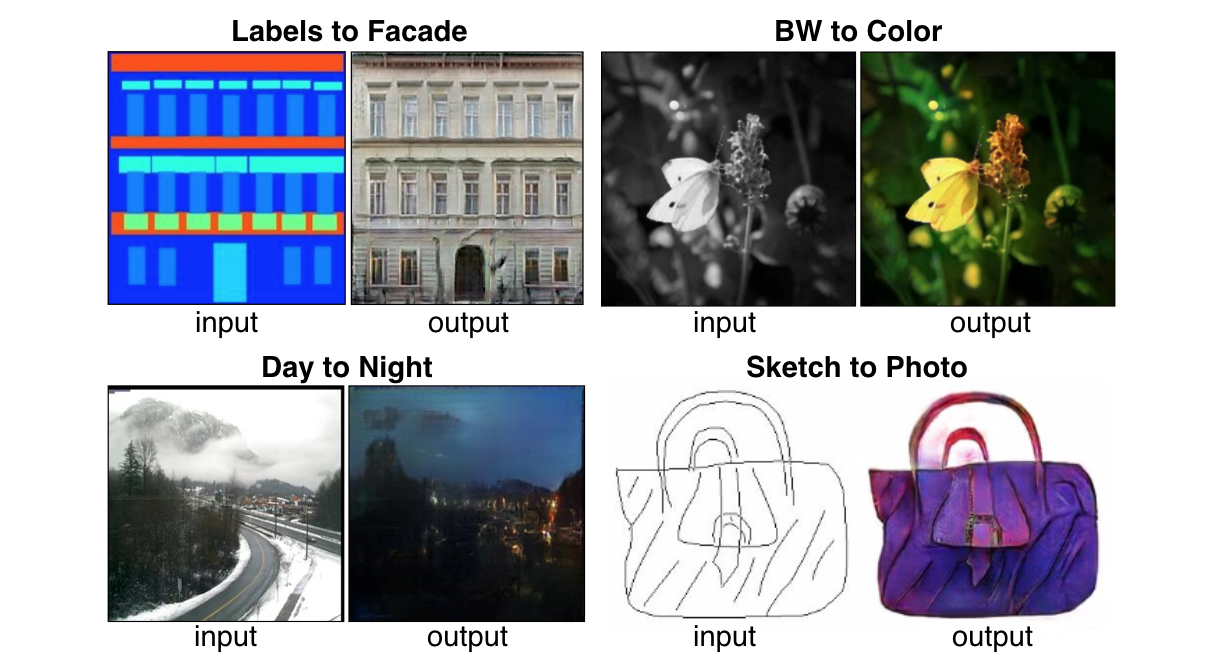
We investigate conditional adversarial networks as a general-purpose solution to image-to-image translation problems. These networks not only learn the mapping from input image to output image, but also learn a loss function to train this mapping. This makes it possible to apply the same generic approach to problems that traditionally would require very different loss formulations. We demonstrate that this approach is effective at synthesizing photos from label maps, reconstructing objects from edge maps, and colorizing images, among other tasks. As a community, we no longer hand-engineer our mapping functions, and this work suggests we can achieve reasonable results without hand-engineering our loss functions either.

Source: Image-to-Image Translation with Conditional Adversarial Networks

This is the pix2pix implementation in Tensorflow

The above link also has concrete examples allowing you to play with the data yourself on level = easy.

Image-to-Image Demo
Interactive Image Translation with pix2pix-tensorflow
Written by Christopher Hesse — February 19th, 2017

This is the man who made the tensorflow port and also uses it to fill in drawings of cats.

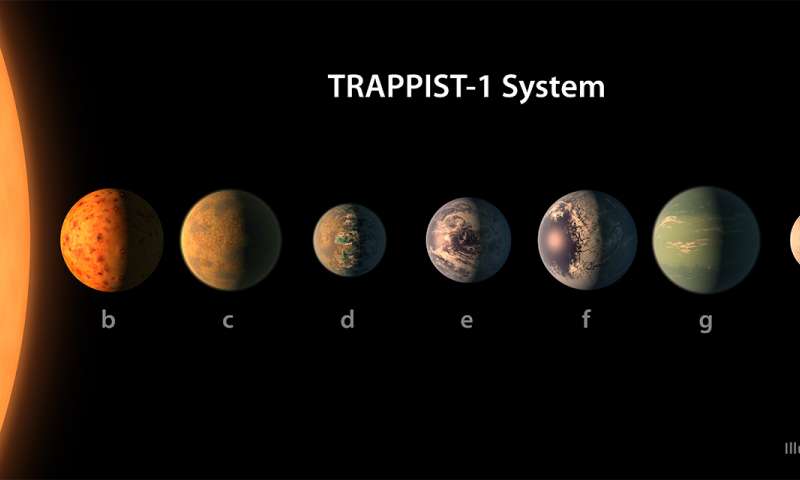
Temperate earth-sized worlds found in extraordinarily rich planetary system

Astronomers have found a system of seven Earth-sized planets just 40 light-years away. They were detected as they passed in front of their parent star, the dwarf star TRAPPIST-1. Three of them lie in the habitable zone and could harbour water, increasing the possibility that the system could play host to life. It has both the largest number of Earth-sized planets yet found and the largest number of worlds that could support liquid water.

Source: Temperate earth-sized worlds found in extraordinarily rich planetary system (Update)

New ETSI group on improving operator experience using Artificial Intelligence

ETSI is pleased to announce the creation of the Industry Specification Group ‘Experiential Network Intelligence’ (ISG ENI).

The purpose of the group is to define a Cognitive Network Management architecture that is based on the “observe-orient-decide-act” control model. It uses AI (Artificial Intelligence) techniques and context-aware policies to adjust offered services based on changes in user needs, environmental conditions and business goals. The system is experiential, in that it learns from its operation and from decisions given to it by operators to improve its knowledge of how to act in the future. This will help operators automate their network configuration and monitoring processes, thereby reducing their operational expenditure and improving the use and maintenance of their networks.

Source: New ETSI group on improving operator experience using Artificial Intelligence

Switched-on DNA: Sparking nano-electronic applications

“It has been established that charge transport is possible in DNA, but for a useful device, one wants to be able to turn the charge transport on and off. We achieved this goal by chemically modifying DNA,” said Tao, who directs the Biodesign Center for Bioelectronics and Biosensors and is a professor in the Fulton Schools of Engineering. “Not only that, but we can also adapt the modified DNA as a probe to measure reactions at the single-molecule level. This provides a unique way for studying important reactions implicated in disease, or photosynthesis reactions for novel renewable energy applications.”

Engineers often think of electricity like water, and the research team’s new DNA switch acts to control the flow of electrons on and off, just like water coming out of a faucet.

Previously, Tao’s research group had made several discoveries to understand and manipulate DNA to more finely tune the flow of electricity through it. They found they could make DNA behave in different ways—and could cajole electrons to flow like waves according to quantum mechanics, or “hop” like rabbits in the way electricity in a copper wire works —creating an exciting new avenue for DNA-based, nano-electronic applications.

Source: Switched-on DNA: Sparking nano-electronic applications