‘Zeno effect’ verified, Heisenberg uncertainty principle controlled: Atoms won’t move while you watch

The researchers observed the atoms under a microscope by illuminating them with a separate imaging laser. A light microscope can’t see individual atoms, but the imaging laser causes them to fluoresce, and the microscope captured the flashes of light. When the imaging laser was off, or turned on only dimly, the atoms tunneled freely. But as the imaging beam was made brighter and measurements made more frequently, the tunneling reduced dramatically.“This gives us an unprecedented tool to control a quantum system, perhaps even atom by atom,[…]Using this tuning, we’ve also been able to demonstrate an effect called ‘emergent classicality’ in this quantum system.” Quantum effects fade, and atoms begin to behave as expected under classical physics.

Source: ‘Zeno effect’ verified: Atoms won’t move while you watch | Cornell Chronicle

The famous Heisenberg uncertainty principle says that position and velocity of a particle are related and cannot be simultaneously measured precisely.
Mimic, the Evil Script That Will Drive Programmers To Insanity

Mimic implements a devilishly sick idea floated on Twitter by Peter Ritchie: “Replace a semicolon (;) with a Greek question mark (;) in your friend’s C# code and watch them pull their hair out over the syntax error.” There are quite a few characters in the Unicode character set that look, to some extent or another, like others – homoglyphs. Mimic substitutes common ASCII characters for obscure homoglyphs. Caution: using this script may get you fired and/or beaten to a pulp.

Source: Mimic, the Evil Script That Will Drive Programmers To Insanity – Slashdot

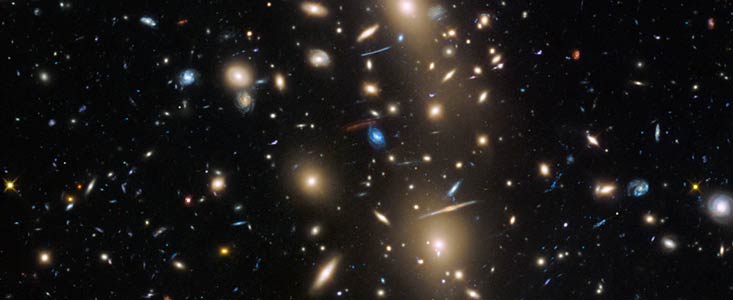
Galaxies formed just after Big Bang viewed

Observations by the NASA/ESA Hubble Space Telescope have taken advantage of gravitational lensing to reveal the largest sample of the faintest and earliest known galaxies in the Universe. Some of these galaxies formed just 600 million years after the Big Bang and are fainter than any other galaxy yet uncovered by Hubble. The team has determined, for the first time with some confidence, that these small galaxies were vital to creating the Universe that we see today.

Source: Hubble spies Big Bang frontiers | ESA/Hubble