Hundreds of South Korean motel guests were secretly filmed and live-streamed online

About 1,600 people have been secretly filmed in motel rooms in South Korea, with the footage live-streamed online for paying customers to watch, police said Wednesday.

Two men have been arrested and another pair investigated in connection with the scandal, which involved 42 rooms in 30 accommodations in 10 cities around the country. Police said there was no indication the businesses were complicit in the scheme.
In South Korea, small hotels of the type involved in this case are generally referred to as motels or inns.
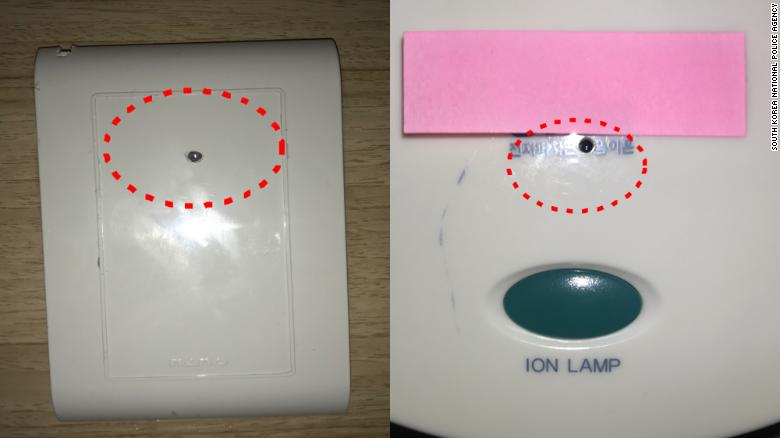
Cameras were hidden inside digital TV boxes, wall sockets and hairdryer holders and the footage was streamed online, the Cyber Investigation Department at the National Police Agency said in a statement.
Cameras found by police hidden inside a hotel wall outlet (left) and hair dryer stand (right).

The site had more than 4,000 members, 97 of whom paid a $44.95 monthly fee to access extra features, such as the ability to replay certain live streams. Between November 2018 and this month, police said, the service brought in upward of $6,000.
“There was a similar case in the past where illegal cameras were (secretly installed) and were consistently and secretly watched, but this is the first time the police caught where videos were broadcast live on the internet,” police said.
South Korea has a serious problem with spy cameras and illicit filming. In 2017, more than 6,400 cases of illegal filming were reported to police, compared to around 2,400 in 2012.

Source: Hundreds of South Korean motel guests were secretly filmed and live-streamed online – CNN

Google Hit With $1.7 Billion Fine in Europe for Abusing Advertising Dominance

“Google has cemented its dominance in online search adverts and shielded itself from competitive pressure by imposing anti-competitive contractual restrictions on third-party websites,” EU antitrust commissioner Margrethe Vestager said on Wednesday. “This is illegal under EU antitrust rules. The misconduct lasted over 10 years and denied other companies the possibility to compete on the merits and to innovate – and consumers the benefits of competition.”

[…]

Vestager noted that in response to the Android fine, Google has done a better job offering users choices for browsers and search engines.

“We’ve seen in the past that a choice screen can be an effective way to promote user choice,” Vestager said. “It is welcome that Google is stepping up its effort and we will watch closely to see how the choice-screen mechanism evolves.”

In a statement and press conference from Brussels, Vestager described Google’s transgressions that led to the latest fine.

Google’s AdSense, which Vestager called “by far the strongest player in online search advertising” in Europe, works when websites embed search functions and the results are displayed alongside advertisements where the revenue is split with publishers.

In contracts with customers reviewed by investigators, Google at various times prohibited any search advertisements from competitors like Microsoft or Yahoo, prohibited any competitors ads from displaying above their own and also required publishers to get written approval from Google before changing the way they handle advertisements from tech rivals.

“Google’s rivals were not able to compete on the merits, either because there was an outright prohibition for them to appear on publisher websites or because Google reserved for itself by far the most valuable commercial space on those websites, while at the same time controlling how rival search adverts could appear,” Vestager said. “Google’s practices amount to an abuse of Google’s dominant position in the online search advertising intermediation market by preventing competition on the merits.”

Source: Google Hit With $1.7 Billion Fine in Europe for Abusing Advertising Dominance

Scientists grow mini-brain that can contract muscle, connect to spinal cord

Scientists have grown a miniature brain in a dish with a spinal cord and muscles attached, an advance that promises to accelerate the study of conditions such as motor neurone disease.

The lentil-sized grey blob of human brain cells were seen to spontaneously send out tendril-like connections to link up with the spinal cord and muscle tissue, which was taken from a mouse. The muscles were then seen to visibly contract under the control of the so-called brain organoid.

The research is is the latest in a series of increasingly sophisticated approximations of the human brain grown in the laboratory – this time with something approaching a central nervous system attached.

Madeline Lancaster, who led the work at the Medical Research Council’s Laboratory of Molecular Biology in Cambridge, said: “We like to think of them as mini-brains on the move.”

The scientists used a new method to grow the miniature brain from human stem cells, which allowed the organoid to reach a more sophisticated stage of development than previous experiments. The latest blob shows similarities, in terms of the variety of neurons and their organisation, to the human foetal brain at 12-16 weeks of pregnancy.

However, the scientists said the structure was still too small and primitive to have anything approaching thoughts, feelings or consciousness.

“It’s still a good idea to have that discussion every time we take it a step further,” said Lancaster. “But we agree generally that we’re still very far away from that.”

While a fully developed human brain has 80-90bn neurons, the organoid has a couple of million, placing it somewhere between a cockroach and a zebrafish in terms of volume of grey matter.

Previously, the sophistication of the organoids scientists had been able to achieve had been limited by the lack of a nutrient supply to the centre of the blob. Once it reached a certain size, the neurons in the centre would become cut off from their nutrient supply and start to die off, and the structure would stop developing.

In the latest research, the scientists grew the organoid and then used a tiny vibrating blade to cut it into half millimetre-thick slices which were placed on a membrane, floating on a nutrient-rich liquid. This meant the entire slice had access to energy and oxygen and it continued developing and forming new connections when it was kept in culture for a year.

Alongside the organoid, the scientists added in a 1mm-long spinal cord, taken from a mouse embryo, and the surrounding back muscle. The brain cells automatically began to send out neuronal connections, linked up with the spinal cord and began sending electrical impulses, which caused the muscles to twitch.

The ambition is to use systems like this to study how the human brain and nervous system develop and why things go wrong in illnesses such as motor neurone disease, epilepsy and schizophrenia.

“Obviously we’re not just trying to create something for the fun of it,” said Lancaster. “We want to use this to model diseases and to understand how these networks are set up in the first place.”

Gray Camp, a geneticist at the Institute of Molecular and Clinical Ophthalmology in Basel, Switzerland, who was not involved in the latest work, described the advance as “a big step for the field”. “It’s extremely exciting to see evidence of functional nerve tracts growing out of developing human brain tissue and innervating other tissues,” he said.

The findings are published in the journal Nature Neuroscience.

Source: Scientists grow ‘mini-brain on the move’ that can contract muscle

Apple Spat With Spotify Is a Fight for Its Future—and It’s Failing to Make Its Case

Apple CEO Tim Cook has been more than clear that services like the iOS App Store are an essential part of the company’s future as consumers hang onto devices for longer and longer periods between upgrades. When Spotify filed an antitrust lawsuit against Apple this week, it fired a direct shot at the tech giant’s strategy. Now, Apple has issued its rebuttal to Spotify’s accusations.

Spotify has had its gripes with the App Store on and off for many years. Apple charges apps a fee for “digital goods and services that are purchased inside the app.” In the case of a subscription service like Spotify’s ad-free premium package, that fee is 30 percent for the first year and 15 percent for each additional year. Most apps that charge for digital services just deal with it and cough up the fee. Because iOS is a walled garden, it’s not possible to offer an alternative place to download an app with purchases that avoid Apple’s fees.

If a company is big enough to take the risk, however, it’s possible to get users to enter their payments through a web browser and then link their accounts to the app without handing over fees to Apple. That’s the approach that Spotify and Netflix have decided to take.

But Spotify is tired of giving users an inconvenient method for signing up and paying for its premium service. The company announced this week that it has filed an antitrust lawsuit with the European Commission, accusing Apple of anti-competitive behavior. In response to Spotify CEO Daniel Ek’s blog post explaining his positions, Apple published its rebuttal on Thursday.

The Apple post spends a lot of time explaining its philosophy regarding the app store and goes on at length about empowering developers and creating a platform from scratch—window dressing arguments, in other words. When it came to specifics, Apple straight up denied a few of Spotify’s claims.

For one thing, Spotify claims that because it doesn’t use Apple’s payment system it is routinely penalized with technical and experiential limitations. Ek explained that “over time, this has included locking Spotify and other competitors out of Apple services such as Siri, HomePod, and Apple Watch.” Apple said that it has actively encouraged Spotify to expand its reach on Siri and AirPlay 2 and were told that the company was “working on it.” As for the Apple Watch, it said the claim was “especially surprising” because the Spotify Watch app is currently the number one app in the Watch Music category. Apple spelled out its position in clear terms, saying, “Spotify is free to build apps for—and compete on—our products and platforms, and we hope they do.”

Apple went on to quibble with some other claims that Spotify made, but it failed to address a couple of points. Ek complained that “numerous other apps on the App Store, like Uber or Deliveroo,” don’t have to pay “the Apple tax.” On that point, Apple’s policy is that it only charges for “digital goods and services that are purchased inside the app,” not services that are offered outside in the real world. Whether or not it should apply its fees to everyone regardless of their source of revenue is a topic that’s up for debate.

But as VentureBeat noted, the most glaring omission from Apple’s blog post is that it doesn’t mention Apple Music at all. The crux of Spotify’s argument is that it is directly competing with Apple’s music streaming service but the 30 percent fee requires it to inflate its prices. Since Apple doesn’t have to pay any fees to itself, Spotify believes it has an unfair competitive advantage.

Apple did not immediately respond to our request for comment on this story, but a spokesperson for Spotify sent us the following statement:

Every monopolist will suggest they have done nothing wrong and will argue that they have the best interests of competitors and consumers at heart. In that way, Apple’s response to our complaint before the European Commission is not new and is entirely in line with our expectations.

We filed our complaint because Apple’s actions hurt competition and consumers, and are in clear violation of the law. This is evident in Apple’s belief that Spotify’s users on iOS are Apple customers and not Spotify customers, which goes to the very heart of the issue with Apple. We respect the process the European Commission must now undertake to conduct its review. Please visit www.TimetoPlayFair.com for the facts of our case.

The thing is, Apple is fighting this war on a few fronts. In the coming months, the Supreme Court is expected to rule on a similar case that argues that in the absence of an alternative app store on iOS, the 30 percent fee amounts to a hidden tax on consumers because developers have to bake the fee into their pricing. It appears that Apple wants to keep its arguments focused on the store as a whole rather than directly engaging with points about its own apps.

Aside from the fact that this is probably Spotify’s best angle on the case, Apple may want to avoid the Apple Music argument because it’s also facing calls from Senator Elizabeth Warren to “break up” the App Store. Though Apple has been a minor focus of Warren’s tech policy proposals, she believes that the company shouldn’t be allowed to put its own products in its exclusive store because it can hobble competitors through the kinds of practices that Spotify is describing. “Either they run the platform or they play in the store,” Warren told The Verge. “They don’t get to do both at the same time.”

In the past, I’ve argued that the benefits of Apple’s approach to the App Store outweigh the downsides. I still think that’s true and if you don’t like the Apple way, then you can go use the many other devices available on the market. But I have to admit that Spotify’s specific case has understandable merit. And it is possible that the European Commission’s hard-nosed attitude towards antitrust could work in Spotify’s favor. Though the cases are slightly different, regulators in Europe did rule that Google’s inclusion of the Chrome browser pre-installed on Android devices gave it an unfair advantage.

Source: Apple Spat With Spotify Is a Fight for Its Future—and It’s Failing to Make Its Case

Wireless Quick Charging Mouse Pads

I had no idea that quick charging mouse mats were a thing, but it seems like a great idea. Considering QI has won the wireless charging race, I have selected a few which have LED colours, because I love them. Note, if you buy on Amazon US you often get cheaper prices for the hardware than elsewhere for some reason.

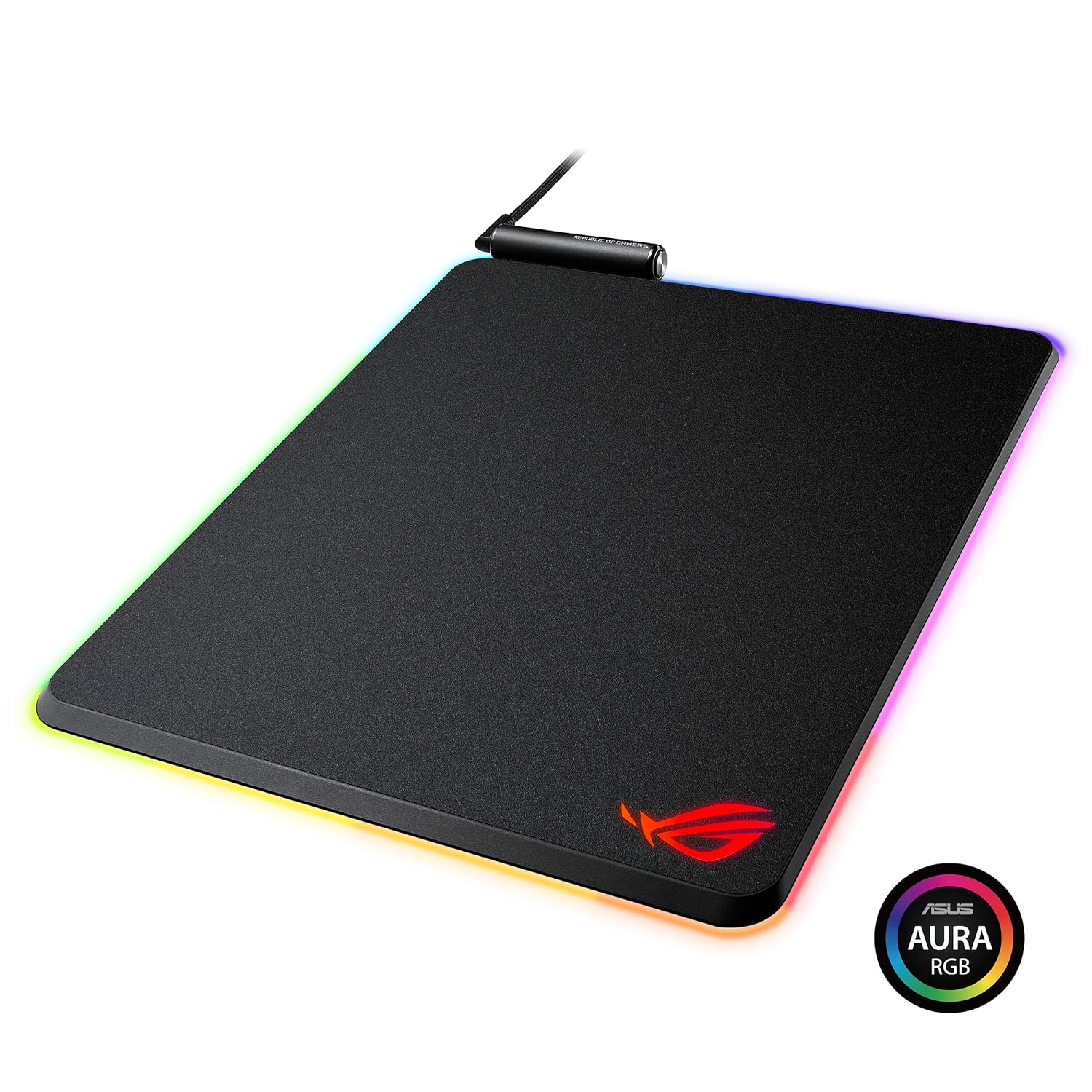
ASUS ROG Balteus Vertical Gaming Mouse Pad with Hard Micro-Textured Gaming Surface, USB Pass-Through, Aura Sync RGB Lighting and Non-Slip Base (12.6” X 14.6”)

  • 12.6” x 14.6” vertical gaming mousepad
  • Hard micro-textured, low-friction gaming surface for smooth gliding and precise control
  • Usb 2.0 pass-through for connecting gaming mice or headsets
  • Lighting mode button can adjust brightness or effects on the fly
  • ASUS Aura Sync RGB lighting features a nearly endless spectrum of colors with the ability to synchronize effects across an ever-expanding ecosystem of AURA Sync enabled products
https://www.linkielist.com/wp-content/uploads/2019/03/91ACunJPTAL._SL1500_.jpg

https://www.amazon.com/ROG-Balteus-Vertical-Micro-Textured-Pass-Through/dp/B07M65DNKH/ref=sr_1_fkmrnull_1?keywords=ROG+Balteus&qid=1552722324&s=gateway&sr=8-1-fkmrnull

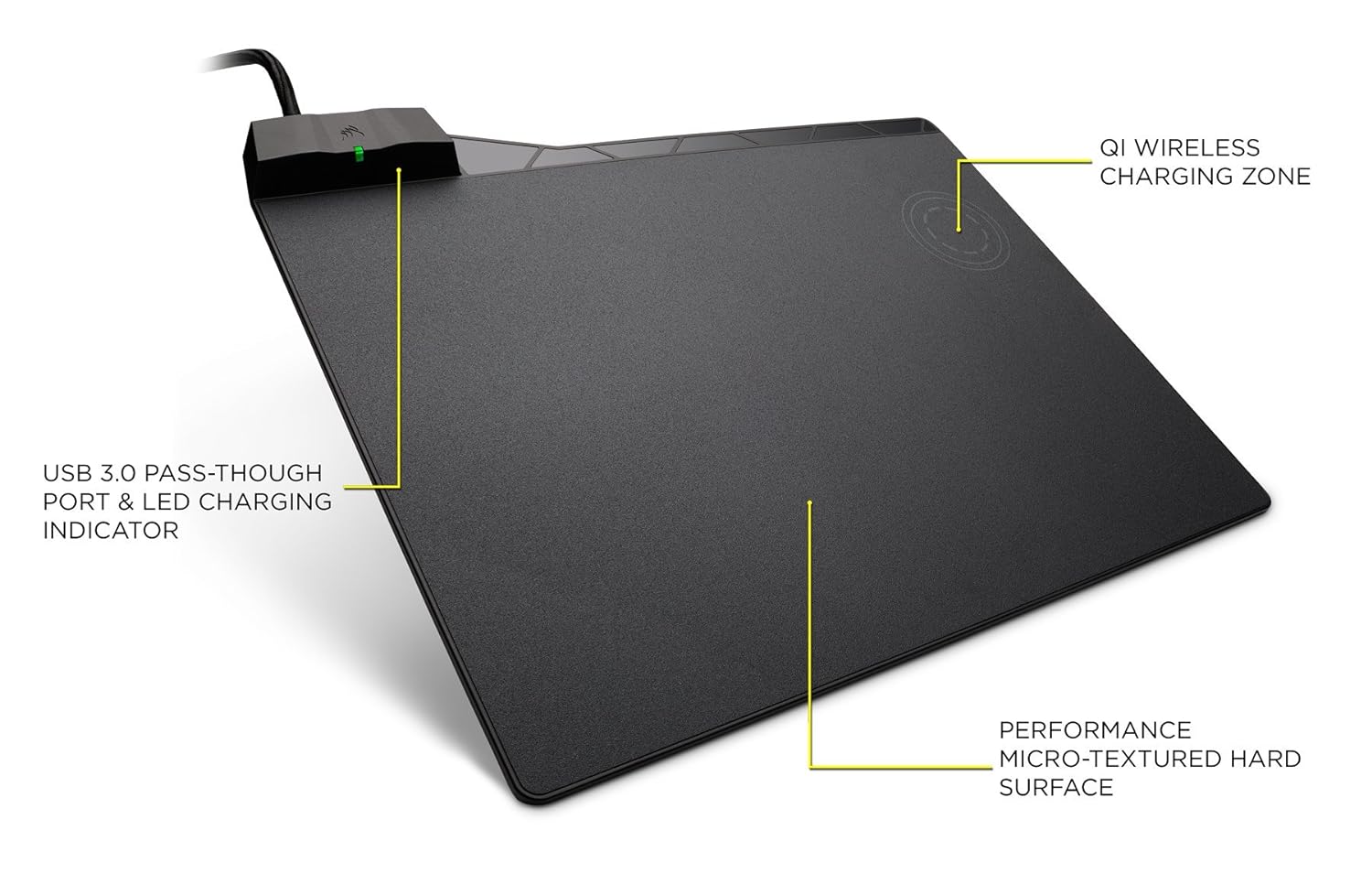
CORSAIR MM1000 Qi Wireless Charging Mouse Pad – Adapters Included for Most Smartphones Including iPhone and Android (CH-9440022-NA)

  • Qi wireless charging allows you to effortlessly charge any QI Certified Device
  • Included USB Micro-B, Type-C and Lightning QI charging adapters enable you to charge almost any other wireless/mobile Device Performance micro-textured Hard surface tuned for Optical or laser mouse precision
  • Convenient USB 3.0 pass-through port for maximum Device compatibility
  • Built-in LED indicator displays charging status at a glance
https://www.linkielist.com/wp-content/uploads/2019/03/71D0F82BHtCL._SL1500_.jpg

https://www.amazon.com/CORSAIR-MM1000-Wireless-Charging-Mouse/dp/B077ZGS1GN


Qi Wireless Fast Charging Mouse Pad Mat for iPhone X iPhone 8 Galaxy S8 S9 Plus Samsung Note 8 9

Input: 9V/1.6A; 5V/2A
Output: 10W (Max).

Material:
Non skid soft lining base protects desktop and keeps the pad in place.
Copper Coil:Built-in circuit protection keeps you and your device safe.

https://www.aliexpress.com/item/Qi-Wireless-Fast-Charging-Mouse-Pad-Mat-for-iPhone-X-iPhone-8-Galaxy-S8-S9-Plus/32952379032.html?spm=2114.search0104.3.275.36ab16adfrHeh2&ws_ab_test=searchweb0_0,searchweb201602_9_10065_10068_319_317_10696_10084_453_10083_454_10618_10304_10307_10820_10821_10301_537_536_10902_10843_10059_10884_10887_321_322_10103,searchweb201603_55,ppcSwitch_0&algo_expid=4fdc03c4-a6a4-4c01-a138-03fdb40bdb5e-39&algo_pvid=4fdc03c4-a6a4-4c01-a138-03fdb40bdb5e


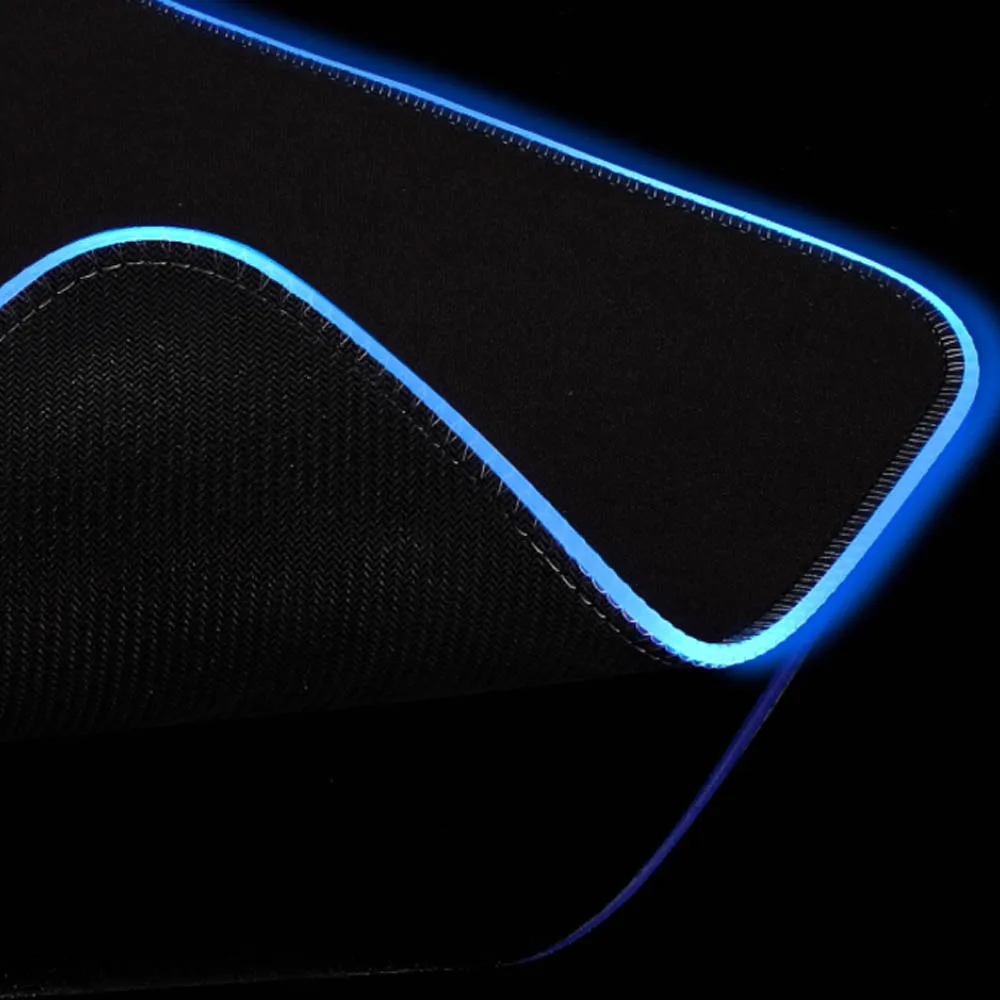
Gaming Mouse Pad RGB Oversized Glowing LED Extended Illuminated Keyboard Thicken Colorful

1、Colorful RGB lights, 9 colors, 10 modes available: red, green, blue, purple, cyan, yellow, white, color, breathing lights.
2、About 4mm/0.16in ultra-thick fine textured fabric with precise positioning and low resistance.
3、Separable USB cable for easy use, convenient storage/portability, foldable.
4、PU non-slip rubber bottom surface, not easy to move.
5、Large size, large mouse activity space, enhance the gaming experience.
Product parameters:
Product Description: Turn on the key to control lighting mode, the default is red light, each press to switch to the next lighting mode:
1.Red 2.Green 3.Blue 4.Purple 5.Cyan 6.Yellow 7.White 8.Automatically switch according to the above color order 9.Fantasy slow flashing 10. Symphony slow flashing 11. Turn off the backlight

Product size: about small 30*25*0.4 cm/11.81*9.84*0.16in   large 78*30*0.4 cm/30.71*11.81*0.16in

Product interface: USB

Product wire: 1.2 m/47.24in black braided data cable

Voltage and current: 5V≤150mA
 

Power: 0.75w

https://www.aliexpress.com/item/Gaming-Mouse-Pad-RGB-Oversized-Glowing-LED-Extended-Illuminated-Keyboard-Thicken-Colorful/32961968489.html?spm=2114.10010108.1000013.2.16166cbe4Od0YC&gps-id=pcDetailBottomMoreThisSeller&scm=1007.13339.99734.0&scm_id=1007.13339.99734.0&scm-url=1007.13339.99734.0&pvid=c183cb4e-d565-4694-bc8f-1c687b5a6fa7

17 Scientists call for global moratorium on gene editing of embryos – where’s the fun in that?

The move is intended to send a clear signal to maverick researchers, and the scientific community more broadly, that any attempt to rewrite the DNA of sperm, eggs or embryos destined for live births is not acceptable.

Beyond a formal freeze on any such work, the experts want countries to register and declare any plans that scientists may put forward in the future, and have these discussed through an international body, potentially run by the World Health Organisation.

Alongside technical debates about the possible benefits of creating genetically modified babies, the scientists said no decisions should be made to go ahead without broad public support.

“What we want to see are wise and open decisions,” said Eric Lander, founding director of the Broad Institute of MIT and Harvard in Cambridge, Massachusetts. “We want to make sure that countries don’t do things secretly, that we declare what we’re thinking, discuss it openly, and be prepared for debate and disagreement.”

Lander, who co-chaired Barack Obama’s council of advisors on science and technology, calls for the moratorium with 16 other experts in the journal Nature. Emmanuelle Charpentier and Feng Zhang, who helped discover and develop the most common gene editing tool, Crispr, contributed to the article.

Source: Scientists call for global moratorium on gene editing of embryos | Science | The Guardian

Designer babies are a great idea, if I could I would definitely create my own! This sounds a bit like an anti-diversity policy to me. Go! Create!

MtGox bitcoin founder gets suspended sentence for data tampering

A Japanese court sentenced the former high-flying creator of the MtGox bitcoin exchange to a suspended jail sentence of two and a half years Friday after finding him guilty of data manipulation.

The Tokyo District Court convicted Mark Karpeles, a 33-year-old computer whizz from France, for tampering with computer data but acquitted him over charges of embezzling millions from client accounts.

The sentence was suspended for four years.

In a summary of the ruling, the court said Karpeles had “harmed the users’ trust greatly” by manipulating data and “abused his expertise as an IT engineer and his position and authority”.

Prosecutors had claimed that Karpeles had pocketed some 341 million yen ($3 million) of client’s money and splashed it on a lavish lifestyle. They called for him to serve 10 years behind bars.

However, in throwing out the embezzlement charges, the judge said there was no financial damage done to MtGox and ruled that Karpeles did not intend to cause any damage.

The judge cited an expert opinion that said owners of small and medium enterprises often borrow funds without proper accounting and ruled that the court assumed Karpeles intended to return the money.

Karpeles entered the courtroom wearing a dark suit and black shoes and he bowed politely to the judge. He was motionless after the verdict was read out.

After the sentencing, the judge asked if Karpeles understood the sentence. Karpeles responded simply: “Yes, I did.”

‘Cold wallet’

MtGox was shut down in 2014 after 850,000 bitcoins (worth half a billion dollars at that time) disappeared from its virtual vaults.

The scandal left a trail of angry investors, rocked the virtual currency community, and dented confidence in the security of .

At one point, MtGox claimed to be handling around 80 percent of all global bitcoin transactions.

During his trial, Karpeles apologised to customers for the company’s bankruptcy but denied both data falsification and embezzlement.

“I swear to God that I am innocent,” Karpeles, speaking in Japanese, told the three-judge panel hearing when his trial opened in 2017.Karpeles always claimed the bitcoins were lost due to an external “hacking attack” and later claimed to have found some 200,000 coins in a “cold wallet”—a storage device not connected to other computers.

“Most people will not believe what I say. The only solution I have is to actually find the real culprits,” he told reporters his trial hearing in July 2017.

Doubts about bitcoin

The acquittal on embezzlement came as a surprise as the vast majority of cases that come to trial in Japan end in a conviction.

Karpeles himself said in an interview with French business daily Les Echos on Wednesday that he had little chance of acquittal.

“All I can hope for is a light sentence which will mean I do not have to go back into detention and do forced work,” he said.

The Frenchman was first arrested in August 2015 and, in an echo of another high-profile case against former Nissan chief and compatriot Carlos Ghosn, was re-arrested several times on different charges.

Karpeles eventually won bail in July 2016—nearly a year after his arrest—paying 10 million yen to secure his freedom pending a trial, which began in July 2017.

During his time on bail, Karpeles has been active on social media—notably voicing doubts about bitcoin and replying to some media questions about conditions in Japanese detention centres.

However, he has largely avoided commenting on his case in detail.

In many ways, the rollercoaster ride of Karpeles has mirrored that of the bitcoin cryptocurrency that made him rich.

At its height in December 2017, the value of a single bitcoin was around $20,000.

It has since slumped and is now worth just under $4,000.

Read more at: https://phys.org/news/2019-03-mtgox-bitcoin-founder-sentence-tampering.html#jCp

Source: MtGox bitcoin founder gets suspended sentence for data tampering

US Air Force buys new  build 70s era vintage F-15EX fleet because F-35 is too expensive

The new-build F-15 was not part of the service’s original budget plans, but was added because the type has lower lifetime operating costs, the USAF acknowledges. The service is committed to buying 72 fighters per year, but cannot afford to purchase only F-35As because of that aircraft’s high operating costs – which average about $35,000 per hour.

“Our challenge was when you look at the force structure that we have there were four fourth-[generation] airplanes – F-16, F-15E, A-10 and F-15C – that we need to fly in [the] 2030s. The F-15C is not going to make it. It is old and it is not going to fly past the mid-20s,” USAF chief of staff General David Goldfein said in testimony to the US Senate Appropriations Committee on 13 March.

“We used the best cost estimate that we had at the time and looked at the various options. The most affordable options – as long as we keep the F-35 absolutely on track with our programme of record – was to look at an F-15 variant to replace the F-15C.”

As part of the Department of Defense’s fiscal year 2020 funding request, the USAF is initially requesting $1.1 billion for eight F-15EXs. The service plans to request 80 of the aircraft in total over the next five years, costing roughly $80 million each. The first F-15EXs are expected to be delivered in FY2022.

Source: US Air Force sees F-15EX as cheap and quick fix

Physicists reverse time using quantum computer

Researchers from the Moscow Institute of Physics and Technology teamed up with colleagues from the U.S. and Switzerland and returned the state of a quantum computer a fraction of a second into the past. They also calculated the probability that an electron in empty interstellar space will spontaneously travel back into its recent past. The study is published in Scientific Reports.

“This is one in a series of papers on the possibility of violating the . That law is closely related to the notion of the arrow of time that posits the one-way direction of time from the past to the future,” said the study’s lead author Gordey Lesovik, who heads the Laboratory of the Physics of Quantum Information Technology at MIPT.

“We began by describing a so-called local perpetual motion machine of the second kind. Then, in December, we published a paper that discusses the violation of the second law via a device called a Maxwell’s demon,” Lesovik said. “The most recent paper approaches the same problem from a third angle: We have artificially created a state that evolves in a direction opposite to that of the thermodynamic arrow of time.”

What makes the future different from the past

Most laws of physics make no distinction between the future and the past. For example, let an equation describe the collision and rebound of two identical billiard balls. If a close-up of that event is recorded with a camera and played in reverse, it can still be represented by the same equation. Moreover, it is not possible to distinguish from the recording if it has been doctored. Both versions look plausible. It would appear that the billiard balls defy the intuitive sense of time.

However, imagine recording a cue ball breaking the pyramid, the billiard balls scattering in all directions. In that case, it is easy to distinguish the real-life scenario from reverse playback. What makes the latter look so absurd is our intuitive understanding of the second law of thermodynamics—an isolated system either remains static or evolves toward a state of chaos rather than order.

Most other laws of physics do not prevent rolling billiard balls from assembling into a pyramid, infused tea from flowing back into the tea bag, or a volcano from “erupting” in reverse. But these phenomena are not observed, because they would require an isolated system to assume a more ordered state without any outside intervention, which runs contrary to the second law. The nature of that law has not been explained in full detail, but researchers have made great headway in understanding the basic principles behind it.

Spontaneous time reversal

Quantum physicists from MIPT decided to check if time could spontaneously reverse itself at least for an individual particle and for a tiny fraction of a second. That is, instead of colliding billiard balls, they examined a solitary electron in empty interstellar space.

“Suppose the electron is localized when we begin observing it. This means that we’re pretty sure about its position in space. The laws of quantum mechanics prevent us from knowing it with absolute precision, but we can outline a small region where the electron is localized,” says study co-author Andrey Lebedev from MIPT and ETH Zurich.

The physicist explains that the evolution of the electron state is governed by Schrödinger’s equation. Although it makes no distinction between the future and the past, the region of space containing the electron will spread out very quickly. That is, the system tends to become more chaotic. The uncertainty of the electron’s position is growing. This is analogous to the increasing disorder in a large-scale system—such as a billiard table—due to the second law of thermodynamics.

The four stages of the actual experiment on a quantum computer mirror the stages of the thought experiment involving an electron in space and the imaginary analogy with billiard balls. Each of the three systems initially evolves from order …more

“However, Schrödinger’s equation is reversible,” adds Valerii Vinokur, a co-author of the paper, from the Argonne National Laboratory, U.S. “Mathematically, it means that under a certain transformation called complex conjugation, the equation will describe a ‘smeared’ electron localizing back into a small region of space over the same time period.” Although this phenomenon is not observed in nature, it could theoretically happen due to a random fluctuation in the cosmic microwave background permeating the universe.The team set out to calculate the probability to observe an electron “smeared out” over a fraction of a second spontaneously localizing into its recent past. It turned out that even across the entire lifetime of the universe—13.7 billion years—observing 10 billion freshly localized electrons every second, the reverse evolution of the particle’s state would only happen once. And even then, the electron would travel no more than a mere one ten-billionth of a second into the past.

Large-scale phenomena involving billiard balls and volcanoes obviously unfold on much greater timescales and feature an astounding number of and other particles. This explains why we do not observe old people growing younger or an ink blot separating from the paper.

Reversing time on demand

The researchers then attempted to reverse time in a four-stage experiment. Instead of an electron, they observed the state of a quantum computer made of two and later three basic elements called superconducting qubits.

  • Stage 1: Order. Each qubit is initialized in the ground state, denoted as zero. This highly ordered configuration corresponds to an electron localized in a small region, or a rack of billiard balls before the break.
  • Stage 2: Degradation. The order is lost. Just like the electron is smeared out over an increasingly large region of space, or the rack is broken on the pool table, the state of the qubits becomes an ever more complex changing pattern of zeros and ones. This is achieved by briefly launching the evolution program on the quantum computer. Actually, a similar degradation would occur by itself due to interactions with the environment. However, the controlled program of autonomous evolution will enable the last stage of the experiment.
  • Stage 3: Time reversal. A special program modifies the state of the quantum computer in such a way that it would then evolve “backwards,” from chaos toward order. This operation is akin to the random microwave background fluctuation in the case of the electron, but this time, it is deliberately induced. An obviously far-fetched analogy for the billiards example would be someone giving the table a perfectly calculated kick.
  • Stage 4: Regeneration. The evolution program from the second stage is launched again. Provided that the “kick” has been delivered successfully, the program does not result in more chaos but rather rewinds the state of the qubits back into the past, the way a smeared electron would be localized or the billiard balls would retrace their trajectories in reverse playback, eventually forming a triangle.

The researchers found that in 85 percent of the cases, the two-qubit quantum computer returned back into the initial state. When three qubits were involved, more errors happened, resulting in a roughly 50 percent success rate. According to the authors, these errors are due to imperfections in the actual quantum computer. As more sophisticated devices are designed, the error rate is expected to drop.

Interestingly, the time reversal algorithm itself could prove useful for making quantum computers more precise. “Our algorithm could be updated and used to test programs written for computers and eliminate noise and errors,” Lebedev explained.

Read more at: https://phys.org/news/2019-03-physicists-reverse-quantum.html#jCp

Source: Physicists reverse time using quantum computer

Nonprofit OpenAI looks at the bill to craft a Holy Grail AGI, gulps, spawns commercial arm to bag investors’ mega-bucks – the end of Open in OpenAI?

OpenAI, a leading machine-learning lab, has launched for-profit spin-off OpenAI LP – so it can put investors’ cash toward the expensive task of building artificial general intelligence.

The San-Francisco-headquartered organisation was founded in late 2015 as a nonprofit, with a mission to build, and encourage the development of, advanced neural network systems that are safe and beneficial to humanity.

It was backed by notable figures including killer-AI-fearing Elon Musk, who has since left the board, and Sam Altman, the former president of Silicon Valley VC firm Y Combinator. Altman stepped down from as YC president last week to focus more on OpenAI.

Altman is now CEO of OpenAI LP. Greg Brockman, co-founder and CTO, and Ilya Sutskever, co-founder and chief scientist, are also heading over to the commercial side and keeping their roles in the new organization. OpenAI LP stated it clearly it wants to “raise investment capital and attract employees with startup-like equity.”

There is still a nonprofit wing, imaginatively named OpenAI Nonprofit, though it is a much smaller entity considering most of its hundred or so employees have switched over to the commercial side, OpenAI LP, to reap the benefits its stock options.

“We’ve experienced firsthand that the most dramatic AI systems use the most computational power in addition to algorithmic innovations, and decided to scale much faster than we’d planned when starting OpenAI,” the lab’s management said in a statement this week. “We’ll need to invest billions of dollars in upcoming years into large-scale cloud compute, attracting and retaining talented people, and building AI supercomputers.”

OpenAI refers to this odd split between OpenAI LP and OpenAI Nonprofit as a “capped-profit” company. The initial round of investors, including LinkedIn cofounder Reid Hoffman and Khosla Ventures, are in line to receive 100 times the amount they’ve invested from OpenAI LP’s profits, if everything goes to plan. Any excess funds afterwards will be handed over to the non-profit side. In order to pay back these early investors, and then some, OpenAI LP will have to therefore find ways to generate fat profits from its technologies.

The reaction to the “capped-profit” model has raised eyebrows. Several machine-learning experts told The Register they were somewhat disappointed by OpenAI’s decision. It once stood out among other AI orgs for its nonprofit status, its focus on developing machine-learning know-how independent of profit and product incentives, and its dedication to open-source research.

Now, for some, it appears to be just another profit-driven Silicon Valley startup stocked with well-paid engineers and boffins.

Source: Nonprofit OpenAI looks at the bill to craft a Holy Grail AGI, gulps, spawns commercial arm to bag investors’ mega-bucks • The Register

Scientists have discovered a shape that blocks all sound–even your co-workers

A team of Boston University researchers recently stuck a loudspeaker into one end of a PVC pipe. They cranked it up loud. What did they hear? Nothing.

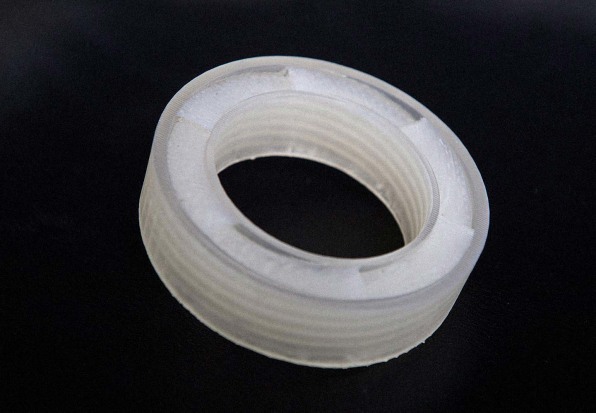
How was this possible? Did they block the other end of the pipe with noise canceling foams or a chunk of concrete? No, nothing of the sort. The pipe was actually left open save for a small, 3D-printed ring placed around the rim. That ring cut 94% of the sound blasting from the speaker, enough to make it inaudible to the human ear.

The mathematically designed, 3D-printed acoustic metamaterial is shaped in such a way that it sends incoming sounds back to where they came from. [Photo: Cydney Scott/Boston University]

Dubbed an “acoustic meta-material,” the ring was printed from a mathematically modeled design, shaped in such a way that it can catch certain frequencies passing through the air and reflect them back toward their source. Typical acoustic paneling works differently, absorbing sound and turning the vibrations into heat. But what’s particularly trippy is that this muffler is completely open. Air and light can travel through it–just sound cannot.

The implications for architecture and interior design are remarkable, because these metamaterials could be applied to the built environment in many different ways. For instance, they could be stacked to build soundproof yet transparent walls. Cubicles will never be the same.

The researchers also believe that HVAC systems could be fitted with these silencers, and drones could have their turbines muted with such rings. Even in MRI machines, which can be harrowingly loud for patients trapped in a small space, could be quieted. There’s really no limit to the possibilities, but it does sound like these silencers will need to be tailored to circumstance. “The idea is that we can now mathematically design an object that can blocks the sounds of anything,” says Boston University professor Xin Zhang, in a press release.

Source: Mathematically perfect rings could soundproof the world

Radio gaga: Techies fear EU directive to stop RF device tinkering will do more harm than good

EU plans to ban the sale of user-moddable radio frequency devices – like phones and routers – have provoked widespread condemnation from across the political bloc.

The controversy centres on Article 3(3)(i) of the EU Radio Equipment Directive, which was passed into law back in 2014.

However, an EU working group is now about to define precisely which devices will be subject to the directive – and academics, researchers, individual “makers” and software companies are worried that their activities and business models will be outlawed.

Article 3(3)(i) states that RF gear sold in the EU must support “certain features in order to ensure that software can only be loaded into the radio equipment where the compliance of the combination of the radio equipment and software has been demonstrated”.

If the law is implemented in its most potentially harmful form, no third-party firmware could be installed onto something like a home router, for example.

Hauke Mehrtens of the Free Software Foundation Europe (FSFE) told The Register: “If the EU forces Wi-Fi router manufacturers to prevent their customers from installing their own software onto their devices this will cause great harm to the OpenWrt project, wireless community networks, innovative startups, computer network researchers and European citizens. This would increase the electronic waste, make it impossible for the user to fix security vulnerabilities by himself or the help of the community and block research which could improve the internet in the EU.”

Source: Radio gaga: Techies fear EU directive to stop RF device tinkering will do more harm than good • The Register

Oh dear, does this not mean you don’t really own the stuff you buy?

Why Is Customer Service So Bad? Because It’s Profitable.

American consumers spend, on average, 13 hours per year in calling queue. According to a 2010 study by Mike Desmarais in the journal Cost Management, a third of complaining customers must make two or more calls to resolve their complaint. And that ignores the portion who simply give up out of exasperation after the first call. In fact, according to a 2017 survey by Customer Care Measurement and Consulting the Carey School of Business at the Arizona State University, over three quarters of complaining consumers were less than satisfied with their experience with the given company’s customer service department.

These accounts seem at odds with the pledges by many companies that they are committed to great customer service. Consider United Airlines, among the lowest ranked of major airlines on customer service, which claims to offer a “level of service to our customers that makes [United] a leader in the airline industry”. This is in line with surveys over time that indicate that consumers consistently perceive that customer service is generally bad and even possibly becoming worse. Despite promises companies make to treat people well, customers don’t seem to be buying it.

There’s some evidence that customer queues may be unavoidable at times. Caller complaints tend to arrive randomly, making it impossible to staff agents to handle unpredictable fluctuations in call volume. But our research suggests that some companies may actually find it profitable to create hassles for complaining customers, even if it were operationally costless not to.

Source: Why Is Customer Service So Bad? Because It’s Profitable.

Smart alarms left 3 million cars vulnerable to hackers who could turn off motors, unlock doors remotely

Two popular smart alarm systems for cars had major security flaws that allowed potential hackers to track the vehicles, unlock their doors and, in some cases, cut off the engine.

The vulnerabilities could be exploited with two simple steps, security researchers from Pen Test Partners, who discovered the flaw, said Friday.

The problems were found in alarm systems made by Viper and Pandora Car Alarm System, two of the largest smart car alarm makers in the world. The two brands have as many as 3 million customers between them and make high-end devices that can cost thousands. Like other smart devices, smart car alarms offer people convenience, allowing owners to find their cars from a distance and unlock their doors from their phones.

Pen Test Partners said it reached out to Viper and Pandora in late February and the companies fixed the security issues in less than a week. They had discovered the flaws last October.

Source: Smart alarms left 3 million cars vulnerable to hackers who could turn off motors – CNET

Freelance devs: Oh, you wanted the app to be secure? The job spec didn’t mention that

Freelance developers hired to implement password-based security systems do so about as effectively as computer science students, which is to say not very well at all.

Boffins at the University of Bonn in Germany set out to expand on research in 2017 and 2018 that found computer science students asked to implement a user registration system didn’t do so securely unless asked, and even then didn’t always get it right.

The scientists speculated that because the surveyed students knew they were taking part in a study, then they didn’t make security a priority. So they modified the experiment to test whether developers unaware that they were participating in a study did any better.

The eggheads – Alena Naiakshina, Anastasia Danilova, Eva Gerlitz, Emanuel von Zezschwitz, and Matthew Smith – describe their findings in a paper titled, “‘If you want, I can store the encrypted password.’ A Password-Storage Field Study with Freelance Developers.”

Their paper is scheduled to be presented at the CHI Conference on Human Factors in Computing Systems Proceedings, which runs from May 4–9, 2019, in Glasgow, Scotland.

Posing as a client trying to build a social networking site, the researchers hired 43 developers for either €100 (~$112) or €200 (~$225) from Freelancer.com to help them create a portion of the fictitious project, the site’s registration system.

Ethics

The deception was approved by the university’s Research Ethics Board and study participants were told after the conclusion of the research that they could withdraw from the study if they wished. None did and only one declined to answer the post-job questionnaire.

The freelancers were hired to work in Java and took anywhere from one to five days to complete the assigned task. Those hired ranged from 22 to 68 years in age (median: 29; mean: 30.34) and 39 of the 43 reported being male. All but two said they’d been programming for at least two years and in Java for at least one year. Most were not fluent in English.

The study confirms previous findings that if you want security, you won’t get it by default; you have to ask for it. “Our sample shows that freelancers who believe they are creating code for a real company also seldom store passwords securely without prompting,” the paper says.

The boffins also found many of the freelancers misunderstood that encryption, hashing and encoding are different things. “We found a number of freelancers were reducing password storage security to a visual representation and thus using Base64 as their preferred method to ensure security,” the paper says. “Additionally, encryption and hashing were used as synonyms, which was often reflected by the freelancers’ programming code.”

Another finding consistent with the student research is that many freelancers (16 in this instance) submitted code copied from the internet.

Source: Freelance devs: Oh, you wanted the app to be secure? The job spec didn’t mention that • The Register

From hard drive to over-heard drive: Boffins convert spinning rust into eavesdropping mic, if you shout!

Eggheads at the University of Michigan in the US, and Zhejiang University in China, have found that hard disk drives (HDDs) can be turned into listening devices, using malicious firmware and signal processing calculations.

For a study titled “Hard Drive of Hearing: Disks that Eavesdrop with a Synthesized Microphone,” computer scientists Andrew Kwong, Wenyuan Xu, and Kevin Fu describe an acoustic side-channel that can be accessed by measuring how sound waves make hard disk parts vibrate.

“Our research demonstrates that the mechanical components in magnetic hard disk drives behave as microphones with sufficient precision to extract and parse human speech,” their paper, obtained by The Register ahead of its formal publication, stated. “These unintentional microphones sense speech with high enough fidelity for the Shazam service to recognize a song recorded through the hard drive.”

The team’s research work, scheduled to be presented in May at the 2019 IEEE Symposium on Security and Privacy, explores how it’s possible to alter HDD firmware to measure the offset of a disk drive’s read/write head from the center of the track it’s seeking.

The offset is referred to as the Positional Error Signal (PES) and hard drives monitor this signal to keep the read/write head in the optimal position for reading and writing data. PES measurements must be very fine because drive heads can only be off by a few nanometers before data errors arise. The sensitivity of the gear, however, means human speech is sufficient to move the needle, so to speak.

“These extremely precise measurements are sensitive to vibrations caused by the slightest fluctuations in air pressure, such as those induced by human vocalizations,” the paper explained.

Vibrations from HDD parts don’t yield particularly good sound, but with digital filtering techniques, human speech can be discerned, given the right conditions.

Flashing HDD firmware is a prerequisite for the snooping, the paper says, because the ATA protocol does not expose the PES. This could be accomplished through traditional attack techniques – binary exploitation, drive-by downloads, or phishing – or by intercepting HDDs somewhere in the supply chain and modifying them. The researchers point to the Grayfish malware attributed to the Equation Group as an example.

[…]

One limiting aspect of the described technique is that it requires a fairly loud conversation in the vicinity of the eavesdropping hard drive. To record comprehensible speech, the conversation had to reach 85 dBA, with 75 dBA being the low threshold for capturing muffled sound. To get Shazam to identify recordings captured through a hard drive, the source file had to be played at 90 dBA. Which is pretty loud. Like lawn mower or food blender loud.

The researchers acknowledge this is louder than most practical scenarios but they say they “expect that an attacker using state of the art filtering and voice recognition algorithms can substantially amplify the channel’s strength.”

While the growing popularity of solid state drives diminish the risk even further, there were still twice as many hard drives sold with PCs in 2017 as there were solid state drives, the researchers claimed.

[…]

They also note that their work may open future research possibilities, such as using a hard disk’s read/write head as a crude sounds generator to issue spoken commands to nearby connected speakers like Alexa, Google Home, and Siri.

Source: From hard drive to over-heard drive: Boffins convert spinning rust into eavesdropping mic • The Register

Iranian hackers ransack Citrix, make off with 6TB+ of emails, biz docs, internal secrets – they had to be told by the FBI that they were hacked at all

Citrix today warned its customers that foreign hackers romped through its internal company network and stole corporate secrets.

The enterprise software giant – which services businesses, the American military, and various US government agencies – said it was told by the FBI on Wednesday that miscreants had accessed Citrix’s IT systems and exfiltrated a significant amount of data.

According to infosec firm Resecurity, which had earlier alerted the Feds and Citrix to the cyber-intrusion, at least six terabytes of sensitive internal files were swiped from the US corporation by the Iranian-backed IRIDIUM hacker gang. The spies hit in December, and Monday this week, we’re told, lifting emails, blueprints, and other documents, after bypassing multi-factor login systems and slipping into Citrix’s VPNs.

Source: Iranian hackers ransack Citrix, make off with 6TB+ of emails, biz docs, internal secrets • The Register

Chelsea Manning jailed for refusing to testify on Wikileaks

Former Army intelligence analyst Chelsea Manning, who served years in prison for leaking one of the largest troves of classified documents in U.S. history, has been sent to jail for refusing to testify before a grand jury investigating Wikileaks.

U.S. District Judge Claude Hilton ordered Manning to jail for contempt of court Friday after a brief hearing in which Manning confirmed she has no intention of testifying. She told the judge she “will accept whatever you bring upon me.”

Manning has said she objects to the secrecy of the grand jury process, and that she already revealed everything she knows at her court-martial.

The judge said she will remain jailed until she testifies or until the grand jury concludes its work.

[…]

Manning anticipated being jailed. In a statement before Friday’s hearing, she said she invoked her First, Fourth and Sixth amendment protections when she appeared before the grand jury in Alexandria on Wednesday. She said she already answered every substantive question during her 2013 court-martial, and is prepared to face the consequences of refusing to answer again.

“In solidarity with many activists facing the odds, I will stand by my principles. I will exhaust every legal remedy available,” she said.

Manning served seven years of a 35-year military sentence for leaking a trove of military and diplomatic documents to the anti-secrecy website before then-President Barack Obama commuted her sentence.

Source: Chelsea Manning jailed for refusing to testify on Wikileaks

Researchers are training image-generating AI with fewer labels by letting the model infer the labels

Generative AI models have a propensity for learning complex data distributions, which is why they’re great at producing human-like speech and convincing images of burgers and faces. But training these models requires lots of labeled data, and depending on the task at hand, the necessary corpora are sometimes in short supply.

The solution might lie in an approach proposed by researchers at Google and ETH Zurich. In a paper published on the preprint server Arxiv.org (“High-Fidelity Image Generation With Fewer Labels“), they describe a “semantic extractor” that can pull out features from training data, along with methods of inferring labels for an entire training set from a small subset of labeled images. These self- and semi-supervised techniques together, they say, can outperform state-of-the-art methods on popular benchmarks like ImageNet.

“In a nutshell, instead of providing hand-annotated ground truth labels for real images to the discriminator, we … provide inferred ones,” the paper’s authors explained.

In one of several unsupervised methods the researchers posit, they first extract a feature representation — a set of techniques for automatically discovering the representations needed for raw data classification — on a target training dataset using the aforementioned feature extractor. They then perform cluster analysis — i.e., grouping the representations in such a way that those in the same group share more in common than those in other groups. And lastly, they train a GAN — a two-part neural network consisting of generators that produce samples and discriminators that attempt to distinguish between the generated samples and real-world samples — by inferring labels.

Source: Researchers are training image-generating AI with fewer labels | VentureBeat

Google launches TensorFlow Lite 1.0 for mobile and embedded devices

Google today introduced TensorFlow Lite 1.0, its framework for developers deploying AI models on mobile and IoT devices. Improvements include selective registration and quantization during and after training for faster, smaller models. Quantization has led to 4 times compression of some models.

“We are going to fully support it. We’re not going to break things and make sure we guarantee its compatibility. I think a lot of people who deploy this on phones want those guarantees,” TensorFlow engineering director Rajat Monga told VentureBeat in a phone interview.

Lite begins with training AI models on TensorFlow, then is converted to create Lite models for operating on mobile devices. Lite was first introduced at the I/O developer conference in May 2017 and in developer preview later that year.

The TensorFlow Lite team at Google also shared its roadmap for the future today, designed to shrink and speed up AI models for edge deployment, including things like model acceleration, especially for Android developers using neural nets, as well as a Keras-based connecting pruning kit and additional quantization enhancements.

Other changes on the way:

  • Support for control flow, which is essential to the operation of models like recurrent neural networks
  • CPU performance optimization with Lite models, potentially involving partnerships with other companies
  • Expand coverage of GPU delegate operations and finalize the API to make it generally available

A TensorFlow 2.0 model converter to make Lite models will be made available for developers to better understand how things wrong in the conversion process and how to fix it.

TensorFlow Lite is deployed by more than two billion devices today, TensorFlow Lite engineer Raziel Alvarez said onstage at the TensorFlow Dev Summit being held at Google offices in Sunnyvale, California.

TensorFlow Lite increasingly makes TensorFlow Mobile obsolete, except for users who want to utilize it for training, but a solution is in the works, Alvarez said.

Source: Google launches TensorFlow Lite 1.0 for mobile and embedded devices | VentureBeat

Leaked Documents Show the U.S. Government Tracking Journalists and Immigration Advocates Through a Secret Database, having them detained at borders

One photojournalist said she was pulled into secondary inspections three times and asked questions about who she saw and photographed in Tijuana shelters. Another photojournalist said she spent 13 hours detained by Mexican authorities when she tried to cross the border into Mexico City. Eventually, she was denied entry into Mexico and sent back to the U.S.

These American photojournalists and attorneys said they suspected the U.S. government was monitoring them closely but until now, they couldn’t prove it.

Now, documents leaked to NBC 7 Investigates show their fears weren’t baseless. In fact, their own government had listed their names in a secret database of targets, where agents collected information on them. Some had alerts placed on their passports, keeping at least three photojournalists and an attorney from entering Mexico to work.

The documents were provided to NBC 7 by a Homeland Security source on the condition of anonymity, given the sensitive nature of what they were divulging.

The source said the documents or screenshots show a SharePoint application that was used by agents from Customs and Border Protection (CBP) Immigration and Customs Enforcement (ICE), the U.S. Border Patrol, Homeland Security Investigations and some agents from the San Diego sector of the Federal Bureau of Investigations (FBI).

The intelligence gathering efforts were done under the umbrella of “Operation Secure Line,” the operation designated to monitor the migrant caravan, according to the source.

The documents list people who officials think should be targeted for screening at the border.

The individuals listed include ten journalists, seven of whom are U.S. citizens, a U.S. attorney, and 47 people from the U.S. and other countries, labeled as organizers, instigators or their roles “unknown.” The target list includes advocates from organizations like Border Angels and Pueblo Sin Fronteras.

To view the documents, click here or the link below.

PHOTOS: Leaked Documents Show Government Tracking Journalists, Immigration AdvocatesPHOTOS: Leaked Documents Show Government Tracking Journalists, Immigration Advocates

NBC 7 Investigates is blurring the names and photos of individuals who haven’t given us permission to publish their information.

[…]

In addition to flagging the individuals for secondary screenings, the Homeland Security source told NBC 7 that the agents also created dossiers on each person listed.

“We are a criminal investigation agency, we’re not an intelligence agency,” the Homeland Security source told NBC 7 Investigates. “We can’t create dossiers on people and they’re creating dossiers. This is an abuse of the Border Search Authority.”

One dossier, shared with NBC 7, was on Nicole Ramos, the Refugee Director and attorney for Al Otro Lado, a law center for migrants and refugees in Tijuana, Mexico. The dossier included personal details on Ramos, including specific details about the car she drives, her mother’s name, and her work and travel history.

After sharing the documents with Ramos, she said Al Otro Lado is seeking more information on why she and other attorneys at the law center have been targeted by border officials.

“The document appears to prove what we have assumed for some time, which is that we are on a law enforcement list designed to retaliate against human rights defenders who work with asylum seekers and who are critical of CBP practices that violate the rights of asylum seekers,” Ramos told NBC 7 by email.

In addition to the dossier on Ramos, a list of other dossier files created was shared with NBC 7. Two of the dossier files were labeled with the names of journalists but no further details were available. Those journalists were also listed as targets for secondary screenings.

Customs and Border Protection has the authority to pull anyone into secondary screenings, but the documents show the agency is increasingly targeting journalists, attorneys, and immigration advocates. Former counterterrorism officials say the agency should not be targeting individuals based on their profession.

Source: Source: Leaked Documents Show the U.S. Government Tracking Journalists and Immigration Advocates Through a Secret Database – NBC 7 San Diego

When 2FA means sweet FA privacy: Facebook admits it slurps mobe numbers for more than just profile security

This time, the Silicon Valley giant has been caught red-handed using people’s cellphone numbers, provided exclusively for two-factor authentication, for targeted advertising and search – after it previously insinuated it wouldn’t do that.

Folks handing over their mobile numbers to protect their accounts from takeovers and hijackings thought the contact detail would be used for just that: security. Instead, Facebook is using the numbers to link netizens to other people, and target them with online ads.

For example, if someone you know – let’s call her Sarah – has given her number to Facebook for two-factor authentication purposes, and you allow the Facebook app to access your smartphone’s contacts book, and it sees Sarah’s number in there, it will offer to connect you two up, even though Sarah thought her number was being used for security only, and not for search. This is not a particularly healthy scenario, for instance, if you and Sarah are no longer, or never were, friends in real life, and yet Facebook wants to wire you up anyway.

Following online outcry over the weekend, a Facebook spokesperson told us today: “We appreciate the feedback we’ve received about these settings, and will take it into account.”

Source: When 2FA means sweet FA privacy: Facebook admits it slurps mobe numbers for more than just profile security • The Register

Anyone surprised much?

Welding glass to metal breakthrough could transform manufacturing

Scientists from Heriot-Watt University have welded glass and metal together using an ultrafast laser system, in a breakthrough for the manufacturing industry.

Various optical materials such as quartz, borosilicate glass and even sapphire were all successfully welded to metals like aluminium, titanium and using the Heriot-Watt laser system, which provides very short, picosecond pulses of infrared light in tracks along the materials to fuse them together.

The new process could transform the and have direct applications in the aerospace, defence, optical technology and even healthcare fields.

Professor Duncan Hand, director of the five-university EPSRC Centre for Innovative Manufacturing in Laser-based Production Processes based at Heriot-Watt, said: “Traditionally it has been very difficult to weld together dissimilar materials like glass and metal due to their different thermal properties—the and highly different thermal expansions involved cause the glass to shatter.

“Being able to weld glass and metals together will be a huge step forward in manufacturing and design flexibility.

“At the moment, equipment and products that involve and metal are often held together by adhesives, which are messy to apply and parts can gradually creep, or move. Outgassing is also an issue—organic chemicals from the adhesive can be gradually released and can lead to reduced product lifetime.

“The process relies on the incredibly short pulses from the laser. These pulses last only a few picoseconds—a picosecond to a second is like a second compared to 30,000 years.

“The parts to be welded are placed in close contact, and the laser is focused through the optical material to provide a very small and highly intense spot at the interface between the two —we achieved megawatt peak power over an area just a few microns across.

“This creates a microplasma, like a tiny ball of lightning, inside the material, surrounded by a highly-confined melt region.

“We tested the welds at -50C to 90C and the welds remained intact, so we know they are robust enough to cope with extreme conditions.”

Read more at: https://phys.org/news/2019-03-welding-breakthrough.html#jCp

Source: Welding breakthrough could transform manufacturing

SPOILER alert, literally: Intel CPUs afflicted with simple data-spewing spec-exec vulnerability

Further demonstrating the computational risks of looking into the future, boffins have found another way to abuse speculative execution in Intel CPUs to steal secrets and other data from running applications.

This security shortcoming can be potentially exploited by malicious JavaScript within a web browser tab, or malware running on a system, or rogue logged-in users, to extract passwords, keys, and other data from memory. An attacker therefore requires some kind of foothold in your machine in order to pull this off. The vulnerability, it appears, cannot be easily fixed or mitigated without significant redesign work at the silicon level.

Speculative execution, the practice of allowing processors to perform future work that may or may not be needed while they await the completion of other computations, is what enabled the Spectre vulnerabilities revealed early last year.

In a research paper distributed this month through pre-print service ArXiv, “SPOILER: Speculative Load Hazards Boost Rowhammer and Cache Attacks,” computer scientists at Worcester Polytechnic Institute in the US, and the University of Lübeck in Germany, describe a new way to abuse the performance boost.

The researchers – Saad Islam, Ahmad Moghimi, Ida Bruhns, Moritz Krebbel, Berk Gulmezoglu, Thomas Eisenbarth and Berk Sunar – have found that “a weakness in the address speculation of Intel’s proprietary implementation of the memory subsystem” reveals memory layout data, making other attacks like Rowhammer much easier to carry out.

The researchers also examined Arm and AMD processor cores, but found they did not exhibit similar behavior.

“We have discovered a novel microarchitectural leakage which reveals critical information about physical page mappings to user space processes,” the researchers explain.

“The leakage can be exploited by a limited set of instructions, which is visible in all Intel generations starting from the 1st generation of Intel Core processors, independent of the OS and also works from within virtual machines and sandboxed environments.”


Source: SPOILER alert, literally: Intel CPUs afflicted with simple data-spewing spec-exec vulnerability • The Register