
The Linkielist

Linking ideas with the world

The Linkielist

BAE Systems uses MAGMA demonstrator to roll and pitch jet aircraft without using moving surfaces

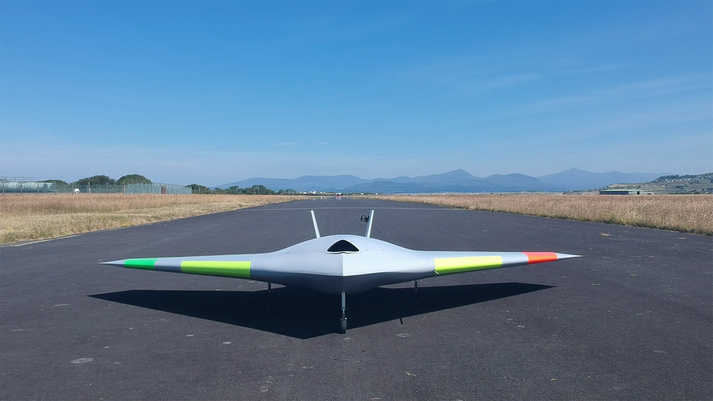
In a series of ground-breaking flight trials that took place in the skies above north-west Wales, the MAGMA unmanned aerial vehicle (UAV) demonstrated two innovative flow control technologies which could revolutionise future aircraft design.
MAGMA, designed and developed by researchers at The University of Manchester in collaboration with engineers from BAE Systems, successfully trialled the two ‘flap-free’ technologies earlier this month at the Llanbedr Airfield.
The technologies have been designed to improve the control and performance of aircraft. By replacing moving surfaces with a simpler ‘blown air’ solution, the trials have paved the way for engineers to create better performing aircraft that are lighter, more reliable and cheaper to operate. The technologies could also improve an aircraft’s stealth as they reduce the number of gaps and edges that currently make aircraft more observable on radar.
Developing such technologies helps to ensure the UK has the right technologies and skills in place for the future and could be applied to the development of a Future Combat Air System. It is the latest technological breakthrough to come from a number of BAE Systems collaborations with academia and industry, that will help the UK to deliver more advanced capability, more quickly, and through shared investment.
[…]
The technologies demonstrated in the trials were:
  • Wing Circulation Control: Taking air from the aircraft engine and blowing it supersonically through narrow slots around a specially shaped wing tailing edge in order to control the aircraft.
  • Fluidic Thrust Vectoring: Controlling the aircraft by blowing air jets inside the nozzle to deflect the exhaust jet and generate a control force.
The trials form part of a long-term collaboration between BAE Systems, academia and the UK government to explore and develop flap-free flight technologies, and the data will be used to inform future research programmes. Other technologies to improve the aircraft performance are being explored in collaboration with NATO Science and Technology Organisation.
Source: MAGMA: the future of flight | Newsroom | BAE Systems | International

Tractors, not phones, will (maybe) get America a right-to-repair law at this rate: Bernie slams ‘truly insane’ situation

A person’s “right to repair” their own equipment may well become a US election issue, with presidential candidate Bernie Sanders making it a main talking point during his tour of Iowa.

“Are you ready for something truly insane?” the veteran politician’s account tweeted on Sunday, “Farmers aren’t allowed to repair their own tractors without paying an authorized John Deere repair agent.”

The tweet links to a clip of a recent Sanders rally during which he told the crowd to cheers: “Unbelievably, farmers are unable to even repair their own tractors, and tractors cost what – at least $150,000 – people are spending $150,000 for a piece of machinery. You know what I think? The person who buys that machinery has a right to fix the damn piece of machinery.”

The right-to-repair was also highlighted as one of Sanders’ key policies issues in his plan to “revitalize rural America,” and he promised: “When we are in the White House, we will pass a national right-to-repair law that gives every farmer in America full rights over the machinery they buy.”

Source: Tractors, not phones, will (maybe) get America a right-to-repair law at this rate: Bernie slams ‘truly insane’ situation • The Register

There is hope yet…

First private Japanese rocket reaches space

Japan can finally include itself among the ranks of countries with successful private spaceflight outfits. Interstellar Technologies has successfully launched its MOMO-3 sounding rocket into space, with the vehicle easily crossing the Kármán line (62 miles in altitude) before splashing into the Pacific. It’s a modest start — the rocket only stayed aloft for 8 minutes and 35 seconds — but it’s also a relief after Interstellar’s previous two attempts ended in failure.

There was a fair amount riding on the mission. Interstellar’s ultimate aim is to ferry small satellites into orbit at a fraction of the cost of government launches, and this takes the company one step closer to achieving its dream. It also relieves some of the pressure on Interstellar founder Takafumi Horie. There had been skepticism about the Livedoor creator’s spaceflight chops given his controversial entrepreneurial history (including a conviction for accounting fraud). This shows that his initiative can work on a basic level — the challenge is translating a test like this into a full-fledged business.

Source: First private Japanese rocket reaches space