
During Brain Surgery, This AI Can Diagnose a Tumor in 2 Minutes

Expert human pathologists typically require around 30 minutes to diagnose brain tumors from tissue samples extracted during surgery. A new artificially intelligent system can do it in less than 150 seconds—and it does so more accurately than its human counterparts.

New research published today in Nature Medicine describes a novel diagnostic technique that leverages the power of artificial intelligence with an advanced optical imaging technique. The system can perform rapid and accurate diagnoses of brain tumors in practically real time, while the patient is still on the operating table. In tests, the AI made diagnoses that were slightly more accurate than those made by human pathologists and in a fraction of the time. Excitingly, the new system could be used in settings where expert neurologists aren’t available, and it holds promise as a technique that could diagnose other forms of cancer as well.

[…]

New York University neuroscientist Daniel Orringer and his colleagues developed a diagnostic technique that combined a powerful new optical imaging technique, called stimulated Raman histology (SRH), with an artificially intelligent deep neural network. SRH uses scattered laser light to illuminate features not normally seen in standard imaging techniques

[…]

To create the deep neural network, the scientists trained the system on 2.5 million images taken from 415 patients. By the end of the training, the AI could categorize tissue into any of 13 common forms of brain tumors, such as malignant glioma, lymphoma, metastatic tumors, diffuse astrocytoma, and meningioma.

A clinical trial involving 278 brain tumor and epilepsy patients and three different medical institutions was then set up to test the efficacy of the system. SRH images were evaluated by either human experts or the AI. Looking at the results, the AI correctly identified the tumor 94.6 percent of the time, while the human neuropathologists were accurate 93.9 percent of the time. Interestingly, the errors made by humans were different than the errors made by the AI. This is actually good news, because it suggests the nature of the AI’s mistakes can be accounted for and corrected in the future, resulting in an even more accurate system, according to the authors.

“SRH will revolutionize the field of neuropathology by improving decision-making during surgery and providing expert-level assessment in the hospitals where trained neuropathologists are not available,” said Matija Snuderl, a co-author of the study and an associate professor at NYU Grossman School of Medicine, in the press release.

Source: During Brain Surgery, This AI Can Diagnose a Tumor in 2 Minutes
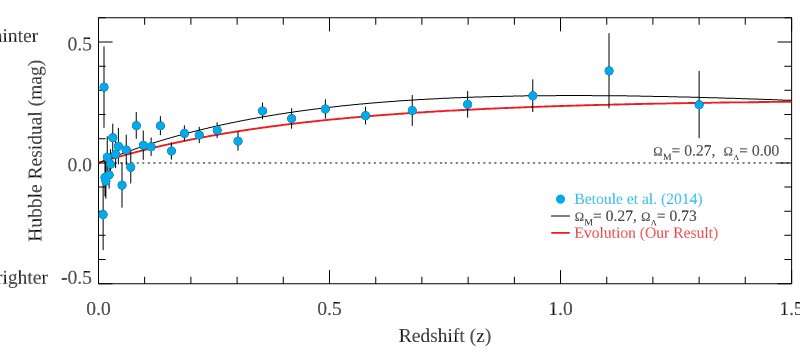
New evidence shows that the key assumption made in the discovery of dark energy is in error

The most direct and strongest evidence for the accelerating universe with dark energy is provided by the distance measurements using type Ia supernovae (SN Ia) for the galaxies at high redshift. This result is based on the assumption that the corrected luminosity of SN Ia through the empirical standardization would not evolve with redshift.

New observations and analysis made by a team of astronomers at Yonsei University (Seoul, South Korea), together with their collaborators at Lyon University and KASI, show, however, that this key assumption is most likely in error. The team has performed very high-quality (signal-to- ~175) spectroscopic observations to cover most of the reported nearby early-type host galaxies of SN Ia, from which they obtained the most direct and reliable measurements of population ages for these host galaxies. They find a significant correlation between SN and stellar population age at a 99.5 percent confidence level. As such, this is the most direct and stringent test ever made for the luminosity evolution of SN Ia. Since SN progenitors in host galaxies are getting younger with redshift (look-back time), this result inevitably indicates a serious systematic bias with redshift in SN cosmology. Taken at face values, the luminosity evolution of SN is significant enough to question the very existence of . When the luminosity evolution of SN is properly taken into account, the team found that the evidence for the existence of dark simply goes away (see Figure 1).

Commenting on the result, Prof. Young-Wook Lee (Yonsei Univ., Seoul), who led the project said, “Quoting Carl Sagan, extraordinary claims require extraordinary evidence, but I am not sure we have such extraordinary evidence for dark energy. Our result illustrates that dark energy from SN cosmology, which led to the 2011 Nobel Prize in Physics, might be an artifact of a fragile and false assumption.”

Other cosmological probes, such as the (CMB) and baryonic acoustic oscillations (BAO), are also known to provide some indirect and “circumstantial” evidence for dark energy, but it was recently suggested that CMB from Planck mission no longer supports the concordance cosmological model which may require new physics (Di Valentino, Melchiorri, & Silk 2019). Some investigators have also shown that BAO and other low-redshift cosmological probes can be consistent with a non-accelerating universe without dark energy (see, for example, Tutusaus et al. 2017). In this respect, the present result showing the luminosity evolution mimicking dark energy in SN cosmology is crucial and very timely.

This result is reminiscent of the famous Tinsley-Sandage debate in the 1970s on luminosity evolution in observational cosmology, which led to the termination of the Sandage project originally designed to determine the fate of the universe.

This work based on the team’s 9-year effort at Las Campanas Observatory 2.5-m telescope and at MMT 6.5-m telescope was presented at the 235th meeting of the American Astronomical Society held in Honolulu on January 5th (2:50 PM in cosmology session, presentation No. 153.05). Their paper is also accepted for publication in the Astrophysical Journal and will be published in January 2020 issue.

Source: New evidence shows that the key assumption made in the discovery of dark energy is in error

Injecting the flu vaccine into a tumor gets the immune system to attack it

Now, some researchers have focused on the immune response, inducing it at the site of the tumor. And they do so by a remarkably simple method: injecting the tumor with the flu vaccine. As a bonus, the mice it was tested on were successfully immunized, too.

Revving up the immune system

This is one of those ideas that seems nuts but had so many earlier results pointing toward it working that it was really just a matter of time before someone tried it. To understand it, you have to overcome the idea that the immune system is always diffuse, composed of cells that wander the blood stream. Instead, immune cells organize at the sites of infections (or tumors), where they communicate with each other to both organize an attack and limit that attack so that healthy tissue isn’t also targeted.

From this perspective, the immune system’s inability to eliminate tumor cells isn’t only the product of their similarities to healthy cells. It’s also the product of the signaling networks that help restrain the immune system to prevent it from attacking normal cells. A number of recently developed drugs help release this self-imposed limit, winning their developers Nobel Prizes in the process. These drugs convert a “cold” immune response, dominated by signaling that shuts things down, into a “hot” one that is able to attack a tumor.

[…]

To check whether something similar might be happening in humans, the researchers identified over 30,000 people being treated for lung cancer and found those who also received an influenza diagnosis. You might expect that the combination of the flu and cancer would be very difficult for those patients, but instead, they had lower mortality than the patients who didn’t get the flu.

[…]

the researchers obtained this year’s flu vaccine and injected it into the sites of tumors. Not only was tumor growth slowed, but the mice ended up immune to the flu virus.

Oddly, this wasn’t true for every flu vaccine. Some vaccines contain chemicals that enhance the immune system’s memory, promoting the formation of a long-term response to pathogens (called adjuvants). When a vaccine containing one of these chemicals was used, the immune system wasn’t stimulated to limit the tumors’ growth.

This suggests that it’s less a matter of stimulating the immune system and more an issue of triggering it to attack immediately. But this is one of the things that will need to be sorted out with further study.

[…]

Source: Injecting the flu vaccine into a tumor gets the immune system to attack it | Ars Technica

Fresh Cambridge Analytica leak ‘shows global manipulation is out of control’

An explosive leak of tens of thousands of documents from the defunct data firm Cambridge Analytica is set to expose the inner workings of the company that collapsed after the Observer revealed it had misappropriated 87 million Facebook profiles.

More than 100,000 documents relating to work in 68 countries that will lay bare the global infrastructure of an operation used to manipulate voters on “an industrial scale” are set to be released over the next months.

It comes as Christopher Steele, the ex-head of MI6’s Russia desk and the intelligence expert behind the so-called “Steele dossier” into Trump’s relationship with Russia, said that while the company had closed down, the failure to properly punish bad actors meant that the prospects for manipulation of the US election this year were even worse.

The release of documents began on New Year’s Day on an anonymous Twitter account, @HindsightFiles, with links to material on elections in Malaysia, Kenya and Brazil. The documents were revealed to have come from Brittany Kaiser, an ex-Cambridge Analytica employee turned whistleblower, and to be the same ones subpoenaed by Robert Mueller’s investigation into Russian interference in the 2016 presidential election

Source: Fresh Cambridge Analytica leak ‘shows global manipulation is out of control’ | UK news | The Guardian

U.S. government limits exports of artificial intelligence software – seem to have forgotten what happened when they limited cryptographic exports in the 90s

The Trump administration will make it more difficult to export artificial intelligence software as of next week, part of a bid to keep sensitive technologies out of the hands of rival powers like China.

Under a new rule that goes into effect on Monday, companies that export certain types of geospatial imagery software from the United States must apply for a license to send it overseas except when it is being shipped to Canada.

The measure is the first to be finalized by the Commerce Department under a mandate from a 2018 law, which tasked the agency with writing rules to boost oversight of exports of sensitive technology to adversaries like China, for economic and security reasons.

Reuters first reported that the agency was finalizing a set of narrow rules to limit such exports in a boon to U.S. industry that feared a much tougher tougher crackdown on sales abroad.

Source: U.S. government limits exports of artificial intelligence software – Reuters

Just in case you forgot about encryption products, clipper chips etc: US products were weakened with backdoors, which meant a) no-one wanted US products and b) there was a wildfire growth of non-US encryption products. So basically the US goal to limit cryptography failed and at a cost to US producers.

Bosch’s LCD Car Visor Only Blocks Your View of the Road Where the Sun Is In Your Eyes

Instead of a rigid panel wrapped in fabric, Bosch’s Virtual Visor features an LCD panel that can be flipped down when the sun is hanging out on the horizon. The panel works alongside a camera that’s pointed at a driver’s face whose live video feed is processed using a custom trained AI to recognize facial features like the nose, mouth, and, most importantly, the eyes. The camera system should recognize shadows cast on the driver’s eyes, and it uses this ability to darken only the areas on the LCD visor where intense sunlight would be passing through and impairing a driver’s vision. The region of the visor that’s darkened is constantly changing based on both the vehicle and driver’s movements, but the rest should remain transparent to provide a less obstructed view of the road and other vehicles ahead.

The Virtual Visor actually started life as a side project for three of Bosch’s powertrain engineers who developed it in their free time and harvested the parts they needed from a discarded computer monitor. As to when the feature will start showing up as an option in new cars remains to be seen—if ever. If you’ve ever dropped your phone or poked at a screen too hard you’ve already aware of how fragile LCD panels can be, so there will need to be lots of in-vehicle testing before this ever goes mainstream. But it’s a clever innovation using technology that at this point is relatively cheap and readily available, so hopefully this is an upgrade that’s not too far away.

Source: Bosch’s LCD Car Visor Only Blocks Your View of the Road Where the Sun Is In Your Eyes