Immune cell which kills most cancers discovered by accident by Welsh scientists in major breakthrough 

A new type of immune cell which kills most cancers has been discovered by accident by British scientists, in a finding which could herald a major breakthrough in treatment.

Researchers at Cardiff University were analysing blood from a bank in Wales, looking for immune cells that could fight bacteria, when they found an entirely new type of T-cell.

That new immune cell carries a never-before-seen receptor which acts like a grappling hook, latching on to most human cancers, while ignoring healthy cells.

In laboratory studies, immune cells equipped with the new receptor were shown to kill lung, skin, blood, colon, breast, bone, prostate, ovarian, kidney and cervical cancer.

Professor Andrew Sewell, lead author on the study and an expert in T-cells from Cardiff University’s School of Medicine, said it was “highly unusual” to find a cell that had broad cancer-fighting therapies, and raised the prospect of a universal therapy.

“This was a serendipitous finding, nobody knew this cell existed,” Prof Sewell told The Telegraph.

“Our finding raises the prospect of a ‘one-size-fits-all’ cancer treatment, a single type of T-cell that could be capable of destroying many different types of cancers across the population. Previously nobody believed this could be possible.”

[…]

the new cell attaches to a molecule on cancer cells called MR1, which does not vary in humans.

It means that not only would the treatment work for most cancers, but it could be shared between people, raising the possibility that banks of the special immune cells could be created for instant ‘off-the-shelf’ treatment in future.

When researchers injected the new immune cells into mice bearing human cancer and with a human immune system, they found ‘encouraging’ cancer-clearing results.

And they showed that T-cells of skin cancer patients, which were modified to express the new receptor, could destroy not only the patient’s own cancer cells, but also other patients’ cancer cells in the laboratory.

[…]

Professor Awen Gallimore, of the University’s division of infection and immunity and cancer immunology lead for the Wales Cancer Research Centre, added: “If this transformative new finding holds up, it will lay the foundation for a ‘universal’ T-cell medicine, mitigating against the tremendous costs associated with the identification, generation and manufacture of personalised T-cells.

“This is truly exciting and potentially a great step forward for the accessibility of cancer immunotherapy.”

Commenting on the study, Daniel Davis, Professor of Immunology at the University of Manchester, said it was an exciting discovery which opened the door to cellular therapies being used for more people.

“We are in the midst of a medical revolution harnessing the power of the immune system to tackle cancer.  But not everyone responds to the current therapies and there can be harmful side-effects.

“The team have convincingly shown that, in a lab dish, this type of immune cell reacts against a range of different cancer cells.

“We still need to understand exactly how it recognises and kills cancer cells, while not responding to normal healthy cells.”

The research was published in the journal Nature Immunology.
Source: Immune cell which kills most cancers discovered by accident by British scientists in major breakthrough 

Local water availability is permanently reduced after planting forests

River flow is reduced in areas where forests have been planted and does not recover over time, a new study has shown. Rivers in some regions can completely disappear within a decade. This highlights the need to consider the impact on regional water availability, as well as the wider climate benefit, of tree-planting plans.

“Reforestation is an important part of tackling , but we need to carefully consider the best places for it. In some places, changes to water availability will completely change the local cost-benefits of tree-planting programmes,” said Laura Bentley, a plant scientist in the University of Cambridge Conservation Research Institute, and first author of the report.

Planting large areas of has been suggested as one of the best ways of reducing atmospheric carbon dioxide levels, since trees absorb and store this greenhouse gas as they grow. While it has long been known that planting trees reduces the amount of water flowing into nearby rivers, there has previously been no understanding of how this effect changes as forests age.

The study looked at 43 sites across the world where forests have been established, and used as a measure of water availability in the region. It found that within five years of planting trees, river flow had reduced by an average of 25%. By 25 years, rivers had gone down by an average of 40% and in a few cases had dried up entirely. The biggest percentage reductions in water availability were in regions in Australia and South Africa.

“River flow does not recover after planting trees, even after many years, once disturbances in the catchment and the effects of climate are accounted for,” said Professor David Coomes, Director of the University of Cambridge Conservation Research Institute, who led the study.

Published in the journal Global Change Biology, the research showed that the type of land where trees are planted determines the degree of impact they have on local water availability. Trees planted on natural grassland where the soil is healthy decrease river flow significantly. On land previously degraded by agriculture, establishing forest helps to repair the soil so it can hold more water and decreases nearby river flow by a lesser amount.

Counterintuitively, the effect of trees on river flow is smaller in drier years than wetter ones. When trees are drought-stressed they close the pores on their leaves to conserve water, and as a result draw up less water from the soil. In the trees use more water from the soil, and also catch the rainwater in their leaves.

“Climate change will affect availability around the world,” said Bentley. “By studying how forestation affects , we can work to minimise any local consequences for people and the environment.”

Source: Local water availability is permanently reduced after planting forests

Ultrafast camera takes 1 trillion frames per second of transparent objects and phenomena, can photograph light pulses

A little over a year ago, Caltech’s Lihong Wang developed the world’s fastest camera, a device capable of taking 10 trillion pictures per second. It is so fast that it can even capture light traveling in slow motion.

But sometimes just being quick is not enough. Indeed, not even the fastest camera can take pictures of things it cannot see. To that end, Wang, Bren Professor of Medical Engineering and Electrical Engineering, has developed a that can take up to 1 trillion pictures per second of transparent objects. A paper about the camera appears in the January 17 issue of the journal Science Advances.

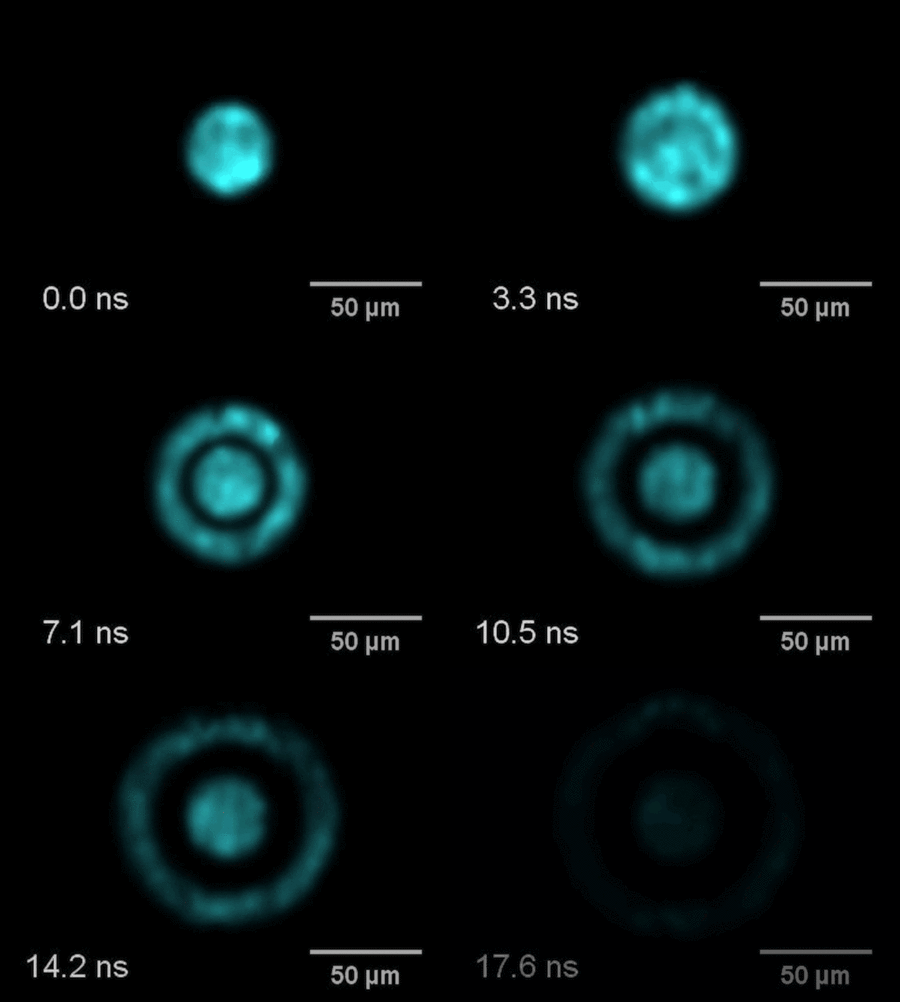
The technology, which Wang calls phase-sensitive compressed ultrafast photography (pCUP), can take video not just of transparent objects but also of more ephemeral things like shockwaves and possibly even of the signals that travel through neurons.

Wang explains that his new imaging system combines the high-speed photography system he previously developed with an old technology, phase-contrast microscopy, that was designed to allow better imaging of objects that are mostly transparent such as cells, which are mostly water.

[…]

Wang says the technology, though still early in its development, may ultimately have uses in many fields, including physics, biology, or chemistry.

“As signals travel through neurons, there is a minute dilation of nerve fibers that we hope to see. If we have a network of neurons, maybe we can see their communication in real time,” Wang says. In addition, he says, because temperature is known to change phase contrast, the system “may be able to image how a flame front spreads in a combustion chamber.”

The paper describing pCUP is titled “Picosecond-resolution phase-sensitive imaging of transparent objects in a single shot.”

Source: Ultrafast camera takes 1 trillion frames per second of transparent objects and phenomena

HP Remotely Disables a Customer’s Printer Until He Joins Company’s Monthly Subscription Service

A Twitter user’s complaint last week in which he produces photo evidence of HP warning him that his ink cartridges would be disabled until he starts paying for HP Instant Ink monthly subscription service has gone viral on the social media.

Ryan Sullivan, the user who made the complaint, said he only discovered the warning after cancelling a random HP subscription — which charged him $4.99 a month — after “over a year” of the billing cycle. “Cartridge cannot be used until printer is enrolled in HP Instant Ink,” Sullivan was informed by an error message.

Source: HP Remotely Disables a Customer’s Printer Until He Joins Company’s Monthly Subscription Service – Slashdot

Opera reportedly has multiple predatory loan apps in the Play Store with interest rates of up to 876%

It’s no secret that Opera isn’t doing so well in the era of Chrome dominance. According to a report published by Hindenburg Research, the company’s losses in browser revenue have apparently led it to create multiple loan apps with short payment windows and interest rates of ~365-876%, which are in violation of new Play Store rules Google enacted last year.

You may recall that Opera became a public company in mid-2017, shortly after it was purchased by a China-based investor group. Since then, Opera’s market share has continued to fall, due to the increasing dominance of Chrome. As a result, Opera decided to pivot to predatory short-term lending in Africa and Asia across four apps: OKash and OPesa in Kenya, CashBean in India, and OPay in Nigeria.

The apps have apparently remained available in the Play Store (except OPesa, which seems to be gone) by advertising different loan rates in the app description than users actually receive. For example, the listing for OKash stated its loans range from 91-365 days (the page now says 61-365 days), but an email response from the company stated it only offered loans from 15-29 days — significantly lower than the 60-day minimum enforced by Google. All of Opera’s other apps were also found to be in violation to varying extents.

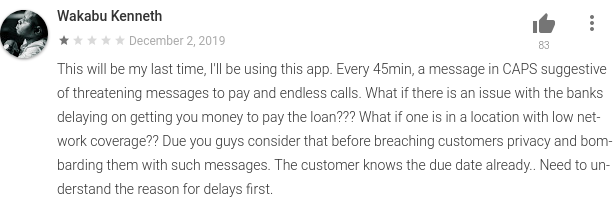
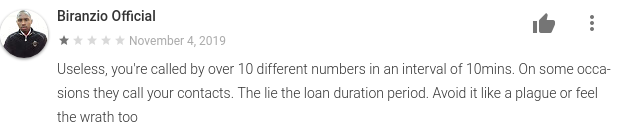
If you think that’s bad, then buckle in! According to Play Store reviews, the OKash and OPesa apps sent text messages or calls to people in the user’s contacts when payments were late, threatening to take legal action or place the borrower on a credit blacklist. A former employee told Hindenburg Research that this practice ended last year “because it was said it was illegal.” That’s probably a good reason to stop doing something, right?

Play Store reviews on OKash

Unfortunately for Opera, scamming low-income people isn’t helping the company’s financial situation. With all apps in violation of Play Store policies (and one already removed from the store), Opera’s primary means of income could very well disappear, and Hindenburg Research found evidence of investor money possibly being redirected to other companies and people:

1. $9.5 million of cash went toward an entity that appears to have been owned 100% by Opera’s Chairman/CEO, despite company disclosures suggesting otherwise. Ostensibly, the reason for the payment was to ‘purchase’ a business that was already funded and operated by Opera. To us, this transaction simply looks like a cash withdrawal.

2. $30 million of cash went into a karaoke app business owned by Opera’s Chairman/CEO, days before the arrest of a key business partner.

3. $31+ million of cash was doled out for “marketing expenses and prepayments” to an antivirus software company controlled by an Opera director and influenced by Opera’s Chairman/CEO. The antivirus company has no other known marketing clients, but is paid to help Opera with Google and Facebook ads and other marketing services. (Note: Most firms use a marketing agency for help with marketing needs.)

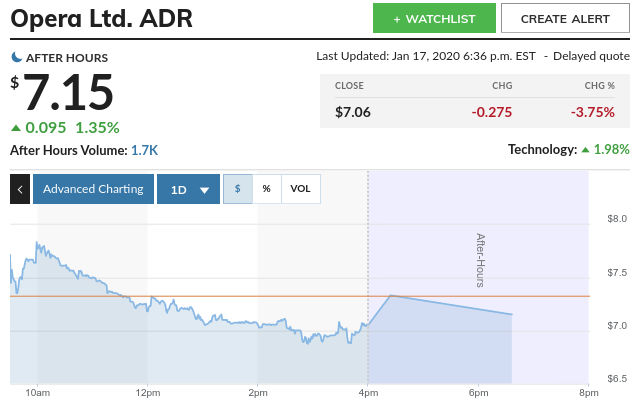
Since the report was released on January 16th, Opera’s stock price has dropped from ~$9 to $7.15 after hours (as of the time of writing).

You can read the full report at the link below. In the meantime, it might be a good idea to uninstall any Opera-owned apps — they might start sending texts to your friends about your browsing habits.

Source: Opera reportedly has multiple predatory loan apps in the Play Store with interest rates of up to 876%