New NZXT Liquid CPU Cooler Plays Animated GIFs, Because Awesome!

PC hardware maker NZXT has just announced the latest additions to its line of liquid CPU coolers, the Kraken X-3 and Z-3. The X-3 has a bright LED ring and rotates so the logo can be repositioned. The Z-3 comes with a 2.36-inch, 24-bit color LCD screen capable of displaying images, computer data, or animated GIFs, because maybe that is a thing people want.

The animated GIF of the CPU cooler displaying animated GIFs atop this post? With the Kraken Z-3 installed on my PC, I could display that GIF of a CPU cooler displaying GIFs as a GIF on my CPU cooler. I could put some anime there. Or maybe some looping pornography. Then I would turn my computer to the side with the glass window facing away from me and never see it again. I need a better way to display the glowing and flashing things inside of my PC. Maybe a mirror or something.

I’ve found NZXT liquid cooling quite reliable in the past. The idea of that reliability combined with this frivolity tickles me to no end. Look, they’ve even made a little trailer showing it off.

The Kraken X-3 and Z-3 are available for purchase in the U.S. starting today. The X-3 is available in 240mm, 280mm, and 360mm sizes for $130, $150, and $180. The Z03, AKA the one with the GIFs, costs $250 for the 280mm and $280 for the 360mm size. That means the ability to have an animated GIF on your CPU cooler costs $100.

Illustration for article titled New Liquid CPU Cooler Plays Animated GIFs, Because Why Not

Worth it.

Source: New Liquid CPU Cooler Plays Animated GIFs, Because Why Not

Facebook Enables Confusing ‘Off-Facebook Activity’ Privacy Tool, which won’t stop any tracking whatsoever

In a blog post earlier today, the famously privacy-conscious Mark Zuckerberg announced that—in honor of Data Privacy Day, which is apparently a thing—the official rollout of a long-awaited Off-Facebook Activity tool that allows Facebook users to monitor and manage the connections between Facebook profiles and their off-platform activity.

“To help shed more light on these practices that are common yet not always well understood, today we’re introducing a new way to view and control your off-Facebook activity,” Zuckerberg said in the post. “Off-Facebook Activity lets you see a summary of the apps and websites that send us information about your activity, and clear this information from your account if you want to.”

Zuck’s use of the phrases “control your off-Facebook activity” and “clear this information from your account” is kinda misleading—you’re not really controlling or clearing much of anything. By using this tool, you’re just telling Facebook to put the data it has on you into two separate buckets that are otherwise mixed together. Put another way, Facebook is offering a one-stop-shop to opt-out of any ties between the sites and services you peruse daily that have some sort of Facebook software installed and your own-platform activity on Facebook or Instagram.

The only thing you’re clearing is a connection Facebook made between its data and the data it gets from third parties, not the data itself.

Illustration for article titled Facebooks Clear History Tool Doesnt Clear Shit
Image: Facebook

As an ad-tech reporter, my bread and butter involves downloading shit that does god-knows-what with your data, which is why I shouldn’t’ve been surprised that Facebook hoovered data from more 520 partners across the internet—either sites I’d visited or apps I’d downloaded. For Gizmodo alone, Facebook tracked “252 interactions” drawn from the handful of plug-ins our blog has installed. (To be clear, you’re going to run into these kinds of trackers e.v.e.r.y.w.h.e.r.e.—not just on our site.)

These plug-ins—or “business tools,” as Facebook describes them—are the pipeline that the company uses to ascertain your off-platform activity and tie it to your on-platform identity. As Facebook describes it:

– Jane buys a pair of shoes from an online clothing and shoe store.

– The store shares Jane’s activity with us using our business tools.

– We receive Jane’s off-Facebook activity and we save it with her Facebook account. The activity is saved as “visited the Clothes and Shoes website” and “made a purchase”.

– Jane sees an ad on Facebook for a 10% off coupon on her next shoe or clothing purchase from the online store.

Here’s the catch, though: When I hit the handy “clear history” button that Facebook now provides, it won’t do jack shit to stop a given shoe store from sharing my data with Facebook—which explicitly laid this out for me when I hit that button:

Your activity history will be disconnected from your account. We’ll continue to receive your activity from the businesses and organizations you visit in the future.

Yes, it’s confusing. Baffling, really. But basically, Facebook has profiles on users and non-users alike. Those of you who have Facebook profiles can use the new tool to disconnect your Facebook data from the data the company receives from third parties. Facebook will still have that third-party-collected data and it will continue to collect more data, but that bucket of data won’t be connected to your Facebook identity.

Illustration for article titled Facebooks Clear History Tool Doesnt Clear Shit
Screenshot: Gizmodo (Facebook)

The data third parties collect about you technically isn’t Facebook’s responsibility, to begin with. If I buy a pair of new sneakers from Steve Madden where that purchase or browsing data goes is ultimately in Steve Madden’s metaphorical hands. And thanks to the wonders of targeted advertising, even the sneakers I’m purchasing in-store aren’t safe from being added as a data point that can be tied to the collective profile Facebook’s gathered on me as a consumer. Naturally, it behooves whoever runs marketing at Steve Madden—or anywhere, really—to plug in as many of those data points as they possibly can.

For the record, I also tried toggling my off-Facebook activity to keep it from being linked to my account, but was told that, while the company would still be getting this information from third parties, it would just be “disconnected from [my] account.”

Put another way: The way I browse any number of sites and apps will ultimately still make its way to Facebook, and still be used for targeted advertising across… those sites and apps. Only now, my on-Facebook life—the cat groups I join, the statuses I comment on, the concerts I’m “interested” in (but never actually attend)—won’t be a part of that profile.

Or put another way: Facebook just announced that it still has its tentacles in every part of your life in a way that’s impossible to untangle yourself from. Now, it just doesn’t need the social network to do it.

Source: Facebook Enables Confusing ‘Off-Facebook Activity’ Privacy Tool

Google releases new dataset search

You can now filter the results based on the types of dataset that you want (e.g., tables, images, text), or whether the dataset is available for free from the provider. If a dataset is about a geographic area, you can see the map. Plus, the product is now available on mobile and we’ve significantly improved the quality of dataset descriptions. One thing hasn’t changed however: anybody who publishes data can make their datasets discoverable in Dataset Search by using an open standard (schema.org) to describe the properties of their dataset on their own web page.

Source: Discovering millions of datasets on the web

Find it here

Leaked AVAST Documents Expose the Secretive Market for Your Web Browsing Data: Google, MS, Pepsi, they all buy it – Really, uninstall it now!

An antivirus program used by hundreds of millions of people around the world is selling highly sensitive web browsing data to many of the world’s biggest companies, a joint investigation by Motherboard and PCMag has found. Our report relies on leaked user data, contracts, and other company documents that show the sale of this data is both highly sensitive and is in many cases supposed to remain confidential between the company selling the data and the clients purchasing it.

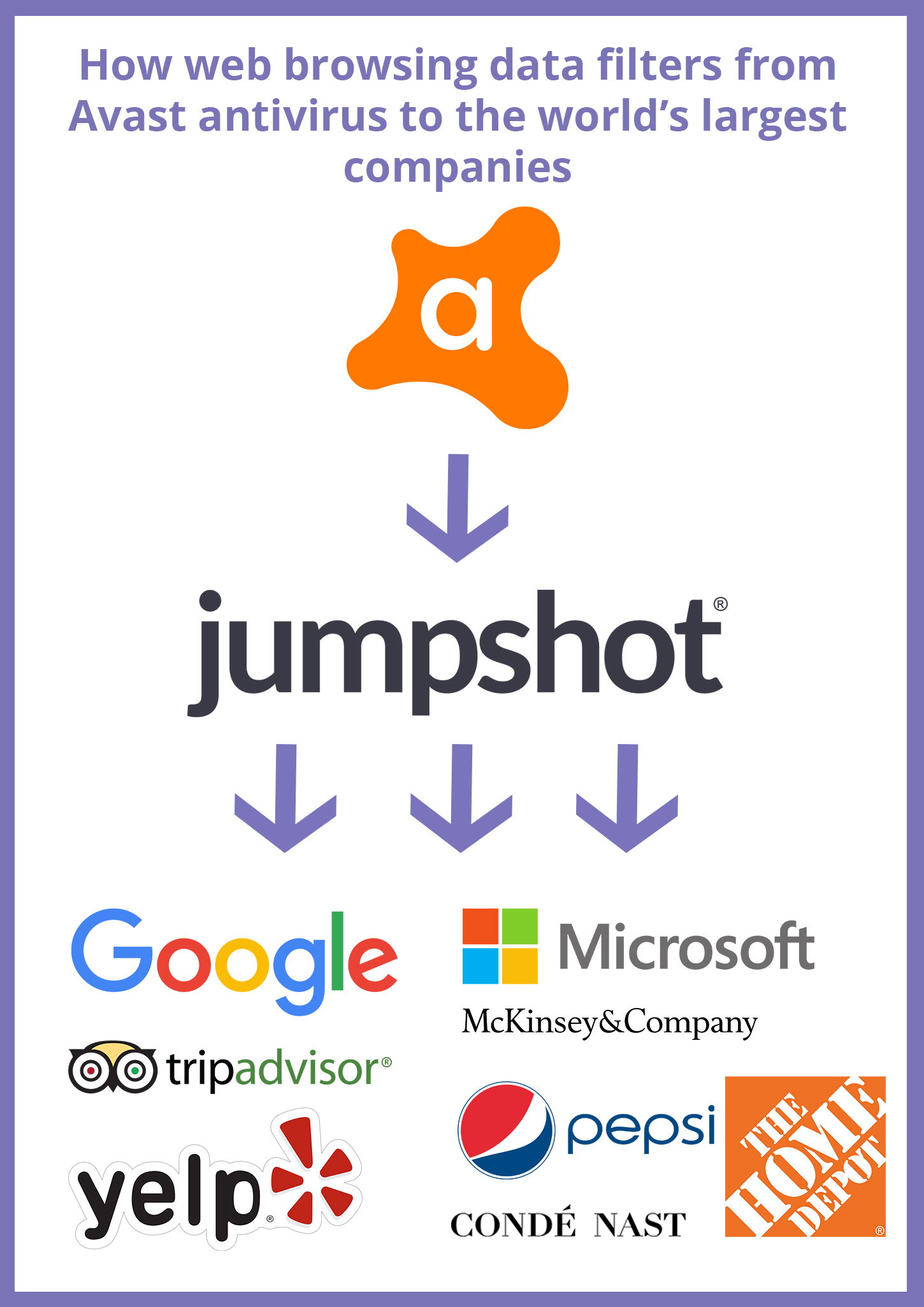
The documents, from a subsidiary of the antivirus giant Avast called Jumpshot, shine new light on the secretive sale and supply chain of peoples’ internet browsing histories. They show that the Avast antivirus program installed on a person’s computer collects data, and that Jumpshot repackages it into various different products that are then sold to many of the largest companies in the world. Some past, present, and potential clients include Google, Yelp, Microsoft, McKinsey, Pepsi, Sephora, Home Depot, Condé Nast, Intuit, and many others. Some clients paid millions of dollars for products that include a so-called “All Clicks Feed,” which can track user behavior, clicks, and movement across websites in highly precise detail.

Avast claims to have more than 435 million active users per month, and Jumpshot says it has data from 100 million devices. Avast collects data from users that opt-in and then provides that to Jumpshot, but multiple Avast users told Motherboard they were not aware Avast sold browsing data, raising questions about how informed that consent is.

The data obtained by Motherboard and PCMag includes Google searches, lookups of locations and GPS coordinates on Google Maps, people visiting companies’ LinkedIn pages, particular YouTube videos, and people visiting porn websites. It is possible to determine from the collected data what date and time the anonymized user visited YouPorn and PornHub, and in some cases what search term they entered into the porn site and which specific video they watched.

[…]

Until recently, Avast was collecting the browsing data of its customers who had installed the company’s browser plugin, which is designed to warn users of suspicious websites. Security researcher and AdBlock Plus creator Wladimir Palant published a blog post in October showing that Avast harvest user data with that plugin. Shortly after, browser makers Mozilla, Opera, and Google removed Avast’s and subsidiary AVG’s extensions from their respective browser extension stores. Avast had previously explained this data collection and sharing in a blog and forum post in 2015. Avast has since stopped sending browsing data collected by these extensions to Jumpshot, Avast said in a statement to Motherboard and PCMag.

[…]

However, the data collection is ongoing, the source and documents indicate. Instead of harvesting information through software attached to the browser, Avast is doing it through the anti-virus software itself. Last week, months after it was spotted using its browser extensions to send data to Jumpshot, Avast began asking its existing free antivirus consumers to opt-in to data collection, according to an internal document.

“If they opt-in, that device becomes part of the Jumpshot Panel and all browser-based internet activity will be reported to Jumpshot,” an internal product handbook reads. “What URLs did these devices visit, in what order and when?” it adds, summarising what questions the product may be able to answer.

Senator Ron Wyden, who in December asked Avast why it was selling users’ browsing data, said in a statement, “It is encouraging that Avast has ended some of its most troubling practices after engaging constructively with my office. However I’m concerned that Avast has not yet committed to deleting user data that was collected and shared without the opt-in consent of its users, or to end the sale of sensitive internet browsing data. The only responsible course of action is to be fully transparent with customers going forward, and to purge data that was collected under suspect conditions in the past.”

[…]

On its website and in press releases, Jumpshot names Pepsi, and consulting giants Bain & Company and McKinsey as clients.

As well as Expedia, Intuit, and Loreal, other companies which are not already mentioned in public Jumpshot announcements include coffee company Keurig, YouTube promotion service vidIQ, and consumer insights firm Hitwise. None of those companies responded to a request for comment.

On its website, Jumpshot lists some previous case studies for using its browsing data. Magazine and digital media giant Condé Nast, for example, used Jumpshot’s products to see whether the media company’s advertisements resulted in more purchases on Amazon and elsewhere. Condé Nast did not respond to a request for comment.

ALL THE CLICKS

Jumpshot sells a variety of different products based on data collected by Avast’s antivirus software installed on users’ computers. Clients in the institutional finance sector often buy a feed of the top 10,000 domains that Avast users are visiting to try and spot trends, the product handbook reads.

Another Jumpshot product is the company’s so-called “All Click Feed.” It allows a client to buy information on all of the clicks Jumpshot has seen on a particular domain, like Amazon.com, Walmart.com, Target.com, BestBuy.com, or Ebay.com.

In a tweet sent last month intended to entice new clients, Jumpshot noted that it collects “Every search. Every click. Every buy. On every site” [emphasis Jumpshot’s.]

[…]

One company that purchased the All Clicks Feed is New York-based marketing firm Omnicom Media Group, according to a copy of its contract with Jumpshot. Omnicom paid Jumpshot $2,075,000 for access to data in 2019, the contract shows. It also included another product called “Insight Feed” for 20 different domains. The fee for data in 2020 and then 2021 is listed as $2,225,000 and $2,275,000 respectively, the document adds.

[…]

The internal product handbook says that device IDs do not change for each user, “unless a user completely uninstalls and reinstalls the security software.”


Source: Leaked Documents Expose the Secretive Market for Your Web Browsing Data – VICE

Ring Doorbell App Gives Away your data to 3rd parties, without your knowledge or consent

An investigation by EFF of the Ring doorbell app for Android found it to be packed with third-party trackers sending out a plethora of customers’ personally identifiable information (PII). Four main analytics and marketing companies were discovered to be receiving information such as the names, private IP addresses, mobile network carriers, persistent identifiers, and sensor data on the devices of paying customers.

The danger in sending even small bits of information is that analytics and tracking companies are able to combine these bits together to form a unique picture of the user’s device. This cohesive whole represents a fingerprint that follows the user as they interact with other apps and use their device, in essence providing trackers the ability to spy on what a user is doing in their digital lives and when they are doing it. All this takes place without meaningful user notification or consent and, in most cases, no way to mitigate the damage done. Even when this information is not misused and employed for precisely its stated purpose (in most cases marketing), this can lead to a whole host of social ills.

[…]

Our testing, using Ring for Android version 3.21.1, revealed PII delivery to branch.io, mixpanel.com, appsflyer.com and facebook.com. Facebook, via its Graph API, is alerted when the app is opened and upon device actions such as app deactivation after screen lock due to inactivity. Information delivered to Facebook (even if you don’t have a Facebook account) includes time zone, device model, language preferences, screen resolution, and a unique identifier (anon_id), which persists even when you reset the OS-level advertiser ID.

Branch, which describes itself as a “deep linking” platform, receives a number of unique identifiers (device_fingerprint_id, hardware_id, identity_id) as well as your device’s local IP address, model, screen resolution, and DPI.

AppsFlyer, a big data company focused on the mobile platform, is given a wide array of information upon app launch as well as certain user actions, such as interacting with the “Neighbors” section of the app. This information includes your mobile carrier, when Ring was installed and first launched, a number of unique identifiers, the app you installed from, and whether AppsFlyer tracking came preinstalled on the device. This last bit of information is presumably to determine whether AppsFlyer tracking was included as bloatware on a low-end Android device. Manufacturers often offset the costs of device production by selling consumer data, a practice that disproportionately affects low-income earners and was the subject of a recent petition to Google initiated by Privacy International and co-signed by EFF.

Most alarmingly, AppsFlyer also receives the sensors installed on your device (on our test device, this included the magnetometer, gyroscope, and accelerometer) and current calibration settings.

Ring gives MixPanel the most information by far. Users’ full names, email addresses, device information such as OS version and model, whether bluetooth is enabled, and app settings such as the number of locations a user has Ring devices installed in, are all collected and reported to MixPanel. MixPanel is briefly mentioned in Ring’s list of third party services, but the extent of their data collection is not. None of the other trackers listed in this post are mentioned at all on this page.

Ring also sends information to the Google-owned crash logging service Crashalytics. The exact extent of data sharing with this service is yet to be determined.

Source: Ring Doorbell App Packed with Third-Party Trackers | Electronic Frontier Foundation