
Feature bloat: Psychology boffins find people tend to add elements to solve a problem rather than take things away

Scientists working on the psychology of problem solving may have hit upon why things always seem to get more complicated.

A newly uncovered heuristic – a mental shortcut or rule of thumb – shows bias towards adding features to find a solution, rather than subtracting existing features.

A simple experiment in Lego has provided some insight into the phenomenon.

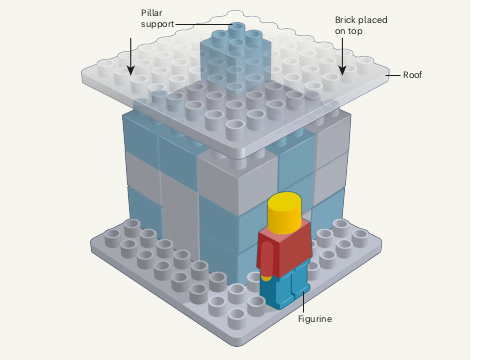
A team led by Gabrielle Adams, assistant professor of public policy and psychology at the University of Virginia, presented 197 participants with a Lego tower, four Duplo blocks high, six-by-six nodules on the horizontal plane. Above the tower was an 8×8 flat roof supported in the corner by a single 2×2 block.

The objective was to stabilise the roof so it would not fall onto a figure below when a brick was placed on top of it.

All the participants were told they could alter the structure however they wanted to. A control group was told “each piece that you add costs ten cents” while a “subtraction-cue condition” group was told “each piece that you add costs 10 cents but removing pieces is free.”

The simplest and cheapest solution was to remove the single block supporting the roof and attach it directly to the tower. But only 41 per cent of participants went with this solution. The remainder decided to add three bricks to support the roof. However, for the group given the subtraction-cue condition, 61 per cent of participants took the first option.

Adams and team also studied how participants make a 10×10 grid of green and white boxes symmetrical on a computer screen. They found people tend to add green boxes to the emptier half of the grid rather than removing them from the fuller half, even when doing the latter would have been more efficient.

The researcher also studied how people completed this task under “cognitive load.” While working on the task, they were asked to press the “F” key whenever they saw a 5 in a string of numerals passing across the top of the screen. The result was that people systematically default to searching for additive transformations, and consequently overlook subtractive transformations.

[P]eople are biased towards creating solutions by adding features rather than taking them away…. A study also observed the tendency at an organisational level

The researchers seem to have discovered a heuristic that people are biased towards creating solutions by adding features rather than taking them away. A study also observed the tendency at an organisational level.

For example, looking at university archives, they found that an incoming president had requested suggestions for changes that would allow the institution to better serve its students and community. Only 11 per cent of the responses involved removing an existing regulation, practice or programme.

corner of a building. When a brick is placed on top, the roof will collapse onto the figurine. The researchers asked study participants to stabilise the structure so that it would support the brick above the figurine, and analysed the ways in which participants solved the problem.

Click to enlarge

The research, published in Nature, argued that the discovery could have far-reaching ramifications.

“As with many heuristics, it is possible that defaulting to a search for additive ideas often serves its users well,” the paper said. “However, the tendency to overlook subtraction may be implicated in a variety of costly modern trends, including overburdened minds and schedules, increasing red tape in institutions and humanity’s encroachment on the safe operating conditions for life on Earth.

“If people default to adequate additive transformations – without considering comparable (and sometimes superior) subtractive alternatives – they may be missing opportunities to make their lives more fulfilling, their institutions more effective and their planet more liveable.” ®
Source: Feature bloat: Psychology boffins find people tend to add elements to solve a problem rather than take things away • The Register

Real-time dialogue between experimenters and dreamers during REM sleep

 Here we show that individuals who are asleep and in the midst of a lucid dream (aware of the fact that they are currently dreaming) can perceive questions from an experimenter and provide answers using electrophysiological signals. We implemented our procedures for two-way communication during polysomnographically verified rapid-eye-movement (REM) sleep in 36 individuals. Some had minimal prior experience with lucid dreaming, others were frequent lucid dreamers, and one was a patient with narcolepsy who had frequent lucid dreams. During REM sleep, these individuals exhibited various capabilities, including performing veridical perceptual analysis of novel information, maintaining information in working memory, computing simple answers, and expressing volitional replies. Their responses included distinctive eye movements and selective facial muscle contractions, constituting correctly answered questions on 29 occasions across 6 of the individuals tested. These repeated observations of interactive dreaming, documented by four independent laboratory groups, demonstrate that phenomenological and cognitive characteristics of dreaming can be interrogated in real time.

Source: (PDF) Real-time dialogue between experimenters and dreamers during REM sleep

Actor in Hollywood Ponzi Scheme “sold” Netflix exculsives for $690 million

Zachary Horwitz never made it big on the Sunset Strip — there was the uncredited part in Brad Pitt’s “Fury” and a host of roles in low-budget thrillers and horror flicks. But federal charges suggest he had acting talent, duping several financial firms out of hundreds of millions of dollars and enabling him to live the Hollywood dream after all.

That meant chartered flights and a $6 million mansion — replete with wine cellar and home gym. Horwitz even included a bottle of Johnnie Walker Blue Label, which retails for more than $200, as a gift to investors along with his company’s “annual report.”

The claims are outlined in legal documents that U.S. prosecutors and the Securities and Exchange Commission released this week alleging Horwitz, 34, was running a massive Ponzi scheme. His scam: a made-up story that he had exclusive deals to sell films to Netflix Inc. and HBO. Dating back to 2014, the SEC said he raised a shocking $690 million in fraudulent funds. On Tuesday, Horwitz was arrested.

Horwitz, who went by the screen name “Zach Avery,” used fabricated contracts and fake emails to swindle at least five firms, according to the government. Investors were issued promissory notes through his firm 1inMM Capital to acquire the rights to movies that would be sold to Netflix and HBO for distribution in Latin America, Australia, New Zealand and other locations.

The claims of business relationships with the media companies were bogus, according to prosecutors, with a Netflix executive going so far as to send a cease-and-desist order to Horwitz and his attorney in February.

While Horwitz promised returns in excess of 35%, he was actually relying on new investors to pay off old ones, according to the SEC, which won a court order to freeze his assets. Ryan Hedges, Horwitz’s attorney, didn’t respond to requests for comment.

[…]

Source: Actor in Hollywood Ponzi Scheme Sent Scotch With Annual Reports – Bloomberg

Apple Never Made iMessage for Android to Lock Users In: Epic v Apple

As part of the ongoing legal battle between Fortnite maker Epic and Apple, some new information has come to light confirming the most annoying thing about Apple’s iMessage app: that Apple could make a cross-platform version of iMessage for Android phones, but it won’t because it would be bad for business.

This info comes from testimony that appears in Epic’s brief against Apple, which was posted recently on Reddit. In the document, there are several statements from well-known Apple execs describing the reasons why Apple never made a cross-platform version of iMessage for Android devices.

In one quote dating back to 2013, Eddy Cue—who is now Apple’s senior vice president for internet software and services—said that Apple “could have made a version [of iMessage] on Android that worked with iOS,” providing the possibility that “users of both platforms would have been able to exchange messages with one another seamlessly.”

Sadly, it seems multiple Apple execs were concerned that doing so would make it too easy for iPhone owners to leave the Apple ecosystem, with Apple’s senior vice president of software engineering, Craig Federighi, having said, “iMessage on Android would simply serve to remove [an] obstacle to iPhone families giving their kids Android phones”—a sentiment Epic’s brief says was also shared by Phil Schiller, who back then was in charge of overseeing Apple’s App Store.

It seems these sentiments have been known within Apple for quite some time. The brief describes a 2016 comment from a former Apple employee who said “the #1 most difficult [reason] to leave the Apple universe app is iMessage … iMessage amounts to serious lock-in,” with Schiller having affirmed the comment by saying, “moving iMessage to Android will hurt us more than help us, this email illustrates why.”

[…]

Source: Apple Never Made iMessage for Android to Lock Users In: Epic v Apple

Alibaba antitrust investigation: Beijing slaps e-commerce giant Alibaba with record US$2.8 billion fine in landmark case. US antitrust still going nowhere.

China’s antitrust regulators slapped a record fine on one of the country’s largest technology conglomerates, closing a months-long investigation that began

last Christmas Eve

and setting the precedent for the government to use anti-monopoly rules to regulate the country’s Big Tech.

Alibaba Group Holding, the world’s largest e-commerce company and owner of this newspaper, was fined 18.2 billion yuan (US$2.8 billion) by the State Administration for Market Regulation (SAMR).

The Hangzhou-based company “abused its dominant market position in China’s online retail platform service market since 2015 by forcing online merchants to open stores or take part in promotions on its platforms,” compelling the market to “

pick one from two

” in a breach of the country’s anti-monopoly law, the regulator said on Saturday.

Alibaba was ordered to correct its misconduct, and pay a fine equivalent to 4 per cent of its total 2019 revenue. The fine was nearly three times

the 6.1 billion yuan penalty paid by Qualcomm

, the world’s largest supplier of mobile chips, in 2015.

[…]

The antitrust investigation of Alibaba was part of the Chinese government’s effort to tame the unfettered growth of the country’s tech behemoths, and to ringfence financial security and prevent risk amid a period of slowing economic growth during the coronavirus pandemic. It has been widely watched, for ramifications that could potentially affect the entire ecosystem of businesses and economy centred around the internet.

The hefty fine was aimed at promoting the “healthy and continuous development of the country’s internet industry” and was by no means a denigration of the “important role of internet platforms in economic and social development,” and shows no change in the state’s “attitude of supporting internet platforms,” according to a commentary by the People’s Daily, the mouthpiece newspaper of the ruling Communist Party.

[…]

Source: Alibaba antitrust investigation: Beijing slaps e-commerce giant with record US$2.8 billion fine in landmark case | South China Morning Post

Glass molded like plastic could usher in new era of complex glass shapes

The production of glass—one of humanity’s oldest materials—is getting a 21st century makeover. A new approach to glassmaking treats the material like plastic, allowing scientists to injection mold vaccine vials, sinuous channels for carrying out lab chemistry, and other complex shapes.

“It’s a really exciting paper,” says André Studart, a materials scientist at ETH Zürich. “This is a great way to form glass into complicated and interesting geometries.”

[…]

In 2017, researchers led by Frederik Kotz, a microsystems engineer at the Albert Ludwig University of Freiburg, set out to change that. They reworked a 3D printer to forge glass rather than printing plastics or metals.

The scientists created a printable powder by mixing silica nanoparticles with a polymer that could be cured with ultraviolet (UV) light. After printing the shapes they wanted, they cured the polymer with UV light so it would hold its shape. They then fired the mix in an oven to burn off the polymer and fuse the silica particles into a continuous glass structure.

The approach worked, making it possible to craft shapes such as tiny pretzels and replica castle gates. The work garnered interest from companies wanting to build minute lenses and other complex transparent optical components for telecommunications equipment. But the procedure was slow, turning out components one by one, rather than a fully industrial approach that could produce parts en masse, as is done with plastic.

To speed things up, Kotz and his colleagues have now extended their nanocomposite approach to work with injection molding, a process used to mass produce plastic parts like toys and car bumpers by the ton. The researchers again started with tiny silica particles. The team then mixed the silica with two polymers, polyethylene glycol (PEG) and polyvinyl butyral (PVB). The mixture created a dry powder with the consistency of toothpaste. The team fed the paste into an extruder that pressed it into a preformed mold with shapes such as a disc or tiny gear.

Outside of the mold, the parts hold their shape because myriad weak attractive bonds, called van der Waals interactions, form between neighboring silica particles. But the parts are still fragile.

To harden them, the researchers used water to wash away the PEG. They then fired the remaining material in two stages: First at 600°C to burn out the PVB, and second at 1300°C to fuse the silica particles into the final piece.

“What you get in the end is high purity silica glass” in any shape you want, Kotz says. The glass parts also end up with the optical and chemical characteristics needed for commercial telecommunications devices and chemical reactors, he and his colleagues report today in Science.

[…]

However, Studart says this new approach to mass producing glass parts still faces a bottleneck: Washing away the PEG must be done slowly, over days, to ensure the glass parts don’t crack. Speed that up, he says, and injection molding of glass could become as popular as it is with plastic.

Source: Glass molded like plastic could usher in new era of complex glass shapes | Science | AAAS