OneWeb, SpaceX satellites dodged a potential collision in orbit

Two satellites from the fast-growing constellations of OneWeb and SpaceX’s Starlink dodged a dangerously close approach with one another in orbit last weekend, representatives from the US Space Force and OneWeb said. It’s the first known collision avoidance event for the two rival companies as they race to expand their new broadband-beaming networks in space.

On March 30th, five days after OneWeb launched its latest batch of 36 satellites from Russia, the company received several “red alerts” from the US Space Force’s 18th Space Control Squadron warning of a possible collision with a Starlink satellite. Because OneWeb’s constellation operates in higher orbits around Earth, the company’s satellites must pass through SpaceX’s mesh of Starlink satellites, which orbit at an altitude of roughly 550 km.

One Space Force alert indicated a collision probability of 1.3 percent, with the two satellites coming as close as 190 feet — a dangerously close proximity for satellites in orbit. If satellites collide in orbit, it could cause a cascading disaster that could generate hundreds of pieces of debris and send them on crash courses with other satellites nearby.

Currently, there’s no national or global authority that would force satellite operators to take action on predicted collisions. Space Force’s urgent alerts sent OneWeb engineers scrambling to email SpaceX’s Starlink team to coordinate maneuvers that would put the two satellites at safer distances from one another.

While coordinating with OneWeb, SpaceX disabled its automated AI-powered collision avoidance system to allow OneWeb to steer its satellite out of the way, according to OneWeb’s government affairs chief Chris McLaughlin. It was unclear why exactly SpaceX disabled the system. SpaceX, which rarely responds to reporters, did not return multiple requests for comment for this story, nor did David Goldman, the company’s director of satellite policy.

SpaceX’s automated system for avoiding satellite collisions has sparked controversy, raising concerns from other satellite operators who say they have no way of knowing which way the system will move a Starlink satellite in the event of a close approach. “Coordination is the issue,” McLaughlin says. “It is not sufficient to say ‘I’ve got an automated system,’ because the other guy may not have, and won’t understand what yours is trying to do.”

[…]

the sharp increase of satellites in orbit, mainly driven by SpaceX’s Starlink venture, has moved faster than any authority can regulate the industry for safety. McKissock says SpaceX has made efforts to increase its transparency in orbit; the company currently provides location data of its satellites to other operators. But its automated system for avoiding collisions is a closed book where openness and coordination are needed the most, analysts and operators say.

“What is the point of having it if you have to turn it off when there’s going to be a potential collision?” Victoria Samson of the Secure World Foundation says, adding that the void of any clear international framework for managing active objects in space makes it largely unclear who would be held responsible if a collision actually occurred.

[…]

Source: OneWeb, SpaceX satellites dodged a potential collision in orbit – The Verge
Debian Votes to Issue No Statement on Stallman’s Return to the FSF Board

Debian Project Secretary Kurt Roeckx has announced the results of a closely-watched vote on what statement would be made about Richard Stallman’s readmission to the Free Software Foundation’s board.
Seven options were considered, with the Debian project’s 420 voting developers also asked to rank their preferred outcomes:

  • Option 1: “Call for the FSF board removal, as in rms-open-letter.github.io”
  • Option 2: “Call for Stallman’s resignation from all FSF bodies”
  • Option 3: “Discourage collaboration with the FSF while Stallman is in a leading position”
  • Option 4: “Call on the FSF to further its governance processes”
  • Option 5: “Support Stallman’s reinstatement, as in rms-support-letter.github.io”
  • Option 6: “Denounce the witch-hunt against RMS and the FSF”
  • Option 7: “Debian will not issue a public statement on this issue”

While all seven options achieved a quorum of votes, two failed to achieve a majority — options 5 and 6. (“Support Stallman’s reinstatement” and “Denounce the witch-hunt…”) The option receiving the most votes was #7 (not issuing a public statement) — but it wasn’t that simple. The vote’s final outcome was determined by comparing every possible pair of options to determine which option would still be preferred by a majority of voters in each possible comparision.

In this case, that winner was still the option which had also received the most votes:

Debian will not issue a public statement on this issue.
The Debian Project will not issue a public statement on whether Richard Stallman should be removed from leadership positions or not.

Any individual (including Debian members) wishing to (co-)sign any of the open letters on this subject is invited to do this in a personal capacity.

The results are captured in an elaborate graph. Numbers inside the ovals show the final ratio of yes to no votes (so a number higher than 1.00 indicates a majority, with much higher numbers indicating much larger majorities). Numbers outside the ovals (along the lines) indicate the number of voters who’d preferred the winning choice over the losing choice (toward which the arrow is pointing).

The winning option is highlighted in blue.

Source: Debian Votes to Issue No Statement on Stallman’s Return to the FSF Board – Slashdot

To be honest this is probably the best thing they could do from a community standpoint.

Project FoX Brings Avionics + Sensor Data to Commercial Computer Tablets In F-35 Stealth Fighter Cockpits

The U.S. Air Force has, for the first time, live-streamed data directly from the F-35A stealth fighter and onto a commercial computer tablet in the cockpit, during ground tests at Nellis Air Force Base in Nevada. The March 31 trial, part of the Fighter Optimization eXperiment, or FoX, demonstrated that data from the jet could be used to communicate with mobile apps running on the tablet and there are hopes that the same concept could be used in the future on other manned fighters, as well as drones.

In the initial trial, the flight test instrumentation system was streamed from the F-35’s onboard systems and onto the tablet, on which apps were running. The first two such apps, developed under Project FoX, are designed to help the pilot of the stealth jet negotiate hostile air defense systems, and to use artificial intelligence (AI) to combat the same types of threat.

U.S. Marine Corps

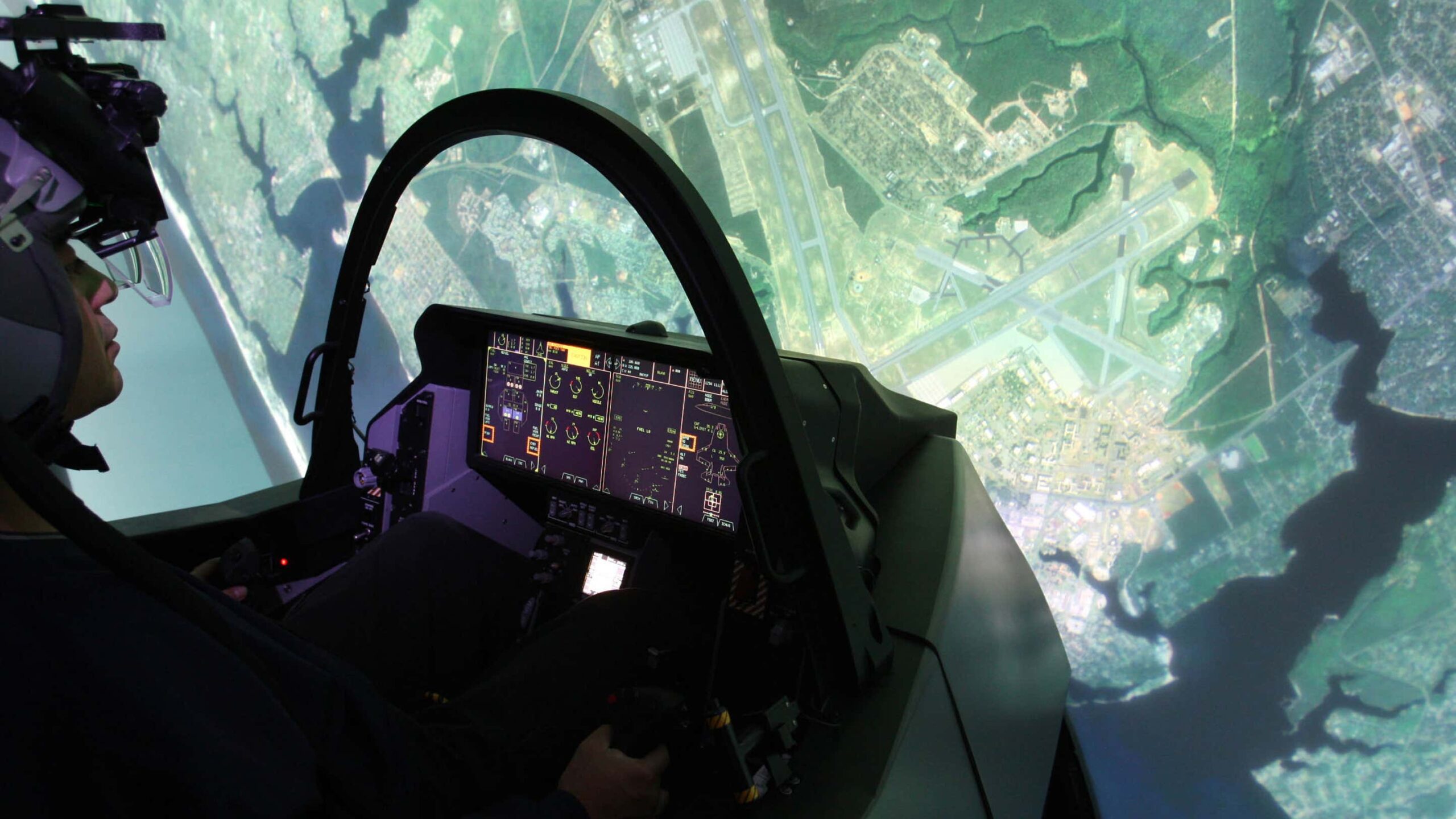
A pilot at Eglin Air Force Base, Florida, using an F-35 Full Mission Simulator.

Until now, although F-35 pilots regularly fly with a tablet on their knee, these haven’t been fully integrated with the cockpit and were not able to be physically plugged into the jet and receive real-time data from its own mission computers and its hugely powerful sensor suite. Now, as well as at Nellis, F-35s at Edwards Air Force Base and at Naval Air Weapons Station China Lake, both in California, are also trialing the FoX Tablet interface. So far, the work had only been conducted with the jets on the ground but, once safety and security aspects are addressed, they will be used in the air, too.

[…]

Previously, this type of information would be presented to the F-35 pilot on the all-glass touchscreen display, which can be customized to present different data, and via the helmet-mounted sight. Both have been the subject of various criticisms in the past, with pilots, for example, pointing to the apparent high degree of latency in information reaching the helmet, which has also been compared unfavorably to a traditional head-up display. The touchscreen doesn’t have any tactile feel or feedback, which can make tapping-in commands a bit challenging during certain environmental and combat conditions.

Even with these existing cockpit interfaces working seamlessly, there is still an argument to be made for having an additional source of situational awareness (SA), especially for the demanding SEAD mission, or other highly complex roles that the F-35 is increasingly finding itself used for, in the form of a tablet. A tablet is portable and, thanks to apps, can present a different tactical picture, or data set, than the other displays. Indeed, tablets are now a frequent fixture in the cockpits of — typically older-generation aircraft — to provide, for example, a means of displaying targeting pod data, or datalink-provided tactical and SA information, as well as flight manual and procedural info.

[…]

“There is no reason why I can’t test the same capability and app on F-18 before F-35 or risk reduce software on F-35 for use by unpiloted aircraft,” LeClair explained. “By connecting a tablet to an aircraft’s data bus, the warfighter and tester will be able to utilize an entire DoD Combat App store of tools, customized to help solve tactical problems in real time.”

[…]

As to how pilots will adapt to the FoX Tablet, LeClair said that “They want this, and they want it yesterday,” noting the “tremendous support from combat aviators.” LeClair likened the tablet concept to an electronic flight bag, the electronic information management device that has replaced the paperwork previously used for flight management tasks. In this way, the FoX Tablet would likely include flight maps, operating manuals, and perhaps even aircraft diagnostic data, as well as a range of apps optimized for different missions or test programs.

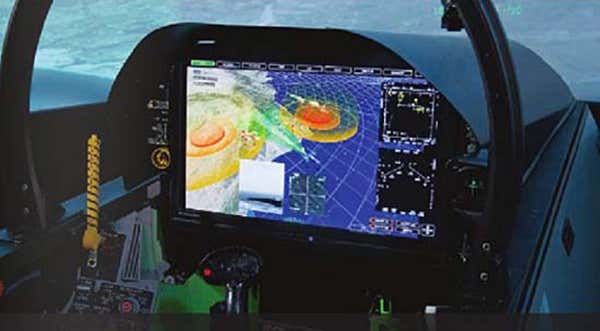
The tablet could also allow data to be displayed differently than what an aircraft’s cockpit displays will allow. For instance, 3D situational awareness display rendering, where threats and other situational and navigational information are displayed in a spatially volumetric form, can provide a huge advantage for aircrews trying to survive in a very dynamic and hostile environment. Some of the latest aircraft have wide area displays and graphics capabilities to do this. As far as we know, the F-35, whose systems are based on nearly 20-year-old tech today, is not capable of being able to generate this type of visual interface. But a tablet could be able to without upgrading the entire cockpit and its backend computing systems that drive its visual interfaces.

Boeing

The Super Hornet Block III’s wide-area display and powerful display processing technology can show a 3D instead of a 2D render of the situation around the aircraft at any given time.

After the FoX Tablet comes the FoX BoX, which should optimize its utility in the cockpit. This is being developed at NAWS China Lake, home to ongoing F/A-18E/F Super Hornet mission systems test work. It aims to use a cyber-secure chipset to run “high-level, AI-capable computer processors that will serve as an operating system to communicate to aircraft, allowing the FoX Tablet to function mainly as a visual interface for aircrew.“

Meanwhile, ground tests of the tablet will continue on the F-35, before moving to the F/A-18, F-16, and the F-22. A first test flight — aboard an as yet unconfirmed platform — should take place later this year.

[…]

Source: Project FoX Brings Computer Tablets To F-35 Stealth Fighter Cockpits

NASA decides to blow up first woman going to the moon by choosing Elon Musk’s SpaceX to try to bring her there on basis of supercheap contract

[…]

NASA has chosen Elon Musk‘s SpaceX to build the spacecraft that take the first woman and next man to the moon.

The American space agency made the official announcement Friday, which includes SpaceX’s  $2.9 billion contract to build the lunar lander that is reportedly much lower than what competitors bid.

The Washington Post shared the news hours before saying the Musk-owned firm beat out Jeff Bezos’ Blue Origin and Dynetics.

Bezos owns the Post, which branded Musk’s win a ‘stunning victory’ over his Amazon tycoon’s rival effort.

[…]

Source: Elon Musk’s SpaceX ‘will bring first woman to the Moon after signing rocket deal with NASA’ | Daily Mail Online

Google AI Blog: Monster Mash: A Sketch-Based Tool for Casual 3D Modeling and Animation

Monster Mash, an open source tool presented at SIGGRAPH Asia 2020 that allows experts and amateurs alike to create rich, expressive, deformable 3D models from scratch — and to animate them — all in a casual mode, without ever having to leave the 2D plane. With Monster Mash, the user sketches out a character, and the software automatically converts it to a soft, deformable 3D model that the user can immediately animate by grabbing parts of it and moving them around in real time. There is also an online demo, where you can try it out for yourself.

Creating a walk cycle using Monster Mash. Step 1: Draw a character. Step 2: Animate it.

Creating a 2D Sketch The insight that makes this casual sketching approach possible is that many 3D models, particularly those of organic forms, can be described by an ordered set of overlapping 2D regions. This abstraction makes the complex task of 3D modeling much easier: the user creates 2D regions by drawing their outlines, then the algorithm creates a 3D model by stitching the regions together and inflating them. The result is a simple and intuitive user interface for sketching 3D figures.

For example, suppose the user wants to create a 3D model of an elephant. The first step is to draw the body as a closed stroke (a). Then the user adds strokes to depict other body parts such as legs (b). Drawing those additional strokes as open curves provides a hint to the system that they are meant to be smoothly connected with the regions they overlap. The user can also specify that some new parts should go behind the existing ones by drawing them with the right mouse button (c), and mark other parts as symmetrical by double-clicking on them (d). The result is an ordered list of 2D regions.

Steps in creating a 2D sketch of an elephant.

Stitching and Inflation To understand how a 3D model is created from these 2D regions, let’s look more closely at one part of the elephant. First, the system identifies where the leg must be connected to the body (a) by finding the segment (red) that completes the open curve. The system cuts the body’s front surface along that segment, and then stitches the front of the leg together with the body (b). It then inflates the model into 3D by solving a modified form of Poisson’s equation to produce a surface with a rounded cross-section (c). The resulting model (d) is smooth and well-shaped, but because all of the 3D parts are rooted in the drawing plane, they may intersect each other, resulting in a somewhat odd-looking “elephant”. These intersections will be resolved by the deformation system.

Illustration of the details of the stitching and inflation process. The schematic illustrations (b, c) are cross-sections viewed from the elephant’s front.

Layered Deformation At this point we just have a static model — we need to give the user an easy way to pose the model, and also separate the intersecting parts somehow. Monster Mash’s layered deformation system, based on the well-known smooth deformation method as-rigid-as-possible (ARAP), solves both of these problems at once. What’s novel about our layered “ARAP-L” approach is that it combines deformation and other constraints into a single optimization framework, allowing these processes to run in parallel at interactive speed, so that the user can manipulate the model in real time.

The framework incorporates a set of layering and equality constraints, which move body parts along the z axis to prevent them from visibly intersecting each other. These constraints are applied only at the silhouettes of overlapping parts, and are dynamically updated each frame.

In steps (d) through (h) above, ARAP-L transforms a model from one with intersecting 3D parts to one with the depth ordering specified by the user. The layering constraints force the leg’s silhouette to stay in front of the body (green), and the body’s silhouette to stay behind the leg (yellow). Equality constraints (red) seal together the loose boundaries between the leg and the body.

Meanwhile, in a separate thread of the framework, we satisfy point constraints to make the model follow user-defined control points (described in the section below) in the xy-plane. This ARAP-L method allows us to combine modeling, rigging, deformation, and animation all into a single process that is much more approachable to the non-specialist user.

The model deforms to match the point constraints (red dots) while the layering constraints prevent the parts from visibly intersecting.

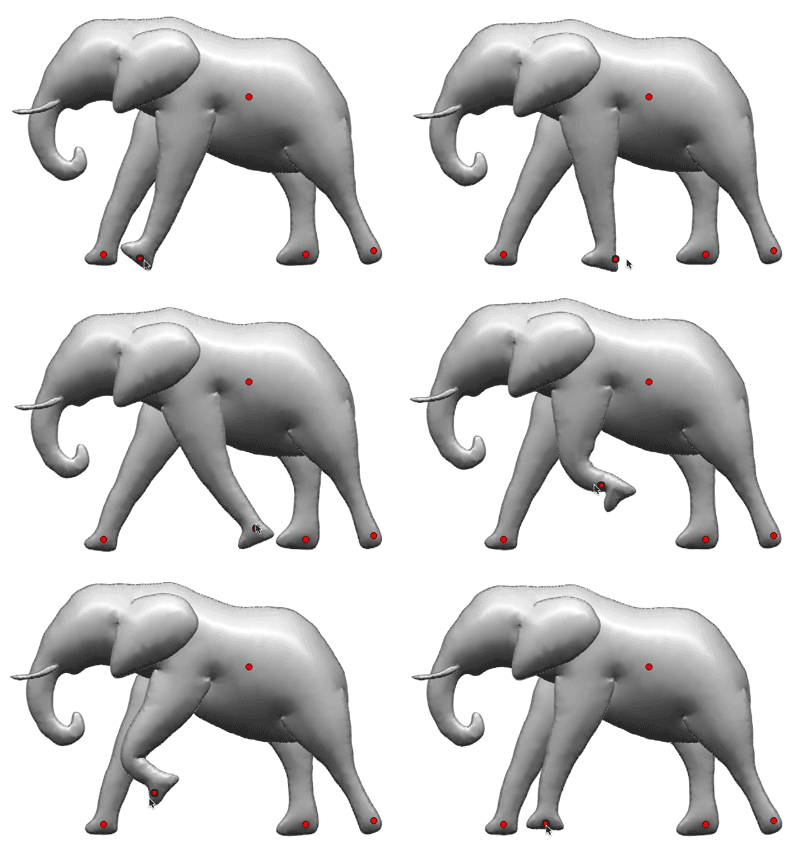
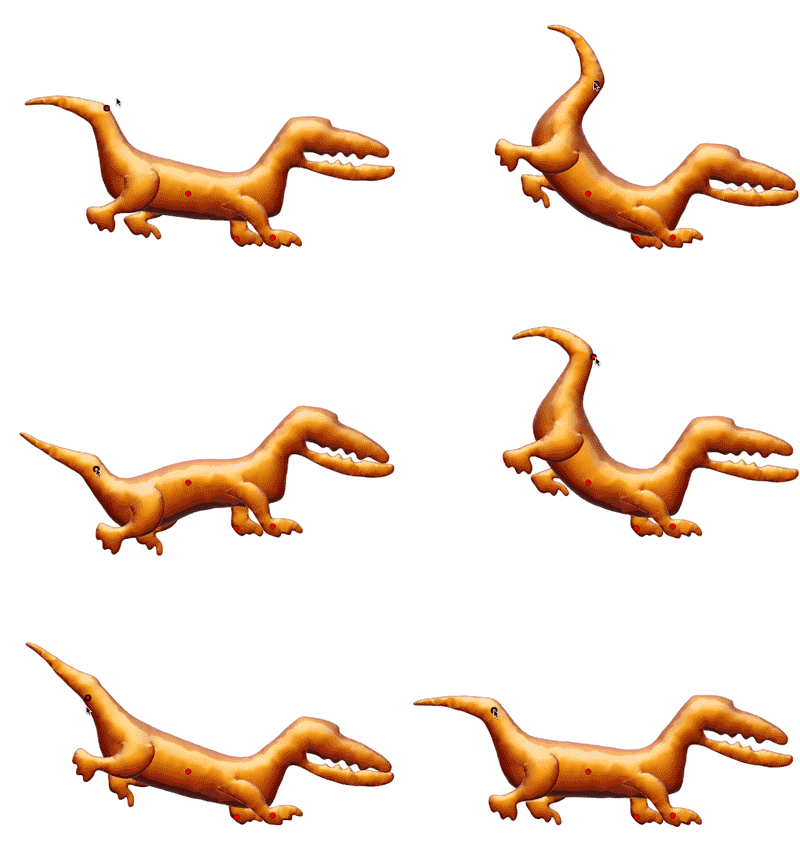
Animation To pose the model, the user can create control points anywhere on the model’s surface and move them. The deformation system converges over multiple frames, which gives the model’s movement a soft and floppy quality, allowing the user to intuitively grasp its dynamic properties — an essential prerequisite for kinesthetic learning.

Because the effect of deformations converges over multiple frames, our system lends 3D models a soft and dynamic quality.

To create animation, the system records the user’s movements in real time. The user can animate one control point, then play back that movement while recording additional control points. In this way, the user can build up a complex action like a walk by layering animation, one body part at a time. At every stage of the animation process, the only task required of the user is to move points around in 2D, a low-risk workflow meant to encourage experimentation and play.

Conclusion We believe this new way of creating animation is intuitive and can thus help democratize the field of computer animation, encouraging novices who would normally be unable to try it on their own as well as experts who often require fast iteration under tight deadlines. Here you can see a few of the animated characters that have been created using Monster Mash. Most of these were created in a matter of minutes.

A selection of animated characters created using Monster Mash. The original hand-drawn outline used to create each 3D model is visible as an inset above each character.

All of the code for Monster Mash is available as open source, and you can watch our presentation and read our paper from SIGGRAPH Asia 2020 to learn more. We hope this software will make creating 3D animations more broadly accessible. Try out the online demo and see for yourself!

Source: Google AI Blog: Monster Mash: A Sketch-Based Tool for Casual 3D Modeling and Animation

Microsoft removes 47% of right to be forgotten requests – some countries are trolling the requests heavily

Country / Region
Requests received and processed
URLs requested
URLs accepted
URLs rejected
Percentage of URLs accepted
Austria 45 103 67 36
65%
Belgium
49
421
105
316
25%
Bulgaria 4 10 8 2
80%
Croatia 3 8 4 4
50%
Cyprus 2 2 0 2
0%
Czech Republic 12 20 13
7
65%
Denmark 24 33 19 14
58%
Estonia 8
49
33 16
67%
Finland
32
112 42 70
38%
France 895 2,495 1,065 1,426
43%
Germany 460
1,705
897 807
53%
Greece 5 43
0
43
0%
Hungary 2 3 3 0
100%
Ireland 28 126 85 41
67%
Italy 178
625
417 208
67%
Latvia 13
32
16 16
50%
Lithuania 2 2 1 1
50%
Luxembourg 2 5
1
4
20%
Malta 2 3 1 2
33%
Netherlands
152
854
596
257
70%
Norway 24 50 22 28
44%
Poland 19 172 116 56
67%
Portugal 4 20 10
10
50%
Romania 7 62 28
34
45%
Russia 23 33 17 16
52%
Slovakia 1 2 2
0
100%
Slovenia 8 13 8 5
62%
Spain 143 383 134 242
35%
Sweden
113
315
126
189
40%
Switzerland 68 273 153 120
56%
United Kingdom 539 2,306
1,256
1,026
54%
Total 2,867 10,280 5,245 4,998
51%

Note: This table shows the number of URLs that were accepted and rejected for European and Russian requests received between July 1 and December 31, 2020 that were processed as of February 15, 2021. The number of URLs accepted and rejected may not reflect requests still pending review as of February 15, 2021. For example, processing delays may result if more information is needed to complete the review on a request.

Cumulative “Right to be forgotten” requests, May 2014 – December 2020


Requests received and processed URLs requested URLs accepted URLs rejected Percentage of URLs accepted
Total 41,613 133,972 62,373 71,562 47%

Note: This table shows the number of URLs that were accepted and rejected for European and Russian requests received between May 2014 and December 31, 2020 that were processed as of February 15, 2021. The number of URLs accepted and rejected may not reflect requests still pending review as of February 15, 2021. For example, processing delays may result if more information is needed to complete the review on a request.

Source: Content Removal Request Report | Microsoft CSR

In some countries apparently it is normal for a single request to make sweeping right to be forgotten deletion requests.

Microsoft honored 99.57% of 17m copyright removal requests last Q 2020

As an intellectual property company itself, Microsoft encourages respect for intellectual property, including copyrights. We also are committed to freedom of expression and the rights of users to engage in uses that may be permissible under applicable copyright laws. Links to webpages containing material that infringes on the rights of copyright owners may be removed from our search results provided we receive a legally sufficient notice of infringement from an owner or an authorized agent acting on that owner’s behalf. The following numbers relate to requests to remove links to webpages from our Bing search engine results.

Copyright removal requests, July to December 2020


Requests
URLs requested
URLs accepted
URLs rejected
Percentage of URLs accepted
17,006,978 59,222,175 58,965,071 257,104
99.57%

Note: The data above details compliant removal requests received by Bing for removal of algorithmic search results. The report does not include: (1) copyright removal requests from the Bing image or video index, (2) from Bing Ads, or (3) removal requests for other online services, such as Outlook and Skype requests, or (4) requests initially deemed non-compliant during preliminary reviews conducted prior to entry of the request into our standard tracking tools. The data includes more than 95% of the copyright removal requests for Bing for the six-month reporting period. Removal requests for Bing represent about 99% of all copyright removal requests received.

Source: Content Removal Request Report | Microsoft CSR

Does this show that people have no recourse to invalid removal requests unless they are willing to spend big money on lawyers?

NL Marines test flight suit

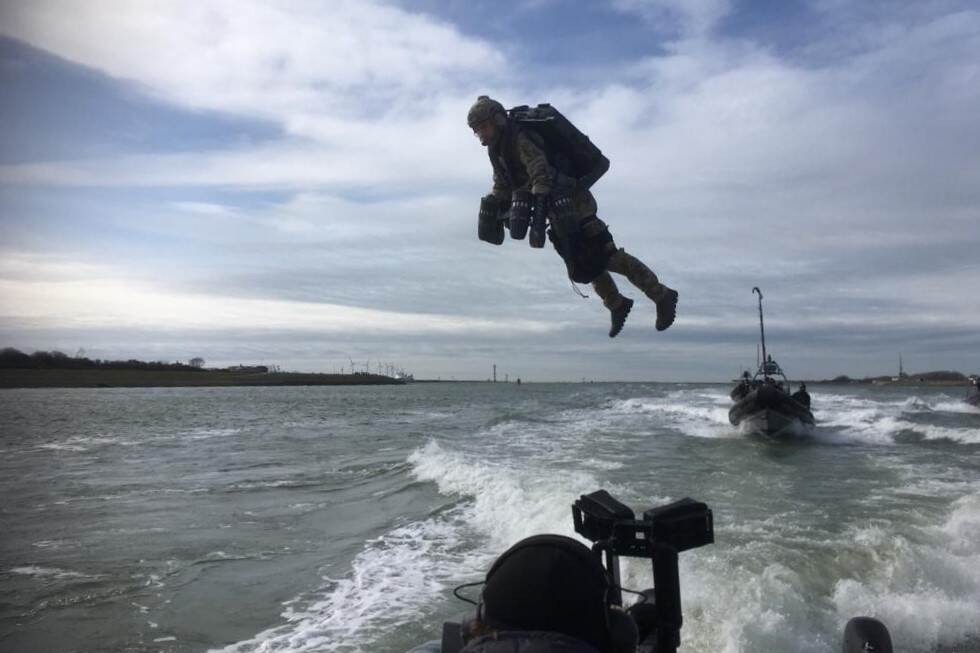
The Marine Corps has been working on a futuristic experiment recently. In collaboration with innovation centre MIND, the GRAVITY Fly Suit has been tested. This makes it easier for special forces to overcome vertical obstacles.

In the flight suit, a person can move through the air in a harness with jet engines. The suit has been tested in various situations, for example when boarding ships. It has also been tested in a built environment.

Thanks to the Fly Suit, the soldiers can get to places that were previously virtually unreachable. As a result, the suit gives new options for tactical deployment. It can also offer civil emergency services new opportunities. The experiment stemmed from a desire for new ways of boarding operations.

[…]

Source: Mariniers testen revolutionair vliegpak | Nieuwsbericht | Defensie.nl

A keyboard? How quaint: Logitech and Baidu link arms to make an AI-enabled, voice-transcribing mouse

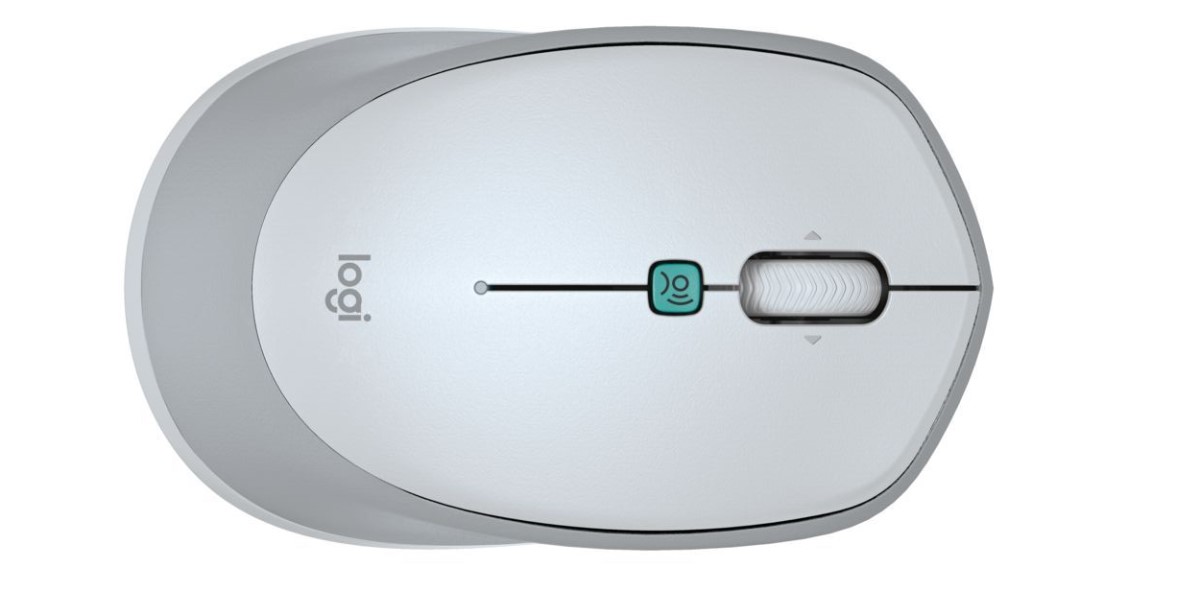
The Logitech Voice M380 wireless mouse looks and acts like a regular mouse but with a special button to initiate voice dictation. Baidu claimed recognition facilitates content creation at two to three times the speed of what one can type.

The device supports dictation in Chinese, English, and Japanese, and can translate content to English, Japanese, Korean, French, Spanish, and Thai. However, as of this month, you can only pick it up in China. There’s no word on when or if it will be available elsewhere.

Logitech M380 voice mouse

The Logitech M380 Baidu voice mouse. Click to enlarge

The mouse uses Baidu’s AI open platform Baidu Brain speech technology. The Chinese tech company said of the platform:

As of September 2020, Baidu Brain has developed more than 270 core AI capabilities and created over 310,000 models for developers.

Baidu Brain is made of a security module and four components: a foundation layer (uses open-source Chinese deep learning platform Paddle Paddle, Kunlun AI processors, and databases); the so-called “perception” layer (aggregates the company’s algorithm in voice technology, computer vision and AR/VR); a cognition layer (integrates new information); and a platform layer.

[…]

The mouse comes in three colours, graphite, rose, and off-white, and costs around $30 (£22, €25).

Source: A keyboard? How quaint: Logitech and Baidu link arms to make an AI-enabled, voice-transcribing mouse • The Register

Aussie biz Azimuth cracked San Bernardino shooter’s iPhone, ending Apple-FBI privacy standoff in 2015

Australian security firm Azimuth has been identified as the experts who managed to crack a mass shooter’s iPhone that was at the center of an encryption standoff between the FBI and Apple.

Until this week it had largely been assumed that Israeli outfit Cellebrite was hired to forcibly unlock an encrypted iPhone 5C used by Syed Farook – who in 2015 shot and killed colleagues at a work event in San Bernardino, California, claiming inspiration from ISIS.

Efforts by law enforcement to unlock and pore over Farook’s phone were unsuccessful, leading to the FBI taking Apple to court to force it to crack its own software to reveal the device’s contents. The Feds got an order from a judge instructing Apple to effectively break its own security to give agents access to the locked and encrypted handset.

But Apple heavily and publicly resisted, leading to a legal showdown that resulted in increasing alarm in the technology industry. Before the courts were forced to resolve the issue of access to encrypted data, however, the FBI announced it had found a way into the phone and dropped the case.

It later emerged the Feds had paid $900,000 to get into the phone… which had nothing of value on it. That isn’t too surprising since it was Farook’s work phone, after all.

[…]

Source: Report: Aussie biz Azimuth cracked San Bernardino shooter’s iPhone, ending Apple-FBI privacy standoff • The Register