McDonald’s Hit by Data Breach – WSJ

McDonald’s Corp. said hackers stole some data from its systems in markets including the U.S., South Korea and Taiwan, in another example of cybercriminals infiltrating high-profile global companies.

The burger chain said Friday that it recently hired external consultants to investigate unauthorized activity on an internal security system, prompted by a specific incident in which the unauthorized access was cut off a week after it was identified, McDonald’s said. The investigators discovered that company data had been breached in markets including the U.S., South Korea and Taiwan, the company said.

In a message to U.S. employees, McDonald’s said the breach disclosed some business contact information for U.S. employees and franchisees, along with some information about restaurants such as seating capacity and the square footage of play areas. The company said no customer data was breached in the U.S., and that the employee data exposed wasn’t sensitive or personal. The company advised employees and franchisees to watch for phishing emails and to use discretion when asked for information.

McDonald’s said attackers stole customer emails, phone numbers and addresses for delivery customers in South Korea and Taiwan. In Taiwan, hackers also stole employee information including names and contact information, McDonald’s said. The company said the number of files exposed was small without disclosing the number of people affected. The breach didn’t include customer payment information, McDonald’s said.

[…]

Source: McDonald’s Hit by Data Breach – WSJ

Also Russia and South Africa may have been hit

How Hackers Used Slack to Break into EA Games

The group of hackers who stole a wealth of data from game publishing giant Electronic Arts broke into the company in part by tricking an employee over Slack to provide a login token, Motherboard has learned.

The group stole the source code for FIFA 21 and related matchmaking tools, as well as the source code for the Frostbite engine that powers games like Battlefield and other internal game development tools. In all, the hackers claim they have 780GB of data, and are advertising it for sale on various underground forums. EA previously confirmed the data impacted in the breach to Motherboard.

A representative for the hackers told Motherboard in an online chat that the process started by purchasing stolen cookies being sold online for $10 and using those to gain access to a Slack channel used by EA. Cookies can save the login details of particular users, and potentially let hackers log into services as that person. In this case, the hackers were able to get into EA’s Slack using the stolen cookie. (Although not necessarily connected, in February 2020 Motherboard reported that a group of researchers discovered an ex-engineer had left a list of the names of EA Slack channels in a public facing code repository).

“Once inside the chat, we messaged a IT Support members we explain to them we lost our phone at a party last night,” the representative said.

The hackers then requested a multifactor authentication token from EA IT support to gain access to EA’s corporate network. The representative said this was successful two times.

Once inside EA’s network, the hackers found a service for EA developers for compiling games. They successfully logged in and created a virtual machine giving them more visibility into the network, and then accessed one more service and downloaded game source code.

The representative for the hackers provided screenshots to help corroborate the various steps of the hack, including the Slack chats themselves. EA then confirmed to Motherboard the contours of the description of the breach given by the hackers.

[…]

Source: How Hackers Used Slack to Break into EA Games

Engineers at MIT Have Created Actual Programmable Fibers – chip clothing

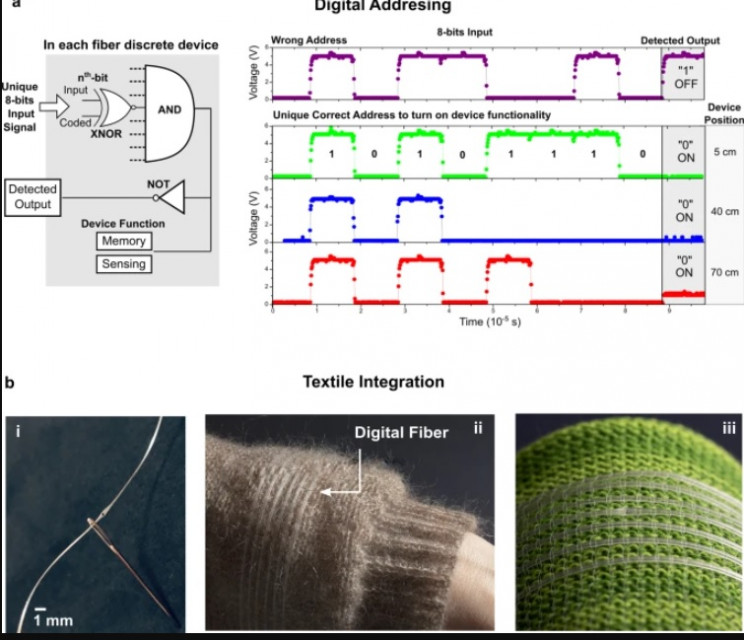
Featured in Nature Communications, this new research could result in the development of wearable tech that could sense, store, analyze, and infer the activity(s) of its wearers in real-time. The senior author of the study, Yeol Fink, believes that digital fibers like those developed in this study could help expand the possibilities for fabrics to “uncover the context of hidden patterns in the human body that could be used for physical performance monitoring, medical inference, and early disease detection.”

Applications for the technology could even expand into other areas of our lives like, for example, storing wedding music within the bride’s gown.

This study is important as, up to now, most electronic fibers have been analog. This means that they carry a continuous electronic signal rather than a purely digital one.

programmable fibers schematic
Source: MIT/Nature Communications

“This work presents the first realization of a fabric with the ability to store and process data digitally, adding a new information content dimension to textiles and allowing fabrics to be programmed literally,” explained Fink.

The fibers are made from chains of hundreds of tiny silicon chips

The fibers were created by chaining hundreds of microscale silicon digital chips into a preform to make a new “smart” polymer fiber. By using precision control, the authors of the study were able to create fibers with the continuous electrical connection between each chip of tens of meters.

These fibers are thin and flexible and can even be passed through the eye of a needle. This would mean they could be seamlessly (pun intended) woven into existing fabrics, and can even withstand being washed at least ten times without degrading.

This would mean this wearable tech could be retrofitted to existing clothing and you wouldn’t even know it’s there.

[…]

The fiber also has a pretty decent storage capacity too — all things considered. During the research, it was found to be possible to write, store, and recall 767-kilobit full-color short movie files and a 0.48-megabyte music file. The files can be stored for two months without power.

MIT programmable fibers fig 3
Source: MIT/Nature Communications

The fibers have also been outfitted with their own neural network

The fibers also integrate a neural network with thousands of connections. This was used to monitor and analyze the surface body temperature of a test subject after being woven into the armpit of the shirt.

By training the neural network with 270-minutes of data the team got it to predict the minute-by-minute activity of the shirt’s wearer with 96% accuracy.

“This type of fabric could give quantity and quality open-source data for extracting out new body patterns that we did not know about before,” Loke added.

With their analytical capabilities, such fibers could, conceivably, provide real-time alerts about a person’s health (like respiratory or heart problems). It could even be used to help deliver muscle activation signals or heart rate data for athletes.

The fibers are also controlled using a small external device that could have microcontrollers added to it in the future.

[…]

Source: Engineers at MIT Have Created Actual Programmable Fibers | IE

One Fastly customer triggered internet meltdown by changing a setting

A major internet blackout that hit many high-profile websites on Tuesday has been blamed on a software bug.

Fastly, the cloud-computing company responsible for the issues, said the bug had been triggered when one of its customers had changed their settings.

The outage has raised questions about relying on a handful of companies to run the vast infrastructure that underpins the internet.

Fastly apologised and said the problem should have been anticipated.

The outage, which lasted about an hour, hit some popular websites such as Amazon, Reddit, the Guardian and the New York Times.

[…]

But a customer quite legitimately changing their settings had exposed a bug in a software update issued to customers in mid-May, causing “85% of our network to return errors”, it said.

Engineers had worked out the cause of the problem about 40 minutes after websites had gone offline at about 11:00 BST, Fastly said.

“Within 49 minutes, 95% of our network was operating as normal,” it said.

The company has deployed a bug fix across its network and promised a “post mortem of the processes and practices we followed during this incident” and to “figure out why we didn’t detect the bug during our software quality assurance and testing processes”.

Source: One Fastly customer triggered internet meltdown – BBC News

FBI paid renegade developer $180k for backdoored AN0M chat app that brought down drug underworld

The FBI has revealed how it managed to hoodwink the criminal underworld with its secretly backdoored AN0M encrypted chat app, leading to hundreds of arrests, the seizure of 32 tons of drugs, 250 firearms, 55 luxury cars, more than $148M, and even cocaine-filled pineapples.

About 12,000 smartphones with AN0M installed were sold into organized crime rings: the devices were touted as pure encrypted messaging tools — no GPS, email or web browsing, and certainly no voice calls, cameras, and microphones. They were “designed by criminals, for criminals exclusively,” one defendant told investigators, Randy Grossman, Acting US Attorney for the Southern District of California, told a press conference on Tuesday.

However, AN0M was forged in a joint operation by Australian and US federal law enforcement, and was deliberately and surreptitiously engineered so that agents could peer into the encrypted conversations and read crooks’ messages. After Australia’s police broke the news that the messaging app had recorded everything from drug deals to murder plots — leading to hundreds of arrests — now the FBI has spilled its side of the story, revealing a complex sting dubbed Operation Trojan Shield.

DoJ's Randy Grossman

The Dept of Justice’s Randy Grossman walks through journalists through Operation Trojan Shield at a press conference on Tuesday

“For the first time the FBI developed and operated its own hardened encrypted device company, called AN0M,” Grossman said.

“Criminal organizations and the individual defendants we have charged purchased and distributed AN0M devices in an effort to secretly plan and execute their crimes. But the devices were actually operated by the FBI.”

Playing the long game

According to court documents [PDF] this all came about after the shutdown of Phantom Secure, a Canadian biz selling Blackberry phones customized for encrypted chat to the criminal community. CEO Vincent Ramos pleaded guilty in 2018 to conspiring with drug traffickers and was sentenced to nine years behind bars and had $80M in assets seized.

The closure of Phantom Secure put the staff working there on the FBI’s radar. The bureau’s San Diego office recruited a developer at the company as a confidential human source (CHS), court documents state. This source had previously been sentenced to six years in the clink for importing illegal drugs, and agreed to cooperate with the Feds to reduce any future punishment potentially coming their way.

Crucially, not only had this programmer worked on the Phantom Secure’s encrypted messaging software, but they were also doing work on rival encrypted comms service Sky Global — which also sold modified handsets with secure messaging features — as well as developing their own secure customized phone called AN0M.

“The CHS … had invested a substantial amount of money into the development of a new hardened encrypted device,” the indictment by FBI Special Agent Nicholas Cheviron reads.

“The CHS offered this next generation device, named ‘AN0M,’ to the FBI to use in ongoing and new investigations. The CHS also agreed to offer to distribute AN0M devices to some of the CHS’s existing network of distributors of encrypted communications devices.”

And so, in October 2018, the three-year sting operation began.

The CHS — who was paid $120,000 plus $59,000 in living and travel expenses by the authorities — worked with the FBI and the Australian Federal Police to hide a master decryption key into the AN0M app. Messages sent by the software’s users were quietly copied and sent off to servers controlled by law enforcement, who were able to use the key to decrypt the texts.

[…]

In this beta test, 50 handsets were passed out Down Under, and this phase of the operation was successful; two of the country’s biggest criminal gangs were successfully penetrated and the message copying system worked perfectly. Aussie police reviewing the texts said they found 100 per cent were related to crime. Everyone who used the app was assigned a unique ID, and these handles were known to the police.

Let’s go global

In the next phase, the CHS expanded the distribution network beyond Australia, and the FBI found itself in a position to collect the data. After negotiations with an unnamed third country, a message-relaying iBot server was set up in that nation to collect the BCC’d conversations, and on October 21, 2019, it began beaming copies of crooks’ chats from AN0M handhelds to an FBI-owned system every Monday, Wednesday, and Friday. The third country’s officials had secured a court order for the surveillance, and the FBI used a Mutual Legal Assistance Treaty, also known as an MLAT, to obtain the decrypted material.

Sales of AN0M grew steadily, and got a boost when French and Dutch police took down the EncroChat encrypted service in 2020. When a similar swoop shuttered Sky Global in 2021, demand skyrocketed. After the latter take-down, AN0M sales tripled to more than 9000 handsets, each costing $1700 with a six-month subscription to the AN0M encrypted messaging network, Grossman said.

The data haul from the application was immense: more than 27 million messages from 100 countries, and between 300 criminal gangs. This included more than 400,000 photos, typically of drugs or guns and, crucially, shipment plans.

[…]

Police around the world have made 800 arrests from AN0M-gathered intelligence, including cuffing six US law enforcement officers. Of all of those detained, they primarily face charges of drug trafficking, money laundering, gun violations, and violent crime.

Grossman also announced Uncle Sam had indicted 17 suspects on RICO charges relating to the use and marketing of the AN0M handsets. Most of these people are said to be distributors, though the prosecutor said three were administrators who helped run the service. Eight of those RICO suspects have already been collared and detained.

[…]

Source: FBI paid renegade developer $180k for backdoored AN0M chat app that brought down drug underworld • The Register

US super-rich ‘pay almost no income tax’

ProPublica says it has seen the tax returns of some of the world’s richest people, including Jeff Bezos, Elon Musk and Warren Buffett.

The website alleges Amazon’s Mr Bezos paid no tax in 2007 and 2011, while Tesla’s Mr Musk paid nothing in 2018.

A White House spokeswoman called the leak “illegal”, and the FBI and tax authorities are investigating.

ProPublica said it was analysing what it called a “vast trove of Internal Revenue Service data” on the taxes of the billionaires, and would release further details over coming weeks.

While the BBC has not been able to confirm the claims, the alleged leak comes at a time of growing debate about the amount of tax paid by the wealthy and widening inequality.

media captionG7 global tax ‘levels the playing field’

ProPublica said the richest 25 Americans pay less in tax – an average of 15.8% of adjusted gross income – than most mainstream US workers.

Jesse Eisinger, senior reporter and editor at ProPublica, told the Today Programme: “We were pretty astonished that you could get [tax] down to zero if you were a multi-billionaire. Actually paying zero in tax really floored us. Ultra-wealthy people can sidestep the system in an entirely legal way.”

“They have enormous ability to find deductions, find credits and exploit loopholes in the system,” he said.

So while the value of their wealth grows enormously through their ownership of shares in their company, that’s not recorded as income.

But there’s more than that, he said: “They also take aggressive tax deductions, often because they have borrowed to fund their lifestyle.”

He said US billionaires buy an asset, build one or inherit a fortune, and then borrow against their wealth.

Because they don’t realise any gains or sell any stock, they’re not taking any income, which could be taxed.

“They then borrow from a bank at a relatively low interest rate, live off that and can use the interest expenses as deductions on their income,” he said.

Biden plans

The website said that “using perfectly legal tax strategies, many of the uber-rich are able to shrink their federal tax bills to nothing or close to it” even as their wealth soared over the past few years.

The wealthy, as with many ordinary citizens, are able to reduce their income tax bills via such things as charitable donations and drawing money from investment income rather than wage income.

ProPublica, using data collected by Forbes magazine, said the wealth of the 25 richest Americans collectively jumped by $401bn from 2014 to 2018 – but they paid $13.6bn in income tax over those years.

President Joe Biden has vowed to increase tax on the richest Americans as part of a mission to improve equality and raise money for his massive infrastructure investment programme.

He wants to raise the top rate of tax, double the tax on what high earners make from investments, and change inheritance tax.

However, ProPublica’s analysis concluded: “While some wealthy Americans, such as hedge fund managers, would pay more taxes under the current Biden administration proposals, the vast majority of the top 25 would see little change.”

[…]

Source: US super-rich ‘pay almost no income tax’ – BBC News

DOJ Recovers Most of Colonial Pipeline Hack Ransom

(WASHINGTON) — The Justice Department has recovered most of a multimillion-dollar ransom payment made to hackers after a cyberattack that caused the operator of the nation’s largest fuel pipeline to halt its operations last month, officials said Monday.

The operation to seize cryptocurrency paid to the Russia-based hacker group is the first of its kind to be undertaken by a specialized ransomware task force created by the Biden administration Justice Department.

[…]

Colonial officials have said they took their pipeline system offline before the attack could spread to its operating system, and decided soon after to pay ransom of 75 bitcoin — then valued at roughly $4.4 million — in hopes of bringing itself back online as soon as it could. The company’s president and chief executive, Joseph Blount, is set to testify before congressional panels this week.

[…]

The Bitcoin amount seized — 63.7, currently valued at $2.3 million after the price of Bitcoin tumbled— amounted to 85% of the total ransom paid, which is the exact amount that the cryptocurrency-tracking firm Elliptic says it believes was the take of the affiliate who carried out the attack. The ransomware software provider, DarkSide, would have gotten the other 15%.

“The extortionists will never see this money,” said Stephanie Hinds, the acting U.S. attorney for the Northern District of California, where a judge earlier Monday authorized the seizure warrant.

[…]

Source: DOJ Recovers Most of Colonial Pipeline Hack Ransom | Time

[…]

Despite paying for the ransom, the encryption tools handed over did not work or help the company’s efforts to restore its systems.   

The Justice Department obtained a warrant from a California district court on Monday in order to seize the money. 

“Following the money remains one of the most basic, yet powerful tools we have,” Monaco said. “Today’s announcements also demonstrate the value of early notification to law enforcement; we thank Colonial Pipeline for quickly notifying the FBI when they learned that they were targeted by DarkSide.”

[…]

Colonial Pipeline faced significant backlash for paying the ransom but the FBI and Justice Department said they were able to use the Bitcoin public ledger to trace the payments back to “a specific address, for which the FBI has the ‘private key,’ or the rough equivalent of a password needed to access assets accessible from the specific Bitcoin address.”

[…]

“We cannot guarantee and we may not be able to do this in every instance.”

Source: ‘Majority’ of ransom paid by Colonial Pipeline seized and returned by DOJ | ZDNet

European Commission Betrays Internet Users By Cravenly Introducing Huge Loophole For Copyright Companies In Upload Filter Guidance

As a recent Techdirt article noted, the European Commission was obliged to issue “guidance” on how to implement the infamous Article 17 upload filters required by the EU’s Copyright Directive. It delayed doing so, evidently hoping that the adviser to the EU’s top court, the Court of Justice of the European Union (CJEU), would release his opinion on Poland’s attempt to get Article 17 struck down before the European Commission revealed its one-sided advice. That little gambit failed when the Advocate General announced that he would publish his opinion after the deadline for the release of the guidance. The European Commission has finally provided its advisory document on Article 17 and, as expected, it contains a real stinker of an idea. The best analysis of what the Commission has done, and why it is so disgraceful comes from Julia Reda and Paul Keller on the Kluwer Copyright Blog. Although Article 17 effectively made upload filters mandatory, it also included some (weak) protections for users, to allow people to upload copyright material for legal uses such as memes, parody, criticism etc. without being blocked. The copyright industry naturally hates any protections for users, and has persuaded the European Commission to eviscerate them:

According to the final guidance, rightholders can easily circumvent the principle that automatic blocking should be limited to manifestly infringing uses by “earmarking” content the “unauthorised online availability of which could cause significant economic harm to them” when requesting the blocking of those works. Uploads that include protected content thus “earmarked” do not benefit from the ex-ante protections for likely legitimate uses. The guidance does not establish any qualitative or quantitative requirements for rightholders to earmark their content. The mechanism is not limited to specific types of works, categories of rightholders, release windows, or any other objective criteria that could limit the application of this loophole.

The requirements that copyright companies must meet are so weak that it is probably inevitable that they will claim most uploads “could cause significant economic harm”, and should therefore be earmarked. Here’s what happens then: before it can be posted online, every earmarked upload requires a “rapid” human review of whether it is infringing or not. Leaving aside the fact that it is very hard for legal judgements to be both “rapid” and correct, there’s also the problem that copyright companies will earmark millions of uploads (just look at DMCA notices), making it infeasible to carry out proper review. But the European Commission also says that if online platforms fail to carry out a human review of everything that is earmarked, and allow some unchecked items to be posted, they will lose their liability protection:

this means that service providers face the risk of losing the liability protections afforded to them by art. 17(4) unless they apply ex-ante human review to all uploads earmarked by rightholders as merely having the potential to “cause significant economic harm”. This imposes a heavy burden on platform operators. Under these conditions rational service providers will have to revert to automatically blocking all uploads containing earmarked content at upload. The scenario described in the guidance is therefore identical to an implementation without safeguards: Platforms have no other choice but to block every upload that contains parts of a work that rightholders have told them is highly valuable.

Thus the already unsatisfactory user rights contained in Article 17 are rendered null and void because of the impossibility of following the European Commission’s new guidance. That’s evidently the result of recent lobbying from the copyright companies, since none of this was present in previous drafts of the guidance. Not content with making obligatory the upload filters that they swore would not be required, copyright maximalists now want to take away what few protections remain for users, thus ensuring that practically all legal uses of copyright material — including memes — are likely to be automatically blocked.

The Kluwer Copyright blog post points out that this approach was not at all necessary. As Techdirt reported a couple of weeks ago, Germany has managed to come up with an implementation of Article 17 that preserves most user rights, even if it is by no means perfect. The European Commission, by contrast, has cravenly given what the copyright industry has demanded, and effectively stripped out those rights. But this cowardly move may backfire. Reda and Keller explain:

the Commission does not provide any justification or rationale why users’ fundamental rights do not apply in situations where rightholders claim that there is the potential for them to suffer significant economic harm. It’s hard to imagine that the CJEU will consider that the version of the guidance published today provides meaningful protection for users’ rights when it has to determine the compliance of the directive with fundamental rights [in the case brought by Poland]. The Commission appears to be acutely aware of this as well and so it has wisely included the following disclaimer in the introductory section of the guidance (emphasis ours):

“The judgment of the Court of Justice of the European Union in the case C-401/192 will have implications for the implementation by the Member States of Article 17 and for the guidance. The guidance may need to be reviewed following that judgment“.

In the end this may turn out to be the most meaningful sentence in the entire guidance.

It would be a fitting punishment for betraying the 450 million citizens the European Commission is supposed to serve, but rarely does, if this final overreach causes upload filters to be thrown out completely.

Source: European Commission Betrays Internet Users By Cravenly Introducing Huge Loophole For Copyright Companies In Upload Filter Guidance | Techdirt

Google to adapt its ad technology after France hands it a $267 million fine

Google has agreed to pay a €220 million ($267 million) fine and change its ad practices after France’s competition authority found it had abused its dominant online ad position. Following a 2019 complaint by News Corp. and French newspaper Le Figaro, France ruled that Google was favoring its own advertising services to the detriment of rivals.

[…]

In a blog post, Google explained how it planned to change its ad rules by offering publishers “increased flexibility” by improving interoperability between its ad manager and third-party ad servers. “Also, we are reaffirming that we will not limit Ad Manager publishers from negotiating specific terms or pricing directly with other sell-side platforms.”

Google’s ad division has faced scrutiny from French regulators in the past. In 2019, the watchdog fined Google €150 million ($167 million) for opaque and unpredictable advertising rules after it suspended the Google Ads account of a French company without notice. Google has also clashed with regulators and publishers in the nation over the use of snippets of content in its news section.

Source: Google to adapt its ad technology after France hands it a $267 million fine | Engadget

Apple’s tightly controlled App Store is teeming with scams

Apple chief executive Tim Cook has long argued it needs to control app distribution on iPhones, otherwise the App Store would turn into “a flea market.”

But among the 1.8 million apps on the App Store, scams are hiding in plain sight. Customers for several VPN apps, which allegedly protect users’ data, complained in Apple App Store reviews that the apps told users their devices have been infected by a virus to dupe them into downloading and paying for software they don’t need. A QR code reader app that remains on the store tricks customers into paying $4.99 a week for a service that is now included in the camera app of the iPhone. Some apps fraudulently present themselves as being from major brands such as Amazon and Samsung.

Of the highest 1,000 grossing apps on the App Store, nearly two percent are scams, according to an analysis by The Washington Post. And those apps have bilked consumers out of an estimated $48 million during the time they’ve been on the App Store, according to market research firm Appfigures. The scale of the problem has never before been reported. What’s more, Apple profits from these apps because it takes a cut of up to a 30 percent of all revenue generated through the App Store. Even more common, according to The Post’s analysis, are “fleeceware” apps that use inauthentic customer reviews to move up in the App Store rankings and give apps a sense of legitimacy to convince customers to pay higher prices for a service usually offered elsewhere with higher legitimate customer reviews.

Two-thirds of the 18 apps The Post flagged to Apple were removed from the App Store.

[…]

Apple has long maintained that its exclusive control of the App Store is essential to protecting customers, and it only lets the best apps on its system. But Apple’s monopoly over how consumers access apps on iPhones can actually create an environment that gives customers a false sense of safety, according to experts. Because Apple doesn’t face any major competition and so many consumers are locked into using the App Store on iPhones, there’s little incentive for Apple to spend money on improving it, experts say.

[…]

Apple unwittingly may be aiding the most sophisticated scammers by eliminating so many of the less competent ones during its app review process, said Miles, who co-authored a paper called “The Economics of Scams.”

[…]

Apple has argued that it is the only company with the resources and know-how to police the App Store. In the trial that Epic Games, the maker of the popular video game “Fortnite,” brought against Apple last month for alleged abuse of its monopoly power, Apple’s central defense was that competition would loosen protections against unwanted apps that pose security risks to customers. The federal judge in the case said she may issue a verdict by August.

The prevalence of scams on Apple’s App Store played a key role at trial. Apple’s lawyers were so focused on the company’s role in making the App Store safe that Epic’s attorneys accused them of trying to scare the court into a ruling in favor of Apple. In other internal emails unearthed during trial that date as far back as 2013, Apple’s Phil Schiller, who runs the App Store, expressed dismay when fraudulent apps made it past App Store review.

After a rip-off version of the Temple Run video game became the top-rated app, according to Schiller’s email exchange, he sent an irate message to two other Apple executives responsible for the store. “Remember our talking about finding bad apps with low ratings? Remember our talk about becoming the ‘Nordstroms’ of stores in quality of service? How does an obvious rip off of the super popular Temple Run, with no screenshots, garbage marketing text, and almost all 1-star ratings become the #1 free app on the store?” Schiller asked his team. “Is no one reviewing these apps? Is no one minding the store?” Apple declined to make Schiller available to comment. At trial, Schiller defended the safety of the app store on the stand. The app review process is “the best way we could come up with … to make it safe and fair.”

Eric Friedman, head of Apple’s Fraud Engineering Algorithms and Risk unit, or FEAR, said that Apple’s screening process is “more like the pretty lady who greets you with a lei at the Hawaiian airport than the drug sniffing dog,” according to a 2016 internal email uncovered during the Epic Games trial. Apple employs a 500-person App Review team, which sifts through submissions from developers. “App Review is bringing a plastic butter knife to a gun fight,” Friedman wrote in another email.

[…]

Though the App Store ratings section is filled with customer complaints referring to apps as scams, there is no way for Apple customers to report this to Apple, other than reaching out to a regular Apple customer service representative. Apple used to have a button, just under the ratings and reviews section in the App Store, that said “report a problem,” which allowed users to report inappropriate apps. Based on discussions among Apple customers on Apple’s own website, the feature was removed some time around 2016.

[…]


Source: Apple’s tightly controlled App Store is teeming with scams – Anchorage Daily News

Apple settles with student after authorized repair workers leaked her naked pics to her Facebook page. Apple blocks Right to repair for danger by unauthorised parties. Hmm.

Apple has paid a multimillion-dollar settlement to an unnamed Oregon college student after one of its outsourced repair facilities posted explicit pictures and videos of her to her Facebook page.

According to legal documents obtained by The Telegraph, the incident occurred in 2016 at a Pegatron-owned repair centre in Sacramento, California. The student had mailed in her device to have an unspecified fault fixed.

While it was at the facility, two technicians published a series of photographs showing the complainant unclothed to her Facebook account, as well as a “sex video.” The complaint said the post was made in a way that impersonated the victim, and was only removed after friends informed her of its existence.

The two men responsible were fired after an investigation. It is not known if the culprits faced criminal charges.

Much of the details of the case, as well as the exact size of the settlement, were sealed. Lawyers for the plaintiff sought a $5m payout. The settlement included non-disclosure provisions that prevented the student from revealing details about the case, or the exact size of the compensation.

Counsel for the victim threatened to sue for infliction of emotional distress, as well as invasion of privacy. The filings show they warned Apple that any lawsuit would result in inevitable negative publicity for the company.

Pegatron settled with the victim separately, per the filings.

In its fight against the right to repair, Apple has argued that allowing independent third-party businesses to service its computers and smartphones would present an unacceptable risk to user privacy and security.

This incident, which occurred at the facilities of an authorised contractor, has undercut that argument somewhat.

It follows a similar incident in November 2019, where a Genius Bar employee texted himself an explicit image taken from an iPhone he was repairing. After the victim complained, the employee was fired.

[…]

Source: Apple settles with student after authorized repair workers leaked her naked pics to her Facebook page • The Register

Bing Censors Image Search for ‘Tank Man’ Even in US

Bing, the search engine owned by Microsoft, is not displaying image results for a search for “Tank man,” even when searching from the United States. The apparent censorship comes on the anniversary of China’s violent crackdown on protests in Tiananmen Square in 1989.

“There are no results for tank man,” the Bing website reads after searching for the term. “Tank man” relates to the infamous image of a single protester standing in front of a line of Chinese tanks during the crackdown.

China censors and blocks distribution of discussion of tank man and Tiananmen Square more generally. This year, anniversary events in Hong Kong have dwindled in size after authorities banned a vigil.

tankman.png

Image: A screenshot of the search results.

Bing displays ordinary, non-image search results for tank man when searching from a U.S. IP address; the issue only impacts the images and videos tabs. Google, for its part, displays both when connecting from the same IP address.

[…]

Source: Bing Censors Image Search for ‘Tank Man’ Even in US

Google, Facebook, Chaos Computer Club join forces to oppose German state spyware

Plans by the German government to allow the police to deploy malware on any target’s devices, and force the tech world to help them, has run into some opposition, funnily enough.

In an open letter this month, the Chaos Computer Club – along with Google, Facebook, and others – said they are against proposals to dramatically expand the use of so-called state trojans, aka government-made spyware, in Germany. Under planned legislation, even people not suspected of committing a crime can be infected, and service providers will be forced to help. Plus all German spy agencies will be allowed to infiltrate people’s electronics and communications.

The proposals bypass the whole issue of backdooring or weakening encryption that American politicians seem fixated on. Once you have root access on a person’s computer or handheld, the the device can be an open book, encryption or not.

“The proposals are so absurd that all of the experts invited to the committee hearing in the Bundestag sharply criticized the ideas,” the CCC said.

“Even Facebook and Google – so far not positively recognized as pioneers of privacy – speak out vehemently against the project. Protect security and trust online – against an unlimited expansion of surveillance and for the protection of encryption.”

Source: Google, Facebook, Chaos Computer Club join forces to oppose German state spyware • The Register

The Navy’s Tanker Drone Makes History By Refueling A Manned Aircraft For The First Time (Updated)

Boeing’s MQ-25 Stingray test asset, known as T1, has conducted the first successful aerial refueling of a manned receiver aircraft by an unmanned tanker. The landmark is a vital one as the U.S. Navy looks forward to adding the MQ-25 to its carrier air wings, or CVWs, in the future.

The Navy’s Naval Air Systems Command (NAVAIR) and Boeing announced today that the T1 test article had demonstrated its tanker capability with an F/A-18F Super Hornet jet fighter on June 4, 2021. The drone had flown from MidAmerica Airport in Mascoutah, Illinois. The MQ-25 demonstrator aircraft passed fuel to the Super Hornet using an Aerial Refueling Store (ARS) mounted under its wing.

Boeing

The MQ-25 T1 refuels an F/A-18F during the drone’s June 4 flight out of MidAmerica Airport, Illinois.

As well as the fighter actually ‘plugging in’ to the drone to receive fuel, the same test mission involved evaluation of formation flying between the manned and unmanned assets, with as little as 20 feet separation between the two. Other test points included tracking the drogue — the basket-like assembly trailed by the MQ-25 that connects with a receiver aircraft’s standard refueling probe. Both aircraft were flying at operationally relevant speeds and altitudes, according to Boeing.

“This flight lays the foundation for integration into the carrier environment, allowing for greater capability toward manned-unmanned teaming concepts,” said Navy Rear Admiral Brian Corey, head of the Program Executive Office for Unmanned Aviation and Strike Weapons. “MQ-25 will greatly increase the range and endurance of the future carrier air wing — equipping our aircraft carriers with additional assets well into the future.”

[…]

In 2015, Northrop Grumman and the Navy successfully demonstrated fully autonomous aerial refueling using the X-47B Unmanned Combat Air System Demonstration (UCAS-D) drone, which refueled in flight from a contractor-operated Boeing 707 tanker. That was the first time an unmanned aircraft had been refueled in-flight.

U.S. Navy

An X-47B completes the first autonomous aerial refueling demonstration over Chesapeake Bay on April 22, 2015.

Prior to that, in 2012, DARPA’s Autonomous High-Altitude Refueling program demonstrated fully autonomous aerial refueling of unmanned air vehicles at high altitude. This culminated with two modified RQ-4 Global Hawkdrones flying in close formation to test probe-and-drogue contacts, as seen in this video:

The first refueling sortie for the MQ-25 demonstrator was the 26th for the T1 test vehicle but there has also been extensive simulations of aerial refueling using MQ-25 digital models.

[…]

Source: The Navy’s Tanker Drone Makes History By Refueling A Manned Aircraft For The First Time (Updated)

Mapped: A Detailed Map of the Online World in Incredible Detail

View the giant full-size (20 MB) version of this map.

Map of the internet's most popular websites

A Map of the Online World in Incredible Detail

The internet is intangible, and because you can’t see it, it can be hard to comprehend its sheer vastness. As well, it’s difficult to gauge the relative size of different web properties. However, this map of the internet by Halcyon Maps offers a unique solution to these problems.

Inspired by the look and design of historical maps, this graphic provides a snapshot of the current state of the World Wide Web, as of April 2021. Let’s take a closer look!

But First, Methodology

Before diving into an analysis, it’s worth touching on the methodology behind this graphic’s design.

This map highlights thousands of the world’s most popular websites by visualizing them as “countries.” These “countries” are organized into clusters that are grouped by their content type (whether it’s a news website, search engine, e-commerce platform, etc).

Visual Capitalist on the mapEditor’s fun fact: Can you spot Visual Capitalist? We’re right in between TechCrunch and The Guardian above.

 

The colored borders represent a website’s logo or user interface. In terms of scale, each website’s territory size is based on its average Alexa web traffic ranking. The data is a yearly average, measured from January 2020 to January 2021.

Along the borders of the map, you can find additional information, from ranked lists of social media consumption to a mini-map of average download speeds across the globe.

According to the designer Martin Vargic, this map took about a year to complete.

[…]

Source: Mapped: A Detailed Map of the Online World in Incredible Detail

Posted in Art

Researchers Trained People to Echolocate in Just 10 Weeks

Scientists in the UK say the same sort of echolocation practiced by bats may also help people living with blindness better navigate the world. In a new study, they found that blind and sighted participants who took part in a 10-week training program were able to learn how to perform echolocation, and the blind participants largely reported that it seemed to improve their mobility and ability to live independently afterward.

[…]

In this new research, published in PLOS One, Thaler and her team wanted to test if inexperienced people, both with and without sight, could be taught how to echolocate in a relatively short period of time and if this skill would then actually help people with blindness.

They recruited 14 sighted people and 12 people who became blind early in life for the experiment, which involved 20 training sessions conducted over 10 weeks. The volunteers were between the ages of 21 and 79, and none had regularly used echolocation in their lives beforehand (two of the blind individuals did have some experience, but everyone else had none). To validate their tests and set a benchmark, they also enlisted the help of seven people who had been practicing echolocation for at least a decade.

Overall, the team found that all of the individuals noticeably improved their performance on tests of echolocation over the 10-week period. These tests would involve situations like being able to recognize the relative location and size of nearby objects or being able to navigate through a natural environment outside of the lab without sight. These improvements didn’t seem to be influenced by the age or degree of blindness among participants. A few people even performed as well as expert echolocators on certain tasks, while some sighted people did better than some blind people.

Blind volunteers were also surveyed three months later about how the training may have affected their lives. They all reported experiencing improvements in their mobility as a result of the training, while 83% also reported feeling more independent. The findings, according to Thaler, suggest that this training can be easily adopted by many people—and that it can help blind people with everyday activities.

[…]

Source: Researchers Trained People to Echolocate in Just 10 Weeks

Simple Slide Coating Gives a Boost to the Resolution of a Microscope

A light-powered microscope has a resolution limit of around 200 nanometers—which makes observing specimens smaller or closer together than that all but impossible. Engineers at the University of California San Diego have found a clever way to improve the resolution of a conventional microscope, but surprisingly it involves no upgrades to the lenses or optics inside it.

According to the Rayleigh Criterion theory, proposed by John William Strutt, 3rd Baron Rayleigh, back in 1896, a traditional light-based microscope’s resolution is limited by not only the optics capabilities of glass lenses but the nature of light itself, as a result of diffraction that occurs when light rays are bent. The limitation means that an observer looking through the microscope at two objects that are closer than 200 nanometers apart will perceive them as a single object.

Electron microscopes, by comparison, blast a sample with a highly focused beam of electrons instead of visible light, and can instead achieve resolutions of less than a single nanometer. There’s a trade-off, however, as samples being observed through an electron microscope need to be placed inside a vacuum chamber which has the unfortunate downside of killing living things, so observing cells and other living phenomena in action isn’t possible. To date, there hasn’t been an in-between option, but it sounds like that’s exactly what these engineers have created.

“Artistic rendering of the new super resolution microscopy technology. Animal cells (red) are mounted on a slide coated with the multilayer hyperbolic metamaterial. Nanoscale structured light (blue) is generated by the metamaterial and then illuminates the animal cells.”
Artistic rendering of the new super resolution microscopy technology. Animal cells (red) are mounted on a slide coated with the multilayer hyperbolic metamaterial. Nanoscale structured light (blue) is generated by the metamaterial and then illuminates the animal cells.”
Illustration: Yeon Ui Lee – University of California San Diego

To create what’s known as a “super-resolution microscope” the engineers didn’t actually upgrade the microscope at all. Instead, they developed a hyperbolic metamaterial—materials with unique structures that manipulate light, originally developed to improve optical imaging—that’s applied to a microscope slide, onto which the sample is placed. This particular hyperbolic metamaterial is made from “nanometers-thin alternating layers of silver and silica glass” which have the effect of shortening and scattering the wavelengths of visible light that pass through it, resulting in a series of random speckled patterns.

Those speckled light patterns end up illuminating the sample sitting on the microscope slide from different angles, allowing a series of low-resolution images to be captured, each highlighting a different part. Those images are then fed into a reconstruction algorithm which intelligently combines them and spits out a high-resolution image.

Comparison of images taken by a light microscope without the hyperbolic metamaterial (left) and with the hyperbolic metamaterial (right): quantum dots.
Image: University of California San Diego

It’s not unlike the sensor-shift approach used in some digital cameras to produce super-resolution photos where the image sensor is moved ever so slightly in various directions while multiple images are captured and then combined to merge all of the extra details captured. This technology—detailed in a paper recently published in the Nature Communications journal—can boost a conventional light microscope’s resolution to 40 nanometers, while still allowing living organisms to be observed. It still can’t compete with what electron microscopes are capable of, but it’s no less remarkable given how easily it can improve the capabilities of more affordable and safer hardware already in use in labs all around the world.

Source: Simple Slide Coating Gives a Boost to the Resolution of a Microscope

A.I. used at sea for first time off coast of Scotland to engage threats to ships

For the first time, Artificial Intelligence (A.I.) is being used by the Royal Navy at sea as part of Exercise Formidable Shield, which is currently taking place off the coast of Scotland.

This Operational Experiment (OpEx) on the Type 45 Destroyer (HMS Dragon) and Type 23 Frigate (HMS Lancaster), is using the A.I. applications, Startle and Sycoiea, which were tested against a supersonic missile threat.

As part of the Above Water Systems programme, led by Defence Science and Technology Laboratory (Dstl) scientists, the A.I. improves the early detection of lethal threat, accelerates engagement timelines and provides Royal Navy Commanders with a rapid hazard assessment to select the optimum weapon or measure to counter and destroy the target.

[…]

As outlined in the recent Defence Command Paper, the MOD is committed to investing in A.I. and increased automation to transform capabilities as the Armed Forces adapt to meet future threats, which will be supported by the £24bn uplift in defence spending over the next four years.

HMS Lancaster and HMS Dragon are currently trialling the use of A.I. as part of a glimpse into the future of air defence at sea.

HMS Lancaster’s Weapon Engineer Officer, Lieutenant Commander Adam Leveridge said:

Observing Startle and Sycoiea augment the human warfighter in real time against a live supersonic missile threat was truly impressive – a glimpse into our highly-autonomous future.

[…]

Source: A.I. used at sea for first time off coast of Scotland – GOV.UK

This Is What Pilots Actually See Inside Red 6’s Augmented Reality Dogfighting Goggles

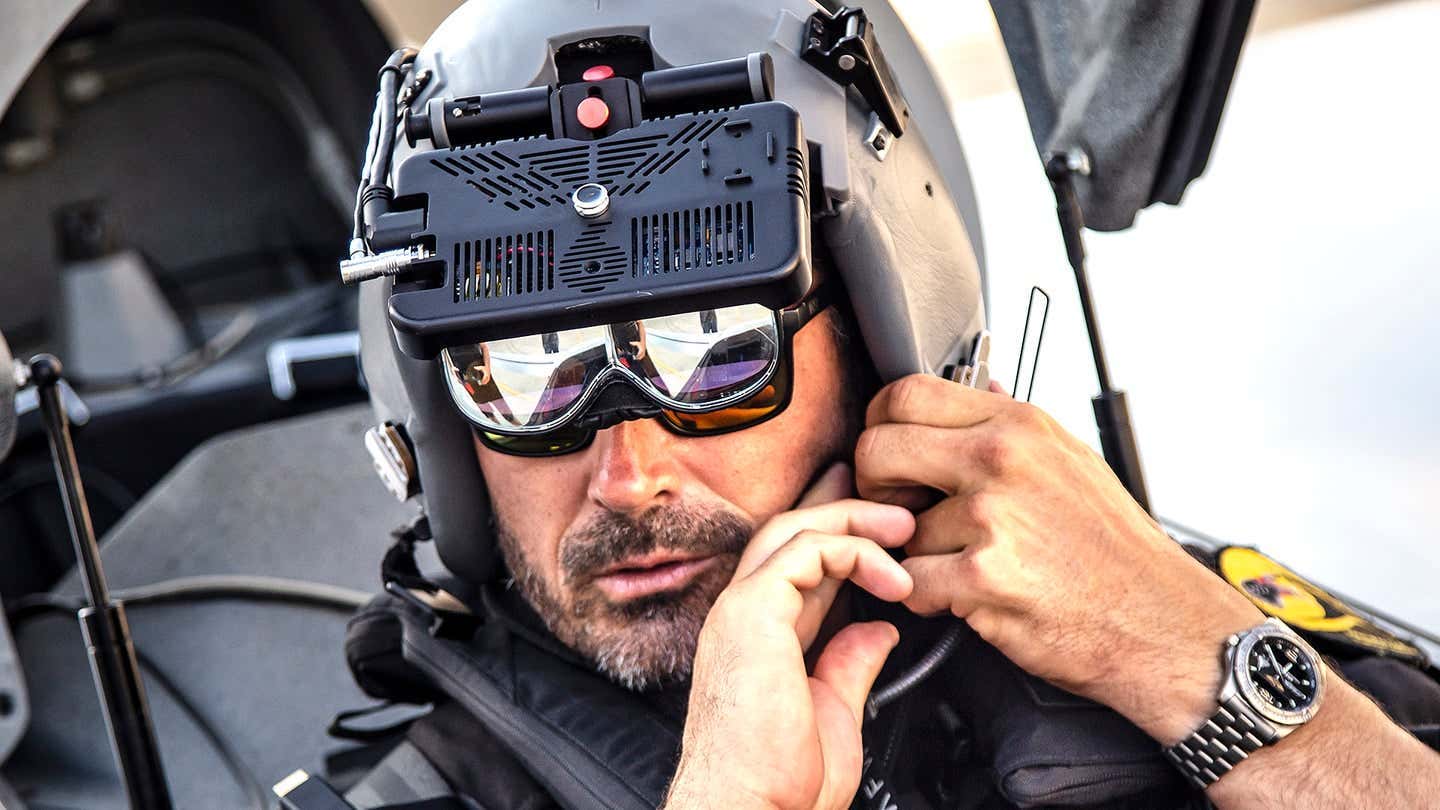
Augmented reality systems are on the verge of making a huge impact on how America’s military fights and trains. When it comes to the latter, one company, aptly named Red 6, has identified an inflection point where cost and existing capabilities become problematic for America’s tactical aircraft communities—training for air-to-air combat. While contractor aggressor services have ballooned in recent years to bring down the cost of providing bad guys for frontline fighter pilots to train against, while also upping the potential density and complexity of the threats that can be portrayed, Red 6 thinks it can do much of this without any other jets, pilots, and millions in yearly fuel costs all. This can be accomplished by moving the adversary aircraft into the synthetic realm via augmented reality goggles. Now we finally get to see exactly what the pilots do when donning Red 6’s increasingly capable helmet-mounted hardware.

You can read all about Red 6, where the company has been, and where it plans to go, in this in-depth feature interview with its founder and former F-22 Raptor pilot, Daniel Robinson. In it, he talks about how Red 6 started out by creating a huge geometric open-sided cube in the sky to test the original idea and has progressed with better hardware and software ever since. The tech has developed to the point where pilots are actually dogfighting synthetic AI-enabled fighters in augmented reality using Red 6’s gear. And, of course, without any actual flying hardware constraints, any aircraft with any performance capabilities can be accurately represented. So what does this look like from the pilot’s perspective? We can finally share the answer to that question below:

Red 6’s system is called the Airborne Tactical Augmented Reality System (ATARS). The company officially describes ATARS as “the first wide field-of-view, full color, demonstrably proven outdoor Augmented Reality solution that works in dynamic outdoor environments. ATARS allows Virtual and Constructive assets into the real world by allowing pilots and ground operators to see synthetic threats in real-time, outdoors. and critically, in high-speed environments. By blending Augmented Reality and artificial intelligence and using both the indoor and outdoor space around us as a medium, Red 6 has redefined the limits of how the world will experience, share, and interact with its information.”

Red 6

CEO Daniel Robinson donning an ATARS for a test flight.

Red 6, which just closed a $30M Series A financing round, with the vast majority of those funds coming from Snowpoint Ventures, is on the attack and plans on spreading its innovations into other combat domains in the future, just as we discussed in our big interview piece. Still, the potential for this system to revolutionize one of the most costly aspects of preparing for modern warfare—air-to-air combat training—is becoming very real. The savings from introducing this system, even to a limited degree, for some recurrent air-to-air training would be massive in terms of all the costs involved, including the wear-and-tear these training flights impose on the adversary aircraft, which is usually a similar fighter from the unit’s own squadron.

The company scored another big win last March when Dr. William Roper, who left his previous job as Assistant Secretary of the Air Force for Acquisition, Technology, and Logistics earlier this year, and is considered a highly influential visionary by some, joined Red 6’s advisory board. This vote of confidence from one of the Pentagon’s leading minds on airpower definitely helped the company’s position as a potential major market disruptor.

As for what comes next, Red 6 is about to enter into phase three of their Small Business Innovation Research (SBIR) initiative with AFWERX, which will see ATARS deployed aboard T-38 Talon trainers of the 586th Flight Test Squadron at Holloman Air Force Base in New Mexico. There, Air Force pilots will put ATARS through its paces. The next step will be integrating it into an F-16 Viper fighter jet, which will bring another level of challenging performance to the concept.

USAF

586th Flight Test Squadron T-38 over White Sands Missile Range.

At the very least, we can hope that allied air forces will have another tool to better and more efficiently train their pilots where applicable in the not so distant future, and in essence, augmenting the reality of their training capabilities.

Source: This Is What Pilots Actually See Inside Red 6’s Augmented Reality Dogfighting Goggles

Return to Office: Employees Are Quitting Instead of Giving Up Work From Home

[…]

A May survey of 1,000 U.S. adults showed that 39% would consider quitting if their employers weren’t flexible about remote work. The generational difference is clear: Among millennials and Gen Z, that figure was 49%, according to the poll by Morning Consult on behalf of Bloomberg News.

“High-five to them,” said Sara Sutton, the CEO of FlexJobs, a job-service platform focused on flexible employment. “Remote work and hybrid are here to stay.”

The lack of commutes and cost savings are the top benefits of remote work, according to a FlexJobs survey of 2,100 people released in April. More than a third of the respondents said they save at least $5,000 per year by working remotely.

Perks of Flexibility

Not having to commute is the top benefit for remote workers.

Source: FlexJobs

Survey of 2,181 total respondents ran from March 17, 2021 through April 5, 2021.


[…]

At least some atop the corporate ladder seem to be paying attention. In a Jan. 12 PwC survey of 133 executives, fewer than one in five said they want to go back to pre-pandemic routines. But only 13% were prepared to let go of the office for good.

Senior Management’s View

Days in the office that executives think is needed to maintain company culture.

Source: PwC

PwC surveyed 133 US executives between Nov. 24 and Dec, 5, 2020,from public and private companies in financial services, technology, media and telecommunications and retail products.

[…]


Source: Return to Office: Employees Are Quitting Instead of Giving Up Work From Home – Bloomberg

Space Debris Has Hit And Damaged The International Space Station

The inevitable has occurred. A piece of space debris too small to be tracked has hit and damaged part of the International Space Station – namely, the Canadarm2 robotic arm.

The instrument is still operational, but the object punctured the thermal blanket and damaged the boom beneath. It’s a sobering reminder that the low-Earth orbit’s space junk problem is a ticking time bomb.

Obviously space agencies around the world are aware of the space debris problem. Over 23,000 pieces are being tracked in low-Earth orbit to help satellites and the ISS avoid collisions – but they’re all about the size of a softball or larger.

Anything below that size is too small to track, but travelling at orbital velocities can still do some significant damage, including punching right through metal plates.

hubble punchAn impact hole left in the Hubble Space Telescope antenna in 1997. (NASA)

Canadarm2 – formally known as the Space Station Remote Manipulator System (SSRMS), designed by the Canadian Space Agency – has been a fixture on the space station for 20 years. It’s a multi-jointed titanium robotic arm that can assist with maneuvering objects outside the ISS, including cargo shuttles, and performing station maintenance.

It’s unclear exactly when the impact occurred. The damage was first noticed on 12 May, during a routine inspection. NASA and the CSA worked together to take detailed images of and assess the damage.

“Despite the impact, results of the ongoing analysis indicate that the arm’s performance remains unaffected,” the CSA wrote in a blog post. “The damage is limited to a small section of the arm boom and thermal blanket. Canadarm2 is continuing to conduct its planned operations.”

Although the ISS seems to have gotten lucky this time, the space debris problem does seem to be increasing. Last year, the ISS had to perform emergency maneuvers three times in order to avoid collisions with space debris at its altitude of around 400 kilometers (250 miles).

[…]

Source: Space Debris Has Hit And Damaged The International Space Station