MoneyGram says hackers stole customers’ personal information and transaction data

U.S. money transfer giant MoneyGram has confirmed that hackers stole its customers’ personal information and transaction data during a cyberattack last month.

The company said in a statement Monday that an unauthorized third party “accessed and acquired” customer data during the cyberattack on September 20. The cyberattack — the nature of which remains unknown — sparked a week-long outage that resulted in the company’s website and app falling offline.

MoneyGram says it serves over 50 million people in more than 200 countries and territories each year.

In its statement Monday, MoneyGram said its investigation is in its “early stages” and is working to determine which consumers were affected by this issue. The company did not say how many customers might be affected. When reached, MoneyGram spokesperson Sydney Schoolfield did not comment beyond the company’s statement.

The stolen customer data includes names, phone numbers, postal and email addresses, dates of birth, and national identification numbers. The data also includes a “limited number” of Social Security numbers and government identification documents, such as driver’s licenses and other documents that contain personal information, like utility bills and bank account numbers. MoneyGram said the types of stolen data will vary by individual.

MoneyGram said that the stolen data also included transaction information, such as dates and amounts of transactions, and, “for a limited number of consumers, criminal investigation information (such as fraud).”

TechCrunch previously reported that MoneyGram had subsequently notified U.K. data protection regulators of a data breach as required under U.K. law.

Source: MoneyGram says hackers stole customers’ personal information and transaction data | TechCrunch

And… why was this data not encrypted?

DOJ Reveals Its Plan for Breaking Up Google’s Search Monopoly

The Department of Justice has laid out its broad-strokes plan for ending Google’s monopoly over internet search after winning its antitrust case against the company in August. The sweeping changes could end Google’s position as the default search engine on billions of devices and require the company to share key information about its search algorithms with competitors.

The regulators’ proposals, laid out Tuesday in a filing with the D.C. federal court where the antitrust case was heard, are aimed not only at rectifying Google’s past anti-competitive practices but also at preventing it from unfairly dominating emerging technologies, particularly internet searches enabled by generative AI tools.

[…]

The first step necessary to unwind Google’s illegal monopoly, according to the DOJ, will likely be to “limit or end” the company’s use of contracts and unfair revenue-sharing agreements that have enshrined Google as the pre-installed search engine on all Android devices and the Chrome browser. It could potentially also include forcing Google’s parent company, Alphabet, to split off the Android and Chrome divisions of its business.

Google’s search tools are powered by the huge amount of data its web crawlers have indexed and the ranking algorithms that prioritize which results users see first. To level the playing field for competitors, the DOJ said it might try to make the company share the indexes, search results, underlying ranking signals, and models used for Google search, including AI-powered search.

“Google’s ability to leverage its monopoly power to feed artificial intelligence features is an emerging barrier to competition and risks further entrenching Google’s dominance,” the DOJ wrote, adding that potential remedies could include prohibiting the company from signing contracts with web publishers that deny rival search engines access to their sites and forcing Google to allow publishers to opt out of having their content scraped and used to generate AI summaries at the top of search results.

The final category of remedies the DOJ proposed would aim to spread the wealth generated by advertisements attached to internet searches by making it easier for smaller competitors to enter markets without being crushed by Google’s economy of scale and by requiring Google to be more transparent with advertisers in its ad auctions.

Source: DOJ Reveals Its Plan for Breaking Up Google’s Search Monopoly

Chinese 3x ISP hack shows why world is right about security backdoors and politicians and security people who want them are idiots

It was revealed this weekend that Chinese hackers managed to access systems run by three of the largest internet service providers (ISPs) in the US.

What’s notable about the attack is that it compromised security backdoors deliberately created to allow for wiretaps by US law enforcement …

[…]

Apple famously refused the FBI’s request to create a backdoor into iPhones to help access devices used by shooters in San Bernardino and Pensacola. The FBI was subsequently successful in accessing all the iPhones concerned without the assistance it sought.

[…]

You cannot have an encryption system which is only a little bit insecure any more than you can be a little bit pregnant. Encryption systems are either secure or they’re not – and if they’re not then it’s a question of when, rather than if, others are able to exploit the vulnerability.

This latest case perfectly illustrates the point. The law required ISPs to create backdoors that could be used for wiretaps by US law enforcement, and hackers have now found and accessed them.

[…]

Source: Chinese hack shows why Apple is right about security backdoors

And of course the arguments against backdoors predate this statement by decades. The hangup on Apple in the article is because it’s an Apple fanboy outlet.

Pro-Palistian Hacktivists Claim Responsibility for Taking Down the Internet Archive, piss off pro Palestinians globally

[…] A pro-Palestenian hacktivist group called SN_BLACKMETA has taken responsibility for the hack on X and Telegram. “They are under attack because the archive belongs to the USA, and as we all know, this horrendous and hypocritical government supports the genocide that is being carried out by the terrorist state of ‘Israel,’” the group said on X when someone asked them why they’d gone after the Archive.

The group elaborated on its reasoning in a now-deleted post on X. Jason Scott, an archivist at the Archive, screenshotted it and shared it. “Everyone calls this organization ‘non-profit’, but if its roots are truly in the United States, as we believe, then every ‘free’ service they offer bleeds millions of lives. Foreign nations are not carrying their values beyond their borders. Many petty children are crying in the comments and most of those comments are from a group of Zionist bots and fake accounts,” the post said.

SN_BLACKMETA also claimed responsibility for a six-day DDoS attack on the Archive back in May. “Since the attacks began on Sunday, the DDoS intrusion has been launching tens of thousands of fake information requests per second. The source of the attack is unknown,” Chris Freeland, Director of Library Services at the Archive said in a post about the attacks back in May.

SN_BLACKMETA launched its Telegram channel on November 23 and has claimed responsibility for a number of other attacks including a six-day DDoS run at Arab financial institutions and various attacks on Israeli tech companies in the spring.

It’s been a hard year for the Internet Archive. In July, the site went down due to “environmental factors” during a major heat wave in the U.S. Last month it lost an appeal in the lawsuit Hachette and other major publishers launched against it.

“If our patrons around the globe think this latest situation is upsetting, then they should be very worried about what the publishing and recording industries have in mind,” Kahle said in a post about the DDoS attack in May. “I think they are trying to destroy this library entirely and hobble all libraries everywhere. But just as we’re resisting the DDoS attack, we appreciate all the support in pushing back on this unjust litigation against our library and others.”

[…]

Source: Hacktivists Claim Responsibility for Taking Down the Internet Archive

Well done SN_BLACKMETA – you have just played into Israels hands. People who were on the fence about Palestine in the West well definitely now lean towards Israel and away from Palestine 🙁

Internet Archive hacked, data breach impacts 31 million users

Internet Archive’s “The Wayback Machine” has suffered a data breach after a threat actor compromised the website and stole a user authentication database containing 31 million unique records.

News of the breach began circulating Wednesday afternoon after visitors to archive.org began seeing a JavaScript alert created by the hacker, stating that the Internet Archive was breached.

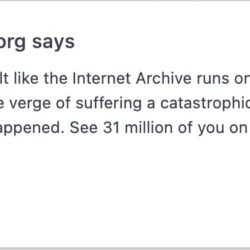
“Have you ever felt like the Internet Archive runs on sticks and is constantly on the verge of suffering a catastrophic security breach? It just happened. See 31 million of you on HIBP!,” reads a JavaScript alert shown on the compromised archive.org site.

JavaScript alert shown on Archive.org
Source: BleepingComputer

The text “HIBP” refers to is the Have I Been Pwned data breach notification service created by Troy Hunt, with whom threat actors commonly share stolen data to be added to the service.

Hunt told BleepingComputer that the threat actor shared the Internet Archive’s authentication database nine days ago and it is a 6.4GB SQL file named “ia_users.sql.” The database contains authentication information for registered members, including their email addresses, screen names, password change timestamps, Bcrypt-hashed passwords, and other internal data.

The most recent timestamp on the stolen records is September 28th, 2024, likely when the database was stolen.

[…]

Update 10/10/24: Internet Archive founder Brewster Kahle shared an update on X last night, confirming the data breach and stating that the threat actor used a JavaScript library to show the alerts to visitors.

“What we know: DDOS attacked-fended off for now; defacement of our website via JS library; breach of usernames/email/salted-encrypted passwords,” reads a first status update tweeted last night.

“What we’ve done: Disabled the JS library, scrubbing systems, upgrading security.”

A second update shared this morning states that DDoS attacks have resumed, taking archive.org and openlibrary.org offline again.

Source: Internet Archive hacked, data breach impacts 31 million users

Who the fuck hacks the internet archive?!