Turning car exhausts into power: New method transforms carbon nanoparticles from emissions into renewable energy catalysts

We have developed a breakthrough method to convert carbon nanoparticles (CNPs) from vehicular emissions into high-performance electrocatalysts. This innovation provides a sustainable approach to pollution management and energy production by repurposing harmful particulate matter into valuable materials for renewable energy applications.

Our work, published in Carbon Neutralization, addresses both environmental challenges and the growing demand for efficient, cost-effective clean energy solutions.

Advancing electrocatalysis with multiheteroatom-doped CNPs

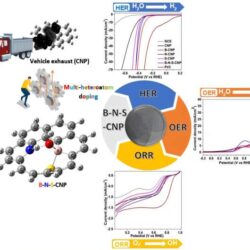
By doping CNPs with boron, nitrogen, oxygen and sulfur, we have significantly enhanced their catalytic performance. These multiheteroatom-doped nanoparticles exhibit remarkable efficiency in key electrochemical reactions. Our catalysts demonstrate high activity in the oxygen reduction reaction (ORR), which is essential for fuel cells and energy storage systems, as well as in the (HER), a crucial process for hydrogen fuel production.

Additionally, they show superior performance in the oxygen evolution reaction (OER), advancing water splitting for green hydrogen generation. By optimizing the composition of these materials, we have created an effective alternative to conventional precious metal-based catalysts, improving both cost-efficiency and sustainability.

[..]

Our research has far-reaching implications for clean energy and sustainable transportation industries. These catalysts can be integrated into fuel cells, enabling more efficient power generation for electric vehicles and energy storage systems. They also play a vital role in hydrogen production, supporting the transition to a hydrogen-based economy. Additionally, their use in renewable energy storage systems enhances the stability of wind and solar power generation.

While our findings demonstrate significant promise, further research is needed to scale up production, optimize material stability, and integrate these catalysts into commercial applications

[…]

Source: Turning pollution into power: New method transforms carbon nanoparticles from emissions into renewable energy catalysts

Why Can’t We Screenshot Frames From DRM-Protected Video on Apple Devices? – or on Android in some apps?

Apple users noticed a change in 2023, “when streaming platforms like Netflix, HBO Max, Amazon Prime, and the Criterion Channel imposed a quiet embargo on the screenshot,” noted the film blog Screen Slate: At first, there were workarounds: users could continue to screenshot by using the browser Brave or by downloading extensions or third-party tools like Fireshot. But gradually, the digital-rights-management tech adapted and became more sophisticated. Today, it is nearly impossible to take a screenshot from the most popular streaming services, at least not on a Macintosh computer. The shift occurred without remark or notice to subscribers, and there’s no clear explanation as to why or what spurred the change…

For PC users, this story takes a different, and happier, turn. With the use of Snipping Tool — a utility exclusive to Microsoft Windows, users are free to screen grab content from all streaming platforms. This seems like a pointed oversight, a choice on the part of streamers to exclude Mac users (though they make up a tiny fraction of the market) because of their assumed cultural class.

“I’m not entirely sure what the technical answer to this is,” tech blogger John Gruber wrote this weekend, “but on MacOS, it seemingly involves the GPU and video decoding hardware…” These DRM blackouts on Apple devices (you can’t capture screenshots from DRM video on iPhones or iPads either) are enabled through the deep integration between the OS and the hardware, thus enabling the blackouts to be imposed at the hardware level. And I don’t think the streaming services opt into this screenshot prohibition other than by “protecting” their video with DRM in the first place. If a video is DRM-protected, you can’t screenshot it; if it’s not, you can.

On the Mac, it used to be the case that DRM video was blacked-out from screen capture in Safari, but not in Chrome (or the dozens of various Chromium-derived browsers). But at some point a few years back, you stopped being able to capture screenshots from DRM videos in Chrome, too — by default. But in Chrome’s Settings page, under System, if you disable “Use graphics acceleration when available” and relaunch Chrome, boom, you can screenshot everything in a Chrome window, including DRM video…

What I don’t understand is why Apple bothered supporting this in the first place for hardware-accelerated video (which is all video on iOS platforms — there is no workaround like using Chrome with hardware acceleration disabled on iPhone or iPad). No one is going to create bootleg copies of DRM-protected video one screenshotted still frame at a time — and even if they tried, they’d be capturing only the images, not the sound. And it’s not like this “feature” in MacOS and iOS has put an end to bootlegging DRM-protected video content.

Gruber’s conclusion? “This ‘feature’ accomplishes nothing of value for anyone, including the streaming services, but imposes a massive (and for most people, confusing and frustrating) hindrance on honest people simply trying to easily capture high-quality (as opposed to, say, using their damn phone to take a photograph of their reflective laptop display) screenshots of the shows and movies they’re watching.”

Source: ‘Why Can’t We Screenshot Frames From DRM-Protected Video on Apple Devices?

And for that matter, there are plenty of apps that refuse screen shotting – I thought Android was the customisable one?

These buildings use batteries made of ice to stay cool and save money

Thousands of buildings across the United States are staying cool with the help of cutting-edge batteries made from one of the world’s simplest materials: ice.

When electricity is cheap, the batteries freeze water. When energy costs go up, building managers turn off their pricey chillers and use the ice to keep things cool.

A typical building uses about a fifth of its electricity for cooling, according to the International Energy Agency. By shifting their energy use to cheaper times of day, the biggest buildings can save hundreds of thousands of dollars a year on their power bills. They can also avoid using electricity from the dirtiest fossil fuel plants.

In places where the weather is hot and energy prices swing widely throughout the day — for instance, Texas, Southern California and most of the American Southwest — buildings could cut their power bills and carbon emissions by as much as a third, experts say.

“That’s huge and absolutely worth doing when you consider how many buildings exist that need cooling,” said Neera Jain, an associate professor of mechanical engineering at Purdue University.

So far, ice batteries have been mostly limited to big commercial buildings with central cooling systems and extra storage space for a giant vat of ice. But new designs could bring the batteries into smaller buildings and even houses.

Source: These buildings use batteries made of ice to stay cool and save money

Trump’s Defense Secretary Hegseth Orders Cyber Command to ‘Stand Down’ on All Russia Operations

The cybersecurity outlet The Record originally reported that under Trump’s new Defense Secretary Pete Hegseth, U.S. Cyber Command has been ordered to “stand down from all planning against Russia, including offensive digital actions.” The outlet cites three anonymous sources who are familiar with the matter. The order reportedly does not apply to the National Security Agency.

The policy shift represents a complete 180-degree turn from America’s posture over the past decade, which has consistently considered Russia one of the top cybersecurity threats. Credible reporting and government investigations have shown that Russia has hacked into U.S. systems countless times.

The Guardian has reported that a memo recently circulated to staff at America’s Cybersecurity and Infrastructure Security Agency (CISA) established “new priorities” for the agency and, while mentioning the threat of digital incursions by China and other enemies, failed to mention Russia.

“Russia and China are our biggest adversaries. With all the cuts being made to different agencies, a lot of cyber security personnel have been fired. Our systems are not going to be protected and our adversaries know this,” a source, who was familiar with the internal memo, told The Guardian. “People are saying Russia is winning. Putin is on the inside now.”

Another anonymous source, who said that CISA staff had been “verbally informed that they were not to follow or report on Russian threats,” expressed concern for the shift: “There are thousands of US government employees and military working daily on the massive threat Russia poses as possibly the most significant nation state threat actor. Not to diminish the significance of China, Iran, or North Korea, but Russia is at least on par with China as the most significant cyber threat,” they said.

[…]

As far as layoffs go, the NSA purge is a drop in the bucket for America’s signals intelligence agency. One of the intel community’s biggest outfits is reputed to employ at least 20,000 employees but has been estimated to use as many as 50,000. In general, despite Trump’s promise to smash the “deep state,” America’s dark and powerful national security state has remained largely untouched since he took office, with his administration’s wrecking ball DOGE content to spend most of its time smashing agencies that dispense services to the public.

Source: Trump’s Defense Secretary Hegseth Orders Cyber Command to ‘Stand Down’ on All Russia Operations

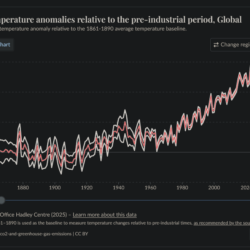
“Cool” years are now hotter than the “warm” years of the past: tracking global temperatures through El Niño and La Niña

Temperatures, as defined by “climate”, are based on temperatures over longer periods of time — typically 20-to-30-year averages — rather than single-year data points. But even when based on longer-term averages, the world has still warmed by around 1.3°C.

But you’ll also notice, in the chart, that temperatures haven’t increased linearly. There are spikes and dips along the long-run trend.

Many of these short-term fluctuations are caused by “ENSO” — the El Niño-Southern Oscillation — a natural climate cycle caused by changes in wind patterns and sea surface temperatures in the Pacific Ocean.

While it’s caused by patterns in the Pacific Ocean and most strongly affects countries in the tropics, it also impacts global temperatures and climate.

There are two key phases of this cycle: the La Niña phase, which tends to cause cooler global temperatures, and the El Niño phase, which brings hotter conditions. The world cycles between El Niño and La Niña phases every two to seven years. There are also “neutral” periods between these phases where the world is not in either extreme.

The zig-zag trend of global temperatures becomes understandable when you are taking the phases of the ENSO cycles into account. In the chart below, we see the data on global temperatures, but the line is now colored by the ENSO phase at that time.

The El Niño (warm phase) is shown in orange and red, and the La Niña (cold phase) is shown in blue.

You can see that temperatures often reach a short-term peak during warm El Niño years before falling back slightly as the world moves into La Niña years, shown in blue.

What’s striking is that global temperatures during recent La Niña years were warmer than El Niño years just a few decades before. “Cold years” today are hotter than “hot years” not too long ago.

Source: “Cool” years are now hotter than the “warm” years of the past: tracking global temperatures through El Niño and La Niña – Our World in Data

Lenovo has a convertable T series laptop – with mouse dot

[…] The ThinkPad T14s 2-in-1 is by far the most interesting of the bunch, with a new convertible body that’s similar to Lenovo’s Yoga laptops, and supports the magnetic Yoga Pen stylus. The laptop comes with up to a 14-inch, 400-nit WUXGA touch display, and inside, you can get up to a Intel Core Ultra 7 H or U 200 series chip, 64GB of LPDDR5x RAM and 1TB of storage. If you’re looking for an option without a 360-degree hinge, the ThinkPad T14s Gen 6 and ThinkPad T14 Gen 6 will also now come with either Intel Core Ultra or AMD Ryzen AI Pro chips, up to 32GB of RAM and up to 2TB of storage.

The lightweight ThinkPad X13 Gen 6.
Lenovo

Lenovo describes the new ThinkPad X13 Gen 6 as “one of the lightest ThinkPad designs ever,” at only 2.05 lbs, but that light weight doesn’t mean the laptop misses out on the latest internals. The X13 Gen 6 comes with either a Intel Core Ultra or AMD Ryzen AI Pro chip, up to 64GB of LPDDR5x RAM and your choice of a 41Wh or 54.7Wh battery. The new ThinkPad can also support Wi-Fi 7 and an optional 5G connection, if you want to take it on the go.

[…]

Source: Lenovo is updating its ThinkPad lineup with new chips and form factors at MWC 2025

The Lenovo Solar PC Concept feels like a device whose time has come

You might be surprised to learn that the first laptop with built-in solar panels is nearly 15 years old. But to me, the bigger shock is that with all the recent advancements in photovoltaic cells, manufacturers haven’t revisited this idea more often. But at MWC 2025, Lenovo is changing that with its Yoga Solar PC Concept.

Weighing 2.6 pounds and measuring less than 0.6 inches thick, the Yoga Solar PC Concept is essentially the same size as a standard 14-inch clamshell. And because its underlying design isn’t all that different from Lenovo’s standard Yoga family, it doesn’t skimp on specs either. It features an OLED display, up to 32GB of RAM, a decent-sized 50.2 WHr battery and even a 2MP IR webcam for use with Windows Hello.

However, all those components aren’t nearly as important as the solar cells embedded in its lid. Lenovo says the panels use Back Contact Cell technology so that its mounting brackets and gridlines can be placed on the rear of the cells. This allows the panels to offer up to 24 percent solar energy conversion, which is pretty good as that matches the efficiency you get from many high-end home solar systems. Furthermore, the PC also supports Dynamic Solar Tracking to automatically adjust the cells’ settings to maximize the amount of energy they can gather.

Lenovo says this means the Yoga Solar PC can generate enough juice to play an hour of videos after only 20 minutes in the sun. But what might be more impressive is that even when the laptop is indoors, it can still harvest power from as little as 0.3 watts of light to help top off its battery. Finally, to help you understand how much power it’s gathering, Lenovo created a bespoke app to track how much light the panels absorb.

Unfortunately, Lenovo doesn’t have any plans to turn this concept into a full commercial device

[…]

Source: The Lenovo Solar PC Concept feels like a device whose time has come

PeerAuth – easy way to authenticate a real person

Machine learning has become more and more powerful, to the point where a bad actor can take a photo and a voice recording of someone you know, and forge a complete video recording. See the “OmniHuman-1” model developed by ByteDance:


Bad actors can now digitally impersonate someone you love, and trick you into doing things like paying a ransom.

To mitigate that risk, I have developed this simple solution where you can setup a unique time-based one-time passcode (TOTP) between any pair of persons.

This is how it works:

  1. Two people, Person A and Person B, sit in front of the same computer and open this page;
  2. They input their respective names (e.g. Alice and Bob) onto the same page, and click “Generate”;
  3. The page will generate two TOTP QR codes, one for Alice and one for Bob;
  4. Alice and Bob scan the respective QR code into a TOTP mobile app (such as Authy or Google Authenticator) on their respective mobile phones;
  5. In the future, when Alice speaks with Bob over the phone or over video call, and wants to verify the identity of Bob, Alice asks Bob to provide the 6-digit TOTP code from the mobile app. If the code matches what Alice has on her own phone, then Alice has more confidence that she is speaking with the real Bob.

Note that this depends on both Alice’s and Bob’s phones being secure. If somebody steals Bob’s phone and manages to bypass the fingerprint or PIN or facial recognition of Bob’s phone, then all bets are off.

Discussion on Hacker News

Source code of this page on GitHub

Source: PeerAuth