About Robin Edgar

Organisational Structures | Technology and Science | Military, IT and Lifestyle consultancy | Social, Broadcast & Cross Media | Flying aircraft

London Transport asked people to write down their Oyster passwords – but don’t worry

London-dwelling Alfie Fresta wanted a National Rail travelcard discount added to his London Oyster card so the discount would work automatically with his pay-as-you-go smartcard.

He was startled when London Overground staff at New Cross Gate station handed him a paper form with a box on it asking for his online Oyster account password.

“I was in utter disbelief,” Fresta told El Reg, having just read about Oyster online accounts being breached by credential-stuffing crooks. “Having worked on a number of web apps, I know storing passwords in clear text is, for lack of a better word, a ginormous no-no.”

Oyster plain text password form from Arriva Rail London, which operates London Overground

The Arriva Rail London form handed to Fresta. ARL is the outsourced operator for TfL’s London Overground services. Click to enlarge

Just to check that this wasn’t a local misunderstanding by station staff, Fresta checked it out at other stations – and was again asked to write down his password in plain text for staff to read.

TfL did not deny that this is its standard procedure for staff adding discounts to Oyster cards, but insisted in a statement to The Register that it doesn’t store those passwords and lets customers take the completed form away afterwards.

A spokeswoman told us: “Customers can add discounts to their Oyster cards at all station ticket machines and our staff are on hand to support them with this process. If a customer prefers to do this via a ticket office rather than a machine, then a password is temporarily provided to the ticket office staff via a form.

“The password is always entered in the presence of the customer and the form is returned to them to ensure it can be disposed of securely. Customers are advised to change the password on first login, if setting up an online Oyster account. We recognise that where possible this process could be improved and work is under way to identify options.”

Fresta was not impressed with TfL’s customer service, telling us he wasn’t given “any explanation as to how the information [would] be handled or why”.

Source: Yes, TfL asked people to write down their Oyster passwords – but don’t worry, they didn’t inhale • The Register

That’s insane!

Indonesia unveils site of new capital on Borneo island

The capital of the world’s fourth most populous country, on the island of Java, is now home to 10 million people and is prone to floods, traffic gridlock and faces the risk of earthquakes.

The as-yet unnamed new capital will straddle the regions of North Penajam Paser and Kutai Kartanegara in Indonesia’s province of East Kalimantan on Borneo, President Joko Widodo told a news conference.

“It is a strategic location at the center of Indonesia, close to growing urban areas,” Widodo said at the presidential palace in Jakarta, adding that planning must start immediately if relocation is to begin in 2024.

The site of the new capital, 2,000 km (1,250 miles) northeast of Jakarta, is one of the regions least prone to the natural disasters that regularly hit the archipelago of 17,000 islands.

There are also economic and political reasons for moving the capital from Java, which Widodo said was home to 54% of Indonesia’s 260 million people and generated 58% of its gross domestic product.

But environmentalists fear the move will hasten the destruction of forests that are home to orangutans, sun bears and long-nosed monkeys, as well as increasing pollution already on the rise from coal mining and palm oil industries.

“The move will have an environmental impact,” said Greenpeace senior forest campaigner Jasmine Puteri. “Jakarta has suffered so many failures from pollution, water crisis, and flooding. We don’t want these problems in the new capital.”

FOREST CITY

Officials say they want the new capital to be “a smart city in the forest” and have set aside 180,000 hectares (445,000 acres) of government land.

Widodo said moving the administrative center would cost just under $33 billion, of which the state would fund 19%, with the rest coming from public-private partnerships and private investment. The price tag includes new government offices and homes for about 1.5 million civil servants.

Source: Indonesia unveils site of new capital on Borneo island – Reuters

PowerShell 7 ups the telemetry but… hey… is that an off switch?

Microsoft emitted a fresh preview of command-line darling PowerShell 7 last night, highlighting some additional slurping – and how to shut it off.

PowerShell 7 Preview 3, which is built on .NET Core 3.0 Preview 8, is the latest step on the way to final release at the end of 2019 and a potential replacement for the venerable PowerShell 5.1.

The first preview dropped back in May and the gang has made solid progress since. This time around, the team has opted to switch on all experimental features of the command-line shell by default in order to get more feedback on whether those features are worth the extra effort to gain “stable” status.

[…]

there are a number of useful features, some targeted squarely at Windows (stripping away reasons to stay with PowerShell 7’s more Windows-focused ancestors) and others that simply make life easy for script fans. The ability to stick a -Parallel parameter to ForEach-Object in order to execute scriptblocks in parallel is a good example, as is a -ThrottleLimit parameter to keep the thread usage under control.

Preview 3 and Telemetry

However, it’s not all good news. Lee, with impressive openness, highlighted the extra telemetry PowerShell would be capturing with this release. Microsoft’s Sydney Smith provided further details and, perhaps more importantly for some users, explained how to turn the slurping off.

New data points being collected include counts of application types such as Cmdlets and Functions, hosted sessions and PowerShell starts by type (API vs Console).

[…]

for the benefit of those who get twitchy about the slurping of data, Smith highlighted the POWERSHELL_TELEMETRY_OPTOUT environment variable, which can be set to the true, yes or 1 to stop PowerShell squirting anything back at Redmond’s servers.

Source: Latest sneak peek at PowerShell 7 ups the telemetry but… hey… is that an off switch? • The Register

Here’s a top tip: Don’t trust the new guy – block web domains less than a month old. They are bound to be dodgy

IT admins could go a long way towards protecting their users from malware and other dodgy stuff on the internet if they ban access to any web domain less than a month old.

This advice comes from Unit 42, the security branch of networking house Palo Alto Networks. To be exact, the recommendation is that any domain created in the past 32 days ought to be blocked. This comes after the gang studied newly-registered domains – NRDs for short – and found that more than 70 per cent fell under the classification of “suspicious,” “not safe for work,” or “malicious.”

“While this may be deemed a bit aggressive by some due to potential false-positives, the risk from threats via NRDs is much greater,” noted Unit 42’s Zhanhao Chen, Jun Javier Wang, and Kelvin Kwan. “At the bare minimum, if access to NRDs are allowed, then alerts should be set up for additional visibility.”

According to Unit 42’s study of new domains created on 1,530 different top level domains (TLDs) from March to May of this year, just 8.4 per cent of NRDs could be confirmed as hosting only benign pages. 2.32 per cent were confirmed not safe for work, while 1.27 per cent of the domains were classified as malicious, meaning they were found to host malware, phishing, or botnet, command and control tools.

The solid majority of the domains, 69.73 per cent to be exact, fell under the label of “suspicious,” meaning the domains appear to have been parked, had insufficient content to be verified as legit, or were considered “questionable,” or “high risk,” but not flat-out malicious. 18.2 per cent were classified as just “other,” rather unhelpfully.

In other words, just under three quarters of new domains are used for sites that vary from completely empty, to shady at best, to verified as attack sites.

Source: Here’s a top tip: Don’t trust the new guy – block web domains less than a month old. They are bound to be dodgy • The Register

Microsoft Contractors Listened to Xbox Owners (mainly kids) in Their Homes – since 2013

Contractors working for Microsoft have listened to audio of Xbox users speaking in their homes in order to improve the console’s voice command features, Motherboard has learned. The audio was supposed to be captured following a voice command like “Xbox” or “Hey Cortana,” but contractors said that recordings were sometimes triggered and recorded by mistake.

The news is the latest in a string of revelations that show contractors working on behalf of Microsoft listen to audio captured by several of its products. Motherboard previously reported that human contractors were listening to some Skype calls as well as audio recorded by Cortana, Microsoft’s Siri-like virtual assistant.

“Xbox commands came up first as a bit of an outlier and then became about half of what we did before becoming most of what we did,” one former contractor who worked on behalf of Microsoft told Motherboard. Motherboard granted multiple sources in this story anonymity as they had signed non-disclosure agreements.

The former contractor said they worked on Xbox audio data from 2014 to 2015, before Cortana was implemented into the console in 2016. When it launched in November 2013, the Xbox One had the capability to be controlled via voice commands with the Kinect system.

[…]

The former contractor said most of the voices they heard were of children.

“The Xbox stuff was actually a bit of a welcome respite, honestly. It was frequently the same games. Same DLCs. Same types of commands,” they added. “‘Xbox give me all the games for free’ or ‘Xbox download [newest Minecraft skins pack]’ or whatever,” they added. The former contractor was paid $10 an hour for their work, according to an employment document shared with Motherboard.

“Occasionally I heard ‘Xbox, tell Solas to heal,’ or something similar, which would be a command for Dragon Age: Inquisition,” the former contractor said, referring to hearing audio of in-game commands.

And that listening continued as the Xbox moved from using Kinect for voice commands over to Cortana. A current contractor provided a document that describes how workers should work with different types of Cortana audio, including commands given to control an Xbox.

Source: Microsoft Contractors Listened to Xbox Owners in Their Homes – VICE

All these guys are using this kind of voice data to improve their AI, so there’s nothing really particularly sinister in that (although they could probably turn on targeted microphones if they want and listen to YOU) but the fact that they lied about it, withheld the information from us and didn’t even mention it in their privacy statements, don’t allow you to opt out – THAT’s a problem.

BTW SONOS is also involved in this…

Moscow’s blockchain voting system cracked a month before election, will be fixed due to responsible disclosure, open source and bug bounties

A French security researcher has found a critical vulnerability in the blockchain-based voting system Russian officials plan to use next month for the 2019 Moscow City Duma election.

Pierrick Gaudry, an academic at Lorraine University and a researcher for INRIA, the French research institute for digital sciences, found that he could compute the voting system’s private keys based on its public keys. This private keys are used together with the public keys to encrypt user votes cast in the election.

Gaudry blamed the issue on Russian officials using a variant of the ElGamal encryption scheme that used encryption key sizes that were too small to be secure. This meant that modern computers could break the encryption scheme within minutes.

“It can be broken in about 20 minutes using a standard personal computer, and using only free software that is publicly available,” Gaudry said in a report published earlier this month.

“Once these [private keys] are known, any encrypted data can be decrypted as quickly as they are created,” he added.

What an attacker can do with these encryption keys is currently unknown, since the voting system’s protocols weren’t yet available in English, so Gaudry couldn’t investigate further.

“Without having read the protocol, it is hard to tell precisely the consequences, because, although we believe that this weak encryption scheme is used to encrypt the ballots, it is unclear how easy it is for an attacker to have the correspondence between the ballots and the voters,” the French researcher said.

“In the worst case scenario, the votes of all the voters using this system would be revealed to anyone as soon as they cast their vote.”

[…]

The French academic was able to test Moscow’s upcoming blockchain-based voting system because officials published its source code on GitHub in July, and asked security researchers to take their best shots.

Following Gaudry’s discovery, the Moscow Department of Information Technology promised to fix the reported issue — the use of a weak private key.

“We absolutely agree that 256×3 private key length is not secure enough,” a spokesperson said in an online response. “This implementation was used only in a trial period. In few days the key’s length will be changed to 1024.”

[…]

However, a public key of a length of 1024 bits may not be enough, according to Gaudry, who believes officials should use one of at least 2048 bits instead.

[…]

There is a good side to this,” he added. “The fact that Moscow allowed others to look at the code, research it and then help them secure it.”

Furthermore, Moscow officials also approved a monetary reward for Gaudry, who according to Russian news site Meduza, stands to make one million Russian ruble, which is just over $15,000.

According to a previous report from July, Gaudry’s reward is near the top prize the Moscow local government promised bug hunters when it put the code on GitHub, which was 1.5 million Russian ruble ($22,500).

“The US system COULD learn a lot from Mother Russia on this one,” Roberts said, referring to the plethora of growing pains the US has been going through recently while trying to secure its electronic voting machines.

These growing pains mostly come from voting machine vendors, who are refusing to engage with the cyber-security community, something the Moscow government had no problem doing.

This closed-source nature around electronic voting machines and election systems used in the US is the reason why Microsoft recently announced plans to open-source on GitHub a new technology for securing electronic voting machines.

Source: Moscow’s blockchain voting system cracked a month before election | ZDNet

Google, Apple, Mozilla end Kazakhstan internet by blocking root CA

On Wednesday, Google, Apple, and Mozilla said their web browsers will block the Kazakhstan root Certificate Authority (CA) certificate – following reports that ISPs in the country have required customers to install a government-issued certificate that enables online spying.

According to the University of Michigan’s Censored Planet project, the country’s snoops “recently began using a fake root CA to perform a man-in-the-middle (MitM) attack against HTTPS connections to websites including Facebook, Twitter, and Google.”

A root CA certificate can, to put it simply, be abused to intercept and access otherwise protected communication between internet users and websites.

The Censored Planet report indicates that researchers first detected data interception on July 17, a practice that has continued intermittently since then (though discussions of Kazakhstan’s possible abuse of root CA certificates date back several years).

The interception does not appear to be widespread – it’s said to affect only 459 (7 per cent) of the country’s 6,736 HTTPS servers. But it affects 37 domains, largely social media and communications services linked to Google, Facebook, and Twitter domains, among others.

Kazakhstan has a population of 18m and 76 per cent internet penetration, according to advocacy group Freedom House, which rates it 62 on a scale of 100 for lack of internet freedom – 100 means no internet access.

Two weeks ago, the government of Kazakhstan said it had discontinued its internet surveillance scheme, initially justified as a way to improve cybersecurity, after lawyers in the country criticized the move.

In notifications to Kazakhstani telecom customers, mobile operators maintained that the government-mandated security certificate represented a lawful demand. Yet, in a statement on August 6, the National Security Committee of the Republic of Kazakhstan said the certificate requirement was just a test, and a successful one at that. And the committee provided instructions for removing the certificate from Android, iOS and Windows devices.

In 2015, Kazakhstan tried to get its root CA certificate into Mozilla trusted root store program but was rebuffed, and then tried to get its citizens to install the cert themselves until thwarted by legal action.

“As far as we know, the installation of the certificate is not legally required in Kazakhstan at this time,” a Mozilla spokesperson said in an email to The Register.

Source: Finally. Thanks so much, nerds. Google, Apple, Mozilla end government* internet spying for good • The Register

Bug-hunter finds local privilege escalation in Steam. Valve refuses to acknowledge and so he’s dropped it on the internet.

The way Kravets tells is (Valve did not respond to a request for comment), the whole saga started earlier this month when he went to report a separate elevation of privilege flaw in Steam Client, the software gamers use to purchase and run games from the games service.

Valve declined to recognize and pay out for the bug, which they said required local access and the ability to drop files on the target machine in order to run and was therefore not really a vulnerability.

“I received a lot of feedback. But Valve didn’t say a single word, HackerOne sent a huge letter and, mostly, kept silence,” Kravets wrote. “Eventually things escalated with Valve and I got banned by them on HackerOne — I can no longer participate in their vulnerability rejection program (the rest of H1 is still available though).”

Now, some two weeks later, Kravets has discovered and disclosed a second elevation of privilege flaw. Like the first, this vulnerability this flaw (a DLL loading vulnerability) would require the attacker to have access to the target’s machine and the ability to write files locally.

Source: Disgruntled bug-hunter drops Steam zero-day to get back at Valve for refusing him a bounty • The Register

The Register then says something pretty stupid:

While neither flaw would be considered a ‘critical’ risk as they each require the attacker to already have access to the target machine (if that’s the case you’re already in serious trouble, so what’s another flaw)

It’s an escalation flaw, which means that as a normal user you can run things administrators are only supposed to run. That’s a problem.

Google Play Publisher account gets terminated – but Google won’t tell you why

Developer Patrick Godeau has claimed his business is under threat after his Google Play Publisher account was terminated without a specific reason given.

Godeau, from France, provides apps for iOS and Android via his company Tokata.

It is a small business but Godeau said in his complaint that he has achieved “millions of downloads”, most via the Play Store.

On 31 July, Godeau received an email stating that “your Google Play Publisher account has been terminated”. He appealed and was told that “we’re unable to reinstate your developer account”. The reason given was not specific, just that it was “due to multiple violations of the Developer Program Policies”.

[…]

In July 2018, Google removed another of his applications specifying “device and network abuse”. He never discovered what the issue was. Maybe he was using the YouTube API wrongly? “Having read though the API terms of service, I couldn’t deduce how my app infringed them,” he said. However, he was able to publish a new version.

The new issue is not so easily resolved. First one of his apps was suspended for what the Play team said is “malicious behaviour”. Shortly after, his entire account was terminated complete with the advice “please do not attempt to register a new developer account”.

Patrick Godeau informs customers that his apps have been removed from the Play Store

Patrick Godeau informs customers that his apps have been removed from the Play Store

The apps remain available on the Apple and Amazon app stores.

Godeau said he has no objection to Google’s efforts to remove malicious apps from the Play Store. His frustration is that he has not been told any specifics about what is wrong with his apps, and that there is no meaningful dialogue with the Play team or appeal against a decision that directly impacts his ability to make a living from software development.

“It seems that I’m not the only one in this situation,” he wrote. “Many Android developers have seen their apps removed and their accounts abruptly terminated by the Google Play bots, often for minor and unintentional reasons, or even for no known reason at all, and almost always without any opportunity to prove their good faith, receiving no other response than automatic messages.”

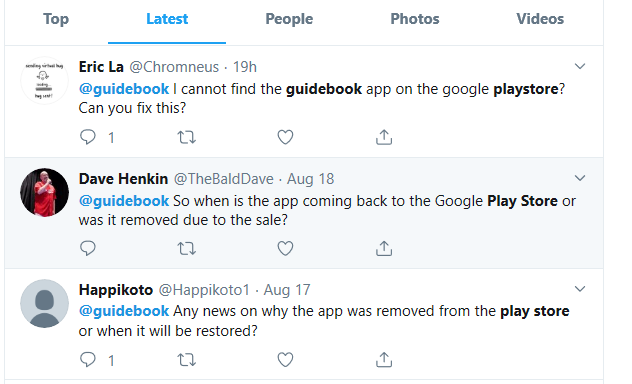
This kind of incident is apparently not uncommon. Another company, Guidebook, which develops apps for events, has also had its apps removed, leaving users taking to Twitter to ask where they are. Guidebook’s Twitter support says “we’re actively working with Google to rectify this.”

Bemused customers take to Twitter in search of Guidebook apps removed from the Play Store

Bemused customers take to Twitter in search of Guidebook apps removed from the Play Store

Another common complaint is that Google does too little to remove pirated or copycat applications from the Play Store, causing potential reputational problems for developers whose customers may get an ad-laden copy instead of the real thing, or simply loss of business to the pirates.

Source: So your Google Play Publisher account has been terminated – of course you would want to know why exactly • The Register

And this is one of the problems when you’re working with an unregulated massive monopoly who can basically dictate whatever arbritrary terms they like, whilst people’s incomes are suffering from them.

They need to be broken up!

<iframe width=”560″ height=”315″ src=”https://www.youtube.com/embed/RFA92mXjXLI” frameborder=”0″ allow=”accelerometer; autoplay; encrypted-media; gyroscope; picture-in-picture” allowfullscreen></iframe>

States to launch antitrust investigation into big tech companies, reports say

The state attorneys in more than a dozen states are preparing to begin an antitrust investigation of the tech giants, The Wall Street Journal and The New York Times reported Monday, putting the spotlight on an industry that is already facing federal scrutiny.

The bipartisan group of attorneys from as many as 20 states is expected to formally launch a probe as soon as next month to assess whether tech companies are using their dominant market position to hurt competition, the WSJ reported.

If true, the move follows the Department of Justice, which last month announced its own antitrust review of how online platforms scaled to their gigantic sizes and whether they are using their power to curb competition and stifle innovation. Earlier this year, the Federal Trade Commission formed a task force to monitor competition among tech platforms.

[…]

Because the tentacles of Google, Facebook, Amazon and Apple reach so many industries, any investigation into them could last for years.

Apple and Google pointed the Times to their previous official statements on the matter, in which they have argued that they have been vastly innovative and created an environment that has benefited the consumers. Amazon and Facebook did not comment.

Also on Monday, Joseph Simons, the chairman of FTC, warned that Facebook’s planned effort to integrate Instagram and WhatsApp could stymie any attempt by the agency to break up the social media giant.

Source: States to launch antitrust investigation into big tech companies, reports say | TechCrunch

And if you like, here is my talk about how exactly the tech giants are becoming monopolies and killing innovation, among many other things.

<iframe width=”560″ height=”315″ src=”https://www.youtube.com/embed/RFA92mXjXLI” frameborder=”0″ allow=”accelerometer; autoplay; encrypted-media; gyroscope; picture-in-picture” allowfullscreen></iframe>

If for some reason you want an Apple Card here’s How to Easily Opt Out of Binding Arbitration

You’ll spot binding arbitration clauses in a lot of financial agreements because it helps keep banks and their business partners out of court. If you agree to binding arbitration, you can’t go to trial against a company or join a class-action lawsuit; you can only have your issue settled by a third-party mediator. If you don’t like what the mediator decides, you still have to live with it.

Not all credit cards allow you to opt out of binding arbitration, but Apple Card does. And it makes it easy for you to opt out by allowing you to do so by text message. In fact, if you have any question about using Apple Card, you can get help via text message (instead of having to use your phone like an actual phone and wait on hold).

Nick Guy shared a screenshot on Twitter to illustrate just how easy it was to opt out of arbitration for his new Apple Card:

Take a minute now to send your opt-out request, then rest easy knowing that if you end up with major beef with Apple Card, you have access to all your options for dealing with it.

Source: How to Easily Opt Out of Apple Card Binding Arbitration

Man sued for using bogus YouTube takedowns to get address for swatting – so copyright is not only inane, it’s also physically dangerous

YouTube is suing a Nebraska man the company says has blatantly abused its copyright takedown process. The Digital Millennium Copyright Act offers online platforms like YouTube legal protections if they promptly take down content flagged by copyright holders. However, this process can be abused—and boy did defendant Christopher L. Brady abuse it, according to YouTube’s legal complaint (pdf).

Brady allegedly made fraudulent takedown notices against YouTube videos from at least three well-known Minecraft streamers. In one case, Brady made two false claims against a YouTuber and then sent the user an anonymous message demanding a payment of $150 by PayPal—or $75 in bitcoin.

“If you decide not to pay us, we will file a 3rd strike,” the message said. When a YouTube user receives a third copyright strike, the YouTuber’s account gets terminated.

A second target was ordered to pay $300 by PayPal or $200 in Bitcoin to avoid a third fraudulent copyright strike.

A third incident was arguably even more egregious. According to YouTube, Brady filed several fraudulent copyright notices against another YouTuber with whom he was “engaged in some sort of online dispute.” The YouTuber responded with a formal counter-notice stating that the content wasn’t infringing—a move that allows the content to be reinstated. However, the law requires the person filing the counter-notice to provide his or her real-world name and address—information that’s passed along to the person who filed the takedown request.

This contact information is supposed to enable a legitimate copyright holder to file an infringement lawsuit in court. But YouTube says Brady had another idea. A few days after filing a counter-notice, the targeted YouTuber “announced via Twitter that he had been the victim of a swatting scheme.” Swatting, YouTube notes, “is the act of making a bogus call to emergency services in an attempt to bring about the dispatch of a large number of armed police officers to a particular address.”

YouTube doesn’t provide hard proof that Brady was responsible for the swatting call, stating only that it “appears” he was responsible based on the sequence of events. But YouTube says it does have compelling evidence that Brady was responsible for the fraudulent takedown notices. And fraudulent takedown notices are themselves against the law.

Section 512(f) of the DMCA says that anyone who “knowingly materially misrepresents” that content is infringing in a takedown notice is liable for costs they impose on both accused infringers and platform owners. While this law has been on the books for more than 20 years, it has rarely been used because most misrepresentations have not been blatant enough to trigger legal liability.

For example, Ars covered the decade-long fight over a “dancing baby” video that happened to have a few seconds of Prince music playing in the background. The Electronic Frontier Foundation argued that the music was clearly allowed under copyright’s fair use doctrine—and that Universal Music should be held liable for submitting a takedown request anyway. A 2016 appeals court ruling made it clear that music labels had some obligation to consider fair use before issuing takedown requests, but the court set the bar so low that the targets of bogus takedowns have little hope of actually collecting damages.

Source: Man sued for using bogus YouTube takedowns to get address for swatting | Ars Technica

Data Breach in Adult Site Luscious Compromises Privacy of All Users

Luscious is a niche pornographic image site focused primarily on animated, user-uploaded content. Based on the research carried out by our team, the site has over 1 million registered users. Each user has a profile, the details of which could be accessed through our research.

Private profiles allow users to upload, share, comment on, and discuss content on Luscious. All of this is understandably done while keeping their identity hidden behind usernames.

The data breach our team discovered compromises this anonymity by potentially allowing hackers to access the personal details of users, including their personal email address. The highly sensitive and private nature of Luscious’ content makes users incredibly vulnerable to a range of attacks and exploitation by malicious hackers.

[…]

The private personal user details we viewed included:

  • Usernames
  • Personal email addresses
  • User activity logs (date joined, most recent log in)
  • Country of residence/location
  • Gender

Some users’ email addresses indicated their full names, increasing their vulnerability to exploitation and cybercrime.

It’s worth mentioning that we estimate 20% of emails on Luscious accounts use fake email addresses to sign up. This suggests that some Luscious users are actively taking extra steps to remain anonymous.

User Behaviours & Activities

The data breach also gave a complete overview of user activities. This allowed us to view things like:

  • The number of image albums they had created
  • Video uploads
  • Comments
  • Blog posts
  • Favorites
  • Followers and accounts followed
  • Their User ID number – so we can know if they’re active or have been banned

Source: Report: Data Breach in Adult Site Compromises Privacy of All Users

Ouch – if you were on there, good luck and change your details immediately!

facial recognition ‘epidemic’ across UK private sites in conjunction with the police

Facial recognition is being extensively deployed on privately owned sites across the UK, according to an investigation by civil liberties group Big Brother Watch.

It found an “epidemic” of the controversial technology across major property developers, shopping centres, museums, conference centres and casinos in the UK.

The investigation uncovered live facial recognition in Sheffield’s major shopping centre Meadowhall.

Site owner British Land said: “We do not operate facial recognition at any of our assets. However, over a year ago we conducted a short trial at Meadowhall, in conjunction with the police, and all data was deleted immediately after the trial.”

The investigation also revealed that Liverpool’s World Museum scanned visitors with facial recognition surveillance during its exhibition, “China’s First Emperor and the Terracotta Warriors” in 2018.

The museum’s operator, National Museums Liverpool, said this had been done because there had been a “heightened security risk” at the time. It said it had sought “advice from Merseyside Police and local counter-terrorism advisors” and that use of the technology “was clearly communicated in signage around the venue”.

A spokesperson added: “World Museum did not receive any complaints and it is no longer in use. Any use of similar technology in the future would be in accordance with National Museums Liverpool’s standard operating procedures and with good practice guidance issued by the Information Commissioner’s Office.”

Big Brother Watch said it also found the Millennium Point conference centre in Birmingham was using facial-recognition surveillance “at the request of law enforcement”. In the privacy policy on Millennium Point’s website, it confirms it does “sometimes use facial recognition software at the request of law enforcement authorities”. It has not responded to a request for further comment.

Earlier this week it emerged the privately owned Kings Cross estate in London was using facial recognition, and Canary Wharf is considering following suit.

Information Commissioner Elizabeth Denham has since launched an investigation, saying she remains “deeply concerned about the growing use of facial recognition technology in public spaces, not only by law enforcement agencies but also increasingly by the private sector”.

The Metropolitan Police’s use of the tech was recently slammed as highly inaccurate and “unlawful”, according to an independent report by researchers from the University of Essex.

Silkie Carlo, director of Big Brother Watch, said: “There is an epidemic of facial recognition in the UK.

“The collusion between police and private companies in building these surveillance nets around popular spaces is deeply disturbing. Facial recognition is the perfect tool of oppression and the widespread use we’ve found indicates we’re facing a privacy emergency.

“We now know that many millions of innocent people will have had their faces scanned with this surveillance without knowing about it, whether by police or by private companies.

“The idea of a British museum secretly scanning the faces of children visiting an exhibition on the first emperor of China is chilling. There is a dark irony that this authoritarian surveillance tool is rarely seen outside of China.”

Carlo urged Parliament to follow in the footsteps of legislators in the US and “ban this authoritarian surveillance from public spaces”. ®

Source: And you thought the cops were bad… Civil rights group warns of facial recog ‘epidemic’ across UK private sites • The Register

YouTube shuts down music companies’ use of manual copyright claims to steal creator revenue, troll block videos

Going forward, copyright owners will no longer be able to monetize creator videos with very short or unintentional uses of music via YouTube’s “Manual Claiming” tool. Instead, they can choose to prevent the other party from monetizing the video or they can block the content. However, YouTube expects that by removing the option to monetize these sorts of videos themselves, some copyright holders will instead just leave them alone.

“One concerning trend we’ve seen is aggressive manual claiming of very short music clips used in monetized videos. These claims can feel particularly unfair, as they transfer all revenue from the creator to the claimant, regardless of the amount of music claimed,” explained YouTube in a blog post.

To be clear, the changes only involve YouTube’s Manual Claiming tool which is not how the majority of copyright violations are handled today. Instead, the majority of claims are created through YouTube’s Content ID match system. This system scans videos uploaded to YouTube against a database of files submitted to the site by copyright owners. Then, when a match is found, the copyright holder owner can choose to block the video or monetize it themselves, and track the video’s viewership stats.

The Manual Claiming tool, on the other hand, is only offered to partners who understand how Content ID works. It allows them to search through publicly available YouTube videos to look for those containing their content and apply a claim when a match is found.

The problem with the Manual Claiming policy is that it was impacting creator content even when the use of the claimed music in videos was very short — even a second long — or unintentional. For example, a creator who was vlogging may have walked past a store that was playing the copyrighted song, but then could lose the revenue from their video as a result.

In April, YouTube said it was looking to address this problem. And just ahead of this year’s VidCon, YouTube announced several well-received changes to the Manual Claiming Policy. It began to require that copyright owners specify the timestamp in the video where the claim occurs — a change that YouTube hoped would create additional friction and cut down on abuse.

Creators were also given tools of their own that let them easily remove the clip or replace the infringing content with free-to-use tracks.

These newly announced changes go even further as they remove the ability for the copyright owner to monetize the infringing video at all. Copyright holders can now only prevent the creators themselves from monetizing the video, or they can block the content. However, given the new creator tools for handling infringing content, it’s likely that creators in those situations would just address the problem content in order to keep their video online.

Source: YouTube shuts down music companies’ use of manual copyright claims to steal creator revenue | TechCrunch

This piece shows you how insane the copyright system is (if you walk past a shop playing some music you can consider it an infringement!) and how the large music maffia can muscle out small players – just calling something an infringement leads to a kafka-esque system where you can’t appeal easily. It’s a good thing that this muscling is now no longer easy to do and so automated.

UPS Has Been Delivering Cargo in Self-Driving Trucks for Months (with 2 people on board)

The self-driving freight truck startup TuSimple has been carrying mail across the state of Arizona for several weeks.

UPS announced on Thursday that its venture capital arm has made a minority investment in TuSimple. The announcement also revealed that since May TuSimple autonomous trucks have been hauling UPS loads on a 115-mile route between Phoenix and Tucson.

UPS confirmed to Gizmodo this is the first time UPS has announced it has been using TuSimple autonomous trucks to deliver packages in the state.

Around the same time as the UPS and TuSimple program began, the United States Postal Service and TuSimple publicized a two-week pilot program to deliver mail between Phoenix and Dallas, a 1,000 mile trip.

TuSimple claims it can cut the average cost of shipping in a tractor-trailer by 30 percent. In an announcement about the new partnership, UPS Ventures managing partner, Todd Lewis, said the venture arm “collaborates with startups to explore new technologies and tailor them to help meet our specific needs.”

UPS would not share the terms of the deal with Gizmodo. TuSimple did not immediately respond to a request for comment.

As the Verge reports, TuSimple puts its own autonomous tech—which relies on nine cameras and two LIDAR sensors—in Navistar vehicles.

The partnership announcement states that TuSimple has been helping UPS understand how to get to Level 4 autonomous driving where a vehicle is fully autonomous and able to reach a particular location. At this point, the TuSimple trucks carrying packages for UPS still have an engineer and a safety driver riding along. When UPS reaches Level 4, it won’t need anyone behind the wheel.

Source: UPS Has Been Delivering Cargo in Self-Driving Trucks for Months And No One Knew

Researchers build a heat shield just 10 atoms thick to protect electronic devices

Excess heat given off by smartphones, laptops and other electronic devices can be annoying, but beyond that it contributes to malfunctions and, in extreme cases, can even cause lithium batteries to explode.

To guard against such ills, engineers often insert glass, plastic or even layers of air as insulation to prevent heat-generating components like microprocessors from causing damage or discomforting users.

Now, Stanford researchers have shown that a few layers of atomically , stacked like sheets of paper atop hot spots, can provide the same insulation as a sheet of glass 100 times thicker. In the near term, thinner heat shields will enable engineers to make even more compact than those we have today, said Eric Pop, professor of electrical engineering and senior author of a paper published Aug. 16 in Science Advances.

[…]

To make nanoscale heat shields practical, the researchers will have to find some mass production technique to spray or otherwise deposit atom-thin layers of materials onto electronic components during manufacturing. But behind the immediate goal of developing thinner insulators looms a larger ambition: Scientists hope to one day control the vibrational energy inside materials the way they now control electricity and light. As they come to understand the heat in solid objects as a form of sound, a new field of phononics is emerging, a name taken from the Greek root word behind telephone, phonograph and phonetics.

“As engineers, we know quite a lot about how to control electricity, and we’re getting better with light, but we’re just starting to understand how to manipulate the high-frequency sound that manifests itself as at the atomic scale,” Pop said.

Source: Researchers build a heat shield just 10 atoms thick to protect electronic devices

Google’s AI can be manipulated into “accidentally” deactivating targetted user accounts

Jordan B. Peterson had his gmail account deactivated and I had the opportunity to inspect the bug report as a full-time employee. What I found was that Google had a technical vulnerability that, when exploited, would take any gmail account down. Certain unknown 3rd party actors are aware of this secret vulnerability and exploit it. This is how it worked: Take a target email address, change exactly one letter in that email address, and then create a new account with that changed email address. Malicious actors repeated this process over and over again until a network of spoof accounts for Jordan B. Peterson existed. Then these spoof accounts started generating spam emails. These email-spam blasts caught the attention of an AI system which fixed the problem by deactivating the spam accounts… and then ALSO the original account belonging to Jordan B. Peterson!

Source: Open Letter: Dear Attorney Representing Tulsi Gabbard, this is how Google is “accidentally” deactivating user accounts | Minds

Google “open sources” LiveTranscribe – except not really: only gives away android coding examples to connect to Google’s cloud speech products

Live Transcribe is an Android application that provides real-time captioning for people who are deaf or hard of hearing. This repository contains the Android client libraries for communicating with Google’s Cloud Speech API that are used in Live Transcribe.

[…]
The libraries provided are nearly identical to those running in the production application Live Transcribe. They have been extensively field tested and unit tested. However, the tests themselves are not open sourced at this time.

Github: live-transcribe-speech-engine

This is part of the problem with big companies playing Open Source – it’s not giving away anything useful or of any value, it’s just showing you how to connect to a product you will have to pay for. But Google is playing this one up and pretending that it’s releasing something worthwhile. It’s a scam.

OMG Cable | Hackaday

The O.MG cable (or Offensive MG kit) from [MG] hides a backdoor inside the shell of a USB connector. Plug this cable into your computer and you’ll be the victim of remote attacks over WiFi.

You might be asking what’s inside this tiny USB cable to make it susceptible to such attacks. That’s the trick: inside the shell of the USB ‘A’ connector is a PCB loaded up with a WiFi microcontroller — the documentation doesn’t say which one — that will send payloads over the USB device. Think of it as a BadUSB device, like the USB Rubber Ducky from Hak5, but one that you can remote control. It is the ultimate way into a system, and all anyone has to do is plug a random USB cable into their computer.

In the years BadUSB — an exploit hidden in a device’s USB controller itself — was released upon the world, [MG] has been tirelessly working on making his own malicious USB device, and now it’s finally ready. The O.MG cable hides a backdoor inside the shell of a standard, off-the-shelf USB cable.

The construction of this device is quite impressive, in that it fits entirely inside a USB plug. But this isn’t a just a PCB from a random Chinese board house: [MG] spend 300 hours and $4000 in the last month putting this project together with a Bantam mill and created his own PCBs, with silk screen. That’s impressive no matter how you cut it.

Source: OMG Cable | Hackaday

http://mg.lol/blog/omg-cable/ The makers

Soft launch of the cable for USD 200

Google  Neural net can spot breast, prostate tumors through microscope

Google Health’s so-called augmented-reality microscope has proven surprisingly accurate at detecting and diagnosing cancerous tumors in real time.

The device is essentially a standard microscope decked out with two extra components: a camera, and a computer running AI software with an Nvidia Titan Xp GPU to accelerate the number crunching. The camera continuously snaps images of body tissue placed under microscope, and passes these images to a convolutional neural network on the computer to analyze. In return, the neural net spits out, in real time allegedly, a heatmap of the cells in the image, labeling areas that are benign and abnormal on the screen for doctors to inspect.

Google’s eggheads tried using the device to detect the presence of cancer in samples of breast and prostate cells. The algorithms had a performance score of 0.92 when detecting cancerous lymph nodes in breast cancer and 0.93 for prostate cancer, with one being a perfect score, so it’s not too bad for what they describe as a proof of concept.

Details of the microscope system have been described in a paper published in Nature this week. The training data for breast cancer was taken from here, and here for prostate cancer. Some of the training data was reserved for inference testing.

The device is a pretty challenging system to build: it requires a processing pipeline that can handle, on the fly, microscope snaps that are high resolution enough to capture details at the cellular level. The size of the images used in this experiment measure 5,120 × 5,120 pixels. That’s much larger than what’s typically used for today’s deep learning algorithms, which have millions of parameters and require billions of floating-point operations just to process images as big as 300 pixels by 300 pixels.

Source: It’s official – Google AI gives you cancer …diagnosis in real time: Neural net can spot breast, prostate tumors • The Register

Scientists Say They’ve Found a New Organ in Skin That Processes Pain

Typically, it’s thought that we perceive harmful sensations on our skin entirely through the very sensitive endings of certain nerve cells. These nerve cells aren’t coated by a protective layer of myelin, as other types are. Nerve cells are kept alive by and connected to other cells called glia; outside of the central nervous system, one of the two major types of glia are called Schwann cells.

An illustration of nociceptive Schwann cells
Illustration: Abdo, et al (Science)

The authors of the new study, published Thursday in Science, say they were studying these helper cells near the skin’s surface in the lab when they came across something strange—some of the Schwann cells seemed to form an extensive “mesh-like network” with their nerve cells, differently than how they interact with nerve cells elsewhere. When they ran further experiments with mice, they found evidence that these Schwann cells play a direct, added role in pain perception, or nociception.

One experiment, for instance, involved breeding mice with these cells in their paws that could be activated when the mice were exposed to light. Once the light came on, the mice seemed to behave like they were in pain, such as by licking themselves or guarding their paws. Later experiments found that these cells—since dubbed nociceptive Schwann cells by the team—respond to mechanical pain, like being pricked or hit by something, but not to cold or heat.

Because these cells are spread throughout the skin as an intricately connected system, the authors argue that the system should be considered an organ.

“Our study shows that sensitivity to pain does not occur only in the skin’s nerve [fibers], but also in this recently discovered pain-sensitive organ,” said senior study author Patrik Ernfors, a pain researcher at Sweden’s Karolinska Institute, in a release from the university.

Source: Scientists Say They’ve Found a New Organ in Skin That Processes Pain

Cut off your fingers: Data Breach in Biometric Security Platform Affecting Millions of Users over thousands of countries – yes unencrypted and yes, editable

Led by internet privacy researchers Noam Rotem and Ran Locar, vpnMentor’s team recently discovered a huge data breach in security platform BioStar 2.  

BioStar 2 is a web-based biometric security smart lock platform. A centralized application, it allows admins to control access to secure areas of facilities, manage user permissions, integrate with 3rd party security apps, and record activity logs.

As part of the biometric software, BioStar 2 uses facial recognition and fingerprinting technology to identify users.

The app is built by Suprema, one of the world’s top 50 security manufacturers, with the highest market share in biometric access control in the EMEA region. Suprema recently partnered with Nedap to integrate BioStar 2 into their AEOS access control system.

AEOS is used by over 5,700 organizations in 83 countries, including some of the biggest multinational businesses, many small local businesses, governments, banks, and even the UK Metropolitan Police.

The data leaked in the breach is of a highly sensitive nature. It includes detailed personal information of employees and unencrypted usernames and passwords, giving hackers access to user accounts and permissions at facilities using BioStar 2. Malicious agents could use this to hack into secure facilities and manipulate their security protocols for criminal activities. 

This is a huge leak that endangers both the businesses and organizations involved, as well as their employees. Our team was able to access over 1 million fingerprint records, as well as facial recognition information. Combined with the personal details, usernames, and passwords, the potential for criminal activity and fraud is massive. 

Once stolen, fingerprint and facial recognition information cannot be retrieved. An individual will potentially be affected for the rest of their lives.

[…]

Our team was able to access over 27.8 million records, a total of 23 gigabytes of data, which included the following information:

  • Access to client admin panels, dashboards, back end controls, and permissions
  • Fingerprint data
  • Facial recognition information and images of users
  • Unencrypted usernames, passwords, and user IDs
  • Records of entry and exit to secure areas
  • Employee records including start dates
  • Employee security levels and clearances
  • Personal details, including employee home address and emails
  • Businesses’ employee structures and hierarchies
  • Mobile device and OS information

[…]

With this leak, criminal hackers have complete access to admin accounts on BioStar 2. They can use this to take over a high-level account with complete user permissions and security clearances, and make changes to the security settings in an entire network. 

Not only can they change user permissions and lock people out of certain areas, but they can also create new user accounts – complete with facial recognition and fingerprints – to give themselves access to secure areas within a building or facility.

Furthermore, hackers can change the fingerprints of existing accounts to their own and hijack a user account to access restricted areas undetected. Hackers and other criminals could potentially create libraries of fingerprints to be used any time they want to enter somewhere without being detected.

This provides a hacker and their team open access to all restricted areas protected with BioStar 2. They also have access to activity logs, so they can delete or alter the data to hide their activities.

As a result, a hacked building’s entire security infrastructure becomes useless. Anybody with this data will have free movement to go anywhere they choose, undetected.

Source: Report: Data Breach in Biometric Security Platform Affecting Millions of Users

And there’s why biometrics are a poor choice in identification – you can’t change your fingertips, but you can edit the records. Using this data it should be fairly easy to print out fingerprints, if you can’t feel bothered to edit the database either.

Also Facebook Admits Yes, It Was Listening To Your Private Conversations via Messenger

“Much like Apple and Google, we paused human review of audio more than a week ago,” Facebook told Bloomberg on Tuesday.

The social media giant said that users could choose the option to have their voice chats on Facebook’s Messenger app transcribed. The contractors were testing artificial intelligence technology to make sure the messages were properly transcribed from voice to text.

Facebook has previously said that they are reading your messages on its Messenger App. Last year, Facebook CEO Mark Zuckerberg said that when “sensational messages” are found, “We stop those messages from going through.”

Zuckerberg also told Bloomberg last year that while conversations in the Messenger app are considered private, Facebook “scans them and uses the same tools to prevent abuse there that it does on the social network more generally.”

Source: Facebook Admits It Was Also Listening To Your Private Conversations | Digital Trends


Amazon, Google, Apple, Facebook – the five riders of the apocalypse are almost complete!