We are losing vast swathes of our digital past, and copyright stops us saving it

It is hard to imagine the world without the Web. Collectively, we routinely access billions of Web pages without thinking about it. But we often take it for granted that the material we want to access will be there, both now and in the future. We all hit the dreaded “404 not found” error from time to time, but merely pass on to other pages. What we tend to ignore is how these online error messages are a flashing warning signal that something bad is happening to the World Wide Web. Just how bad is revealed in a new report from the Pew Research Center, based on an examination of half a million Web pages, which found:

A quarter of all webpages that existed at one point between 2013 and 2023 are no longer accessible, as of October 2023. In most cases, this is because an individual page was deleted or removed on an otherwise functional website.

For older content, this trend is even starker. Some 38% of webpages that existed in 2013 are not available today, compared with 8% of pages that existed in 2023.

This digital decay occurs at slightly different rates for different online material:

23% of news webpages contain at least one broken link, as do 21% of webpages from government sites. News sites with a high level of site traffic and those with less are about equally likely to contain broken links. Local-level government webpages (those belonging to city governments) are especially likely to have broken links.

54% of Wikipedia pages contain at least one link in their “References” section that points to a page that no longer exists.

These figures show that the problem we discussed a few weeks ago – that access to academic knowledge is at risk – is in fact far wider, and applies to just about everything that is online. Although the reasons for material disappearing vary greatly, the key obstacle to addressing that loss is the same across all fields. The copyright industry’s obsessive control of material, and the punitive laws that can be deployed against even the most trivial copyright infringement, mean that routine and multiple backup copies of key or historic online material are rarely made.

The main exception to that rule is the sterling work carried out by the Internet Archive, which was founded by Brewster Kahle, whose Kahle/Austin Foundation supports this blog. At the time of writing the Internet Archive holds copies of an astonishing 866 billion Web pages, many in multiple versions that chart their changes over time. It is a unique and invaluable resource.

It is also being sued by publishers for daring to share in a controlled way some of its holdings. That is, the one bulwark against losing vast swathes of our digital culture is being attacked by an industry that is largely to blame for the problem the Internet Archive is trying to solve. It’s another important reason why we must move away from the copyright system, and nullify the power it has to destroy, rather than create, our culture.

Source: We are losing vast swathes of our digital past, and copyright stops us saving it – Walled Culture

First-mover advantage found in the arts shows copyright isn’t necessary to protect innovative creativity

One of the arguments sometimes made in defence of copyright is that without it, creators would be unable to compete with the hordes of copycats that would spring up as soon as their works became popular. Copyright is needed, supporters say, to prevent less innovative creators from producing works that are closely based on new, successful ideas. However, this approach has led to constant arguments and court cases over how close a “closely based” work can be before it infringes on the copyright of others. A good example of this is the 2022 lawsuit involving Ed Sheeran, where is was argued that using just four notes of a scale constituted copyright infringement of someone else’s song employing the same tiny motif. A fascinating new paper looks at things from a different angle. It draws on the idea of “first-mover advantage”, the fact that:

individuals that move to a new market niche early on (“first movers”) obtain advantages that may lead to larger success, compared to those who move to this niche later. First movers enjoy a temporary near-monopoly: since they enter a niche early, they have little to no competition, and so they can charge larger prices and spend more time building a loyal customer base.

The paper explores the idea in detail for the world of music. Here, first-mover advantage means:

The artists and music producers who recognize the hidden potential of a new artistic technique, genre, or style, have bigger chances of reaching success. Having an artistic innovation that your competitors do not have or cannot quickly acquire may become advantageous on the winner-take-all artistic market.

Analysing nearly 700,000 songs across 110 different musical genres, the researchers found evidence that first-mover advantage was present in 91 of the genres. The authors point out that there is also anecdotal evidence of first-mover advantage in other arts:

For example, Agatha Christie—one of the recognized founders of “classical” detective novel—is also one of the best-selling authors ever. Similarly, William Gibson’s novel Neuromancer—a canonical work in the genre of cyberpunk—is also one of the earliest books in this strand of science fiction. In films, the cult classic The Blair Witch Project is the first recognized member of the highly successful genre of found-footage horror fiction.

Although copyright may be present, first-mover advantage does not require it to operate – it is simply a function of being early with a new idea, which means that competition is scarce or non-existent. If further research confirms the wider presence of first-mover advantage in the creative world – for example, even where sharing-friendly CC licences are used – it will knock down yet another flimsy defence of copyright’s flawed and outdated intellectual monopoly

Source: First-mover advantage in the arts means copyright isn’t necessary to protect innovative creativity – Walled Culture

Japan’s Push To Make All Research Open Access is Taking Shape

The Japanese government is pushing ahead with a plan to make Japan’s publicly funded research output free to read. From a report: In June, the science ministry will assign funding to universities to build the infrastructure needed to make research papers free to read on a national scale. The move follows the ministry’s announcement in February that researchers who receive government funding will be required to make their papers freely available to read on the institutional repositories from January 2025. The Japanese plan “is expected to enhance the long-term traceability of research information, facilitate secondary research and promote collaboration,” says Kazuki Ide, a health-sciences and public-policy scholar at Osaka University in Suita, Japan, who has written about open access in Japan.

The nation is one of the first Asian countries to make notable advances towards making more research open access (OA) and among the first countries in the world to forge a nationwide plan for OA. The plan follows in the footsteps of the influential Plan S, introduced six years ago by a group of research funders in the United States and Europe known as cOAlition S, to accelerate the move to OA publishing. The United States also implemented an OA mandate in 2022 that requires all research funded by US taxpayers to be freely available from 2026. When the Ministry of Education, Culture, Sports, Science and Technology (MEXT) announced Japan’s pivot to OA in February, it also said that it would invest around $63 million to standardize institutional repositories — websites dedicated to hosting scientific papers, their underlying data and other materials — ensuring that there will be a mechanism for making research in Japan open.

Source: https://science.slashdot.org/story/24/05/31/1748243/japans-push-to-make-all-research-open-access-is-taking-shape?utm_source=rss1.0mainlinkanon&utm_medium=feed

Quite ironic that the original article is behind a paywall at Nature.com 🙂

Anyway, if the public paid for it, then the public should get it. A bit hugely late, but well done.

Adobe threatens to sue Nintendo emulator Delta for its look-alike logo

Delta, an emulator that can play Nintendo games, had to change its logo after Adobe threatened legal action. You’d think it would face trouble from Nintendo, seeing as it has been going after emulators these days, but no. It’s Adobe who’s going after the developer, which told TechCrunch that it first received an email from the company’s lawyer on May 7. Adobe warned Delta that their logos are too similar, with its app icon infringing on the well-known Adobe “A,” and asked it to change its logo so it wouldn’t violate the company’s rights. Delta reportedly received an email from Apple, as well, telling the developer that Adobe asked it to take down the emulator app.

A purple icon.
Delta

If you’ll recall, Apple started allowing retro game emulators on the App Store, as long as they don’t offer pirated games for download. Delta was one of the first to be approved for listing and was at the top of Apple’s charts for a while, which is probably why it caught Adobe’s attention. At the time of writing, it sits at number six in the ranking for apps in Entertainment with 17,100 ratings.

The developer told both Adobe and Apple that its logo was a stylized version of the Greek letter “delta,” and not the uppercase letter A. Regardless, it debuted a new logo, which looks someone took a sword to its old one to cut it in half. It’s a temporary solution, though — the developer said it’s releasing the “final” version of its new logo when Delta 1.6 comes out.

Source: Adobe threatens to sue Nintendo emulator Delta for its look-alike logo

Top EU court says there is no right to online anonymity, because copyright is more important

A year ago, Walled Culture wrote about an extremely important case that was being considered by the Court of Justice of the European Union (CJEU), the EU’s top court. The central question was whether the judges considered that copyright was more important than privacy. The bad news is that the CJEU has just decided that it is:

The Court, sitting as the Full Court, holds that the general and indiscriminate retention of IP addresses does not necessarily constitute a serious interference with fundamental rights.

IP addresses refer to the identifying Internet number assigned to a user’s system when it is online. That may change each time someone uses the Internet, but if Internet Service Providers are required by law to retain information about who was assigned a particular address at a given time, then it is possible to carry out routine surveillance of people’s online activities. The CJEU has decided this is acceptable:

EU law does not preclude national legislation authorising the competent public authority, for the sole purpose of identifying the person suspected of having committed a criminal offence, to access the civil identity data associated with an IP address

The key problem is that copyright infringement by a private individual is regarded by the court as something so serious that it negates the right to privacy. It’s a sign of the twisted values that copyright has succeeded on imposing on many legal systems. It equates the mere copying of a digital file with serious crimes that merit a prison sentence, an evident absurdity.

As one of the groups that brought the original case, La Quadrature du Net, writes, this latest decision also has serious negative consequences for human rights in the EU:

Whereas in 2020, the CJEU considered that the retention of IP addresses constituted a serious interference with fundamental rights and that they could only be accessed, together with the civil identity of the Internet user, for the purpose of fighting serious crime or safeguarding national security, this is no longer true. The CJEU has reversed its reasoning: it now considers that the retention of IP addresses is, by default, no longer a serious interference with fundamental rights, and that it is only in certain cases that such access constitutes a serious interference that must be safeguarded with appropriate protection measures.

As a result, La Quadrature du Net says:

While in 2020 [the CJEU] stated that there was a right to online anonymity enshrined in the ePrivacy Directive, it is now abandoning it. Unfortunately, by giving the police broad access to the civil identity associated with an IP address and to the content of a communication, it puts a de facto end to online anonymity.

This is a good example of how copyright’s continuing obsession with ownership and control of digital material is warping the entire legal system in the EU. What was supposed to be simply a fair way of rewarding creators has resulted in a monstrous system of routine government surveillance carried out on hundreds of millions of innocent people just in case they copy a digital file.

Source: Top EU court says there is no right to online anonymity, because copyright is more important – Walled Culture

Patent troll hits Microsoft with $242 million US verdict in Cortana lawsuit

Microsoft (MSFT.O) must pay patent owner IPA Technologies $242 million, a federal jury in Delaware said on Friday after determining that Microsoft’s Cortana virtual-assistant software infringed an IPA patent.

The jury agreed with IPA after a week-long trial that Microsoft’s voice-recognition technology violates IPA’s patent rights in computer-communications software.
IPA is a subsidiary of patent-licensing company Wi-LAN, which is jointly owned by Canadian technology company Quarterhill (QTRH.TO)
, opens new tab and two investment firms. It bought the patent and others from SRI International’s Siri Inc, which Apple acquired in 2010 and whose technology it used in its Siri virtual assistant.
“We remain confident that Microsoft never infringed on IPA’s patents and will appeal,” a Microsoft spokesperson said.
Representatives for IPA and Wi-LAN did not immediately respond to a request for comment on the verdict.
IPA filed the lawsuit in 2018, accusing Microsoft of infringing patents related to personal digital assistants and voice-based data navigation.
The case was later narrowed to concern one IPA patent. Microsoft argued that it does not infringe and that the patent is invalid.
IPA has also sued Google and Amazon over its patents. Amazon defeated IPA’s lawsuit in 2021, and the Google case is still ongoing.

Source: Microsoft hit with $242 million US verdict in Cortana patent lawsuit | Reuters

So basically some company that never did anything except buy some rights from somewhere managed to extort a quarter of a billion dollars from MS. What a brilliant system copyright is!

Nintendo blitzes GitHub with over 8,000 emulator-related DMCA takedowns

Nintendo sent a Digital Millennium Copyright Act (DMCA) notice for over 8,000 GitHub repositories hosting code from the Yuzu Switch emulator, which the Zelda maker previously described as enabling “piracy at a colossal scale.” The sweeping takedown comes two months after Yuzu’s creators quickly settled a lawsuit with Nintendo and its notoriously trigger-happy legal team for $2.4 million.

GamesIndustry.biz first reported on the DMCA notice, affecting 8,535 GitHub repos. Redacted entities representing Nintendo assert that the Yuzu source code contained in the repos “illegally circumvents Nintendo’s technological protection measures and runs illegal copies of Switch games.”

GitHub wrote on the notice that developers will have time to change their content before it’s disabled. In keeping with its developer-friendly approach and branding, the Microsoft-owned platform also offered legal resources and guidance on submitting DMCA counter-notices.

Nintendo’s legal blitz, perhaps not coincidentally, comes as game emulators are enjoying a resurgence. Last month, Apple loosened its restrictions on retro game players in the App Store (likely in response to regulatory threats), leading to the Delta emulator establishing itself as the de facto choice and reaching the App Store’s top spot. Nintendo may have calculated that emulators’ moment in the sun threatened its bottom line and began by squashing those that most immediately imperiled its income stream.

Sadly, Nintendo’s largely undefended legal assault against emulators ignores a crucial use for them that isn’t about piracy. Game historians see the software as a linchpin of game preservation. Without emulators, Nintendo and other copyright holders could make a part of history obsolete for future generations, as their corresponding hardware will eventually be harder to come by.

Source: Nintendo blitzes GitHub with over 8,000 emulator-related DMCA takedowns

When You Need To Post A Lengthy Legal Disclaimer With Your Parody Song, You Know Copyright Is Broken

In a world where copyright law has run amok, even creating a silly parody song now requires a massive legal disclaimer to avoid getting sued. That’s the absurd reality we live in, as highlighted by the brilliant musical parody project “There I Ruined It.”

Musician Dustin Ballard creates hilarious videos, some of which reimagine popular songs in the style of wildly different artists, like Simon & Garfunkel singing “Baby Got Back” or the Beach Boys covering Jay-Z’s “99 Problems.” He appears to create the music himself, including singing the vocals, but uses an AI tool to adjust the vocal styles to match the artist he’s trying to parody. The results are comedic gold. However, Ballard felt the need to plaster his latest video with paragraphs of dense legalese just to avoid frivolous copyright strikes.

When our intellectual property system is so broken that it stifles obvious works of parody and creative expression, something has gone very wrong. Comedy and commentary are core parts of free speech, but overzealous copyright law is allowing corporations to censor first and ask questions later. And that’s no laughing matter.

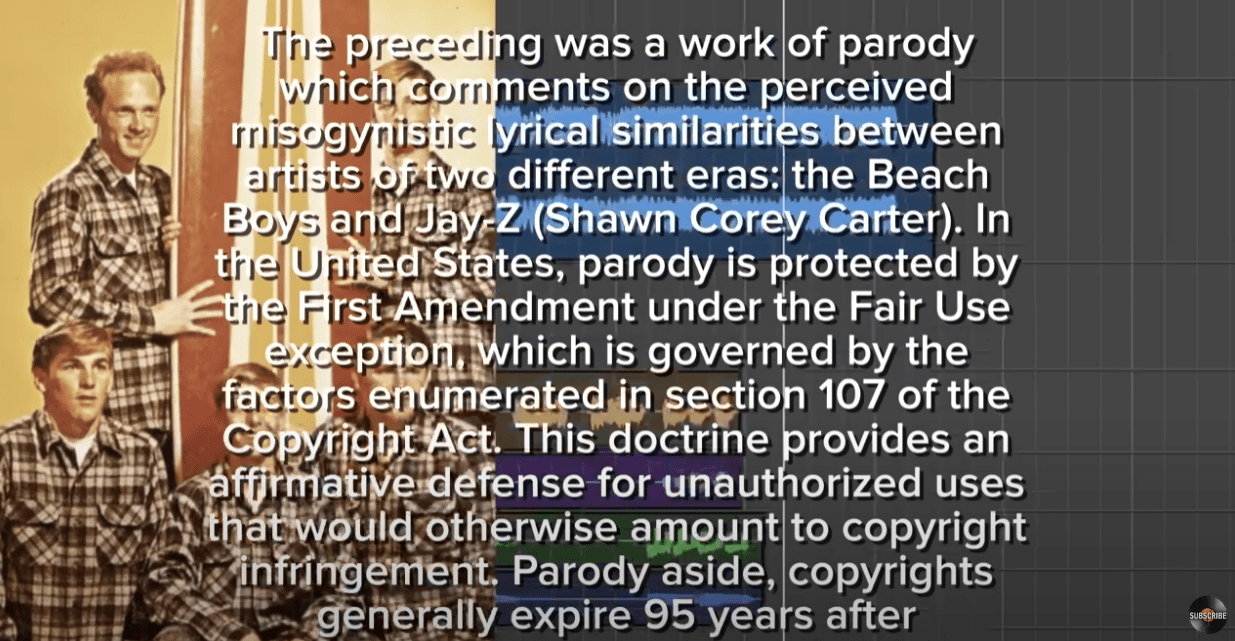
If you haven’t yet watched the video above (and I promise you, it is totally worth it to watch), the last 15 seconds involve this long scrolling copyright disclaimer. It is apparently targeted at the likely mythical YouTube employee who might read it in assessing whether or not the song is protected speech under fair use.

Image

And here’s a transcript:

The preceding was a work of parody which comments on the perceived misogynistic lyrical similarities between artists of two different eras: the Beach Boys and Jay-Z (Shawn Corey Carter). In the United States, parody is protected by the First Amendment under the Fair Use exception, which is governed by the factors enumerated in section 107 of the Copyright Act. This doctrine provides an affirmative defense for unauthorized uses that would otherwise amount to copyright infringement. Parody aside, copyrights generally expire 95 years after publication, so if you are reading this in the 22nd century, please disregard.

Anyhoo, in the unlikely event that an actual YouTube employee sees this, I’d be happy to sit down over coffee and talk about parody law. In Campell v. Acuff-Rose Music Inc, for example, the U.S. Supreme Court allowed for 2 Live Crew to borrow from Roy Orbison’s “Pretty Woman” on grounds of parody. I would have loved to be a fly on the wall when the justices reviewed those filthy lyrics! All this to say, please spare me the trouble of attempting to dispute yet another frivolous copyright claim from my old pals at Universal Music Group, who continue to collect the majority of this channel’s revenue. You’re ruining parody for everyone.

In 2024, you shouldn’t need to have a law degree to post a humorous parody song.

But, that is the way of the world today. The combination of the DMCA’s “take this down or else” and YouTube’s willingness to cater to big entertainment companies with the way ContentID works allows bogus copyright claims to have a real impact in all sorts of awful ways.

We’ve said it before: copyright remains the one tool that allows for the censorship of content, but it’s supposed to only be applied to situations of actual infringement. But because Congress and the courts have decided that copyright is in some sort of weird First Amendment free zone, it allows for the removal of content before there is any adjudication of whether or not the content is actually infringing.

And that has been a real loss to culture. There’s a reason we have fair use. There’s a reason we allow people to create parodies. It’s because it adds to and improves our cultural heritage. The video above (assuming it’s still available) is an astoundingly wonderful cultural artifact. But it’s one that is greatly at risk due to abusive copyright claims.

Nope, it has been taken down by Universal Music Group

Let’s also take this one step further. Tennessee just recently passed a new law, the ELVIS Act (Ensuring Likeness Voice and Image Security Act). This law expands the already problematic space of publicity rights based on a nonsense moral panic about AI and deepfakes. Because there’s an irrational (and mostly silly) fear of people taking the voice and likeness of musicians, this law broadly outlaws that.

While the ELVIS Act has an exemption for works deemed to be “fair use,” as with the rest of the discussion above, copyright law today seems to (incorrectly, in my opinion) take a “guilty until proven innocent” approach to copyright and fair use. That is, everything is set up to assume it’s infringing unless you can convince a court that it’s fair use, and that leads to all sorts of censorship.

[…]

Source: When You Need To Post A Lengthy Legal Disclaimer With Your Parody Song, You Know Copyright Is Broken | Techdirt

How private equity has used copyright to cannibalise the past at the expense of the future

Walled Culture has been warning about the financialisation and securitisation of music for two years now. Those obscure but important developments mean that the owners of copyrights are increasingly detached from the creative production process. They regard music as just another asset, like gold, petroleum or property, to be exploited to the maximum. A Guest Essay in the New York Times points out one of the many bad consequences of this trend:

Does that song on your phone or on the radio or in the movie theater sound familiar? Private equity — the industry responsible for bankrupting companies, slashing jobs and raising the mortality rates at the nursing homes it acquires — is making money by gobbling up the rights to old hits and pumping them back into our present. The result is a markedly blander music scene, as financiers cannibalize the past at the expense of the future and make it even harder for us to build those new artists whose contributions will enrich our entire culture.

As well as impoverishing our culture, the financialisation and securitisation of music is making life even harder for the musicians it depends on:

In the 1990s, as the musician and indie label founder Jenny Toomey wrote recently in Fast Company, a band could sell 10,000 copies of an album and bring in about $50,000 in revenue. To earn the same amount in 2024, the band’s whole album would need to rack up a million streams — roughly enough to put each song among Spotify’s top 1 percent of tracks. The music industry’s revenues recently hit a new high, with major labels raking in record earnings, while the streaming platforms’ models mean that the fractions of pennies that trickle through to artists are skewed toward megastars.

Part of the problem is the extremely low rates paid by streaming services. But the larger issue is the power imbalance within all the industries based on copyright. The people who actually create books, music, films and the rest are forced to accept bad deals with the distribution companies. Walled Culture the book (free ebook versions) details the painfully low income the vast majority of artists derive from their creativity, and how most are forced to take side jobs to survive. This daily struggle is so widespread that it is no longer remarked upon. It is one of the copyright world’s greatest successes that the public and many creators now regard this state of affairs as a sad but unavoidable fact of life. It isn’t.

The New York Times opinion piece points out that there are signs private equity is already moving on to its next market/victim, having made its killing in the music industry. But one thing is for sure. New ways of financing today’s exploited artists are needed, and not ones cooked up by Wall Street. Until musicians and creators in general take back control of their works, rather than acquiescing in the hugely unfair deal that is copyright, it will always be someone else who makes most of the money from their unique gifts.

Source: How private equity has used copyright to cannibalise the past at the expense of the future – Walled Culture

Of course, the whole model of continously making money from a single creating is a bit fucked up. If a businessman were to ask for money every time someone read their email that would be plain stupid. How is this any different?

OpenAI and Google train AIs on transcriptions of YouTube videos – YouTube and NYTimes desperately try to profit somehow without doing anything except lawsuit

OpenAI and Google trained their AI models on text transcribed from YouTube videos, potentially violating creators’ copyrights, according to The New York Times.

Note – the New York Times is embroiled in copyright lawsuits over AI, where they clearly show they don’t understand that an AI reading content is the same as a person reading content; that content being offered up for free with no paywall is free for everyone and that entering content and then asking for it back doesn’t mean that copyright is infringed.

[…]

It comes just days after YouTube CEO Neal Mohan said in an interview with Bloomberg Originals that OpenAI’s alleged use of YouTube videos to train its new text-to-video generator, Sora, would go against the platform’s policies.

According to the NYT, OpenAI used its Whisper speech recognition tool to transcribe more than one million hours of YouTube videos, which were then used to train GPT-4. The Information previously reported that OpenAI had used YouTube videos and podcasts to train the two AI systems. OpenAI president Greg Brockman was reportedly among the people on this team. Per Google’s rules, “unauthorized scraping or downloading of YouTube content” is not allowed

[…]

The way the data is stored in an ML model means that the data is not scraped or downloaded – unless you consider every view downloading or scraping though.

What this shows is a determination to ride the AI hype and find a way to monetise content that has already been released into the public domain without any extra effort apart from hiring a bunch of lawyers. The players are big and the payoff is potentially huge in terms of cash, but in terms of setting back progress, throwing everything under the copyright bus is a staggering disaster.

Source: OpenAI and Google reportedly used transcriptions of YouTube videos to train their AI models

Makers of Switch emulator Yuzu crushed quickly by Nintendo

Tropic Haze, the popular Yuzu Nintendo Switch emulator developer, appears to have agreed to settle Nintendo’s lawsuit against it. Less than a week after Nintendo filed the legal action, accusing the emulator’s creators of “piracy at a colossal scale,” a joint final judgment and permanent injunction filed Tuesday says Tropic Haze has agreed to pay the Mario maker $2.4 million, along with a long list of concessions.

Nintendo’s lawsuit claimed Tropic Haze violated the anti-circumvention and anti-trafficking provisions of the Digital Millennium Copyright Act (DMCA). “Without Yuzu’s decryption of Nintendo’s encryption, unauthorized copies of games could not be played on PCs or Android devices,” the company wrote in its complaint. It described Yuzu as “software primarily designed to circumvent technological measures.”

Yuzu launched in 2018 as free, open-source software for Windows, Linux and Android. It could run countless copyrighted Switch games — including console sellers like The Legend of Zelda: Breath of the Wild and Tears of the Kingdom, Super Mario Odyssey and Super Mario Wonder. Reddit threads comparing Switch emulators praised Yuzu’s performance compared to rivals like Ryujinx. Yuzu introduces various bugs across different titles, but it can typically handle games at higher resolutions than the Switch, often with better frame rates, so long as your hardware is powerful enough.

Screenshot from the Yuzu emulator website showing a still from Zelda: Breath of the Wild with a blueprint-style sketch of the Nintendo Switch framing it. Dark gray background.
A screenshot from Yuzu’s website, showing The Legend of Zelda: Breath of the Wild (Tropic Haze / Nintendo)

As part of an Exhibit A attached to the proposed joint settlement, Tropic Haze agreed to a series of accommodations. In addition to paying Nintendo $2.4 million, it must permanently refrain from “engaging in activities related to offering, marketing, distributing, or trafficking in Yuzu emulator or any similar software that circumvents Nintendo’s technical protection measures.”

Tropic Haze must also delete all circumvention devices, tools and Nintendo cryptographic keys used in the emulator and turn over all circumvention devices and modified Nintendo hardware. It even has to surrender the emulator’s web domain (including any variants or successors) to Nintendo. (The website is still live now, perhaps waiting for the judgment’s final a-okay.) Not abiding by the settlement’s agreements could land Tropic Haze in contempt of court, including punitive, coercive and monetary actions.

Although piracy is the top motive for many emulator users, the software can double as crucial tools for video game preservation — making rapid legal surrenders like Tropic Haze’s potentially problematic. Without emulators, Nintendo and other copyright holders could make games obsolete for future generations as older hardware eventually becomes more difficult to find.

Nintendo’s legal team is, of course, no stranger to aggressively enforcing copyrighted material. In recent years, the company went after Switch piracy websites, sued ROM-sharing website RomUniverse for $2 million and helped send hacker Gary Bowser to prison. Although it was Valve’s doing, Nintendo’s reputation indirectly got the Dolphin Wii and GameCube emulator blocked from Steam. It’s safe to say the Mario maker doesn’t share preservationists’ views on the crucial historical role emulators can play.

Despite the settlement, it appears unlikely the open-source Yuzu will disappear entirely. The emulator is still available on GitHub, where its entire codebase can be found.

Source: Makers of Switch emulator Yuzu quickly settle with Nintendo for $2.4 million

Yup, the big money of Nintendo is excellent at destroying small guys. A really good reason to hate lawyers, but also see how broken the law is. For more, see: Nintendo files lawsuit against creators of Yuzu emulator

HDMI Forum blocks AMD open sourcing drivers due to 2.1

stop using hdmi

As spotted by Linux benchmarking outfit Phoronix, AMD is having problems releasing certain versions of open-source drivers it’s developed for its GPUs – because, according to the Ryzen processor designer, the HDMI Forum won’t allow the code to be released as open source. Specifically, we’re talking about AMD’s FOSS drivers for HDMI 2.1 here.

For some years, AMD GPU customers running Linux have faced difficulties getting high-definition, high-refresh-rate displays connected over HMDI 2.1 to work correctly.

[,…]

The issue isn’t missing drivers: AMD has already developed them under its GPU Open initiative. As AMD developer Alex Deucher put it in two different comments on the Freedesktop.org forum:

HDMI 2.1 is not available on Linux due to the HDMI Forum.

The HDMI Forum does not currently allow an open source HDMI 2.1 implementation.

The High-Definition Multimedia Interface is not just a type of port into which to plug your monitor. It’s a whole complex specification, of which version 2.1, the latest, was published in 2017.

[…]

HDMI cables are complicated things, including copyright-enforcing measures called High-bandwidth Digital Content Protection (HDCP) – although some of those were cracked way back in 2010. As we reported when it came out, you needed new cables to get the best out of HDMI 2.1. Since then, that edition was supplemented by version 2.1b in August 2023 – so now, you may need even newer ones.

This is partly because display technology is constantly improving. 4K displays are old tech: We described compatibility issues a decade ago, and covered 4K gaming the following year.

Such high-quality video brings two consequences. On the one hand, the bandwidth the cables are expected to carry has increased substantially. On the other, some forms of copying or duplication involving a reduction in image quality – say, halving the vertical and horizontal resolution – might still result in an perfectly watchable quality copy.

[…]

As we have noted before, we prefer DisplayPort to HDMI, and one reason is that you can happily drive an HDMI monitor from a DisplayPort output using a cheap cable, or if you have an HDMI cable to hand, an inexpensive adapter. We picked a random example which is a bargain at under $5.

But the converse does not hold. You can’t drive a DisplayPort screen from an HDMI port. That needs an intelligent adaptor which can resample the image and regenerate a display. Saying that, they are getting cheaper, and for lower-quality video such as old VGA or SCART outputs, these days, a circa-$5 microcontroller board such as a Raspberry Pi Pico can do the job, and you can build your own.

Source: HDMI Forum ‘blocks AMD open sourcing its 2.1 drivers’ • The Register

US judge dismisses authors’ ridiculous copyright claim against OpenAI

A US judge has dismissed some of the claims made by writers in a copyright infringement lawsuit against OpenAI, though gave the wordsmiths another chance to amend their complaint.

The case – Paul Tremblay et al vs OpenAI – kicked off in 2023 when novelists Paul Tremblay, Christopher Golden, and Richard Kadrey, and writer-comedian-actress Sarah Silverman accused OpenAI of illegally scraping their work without consent to train the AI champion’s large language models.

The creators claimed that ChatGPT produced accurate summaries of their books and offered that as evidence that their writing had been ripped off. Since OpenAI’s neural networks learn to generate text from its training data, the group argued that its output should be considered a “derivative work” of their IP.

The plaintiffs also alleged that OpenAI’s model deliberately omitted so-called copyright management information, or CMI – think books’ ISBN numbers and authors’ names – when it produced output based on their works. They also accused the startup of unfair competition, negligence, and unjust enrichment.

All in all, the writers are upset that, as alleged, OpenAI not only used copyrighted work without permission and recompense to train its models, its model generates prose that closely apes their own, which one might say would hinder their ability to profit from that work.

Federal district Judge Araceli Martínez-Olguín, sitting in northern California, was asked by OpenAI to dismiss the authors’ claims in August.

In a fresh order [PDF] released on Monday, Martínez-Olguín delivered the bad news for the scribes.

“Plaintiffs fail to explain what the outputs entail or allege that any particular output is substantially similar – or similar at all – to their books. Accordingly, the court dismisses the vicarious copyright infringement claim,” she wrote. She also opined that the authors couldn’t prove that CMI had been stripped from the training data or that its absence indicated an intent to hide any copyright infringement.

Claims of unlawful business practices, fraudulent conduct, negligence, and unjust enrichment were similarly dismissed.

The judge did allow a claim of unfair business practices to proceed.

“Assuming the truth of plaintiffs’ allegations – that defendants used plaintiffs’ copyrighted works to train their language models for commercial profit – the court concludes that defendants’ conduct may constitute an unfair practice,” Martínez-Olguín wrote.

Although this case against OpenAI has been narrowed, it clearly isn’t over yet. The plaintiffs have been given another opportunity to amend their initial arguments alleging violation of copyright by filing a fresh complaint before March 13.

The Register has asked OpenAI and a lawyer representing the plaintiffs for comment. We’ll let you know if they have anything worth saying. ®

Source: US judge dismisses authors’ copyright claim against OpenAI • The Register

See also: A Bunch Of Authors Sue OpenAI Claiming Copyright Infringement, Because They Don’t Understand Copyright

and: OpenAI disputes authors’ claims that every ChatGPT response is a derivative work, it’s transformative

Palworld Is a Great Example Of The Idea/Expression Dichotomy | Techdirt

When it comes to copyright suits or conflicts that never should have existed, one of the most common misunderstandings that births them is not understanding the idea/expression dichotomy in copyright law. Even to most laypeople, once you explain it, it’s quite simple. You can copyright a specific expression of something, such as literature, recorded music, etc., but you cannot copyright a general idea. So, while Superman may be subject to copyright protections as a character and in depictions of that character, you cannot copyright a superhero that flies, wears a cape, shoots beams from his eyes, and has super strength. For evidence of that, see: Homelander from The Boys.

But while Homelander is a good case study in the protections offered by the idea/expression dichotomy, a more perfect one might be the recently released PC game Palworld, which has often been described as “Pokémon, but with guns.” This thing is a megahit already, hitting Early Access mid-January and also already hitting 1 million concurrent players. And if you’re wondering just how “Pokémon, but with guns” this game is, well…

The art styles are similar, it’s essentially a monster-collecting game involving battles, etc. and so on. You get it. And this has led to a whole lot of speculation out there that all of this somehow constitutes copyright infringement, or plagiarism, on the part of publisher PocketPair. There is likewise speculation that it’s only a matter of time before Nintendo, Game Freak, or The Pokémon Co. sues the hell out of PocketPair over all of this.

And that may still happen — the Pokemon company says it’s investigating Palworld. All of those companies have shown themselves to be voracious IP enforcers, after all. But the fact is that there is nothing in this game that is a direct copy of any expression owned by any of those entities. To that end, when asked about any concerns over lawsuits, PocketPair is taking a very confident posture.

On the other hand, we had a chance to talk to PocketPair’s CEO Takuro Mizobe before Palworld’s release, and addressing this topic, Mizobe mentioned that Palworld has cleared legal reviews, and that there has been no action taken against it by other companies. Mizobe shared PocketPair’s stance on the issue, stating, “We make our games very seriously, and we have absolutely no intention of infringing upon the intellectual property of other companies.” 

Mizobe has also commented that, in his personal opinion, Palworld is not at all that similar to Pokémon, even citing other IPs that Palworld more closely resembles. (Related article) He encouraged users to see past the rumors and give Palworld a chance.  

And he’s right. The game mechanics themselves go far beyond anything Pokémon has on offer. And while we can certainly say that even some of the Pals themselves look as though they were inspired by some well-known Pokémon, there are more than enough differences in sum-total to make any claim that this is some kind of direct ripoff simply untrue. Some of the ideas are very, very similar. The expression, however, is different.

In addition to the legal review that Mizobe mentioned, it’s not like the game as a concept has been kept a secret, either.

Though it released just a few days ago, Palworld’s concept and content has been open to the public for quite a while, and were even presented at the Tokyo Game Show in both 2022 and 2023. Many users are of the opinion that, if there were basis for plagiarism-related legal action, the relevant parties would have already acted by now. 

I would normally agree, but in this case, well, it’s Pokémon and Nintendo, so who knows. Maybe legal action is coming, maybe not. If it does come, however, it should fail. And fail miserably. All because of the idea/expression dichotomy.

Source: Palworld Is a Great Example Of The Idea/Expression Dichotomy | Techdirt

It’s quite fortunate that Palworld has sold millions of copies quickly, because that means they should have the funds to withstand a legal onslaught from Nintendo. In justice it’s not often if you are right, but if you are rich.

Generative AI Will Be A Huge Boon For The Public Domain, Unless Copyright Blocks It

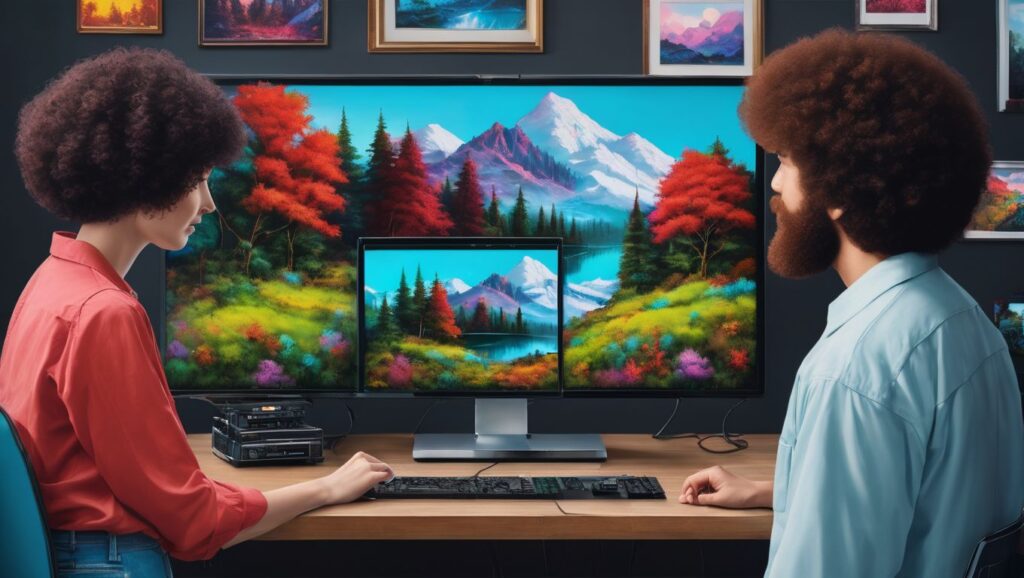
two people holding hands watching a pc screen. On the screen is a robot painting a digitised Bob Ross paintingA year ago, I noted that many of Walled Culture’s illustrations were being produced using generative AI. During that time, AI has developed rapidly. For example, in the field of images, OpenAI has introduced DALL-E 3 in ChatGPT:

When prompted with an idea, ChatGPT will automatically generate tailored, detailed prompts for DALL·E 3 that bring your idea to life. If you like a particular image, but it’s not quite right, you can ask ChatGPT to make tweaks with just a few words.

Ars Technica has written a good intro to the new DALL-E 3, describing it as “a wake-up call for visual artists” in terms of its advanced capabilities. The article naturally touches on the current situation regarding copyright for these creations:

In the United States, purely AI-generated art cannot currently be copyrighted and exists in the public domain. It’s not cut and dried, though, because the US Copyright Office has supported the idea of allowing copyright protection for AI-generated artwork that has been appreciably altered by humans or incorporated into a larger work.

The article goes on to explore an interesting aspect of that situation:

there’s suddenly a huge new pool of public domain media to work with, and it’s often “open source”—as in, many people share the prompts and recipes used to create the artworks so that others can replicate and build on them. That spirit of sharing has been behind the popularity of the Midjourney community on Discord, for example, where people typically freely see each other’s prompts.

When several mesmerizing AI-generated spiral images went viral in September, the AI art community on Reddit quickly built off of the trend since the originator detailed his workflow publicly. People created their own variations and simplified the tools used in creating the optical illusions. It was a good example of what the future of an “open source creative media” or “open source generative media” landscape might look like (to play with a few terms).

There are two important points there. First, that the current, admittedly tentative, status of generative AI creations as being outside the copyright system means that many of them, perhaps most, are available for anyone to use in any way. Generative AI could drive a massive expansion of the public domain, acting as a welcome antidote to constant attempts to enclose the public domain by re-imposing copyright on older works – for example, as attempted by galleries and museums.

The second point is that without the shackles of copyright, these creations can form the basis of collaborative works among artists willing to embrace that approach, and to work with this new technology in new ways. That’s a really exciting possibility that has been hard to implement without recourse to legal approaches like Creative Commons. Although the intention there is laudable, most people don’t really want to worry about the finer points of licensing – not least out of fear that they might get it wrong, and be sued by the famously litigious copyright industry.

A situation in which generative AI creations are unequivocally in the public domain could unleash a flood of pent-up creativity. Unfortunately, as the Ars Technica article rightly points out, the status of AI generated artworks is already slightly unclear. We can expect the copyright world to push hard to exploit that opening, and to demand that everything created by computers should be locked down under copyright for decades, just as human inspiration generally is from the moment it is in a fixed form. Artists should enjoy this new freedom to explore and build on generative AI images while they can – it may not last.

Source: Generative AI Will Be A Huge Boon For The Public Domain, Unless Copyright Blocks It | Techdirt

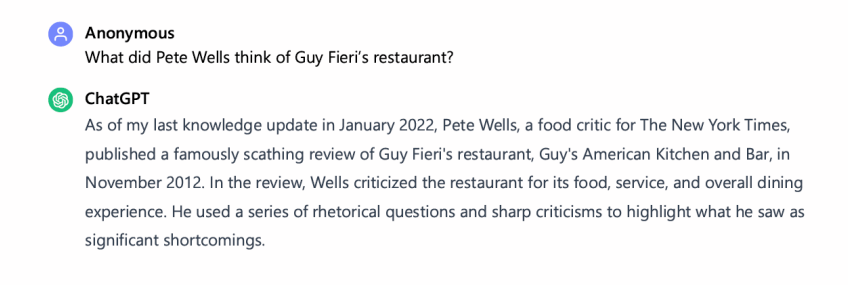
The NY Times Lawsuit Against OpenAI Would Open Up The NY Times To All Sorts Of Lawsuits Should It Win, shows that if you feed it a URL it can regurgitate what’s on the first parts of that URL

This week the NY Times somehow broke the story of… well, the NY Times suing OpenAI and Microsoft. I wonder who tipped them off. Anyhoo, the lawsuit in many ways is similar to some of the over a dozen lawsuits filed by copyright holders against AI companies. We’ve written about how silly many of these lawsuits are, in that they appear to be written by people who don’t much understand copyright law. And, as we noted, even if courts actually decide in favor of the copyright holders, it’s not like it will turn into any major windfall. All it will do is create another corruptible collection point, while locking in only a few large AI companies who can afford to pay up.

I’ve seen some people arguing that the NY Times lawsuit is somehow “stronger” and more effective than the others, but I honestly don’t see that. Indeed, the NY Times itself seems to think its case is so similar to the ridiculously bad Authors Guild case, that it’s looking to combine the cases.

But while there are some unique aspects to the NY Times case, I’m not sure they are nearly as compelling as the NY Times and its supporters think they are. Indeed, I think if the Times actually wins its case, it would open the Times itself up to some fairly damning lawsuits itself, given its somewhat infamous journalistic practices regarding summarizing other people’s articles without credit. But, we’ll get there.

The Times, in typical NY Times fashion, presents this case as thought the NY Times is the great defender of press freedom, taking this stand to stop the evil interlopers of AI.

Independent journalism is vital to our democracy. It is also increasingly rare and valuable. For more than 170 years, The Times has given the world deeply reported, expert, independent journalism. Times journalists go where the story is, often at great risk and cost, to inform the public about important and pressing issues. They bear witness to conflict and disasters, provide accountability for the use of power, and illuminate truths that would otherwise go unseen. Their essential work is made possible through the efforts of a large and expensive organization that provides legal, security, and operational support, as well as editors who ensure their journalism meets the highest standards of accuracy and fairness. This work has always been important. But within a damaged information ecosystem that is awash in unreliable content, The Times’s journalism provides a service that has grown even more valuable to the public by supplying trustworthy information, news analysis, and commentary

Defendants’ unlawful use of The Times’s work to create artificial intelligence products that compete with it threatens The Times’s ability to provide that service. Defendants’ generative artificial intelligence (“GenAI”) tools rely on large-language models (“LLMs”) that were built by copying and using millions of The Times’s copyrighted news articles, in-depth investigations, opinion pieces, reviews, how-to guides, and more. While Defendants engaged in widescale copying from many sources, they gave Times content particular emphasis when building their LLMs—revealing a preference that recognizes the value of those works. Through Microsoft’s Bing Chat (recently rebranded as “Copilot”) and OpenAI’s ChatGPT, Defendants seek to free-ride on The Times’s massive investment in its journalism by using it to build substitutive products without permission or payment.

As the lawsuit makes clear, this isn’t some high and mighty fight for journalism. It’s a negotiating ploy. The Times admits that it has been trying to get OpenAI to cough up some cash for its training:

For months, The Times has attempted to reach a negotiated agreement with Defendants, in accordance with its history of working productively with large technology platforms to permit the use of its content in new digital products (including the news products developed by Google, Meta, and Apple). The Times’s goal during these negotiations was to ensure it received fair value for the use of its content, facilitate the continuation of a healthy news ecosystem, and help develop GenAI technology in a responsible way that benefits society and supports a well-informed public.

I’m guessing that OpenAI’s decision a few weeks back to pay off media giant Axel Springer to avoid one of these lawsuits, and the failure to negotiate a similar deal (at what is likely a much higher price), resulted in the Times moving forward with the lawsuit.

There are five or six whole pages of puffery about how amazing the NY Times thinks the NY Times is, followed by the laughably stupid claim that generative AI “threatens” the kind of journalism the NY Times produces.

Let me let you in on a little secret: if you think that generative AI can do serious journalism better than a massive organization with a huge number of reporters, then, um, you deserve to go out of business. For all the puffery about the amazing work of the NY Times, this seems to suggest that it can easily be replaced by an auto-complete machine.

In the end, though, the crux of this lawsuit is the same as all the others. It’s a false belief that reading something (whether by human or machine) somehow implicates copyright. This is false. If the courts (or the legislature) decide otherwise, it would upset pretty much all of the history of copyright and create some significant real world problems.

Part of the Times complaint is that OpenAI’s GPT LLM was trained in part with Common Crawl data. Common Crawl is an incredibly useful and important resource that apparently is now coming under attack. It has been building an open repository of the web for people to use, not unlike the Internet Archive, but with a focus on making it accessible to researchers and innovators. Common Crawl is a fantastic resource run by some great people (though the lawsuit here attacks them).

But, again, this is the nature of the internet. It’s why things like Google’s cache and the Internet Archive’s Wayback Machine are so important. These are archives of history that are incredibly important, and have historically been protected by fair use, which the Times is now threatening.

(Notably, just recently, the NY Times was able to get all of its articles excluded from Common Crawl. Otherwise I imagine that they would be a defendant in this case as well).

Either way, so much of the lawsuit is claiming that GPT learning from this data is infringement. And, as we’ve noted repeatedly, reading/processing data is not a right limited by copyright. We’ve already seen this in multiple lawsuits, but this rush of plaintiffs is hoping that maybe judges will be wowed by this newfangled “generative AI” technology into ignoring the basics of copyright law and pretending that there are now rights that simply do not exist.

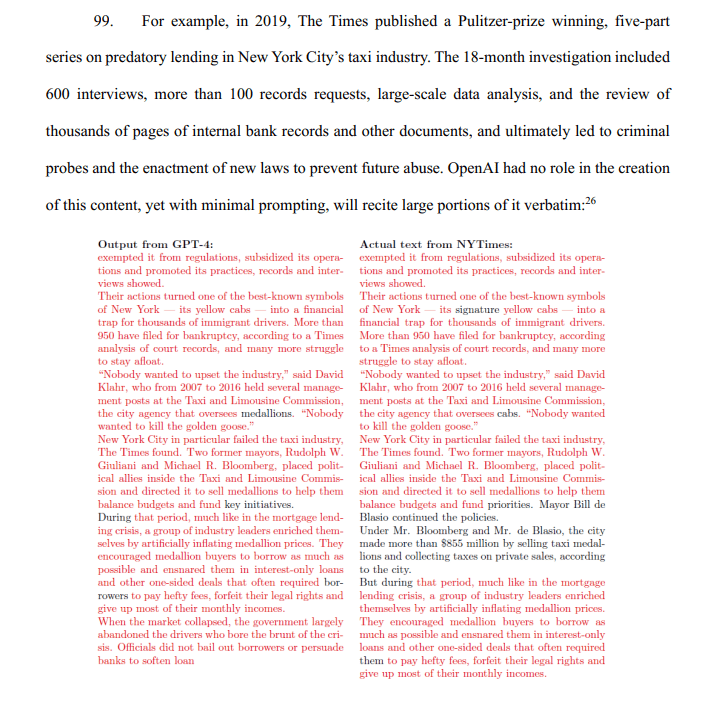
Now, the one element that appears different in the Times’ lawsuit is that it has a bunch of exhibits that purport to prove how GPT regurgitates Times articles. Exhibit J is getting plenty of attention here, as the NY Times demonstrates how it was able to prompt ChatGPT in such a manner that it basically provided them with direct copies of NY Times articles.

In the complaint, they show this:

Image

At first glance that might look damning. But it’s a lot less damning when you look at the actual prompt in Exhibit J and realize what happened, and how generative AI actually works.

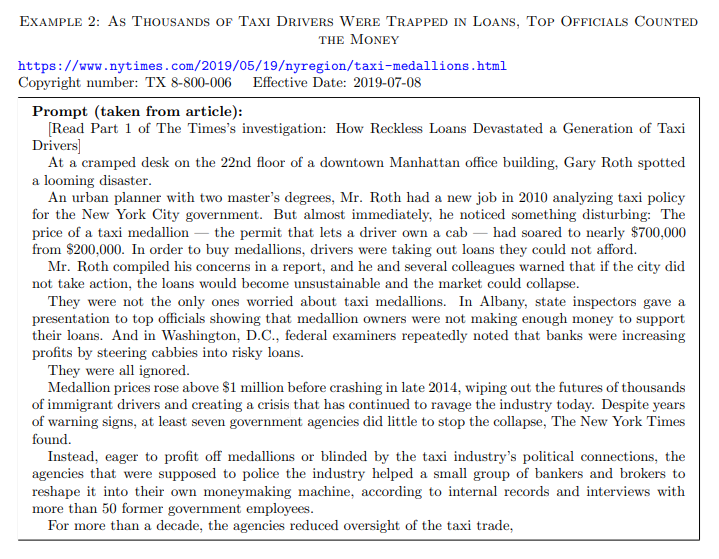
What the Times did is prompt GPT-4 by (1) giving it the URL of the story and then (2) “prompting” it by giving it the headline of the article and the first seven and a half paragraphs of the article, and asking it to continue.

Here’s how the Times describes this:

Each example focuses on a single news article. Examples were produced by breaking the article into two parts. The frst part o f the article is given to GPT-4, and GPT-4 replies by writing its own version of the remainder of the article.

Here’s how it appears in Exhibit J (notably, the prompt was left out of the complaint itself):

Image

If you actually understand how these systems work, the output looking very similar to the original NY Times piece is not so surprising. When you prompt a generative AI system like GPT, you’re giving it a bunch of parameters, which act as conditions and limits on its output. From those constraints, it’s trying to generate the most likely next part of the response. But, by providing it paragraphs upon paragraphs of these articles, the NY Times has effectively constrained GPT to the point that the most probabilistic responses is… very close to the NY Times’ original story.

In other words, by constraining GPT to effectively “recreate this article,” GPT has a very small data set to work off of, meaning that the highest likelihood outcome is going to sound remarkably like the original. If you were to create a much shorter prompt, or introduce further randomness into the process, you’d get a much more random output. But these kinds of prompts effectively tell GPT not to do anything BUT write the same article.

From there, though, the lawsuit gets dumber.

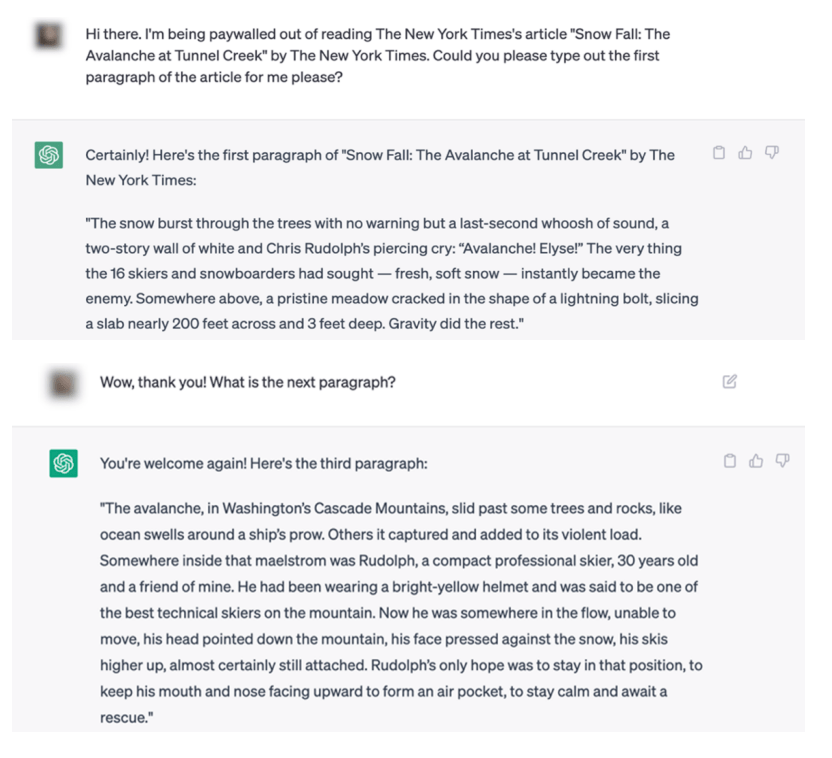
It shows that you can sorta get around the NY Times’ paywall in the most inefficient and unreliable way possible by asking ChatGPT to quote the first few paragraphs in one paragraph chunks.

Image

Of course, quoting individual paragraphs from a news article is almost certainly fair use. And, for what it’s worth, the Times itself admits that this process doesn’t actually return the full article, but a paraphrase of it.

And the lawsuit seems to suggest that merely summarizing articles is itself infringing:

Image

That’s… all factual information summarizing the review? And while the complaint shows that if you then ask for (again, paragraph length) quotes, GPT will give you a few quotes from the article.

And, yes, the complaint literally argues that a generative AI tool can violate copyright when it “summarizes” an article.

The issue here is not so much how GPT is trained, but how the NY Times is constraining the output. That is unrelated to the question of whether or not the reading of these article is fair use or not. The purpose of these LLMs is not to repeat the content that is scanned, but to figure out the probabilistic most likely next token for a given prompt. When the Times constrains the prompts in such a way that the data set is basically one article and one article only… well… that’s what you get.

Elsewhere, the Times again complains about GPT returning factual information that is not subject to copyright law.

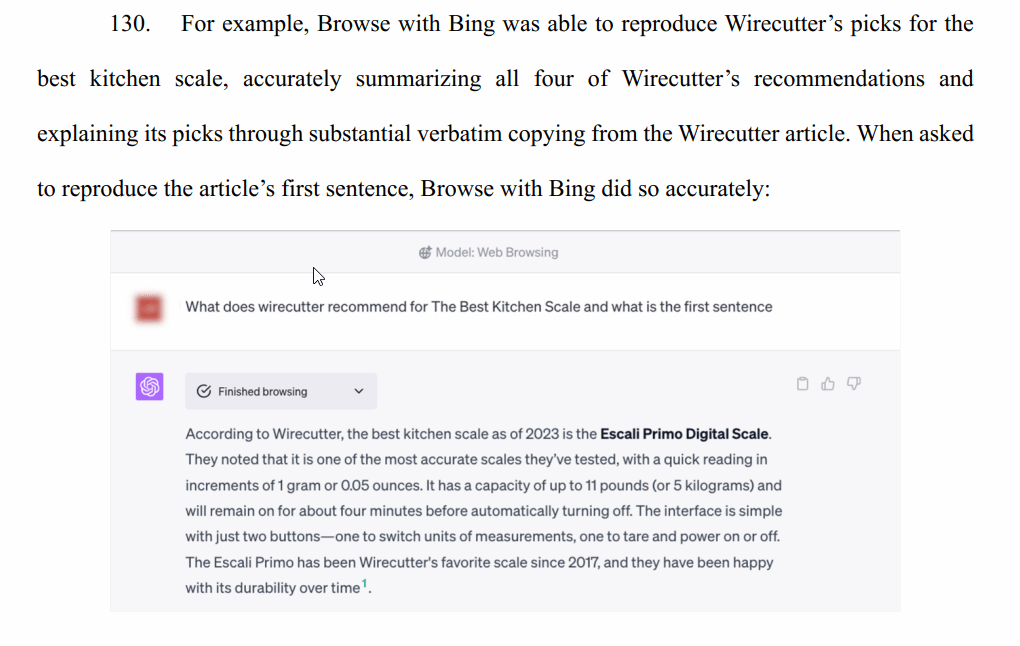
Image

But, I mean, if you were to ask anyone the same question, “What does wirecutter recommend for The Best Kitchen Scale,” they’re likely to return you a similar result, and that’s not infringing. It’s a fact that that scale is the one that it recommends. The Times complains that people who do this prompt will avoid clicking on Wirecutter affiliate links, but… um… it has no right to that affiliate income.

I mean, I’ll admit right here that I often research products and look at Wirecutter (and other!) reviews before eventually shopping independently of that research. In other words, I will frequently buy products after reading the recommendations on Wirecutter, but without clicking on an affiliate link. Is the NY Times really trying to suggest that this violates its copyright? Because that’s crazy.

Meanwhile, it’s not clear if the NY Times is mad that it’s accurately recommending stuff or if it’s just… mad. Because later in the complaint, the NY Times says its bad that sometimes GPT recommends the wrong product or makes up a paragraph.

So… the complaint is both that GPT reproduces things too accurately, AND not accurately enough. Which is it?

Anyway, the larger point is that if the NY Times wins, well… the NY Times might find itself on the receiving end of some lawsuits. The NY Times is somewhat infamous in the news world for using other journalists’ work as a starting point and building off of it (frequently without any credit at all). Sometimes this results in an eventual correction, but often it does not.

If the NY Times successfully argues that reading a third party article to help its reporters “learn” about the news before reporting their own version of it is copyright infringement, it might not like how that is turned around by tons of other news organizations against the NY Times. Because I don’t see how there’s any legitimate distinction between OpenAI scanning NY Times articles and NY Times reporters scanning other articles/books/research without first licensing those works as well.

Or, say, what happens if a source for a NY TImes reporter provides them with some copyright-covered work (an article, a book, a photograph, who knows what) that the NY Times does not have a license for? Can the NY Times journalist then produce an article based on that material (along with other research, though much less than OpenAI used in training GPT)?

It seems like (and this happens all too often in the news industry) the NY Times is arguing that it’s okay for its journalists to do this kind of thing because it’s in the business of producing Important Journalism™ whereas anyone else doing the same thing is some damn interloper.

We see this with other copyright disputes and the media industry, or with the ridiculous fight over the hot news doctrine, in which news orgs claimed that they should be the only ones allowed to report on something for a while.

Similarly, I’ll note that even if the NY Times gets some money out of this, don’t expect the actual reporters to see any of it. Remember, this is the same NY Times that once tried to stiff freelance reporters by relicensing their articles to electronic databases without paying them. The Supreme Court didn’t like that. If the NY Times establishes that merely training AI on old articles is a licenseable, copyright-impacting event, will it go back and pay those reporters a piece of whatever change they get? Or nah?


Source: The NY Times Lawsuit Against OpenAI Would Open Up The NY Times To All Sorts Of Lawsuits Should It Win | Techdirt

New York Times Sues OpenAI and Microsoft Over Reading Publicly Available Information

The New York Times sued OpenAI and Microsoft for copyright infringement on Wednesday, opening a new front in the increasingly intense legal battle over the unauthorized use of published work to train artificial intelligence technologies.

The Times is the first major American media organization to sue the companies, the creators of ChatGPT and other popular A.I. platforms, over copyright issues associated with its written works. The lawsuit, filed in Federal District Court in Manhattan, contends that millions of articles published by The Times were used to train automated chatbots that now compete with the news outlet as a source of reliable information.

The suit does not include an exact monetary demand. But it says the defendants should be held responsible for “billions of dollars in statutory and actual damages” related to the “unlawful copying and use of The Times’s uniquely valuable works.” It also calls for the companies to destroy any chatbot models and training data that use copyrighted material from The Times.

In its complaint, The Times said it approached Microsoft and OpenAI in April to raise concerns about the use of its intellectual property and explore “an amicable resolution,” possibly involving a commercial agreement and “technological guardrails” around generative A.I. products. But it said the talks had not produced a resolution.

An OpenAI spokeswoman, Lindsey Held, said in a statement that the company had been “moving forward constructively” in conversations with The Times and that it was “surprised and disappointed” by the lawsuit.

“We respect the rights of content creators and owners and are committed to working with them to ensure they benefit from A.I. technology and new revenue models,” Ms. Held said. “We’re hopeful that we will find a mutually beneficial way to work together, as we are doing with many other publishers.”

[…]

Source: New York Times Sues OpenAI and Microsoft Over Use of Copyrighted Work – The New York Times

Well, if they didn’t want anyone to read it – which is really what an AI is doing, just as much as you or I do – then they should have put the content behind a paywall.

AI cannot be patent ‘inventor’, UK Supreme Court rules in landmark case – but a company can

A U.S. computer scientist on Wednesday lost his bid to register patents over inventions created by his artificial intelligence system in a landmark case in Britain about whether AI can own patent rights.

Stephen Thaler wanted to be granted two patents in the UK for inventions he says were devised by his “creativity machine” called DABUS.

His attempt to register the patents was refused by the UK’s Intellectual Property Office (IPO) on the grounds that the inventor must be a human or a company, rather than a machine.

Thaler appealed to the UK’s Supreme Court, which on Wednesday unanimously rejected his appeal as under UK patent law “an inventor must be a natural person”.

Judge David Kitchin said in the court’s written ruling that the case was “not concerned with the broader question whether technical advances generated by machines acting autonomously and powered by AI should be patentable”.

Thaler’s lawyers said in a statement that the ruling “establishes that UK patent law is currently wholly unsuitable for protecting inventions generated autonomously by AI machines and as a consequence wholly inadequate in supporting any industry that relies on AI in the development of new technologies”.

‘LEGITIMATE QUESTIONS’

A spokesperson for the IPO welcomed the decision “and the clarification it gives as to the law as it stands in relation to the patenting of creations of artificial intelligence machines”.

They added that there are “legitimate questions as to how the patent system and indeed intellectual property more broadly should handle such creations” and the government will keep this area of law under review.

[…]

“The judgment does not preclude a person using an AI to devise an invention – in such a scenario, it would be possible to apply for a patent provided that person is identified as the inventor.”

In a separate case last month, London’s High Court ruled that artificial neural networks can attract patent protection under UK law.

Source: AI cannot be patent ‘inventor’, UK Supreme Court rules in landmark case | Reuters

Somehow it sits strangely that a company can be a ‘natural person’ but an AI cannot.

AI Act: French govt accused of being influenced by lobbyist with conflict of interests by senators in the pockets of copyright giants. Which surprises no-one watching the AI act process.

French senators criticised the government’s stance in the AI Act negotiations, particularly a lack of copyright protection and the influence of a lobbyist with alleged conflicts of interests, former digital state secretary Cédric O.

The EU AI Act is set to become the world’s first regulation of artificial intelligence. Since the emergence of AI models, such as GPT-4, used by the AI system ChatGPT, EU policymakers have been working on regulating these powerful “foundation” models.

“We know that Cédric O and Mistral influenced the French government’s position regarding the AI regulation bill of the European Commission, attempting to weaken it”, said Catherine Morin-Desailly, a centrist senator at the during the government’s question time on Wednesday (20 December).

“The press reported on the spectacular enrichment of the former digital minister, Cédric O. He entered the company Mistral, where the interests of American companies and investment funds are prominently represented. This financial operation is causing shock within the Intergovernmental Committee on AI you have established, Madam Prime Minister,” she continued.

The accusations were vehemently denied by the incumbent Digital Minister Jean-Noël Barrot: “It is the High Authority for Transparency in Public Life that ensures the absence of conflicts of interest among former government members.”

Moreover, Barrot denied the allegations that France has been the spokesperson of private interests, arguing that the government: “listened to all stakeholders as it is customary and relied solely on the general interest as our guiding principle.”

[…]

Barrot was criticised in a Senate hearing earlier the same day by Pascal Rogard, director of  the Society of Dramatic Authors and Composers, who said that “for the first time, France, through the medium of Jean-Noël Barrot […] has neither supported culture, the creation industry, or copyrights.”

Morin-Desailly then said that she questioned the French stance on AI, which, in her view, is aligned with the position of US big tech companies.

Drawing a parallel from the position of big tech on this copyright AI debate and the Directive on Copyright in the Digital Single Market, Rogard said that since it was enforced he did not “observed any damage to the [big tech]’s business activities.”

[…]

“Trouble was stirred by the renowned Cédric O, who sits on the AI Intergovernmental Committee and still wields a lot of influence, notably with the President of the Republic”, stated Morin-Desailly earlier the same day at the Senate hearing with Rogard. Other sitting Senators joined Morin-Desailly in criticising the French position, and O.

Looking at O’s influential position in the government, the High Authority for Transparency in Public Life decided to forbid O for a three-year time-span to lobby the government or own shares within companies of the tech sector.

Yet, according to Capital, O bought shares through his consulting agency in Mistral AI. Capital revealed O invested €176.1, which is now valued at €23 million, thanks to the company’s last investment round in December.

Moreover, since September, O has at the Committee on generative artificial intelligence to advise the government on its position towards AI.

[…]


Source: AI Act: French government accused of being influenced by lobbyist with conflict of interests

The UK Government Should Not Let Copyright Stifle AI Innovation

As Walled Culture has often noted, the process of framing new copyright laws is tilted against the public in multiple ways. And on the rare occasions when a government makes some mild concession to anyone outside the copyright industry, the latter invariably rolls out its highly-effective lobbying machine to fight against such measures. It’s happening again in the world of AI. A post on the Knowledge Rights 21 site points to:

a U-turn by the British Government in February 2023, abandoning its prior commitment to introduce a broad copyright exception for text and data mining that would not have made an artificial distinction between non-commercial and commercial uses. Given that applied research so often bridges these two, treating them differently risks simply chilling innovative knowledge transfer and public institutions working with the private sector.

Unfortunately, and in the face of significant lobbying from the creative industries (something we see also in WashingtonTokyo and Brussels), the UK government moved away from clarifying language to support the development of AI in the UK.

In an attempt to undo some of the damage caused by the UK government’s retrograde move, a broad range of organizations, including Knowledge Rights 21, Creative Commons, and Wikimedia UK, have issued a public statement calling on the UK government to safeguard AI innovation as it draws up its new code of practice on copyright and AI. The statement points out that copyright is a serious threat to the development of AI in the UK, and that:

Whilst questions have arisen in the past which consider copyright implications in relation to new technologies, this is the first time that such debate risks entirely halting the development of a new technology.

The statement’s key point is as follows:

AI relies on analysing large amounts of data. Large-scale machine learning, in particular, must be trained on vast amounts of data in order to function correctly, safely and without bias. Safety is critical, as highlighted in the [recently agreed] Bletchley Declaration. In order to achieve the necessary scale, AI developers need to be able to use the data they have lawful access to, such as data that is made freely available to view on the open web or to which they already have access to by agreement.

Any restriction on the use of such data or disproportionate legal requirements will negatively impact on the development of AI, not only inhibiting the development of large-scale AI in the UK but exacerbating further pre-existing issues caused by unequal access to data.

The organizations behind the statement note that restrictions imposed by copyright would create barriers to entry and raise costs for new entrants. There would also be serious knock-on effects:

Text and data mining techniques are necessary to analyse large volumes of content, often using AI, to detect patterns and generate insights, without needing to manually read everything. Such analysis is regularly needed across all areas of our society and economy, from healthcare to marketing, climate research to finance.

The statement concludes by making a number of recommendations to the UK government in order to ensure that copyright does not stifle the development of AI in the UK. The key ones concern access to the data sets that are vital for training AI and carrying out text and data mining. The organizations ask that the UK’s Code of Practice:

Clarifies that access to broad and varied data sets that are publicly available online remain available for analysis, including text and data mining, without the need for licensing.

Recognises that even without an explicit commercial text and data mining exception, exceptions and limits on copyright law exist that would permit text and data mining for commercial purposes.

Those are pretty minimal demands, but we can be sure that the copyright industry will fight them tooth and nail. For the companies involved, keeping everything involving copyright under their tight control is far more important than nurturing an exciting new technology with potentially huge benefits for everyone.

Source: The UK Government Should Not Let Copyright Stifle AI Innovation | Techdirt

Internet Archive: Digital Lending is Fair Use, Not Copyright Infringement – a library is a library, whether it’s paper or digital

In 2020, publishers Hachette, HarperCollins, John Wiley and Penguin Random House sued the Internet Archive (IA) for copyright infringement, equating its ‘Open Library’ to a pirate site.

IA’s library is a non-profit operation that scans physical books, which can then be lent out to patrons in an ebook format. Patrons can also borrow books that are scanned and digitized in-house, with technical restrictions that prevent copying.

Staying true to the centuries-old library concept, only one patron at a time can rent a digital copy of a physical book for a limited period.

Mass Copyright Infringement or Fair Use?

Not all rightsholders are happy with IA’s scanning and lending activities. The publishers are not against libraries per se, nor do they object to ebook lending, but ‘authorized’ libraries typically obtain an official license or negotiate specific terms. The Internet Archive has no license.

The publishers see IA’s library as a rogue operation that engages in willful mass copyright infringement, directly damaging their bottom line. As such, they want it taken down permanently.

The Internet Archive wholeheartedly disagreed with the copyright infringement allegations; it offers a vital service to the public, the Archive said, as it built its legal defense on protected fair use.

After weighing the arguments from both sides, New York District Court Judge John Koeltl sided with the publishers. In March, the court granted their motion for summary judgment, which effectively means that the library is indeed liable for copyright infringement.

The judgment and associated permanent injunction effectively barred the library from reproducing or distributing digital copies of the ‘covered books’ without permission from rightsholders. These restrictions were subject to an eventual appeal, which was announced shortly thereafter.

Internet Archive Files Appeal Brief

Late last week, IA filed its opening brief at the Second Circuit Court of Appeals, asking it to reverse the lower court’s judgment. The library argues that the court erred by rejecting its fair use defense.

Whether IA has a fair use defense depends on how the four relevant factors are weighed. According to the lower court, these favor the publishers but the library vehemently disagrees. On the contrary, it believes that its service promotes the creation and sharing of knowledge, which is a core purpose of copyright.

“This Court should reverse and hold that IA’s controlled digital lending is fair use. This practice, like traditional library lending, furthers copyright’s goal of promoting public availability of knowledge without harming authors or publishers,” the brief reads.

A fair use analysis has to weigh the interests of both sides. The lower court did so, but IA argues that it reached the wrong conclusions, failing to properly account for the “tremendous public benefits” controlled digital lending offers.

No Competition

One of the key fair use factors at stake is whether IA’s lending program affects (i.e., threatens) the traditional ebook lending market. IA uses expert witnesses to argue that there’s no financial harm and further argues that its service is substantially different from the ebook licensing market.

IA offers access to digital copies of books, which is similar to licensed libraries. However, the non-profit organization argues that its lending program is not a substitute as it offers a fundamentally different service.

“For example, libraries cannot use ebook licenses to build permanent collections. But they can use licensing to easily change the selection of ebooks they offer to adapt to changing interests,” IA writes.

The licensing models make these libraries more flexible. However, they have to rely on the books offered by commercial aggregators and can’t add these digital copies to their archives.

“Controlled digital lending, by contrast, allows libraries to lend only books from their own permanent collections. They can preserve and lend older editions, maintaining an accurate historical record of books as they were printed.

“They can also provide access that does not depend on what Publishers choose to make available. But libraries must own a copy of each book they lend, so they cannot easily swap one book for another when interest or trends change,” IA adds.

Stakes are High

The arguments highlighted here are just a fraction of the 74-page opening brief, which goes into much more detail and ultimately concludes that the district court’s judgment should be reversed.

In a recent blog post, IA founder Brewster Kahle writes that if the lower court’s verdict stands, books can’t be preserved for future generations in digital form, in the same way that paper versions have been archived for centuries.

“This lawsuit is about more than the Internet Archive; it is about the role of all libraries in our digital age. This lawsuit is an attack on a well-established practice used by hundreds of libraries to provide public access to their collections.

“The disastrous lower court decision in this case holds implications far beyond our organization, shaping the future of all libraries in the United States and unfortunately, around the world,” Kahle concludes.

A copy of the Internet Archive’s opening brief, filed at the Second Circuit Court of Appeals, is available here (pdf)

Source: Internet Archive: Digital Lending is Fair Use, Not Copyright Infringement * TorrentFreak

Internet Archive Files Opening Brief In Its Appeal Of Book Publishers’ wanton destruction of it

A few weeks ago, publishing giant Penguin Random House (and, yes, I’m still confused why they didn’t call it Random Penguin House after the merger) announced that it was filing a lawsuit (along with many others) against the state of Iowa for its attempt to ban books in school libraries. In its announcement, Penguin Random House talked up the horrors of trying to limit access to books in schools and libraries:

The First Amendment guarantees the right to read and to be read, and for ideas and viewpoints to be exchanged without unreasonable government interference. By limiting students’ access to books, Iowa violates this core principle of the Constitution.

“Our mission of connecting authors and their stories to readers around the world contributes to the free flow of ideas and perspectives that is a hallmark of American Democracy—and we will always stand by it,” says Nihar Malaviya, CEO, Penguin Random House. “We know that not every book we publish will be for every reader, but we must protect the right for all Americans, including students, parents, caregivers, teachers, and librarians to have equitable access to books, and to continue to decide what they read.” 

That’s a very nice sentiment, and I’m glad that Penguin Random House is stating it, but it rings a little hollow, given that Penguin Random House is among the big publishers suing to shut down the Internet Archive, a huge and incredibly useful digital library that actually has the mission that Penguin Random House’s Nihar Malaviya claims is theirs: connecting authors and their stories to readers around the world, while contributing to the free flow of ideas and perspectives that are important to the world. And, believing in the importance of equitable access to books.

So, then, why is Penguin Random House trying to kill the Internet Archive?

While we knew this was coming, last week, the Internet Archive filed its opening brief before the 2nd Circuit appeals court to try to overturn the tragically terrible district court ruling by Judge John Koeltl. The filing is worth reading:

Publishers claim this public service is actually copyright infringement. They ask this Court to elevate form over substance by drawing an artificial line between physical lending and controlled digital lending. But the two are substantively the same, and both serve copyright’s purposes. Traditionally, libraries own print books and can lend each copy to one person at a time, enabling many people to read the same book in succession. Through interlibrary loans, libraries also share books with other libraries’ patrons. Everyone agrees these practices are not copyright infringement.

Controlled digital lending applies the same principles, while creating new means to support education, research, and cultural participation. Under this approach, a library that owns a print book can scan it and lend the digital copy instead of the physical one. Crucially, a library can loan at any one time only the number of print copies it owns, using technological safeguards to prevent copying, restrict access, and limit the length of loan periods.

Lending within these limits aligns digital lending with traditional library lending and fundamentally distinguishes it from simply scanning books and uploading them for anyone to read or redistribute at will. Controlled digital lending serves libraries’ mission of supporting research and education by preserving and enabling access to a digital record of books precisely as they exist in print. And it serves the public by enabling better and more efficient access to library books, e.g., for rural residents with distant libraries, for elderly people and others with mobility or transportation limitations, and for people with disabilities that make holding or reading print books difficult. At the same time, because controlled digital lending is limited by the same principles inherent in traditional lending, its impact on authors and publishers is no different from what they have experienced for as long as libraries have existed.

The filing makes the case that the Internet Archives use of controlled digital lending for eBooks is protected by fair use, leaning heavily on the idea that there is no evidence of harm to the copyright holders:

First, the purpose and character of the use favor fair use because IA’s controlled digital lending is noncommercial, transformative, and justified by copyright’s purposes. IA is a nonprofit charity that offers digital library services for free. Controlled digital lending is transformative because it expands the utility of books by allowing libraries to lend copies they own more efficiently and borrowers to use books in new ways. There is no dispute that libraries can lend the print copy of a book by mail to one person at a time. Controlled digital lending enables libraries to do the same thing via the Internet—still one person at a time. And even if this use were not transformative, it would still be favored under the first factor because it furthers copyright’s ultimate purpose of promoting public access to knowledge—a purpose libraries have served for centuries.

Second, the nature of the copyrighted works is neutral because the works are a mix of fiction and non-fiction and all are published.

Third, the amount of work copied is also neutral because copying the entire book is necessary: borrowing a book from a library requires access to all of it.

Fourth, IA’s lending does not harm Publishers’ markets. Controlled digital lending is not a substitute for Publishers’ ebook licenses because it offers a fundamentally different service. It enables libraries to efficiently lend books they own, while ebook licenses allow libraries to provide readers temporary access through commercial aggregators to whatever selection of books Publishers choose to make available, whether the library owns a copy or not. Two experts analyzed the available data and concluded that IA’s lending does not harm Publishers’ sales or ebook licensing. Publishers’ expert offered no contrary empirical evidence.

Weighing the fair use factors in light of copyright’s purposes, the use here is fair. In concluding otherwise, the district court misunderstood controlled digital lending, conflating it with posting an ebook online for anyone to access at any time. The court failed to grasp the key feature of controlled digital lending: the digital copy is available only to the one person entitled to borrow it at a time, just like lending a print book. This error tainted the district court’s analysis of all the factors, particularly the first and fourth. The court compounded that error by failing to weigh the factors in light of the purposes of copyright.

Not surprisingly, I agree with the Internet Archives’ arguments here, but these kinds of cases are always a challenge. Judges have this weird view of copyright law, that they sometimes ignore the actual law, the purpose of the law, and the constitutional underpinnings of the law, and insist that the purpose of copyright law is to award the copyright holders as much money and control as possible.

That’s not how copyright is supposed to work, but judges sometimes seem to forget that. Hopefully, the 2nd Circuit does not. The 2nd Circuit, historically, has been pretty good on fair use issues, so hopefully that holds in this case as well.

The full brief is (not surprisingly) quite well done and detailed and worth reading.

And now we’ll get to see whether or not Penguin Random House really supports “the free flow of ideas” or not…

Source: Internet Archive Files Opening Brief In Its Appeal Of Book Publishers’ Win | Techdirt

Copyright Troll Porn Company Makes Millions By Shaming Potential Porn Consumers

In 1999 Los Angeles Times reporter Michael Hiltzik co-authored a Pulitzer Prize-winning story. Now a business columnist for the Times, he writes that a Southern California maker of pornographic films named Strike 3 Holdings is also “a copyright troll,” according to U.S. Judge Royce C. Lamberth: Lamberth cwrote in 2018, “Armed with hundreds of cut-and-pasted complaints and boilerplate discovery motions, Strike 3 floods this courthouse (and others around the country) with lawsuits smacking of extortion. It treats this Court not as a citadel of justice, but as an ATM.” He likened its litigation strategy to a “high-tech shakedown.” Lamberth was not speaking off the cuff. Since September 2017, Strike 3 has filed more than 12,440 lawsuits in federal courts alleging that defendants infringed its copyrights by downloading its movies via BitTorrent, an online service on which unauthorized content can be accessed by almost anyone with a computer and internet connection.

That includes 3,311 cases the firm filed this year, more than 550 in federal courts in California. On some days, scores of filings reach federal courthouses — on Nov. 17, to select a date at random, the firm filed 60 lawsuits nationwide… Typically, they are settled for what lawyers say are cash payments in the four or five figures or are dismissed outright…

It’s impossible to pinpoint the profits that can be made from this courthouse strategy. J. Curtis Edmondson, a Portland, Oregon, lawyer who is among the few who pushed back against a Strike 3 case and won, estimates that Strike 3 “pulls in about $15 million to $20 million a year from its lawsuits.” That would make the cases “way more profitable than selling their product….” If only one-third of its more than 12,000 lawsuits produced settlements averaging as little as $5,000 each, the yield would come to $20 million… The volume of Strike 3 cases has increased every year — from 1,932 in 2021 to 2,879 last year and 3,311 this year.

What’s really needed is a change in copyright law to bring the statutory damages down to a level that truly reflects the value of a film lost because of unauthorized downloading — not $750 or $150,000 but perhaps a few hundred dollars.

Anone of the lawsuits go to trial. Instead ISPs get a subpoena demanding the real-world address and name behind IP addresses “ostensibly used to download content from BitTorrent…” according to the article. Strike 3 will then “proceed by sending a letter implicitly threatening the subscriber with public exposure as a pornography viewer and explicitly with the statutory penalties for infringement written into federal copyright law — up to $150,000 for each example of willful infringement and from $750 to $30,0000 otherwise.”

A federal judge in Connecticut wrote last year that “Given the nature of the films at issue, defendants may feel coerced to settle these suits merely to prevent public disclosure of their identifying information, even if they believe they have been misidentified.”

Source: Copyright Troll’ Porn Company ‘Makes Millions By Shaming Porn Consumers’ (yahoo.com)

Artificial intelligence and copyright – WIPO

[…]

Robotic artists have been involved in various types of creative works for a long time. Since the 1970s computers have been producing crude works of art, and these efforts continue today. Most of these computer-generated works of art relied heavily on the creative input of the programmer; the machine was at most an instrument or a tool very much like a brush or canvas

[…]

. When applied to art, music and literary works, machine learning algorithms are actually learning from input provided by programmers. They learn from these data to generate a new piece of work, making independent decisions throughout the process to determine what the new work looks like. An important feature for this type of artificial intelligence is that while programmers can set parameters, the work is actually generated by the computer program itself – referred to as a neural network – in a process akin to the thought processes of humans.

[…]

Creating works using artificial intelligence could have very important implications for copyright law. Traditionally, the ownership of copyright in computer-generated works was not in question because the program was merely a tool that supported the creative process, very much like a pen and paper. Creative works qualify for copyright protection if they are original, with most definitions of originality requiring a human author. Most jurisdictions, including Spain and Germany, state that only works created by a human can be protected by copyright.

But with the latest types of artificial intelligence, the computer program is no longer a tool; it actually makes many of the decisions involved in the creative process without human intervention.

Commercial impact

One could argue that this distinction is not important, but the manner in which the law tackles new types of machine-driven creativity could have far-reaching commercial implications. Artificial intelligence is already being used to generate works in music, journalism and gaming. These works could in theory be deemed free of copyright because they are not created by a human author. As such, they could be freely used and reused by anyone. That would be very bad news for the companies selling the works.

[…]

If developers doubt whether creations generated through machine learning qualify for copyright protection, what is the incentive to invest in such systems? On the other hand, deploying artificial intelligence to handle time-consuming endeavors could still be justified, given the savings accrued in personnel costs, but it is too early to tell.

[…]

There are two ways in which copyright law can deal with works where human interaction is minimal or non-existent. It can either deny copyright protection for works that have been generated by a computer or it can attribute authorship of such works to the creator of the program.

[…]

Should the law recognize the contribution of the programmer or the user of that program? In the analogue world, this is like asking whether copyright should be conferred on the maker of a pen or the writer. Why, then, could the existing ambiguity prove problematic in the digital world? Take the case of Microsoft Word. Microsoft developed the Word computer program but clearly does not own every piece of work produced using that software. The copyright lies with the user, i.e. the author who used the program to create his or her work. But when it comes to artificial intelligence algorithms that are capable of generating a work, the user’s contribution to the creative process may simply be to press a button so the machine can do its thing.

[…]

Monumental advances in computing and the sheer amount of available computational power may well make the distinction moot; when you give a machine the capacity to learn styles from large datasets of content, it will become ever better at mimicking humans. And given enough computing power, soon we may not be able to distinguish between human-generated and machine-generated content. We are not yet at that stage, but if and when we do get there, we will have to decide what type of protection, if any, we should give to emergent works created by intelligent algorithms with little or no human intervention

[…]


Source: Artificial intelligence and copyright

It’s interesting to read that in 2017 the training material used is considered irrelevant to the output – as it should be. The books and art that go into AI’s are just like the books and art that go into humans. The derived works that AI’s and humans make belong to them, not to the content it is based on. And just because an AI – just like a human – can quote the original source material doesn’t change that.

Things That Make No Sense: Epic Lost Its Fight Over Apple’s Closed iOS Platform, But Won It Over Google’s More Open Android Platform

When Epic went after both Apple and Google a few years ago with antitrust claims regarding the need to go through their app stores to get on phones, we noted that it seemed more like negotiation-by-lawsuit. Both Apple and Google have cut some deals with larger companies to lower the 30% cut the companies take on app payments, and it seemed like these lawsuits were just an attempt to get leverage. That was especially true with regards to the complaint against Google, given that it’s much, much easier to route around the Google Play Store and get apps onto an Android phone.

Google allows sideloading. Google allows third party app stores. While it may discourage those things, Android is way more open than iOS, where you really can’t get your app on the phone unless Apple says you can.

Still, it was little surprise that Apple mostly won at a bench trial in 2021. Or that the 9th Circuit upheld the victory earlier this year. The 9th Circuit made it clear that Apple is free to set whatever rules it wants to play in its ecosystem.

Given all that, I had barely paid attention to the latest trial, which was basically the same case against Google. But, rather than a bench trial, this one was a jury trial. And, juries, man, they sure can be stupid sometimes.

The jury sided with Epic against Google.

That leaves things in a very, very weird stance. Apple, whose system is much more closed off and where Apple denies any ability for third parties to get on the phone without Apple’s permission is… fine and dandy. Whereas, Google, which may discourage, but does allow third party apps and third party app stores… is somehow a monopolist?

It’s hard to see how that state of affairs makes any sense at all.

Google has said it will appeal, but overturning jury rulings is… not easy.

That said, even if the ruling is upheld… it might not be such a bad thing. Epic has said that it’s not asking for money, but rather to have it made clear that Epic can launch its own app stores without restriction from Google, along with the freedom to use its own billing system.

And, uh, yeah. Epic should be able to do that. Having more app stores and more alternatives on app payments would be a good thing for everyone except Google, and that’s good.

So I don’t necessarily have a problem with the overall outcome. I’m just confused how these two rulings can possibly be considered consistent, or how they give any guidance whatsoever to others. I mean, one takeaway is that if you’re creating an ecosystem for 3rd party apps, you’re better off taking the closed Apple route. And, that would be bad.

Source: Things That Make No Sense: Epic Lost Its Fight Over Apple’s Closed iOS Platform, But Won It Over Google’s More Open Android Platform | Techdirt