Rapid progress in research involving miniature human brains grown in a dish has led to a host of ethical concerns, particularly when these human brain cells are transplanted into nonhuman animals. A new paper evaluates the potential risks of creating “humanized” animals, while providing a pathway for scientists to move forward in this important area.
Neuroscientist Isaac Chen from the Perelman School of Medicine at the University of Pennsylvania, along with his colleagues, has written a timely Perspective paper published today in the science journal Cell Stem Cell. The paper was prompted by recent breakthroughs involving the transplantation of human brain organoids into rodents—a practice that’s led to concerns about the “humanization” of lab animals.
In their paper, the authors evaluate the current limits of this biotechnology and the potential risks involved, while also looking ahead to the future. Chen and his colleagues don’t believe anything needs to be done right now to limit these sorts of experiments, but that could change once scientists start to enhance certain types of brain functions in chimeric animals, that is, animals endowed with human attributes, in this case human brain cells.
In the future, the authors said, scientists will need to be wary of inducing robust levels of consciousness in chimeric animals and even stand-alone brain organoids, similar to the sci-fi image of a conscious brain in a vat.
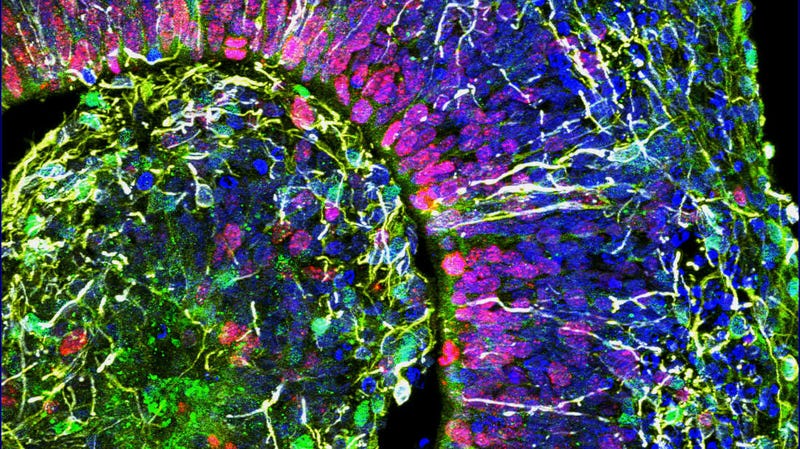
Cross-section of a brain organoid.
Image: Trujillo et al., 2019, Cell Stem Cell
Human brain organoids are proving to be remarkably useful. Made from human stem cells, brain organoids are tiny clumps of neural cells which scientists can use in their research.
To be clear, pea-sized organoids are far too basic to induce traits like consciousness, feelings, or any semblance of awareness, but because they consist of living human brain cells, scientists can use them to study brain development, cognitive disorders, and the way certain diseases affect the brain, among other things. And in fact, during the opening stages of the Zika outbreak, brain organoids were used to study how the virus infiltrates brain cells.
The use of brain organoids in this way is largely uncontroversial, but recent research involving the transplantation of human brain cells into rodent brains is leading to some serious ethical concerns, specifically the claim that scientists are creating part-human animals.
Anders Sandberg, a researcher at the University of Oxford’s Future of Humanity Institute, said scientists are not yet able to generate full-sized brains due to the lack of blood vessels, supporting structure, and other elements required to build a fully functioning brain. But that’s where lab animals can come in handy.
“Making organoids of human brain cells is obviously interesting both for regenerating brain damage and for research,” explained Sandberg, who’s not affiliated with the new paper. “They do gain some structure, even though it is not like a full brain or even part of a brain. One way of getting around the problem of the lack of blood vessels in a petri dish is to implant them in an animal,” he said. “But it’s at this point when people start to get a bit nervous.”
The concern, of course, is that the human neural cells, when transplanted into a nonhuman animal, say a mouse or rat, will somehow endow the creature with human-like traits, such as greater intelligence, more complex emotions, and so on.
The next time you’re hunting for a parking spot, mathematics could help you identify the most efficient strategy, according to a recent paper in the Journal of Statistical Mechanics. It’s basically an optimization problem: weighing different variables and crunching the numbers to find the optimal combination of those factors. In the case of where to put your car, the goal is to strike the optimal balance of parking close to the target—a building entrance, for example—without having to waste too much time circling the lot hunting for the closest space.
Paul Krapivsky of Boston University and Sidney Redner of the Santa Fe Institute decided to build their analysis around an idealized parking lot with a single row (a semi-infinite line), and they focused on three basic parking strategies. A driver who employs a “meek” strategy will take the first available spot, preferring to park as quickly as possible even if there might be open spots closer to the entrance. A driver employing an “optimistic” strategy will go right to the entrance and then backtrack to find the closest possible spot.
Finally, drivers implementing a “prudent” strategy will split the difference. They might not grab the first available spot, figuring there will be at least one more open spot a bit closer to the entrance. If there isn’t, they will backtrack to the space a meek driver would have claimed immediately.
[…]
Based on their model, the scientists concluded that the meek strategy is the least effective of the three, calling it “risibly inefficient” because “many good parking spots are unfilled and most cars are parked far from the target.”
Determining whether the optimistic or prudent strategy was preferable proved trickier, so they introduced a cost variable. They defined it as “the distance from the parking spot to the target plus time wasted looking for a parking spot.” Their model also assumes the speed of the car in the lot is the same as average walking speed.
“On average, the prudent strategy is less costly,” the authors concluded. “Thus, even though the prudent strategy does not allow the driver to take advantage of the presence of many prime parking spots close to the target, the backtracking that must always occur in the optimistic strategy outweighs the benefit.” Plenty of people might indeed decide that walking a bit farther is an acceptable tradeoff to avoid endlessly circling a crowded lot hunting for an elusive closer space. Or maybe they just want to rack up a few extra steps on their FitBit.
The authors acknowledge some caveats to their findings. This is a “minimalist physics-based” model, unlike more complicated models used in transportation studies that incorporate factors like parking costs, time limits, and so forth. And most parking lots are not one-dimensional (a single row). The model used by the authors also assumes that cars enter the lot from the right at a fixed rate, and every car will have time to find a spot before the next car enters—a highly unrealistic scenario where there is no competition between cars for a given space. (Oh, if only…)
A man has been able to move all four of his paralysed limbs with a mind-controlled exoskeleton suit, French researchers report.
Thibault, 30, said taking his first steps in the suit felt like being the “first man on the Moon”.
His movements, particularly walking, are far from perfect and the robo-suit is being used only in the lab.
But researchers say the approach could one day improve patients’ quality of life.
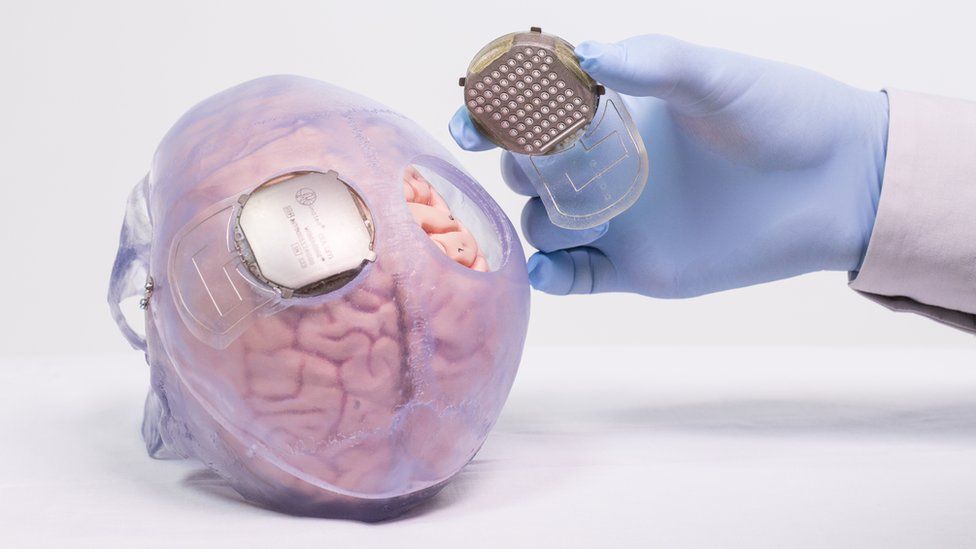
Thibault had surgery to place two implants on the surface of the brain, covering the parts of the brain that control movement
Sixty-four electrodes on each implant read the brain activity and beam the instructions to a nearby computer
Sophisticated computer software reads the brainwaves and turns them into instructions for controlling the exoskeleton
[…]
in 2017, he took part in the exoskeleton trial with Clinatec and the University of Grenoble.
Initially he practised using the brain implants to control a virtual character, or avatar, in a computer game, then he moved on to walking in the suit.
Media captionMind-controlled exoskeleton allows paralysed 30-year-old man to walk in French lab
“It was like [being the] first man on the Moon. I didn’t walk for two years. I forgot what it is to stand, I forgot I was taller than a lot of people in the room,” he said.
It took a lot longer to learn how to control the arms.
“It was very difficult because it is a combination of multiple muscles and movements. This is the most impressive thing I do with the exoskeleton.”
[…]
“This is far from autonomous walking,” Prof Alim-Louis Benabid, the president of the Clinatec executive board, told BBC News.
[…]
In tasks where Thibault had to touch specific targets by using the exoskeleton to move his upper and lower arms and rotate his wrists, he was successful 71% of the time.
Prof Benabid, who developed deep brain stimulation for Parkinson’s disease, told the BBC: “We have solved the problem and shown the principle is correct. This is proof we can extend the mobility of patients in an exoskeleton.
[…]
At the moment they are limited by the amount of data they can read from the brain, send to a computer, interpret and send to the exoskeleton in real-time.
They have 350 milliseconds to go from thought to movement otherwise the system becomes difficult to control.
It means out of the 64 electrodes on each implant, the researchers are using only 32.
So there is still the potential to read the brain in more detail using more powerful computers and AI to interpret the information from the brain.
Scientists have discovered nitrogen- and oxygen- containing organic molecules in ice grains blown out by Saturn’s moon Enceladus, according to a new study.
Gas giants Saturn and Jupiter are orbited by some moons that almost seem more like planets themselves. One such moon is Saturn’s Enceladus, an icy orb thought to contain a very deep subsurface water ocean beneath a thick icy crust. Finding organic molecules on Enceladus is exciting, since water plus energy plus organic molecules might be the ingredients for life.
Enceladus blasted the material out in plumes from cracks in its south polar crust. The plumes carry a mixture of material from the moon’s rocky core and subsurface ocean. The Cassini mission flew through these plumes in 2004 and 2008, gathering data on the material with two of its instruments, the Ion and Neutral Mass Spectrometer (INMS) and the Cosmic Dust Analyser (CDA). For the new study, researchers based in Germany and the United States took a deeper look at the CDA’s data and found new organic compounds, according to the paper published in the Monthly Notices of the Royal Astronomical Society.
The molecules included amines, which are nitrogen- and oxygen-containing organic molecules similar to those on Earth that turn into amino acids. As a reminder, “organic” in this case simply means “containing carbon,” though these are the kind of compounds that can produce the complex molecules found in life on Earth.
[…]
Scientists have previously reported finding large organic molecules in Cassini data. This paper presents a new kind of molecule, one of interest to those hunting for life.
Their initial discovery had seemed like a contradiction because most other polymer fibres embrittle in the cold. But after many years of working on the problem, the group of researchers have discovered that silk’s cryogenic toughness is based on its nano-scale fibrills. Sub-microscopic order and hierarchy allows a silk to withstand temperatures of down to -200 C. And possibly even lower, which would make these classic natural luxury fibres ideal for applications in the depths of chilly outer-space.
The interdisciplinary team examined the behaviour and function of several animal silks cooled down to liquid nitrogen temperature of -196 C. The fibres included spider silks but the study focused on the thicker and much more commercial fibres of the wild silkworm Antheraea pernyi.
In an article published today in Materials Chemistry Frontiers, the team was able to show not only ‘that’ but also ‘how’ silk increases its toughness under conditions where most materials would become very brittle. Indeed, silk seems to contradict the fundamental understanding of polymer science by not losing but gaining quality under really cold conditions by becoming both stronger and more stretchable. This study examines the ‘how’ and explains the ‘why’. It turns out that the underlying processes rely on the many nano-sized fibrils that make up the core of a silk fibre.
[…]
It would appear that this study has far-reaching implications by suggesting a broad spectrum of novel applications for silks ranging from new materials for use in Earth’s polar regions to novel composites for light-weight aeroplanes and kites flying in the strato- and meso-sphere to, perhaps, even giant webs spun by robot spiders to catch astro-junk in space.
Global shipping companies have spent billions rigging vessels with “cheat devices” that circumvent new environmental legislation by dumping pollution into the sea instead of the air, The Independent can reveal.
More than $12bn (£9.7bn) has been spent on the devices, known as open-loop scrubbers, which extract sulphur from the exhaust fumes of ships that run on heavy fuel oil.
This means the vessels meet standards demanded by the International Maritime Organisation (IMO) that kick in on 1 January.
However, the sulphur emitted by the ships is simply re-routed from the exhaust and expelled into the water around the ships, which not only greatly increases the volume of pollutants being pumped into the sea, but also increases carbon dioxide emissions.
The change could have a devastating effect on wildlife in British waters and around the world, experts have warned.
Researchers at Chalmers University of Technology, Sweden, have disproved the prevailing theory of how DNA binds itself. It is not, as is generally believed, hydrogen bonds which bind together the two sides of the DNA structure. Instead, water is the key. The discovery opens doors for new understanding in research in medicine and life sciences. The findings are published in PNAS.
DNA is constructed of two strands consisting of sugar molecules and phosphate groups. Between these two strands are nitrogen bases, the compounds that make up genes, with hydrogen bonds between them. Until now, it was commonly thought that those hydrogen bonds held the two strands together.
But now, researchers from Chalmers University of Technology show that the secret to DNA’s helical structure may be that the molecules have a hydrophobic interior, in an environment consisting mainly of water. The environment is therefore hydrophilic, while the DNA molecules’ nitrogen bases are hydrophobic, pushing away the surrounding water. When hydrophobic units are in a hydrophilic environment, they group together to minimize their exposure to the water.
[…]
e have also shown that DNA behaves totally differently in a hydrophobic environment. This could help us to understand DNA, and how it repairs. Nobody has previously placed DNA in a hydrophobic environment like this and studied how it behaves, so it’s not surprising that nobody has discovered this until now.”
The researchers also studied how DNA behaves in an environment that is more hydrophobic than normal, a method they were the first to experiment with. They used the hydrophobic solution polyethylene glycol, and changed the DNA’s surroundings step-by-step from the naturally hydrophilic environment to a hydrophobic one. They aimed to discover if there is a limit where DNA starts to lose its structure, when the DNA does not have a reason to bind, because the environment is no longer hydrophilic. The researchers observed that when the solution reached the borderline between hydrophilic and hydrophobic, the DNA molecules’ characteristic spiral form started to unravel.
Upon closer inspection, they observed that when the base pairs split from one another (due to external influence, or simply from random movements), holes are formed in the structure, allowing water to leak in. Because DNA wants to keep its interior dry, it presses together, with the base pairs coming together again to squeeze out the water. In a hydrophobic environment, this water is missing, so the holes stay in place.
“Hydrophobic catalysis and a potential biological role of DNA unstacking induced by environment effects” is published in Proceedings of the National Academy of Sciences (PNAS).
There’s been a lot of research into how to give robots and prosthesis wearers a sense of touch, but it has focused largely on the hands. Now, researchers led by ETH Zurich want to restore sensory feedback for leg amputees, too. In a paper published in Nature Medicine today, the team describes how they modified an off-the-shelf prosthetic leg with sensors and electrodes to give wearers a sense of knee movement and feedback from the sole of the foot on the ground. While their initial sample size was small — just two users — the results are promising.
The researchers worked with two patients with above-the-knee, or transfemoral, amputations. They used an Össur prosthetic leg, which comes with a microprocessor and an angle sensor in the knee joint, IEEE Spectrum explains. The team then added an insole with seven sensors to the foot. Those sensors transmit signals in real-time, via Bluetooth to a controller strapped to the user’s ankle. An algorithm in the controller encodes the feedback into neural signals and delivers that to a small implant in the patient’s tibial nerve, at the back of the thigh. The brain can then interpret those signals as feedback from the knee and foot.
The modified prosthetic helped the users walk faster, feel more confident and consume less oxygen — an indication that it was less strenuous than traditional prosthesis. The team also tested activating the tibial nerve implant to relieve phantom limb pain. Both patients saw a significant reduction in pain after a few minutes of electrical stimulation, but they had to be connected to a device in a lab to receive the treatment. With more testing, the researchers hope they might be able to bring these technologies to more amputees and make both available outside of the lab.
A team of researchers from Zhejiang University and Xiamen University has found a way to repair human tooth enamel. In their paper published in the journal Science Advances, the group describes their process and how well it worked when tested.
[…]
the researchers first created extremely tiny (1.5-nanometer diameter) clusters of calcium phosphate, the main ingredient of natural enamel. Each of the tiny clusters was then prepared with the chemical compound triethylamine—doing so prevented the clusters from clumping together. The clusters were then mixed with a gel that was applied to a sample of crystalline hydroxyapatite—a material very similar to human enamel. Testing showed that the clusters fused with the tooth stand-in, and in doing so, created a layer that covered the sample. They further report that the layer was much more tightly arranged than prior teams had achieved with similar work. They claim that such tightness allowed the new material to fuse with the old as a single layer, rather than multiple crystalline areas.
The team then carried out the same type of testing using real human teeth that had been treated with acid to remove the enamel. They report that within 48 hours of application, crystalline layers of approximately 2.7 micrometers had formed on the teeth. Close examination with a microscope showed that the layer had a fish-scale like structure very similar to that of natural enamel. Physical testing showed the enamel to be nearly identical to natural enamel in strength and wear resistance.
The researchers note that more work is required before their technique can be used by dentists—primarily to make sure that it does not have any undesirable side effects.
A new study has revealed an unsettling truth about the citation metrics that are commonly used to gauge scientists’ level of impact and influence in their respective fields of research.
Citation metrics indicate how often a scientist’s research output is formally referenced by colleagues in the footnotes of their own papers – but a comprehensive analysis of this web of linkage shows the system is compromised by a hidden pattern of behaviour that often goes unnoticed.
Specifically, among the 100,000 most cited scientists between 1996 to 2017, there’s a stealthy pocket of researchers who represent “extreme self-citations and ‘citation farms’ (relatively small clusters of authors massively citing each other’s papers),” explain the authors of the new study, led by physician turned meta-researcher John Ioannidis from Stanford University.
[…]
Among the 100,000 most highly cited scientists for the period of 1996 to 2017, over 1,000 researchers self-cited more than 40 percent of their total citations – and over 8,500 researchers had greater than 25 percent self-citations.
There’s no suggestion that any of these self-citations are necessarily or automatically unethical or unwarranted or self-serving in themselves. After all, in some cases, your own published scientific research may be the best and most relevant source to link to.
But the researchers behind the study nonetheless suggest that the prevalence of extreme cases revealed in their analysis debases the value of citation metrics as a whole – which are often used as a proxy of a scientist’s standing and output quality (not to mention employability).
“With very high proportions of self-citations, we would advise against using any citation metrics since extreme rates of self-citation may herald also other spurious features,” the authors write.
“These need to be examined on a case-by-case basis for each author, and simply removing the self-citations may not suffice.”
[…]
“When we link professional advancement and pay attention too strongly to citation-based metrics, we incentivise self-citation,” psychologist Sanjay Srivastava from the University of Oregon, who wasn’t involved in the study, told Nature.
“Ultimately, the solution needs to be to realign professional evaluation with expert peer judgement, not to double down on metrics.”
Robotics engineers at MIT have built a threadlike robot worm that can be magnetically steered to deftly navigate the extremely narrow and winding arterial pathways of the human brain. One day it could be used to quickly clear blockages and clots that contribute to strokes and aneurysms
[…]
Strokes are a leading cause of death and disability in the United States, but relieving blood vessel blockages within the first 90 minutes of treatment has been found to dramatically increase survival rates of patients. The process is a complicated one, however, requiring skilled surgeons to manually guide a thin wire through a patient’s arteries up into a damaged brain vessel followed by a catheter that can deliver treatments or simply retrieve a clot. Not only is there the potential for these wires to damage vessel linings as they inch through the body, but during the process, surgeons are exposed to excess radiation from a fluoroscope which guides them by generating x-ray images in real-time. There’s a lot of room for improvement.
Using their expertise in both water-based biocompatible hydrogels, and the use of magnets to manipulate simple machines, the MIT engineers created a robotic worm featuring a pliable nickel-titanium alloy core with memory shape characteristics so that when bent it returns to its original shape. The core was then coated in a rubbery paste that was embedded with magnetic particles, which was then wrapped in an outer coating of hydrogels allowing the robotic worm to glide through arteries and blood vessels without any friction that could potentially cause damage.
The robot was tested on a small obstacle course featuring a twisting path of small rings guided by a strong magnet that could be operated at enough distance to be placed outside a patient. The engineers also mocked up a life-size replica of a brain’s blood vessels and found that not only could the robot easily navigate that obstacle but that there was also the potential to upgrade it with additional tools like a delivery mechanism for clot reducing drugs. They even successfully replaced the worm’s metal core with an optical cable, so that once it reached its destination, it could deliver powerful laser pulses to help remove a blockage.
The robot would not only make the post-stroke procedure faster and faster, but it would also reduce the exposure to radiation that surgeons often have to endure. And while it was tested using a manually operated magnet to steer it, eventually machines could be built to control the position of the magnet (MRI machines already surround patients in intense magnetic fields) with improved accuracy, which would in turn further improve and accelerate the robot’s journey through a patient’s body.
An Irish teenager just won $50,000 for his project focusing on extracting micros-plastics from water.
Google launched the Google Science Fair in 2011 where students ages 13 through 18 can submit experiments and their results in front of a panel of judges. The winner receives $50,000. The competition is also sponsored by Lego, Virgin Galactic, National Geographic and Scientific American.
Fionn Ferreira, an 18-year-old from West Cork, Ireland won the competition for his methodology to remove microplastics from water.
Microplastics are defined as having a diameter of 5nm or less and are too small for filtering or screening during wastewater treatment. Microplastics are often included in soaps, shower gels, and facial scrubs for their ability to exfoliate the skin. Microplastics can also come off clothing during normal washing.
These microplastics then make their way into waterways and are virtually impossible to remove through filtration. Small fish are known to eat microplastics and as larger fish eat smaller fish these microplastics are concentrated into larger fish species that humans consume.
Ferreira used a combination of oil and magnetite powder to create a ferrofluid in the water containing microplastics. The microplastics combined with the ferrofluid which was then extracted.
After the microplastics bound to the ferrofluid, Ferreira used a magnet to remove the solution and leave only water.
After 1,000 tests, the method was 87% effective in removing microplastics of all sorts from water. The most effective microplastic removed was that from a washing machine with the hardest to remove being polypropylene plastics.
With the confirmation of the methodology, Ferreira hopes to scale the technology to be able to implement at wastewater treatment facilities.
This would prevent the microplastics from ever reaching waterways and the ocean. While reduction in the use of microplastics is the ideal scenario, this methodology presents a new opportunity to screen for microplastics before they are consumed as food by fish.
At 18 Ferreira has an impressive array of accomplishments. He is the curator at the Schull Planetarium, speaks 3 languages fluently, won 12 previous science fair competitions, plays the trumpet in an orchestra and has a minor planet named after him by MIT.
Researchers from the Austrian Academy of Sciences and the University of Vienna have experimentally demonstrated what was previously only a theoretical possibility. Together with quantum physicists from the University of Science and Technology of China, they have succeeded in teleporting complex high-dimensional quantum states. The research teams report this international first in the journal Physical Review Letters.
In their study, the researchers teleported the quantum state of one photon (light particle) to another distant one. Previously, only two-level states (“qubits”) had been transmitted, i.e., information with values “0” or “1”. However, the scientists succeeded in teleporting a three-level state, a so-called “qutrit”. In quantum physics, unlike in classical computer science, “0” and “1” are not an ‘either/or’ – both simultaneously, or anything in between, is also possible. The Austrian-Chinese team has now demonstrated this in practice with a third possibility “2”.
[…]
The quantum state to be teleported is encoded in the possible paths a photon can take. One can picture these paths as three optical fibers. Most interestingly, in quantum physics a single photon can also be located in all three optical fibers at the same time. To teleport this three-dimensional quantum state, the researchers used a new experimental method. The core of quantum teleportation is the so-called Bell measurement. It is based on a multiport beam splitter, which directs photons through several inputs and outputs and connects all optical fibers together. In addition, the scientists used auxiliary photons—these are also sent into the multiple beam splitter and can interfere with the other photons.
Through clever selection of certain interference patterns, the quantum information can be transferred to another photon far from the input photon, without the two ever physically interacting. The experimental concept is not limited to three dimensions, but can in principle be extended to any number of dimensions, as Erhard emphasizes.
Higher information capacities for quantum computers
With this, the international research team has also made an important step towards practical applications such as a future quantum internet, since high-dimensional quantum systems can transport larger amounts of information than qubits. “This result could help to connect quantum computers with information capacities beyond qubits”, says Anton Zeilinger, quantum physicist at the Austrian Academy of Sciences and the University of Vienna, about the innovative potential of the new method.
[…]
In future work, the quantum physicists will focus on how to extend the newly gained knowledge to enable teleportation of the entire quantum state of a single photon or atom.
thanks to the work of Shabir Barzanjeh at the Institute of Science and Technology Austria and a few colleagues. This team has used entangled microwaves to create the world’s first quantum radar. Their device, which can detect objects at a distance using only a few photons, raises the prospect of stealthy radar systems that emit little detectable electromagnetic radiation.
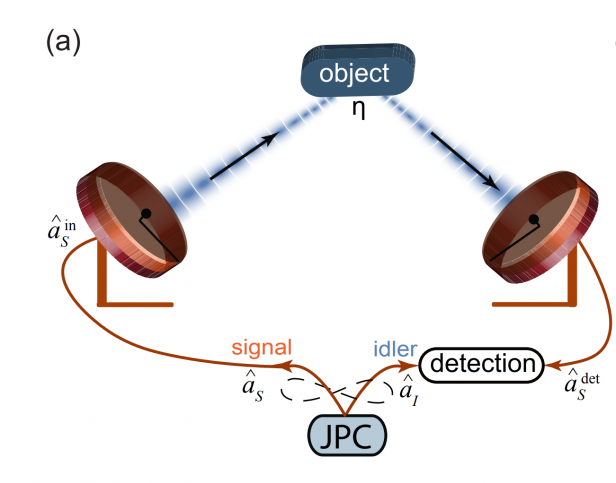
The device is simple in essence. The researchers create pairs of entangled microwave photons using a superconducting device called a Josephson parametric converter. They beam the first photon, called the signal photon, toward the object of interest and listen for the reflection.
In the meantime, they store the second photon, called the idler photon. When the reflection arrives, it interferes with this idler photon, creating a signature that reveals how far the signal photon has traveled. Voila—quantum radar!
This technique has some important advantages over conventional radar. Ordinary radar works in a similar way but fails at low power levels that involve small numbers of microwave photons. That’s because hot objects in the environment emit microwaves of their own.
In a room temperature environment, this amounts to a background of around 1,000 microwave photons at any instant, and these overwhelm the returning echo. This is why radar systems use powerful transmitters.
Entangled photons overcome this problem. The signal and idler photons are so similar that it is easy to filter out the effects of other photons. So it becomes straightforward to detect the signal photon when it returns.
Of course, entanglement is a fragile property of the quantum world, and the process of reflection destroys it. Nevertheless, the correlation between the signal and idler photons is still strong enough to distinguish them from background noise.
[…]
A big advantage is the low levels of electromagnetic radiation required. “Our experiment shows the potential as a non-invasive scanning method for biomedical applications, e.g., for imaging of human tissues or non-destructive rotational spectroscopy of proteins,” say Barzanjeh and co.
Then there is the obvious application as a stealthy radar that is difficult for adversaries to detect over background noise. The researchers say it could be useful for short-range low-power radar for security applications in closed and populated environments.
Kang Lee, a professor of applied psychology and human development at the Ontario Institute for Studies in Education and Canada Research Chair in developmental neuroscience, was the lead author of the study, working alongside researchers from the Faculty of Medicine’s department of physiology, and from Hangzhou Normal University and Zhejiang Normal University in China.
Using a technology co-discovered by Lee and his postdoctoral researcher Paul Zheng called transdermal optical imaging, researchers measured the blood pressure of 1,328 Canadian and Chinese adults by capturing two-minute videos of their faces on an iPhone. Results were compared to standard devices used to measure blood pressure.
The researchers found they were able to measure three types of blood pressure with 95 to 96 per cent accuracy.
[…]
Transdermal optical imaging works by capitalizing on the translucent nature of facial skin. When the light reaches the face, it penetrates the skin and reaches hemoglobin underneath it, which is red. This technology uses the optical sensor on a smartphone to capture the reflected red light from hemoglobin, which allows the technology to visualize and measure blood flow changes under the skin.
“From the video captured by the technology, you can see how the blood flows in different parts of the face and through this ebb and flow of blood in the face, you can get a lot of information,” says Lee.
He understood that the transdermal optical imaging technology had significant practical implications, so, with the help of U of T and MaRS, he formed a startup company called Nuralogix alongside entrepreneur Marzio Pozzuoli, who is now the CEO.
[…]
Nuralogix has developed a smartphone app called Anura that allows people to try out the transdermal optical imaging software for themselves. In the publicly available version of the app, people can record a 30-second video of their face and will receive measurements for stress levels and resting heart rate. In the fall, the company will release a version of the app in China that includes blood pressure measurements.
Lee says there is more research to be done to ensure that health measurements using transdermal optical imaging are as accurate as possible. In the recent study, for example, only people with regular or slightly higher blood pressure were measured. The study sample also did not have people with very dark or very fair skin. More diverse research subjects will make measurements more accurate, says Lee, but there are challenges when looking for people with very high and low blood pressure.
“In order to improve our app to make it usable, particularly for people with hypertension, we need to collect a lot of data from them, which is very, very hard because a lot of them are already taking medicine,” says Lee. “Ethically, we cannot tell them not to take medicine, but from time to time, we get participants who do not take medicine so we can get hypertensive and hypotensive people this way.”
While there are a wide range of applications for transdermal optical imaging technology, Lee says data privacy is of utmost concern. He says when a person uses the software by recording a video of their face, only the results are uploaded to the cloud but the video is not.
“We only extract blood flow information from your face and send that to the cloud. So from the cloud, if I look at your blood flow, I couldn’t tell it is you,” he says.
[…]
The research team also hopes to expand the capabilities of the technology to measure other health markers, including blood-glucose levels, hemoglobin and cholesterol.
Nuralogix plans on monetizing the technology by making an app that allows consumers to pay a low monthly fee to access more detailed health data. They are also licensing the technology through a product called DeepAffex, a cloud-based AI engine that can be used by businesses who are interested in the transdermal optical imaging technology in a range of industries from health care to security.

The majority of YouTube videos about the climate crisis oppose the scientific consensus and “hijack” technical terms to make them appear credible, a new study has found. Researchers have warned that users searching the video site to learn about climate science may be exposed to content that goes against mainstream scientific belief.
Dr Joachim Allgaier of RWTH Aachen University in Germany analysed 200 YouTube videos to see if they adhered to or challenged the scientific consensus. To do so, he chose 10 search terms:
The videos were then assessed to judge how closely they adhered to the scientific consensus, as represented by the findings of reports by UN Intergovernmental Panel on Climate Change (IPCC) from 2013 onwards.
These concluded that humans have been the “dominant cause” of global warming since the 1950s. However, Allgaier found that the message of 120 of the top 200 search results went against this view.
To avoid personalised results, Allgaier used the anonymisation tool Tor, which hides a computer’s IP address and means YouTube treats each search as coming from a different user.
The results for the search terms climate, climate change, climate science and global warming mostly reflected the scientific consensus view. Allgaier said this was because many contained excerpts from TV news programmes or documentaries.
The same could not be said for the results of searches related to chemtrails, climate engineering, climate hacking, climate manipulation, climate modification and geoengineering. Very few of these videos explained the scientific rationale behind their ideas, Allgaier said.
Using a technique to 3D-print liquids, the scientists created millimeter-size droplets from water, oil and iron-oxides. The liquid droplets keep their shape because some of the iron-oxide particles bind with surfactants — substances that reduce the surface tension of a liquid. The surfactants create a film around the liquid water, with some iron-oxide particles creating part of the filmy barrier, and the rest of the particles enclosed inside, Russell said.
The team then placed the millimeter-size droplets near a magnetic coil to magnetize them. But when they took the magnetic coil away, the droplets demonstrated an unseen behavior in liquids — they remained magnetized. (Magnetic liquids called ferrofluids do exist, but these liquids are only magnetized when in the presence of a magnetic field.)
When those droplets approached a magnetic field, the tiny iron-oxide particles all aligned in the same direction. And once they removed the magnetic field, the iron-oxide particles bound to the surfactant in the film were so jam-packed that they couldn’t move and so remained aligned. But those free-floating inside the droplet also remained aligned.
The scientists don’t fully understand how these particles hold onto the field, Russell said. Once they figure that out, there are many potential applications. For example, Russell imagines printing a cylinder with a non-magnetic middle and two magnetic caps. “The two ends would come together like a horseshoe magnet,” and be used as a mini “grabber,” he said.
In an even more bizarre application, imagine a mini liquid person — a smaller-scale version of the liquid T-1000 from the second “Terminator” movie — Russell said. Now imagine that parts of this mini liquid man are magnetized and parts aren’t. An external magnetic field could then force the little person to move its limbs like a marionette.
“For me, it sort of represents a sort of new state of magnetic materials,” Russell said. The findings were published on July 19 in the journal Science.
The scientific consensus that humans are causing global warming is likely to have passed 99%, according to the lead author of the most authoritative study on the subject, and could rise further after separate research that clears up some of the remaining doubts.
Three studies published in Nature and Nature Geoscience use extensive historical data to show there has never been a period in the last 2,000 years when temperature changes have been as fast and extensive as in recent decades.
It had previously been thought that similarly dramatic peaks and troughs might have occurred in the past, including in periods dubbed the Little Ice Age and the Medieval Climate Anomaly. But the three studies use reconstructions based on 700 proxy records of temperature change, such as trees, ice and sediment, from all continents that indicate none of these shifts took place in more than half the globe at any one time.
The Little Ice Age, for example, reached its extreme point in the 15th century in the Pacific Ocean, the 17th century in Europe and the 19th century elsewhere, says one of the studies. This localisation is markedly different from the trend since the late 20th century when records are being broken year after year over almost the entire globe, including this summer’s European heatwave.
[…]
“There is no doubt left – as has been shown extensively in many other studies addressing many different aspects of the climate system using different methods and data sets,” said Stefan Brönnimann, from the University of Bern and the Pages 2K consortium of climate scientists.
Commenting on the study, other scientists said it was an important breakthrough in the “fingerprinting” task of proving how human responsibility has changed the climate in ways not seen in the past.
“This paper should finally stop climate change deniers claiming that the recent observed coherent global warming is part of a natural climate cycle. This paper shows the truly stark difference between regional and localised changes in climate of the past and the truly global effect of anthropogenic greenhouse emissions,” said Mark Maslin, professor of climatology at University College London.
Previous studies have shown near unanimity among climate scientists that human factors – car exhausts, factory chimneys, forest clearance and other sources of greenhouse gases – are responsible for the exceptional level of global warming.
A 2013 study in Environmental Research Letters found 97% of climate scientists agreed with this link in 12,000 academic papers that contained the words “global warming” or “global climate change” from 1991 to 2011. Last week, that paper hit 1m downloads, making it the most accessed paper ever among the 80+ journals published by the Institute of Physics, according to the authors.
Scientists from the University Hospital of Dresden Technical University in Germany bio-printed skin and bone samples upside down to help determine if the method could be used in a low-gravity environment. It worked. ESA released videos of the printing in action.
The skin sample was printed using human blood plasma as a “bio ink.” The researchers added plant and algae-based materials to increase the viscosity so it wouldn’t just fly everywhere in low gravity.
“Producing the bone sample involved printing human stem cells with a similar bio-ink composition, with the addition of a calcium phosphate bone cement as a structure-supporting material, which is subsequently absorbed during the growth phase,” said Nieves Cubo, a bioprinting specialist at the university.
These samples are just the first steps for the ESA’s ambitious 3D bio-printing project, which is investigating what it would take to equip astronauts with medical and surgical facilities to help them survive and treat injuries on long spaceflights and on Mars.
“Carrying enough medical supplies for all possible eventualities would be impossible in the limited space and mass of a spacecraft,” said Tommaso Ghidini, head of ESA’s Structures, Mechanisms and Materials Division. “Instead, a 3D bioprinting capability will let them respond to medical emergencies as they arise.”
“While neuronally encoded behavior isn’t thought to be inherited across generations, we wanted to test the possibility that environmentally triggered modifications could allow ‘memory’ of parental experiences to be inherited,” explains Julianna “Lita” Bozler, a Ph.D. candidate in the Bosco Lab at the Geisel School of Medicine, who served as lead author on the study.
When exposed to parasitoid wasps—which deposit their eggs into and kill the larvae of fruit flies—Drosophila melanogaster females are known to shift their preference to food containing ethanol as an egg laying substrate, which protects their larvae from wasp infection.
For the study, the fruit flies were cohabitated with female wasps for four days before their eggs were collected. The embryos were separated into two cohorts—a wasp-exposed and unexposed (control) group—and developed to maturity without any contact with adult flies or wasps. One group was used to propagate the next generation and the other was analyzed for ethanol preference.
“We found that the original wasp-exposed flies laid about 94 percent of their eggs on ethanol food, and that this behavior persisted in their offspring, even though they’d never had direct interaction with wasps,” says Bozler.
The ethanol preference was less potent in the first-generation offspring, with 73 percent of their eggs laid on ethanol food. “But remarkably, this inherited ethanol preference persisted for five generations, gradually reverting back to a pre-wasp exposed level,” she says. “This tells us that inheritance of ethanol preference is not a permanent germline change, but rather a reversible trait.”
Importantly, the research team determined that one of the critical factors driving ethanol preference behavior is the depression of Neuropeptide-F (NPF) that is imprinted in a specific region of the female fly’s brain. While this change, based in part on visual signals, was required to initiate transgenerational inheritance, both male and female progeny were able to pass on ethanol preference to their offspring.
Indoor levels of carbon dioxide could be clouding our thinking and may even pose a wider danger to human health, researchers say.
While air pollutants such as tiny particles and nitrogen oxides have been the subject of much research, there have been far fewer studies looking into the health impact of CO2.
However, the authors of the latest study – which reviews current evidence on the issue – say there is a growing body of research suggesting levels of CO2 that can be found in bedrooms, classrooms and offices might have harmful effects on the body, including affecting cognitive performance.
“There is enough evidence to be concerned, not enough to be alarmed. But there is no time to waste,” said Dr Michael Hernke, a co-author of the study from the University of Wisconsin-Madison, stressing further research was needed.
Writing in the journal Nature Sustainability, Hernke and colleagues report that they considered 18 studies of the levels of CO2 humans are exposed to, as well as its health impacts on both humans and animals.
Traditionally, the team say, it had been thought that CO2 levels would need to reach a very high concentration of at least 5,000 parts per million (ppm) before they would affect human health. But a growing body of research suggests CO2 levels as low as 1,000ppm could cause health problems, even if exposure only lasts for a few hours.
The team say crowded or poorly ventilated classrooms, office environments and bedrooms have all been found to have levels of CO2 that exceed 1,000ppm, and are spaces that people often remain in for many hours at a time. Air-conditioned trains and planes have also been found to exceed 1,000ppm.
[…]
The team found a number of studies have looked at the impact of such levels on human cognitive performance and productivity. In one study of 24 employees, cognitive scores were 50% lower when the participants were exposed to 1,400ppm of CO2 compared with 550ppm during a working day.
The team additionally looked at the impact of CO2 levels on animals, finding that a few hours’ exposure to 2,000 ppm was linked to inflammatory responses that could lead to damage to blood vessels. There is also tentative evidence suggesting that prolonged exposure to levels between 2,000 and 3,000ppm is linked to effects including stress, kidney calcification and bone demineralisation.
Researchers in a warming Arctic are discovering organisms, frozen and presumed dead for millennia, that can bear life anew. These ice age zombies range from simple bacteria to multicellular animals, and their endurance is prompting scientists to revise their understanding of what it means to survive.
“You wouldn’t assume that anything buried for hundreds of years would be viable,” said La Farge, who researches mosses at the University of Alberta. In 2009, her team was scouring Teardrop’s margin to collect blackened plant matter spit out by the shrinking glacier. Their goal was to document the vegetation that long ago formed the base of the island’s ecosystem.
“The material had always been considered dead. But by seeing green tissue, “I thought, ‘Well, that’s pretty unusual,’ ” La Farge said about the centuries-old moss tufts she found.
She brought dozens of these curious samples back to Edmonton, lavishing them with nutrient-rich soils in a bright, warm laboratory. Almost a third of the samples burst forth with new shoots and leaves. “We were pretty blown away,” La Farge said. The moss showed few ill effects of its multi-centennial deep-freeze.
[,,,]
Tatiana Vishnivetskaya has studied ancient microbes long enough to make the extreme feel routine. A microbiologist at the University of Tennessee, Vishnivetskaya drills deep into the Siberian permafrost to map the web of single-celled organisms that flourished ice ages ago. She has coaxed million-year-old bacteria back to life on a petri dish. They look “very similar to bacteria you can find in cold environments (today),” she said.
But last year, Vishnivetskaya’s team announced an “accidental finding” – one with a brain and nervous system – that shattered scientists’ understanding of extreme endurance.
As usual, the researchers were seeking singled-celled organisms, the only life-forms thought to be viable after millennia locked in the permafrost. They placed the frozen material on petri dishes in their room-temperature lab and noticed something strange. Hulking among the puny bacteria and amoebae were long, segmented worms complete with a head at one end and anus at the other – nematodes.
“Of course we were surprised and very excited,” Vishnivetskaya said. Clocking in at a half-millimeter long, the nematodes that wriggled back to life were the most complex creatures Vishnivetskaya – or anyone else – had ever revived after a lengthy deep freeze.
She estimated one nematode to be 41,000 years old – by far the oldest living animal ever discovered.
Mold spores commonly found aboard the International Space Station (ISS) turn out to be radiation resistant enough to survive 200 times the X-ray dose needed to kill a human being. Based on experiments by a team of researchers led by Marta Cortesão, a microbiologist at the German Aerospace Center (DLR) in Cologne, the new study indicates that sterilizing interplanetary spacecraft may be much more difficult than previously thought.
[…]
The ISS is a collection of sealed cans inhabited by people who spend every minute of the day sweating, touching things, and exhaling moist air. Even with regular cleaning and a life support system designed to keep things under control, the result is a constant battle against mold and bacteria.
[…]
The researchers exposed samples of Aspergillus and Pennicillium spores to X-rays, heavy ions, and high-frequency ultraviolet light of the kinds and intensities found in space. Such radiation damages DNA and breaks down cell structures, but the spores survived X-rays up to 1,000 gray, heavy ions at 500 gray, and UV rays up to 3,000 joules per meter squared.
Gray is a measurement of radiation exposure based on the absorption of one joule of radiation energy per kilogram of matter. To place the results into perspective, five gray will kill a person and 0.7 gray is how much radiation the crew of a Mars mission would receive on a 180-day mission.
Since mold spores can already survive heat, cold, chemicals, and drying out, being able to take on radiation as well poses new challenges. It means that not only will manned missions have to put a lot of effort into keeping the ship clean and healthy, it also means that unmanned planetary missions, which must be free of terrestrial organisms to prevent contaminating other worlds, will be harder to sterilize.
But according to Cortesão there is a positive side to this resiliency. Since fungal spores are hard to kill, they’d be easier to carry along and grow under controlled conditions in space, so they can be used as raw materials or act as biological factories.
“Mold can be used to produce important things, compounds like antibiotics and vitamins, says Cortesão. “It’s not only bad, a human pathogen and a food spoiler, it also can be used to produce antibiotics or other things needed on long missions.”
Since the present study only looked at radiation, orbital experiments are scheduled for later this year that will test their ability to withstand the combination of radiation, vacuum, cold, and low gravity found in space.