Critical Vulnerability in Harbor (container security!) Enables Privilege Escalation from Zero to Admin (CVE-2019-16097)

Aviv Sasson, a security researcher from the cloud division of Unit 42, has identified a critical vulnerability in a widespread cloud native registry called Harbor. The vulnerability allows attackers to take over Harbor registries by sending them a malicious request.

The maintainers of Harbor released a patch that closes this critical security hole. Versions 1.7.6 and 1.8.3 include this fix.

Unit 42 has found 1,300 Harbor registries open to the internet with vulnerable default settings, which are currently at risk until they’re updated.

[…]

Harbor is an open source cloud native registry that stores, signs and scan images for vulnerabilities. Harbor integrates with Docker Hub, Docker Registry, Google Container Registry and other registries. It provides a simple GUI that allows users to download, upload and scan images according to their permissions.

[…]

The vulnerability is in user.go:317.

if err := ua.DecodeJSONReq(&user); err != nil

In this line of code, we take the data from the post request and decode it into a user object.

A normal request payload will look like this:

{“username”:”test”,”email”:”test123@gmai.com”,”realname”:”no name”,”password”:”Password1\u0021″,”comment”:null}

The problem is that we can send a request and add the parameter “has_admin_role”.

If we send the same request with “has_admin_role” = True, then the user that will be created will be an admin. It’s as simple as that.

Exploitation

I wrote a simple Python script that sends a post request to /api/users in order to create a new user with admin privileges, by setting the “has_admin_role” parameter in the request body to True. After running this script, all we need to do is to open Harbor in the browser and just sign in to the user we created.

Source: Critical Vulnerability in Harbor Enables Privilege Escalation from Zero to Admin (CVE-2019-16097)

When were you at Tesco? Let’s have a look. parking app hauled offline after exposing 10s of millions of Automatic Number Plate Recognition images by Ranger Services and NCP

Tesco has shuttered its parking validation web app after The Register uncovered tens of millions of unsecured ANPR images sitting in a Microsoft Azure blob.

The images consisted of photos of cars taken as they entered and left 19 Tesco car parks spread across Britain. Visible and highlighted were the cars’ numberplates, though drivers were not visible in the low-res images seen by The Register.

Used to power the supermarket’s outsourced parkshopreg.co.uk website, the Azure blob had no login or authentication controls. Tesco admitted to The Register that “tens of millions” of timestamped images were stored on it, adding that the images had been left exposed after a data migration exercise.

Ranger Services, which operated the Azure blob and the parkshopreg.co.uk web app, said it had nothing to add and did not answer any questions put to it by The Register. We understand that they are still investigating the extent of the breach. The firm recently merged with rival parking operator CP Plus and renamed itself GroupNexus.

[…]

The Tesco car parks affected by the breach include Braintree, Chelmsford, Chester, Epping, Fareham, Faversham, Gateshead, Hailsham, Hereford, Hove, Hull, Kidderminster, Woolwich, Rotherham, Sale (Cheshire), Slough, Stevenage, Truro, Walsall and Weston-super-Mare.

The web app compared the store-generated code with the ANPR images to decide whom to issue with parking charges. Ranger Services has pulled parkshopreg.co.uk offline, with its homepage now defaulting to a 403 error page.

[…]

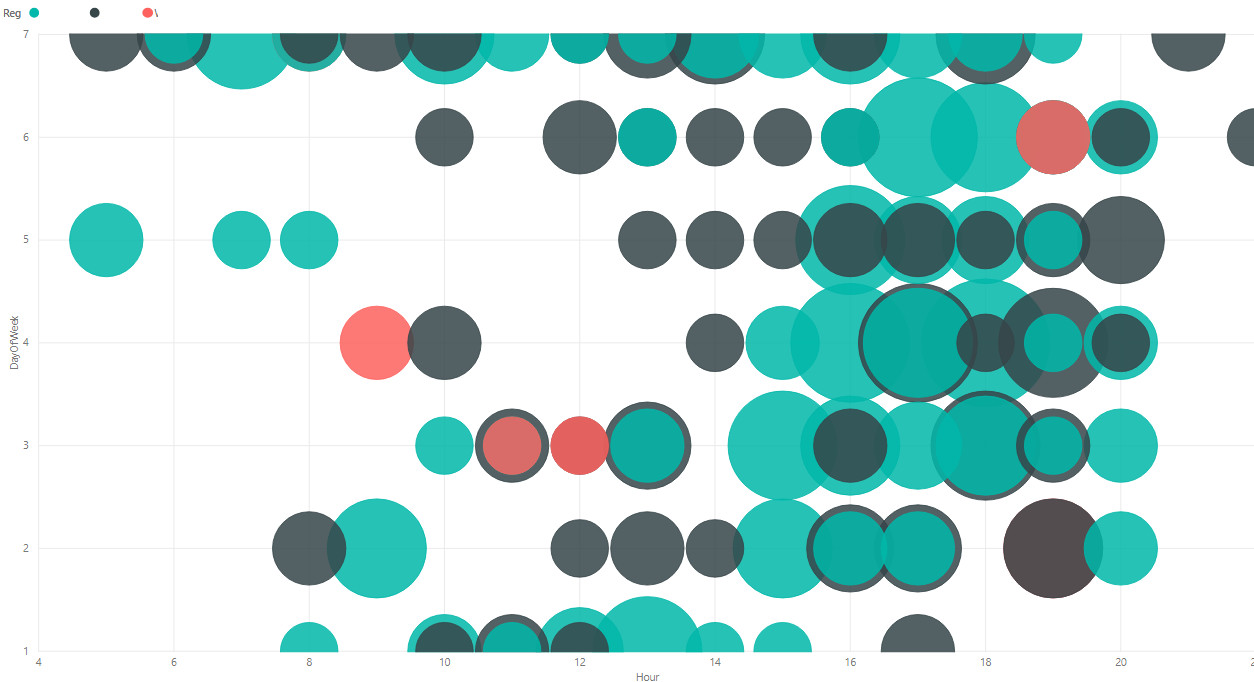
A malicious person could use the data in the images to create graphs showing the most likely times for a vehicle of interest to be parked at one of the affected Tesco shops.

This was what Reg reader Ross was able to do after he realised just how insecure the database behind the parking validation app was.

Frequency of parking for 3 vehicles at Tesco in Faversham

Frequency of parking for three vehicles at Tesco in Faversham. Each colour represents one vehicle; the size of the circle shows how frequently they parked at the given time. Click to embiggen

A Tesco spokesman told The Register: “A technical issue with a parking app meant that for a short period historic images and times of cars entering and exiting our car parks were accessible. Whilst no images of people, nor any sensitive data were available, any security breach is unacceptable and we have now disabled the app as we work with our service provider to ensure it doesn’t happen again.”

We are told that during a planned data migration exercise to an AWS data lake, access to the Azure blob was opened to aid with the process. While it has been shut off, Tesco hasn’t told us how long it was left open for.

Tesco said that because it bought the car park monitoring services in from a third party, the third party was responsible for protecting the data in law. Ranger Services had not responded to The Register’s questions about whether it had informed the Information Commissioner’s Office by the time of writing.

[…]

As part of our investigation into the Tesco breach we also found exposed data in an unsecured AWS bucket belonging to car park operator NCP. The data was powering an online dashboard that could also be accessed without any login creds at all. A few tens of thousands of images were exposed in that bucket.

[…]

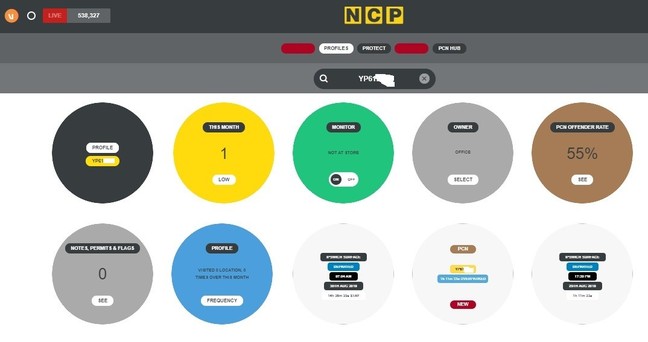
The unsecured NCP Vizuul dashboard

The unsecured NCP Vizuul dashboard

The dashboard, hosted at Vizuul.com, allowed the casual browser to pore through aggregated information drawn from ANPR cameras at an unidentified location. The information on display allowed one to view how many times a particular numberplate had infringed the car park rules, how many times it has been flagged in particular car parks, and how many penalty charge notices had been issued to it in the past.

The dashboard has since been pulled from public view.

Source: Tesco parking app hauled offline after exposing 10s of millions of Automatic Number Plate Recognition images • The Register

Scotiabank slammed for ‘muppet-grade security’ after internal source code and credentials spill onto open internet

Scotiabank leaked online a trove of its internal source code, as well as some of its private login keys to backend systems, The Register can reveal.

Over the past 24 hours, the Canadian financial giant has torn down GitHub repositories, inadvertently left open to the public, that contained this sensitive information, after The Register raised the alarm. These repositories featured, among other things, software blueprints and access keys for a foreign exchange rate system, mobile application code, and login credentials for services and database instances: a potential gold mine of vulnerabilities for criminals and hackers to exploit.

We were tipped off to the security blunder by Jason Coulls, an IT pro based in the Great White North, who discovered the data sitting out in the open, some of which was exposed for months, we’re told. As well as Scotiabank, GitHub, and payment and card processors integrated with the bank, were also alerted prior to publication.

[…]

According to Coulls, this latest gaffe isn’t the first time Scotiabank has spilled its internal secrets online.

“In my experience, this muppet-grade security is perfectly normal for Scotiabank, as they usually leak information once every three weeks on average,” Coulls mused.

“Scotiabank had [IBM] AS/400 and DB2 instances where the credentials and connection information is public. They regularly leak source code for everything, from customer-facing mobile apps to server-side REST APIs. They also leak customer data. If they ever claimed that security is a top priority, I would dread to see how they handle low priority things.”

Source: Scotiabank slammed for ‘muppet-grade security’ after internal source code and credentials spill onto open internet • The Register

Windows 7’s July 2019 Security Patch Includes Telemetry – but you can disable it in task scheduler

To the surprise of Windows watchers, the latest Windows 7 “security-only” update includes telemetry. The telemetry in question is Microsoft’s “Compatibility Appraiser,” which checks PCs for problems that could prevent upgrading to Windows 10.

As Woody Leonhard points out on Computerworld, this is pretty odd on Microsoft’s part—the telemetry code was previously available and is probably installed on your system already if you use Windows 7. But, it was restricted to the normal “cumulative” update rollups. As Ed Bott explains on ZDNet:

What was surprising about this month’s Security-only update, formally titled the “July 9, 2019—KB4507456 (Security-only update),” is that it bundled the Compatibility Appraiser, KB2952664, which is designed to identify issues that could prevent a Windows 7 PC from updating to Windows 10.

It’s hard to say exactly why Microsoft is trying to install the telemetry on all Windows 7 PCs now, but extended support for Windows 7 expires on January 14, 2020. Windows 7 users don’t have much time left before they should upgrade—just six months. Windows 7 is already nagging users about updates. Microsoft may want to understand how many Windows 7 machines are left in the wild and whether they have compatibility problems with new software.

When Ed Bott asked Microsoft why it added the telemetry code to this update, he received a “no comment.” As usual, Microsoft is making itself look bad by refusing to be transparent and explain what it’s doing. The security update doesn’t seem to bundle any code for upgrading to Windows 10.

We still always recommend installing security patches for your PC. After installation, you can stop the telemetry from running, if you like. As abbodi86 advises on the Ask Woody forums:

Disabling (or deleting) these scheduled tasks after installation (before reboot) should be enough to turn off the appraiser

\Microsoft\Windows\Application Experience\ProgramDataUpdater
\Microsoft\Windows\Application Experience\Microsoft Compatibility Appraiser
\Microsoft\Windows\Application Experience\AitAgent

If you don’t want this code running. head to the Task Scheduler and disable these scheduled tasks. If you disable them before a reboot after running the update, they won’t even run once.

Source: Windows 7’s July 2019 Security Patch Includes Telemetry

Report: Massive Fraud Network Uncovered, Targeting Groupon & Online Ticket Vendors

vpnMentor’s research team, led by Noam Rotem and Ran Locar, recently exposed a massive criminal operation that has been defrauding Groupon and other major online ticket vendors at least since 2016.

As part of a larger web mapping research project, we discovered a cache of 17 million emails on an unsecured database. Our initial research suggested the data breach was the result of a vulnerability in a ticket processing platform used by Groupon and other online ticket vendors.

Upon further investigation, however, we began to suspect a wider criminal enterprise might be at play. We’ve worked on many similar database breaches, and certain aspects of this one didn’t add up. After contacting Groupon with our concerns, the full extent of what we’d uncovered was revealed.

The database belonged to a sophisticated criminal network. Since 2016, They have been using a combination of email, credit card, and ticket fraud against Groupon, Ticketmaster, and many other vendors.

Groupon has been trying to shut this operation down ever since it started, but it has proven resilient.

[…]

Finding any information on Neuroticket proved difficult. Considering it seemed a popular piece of software, it didn’t even have a website.

Meanwhile, we began to suspect many of the email addresses on the database were fake. To test this theory, we randomly selected 10 email address and contacted the apparent owners. Only one person replied to us.

[…]

At this point, Groupon’s security team linked this database to a criminal network they had been chasing since 2016.

That year, a criminal operation opened 2 million fraudulent accounts on Groupon. With stolen credit cards, they used the accounts to buy tickets on the site, and then resell them to innocent people online.

Groupon had been able to close most of the accounts, but not all of them. The operation has remained resilient, despite excellent work by the company. Groupon’s Chief Information Security Officer (CISO) estimates the number of fraudulent accounts in the network we helped uncover to be as high as 20,000.

Working together with our research team, Groupon has been able to analyze the data and finally zero in on the entire criminal network.

From the beginning of this process, Groupon’s CISO has been incredibly co-operative, proactive, and professional. However, at some point they stopped replying, and we were left without answers.

Source: Report: Massive Fraud Network Uncovered, Targeting Groupon & Online Ticket Vendors

Weakness in Intel chips DDIO lets researchers steal encrypted SSH keystrokes through side channel attacks

In late 2011, Intel introduced a performance enhancement to its line of server processors that allowed network cards and other peripherals to connect directly to a CPU’s last-level cache, rather than following the standard (and significantly longer) path through the server’s main memory. By avoiding system memory, Intel’s DDIO—short for Data-Direct I/O—increased input/output bandwidth and reduced latency and power consumption.

Now, researchers are warning that, in certain scenarios, attackers can abuse DDIO to obtain keystrokes and possibly other types of sensitive data that flow through the memory of vulnerable servers. The most serious form of attack can take place in data centers and cloud environments that have both DDIO and remote direct memory access enabled to allow servers to exchange data. A server leased by a malicious hacker could abuse the vulnerability to attack other customers. To prove their point, the researchers devised an attack that allows a server to steal keystrokes typed into the protected SSH (or secure shell session) established between another server and an application server.

The researchers have named their attack NetCAT, short for Network Cache ATtack. Their research is prompting an advisory for Intel that effectively recommends turning off either DDIO or RDMA in untrusted networks. The researchers say future attacks may be able to steal other types of data, possibly even when RDMA isn’t enabled. They are also advising hardware makers do a better job of securing microarchitectural enhancements before putting them into billions of real-world servers.

“While NetCAT is powerful even with only minimal assumptions, we believe that we have merely scratched the surface of possibilities for network-based cache attacks, and we expect similar attacks based on NetCAT in the future,” the researchers, from the Vrije Universiteit Amsterdam and ETH Zurich, wrote in a paper published on Tuesday. “We hope that our efforts caution processor vendors against exposing microarchitectural elements to peripherals without a thorough security design to prevent abuse.”

Source: Weakness in Intel chips lets researchers steal encrypted SSH keystrokes | Ars Technica

D-Link, Comba network gear leave passwords open for potentially whole world to see

DSL modems and Wi-Fi routers from D-Link and Comba have been found to be leaving owners’ passwords out in the open.

Simon Kenin, a security researcher with Trustwave SpiderLabs, took credit for the discovery of five bugs that leave user credentials accessible to attackers.

For D-Link gear, two bugs were discovered in the firmware for the DSL-2875AL and DSL-2877AL wireless ADSL modem/router. The first bug describes a configuration file in the DSL-2875AL that contains the user password, and does not require any authentication to view: you just have to be able to reach the web-based admin console, either on the local network or across the internet, depending the device’s configuration.

“This file is available to anyone with access to the web-based management IP address and does not require any authentication,” Trustwave’s Karl Sigler said on Tuesday. “The path to the file is https://[router ip address]/romfile.cfg and the password is stored in clear text there.”

The second flaw is present in both the 2857AL and 2877AL models. It is less a “flaw” than a glaring security oversight: the source code for the router log-in page (again, accessible to anyone that can reach its built-in web UI server) contains the ISP username and password of the user in plain text. This can be pulled up simply by choosing the “view source” option in a browser window.

Fixes have been released for both models. Those with the 2877AL modem will want to get Firmware 1.00.20AU 20180327, while owners of the 2875AL should update to at least version 1.00.08AU 20161011.

The Register tried to get in touch with D-Link for comment on the matter, but was unable to get a response. Trustwave didn’t fare much better, saying that the bugs were only listed as patched after the researchers told D-Link they were going public with the findings, after waiting months for the router biz to get its act together.

Source: D-Link, Comba network gear leave passwords open for potentially whole world to see • The Register

Cheap GPS kiddie trackers have default password 123456 and send all information unencrypted

GPS trackers are designed to bring you greater peace of mind by helping you to locate your kids, your pets, and even your car. They can help keep the elderly or disabled safe by providing them with a simple SOS button to call for immediate help. Many devices are marketed for these purposes on common sites like Amazon and eBay and can be purchased for $25-$50 USD, making them more financially attractive than using a smartphone for some of the same capabilities.

[…]

As the instructions state, there is a web portal and a mobile application that you can use to manage the tracker. We took the path of least resistance and first opened a web application which is reachable at http://en.i365gps.com.

[…]

As you can see the first red flag is that the login form is served over HTTP protocol, not over the more secure HTTPS. Moreover, you have two options to connect to the cloud: by using an account with username and password or using ID and password. Which one to pick? We turned to the leaflet for answers. It says:

Figure 5: Default password

This applies both for Android application as well as for web application. What is also an alarming fact is that last sentence: “…user needs to contact reseller to register a username if need to login by username.” Since you have to call the reseller to request a username, it’s fairly clear you are intended to use the ID, the password for which is “123456.” Not a good start.

[…]

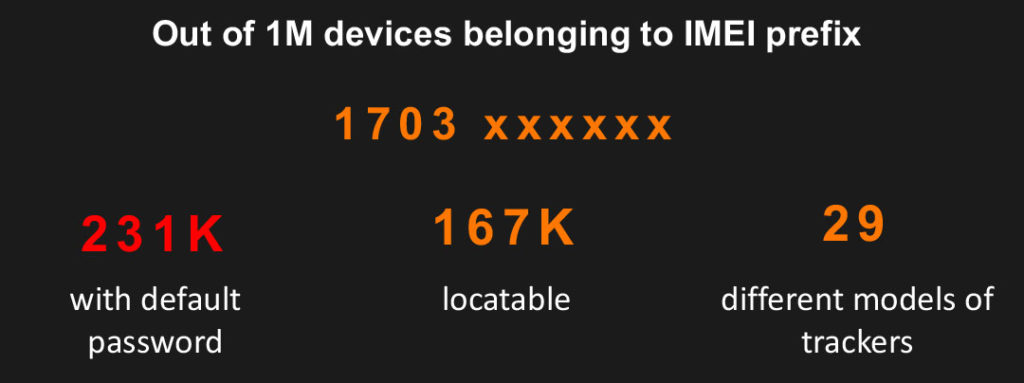
Ok so let’s get back to the IMEI/ID that in combination with default password serves as the credentials for your account. Remember how easy it was to scan through that 1M of possible IMEI numbers as they have the same prefix? So we scanned an arbitrary 4M sequential serial numbers ourselves just to get an idea of the scale of the devices out there and we learned that at least six hundred thousand devices are live in the wild with default passwords. We executed a deeper scan of a subset of one million of these devices to determine make, model, and location; of the one million, we scanned, over 167,000 were locatable.

Figure 29: a result of a detailed scan of 1M serial numbers for tracker devices
Figure 30: last GPS position of trackers

Now it’s obvious that the same infrastructure is used for all or at least most of the trackers from this vendor as we identified 29 different models of trackers during this scan of 1M IMEIs. All the models are sold by wholesaler Shenzen i365, and we were able to determine that some models in this scan are being sold under different product names, which leads us to the conclusion that infrastructure and devices are being white labelled and sold under different brand names. In many instances, however, we were only able to determine a generic model number.

Number of trackers Tracker model
60601 T58
36658 A9
26654 T8S
20778 T28
20640 TQ
11480 A16
10263 A6
9121 3G
7452 A18
5092 A21
4083 T28A
3626 A12
2921 A19
2839 A20
2638 A20S
2610 S1
1664 P1
749 FA23
607 A107
280 RomboGPS
79 PM01
55 A21P
26 PM02
16 A16X
15 PM03
4 WA3
4 P1-S
3 S6
1 S9

Figure 31: trackers models and their counts in 1M detailed sample scan

Figure 32: affected models

You are probably already feeling like there is a lot more to this story than meets the eye as we found devices that are not produced by this particular company during this scan. It turns out that this problem is much bigger than it looks. How big? We’ll show you in the follow-up to this which goes deeper into the relationships between different products and companies and into many surprising facts about cloud infrastructure. We found more alarming vulnerabilities and much more instances of this cloud and trackers.

But so far we think we are speaking of approximately 50 different applications sharing the same platform (and probably also the same vulnerabilities) as seen in this picture:

Figure 33: the research continues, see you in part 2 where we uncover more about platform/cloud

Source: The secret life of GPS trackers (1/2) – Avast Threat Labs

Tesla Malfunction Locks Out Owners Who Depended on App for Entry, Forces Them to Scramble for ‘Keys’

Some Tesla users who rely on the app to gain entry to their Model 3 were temporarily unable to get into their electric cars on Labor Day.

The Next Web reported that a number of people tweeted out their frustrations on Monday when they were “locked out” of their car due to phone app issues. Downdetector, a tracker for users to report technical difficulties with web-based services, also showed that many users were having trouble with Tesla’s app.

A Tesla spokesperson confirmed to Gizmodo that Tesla’s app was temporarily unavailable on Monday but full functionality was soon restored. Tweets suggest the app was down for around three hours at least.

Source: Tesla Malfunction Locks Out Owners Who Depended on App for Entry, Forces Them to Scramble for ‘Keys’

Well done, Elon Musk!

Hundreds of Millions of Facebook Users Phone Numbers Exposed

Facebook is staring down yet another security blunder, this time with an incident involving an exposed server containing hundreds of millions of phone numbers that were previously associated with accounts on its platform.

The situation appears to be pinned to a feature no longer enabled on the platform but allowed users to search for someone based on their phone number. TechCrunch’s Zack Whittaker first reported Wednesday that a server—which did not belong to Facebook but was evidently not password protected and therefore accessible to anyone who could find it—was discovered online by security researcher Sanyam Jain and found to contain records on more than 419 million Facebook users, including 133 records on users based in the U.S.

(A Facebook spokesperson disputed the 419 million figure in a call with Gizmodo, claiming the server contained “closer to half” of that number, but declined to provide a specific figure.)

According to TechCrunch, records contained on the server included a Facebook user’s phone number and individual Facebook ID. Using both, TechCrunch said it was able to cross-check them to verify records and additionally found that in some cases, records included a user’s country, name, and gender. The report stated that it’s unclear who scraped the data from Facebook or why. The Facebook spokesperson said that the company became aware of the situation a few days ago but would not specify an exact date.

Whittaker noted that having access to a user’s phone number could allow a bad actor to force-reset accounts linked to that number, and could further expose them to intrusions like spam calls or other abuse. But it could also allow a bad actor to pull up a host of private information on a person by inputting it into any number of public databases or with some legwork or by impersonation grant a hacker access to apps or even a bank account.

Source: Hundreds of Millions of Facebook Users Phone Numbers Exposed

Don’t fly with your Explody MacBook!

Following an Apple notice that a “limited number” of 15-inch MacBook Pros may have faulty batteries that could potentially create a fire safety risk, multiple airlines have barred transporting Apple laptops in their checked luggage—in some cases, regardless of whether they fall under the recall.

Bloomberg reported Wednesday that Qantas Airways and Virgin Australia had joined the growing list of airlines enforcing policies around the MacBook Pros. In a statement by email, a spokesperson for Qantas told Gizmodo that “[u]ntil further notice, all 15 inch Apple MacBook Pros must be carried in cabin baggage and switched off for flight following a recall notice issued by Apple.”

Virgin Australia, meanwhile, said in a “Dangerous Goods” notice on its website that any MacBook model “must be placed in carry-on baggage only. No Apple MacBooks are permitted in checked in baggage until further notice.”

Apple in June announced a voluntary recall program for the affected models of 15-inch Retina display MacBook Pro, which it said were sold between September 2015 and February 2017. Apple said at the time it would fix affected models for free, adding that “[c]ustomer safety is always Apple’s top priority.”

Apple did not immediately return a request for comment about airline policies implemented in response to the recall.

Both Singapore Airlines and Thai Airways also recently instituted policies around the MacBook Pros. In a statement on its website over the weekend, Singapore Airlines said that passengers are prohibited from bringing affected models on its aircraft either in their carry-ons or in their checked luggage “until the battery has been verified as safe or replaced by the manufacturer.”

Bloomberg previously reported that airlines TUI Group Airlines, Thomas Cook Airlines, Air Italy, and Air Transat also introduced bans on the laptops. The cargo activity of all four is managed by Total Cargo Expertise, which reportedly said in an internal notice to its staff that the affected devices are “prohibited on board any of our mandate carriers.”

Both the Federal Aviation Administration and European Union Aviation Safety Agency said they had contacted airlines following Apple’s announcement regarding the recall. The FAA said that it alerted U.S. carriers to the issue in July.

Apple allows MacBook users to see if their devices are affected by inputting a serial number. While checking individual serial numbers for each and every device that comes through security checkpoints has the potential to slow service, banning all MacBooks either outright or in the cabin seems like a severe overreaction and, to be honest, a gigantic pain in the ass for customers.

Source: Airlines Are Banning MacBooks From Checked Luggage

I’d say removing macbooks from check in luggage and then looking if the serials are OK or not will take a stupid amount of time. Banning them from check in luggage makes perfect sense.

Lenovo Solution Centre can turn users into Admins – Lenovo changes end of life for LSC until before the last release in response.

Not only has a vulnerability been found in Lenovo Solution Centre (LSC), but the laptop maker fiddled with end-of-life dates to make it seem less important – and is now telling the world it EOL’d the vulnerable monitoring software before its final version was released.

The LSC privilege-escalation vuln (CVE-2019-6177) was found by Pen Test Partners (PTP), which said it has existed in the code since it first began shipping in 2011. It was bundled with the vast majority of the Chinese manufacturer’s laptops and other devices, and requires Windows to run. If you removed the app, or blew it away with a Linux install, say, you’re safe right now.

[…]

he solution? Uninstall Lenovo Solution Centre, and if you’re really keen you can install Lenovo Vantage and/or Lenovo Diagnostics to retain the same branded functionality, albeit without the priv-esc part.

All straightforward. However, it went a bit awry when PTP reported the vuln to Lenovo. “We noticed they had changed the end-of-life date to make it look like it went end of life even before the last version was released,” they told us.

Screenshots of the end-of-life dates – initially 30 November 2018, and then suddenly April 2018 after the bug was disclosed – can be seen on the PTP blog. The last official release of the software is dated October 2018, so Lenovo appears to have moved the EOL date back to April of that year for some reason.

Source: Security gone in 600 seconds: Make-me-admin hole found in Lenovo Windows laptop crapware. Delete it now • The Register

London Transport asked people to write down their Oyster passwords – but don’t worry

London-dwelling Alfie Fresta wanted a National Rail travelcard discount added to his London Oyster card so the discount would work automatically with his pay-as-you-go smartcard.

He was startled when London Overground staff at New Cross Gate station handed him a paper form with a box on it asking for his online Oyster account password.

“I was in utter disbelief,” Fresta told El Reg, having just read about Oyster online accounts being breached by credential-stuffing crooks. “Having worked on a number of web apps, I know storing passwords in clear text is, for lack of a better word, a ginormous no-no.”

Oyster plain text password form from Arriva Rail London, which operates London Overground

The Arriva Rail London form handed to Fresta. ARL is the outsourced operator for TfL’s London Overground services. Click to enlarge

Just to check that this wasn’t a local misunderstanding by station staff, Fresta checked it out at other stations – and was again asked to write down his password in plain text for staff to read.

TfL did not deny that this is its standard procedure for staff adding discounts to Oyster cards, but insisted in a statement to The Register that it doesn’t store those passwords and lets customers take the completed form away afterwards.

A spokeswoman told us: “Customers can add discounts to their Oyster cards at all station ticket machines and our staff are on hand to support them with this process. If a customer prefers to do this via a ticket office rather than a machine, then a password is temporarily provided to the ticket office staff via a form.

“The password is always entered in the presence of the customer and the form is returned to them to ensure it can be disposed of securely. Customers are advised to change the password on first login, if setting up an online Oyster account. We recognise that where possible this process could be improved and work is under way to identify options.”

Fresta was not impressed with TfL’s customer service, telling us he wasn’t given “any explanation as to how the information [would] be handled or why”.

Source: Yes, TfL asked people to write down their Oyster passwords – but don’t worry, they didn’t inhale • The Register

That’s insane!

Here’s a top tip: Don’t trust the new guy – block web domains less than a month old. They are bound to be dodgy

IT admins could go a long way towards protecting their users from malware and other dodgy stuff on the internet if they ban access to any web domain less than a month old.

This advice comes from Unit 42, the security branch of networking house Palo Alto Networks. To be exact, the recommendation is that any domain created in the past 32 days ought to be blocked. This comes after the gang studied newly-registered domains – NRDs for short – and found that more than 70 per cent fell under the classification of “suspicious,” “not safe for work,” or “malicious.”

“While this may be deemed a bit aggressive by some due to potential false-positives, the risk from threats via NRDs is much greater,” noted Unit 42’s Zhanhao Chen, Jun Javier Wang, and Kelvin Kwan. “At the bare minimum, if access to NRDs are allowed, then alerts should be set up for additional visibility.”

According to Unit 42’s study of new domains created on 1,530 different top level domains (TLDs) from March to May of this year, just 8.4 per cent of NRDs could be confirmed as hosting only benign pages. 2.32 per cent were confirmed not safe for work, while 1.27 per cent of the domains were classified as malicious, meaning they were found to host malware, phishing, or botnet, command and control tools.

The solid majority of the domains, 69.73 per cent to be exact, fell under the label of “suspicious,” meaning the domains appear to have been parked, had insufficient content to be verified as legit, or were considered “questionable,” or “high risk,” but not flat-out malicious. 18.2 per cent were classified as just “other,” rather unhelpfully.

In other words, just under three quarters of new domains are used for sites that vary from completely empty, to shady at best, to verified as attack sites.

Source: Here’s a top tip: Don’t trust the new guy – block web domains less than a month old. They are bound to be dodgy • The Register

Moscow’s blockchain voting system cracked a month before election, will be fixed due to responsible disclosure, open source and bug bounties

A French security researcher has found a critical vulnerability in the blockchain-based voting system Russian officials plan to use next month for the 2019 Moscow City Duma election.

Pierrick Gaudry, an academic at Lorraine University and a researcher for INRIA, the French research institute for digital sciences, found that he could compute the voting system’s private keys based on its public keys. This private keys are used together with the public keys to encrypt user votes cast in the election.

Gaudry blamed the issue on Russian officials using a variant of the ElGamal encryption scheme that used encryption key sizes that were too small to be secure. This meant that modern computers could break the encryption scheme within minutes.

“It can be broken in about 20 minutes using a standard personal computer, and using only free software that is publicly available,” Gaudry said in a report published earlier this month.

“Once these [private keys] are known, any encrypted data can be decrypted as quickly as they are created,” he added.

What an attacker can do with these encryption keys is currently unknown, since the voting system’s protocols weren’t yet available in English, so Gaudry couldn’t investigate further.

“Without having read the protocol, it is hard to tell precisely the consequences, because, although we believe that this weak encryption scheme is used to encrypt the ballots, it is unclear how easy it is for an attacker to have the correspondence between the ballots and the voters,” the French researcher said.

“In the worst case scenario, the votes of all the voters using this system would be revealed to anyone as soon as they cast their vote.”

[…]

The French academic was able to test Moscow’s upcoming blockchain-based voting system because officials published its source code on GitHub in July, and asked security researchers to take their best shots.

Following Gaudry’s discovery, the Moscow Department of Information Technology promised to fix the reported issue — the use of a weak private key.

“We absolutely agree that 256×3 private key length is not secure enough,” a spokesperson said in an online response. “This implementation was used only in a trial period. In few days the key’s length will be changed to 1024.”

[…]

However, a public key of a length of 1024 bits may not be enough, according to Gaudry, who believes officials should use one of at least 2048 bits instead.

[…]

There is a good side to this,” he added. “The fact that Moscow allowed others to look at the code, research it and then help them secure it.”

Furthermore, Moscow officials also approved a monetary reward for Gaudry, who according to Russian news site Meduza, stands to make one million Russian ruble, which is just over $15,000.

According to a previous report from July, Gaudry’s reward is near the top prize the Moscow local government promised bug hunters when it put the code on GitHub, which was 1.5 million Russian ruble ($22,500).

“The US system COULD learn a lot from Mother Russia on this one,” Roberts said, referring to the plethora of growing pains the US has been going through recently while trying to secure its electronic voting machines.

These growing pains mostly come from voting machine vendors, who are refusing to engage with the cyber-security community, something the Moscow government had no problem doing.

This closed-source nature around electronic voting machines and election systems used in the US is the reason why Microsoft recently announced plans to open-source on GitHub a new technology for securing electronic voting machines.

Source: Moscow’s blockchain voting system cracked a month before election | ZDNet

Bug-hunter finds local privilege escalation in Steam. Valve refuses to acknowledge and so he’s dropped it on the internet.

The way Kravets tells is (Valve did not respond to a request for comment), the whole saga started earlier this month when he went to report a separate elevation of privilege flaw in Steam Client, the software gamers use to purchase and run games from the games service.

Valve declined to recognize and pay out for the bug, which they said required local access and the ability to drop files on the target machine in order to run and was therefore not really a vulnerability.

“I received a lot of feedback. But Valve didn’t say a single word, HackerOne sent a huge letter and, mostly, kept silence,” Kravets wrote. “Eventually things escalated with Valve and I got banned by them on HackerOne — I can no longer participate in their vulnerability rejection program (the rest of H1 is still available though).”

Now, some two weeks later, Kravets has discovered and disclosed a second elevation of privilege flaw. Like the first, this vulnerability this flaw (a DLL loading vulnerability) would require the attacker to have access to the target’s machine and the ability to write files locally.

Source: Disgruntled bug-hunter drops Steam zero-day to get back at Valve for refusing him a bounty • The Register

The Register then says something pretty stupid:

While neither flaw would be considered a ‘critical’ risk as they each require the attacker to already have access to the target machine (if that’s the case you’re already in serious trouble, so what’s another flaw)

It’s an escalation flaw, which means that as a normal user you can run things administrators are only supposed to run. That’s a problem.

Cut off your fingers: Data Breach in Biometric Security Platform Affecting Millions of Users over thousands of countries – yes unencrypted and yes, editable

Led by internet privacy researchers Noam Rotem and Ran Locar, vpnMentor’s team recently discovered a huge data breach in security platform BioStar 2.  

BioStar 2 is a web-based biometric security smart lock platform. A centralized application, it allows admins to control access to secure areas of facilities, manage user permissions, integrate with 3rd party security apps, and record activity logs.

As part of the biometric software, BioStar 2 uses facial recognition and fingerprinting technology to identify users.

The app is built by Suprema, one of the world’s top 50 security manufacturers, with the highest market share in biometric access control in the EMEA region. Suprema recently partnered with Nedap to integrate BioStar 2 into their AEOS access control system.

AEOS is used by over 5,700 organizations in 83 countries, including some of the biggest multinational businesses, many small local businesses, governments, banks, and even the UK Metropolitan Police.

The data leaked in the breach is of a highly sensitive nature. It includes detailed personal information of employees and unencrypted usernames and passwords, giving hackers access to user accounts and permissions at facilities using BioStar 2. Malicious agents could use this to hack into secure facilities and manipulate their security protocols for criminal activities. 

This is a huge leak that endangers both the businesses and organizations involved, as well as their employees. Our team was able to access over 1 million fingerprint records, as well as facial recognition information. Combined with the personal details, usernames, and passwords, the potential for criminal activity and fraud is massive. 

Once stolen, fingerprint and facial recognition information cannot be retrieved. An individual will potentially be affected for the rest of their lives.

[…]

Our team was able to access over 27.8 million records, a total of 23 gigabytes of data, which included the following information:

  • Access to client admin panels, dashboards, back end controls, and permissions
  • Fingerprint data
  • Facial recognition information and images of users
  • Unencrypted usernames, passwords, and user IDs
  • Records of entry and exit to secure areas
  • Employee records including start dates
  • Employee security levels and clearances
  • Personal details, including employee home address and emails
  • Businesses’ employee structures and hierarchies
  • Mobile device and OS information

[…]

With this leak, criminal hackers have complete access to admin accounts on BioStar 2. They can use this to take over a high-level account with complete user permissions and security clearances, and make changes to the security settings in an entire network. 

Not only can they change user permissions and lock people out of certain areas, but they can also create new user accounts – complete with facial recognition and fingerprints – to give themselves access to secure areas within a building or facility.

Furthermore, hackers can change the fingerprints of existing accounts to their own and hijack a user account to access restricted areas undetected. Hackers and other criminals could potentially create libraries of fingerprints to be used any time they want to enter somewhere without being detected.

This provides a hacker and their team open access to all restricted areas protected with BioStar 2. They also have access to activity logs, so they can delete or alter the data to hide their activities.

As a result, a hacked building’s entire security infrastructure becomes useless. Anybody with this data will have free movement to go anywhere they choose, undetected.

Source: Report: Data Breach in Biometric Security Platform Affecting Millions of Users

And there’s why biometrics are a poor choice in identification – you can’t change your fingertips, but you can edit the records. Using this data it should be fairly easy to print out fingerprints, if you can’t feel bothered to edit the database either.

Researchers Bypass Apple FaceID Using glasses to fool liveness detection

Researchers on Wednesday during Black Hat USA 2019 demonstrated an attack that allowed them to bypass a victim’s FaceID and log into their phone simply by putting a pair of modified glasses on their face. By merely placing tape carefully over the lenses of a pair glasses and placing them on the victim’s face the researchers demonstrated how they could bypass Apple’s FaceID in a specific scenario. The attack itself is difficult, given the bad actor would need to figure out how to put the glasses on an unconscious victim without waking them up.

To launch the attack, researchers with Tencent tapped into a feature behind biometrics called “liveness” detection, which is part of the biometric authentication process that sifts through “real” versus “fake” features on people.

[…]

Researchers specifically honed in on how liveness detection scans a user’s eyes. They discovered that the abstraction of the eye for liveness detection renders a black area (the eye) with a white point on it (the iris). And, they discovered that if a user is wearing glasses, the way that liveness detection scans the eyes changes.

“After our research we found weak points in FaceID… it allows users to unlock while wearing glasses… if you are wearing glasses, it won’t extract 3D information from the eye area when it recognizes the glasses.”

Putting these two factors together, researchers created a prototype of glasses – dubbed “X-glasses” – with black tape on the lenses, and white tape inside the black tape. Using this trick they were then able to unlock a victim’s mobile phone and then transfer his money through mobile payment App by placing the tape-attached glasses above the sleeping victim’s face to bypass the attention detection mechanism of both FaceID and other similar technologies.

The attack comes with obvious drawbacks – the victim must be unconscious, for one, and can’t wake up when the glasses are placed on their face.

Source: Researchers Bypass Apple FaceID Using Biometrics ‘Achilles Heel’ | Threatpost

A reminder why Open Source is so important: Someone audited Kubernetes

The Cloud Native Computing Foundation (CNCF) today released a security audit of Kubernetes, the widely used container orchestration software, and the findings are about what you’d expect for a project with about two million lines of code: there are plenty of flaws that need to be addressed.

The CNCF engaged two security firms, Trail of Bits and Atredis Partners, to poke around Kubernetes code over the course of four months. The companies looked at Kubernetes components involved in networking, cryptography, authentication, authorization, secrets management, and multi-tenancy.

Having identified 34 vulnerabilities – 4 high severity, 15 medium severity, 8 low severity and 7 informational severity – the Trail of Bits report advises project developers to rely more on standard libraries, to avoid custom parsers and specialized configuration systems, to choose “sane defaults,” and to ensure correct filesystem and kernel interactions prior to performing operations.

“The assessment team found configuration and deployment of Kubernetes to be non-trivial, with certain components having confusing default settings, missing operational controls, and implicitly designed security controls,” the Trail of Bits report revealed. “Also, the state of the Kubernetes codebase has significant room for improvement.”

Underscoring these findings, Kubernetes 1.13.9, 1.14.5, and 1.15.2 were released on Monday to fix two security issues in the software, CVE-2019-11247 and CVE-2019-11249. The former could allow a user in one namespace to access a resource scoped to a cluster. The latter could allow a malicious container to create or replace a file on the client computer when the client employs the kubectl cp command.

As noted by the CNCF, the security auditors found: policy application inconsistencies, which prompt a false sense of security; insecure TLS used by default; environmental variables and command-line arguments that reveal credentials; secrets leaked in logs; no support for certificate revocation, and seccomp (a system-call filtering mechanism in the Linux kernel) not activated by default.

The findings include advice to cluster admins, such as not using both Role-Based Access Controls and Attribute-Based Access Controls because of the potential for inadvertent permission grants if one of these fails.

They also include various recommendations and best practices for developers to follow as they continue making contributions to Kubernetes.

For example, one recommendation is to avoid hardcoding file paths to dependencies. The report points to Kubernetes’ kublet process, “where a dependency on hardcoded paths for PID files led to a race condition which could allow an attacker to escalate privileges.”

The report also advises enforcing minimum files permissions, monitoring processes on Linux, and various other steps to make Kubernetes more secure.

In an email to The Register, Chris Aniszczyk, CTO and COO of CNCF, expressed satisfaction with the audit process. “We view it positively that the whole process of doing a security audit was handled transparently by the members of the Kubernetes Security Audit WG, from selecting a vendor to working with the upstream project,” he said. “I don’t know of any other open source organization that has shared and open sourced the whole process around a security audit and the results. Transparency builds trust in open source communities, especially around security.”

Asked how he’d characterize the risks present in Kubernetes at the moment, Aniszczyk said, “The Kubernetes developers responded quickly and created appropriate CVEs for critical issues. In the end, we would rather have the report speak for itself in terms of the findings and recommendations.”

Source: Captain, we’ve detected a disturbance in space-time. It’s coming from Earth. Someone audited the Kubernetes source • The Register

Why is this good? Because these holes will be fixed instead of exploited.

Democratic Senate campaign group exposed 6.2 million Americans’ emails

Data breach researchers at security firm UpGuard found the data in late July, and traced the storage bucket back to a former staffer at the Democratic Senatorial Campaign Committee, an organization that seeks grassroots donations and contributions to help elect Democratic candidates to the U.S. Senate.

Following the discovery, UpGuard researchers reached out to the DSCC and the storage bucket was secured within a few hours. The researchers shared their findings exclusively with TechCrunch and published their findings.

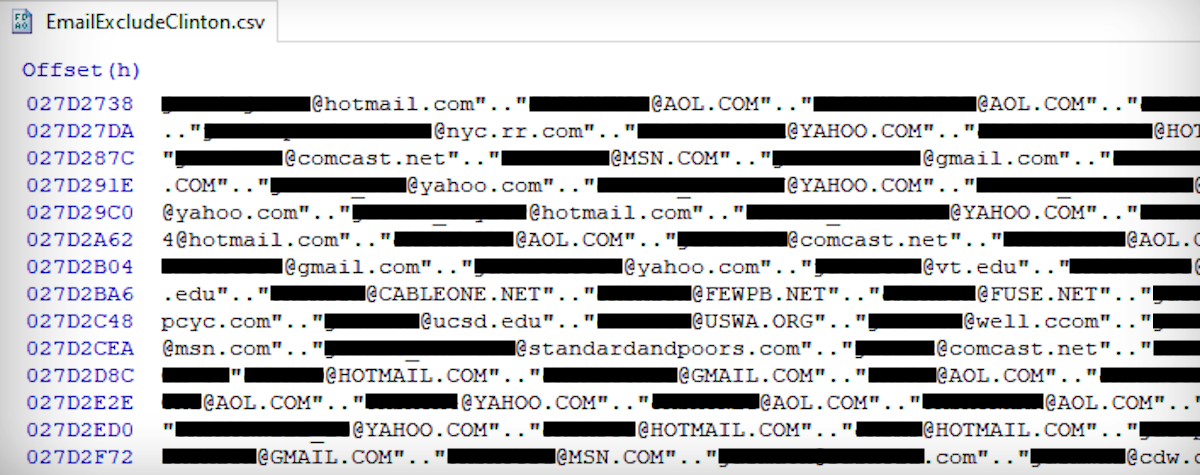
The spreadsheet was titled “EmailExcludeClinton.csv” and was found in a similarly named unprotected Amazon S3 bucket without a password. The file was uploaded in 2010 — a year after former Democratic senator and presidential candidate Hillary Clinton, whom the data is believed to be named after, became secretary of state.

UpGuard said the data may be people “who had opted out or should otherwise be excluded” from the committee’s marketing.

screenshot

A redacted portion of the email spreadsheet (Image: UpGuard/supplied)

Stewart Boss, a spokesperson for the DSCC, denied the data came from Sen. Hillary Clinton’s campaign and claimed the data had been created using the committee’s own information.

“A spreadsheet from nearly a decade ago that was created for fundraising purposes was removed in compliance with the stringent protocols we now have in place,” he told TechCrunch in an email.

Despite several follow-ups, the spokesperson declined to say how the email addresses were collected, where the information came from, what the email addresses were used for, how long the bucket was exposed, or if the committee knew if anyone else accessed or obtained the data.

We also contacted the former DSCC staffer who owned the storage bucket and allegedly created the database, but did not hear back.

Most of the email addresses were from consumer providers, like AOL, Yahoo, Hotmail and Gmail, but the researchers found more than 7,700 U.S. government email addresses and 3,400 U.S. military email addresses, said the UpGuard researchers.

The DSCC security lapse is the latest in a string of data exposures in recent years — some of which were also discovered by UpGuard. Two incidents in 2015 and 2017 exposed 191 million and 198 million Americans’ voter data, respectively, including voter profiles and political persuasions. Last year, 14 million voter records on Texas residents were also found on an exposed server.

Source: Democratic Senate campaign group exposed 6.2 million Americans’ emails | TechCrunch

And Amazon is still not putting these buckets up secured by default.

We’ve, um, changed our password policy, says CafePress amid reports of 23m pwned accounts

Twee T-shirts ‘n’ merch purveyor CafePress had 23 million user records swiped – reportedly back in February – and this morning triggered a mass password reset, calling it a change in internal policy.

Details of the security breach emerged when infosec researcher Troy Hunt’s Have I Been Pwned service – which lists websites known to have been hacked, allowing people to check if their information has been stolen – began firing out emails to affected people in the small hours of this morning.

According to HIBP, a grand total of 23,205,290 CafePress customers’ data was swiped by miscreants, including email addresses, names, phone numbers, and physical addresses.

We have asked CafePress to explain itself and will update this article if the company responds. There was no indication on its UK or US websites at the time of writing to indicate that the firm had acknowledged any breach.

[…]

Musing on the 77 per cent of email addresses from the breach having been seen in previous HIBP reports, Woodward said that factoid “brings me to a problem that isn’t being discussed that much, and which this kind of breach does highlight: the use of email as the user name. It’s clearly meant to make life easier for users, but the trouble is once hackers know an email has been used as a username in one place it is instantly useful for mounting credential-stuffing attacks elsewhere.”

“I wonder,” he told The Register, “if we shouldn’t be using unique usernames and passwords for each site. However, it would mean that it becomes doubly difficult to keep track of your credentials, especially if you’re using different strong passwords for each site, which I hope they are. But all users need do is start using a password manager, which I really wish they would.”

Source: We’ve, um, changed our password policy, says CafePress amid reports of 23m pwned accounts • The Register

You Can’t Trust Companies to Tell the Truth About Data Breaches

Last week, online sneaker-trading platform StockX asked its users to reset their passwords due to “recently completed system updates on the StockX platform.” In actuality, the company suffered a large data breach back in May, and only finally came clean about it when pressed by reporters who had access to some of the leaked data.

In other words, StockX lied. And while it disclosed details on the breach in the end, there’s still no explanation for why it took StockX so long to figure out what happened, nor why the company felt the need to muddy the situation with its suspicious password-reset email last week.

While most companies are fairly responsible about security disclosures, there’s no question that plenty would prefer if information about massive security breaches affecting them never hit the public eye. And even when companies have to disclose the details of a breach, they can get cagey—as we saw with Capital One’s recent problems.

Source: You Can’t Trust Companies to Tell the Truth About Data Breaches

Sadly it’s partially understandable, considering the lawsuit shotguns brought to bear on companies following disclosure.

Having said that, many of the disclosures are the results of really really stupid mistakes, such as storing credentials in plain text and not securing AWS buckets.

Monzo online bank stored bank card codes in log files as plain text

Trendy online-only Brit bank Monzo is telling hundreds of thousands of its customers to pick a new PIN – after it discovered it was storing their codes as plain-text in log files.

As a result, 480,000 folks, a fifth of the bank’s customers, now have to go to a cash machine, and reset their PINs.

The bank said the numbers, normally tightly secured with extremely limited access, had accidentally been kept in an encrypted-at-rest log file. The content of those logs were, however, accessible to roughly 100 Monzo engineers who normally would not have the clearance nor any need to see customer PINs.

The PINs were logged for punters who had used the “card number reminder” and “cancel a standing order” features.

To hear Monzo tell it, the misconfigured logs, along with the PINs, were discovered on Friday evening. By Saturday morning, the UK bank updated its mobile app so that no new PINs were sent to the log collector. On Monday, the last of the logged data had been deleted.

Source: PIN the blame on us, says Monzo in mondo security blunder: Bank card codes stored in log files as plain text • The Register

It’s 2019 – and you can completely pwn a Qualcomm-powered Android over the air

It is possible to thoroughly hijack a nearby vulnerable Qualcomm-based Android phone, tablet, or similar gadget, via Wi-Fi, we learned on Monday. This likely affects millions of Android devices.

Specifically, the following two security holes, dubbed Qualpwn and found by Tencent’s Blade Team, can be leveraged one after the other to potentially take over a handheld:

CVE-2019-10540 […] could be exploited by nearby miscreants over the air to silently squirt spyware into your phone to snoop on its wireless communications.

CVE-2019-10538: This vulnerability can be exploited by malicious code running within the Wi-Fi controller to overwrite parts of the Linux kernel running the device’s main Android operating system, paving the way for a full device compromise.

Source: It’s 2019 – and you can completely pwn a Qualcomm-powered Android over the air • The Register