A new lithium-ion battery design makes it possible for electric vehicle drivers to charge their cars and hit the road in as little as ten minutes, according to a new study.
The quick charge gives drivers up to 200 miles per ten minute charge while maintaining 2,500 charging cycles, the researchers behind the study say. That is equivalent to over half a million miles throughout the battery’s life, a press release notes. All that happens in the time it takes you to brew a morning coffee.
Researchers say that this design could finally make electric vehicles a viable competitor for traditional vehicles. “Range anxiety” is the fear of being stranded if your electric vehicle runs out of charge which has been a common barrier to adoption for many drivers.
In the study, published on Wednesday in Joule, researchers from Penn State University describe an asymmetric approach to fast-charging batteries that mitigates the effects of natural degradation of the lithium-ion batteries. This is achieved by quickly charging at a high temperature and then storing the charge more slowly at a cooler temperature. The researchers found that this approach allowed the batteries to avoid performance loss usually created from “battery plaque,” called lithium plating or solid-electrolyte-interphase (SEI) growth, which typically grows on batteries over time when exposed to heat.
[…]
In order to charge your car in just ten minutes with these new batteries in the future though, you might have to buy a new car or at least replace the battery.
“[The car] would require a new battery with our internal heating structure built in,” Chao-Yang Wang, coauthor of the study and director of the Electrochemical Engine Center at Penn State, said in an email.
Counter-Strike: Global Offensive players will no longer be able to trade container keys between accounts because the trade was part of a massive worldwide fraud network. Players earned cases in Counter-Strike containing weapons and cosmetic upgrades, but had to purchase the keys to open the boxes. Developer Valve runs an internal marketplace on Steam where it allowed players to trade the boxes and the keys. Valve patched the game on October 28 and explained the problem in its patch notes.
“In the past, most key trades we observed were between legitimate customers,” the statement said. “However, worldwide fraud networks have recently shifted to using CS:GO keys to liquidate their gains. At this point, nearly all key purchases that end up being traded or sold on the marketplace are believed to be fraud-sourced.”
This isn’t the first time Counter-Strike’s microtransactions were at the center of fraud. In September, 2017, the Federal Trade Commission settled with two YouTubers who ran popular websites that allowed fans to gamble their Counter-Strike skins. The influencers advertised the gambling site to fans on YouTube with video titles like HOW TO WIN $13,000 IN 5 MINUTES CS GO Betting without disclosing that they owned it.
Facebook has ended its appeal against the UK Information Commissioner’s Office and will pay the outstanding £500,000 fine for breaches of data protection law relating to the Cambridge Analytica scandal.
Prior to today’s announcement, the social network had been appealing against the fine, alleging bias and requesting access to ICO documents related to the regulator’s decision making. The ICO, in turn, was appealing a decision that it should hand over these documents.
The issue for the watchdog was the misuse of UK citizens’ Facebook profile information, specifically the harvesting and subsequent sale of data scraped from their profiles to Cambridge Analytica, the controversial British consulting firm used by US prez Donald Trump’s election campaign.
The app that collected the data was “thisisyourdigitallife”, created by Cambridge developer Aleksandr Kogan. It hoovered up Facebook users’ profiles, dates of birth, current city, photos in which those users were tagged, pages they had liked, posts on their timeline, friends’ lists, email addresses and the content of Facebook messages. The data was then processed in order to create a personality profile of the user.
“Given the way our platform worked at the time,” Zuck has said, “this meant Kogan was able to access tens of millions of their friends’ data”. Facebook has always claimed it learned of the data misuse from news reports, though this has been disputed.
Both sides will now end the legal fight and Facebook will pay the ICO a fine but make no admission of liability or guilt. The money is not kept by the data protection watchdog but goes to the Treasury consolidated fund and both sides will pay their own costs. The ICO spent an eye-watering £2.5m on the Facebook probe.
VP of product Scott Williamson announced on 10 October that “to make GitLab better faster, we need more data on how users are using GitLab”.
GitLab is a web application that runs on Linux, with options for self-hosting or using the company’s cloud service. It is open source, with both free and licensed editions.
Williamson said that while nothing was changing with the free self-hosted Community Edition, the hosted and licensed products would all now “include additional JavaScript snippets (both open source and proprietary) that will interact with both GitLab and possibly third-party SaaS telemetry services (we will be using Pendo)”. The only opt-out was to be support for the Do Not Track browser mechanism.
GitLab customers and even some staff were not pleased. For example, Yorick Peterse, a GitLab staff developer, said telemetry should be opt-in and that the requisite update to the terms of service would break some API usage (because bots do not know how to accept terms of service), adding: “We have plenty of customers who would not be able to use GitLab if it starts tracking data for on-premises installations.”
There is more background in the issue here, which concerns adding the identity of the user to the Snowplow analytics service used by GitLab.
“This effectively changes our Snowplow integration from being an anonymous aggregated thing to a thing that tracks user interaction,” engineering manager Lukas Eipert said back in July. “Ethically, I have problems with this and legally this could have a big impact privacy wise (GDPR). I hereby declare my highest degree of objection to this change that I can humanly express.”
On the other hand, GitLab CFO Paul Machle said: “This should not be an opt in or an opt out. It is a condition of using our product. There is an acceptance of terms and the use of this data should be included in that.”
On 23 October, an email was sent to GitLab customers announcing the changes.
Yesterday, however, CEO Sid Sijbrandij put the plans on hold, saying: “Based on considerable feedback from our customers, users, and the broader community, we reversed course the next day and removed those changes before they went into effect. Further, GitLab will commit to not implementing telemetry in our products that sends usage data to a third-party product analytics service.” Sijbrandij also promised a review of what went wrong. “We will put together a new proposal for improving the user experience and share it for feedback,” he said.
Despite this embarrassing backtrack, the incident has demonstrated that GitLab does indeed have an open process, with more internal discussion on view than would be the case with most companies. Nevertheless, the fact that GitLab came so close to using personally identifiable tracking without specific opt-in has tarnished its efforts to appear more community-driven than alternatives like Microsoft-owned GitHub. ®
Pagers used within the United Kingdom’s National Health Service are leaking sensitive patient information, and an amateur radio enthusiast has been broadcasting some of that medical data on a webcam livestream, a security researcher has found.
TechCrunch reports that Florida-based security researcher Daley Borda stumbled upon the strange confluence of archaic tech that flowed together to create a security nightmare.
Borda regularly scans the internet looking for concerning privacy and security activity. He recently discovered a grainy livestream showing a radio rig in North London that picked up radio waves and converted the transmissions into text that was displayed on a computer screen, according to TechCrunch. The hobbyist had set up a webcam that captured what was on the display, which showed medical emergencies as they were being reported. The webcam reportedly had no password, so anyone could find it and see the messages that showed directions meant for ambulances responding to emergency calls.
“You can see details of calls coming in—their name, address, and injury,” Borda told TechCrunch, which verified his discovery.
The tech news outlet reviewed several concerning messages that showed the location where people were reporting medical emergencies, including one that showed the address where a 49-year-old man was having chest pains and one that showed the address of a 98-year old man who had fallen.
[…]
A spokesperson for NHS told Gizmodo that the NHS consists of several different organizations, like hospital trusts and ambulances trusts, and “each organization is responsible for the technology it buys and uses (including pagers).” They pointed Gizmodo to a statement that Health and Social Care Secretary Matt Hancock issued in February instructed the NHS to stop using pagers by 2022. In his statement, he said the NHS uses 130,000 pagers.
On Tuesday, Don HO, the developer of Notepad++, a free GPL source code editor and notepad application for Microsoft Windows, released version 7.8.1, prompting a social media firestorm and a distributed denial of service attack.
“The site notepad-plus-plus.org has suffered DDoS attack from 1230 to 1330 Paris time,” HO said in an email to The Register. “I saw the [reduced] amount of visitors via Google analytics then the support of my host confirmed the attack. The DDoS attack has been stopped by an anti-DDoS service provided by our host [Cloudflare].”
Previous politically-themed Notepad++ releases have focused on Tiananmen Square and the terrorist attack on French satirical publication Charlie Hebdo.
A post on the project’s website explains HO’s decision to criticize the Chinese government, something companies with business interests in China generally try not to do for fear of retribution.
Some of the ‘issues’ raised by pro-China supports on the Notepad++ GitHub page … Click to enlarge
“People will tell me again to not mix politics with software/business,” HO’s post says. “Doing so surely impacts the popularity of Notepad++: talking about politics is exactly what software and commercial companies generally try to avoid.”
“The problem is, if we don’t deal with politics, politics will deal with us. We can choose to not act when people are being oppressed, but when it’s our turn to be oppressed, it will be too late and there will be no one for us. You don’t need to be Uyghur or a Muslim to act, you need only to be a human and have empathy for our fellow humans.”
WASHINGTON (Reuters) – Senior government officials in multiple U.S.-allied countries were targeted earlier this year with hacking software that used Facebook Inc’s (FB.O) WhatsApp to take over users’ phones, according to people familiar with the messaging company’s investigation.
Sources familiar with WhatsApp’s internal investigation into the breach said a “significant” portion of the known victims are high-profile government and military officials spread across at least 20 countries on five continents. Many of the nations are U.S. allies, they said.
The hacking of a wider group of top government officials’ smartphones than previously reported suggests the WhatsApp cyber intrusion could have broad political and diplomatic consequences.
WhatsApp filed a lawsuit on Tuesday against Israeli hacking tool developer NSO Group. The Facebook-owned software giant alleges that NSO Group built and sold a hacking platform that exploited a flaw in WhatsApp-owned servers to help clients hack into the cellphones of at least 1,400 users between April 29, 2019, and May 10, 2019.
The total number of WhatsApp users hacked could be even higher. A London-based human rights lawyer, who was among the targets, sent Reuters photographs showing attempts to break into his phone dating back to April 1.
While it is not clear who used the software to hack officials’ phones, NSO has said it sells its spyware exclusively to government customers.
Some victims are in the United States, United Arab Emirates, Bahrain, Mexico, Pakistan and India, said people familiar with the investigation. Reuters could not verify whether the government officials were from those countries or elsewhere.
Some Indian nationals have gone public with allegations they were among the targets over the past couple of days; they include journalists, academics, lawyers and defenders of India’s Dalit community.
NSO said in a statement that it was “not able to disclose who is or is not a client or discuss specific uses of its technology.” Previously it has denied any wrongdoing, saying its products are only meant to help governments catch terrorists and criminals.
Cybersecurity researchers have cast doubt on those claims over the years, saying NSO products were used against a wide range of targets, including protesters in countries under authoritarian rule.
Google’s Senior Vice President of Devices & Services, Rick Osterloh, broke the news on the official Google blog, saying:
Over the years, Google has made progress with partners in this space with Wear OS and Google Fit, but we see an opportunity to invest even more in Wear OS as well as introduce Made by Google wearable devices into the market. Fitbit has been a true pioneer in the industry and has created engaging products, experiences and a vibrant community of users. By working closely with Fitbit’s team of experts, and bringing together the best AI, software and hardware, we can help spur innovation in wearables and build products to benefit even more people around the world.
Earlier this week, on October 28, a report from Reuters surfaced to indicate that Google was in a bid to purchase Fitbit. It’s a big move, but it’s also one that makes good sense.
Google’s Wear OS wearable platform has been in something of a rut for the last few years. The company introduced the Android Wear to Wear OS rebrand in 2018 to revitalize its branding/image, but the hardware offerings have still been pretty ho-hum. Third-party watches like the Fossil Gen 5 have proven to be quite good, but without a proper “Made by Google” smartwatch and other major players, such as Samsung, ignoring the platform, it’s been left to just sort of exist.
$18 million of fraudulent charges from the app blocked by malware security platform Secure-D
London, October 31st, 2019 – A popular Android keyboard app, ai.type, downloaded more than 40 million times and included in the Google Play app store, has been caught making millions of unauthorized purchases of premium digital content, researchers at mobile technology company Upstream report. The app has been delivering millions of invisible ads and fake clicks, while delivering genuine user data about real views, clicks and purchases to ad networks. Ai.type carries out some of its activity hiding under other identities[1], including disguising itself to spoof popular apps such as Soundcloud. The app’s tricks have also included a spike in suspicious activity once removed from the Google Play store.
The Upstream Secure-D mobile security platform has so far detected and blocked more than 14 million suspicious transaction requests from only 110,000 unique devices that downloaded the ai.type keyboard. If not blocked these transaction requests would have triggered the purchase of premium digital services, potentially costing users up to $18 million in unwanted charges. The suspicious activity has been recorded across 13 countries but was particularly high in Egypt and Brazil.
Ai.type is disguised as a free treat for mobile users. It is a customizable on-screen keyboard app developed by Israeli firm ai.type LTD, which describes the app as a “Free Emoji Keyboard”. Despite the fact that the app was removed from Google Play in June 2019, the app remains on millions of Android devices and is still available from other Android marketplaces.
A young Dutch inventor is widening his effort to clean up floating plastic from the Pacific Ocean by moving into rivers, too, using a new floating device to catch garbage before it reaches the seas.
The 25-year-old university dropout Boyan Slat founded The Ocean Cleanup to develop and deploy a system he invented when he was 18 that catches plastic waste floating in the ocean.
On Saturday he unveiled the next step in his fight: A floating solar-powered device that he calls the “Interceptor” that scoops plastic out of rivers as it drifts past.
“We need to close the tap, which means preventing more plastic from reaching the ocean in the first place,” he said, calling rivers “the arteries that carry the trash from land to sea.”
[…]
Three of the machines have already been deployed to Indonesia, Malaysia and Vietnam—and a fourth is heading to the Dominican Republic, he said.
Izham Hashim from the government of Selangor state in Malaysia was present at the launch and said he was happy with the machine.
“It has been used for 1 1/2 months in the river and it’s doing very well, collecting the plastic bottles and all the rubbish,” he said.
Slat said he believes 1,000 rivers are responsible for some 80% of plastic pouring into the world’s oceans and he wants to tackle them all in the next five years.
[…]
The vessel is designed to be moored in rivers and has a shaped nose to deflect away larger floating debris like tree trunks. The interceptors work by guiding plastic waste into an opening in its bow, a conveyor belt then carries the trash into the guts of the machine where it is dropped into dumpsters. The interceptor sends a text message to local operators that can come and empty it when it’s full.
Slat showed off how it worked by dumping hundreds of yellow rubber ducks into the water at the launch event in Rotterdam’s port. The interceptor caught nearly all of them.
The machines currently cost about 700,000 euros ($775,600), but Slat said the cost will likely drop as production increases.
The internet has made it easier than ever to reach a lot of readers quickly. It has birthed new venues for publication and expanded old ones. At the same time, a sense of urgency of current affairs, from politics to science, technology to the arts, has driven new interest in bringing scholarship to the public directly.
Scholars still have a lot of anxiety about this practice. Many of those relate to the university careers and workplaces: evaluation, tenure, reactions from their peers, hallway jealousy, and so on. These are real worries, and as a scholar and university professor myself, I empathize with many of them.
But not with this one: The worry that they’ll have to “dumb down” their work to reach broader audiences. This is one of the most common concerns I hear from academics. “Do we want to dumb down our work to reach these readers?” I’ve heard them ask among themselves. It’s a wrongheaded anxiety.
Like all experts, academics are used to speaking to a specialized audience. That’s true no matter their discipline, from sociology to geotechnical engineering to classics. When you speak to a niche audience among peers, a lot of understanding comes for free. You can use technical language, make presumptions about prior knowledge, and assume common goals or contexts. When speaking to a general audience, you can’t take those circumstances as a given.
But why would doing otherwise mean “dumbing down” the message? It’s an odd idea when you think about it. The whole reason to reach people who don’t know what you know, as an expert, is so that they might know about it. Giving them reason to care, process, and understand is precisely the point.
The phrase dumbing down got its start in entertainment. During the golden age of Hollywood, in the 1930s, dumbing down became a screenwriter’s shorthand for making an idea simple enough that people with limited education or experience could understand it. Over time, it came to refer to intellectual oversimplification of all kinds, particularly in the interest of making something coarsely popular. In education, it named a worry about curricula and policy: that students were being asked to do less, held to a lower standard than necessary—than they were capable of—and that is necessary to produce an informed citizenry.
In the process, dumbing down has entrenched and spread as a lamentation, often well beyond any justification
[…]
But to assume that even to ponder sharing the results of scholarship amounts to dumbing down, by default, is a new low in this term for new lows. Posturing as if it’s a problem with the audience, rather than with the expert who refuses to address that audience, is perverse.
One thing you learn when writing for an audience outside your expertise is that, contrary to the assumption that people might prefer the easiest answers, they are all thoughtful and curious about topics of every kind. After all, people have areas in their own lives in which they are the experts. Everyone is capable of deep understanding.
Up to a point, though: People are also busy, and they need you to help them understand why they should care. Doing that work—showing someone why a topic you know a lot about is interesting and important—is not “dumb”; it’s smart. Especially if, in the next breath, you’re also intoning about how important that knowledge is, as academics sometimes do. If information is vital to human flourishing but withheld by experts, then those experts are either overestimating its importance or hoarding it.
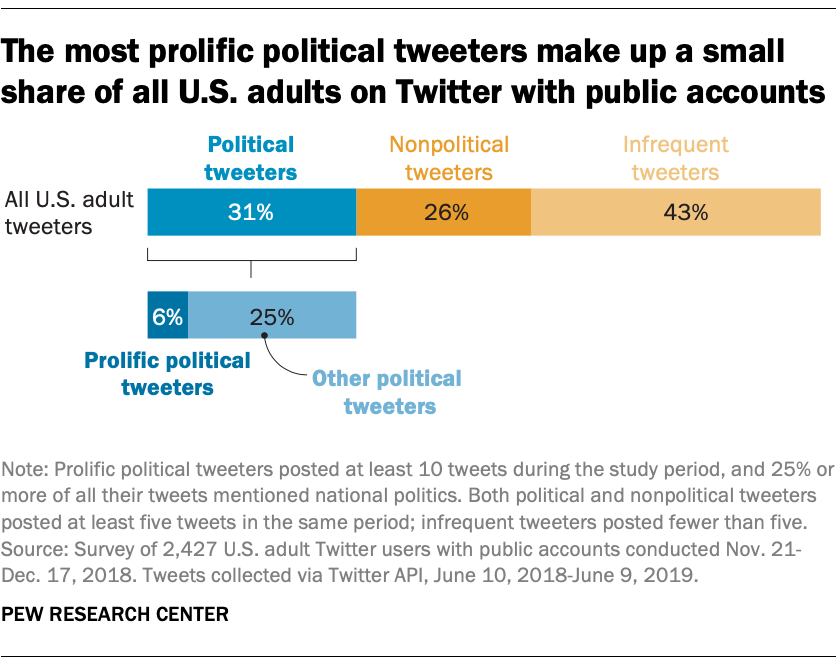
For years now, Twitter has been an important platform for disseminating news and sharing opinions about U.S. politics, and 22% of U.S. adults say they use the platform. But the Twitter conversation about national politics among U.S. adult users is driven by a small number of prolific political tweeters. These users make up just 6% of all U.S. adults with public accounts on the site, but they account for 73% of tweets from American adults that mention national politics.
Most U.S. adults on Twitter largely avoid the topic: The median user never tweeted about national politics, while 69% only tweeted about it once or not at all. Across all tweets from U.S. adults, just 13% focused on national politics, according to a new Pew Research Center analysis based on public tweets that were posted between June 2018 and June 2019.
An open database exposing records containing the sensitive data of hotel customers as well as US military personnel and officials has been disclosed by researchers.
On Monday, vpnMentor’s cybersecurity team, led by Noam Rotem and Ran Locar, said the database belonged to Autoclerk, a service owned by Best Western Hotels and Resorts group.
Autoclerk is a reservations management system used by resorts to manage web bookings, revenue, loyalty programs, guest profiles, and payment processing.
In a report shared with ZDNet, the researchers said the open Elasticsearch database was discovered through vpnMentor’s web mapping project. It was possible to access the database, given it had no encryption or security barriers whatsoever, and perform searches to examine the records contained within.
The team says that “thousands” of individuals were impacted, although due to ethical reasons it was not possible to examine every record in the leaking database to come up with a specific number.
Hundreds of thousands of booking reservations for guests were available to view and data including full names, dates of birth, home addresses, phone numbers, dates and travel costs, some check-in times and room numbers, and masked credit card details were also exposed.
Data breaches are a common occurrence and can end up compromising information belonging to thousands or millions of us in single cases of a successful cyberattack.
What is more uncommon, however, is that the US government and military figures have also been involved in this security incident.
It appears that one of the platforms connected to Autoclerk exposed in the breach is a contractor of the US government that deals with travel arrangements.
vpnMentor was able to view records relating to the travel arrangements of government and military personnel — both past and future — who are connected to the US government, military, and Department of Homeland Security (DHS).
Within the records, for example, were logs for US Army generals visiting Russia and Israel, among other countries.
People who are “locked in”—fully paralyzed by stroke or neurological disease—have trouble trying to communicate even a single sentence. Electrodes implanted in a part of the brain involved in motion have allowed some paralyzed patients to move a cursor and select onscreen letters with their thoughts. Users have typed up to 39 characters per minute, but that’s still about three times slower than natural handwriting.
In the new experiments, a volunteer paralyzed from the neck down instead imagined moving his arm to write each letter of the alphabet. That brain activity helped train a computer model known as a neural network to interpret the commands, tracing the intended trajectory of his imagined pen tip to create letters (above).
Eventually, the computer could read out the volunteer’s imagined sentences with roughly 95% accuracy at a speed of about 66 characters per minute, the team reported here this week at the annual meeting of the Society for Neuroscience.
The researchers expect the speed to increase with more practice. As they refine the technology, they will also use their neural recordings to better understand how the brain plans and orchestrates fine motor movements.
Google employees are accusing the company’s leadership of developing an internal surveillance tool that they believe will be used to monitor workers’ attempts to organize protests and discuss labor rights.
Earlier this month, employees said they discovered that a team within the company was creating the new tool for the custom Google Chrome browser installed on all workers’ computers and used to search internal systems. The concerns were outlined in a memo written by a Google employee and reviewed by Bloomberg News and by three Google employees who requested anonymity because they aren’t authorized to talk to the press
YouTube is the biggest social media platform in the country, and, perhaps, the most misunderstood. Over the past few years, the Google-owned platform has become a media powerhouse where political discussion is dominated by right-wing channels offering an ideological alternative to established news outlets. And, according to new research from Penn State University, these channels are far from fringe—they’re the new mainstream, and recently surpassed the big three US cable news networks in terms of viewership.
The paper, written by Penn State political scientists Kevin Munger and Joseph Phillips, tracks the explosive growth of alternative political content on YouTube, and calls into question many of the field’s established narratives. It challenges the popular school of thought that YouTube’s recommendation algorithm is the central factor responsible for radicalizing users and pushing them into a far-right rabbit hole.
The authors say that thesis largely grew out of media reports, and hasn’t been rigorously analyzed. The best prior studies, they say, haven’t been able to prove that YouTube’s algorithm has any noticeable effect. “We think this theory is incomplete, and potentially misleading,” Munger and Phillips argue in the paper. “And we think that it has rapidly gained a place in the center of the study of media and politics on YouTube because it implies an obvious policy solution—one which is flattering to the journalists and academics studying the phenomenon.”
Instead, the paper suggests that radicalization on YouTube stems from the same factors that persuade people to change their minds in real life—injecting new information—but at scale. The authors say the quantity and popularity of alternative (mostly right-wing) political media on YouTube is driven by both supply and demand. The supply has grown because YouTube appeals to right-wing content creators, with its low barrier to entry, easy way to make money, and reliance on video, which is easier to create and more impactful than text.
“This is attractive for a lone, fringe political commentator, who can produce enough video content to establish themselves as a major source of media for a fanbase of any size, without needing to acquire power or legitimacy by working their way up a corporate media ladder,” the paper says.
According to the authors, that increased supply of right-wing videos tapped a latent demand. “We believe that the novel and disturbing fact of people consuming white nationalist video media was not caused by the supply of this media ‘radicalizing’ an otherwise moderate audience,” they write. “Rather, the audience already existed, but they were constrained” by limited supply.
Other researchers in the field agree, including those whose work has been cited by the press as evidence of the power of YouTube’s recommendation system. Manoel Ribeiro, a researcher at the Swiss Federal Institute of Technology Lausanne and one of the authors of what the Penn State researchers describe as “the most rigorous and comprehensive analysis of YouTube radicalization to date,” says that his work was misinterpreted to fit the algorithmic radicalization narrative by so many outlets that he lost count.
For his study, published in July, Ribeiro and his coauthors examined more othan 330,000 YouTube videos from 360 channels, mostly associated with far right ideology. They broke the channels into four groups, based on their degree of radicalization. They found that a YouTube viewer who watches a video from the second-most-extreme group and follows the algorithm’s recommendations has only a 1-in-1,700 chance of arriving at a video from the most extreme group. For a viewer who starts with a video from the mainstream media, the chance of being shown a video from the most extreme group is roughly 1 in 100,000.
Munger and Phillips cite Ribeiro’s paper in their own, published earlier this month. They looked at 50 YouTube channels that researcher Rebecca Lewis identified in a 2018 paper as the “Alternative Influence Network.” Munger and Phillips’ reviewed the metadata for close to a million YouTube videos posted by those channels and mainstream news organizations between January 2008 and October 2018. The researchers also analyzed trends in search rankings for the videos, using YouTube’s API to obtain snapshots of how they were recommended to viewers at different points over the last decade.
Munger and Phillips divided Lewis’s Alternative Influence Network into five groups—from “Liberals” to “Alt-right”—based on their degree of radicalization. Liberals included channels by Joe Rogan and Steven Bonnell II. “Skeptics” included Carl Benjamin, Jordan Peterson, and Dave Rubin. “Conservatives,” included YouTubers like Steven Crowder, Dennis Prager of PragerU, and Ben Shapiro. The “Alt-Lite” category included both fringe creators that espouse more mainstream conservative views, like InfoWars’ Paul Joseph Watson, and those that express more explicitly white nationalist messages, like Stefan Molyneux and Lauren Southern. The most exteme category, the “Alt-Right,” refers to those who push strong anti-Semitic messages and advocate for the genetic superiority of white people, including Richard Spencer, Red Ice TV, and Jean-Francois Gariepy.
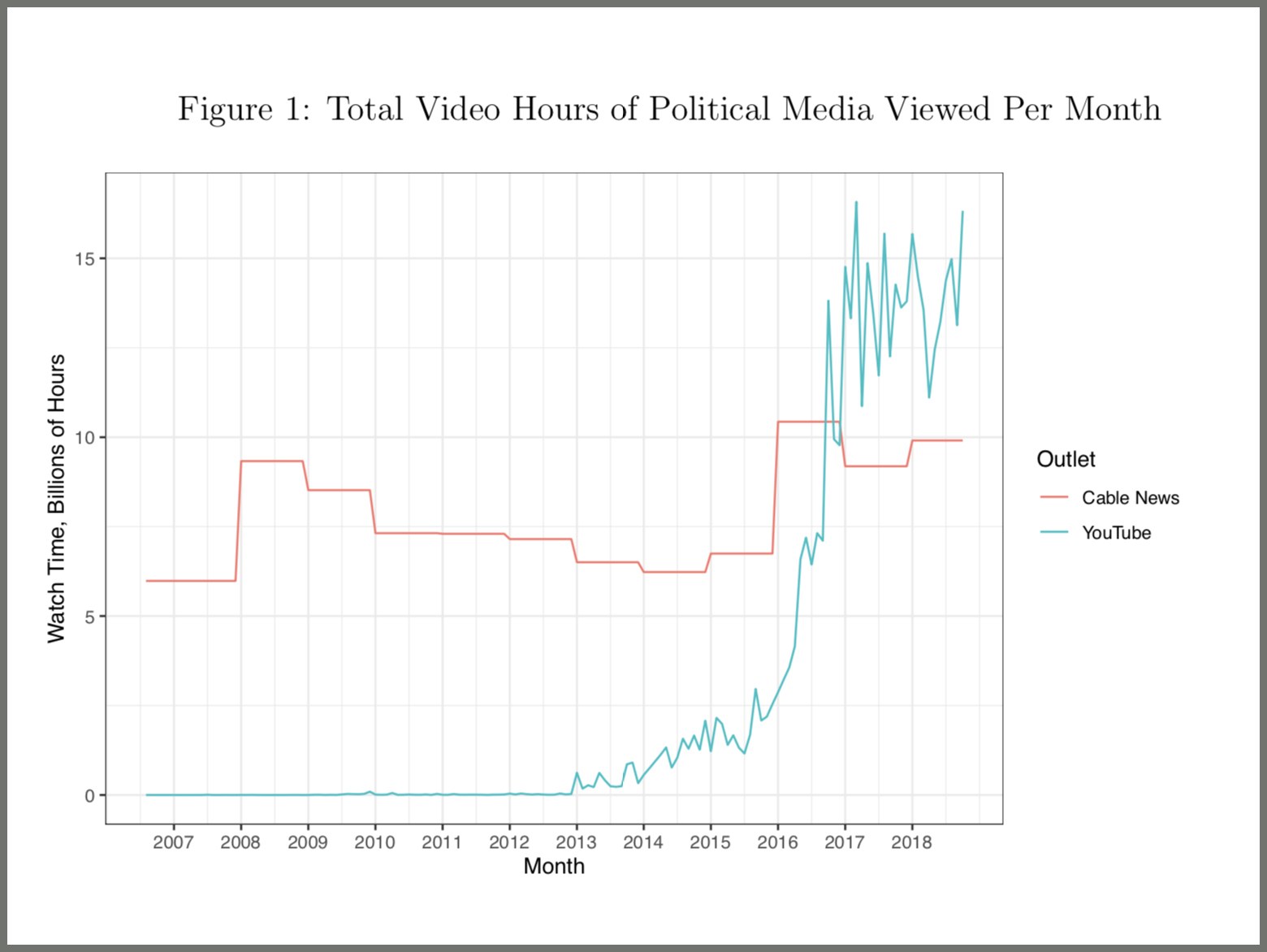
This chart shows how total viewership of political videos on YouTube has overtaken the combined viewership on cable news channels.
Illustration: Kevin Munger & Joseph Phillips/Penn State University
Munger and Phillips found that every part of the Alternative Influence Network rose in viewership between 2013 and 2016. Since 2017, they say, global hourly viewership of these channels “consistently eclipsed” that of the top three US cable networks combined. To compare YouTube’s global audience with the cable networks’ US-centric audience, the researchers assumed that each cable viewer watched all three networks for 24 hours straight each day, while each YouTube viewer watched a single video for only 10 minutes.
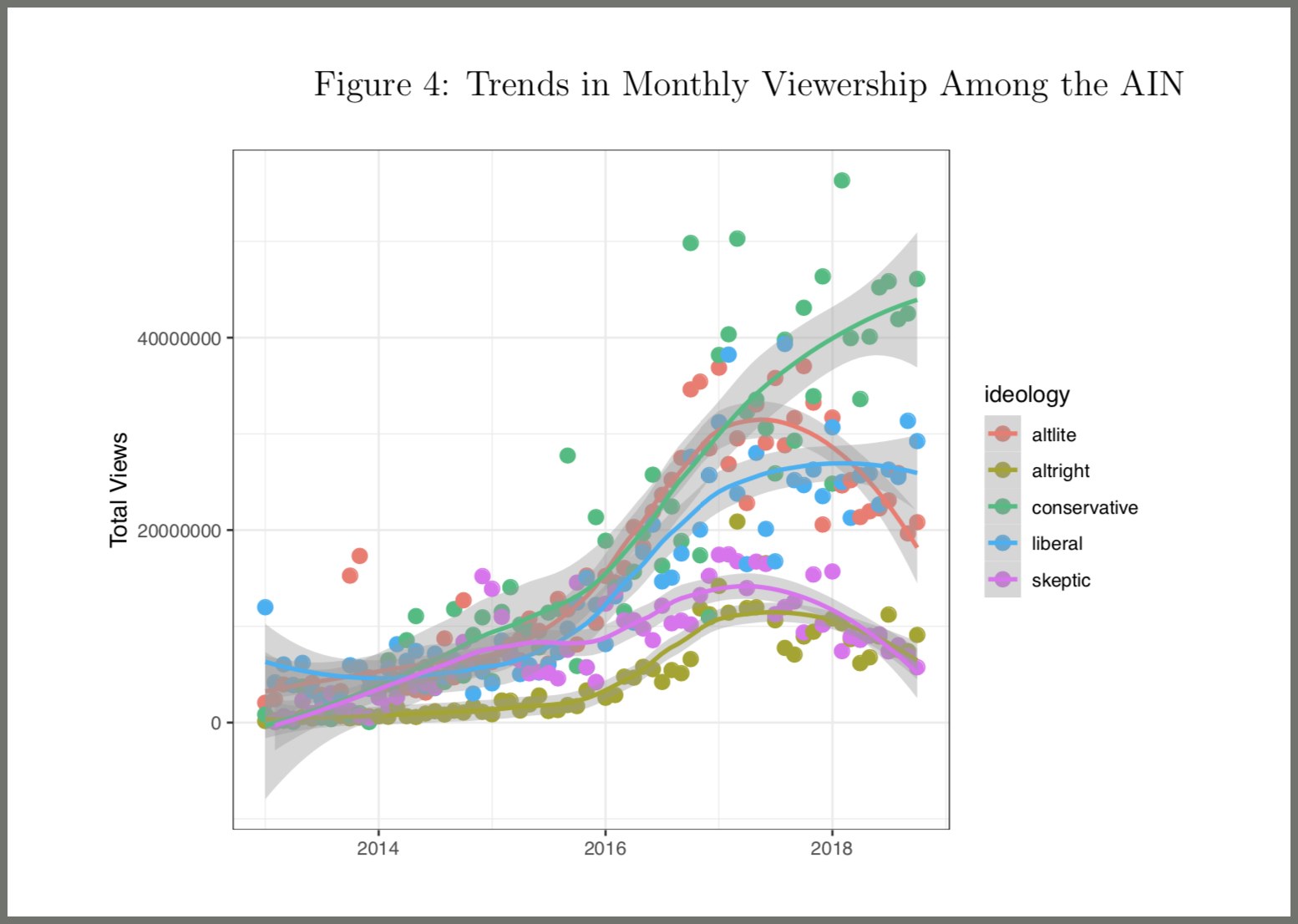
The sagging red and olive lines show how viewership on YouTube of the most extreme political videos has declined since 2017.
Illustration: Kevin Munger & Joseph Phillips/Penn State University
Overall viewership for the Alternative Influence Network has exploded in recent years, mirroring the far-right’s real-world encroachment on the national stage. But the report found that viewership on YouTube of the most extreme far-right content—those in the Alt-Lite and Alt-Right groups, specifically—has actually declined since 2017, while videos in the Conservative category more than doubled in popularity.
Lewis says that the decline could be explained by changes in the universe of right-wing video creators. Some of the creators she included in the list of Alternative Influence Network channels have lost popularity since her study was published, while others have emerged to take their place. However, this latter group was not included in the Penn State researchers’ report. Munger said the findings are preliminary and part of a working paper.
Nonetheless, Lewis praises the Penn State paper as essential reading for anyone studying YouTube politics. She lauded it as the first quantitative study on YouTube to shift focus from the recommendation algorithm—a transition that she says is crucial. Ribeiro agrees, describing it as a fascinating and novel perspective that he believes will encourage broader scholarly analysis in the field.
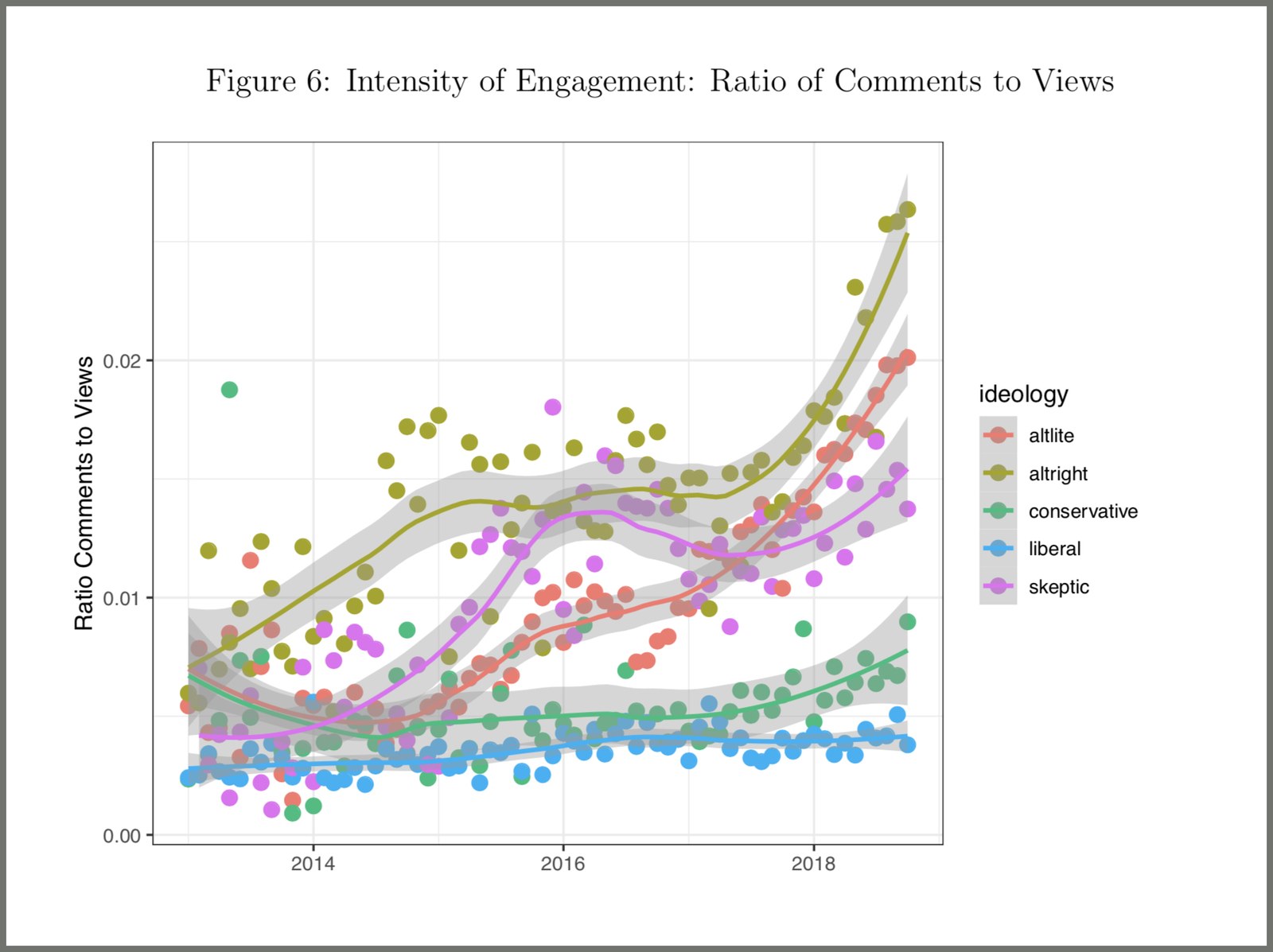
One thing that’s clear is that the remaining viewers of Alt-Right videos are significantly more engaged than other viewers, based on an analysis of ratio of likes and comments per video views.
But the most extreme videos still rank highest in engagement, based on an analysis of likes and comments.
Illustration: Kevin Munger & Joseph Phillips/Penn State University
Munger and Phillips say they were inspired to illustrate the complexity of YouTube’s alternative political ecosystem, and to encourage the development of more comprehensive, evidence-based narratives to explain YouTube politics.
“For these far-right groups, the audience is treating it much more as interactive space,” said Munger, in reference to the engagement graph above. “And this could lead to the creation of a community,” which is a much more potent persuasive force than any recommendation system. When it comes to radicalization, he says, these are the sorts of factors we should be concerned about—not the effects of each algorithmic tweak.
The BBC has made its international news website available via the Tor network, in a bid to thwart censorship attempts.
The Tor browser is privacy-focused software used to access the dark web.
The browser can obscure who is using it and what data is being accessed, which can help people avoid government surveillance and censorship.
Countries including China, Iran and Vietnam are among those who have tried to block access to the BBC News website or programmes.
Instead of visiting bbc.co.uk/news or bbc.com/news, users of the Tor browser can visit the new bbcnewsv2vjtpsuy.onion web address. Clicking this web address will not work in a regular web browser.
The dark web copy of the BBC News website will be the international edition, as seen from outside the UK.
It will include foreign language services such as BBC Arabic, BBC Persian and BBC Russian.
But UK-only content and services such as BBC iPlayer will not be accessible, due to broadcast rights.
What is Tor?
Tor is a way to access the internet that requires software, known as the Tor browser, to use it.
The name is an acronym for The Onion Router. Just as there are many layers to the vegetable, there are many layers of encryption on the network.
It was originally designed by the US Naval Research Laboratory, and continues to receive funding from the US State Department.
It attempts to hide a person’s location and identity by sending data across the internet via a very circuitous route involving several “nodes” – which, in this context, means using volunteers’ PCs and computer servers as connection points.
Encryption applied at each hop along this route makes it very hard to connect a person to any particular activity.
Growing demand for SUVs was the second largest contributor to the increase in global CO2 emissions from 2010 to 2018, an analysis has found.
In that period, SUVs doubled their global market share from 17% to 39% and their annual emissions rose to more than 700 megatonnes of CO2, more than the yearly total emissions of the UK and the Netherlands combined.
No energy sector except power drove a larger increase in carbon emissions, putting SUVs ahead of heavy industry (including iron, steel, cement and aluminium), aviation and shipping.
“We were quite surprised by this result ourselves,” said Laura Cozzi, the chief energy modeller of the International Energy Agency, which produced the report.
The recent dramatic shift towards heavier SUVs has offset both efficiency improvements in smaller cars and carbon savings from electric vehicles.
As the global fleet of SUVs has grown, emissions from the vehicles have increased more than fourfold in eight years. If SUV drivers were a nation, they would rank seventh in the world for carbon emissions.
“An SUV is bigger, it’s heavier, the aerodynamics are poor, so as a result you get more CO2,” said Florent Grelier from the campaign group Transport & Environment.
[…]
SUVs started to become popular in the 1980s, and often earned nicknames such as “Chelsea tractor” as a result of the wealthy city suburbs they became associated with. Since then, sales have continued to rise, and the vehicles are often marketed as a status symbol.
However, opposition to SUVs in cities is also rising. Recent protestsin Berlin demanded a ban on the vehicles after a driver hit and killed four pedestrians, while activists at a Frankfurt motor show protested against the vehicles’ impact on the climate. SUVs are significantly more likely to kill pedestrians in crashes, and although they are often marketed as safer, those driving them are 11% more likely to die in a crash than people in normal cars.
Cozzi said a number of factors were driving the demand for bigger cars. While perceptions of heightened safety or increased social status could play a role at the individual level, she also pointed towards manufacturers’ changing offering.
She said the difficult market situation led carmakers to look for the most profitable models in their ranges.
“There is a really big need for car manufacturers to find the margins wherever it is possible, and the SUV segment seems to be one of those places,” she said.
For those unfamiliar with SandDance, it was introduced nearly four years ago as a system for exploring and presenting data using “unit visualizations.” Instead of aggregating data and showing the resulting sums as bar charts, SandDance shows every single row of a dataset (for datasets up to ~500K rows). It represents each of these rows as a mark that can be colored and organized into different areas on the screen. Thus, bar charts are made of their constituent units, stacked, or sorted.
Nice. I hadn’t heard about SandDance until now, but I’m saving for later. You can grab the source on GitHub.
In 1999, at the peak of Hydrogen fuel cell company start ups in California he left BAe to start his own fuel cell company. “My old boss at Rolls Royce pointed out that the Hydrogen needed to come from somewhere. So I looked at other technologies and found metal-air,”he says.
Technically described as “(Al)/air” batteries, these are the — almost — untold story from the battery world. For starters, an aluminum-air battery system can generate enough energy and power for driving ranges and acceleration similar to gasoline-powered cars.
Sometimes known as “Metal-Air” batteries, these have been successfully used in “off-grid” applications for many years, just as batteries powering army radios. The most attractive metal in this type of battery is aluminum because it is the most common metal on Earth and has one of the highest energy densities.
Think of an air-breathing battery which uses aluminum as a “fuel.” That means it can provide vehicle power with energy originating from clean sources (hydro, geothermal, nuclear etc.). These are the power sources for most aluminum smelters all over the world. The only waste product is aluminum hydroxide and this can be returned to the smelter as the feedstock for — guess what? — making more aluminum! This cycle is therefore highly sustainable and separate from the oil industry. You could even recycle aluminum cans and use them to make batteries.
Imagine that — a power source separate from the highly polluting oil industry.
“I rented a lab, read everything on it and then turned back into a Development Engineer, which means: thinking, making, testing and tweaking until you find answers. One or two bolts from the blue and I saw a massive difference on one test,” says Jackson.
But hardly anyone was using them in mainstream applications. Why?
Aluminum-air batteries had been around for a while. But the problem with a battery which generated electricity by “eating” aluminum was that it was simply not efficient. The electrolyte used just didn’t work well.
This was important. An electrolyte is a chemical medium inside a battery that allows the flow of electrical charge between the cathode and anode. When a device is connected to a battery — a light bulb or an electric circuit — chemical reactions occur on the electrodes that create a flow of electrical energy to the device.
When an aluminum-air battery starts to run, a chemical reaction produces a “gel” by-product which can gradually block the airways into the cell. It seemed like an intractable problem for researchers to deal with.
But after a lot of experimentation, in 2001, Jackson developed what he believed to be a revolutionary kind of electrolyte for aluminum-air batteries which had the potential to remove the barriers to commercialization.
“Everything was steady, the hydrogen and gel were almost gone but the power was a lot better.”
His specially developed electrolyte did not produce the hated gel that would destroy the efficiency of an aluminum-air battery. For Jackson, it seemed like a game-changer: “All I needed to do was to tell the government. ‘Simple’, I thought.”
The breakthrough — if proven — had huge potential. The energy density of his battery was about eight times that of a lithium-ion battery. He was incredibly excited. Then he tried to tell politicians…
Despite a detailed demonstration of a working battery to Lord “Jim” Knight in 2001, followed by email correspondence and a promise to “pass it onto Tony (Blair),” there was no interest from the U.K. government.
And Jackson faced bureaucratic hurdles. The U.K. government’s official innovation body, Innovate UK, emphasized lithium battery technology, not aluminum-air batteries.
He was struggling to convince public and private investors to back him, such was the hold the “lithium battery lobby” had over the sector.
This emphasis on lithium batteries over anything else meant U.K. the government was effectively leaving on the table a technology which could revolutionize electrical storage and mobility and even contribute to the fight against carbon emission and move the U.K. toward its pollution-reduction goals.
Disappointed in the U.K., Jackson upped sticks and found better backing in France, where he moved his R&D in 2005.
Finally, in 2007, the potential of Jackson’s invention was confirmed independently in France at the Polytech Nantes institution. Its advantages over Lithium Ion batteries were (and still are) increased cell voltage. They used ordinary aluminum, would create very little pollution and had a steady, long-duration power output.
As a result, in 2007 the French Government formally endorsed the technology as “strategic and in the national interest of France.”
At this point, the U.K.’s Foreign Office suddenly woke up and took notice.
It promised Jackson that the UKTI would deliver “300%” effort in launching the technology in the U.K. if it was “repatriated” back to the U.K.
However, in 2009, the U.K.’s Technology Strategy Board refused to back the technology, citing that the Automotive Council Technology Road Map “excluded this type of battery.” Even though the Carbon Trust agreed that it did indeed constitute a “credible CO2-reduction technology,” it refused to assist Jackson further.
Meanwhile, other governments were more enthusiastic about exploring metal-air batteries.
[…]
Jackson tried to tell the U.K. government they were making a mistake. Appearing before the Parliamentary Select Committee for business-energy and industrial strategy, he described how the U.K. had created a bias toward lithium-ion technology which had led to a battery-tech ecosystem which was funding lithium-ion research to the tune of billions of pounds. In 2017, Prime Minister Theresa May further backed the lithium-ion industry.
Jackson (pictured below) refused to take no for an answer.
He applied to U.K.’s Defence Science and Technology Laboratory. But in 2017 they replied with a “no-fund” decision which dismissed the technology, even though DSTL had an actual programme of its own on aluminum-air technology, dedicated to finding a better electrolyte, at Southampton University.
Jackson turned to the auto industry instead. He formed his company MAL (branded as “Metalectrique“) in 2013 and used seed funding to successfully test a long-range design of power pack in its laboratory facilities in Tavistock, U.K.
Here he is on a regional BBC channel explaining the battery:
He worked closely with Lotus Engineering to design and develop long-range replacement power packs for the Nissan Leaf and the Mahindra Reva “G-Wiz’ electric cars. At the time, Nissan expressed a strong interest in this “Beyond Lithium Technology” (their words) but they were already committed to fitting LiON batteries to the Leaf. Undeterred, Jackson concentrated on the G-Wiz and went on to produce full-size battery cells for testing and showed that aluminum-air technology was superior to any other existing technology.
In tests, Jackson’s Aluminium-Air power technology could create a 1,500 mile range battery with a 90 second swap system. The benefits are obvious: Cost effective for the driver; safe & CO2 free; recyclable and reusable; and with an £0.08 / mile cost to driver. The batteryis also low cost: just £60/kWh (Battery Price to OEM).
[…]
The advantages of aluminum-air technology are numerous. Without having to charge the battery, a car could simply swap out the battery in seconds, completely removing “charge time.” Most current charging points are rated at 50 kW which is roughly one-hundredth of that required to charge a lithium battery in five minutes. Meanwhile, hydrogen fuel cells would require a huge and expensive hydrogen distribution infrastructure and a new hydrogen generation system.
But Jackson has kept on pushing, convinced his technology can address both the power needs of the future, and the climate crisis.
Last May, he started getting much-needed recognition.
The U.K.’s Advanced Propulsion Centre included the Metalectrique battery as part of its grant investment into 15 U.K. startups to take their technology to the next level as part of its Technology Developer Accelerator Programme (TDAP). The TDAP is part of a 10-year program to make U.K. a world-leader in low-carbon propulsion technology.
The catch? These 15 companies have to share a paltry £1.1 million in funding.
And as for Jackson? He’s still raising money for Metalectrique and spreading the word about the potential for aluminum-air batteries to save the planet.
What happens when it runs out of juice? You replace it with a new one while the old one gets recycled. At the beginning of the electric car era when charging infrastructure was nonexistent, the idea of swapping spent batteries for fully charged new ones was considered feasible. Jackson says such a thing could be the future, with his batteries/fuel cells sold at grocery stores and retail outlets. He says the process of disconnecting the old one and connecting the new one will take about 90 seconds.
But is it tin foil hat time? Is this story just another example of some crackpot inventing some radical new product that defies conventional physics, like cold fusion? Lots of people think so, and in fact Jackson says powerful forces have attempted to prevent his idea from reaching a larger audience. But an independent evaluation by the UK Trade and Investment agency in 2017 said Jackson’s invention was a “very attractive battery” based on “well established’” technology, and that it produced much more energy per kilogram than standard electric vehicle types, according to a report in theDaily Mail.
Some comparisons are in order. A Tesla Model S can drive up to 370 miles on a single charge. Jackson says if you drove the same car with an aluminum-air cell that weighed the same as the Tesla’s lithium-ion battery, it would have a range of 2,700 miles. Aluminum-air cells also take up less space. If that same Tesla were fitted with an aluminum-air fuel cell the same size as its current battery, it could run non-stop for 1,500 miles.
[…]
Jackson has also secured a £108,000 grant for further research from the Advanced Propulsion Center, a partner of the Department for Business, Innovation and Skills. His technology has been validated by two French universities. He says: “It has been a tough battle but I’m finally making progress. From every logical standpoint, this is the way to go.”
Austin Electric has three targets for the new batteries — the three-wheeled tuk-tuks used for transportation in many countries such as Pakistan, electric bicycles with far more range than current models, and a program that will convert front wheel drive cars with internal combustion engines into hybrids by fitting aluminum-air batteries and motors to drive the rear wheels.
Jackson expects the conversion operation to start next year. He says the cost of each conversion will be £3,500 or about $4,000. He thinks this will be a proof of concept “stepping-stone” phase in the transition to aluminum-air batteries for all vehicles. “We are in discussions with two aircraft manufacturers. It’s not going to be suitable for jets. But it would work in propeller planes, and be suitable for short-haul passenger and cargo flights.”
It’s ridiculous that this invention is only now going into small scale production and only gets 108k for development. Considering this is relevant and the technology is really viable, this should be on the top of the agenda. What happens to li-ion batteries is melt and destroy the environment.
The UK government could use facial recognition to verify the age of Brits online “so long as there is an appropriate concern for privacy,” junior minister for Digital, Culture, Media and Sport Matt Warman said.
The minister was responding to an urgent Parliamentary question directed to Culture Secretary Nicky Morgan about the future of Blighty’s online age-verification system, following her announcement this week that the controversial project had been dropped. He indicated the government is still keen to shield kids from adult material online, one way or another.
“In many ways, this is a technology problem that requires a technology solution,” Warman told the House of Commons on Thursday.
“People have talked about whether facial recognition could be used to verify age, so long as there is an appropriate concern for privacy. All of these are things I hope we will be able to wrap up in the new approach, because they will deliver better results for consumers – child or adult alike.”
The government also managed to spend £2.2m on the aforementioned-and-now-shelved proposal to introduce age-verification checks on netizens viewing online pornography, Warman admitted in his response.
Mercedes-Benz car owners have said that the app they used to remotely locate, unlock and start their cars was displaying other people’s account and vehicle information.
TechCrunch spoke to two customers who said the Mercedes-Benz’ connected car app was pulling in information from other accounts and not their own, allowing them to see other car owners’ names, recent activity, phone numbers, and more.
The apparent security lapse happened late-Friday before the app went offline “due to site maintenance” a few hours later.
Japanese hotel chain HIS Group has apologised for ignoring warnings that its in-room robots were hackable to allow pervs to remotely view video footage from the devices.
The Henn na Hotel is staffed by robots: guests can be checked in by humanoid or dinosaur reception bots before proceeding to their room.
Having heard nothing, the researcher made the hack public on 13 October. The vulnerability allows guests to gain access to cameras and microphones in the robot remotely so they could watch and listen to anyone in the room in the future.
The hotel is one of a chain of 10 in Japan which use a variety of robots instead of meat-based staff.
So far the reference is only to Tapia robots at one hotel, although it is not clear if the rest of the chain uses different devices.
The HIS Group tweeted: “We apologize for any uneasiness caused,” according to the Tokyo Reporter.
The paper was told that the company had decided the risks of unauthorised access were low, however, the robots have now been updated.
The chain has suffered a bunch of other issues with the robots, including problems with voice recognition systems reacting to guests snoring and a failure of the reception dinosaurs to understand guests’ names
As with browser add-ons, you’re entirely at the mercy of a developer. And should they use their powers for evil, you could be giving up everything you’re saying to your device to some random person.
At least, that’s the scenario presented by Germany’s Security Research Labs (SRLabs), who built a number of dummy Skills (Amazon) and Actions (Google) that passed both company’s checks and were actually listed for download to your Echo or Google Home devices. The catch? As Ars Technica describes:
“The malicious apps had different names and slightly different ways of working, but they all followed similar flows. A user would say a phrase such as: ‘Hey Alexa, ask My Lucky Horoscope to give me the horoscope for Taurus’ or ‘OK Google, ask My Lucky Horoscope to give me the horoscope for Taurus.’ The eavesdropping apps responded with the requested information while the phishing apps gave a fake error message. Then the apps gave the impression they were no longer running when they, in fact, silently waited for the next phase of the attack.
The security researchers actually developed two kinds of apps—one for eavesdropping, one for phishing—that both worked similarly. In the former, the app would simply do whatever it is you told it to, but it wouldn’t stop recording your voice; in the latter, the app would pretend to accomplish a task, wait a bit, then give you a fake message that your device was updated and you needed to provide your password for the update to complete. And any password you then provided was shuffled off to the developer’s servers.
Both Amazon and Google have since pulled the offending skills/actions—after being notified of their existence by SRLabs—and are working on extra “mechanisms” and “mitigations” to ensure these kind of exploits don’t make their way into other skills and actions
For years I’ve gone back and forth over the practice of obscuring license plates on photos on the internet. License plates are already publicly-viewable things, so what’s the point in obscuring them, right? Well, now I think there actually is a good reason to obscure your license plates in photos because it appears that Google and Facebook are actually reading the plates in photos, and then making the actual license plate alphanumeric sequence searchable. I tested it. It works.
Starting with Google, the way this works is to search for the license plate number using Google Images. That’s it.
In my testing, I started with my own cars that I know have had images of their license plates in Jalopnik articles. For my Nissan Pao, a search of my license plate number brings up an image of my car, from one of my articles, as the first result:
It’s worth noting that the image search results aren’t even trying to differentiate the search term as a license plate; the number sequence has just been tagged to the photo automatically after whatever hidden Google OCR system reads the license plate. This can mean that someone searching a similar sequence of characters could likely end up with a result for your car if enough of those characters match your license plate.
[…]
I just checked a test I did on Facebook earlier today to see if they’re reading and tagging license plates, and, yep, it appears they are:
So, people can type your license plate into Facebook and, if it’s visible in any of your photos, it seems like it’ll show up! Great for you budding stalkers out there!
The takeaway here is that you should just assume your license plate is known and tagged to pictures of your car. Even if you obscure your plate in every image you yourself post, there’s no way to know what images your car and its license plate may be in the background of, meaning if it’s not searchable yet, it likely will be.
I suppose the positive side is that if you see a hit and run or someone’s blocking you in, it’s a lot easier to find out who’s being the jerk. On the negative side, it’s just a reminder that privacy in so many ways is eroding away, and there’s damn little we can do about it.


 Most U.S. adults on Twitter largely avoid the topic: The median user never tweeted about national politics, while 69% only tweeted about it once or not at all. Across all tweets from U.S. adults, just 13% focused on national politics, according to a new