Illusory movement perception improves motor control for prosthetic hands

The ability to sense the spatial position and movements of one’s own body (kinesthetic sense) is critical for limb use. Because prostheses do not provide physical feedback during movement, amputees may not feel that they are in control of their bodily movements (sense of agency) when manipulating a prosthesis. Marasco et al. developed an automated neural-machine interface that vibrates the muscles used for control of prosthetic hands. This system instilled kinesthetic sense in amputees, allowing them to control prosthetic hand movements in the absence of visual feedback and increasing their sense of agency. This approach might be an effective strategy for improving motor performance and quality of life in amputees.

To effortlessly complete an intentional movement, the brain needs feedback from the body regarding the movement’s progress. This largely nonconscious kinesthetic sense helps the brain to learn relationships between motor commands and outcomes to correct movement errors. Prosthetic systems for restoring function have predominantly focused on controlling motorized joint movement. Without the kinesthetic sense, however, these devices do not become intuitively controllable. We report a method for endowing human amputees with a kinesthetic perception of dexterous robotic hands. Vibrating the muscles used for prosthetic control via a neural-machine interface produced the illusory perception of complex grip movements. Within minutes, three amputees integrated this kinesthetic feedback and improved movement control. Combining intent, kinesthesia, and vision instilled participants with a sense of agency over the robotic movements. This feedback approach for closed-loop control opens a pathway to seamless integration of minds and machines.

Source: Illusory movement perception improves motor control for prosthetic hands | Science Translational Medicine

Can AMD Vulnerabilities Be Used to Game the Stock Market?

On Tuesday, a little known security company claimed to have found vulnerabilities and backdoors in some AMD processors. Within some parts of the security community, the story behind the researchers’ discovery quickly became more interesting than the discovery itself.

The researchers, who work for CTS Labs, only reported the flaws to AMD shortly before publishing their report online. Typically, researchers give companies a few weeks or even months to fix the issues before going public with their findings. To make things even stranger, a little bit over 30 minutes after CTS Labs published its report, a controversial financial firm called Viceroy Research published what they called an “obituary” for AMD.

“We believe AMD is worth $0.00 and will have no choice but to file for Chapter 11 (Bankruptcy) in order to effectively deal with the repercussions of recent discoveries,” Viceroy wrote in its report.

CTS Labs seemed to hint that it too had a financial interest in the performance of AMD stock.

“We may have, either directly or indirectly, an economic interest in the performance of the securities of the companies whose products are the subject of our reports,” CTS Labs wrote in the legal disclaimer section of its report.

On Twitter, rumors started to swirl. Are the researchers trying to make money by betting that AMD’s share price will go down due to the news of the vulnerabilities? Or, in Wall Street jargon, were CTS Labs and Viceroy trying to short sell AMD stock?

Security researcher Arrigo Triulzi speculated that Viceroy and CTS Lab were profit sharing for shorting, while Facebook’s chief security officer Alex Stamos warned against a future where security research is driven by short selling.

Yaron Luk, co-founder of CTS Labs, told Motherboard that “Viceroy is not a client of CTS, and CTS did not send its research to Viceroy.” When asked about the company’s financial motivations, Luk said that “we are a for-profit company that gets paid for its research by a variety of research clients.”

“We do not discuss our research clients,” he wrote in an email sent after publication of this article. “In addition, we are driven by the desire to make products more secure, and to protect users, as we hold companies responsible for their security practices.”

Viceroy’s founder, Fraser Perring, was adamant about its company’s intentions.

“We haven’t hidden the fact that we short the stock,” Perring said in a phone call with Motherboard. “Where does a company with these serious issues go? For us you can’t invest in it.”

Source: Can AMD Vulnerabilities Be Used to Game the Stock Market? – Motherboard

The 600+ Companies PayPal Shares Your Data With – Schneier on Security

One of the effects of GDPR — the new EU General Data Protection Regulation — is that we’re all going to be learning a lot more about who collects our data and what they do with it. Consider PayPal, that just released a list of over 600 companies they share customer data with. Here’s a good visualization of that data.

Is 600 companies unusual? Is it more than average? Less? We’ll soon know.

Source: The 600+ Companies PayPal Shares Your Data With – Schneier on Security

Google: 60.3% of potentially harmful Android apps in 2017 were detected via machine learning

When Google shared earlier this year that more than 700,000 apps were removed from Google Play in 2017 for violating the app store’s policies (a 70 percent year-over-year increase), the company credited its implementation of machine learning models and techniques to detect abusive app content and behaviors such as impersonation, inappropriate content, or malware.

But the company did not share any details. Now we’re learning that 6 out of every 10 detections were thanks to machine learning. Oh, and the team says “we expect this to increase in the future.”

Every day, Play Protect automatically reviews more than 50 billion apps — these automatic reviews led to the removal of nearly 39 million PHAs last year, Google shared.

Source: Google: 60.3% of potentially harmful Android apps in 2017 were detected via machine learning | VentureBeat

Major Survey of IT Pros Reveals Why Everything Gets Hacked All the Damn Time, paying for ransomware is like flipping a coin

More than 1,000 security employees in as many as 17 countries participated in the survey. Most said the biggest hurdle to mounting an adequate defense against cyber threats today is the lack of skilled personnel. (Poor security awareness and an inability to sift through enormous piles of data tied for second place.)

The survey, which included 1,200 respondents working in 19 industries, was compiled by CyberEdge Group, a research and marketing firm serving high-tech vendors and service providers.

More interesting is the feedback collected from respondents who said their organizations were infected with ransomware in the last year. (Ransomware tied with phishing attacks for the second most crucial security concern; the first, as per usual, is malware.)

Slightly more than half of the respondents’ organizations that actually paid a ransom to recover stolen or encrypted data—either in Bitcoin or some other anonymous currency—were unable to recover their data. In total, the report says, a little under 39 percent of the organizations resolved to pay.

“Flip a coin once to determine whether your organization will be affected by ransomware,” CyberEdge suggests. “If it will be, flip it again to determine whether paying the ransom will actually get your data back.”

Source: Major Survey of IT Pros Reveals Why Everything Gets Hacked All the Damn Time

Samba allows anyone to change everyone’s password

On a Samba 4 AD DC the LDAP server in all versions of Samba from
4.0.0 onwards incorrectly validates permissions to modify passwords
over LDAP allowing authenticated users to change any other users'
passwords, including administrative users and privileged service
accounts (eg Domain Controllers).

The LDAP server incorrectly validates certain LDAP password
modifications against the "Change Password" privilege, but then
performs a password reset operation.

Source: Samba – Security Announcement Archive

Madison Square Garden Has Used Face-Scanning Technology on Customers

Madison Square Garden has quietly used facial-recognition technology to bolster security and identify those entering the building, according to multiple people familiar with the arena’s security procedures.

The technology uses cameras to capture images of people, and then an algorithm compares the images to a database of photographs to help identify the person and, when used for security purposes, to determine if the person is considered a problem. The technology, which is sometimes used for marketing and promotions, has raised concerns over personal privacy and the security of any data that is stored by the system.

Source: Madison Square Garden Has Used Face-Scanning Technology on Customers

What is your personal info worth to criminals? There’s a dark web market price index for that

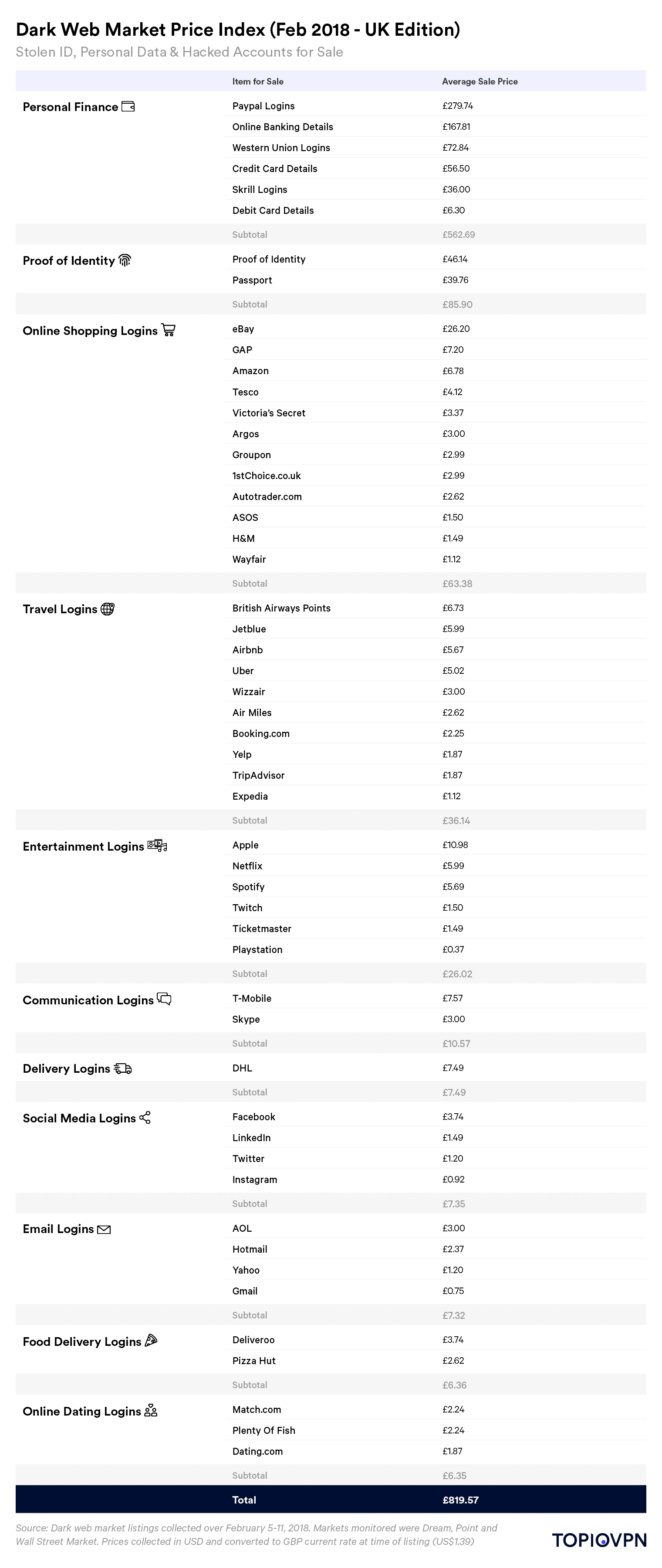
Your entire online identity could be worth little more than £800, according to brand new research into the illicit sale of stolen personal info on the dark web (or just $1,200 if you are in the United States, according to the US edition of the index). While it may be no surprise to learn that credit card details are the most traded, did you know that fraudsters are hacking Uber, Airbnb, Spotify and Netflix accounts and selling them for little more than £5 each?

Everything has a price on the dark web it seems. Paypal accounts with a healthy balance attract the highest prices (£280 on average). At the other end of the scale though, hacked Deliveroo or Tesco accounts sell for less than £5. Cybercriminals can easily spend more on their lunchtime sandwich than buying up stolen credentials for online shopping accounts like Argos (£3) and ASOS (£1.50).

The average person has dozens of accounts that form their online identity, all of which can be hacked and sold. Our team of security experts reviewed tens of thousands of listings on three of the most popular dark web markets, Dream, Point and Wall Street Market. These encrypted websites, which can only be reached using the Tor browser, allow criminals to anonymously sell stolen personal info, along with all sorts of other contraband, such as illicit drugs and weapons.

We focused on listings featuring stolen ID, hacked accounts and personal info relevant to the UK to create the Dark Web Market Price Index. We calculated average sale prices for each items and were shocked to see that £820 is all it would cost to buy up someone’s entire identity if they were to have all the listed items

Source: Dark Web Market Price Index (Feb 2018 – UK Edition) | Top10VPN.com

Hardcoded Password Found in Cisco Software

The hardcoded password issue affects Cisco’s Prime Collaboration Provisioning (PCP), a software application that can be used for the remote installation and maintenance of other Cisco voice and video products. Cisco PCP is often installed on Linux servers.

Cisco says that an attacker could exploit this vulnerability (CVE-2018-0141) by connecting to the affected system via Secure Shell (SSH) using the hardcoded password.
Flaw considered critical despite “local” attack vector

The flaw can be exploited only by local attackers, and it also grants access to a low-privileged user account. In spite of this, Cisco has classified the issue as “critical.”
Although this vulnerability has a Common Vulnerability Scoring System (CVSS) Base score of 5.9, which is normally assigned a Security Impact Rating (SIR) of Medium, there are extenuating circumstances that allow an attacker to elevate privileges to root. For these reasons, the SIR has been set to Critical.

The reasons are that an attacker can infect another device on the same network and use it as a proxy for his SSH connection to the vulnerable Cisco PCP instance, allowing for remote, over-the-Internet exploitation.

Source: Hardcoded Password Found in Cisco Software

Highly painful

Sandvine’s PacketLogic Devices Used to Deploy Government Spyware in Turkey and Redirect Egyptian Users to Affiliate Ads when trying to download popular software

This report describes our investigation into the apparent use of Sandvine/Procera Networks Deep Packet Inspection (DPI) devices to deliver nation-state malware in Turkey and indirectly into Syria, and to covertly raise money through affiliate ads and cryptocurrency mining in Egypt.
Key Findings

Through Internet scanning, we found deep packet inspection (DPI) middleboxes on Türk Telekom’s network. The middleboxes were being used to redirect hundreds of users in Turkey and Syria to nation-state spyware when those users attempted to download certain legitimate Windows applications.
We found similar middleboxes at a Telecom Egypt demarcation point. On a number of occasions, the middleboxes were apparently being used to hijack Egyptian Internet users’ unencrypted web connections en masse, and redirect the users to revenue-generating content such as affiliate ads and browser cryptocurrency mining scripts.
After an extensive investigation, we matched characteristics of the network injection in Turkey and Egypt to Sandvine PacketLogic devices. We developed a fingerprint for the injection we found in Turkey, Syria, and Egypt and matched our fingerprint to a second-hand PacketLogic device that we procured and measured in a lab setting.
The apparent use of Sandvine devices to surreptitiously inject malicious and dubious redirects for users in Turkey, Syria, and Egypt raises significant human rights concerns.

1. Summary

This report describes how we used Internet scanning to uncover the apparent use of Sandvine/Procera Networks Deep Packet Inspection (DPI) devices (i.e. middleboxes) for malicious or dubious ends, likely by nation-states or ISPs in two countries.
1.1. Turkey

We found that a series of middleboxes on Türk Telekom’s network were being used to redirect hundreds of users attempting to download certain legitimate programs to versions of those programs bundled with spyware. The spyware we found bundled by operators was similar to that used in the StrongPity APT attacks. Before switching to the StrongPity spyware, the operators of the Turkey injection used the FinFisher “lawful intercept” spyware, which FinFisher asserts is sold only to government entities.

Targeted users in Turkey and Syria who downloaded Windows applications from official vendor websites including Avast Antivirus, CCleaner, Opera, and 7-Zip were silently redirected to malicious versions by way of injected HTTP redirects. This redirection was possible because official websites for these programs, even though they might have supported HTTPS, directed users to non-HTTPS downloads by default. Additionally, targeted users in Turkey and Syria who downloaded a wide range of applications from CBS Interactive’s Download.com (a platform featured by CNET to download software) were instead redirected to versions containing spyware. Download.com does not appear to support HTTPS despite purporting to offer “secure download” links.1

Source: BAD TRAFFIC: Sandvine’s PacketLogic Devices Used to Deploy Government Spyware in Turkey and Redirect Egyptian Users to Affiliate Ads?

Artificial intelligence: Commission kicks off work on marrying cutting-edge technology and ethical standards

The Commission is setting up a group on artificial intelligence to gather expert input and rally a broad alliance of diverse stakeholders.

The expert group will also draw up a proposal for guidelines on AI ethics, building on today’s statement by the European Group on Ethics in Science and New Technologies.

From better healthcare to safer transport and more sustainable farming, artificial intelligence (AI) can bring major benefits to our society and economy. And yet, questions related to the impact of AI on the future of work and existing legislation are raised. This calls for a wide, open and inclusive discussion on how to use and develop artificial intelligence both successfully and ethically sound.
[…]
Today the Commission has opened applications to join an expert group in artificial intelligence which will be tasked to:

advise the Commission on how to build a broad and diverse community of stakeholders in a “European AI Alliance”;
support the implementation of the upcoming European initiative on artificial intelligence (April 2018);
come forward by the end of the year with draft guidelines for the ethical development and use of artificial intelligence based on the EU’s fundamental rights. In doing so, it will consider issues such as fairness, safety, transparency, the future of work, democracy and more broadly the impact on the application of the Charter of Fundamental Rights. The guidelines will be drafted following a wide consultation and building on today’s statement by the European Group on Ethics in Science and New Technologies (EGE), an independent advisory body to the European Commission.

Source: European Commission – PRESS RELEASES – Press release – Artificial intelligence: Commission kicks off work on marrying cutting-edge technology and ethical standards

Phishing and Attempted Stealing Incident on Binance VIA / BTC coins not only stopped, but costs hackers money

On Mar 7, UTC 14:58-14:59, within this 2 minute period, the VIA/BTC market experienced abnormal trading activity. Our automatic risk management system was triggered, and all withdrawals were halted immediately.

This was part of a large scale phishing and stealing attempt.

So far: All funds are safe and no funds have been stolen.

The hackers accumulated user account credentials over a long period of time. The earliest phishing attack seems to have dated back to early Jan. However it was around Feb 22, where a heavy concentration of phishing attacks were seen using unicode domains, looking very much like binance.com, with the only difference being 2 dots at the bottom of 2 characters. Many users fell for these traps and phishing attempts. After acquiring these user accounts, the hacker then simply created a trading API key for each account but took no further actions, until yesterday.

Yesterday, within the aforementioned 2 minute period, the hackers used the API keys, placed a large number of market buys on the VIA/BTC market, pushing the price high, while 31 pre-deposited accounts were there selling VIA at the top. This was an attempt to move the BTC from the phished accounts to the 31 accounts. Withdrawal requests were then attempted from these accounts immediately afterwards.

However, as withdrawals were already automatically disabled by our risk management system, none of the withdrawals successfully went out. Additionally, the VIA coins deposited by the hackers were also frozen. Not only did the hacker not steal any coins out, their own coins have also been withheld.

Source: Summary of the Phishing and Attempted Stealing Incident on Binance – Binance

MoviePass Is Tracking Your Location

According to Media Play News, MoviePass CEO Mitch Lowe had some interesting things to say during his Hollywood presentation that took place late last week, entitled “New Oil: How Will MoviePass Monetize It?” Most notably, he openly admitted that his app tracks people’s location, even when they’re not actively using the app:

“We get an enormous amount of information… We know all about. We watch how you drive from home to the movies. We watch where you go afterwards.”

Lowe also commented on how they knew subscribers’ addresses, their demographics, and how they can track subs via the app and the phone’s GPS. This drew nervous laughter from the crowd—many of whom were MoviePass subscribers themselves—but Lowe assured them that this collecting of tracking data fits into their long-term revenue plan. He explained that their vision is to “build a night at the movies,” with MoviePass eventually directing subscribers to places to eat before movies, and places to grab drinks afterward (all for a cut from the vendors).

We knew MoviePass was collecting data on us from the start—that’s how they plan to make their money—so how is this any different? Well, subscribers are claiming they didn’t clearly disclose such persistent location tracking in their privacy policy. In regard to location tracking, the privacy policy mentions a “single request” in a section titled “Check ins” that’s used when you’re selecting a theater and movie to watch. However, the section also mentions real-time location data “as a means to develop, improve and personalize the service.” It’s a vague statement that could mean just about anything, but it’s understandable if users didn’t assume it meant watching them wherever they went, even when they’re not using the app.

Source: MoviePass Is Tracking Your Location

Retina X ‘Stalkerware’ Shuts Down Apps ‘Indefinitely’ After Getting Hacked Again

A company that sells spyware to regular consumers is “immediately and indefinitely halting” all of its services, just a couple of weeks after a new damaging hack.

Retina-X Studios, which sells several products marketed to parents and employers to keep tabs on their children and employees—but also used by jealous partners to spy on their significant others—announced that its shutting down all its spyware apps on Tuesday with a message at the top of its website.

“Regrettably Retina-X Studios, which offers cutting edge technology that helps parents and employers gather important information on devices they own, has been the victim of sophisticated and repeated illegal hackings,” read the message, which was titled “important note” in all caps.

Got a tip? You can contact Lorenzo Franceschi-Bicchierai securely on Signal on +1 917 257 1382 and Joseph Cox on Signal on +44 20 8133 5190. Details on our SecureDrop, a system to anonymously submit documents or information, can be found here.

The company sells subscriptions to apps that allow the operator to access practically anything on a target’s phone or computer, such as text messages, emails, photos , and location information. Retina-X is just one of a slew of companies that sell such services, marketing them to everyday users—as opposed to law enforcement or intelligence agencies. Some critics call these apps “Stalkerware.”

Source: ‘Stalkerware’ Seller Shuts Down Apps ‘Indefinitely’ After Getting Hacked Again – Motherboard

ESA builds air-breathing engine that works in space

The European Space Agency has hailed the successful test of an air-breathing engine that works in space.

The engines don’t need the oxygen found in air to burn. Instead, as the ESA has explained here, the idea is to collect air, compress it, give it a charge and then squirt it out to provide thrust.

The engine has no moving parts and all that’s needed to power the engine is electricity. Spacecraft can generally harvest that from the Sun.

The concept’s been used before by the ESA’s GOCE gravity-mapping mission, but it carried 40kg of Xenon gas to provide it with thrust so it could change altitude when its orbit became low. And once it ran out of propellant … you can guess the rest.

Hence the interest in an engine that can harvest air to keep a satellite aloft and in very low orbits. Anything in such an orbit that wants to stay there will need a periodic boost, as the drag caused by the outer reaches of the atmosphere slow spacecraft and degrade their orbits.

Source: ESA builds air-breathing engine that works in space • The Register

Researchers Bypassed Windows Password Locks With Cortana Voice Commands

Tal Be’ery and Amichai Shulman found that the always-listening Cortana agent responds to some voice commands even when computers are asleep and locked, allowing someone with physical access to plug a USB with a network adapter into the computer, then verbally instruct Cortana to launch the computer’s browser and go to a web address that does not use https—that is, a web address that does not encrypt traffic between a user’s machine and the website. The attacker’s malicious network adapter then intercepts the web session to send the computer to a malicious site instead, where malware downloads to the machine, all while the computer owner believes his or her machine is protected.

Source: Researchers Bypassed Windows Password Locks With Cortana Voice Commands – Motherboard

Leaked Files Show How the NSA Tracks Other Countries’ Hackers

When the mysterious entity known as the “Shadow Brokers” released a tranche of stolen NSA hacking tools to the internet a year ago, most experts who studied the material homed in on the most potent tools, so-called zero-day exploits that could be used to install malware and take over machines. But a group of Hungarian security researchers spotted something else in the data, a collection of scripts and scanning tools that the National Security Agency uses to detect other nation-state hackers on the machines it infects.

It turns out those scripts and tools are just as interesting as the exploits. They show that in 2013 — the year the NSA tools were believed to have been stolen by the Shadow Brokers — the agency was tracking at least 45 different nation-state operations, known in the security community as advanced persistent threats, or APTs. Some of these appear to be operations known by the broader security community — but some may be threat actors and operations currently unknown to researchers.

The scripts and scanning tools dumped by Shadow Brokers and studied by the Hungarians were created by an NSA team known as Territorial Dispute, or TeDi. Intelligence sources told The Intercept that the NSA established the team after hackers, believed to be from China, stole designs for the military’s Joint Strike Fighter plane, along with other sensitive data, from U.S. defense contractors in 2007; the team was supposed to detect and counter sophisticated nation-state attackers more quickly, when they first began to emerge online.

“As opposed to the U.S. only finding out in five years that everything was stolen, their goal was to try to figure out when it was being stolen in real time,” one intelligence source told The Intercept.

But their mission evolved to also provide situational awareness for NSA hackers to help them know when other nation-state actors are in machines that they’re trying to hack.

Source: Leaked Files Show How the NSA Tracks Other Countries’ Hackers

If you’re so smart, why aren’t you rich? Turns out it’s just chance.

The most successful people are not the most talented, just the luckiest, a new computer model of wealth creation confirms. Taking that into account can maximize return on many kinds of investment.
[…]
The distribution of wealth follows a well-known pattern sometimes called an 80:20 rule: 80 percent of the wealth is owned by 20 percent of the people. Indeed, a report last year concluded that just eight men had a total wealth equivalent to that of the world’s poorest 3.8 billion people.
[…]
while wealth distribution follows a power law, the distribution of human skills generally follows a normal distribution that is symmetric about an average value. For example, intelligence, as measured by IQ tests, follows this pattern. Average IQ is 100, but nobody has an IQ of 1,000 or 10,000.

The same is true of effort, as measured by hours worked. Some people work more hours than average and some work less, but nobody works a billion times more hours than anybody else.

And yet when it comes to the rewards for this work, some people do have billions of times more wealth than other people. What’s more, numerous studies have shown that the wealthiest people are generally not the most talented by other measures.
[…]
Alessandro Pluchino at the University of Catania in Italy and a couple of colleagues. These guys have created a computer model of human talent and the way people use it to exploit opportunities in life. The model allows the team to study the role of chance in this process.

The results are something of an eye-opener. Their simulations accurately reproduce the wealth distribution in the real world. But the wealthiest individuals are not the most talented (although they must have a certain level of talent). They are the luckiest.
[…]
Pluchino and co’s model is straightforward. It consists of N people, each with a certain level of talent (skill, intelligence, ability, and so on). This talent is distributed normally around some average level, with some standard deviation. So some people are more talented than average and some are less so, but nobody is orders of magnitude more talented than anybody else.
[…]
The computer model charts each individual through a working life of 40 years. During this time, the individuals experience lucky events that they can exploit to increase their wealth if they are talented enough.

However, they also experience unlucky events that reduce their wealth. These events occur at random.

At the end of the 40 years, Pluchino and co rank the individuals by wealth and study the characteristics of the most successful. They also calculate the wealth distribution. They then repeat the simulation many times to check the robustness of the outcome.

When the team rank individuals by wealth, the distribution is exactly like that seen in real-world societies. “The ‘80-20’ rule is respected, since 80 percent of the population owns only 20 percent of the total capital, while the remaining 20 percent owns 80 percent of the same capital,” report Pluchino and co.

That may not be surprising or unfair if the wealthiest 20 percent turn out to be the most talented. But that isn’t what happens. The wealthiest individuals are typically not the most talented or anywhere near it. “The maximum success never coincides with the maximum talent, and vice-versa,” say the researchers.

So if not talent, what other factor causes this skewed wealth distribution? “Our simulation clearly shows that such a factor is just pure luck,” say Pluchino and co.

The team shows this by ranking individuals according to the number of lucky and unlucky events they experience throughout their 40-year careers. “It is evident that the most successful individuals are also the luckiest ones,” they say. “And the less successful individuals are also the unluckiest ones.”
[…]
They use their model to explore different kinds of funding models to see which produce the best returns when luck is taken into account.

The team studied three models, in which research funding is distributed equally to all scientists; distributed randomly to a subset of scientists; or given preferentially to those who have been most successful in the past. Which of these is the best strategy?

The strategy that delivers the best returns, it turns out, is to divide the funding equally among all researchers. And the second- and third-best strategies involve distributing it at random to 10 or 20 percent of scientists.

In these cases, the researchers are best able to take advantage of the serendipitous discoveries they make from time to time. In hindsight, it is obvious that the fact a scientist has made an important chance discovery in the past does not mean he or she is more likely to make one in the future.

A similar approach could also be applied to investment in other kinds of enterprises, such as small or large businesses, tech startups, education that increases talent, or even the creation of random lucky events.

Source: If you’re so smart, why aren’t you rich? Turns out it’s just chance.

Internet of Babies – 52000 baby monitors open for public viewing

Earlier this month, we published our first article of our Internet of Things series, “IoD – Internet of Dildos“. As promised, we expanded our research and would like to present you with the first results of our “IoB – Internet of Babies” research.

Baby monitors serve an important purpose in securing and monitoring our loved ones. Unfortunately, the investigated device “Mi-Cam” from miSafes (and potentially further devices) is affected by a number of critical security vulnerabilities which raise serious security and privacy concerns. An attacker is able to access and interact with arbitrary video baby monitors and hijack other user accounts. Based on observed user identifier values extracted from the cloud API and Google Play store data, an estimated total number over 52000 user accounts and video baby monitors are affected (implying a 1:1 distribution of user accounts to video baby monitors). Even worse, neither the vendor nor the CNCERT/CC could be reached for the coordination for our responsible disclosure process. Hence the issues are (up until the publication of this article) not patched and our recommendation is to keep the video baby monitors offline until further notice.

Source: Internet of Babies – When baby monitors fail to be smart | SEC Consult

The “Black Mirror” scenarios that are leading some experts to call for more secrecy on AI – MIT Technology Review

a new report by more than 20 researchers from the Universities of Oxford and Cambridge, OpenAI, and the Electronic Frontier Foundation warns that the same technology creates new opportunities for criminals, political operatives, and oppressive governments—so much so that some AI research may need to be kept secret.

Included in the report, The Malicious Use of Artificial Intelligence: Forecasting, Prevention, and Mitigation, are four dystopian vignettes involving artificial intelligence that seem taken straight out of the Netflix science fiction show Black Mirror.

Source: The “Black Mirror” scenarios that are leading some experts to call for more secrecy on AI – MIT Technology Review

This is completely ridiculous. The knowledge is out there and if not, will be stolen. In that case, if you don’t know about potential attack vectors, you are completely defenseless against them and so are security firms trying to help you.

Besides this, basing security on Movie Plots you can think up (and I’m pretty sure any reader can think up loads more, quite easily!) doesn’t work, because then you are vulnerable to any of the movie plots the other thought up and you didn’t.

Good security is basic and intrinsic. AI / ML is here and we need a solid discussion in our societies as to how we want it to impact us, instead of all this cold war fear mongering.

IBM Finds Fortune 500 Companies will lose $9 billion to phishing scams in 2018 – this is what these attacks look like

IBM X-Force Incident Response and Intelligence Services (IRIS) assesses that threat groups of likely Nigerian origin are engaged in a widespread credential harvesting, phishing and social engineering campaign designed to steal financial assets. Beginning in the fall of 2017, X-Force IRIS experienced a significant increase in clients reporting instances of fraud or attempted fraud via wire transfer payments. These threat groups successfully used business email compromise (BEC) scams to convince accounts payable personnel at some Fortune 500 companies to initiate fraudulent wire transfers into attacker-controlled accounts, resulting in the theft of millions of dollars.
[…]
Business email compromise scams involve taking over or impersonating a trusted user’s email account to target companies that conduct international wire transfers with the goal of diverting payments to an attacker-controlled account.

These attacks are almost entirely based on phishing and social engineering, and are thus attractive to cybercriminals due to their relative simplicity. In most cases, BEC scams involve little to no technical knowledge, malware or special tools.

A recent report by Trend Micro predicted that BEC attacks will comprise over $9 billion in losses in 2018, up from $5.3 billion at the end of 2016. According to the FBI, BEC scams have been reported in every U.S. state and across 131 nations, and have resulted in high-profile arrests.
[…]
The following tactics were common to the attacks examined by X-Force IRIS researchers:

Phishing emails were sent either directly from or spoofed to appear to be from known contacts in the target employee’s address book.

Attackers mimicked previous conversations or inserted themselves into current conversations between business email users.

Attackers masqueraded as a known contact from a known vendor or associated company and requested that wire payments be sent to an “updated” bank account number or beneficiary.

Attackers created mail filters to ensure that communications were conducted only between the attacker and victim and, in some cases, to monitor a compromised user’s inbox.

In cases in which additional approval or paperwork was needed, the attackers found and filled out appropriate forms and spoofed supervisor emails to get required approvals.

Without the use of any malware, and with legitimate stakeholders performing the actual transactions, traditional detection tools and spam filters failed to identify evidence of a compromise.
[…]
The BEC scams identified by IBM incident responders consist of two separate but connected goals. The first is to harvest mass amounts of business user credentials, and the second is to use these credentials to impersonate their rightful owners and ultimately trick employees into diverting fund transfers to bank accounts the attackers control.

To achieve the first goal, the attackers used credential sets they had already compromised to send a mass phishing email to the user’s internal and external contacts. The phish was often sent to several hundred contacts at a time and was engineered to look legitimate to the spammed contacts.
[…]
To accomplish the second goal, the attackers focused on stolen credentials from companies that use single-factor authentication and an email web portal. For example, companies that only require a username and password for employees to access their Microsoft Office 365 accounts were compromised. Using email web portals ensured the attackers’ ability to complete these attacks online and without compromising the victim’s corporate network. The attackers specifically targeted personnel involved in the organization’s accounts payable departments to ensure that the victim had access to the company’s bank accounts.

Before engaging with any employee, the attackers likely undertook a reconnaissance phase, looking through activity within the user’s email folders in search of subjects and opportunities to exploit and, eventually, creating or inserting themselves into relevant conversations.
[…]
Since the attackers conducted correspondence from a victim user’s email, they created email rules to keep the victim unaware of the compromise. In cases in which the attackers impersonated the user, the attackers auto-deleted all emails delivered from within the user’s company. They likely did this to prevent the user from seeing any fraudulent correspondence or unusual messages in his or her inbox. Additionally, the attacker auto-forwarded email responses to a different email to read the responses without logging in to the compromised account.

Separately, when attackers used stolen credentials to send mass phishing emails, they simultaneously set up an email rule to filter all responses to the phish, undelivered messages, or messages containing words such as “hacked” or “email” to the user’s RSS feeds folder and marked them as read.

Source: IBM X-Force IRIS Uncovers Active Business Email Compromise Campaign Targeting Fortune 500 Companies

Glitch on Bitcoin Exchange Drops Prices to Zero Dollars, User Tries to Make Off With Trillions

Zaif, A cryptocurrency exchange in Japan reportedly experienced a temporary glitch last week that suddenly offered investors their pick of coins for the low, low price of zero dollars. Several customers took advantage of the opportunity, but one really ran with it.

According to Reuters, it was possible to buy cryptocurrencies for free on the Zaif exchange for about 20 minutes on February 16th. The exchange reportedly revealed the problem to reporters on Tuesday.
[…]
there’s still one customer that’s putting up a fight over their heavily-discounted purchase. How much did they try to pull out? According to Japanese outlet Asahi Shimbun, one customer apparently “purchased” 2,200 trillion yen worth of bitcoin and proceeded to try to cash it out. That’s about $20 trillion. Considering the fact that Bitcoin has a market cap of just over $183 billion, that sell order really must have confused some traders for a bit.

Reuters points out that the glitch couldn’t have come at a worse time for the Japanese cryptocurrency exchange business. Following the recent $400 million heist at the Japanese exchange Coincheck, two separate industry groups have agreed to form a self-regulating body that would strive to protect investors with stronger safeguards. It would also, presumably, demonstrate to authorities that they don’t need to get involved. The Japanese yen is by far the most exchanged national currency in the Bitcoin world, so attracting regulations would have a global impact.

Source: Glitch on Bitcoin Exchange Drops Prices to Zero Dollars, User Tries to Make Off With Trillions

The Car of the Future Will Sell Your Data

Picture this: You’re driving home from work, contemplating what to make for dinner, and as you idle at a red light near your neighborhood pizzeria, an ad offering $5 off a pepperoni pie pops up on your dashboard screen.

Are you annoyed that your car’s trying to sell you something, or pleasantly persuaded? Telenav Inc., a company developing in-car advertising software, is betting you won’t mind much. Car companies—looking to earn some extra money—hope so, too.

Automakers have been installing wireless connections in vehicles and collecting data for decades. But the sheer volume of software and sensors in new vehicles, combined with artificial intelligence that can sift through data at ever-quickening speeds, means new services and revenue streams are quickly emerging. The big question for automakers now is whether they can profit off all the driver data they’re capable of collecting without alienating consumers or risking backlash from Washington.

“Carmakers recognize they’re fighting a war over customer data,” said Roger Lanctot, who works with automakers on data monetization as a consultant for Strategy Analytics. “Your driving behavior, location, has monetary value, not unlike your search activity.”

Carmakers’ ultimate objective, Lanctot said, is to build a database of consumer preferences that could be aggregated and sold to outside vendors for marketing purposes, much like Google and Facebook do today.
[…]
Telenav, the Silicon Valley company looking to bring pop-up ads to your infotainment screen, has been testing a “freemium” model borrowed from streaming music services to entice drivers to share their data.

Say you can’t afford fancy features like embedded navigation or the ability to start your car through a mobile app. The original automaker will install them for free, so long as you’re willing to tolerate the occasional pop-up ad while idling at a red light. Owners of luxury cars won’t have to suffer such indignities, since the higher price tag paid likely would have already included an internet connection.
[…]
The pop-up car ads could generate an average of $30 annually per vehicle, to be split between Telenav and the automaker. He declined to say whether anyone has signed up for the software, which was just unveiled at CES, but added Telenav is in “deep discussions” with several manufacturers. Because of the long production cycles of the industry, it’ll be about three years before the ads will show up in new models.

Source: The Car of the Future Will Sell Your Data – Bloomberg

of course they bring in the fear factor, they wouldn’t be honest and talk about the profit factor. As soon as people start trying to scare you, you know they are trying to con you.

Auto executives emphasize that data-crunching will allow them to build a better driving experience—enabling cars to predict flat tires, find a parking space or charging station, or alert city managers to dangerous intersections where there are frequent accidents. Data collection could even help shield drivers from crime, Ford Motor Co.’s chief executive officer said last month at the CES technology trade show.

“If a robber got in the car and took off, would you want us to know where that robber went to catch him?” Jim Hackett asked the audience during a keynote in Las Vegas. “Are you willing to trade that?”

You spend huge amounts on a car, I really really don’t want it sending information back to the maker, much less having the maker sell that data!

Tesla accused of knowingly selling defective vehicles in new lawsuit

A former Tesla employee claims the company knowingly sold defective cars, often referred to as “lemons,” and that he was demoted and eventually fired after reporting the practice to his superiors. He made these allegations in a lawsuit filed in late January in New Jersey Superior Court under the Conscientious Employee Protection Act (CEPA).The former employee, Adam Williams, worked for Tesla as a regional manager in New Jersey dating back to late 2011. While there, he says he watched the company fail “to disclose to consumers high-dollar, pre-delivery damage repairs” before delivering its vehicles, according to the complaint. Instead, he says the company sold these cars as “used,” or labeled as “demo/loaner” vehicles.
[…]
This is not the first time Tesla has dealt with a lawsuit that involved accusations of lemon law issues. The company settled a lawsuit with a Model X owner in 2016 who complained about problems with the doors and software of his vehicle.

Source: Tesla accused of knowingly selling defective vehicles in new lawsuit – The Verge

Ouch. Sounds like something Musk would do though.