The Linkielist

Linking ideas with the world

The Linkielist

MindBody-owned FitMetrix exposed millions of user records — thanks to servers without passwords – AWS strikes again

FitMetrix, a fitness technology and performance tracking company owned by gym booking giant Mindbody, has exposed millions of user records because it left several of its servers without a password.

The company builds fitness tracking software for gyms and group classes — like CrossFit and SoulCycle — that displays heart rate and other fitness metric information for interactive workouts. FitMetrix was acquired by gym and wellness scheduling service Mindbody earlier this year for $15.3 million, according to a government filing.

Last week, a security researcher found three FitMetrix unprotected servers leaking customer data.

It isn’t known how long the servers had been exposed, but the servers were indexed by Shodan, a search engine for open ports and databases, in September.

The servers included two of the same ElasticSearch instances and a storage server — all hosted on Amazon Web Service — yet none were protected by a password, allowing anyone who knew where to look to access the data on millions of users.

Bob Diachenko, Hacken.io’s director of cyber risk research, found the databases containing 113.5 million records — though it’s not known how many users were directly affected. Each record contained a user’s name, gender, email address, phone numbers, profile photos, their primary workout location, emergency contacts and more. Many of the records were not fully complete.

Source: MindBody-owned FitMetrix exposed millions of user records — thanks to servers without passwords | TechCrunch

The US Democracy is turning away so many people at polling stations, they need a What to Do If You’re Turned Away at the Polls guide

Several states have instituted stricter voter ID laws since the 2016 presidential election; more, still, are purging voter rolls in the lead up to the election, and the recent Supreme Court decision to uphold Ohio’s aggressive purging law means you can expect many more people to be removed. So, even if you’re registered to vote (and you should really double check) you might find yourself turned away at the polls come November 6.

Source: What to Do If You’re Turned Away at the Polls

One man, one vote? Not so much. Two parties and no voters.

Why are Xiaomi’s fitness tracker and Apple watches detecting a heartbeat from a roll of toilet paper and bananas?

Why is Xiaomi’s fitness tracker detecting a heartbeat from a roll of toilet paper?

Weibo users are confused, but the answer isn’t as wild as it seems

Does a roll of toilet paper have a heart? Obviously not. So why does Xiaomi’s fitness band display a heart rate when it’s wrapped around a roll of toilet paper?

Weibo users have been discussing the phenomenon, with plenty of pictures from mystified users who say the Xiaomi Mi Band 3 fitness tracker is “detecting” a heart rate on toilet paper.

So we decided to get a Mi Band 3 — and of course, a roll of toilet paper — to check it out.

Bizarrely, it’s true.

It didn’t work all the time — only around a quarter of attempts gave us a heartbeat. The numbers were pretty random (ranging from 59bpm to 88bpm), but they were real.

So what about other objects? We tried wrapping the Mi Band 3 around a mug, because we had a mug, and a banana, because the internet likes bananas. Both gave us a heart rate quickly and far more consistently than the toilet paper did.

59bpm? That roll of toilet paper is so chill right now. (Picture: Abacus)

But the Xiaomi band isn’t alone. We also tried the banana and mug with an Apple Watch Series 4 and a Ticwatch, an Android Wear smartwatch. Both also displayed a heartbeat for the two heartless objects, ranging from 33bpm on the banana (Apple Watch) to 130bpm for the mug (Ticwatch).

Source: Why is Xiaomi’s fitness tracker detecting a heartbeat from a roll of toilet paper? | Abacus

Pentagon’s weapons systems are laughably easy to hack

New computerized weapons systems currently under development by the US Department of Defense (DOD) can be easily hacked, according to a new report published today.

The report was put together by the US Government Accountability Office (GAO), an agency that provides auditing, evaluation, and investigative services for Congress.

Congress ordered the GAO report in preparation to approve DOD funding of over $1.66 trillion, so the Pentagon could expand its weapons portfolio with new toys in the coming years.

But according to the new report, GAO testers “playing the role of adversary” found a slew of vulnerabilities of all sort of types affecting these new weapons systems.

“Using relatively simple tools and techniques, testers were able to take control of systems and largely operate undetected, due in part to basic issues such as poor password management and unencrypted communications,” GAO officials said.

The report detailed some of the most eye-catching hacks GAO testers performed during their analysis.

In one case, it took a two-person test team just one hour to gain initial access to a weapon system and one day to gain full control of the system they were testing.

Some programs fared better than others. For example, one assessment found that the weapon system satisfactorily prevented unauthorized access by remote users, but not insiders and near-siders. Once they gained initial access, test teams were often able to move throughout a system, escalating their privileges until they had taken full or partial control of a system.

In one case, the test team took control of the operators’ terminals. They could see, in real-time, what the operators were seeing on their screens and could manipulate the system. They were able to disrupt the system and observe how the operators responded.

Another test team reported that they caused a pop-up message to appear on users’ terminals instructing them to insert two quarters to continue operating.

Multiple test teams reported that they were able to copy, change, or delete system data including one team that downloaded 100 gigabytes, approximately 142 compact discs, of data.

One test report indicated that the test t eam was able to guess an administrator password in nine seconds.

For example, in some cases, simply scanning a system caused parts of the system to shut down. One test had to be stopped due to safety concerns after the test team scanned the system.

Nearly all major acquisition programs that were operationally tested between 2012 and 2017 had mission-critical cyber vulnerabilities that adversaries could compromise.

Source: Pentagon’s new next-gen weapons systems are laughably easy to hack | ZDNet

Who would have thought it – after they decided to use  Windows (95) for Warships

AI lifeline to help devs craft smartmobe apps that suck a whole lot less… battery capacity

Artificial intelligence can help developers design mobile phone apps that drain less battery, according to new research.

The system, dubbed DiffProff, will be presented this week at the USENIX Symposium on Operating Systems Design and Implementation conference in California, was developed by Charlie Hu and Abhilash Jindal, who have a startup devoted to better battery testing via software.

DiffProf rests on the assumption that apps that carry out the same function perform similar tasks in slightly different ways. For example, messaging apps like Whatsapp, Google Hangouts, or Skype, keep old conversations and bring up a keyboard so replies can be typed and sent. Despite this, Whatsapp is about three times more energy efficient than Skype.

“What if a feature of an app needs to consume 70 percent of the phone’s battery? Is there room for improvement, or should that feature be left the way it is?” said Hu, who is also a professor of electrical and computer engineering at Purdue University.

The research paper describing DiffProf is pretty technical. Essentially, it describes a method that uses “differential energy profiling” to create energy profiles for different apps. First, the researchers carry out a series of automated tests on apps by performing identical tasks on each app to work out energy efficiency.

Next, the profile also considers the app’s “call tree” also known as a call graph. These describe the different computer programs that are executed in order to perform a broader given task.

Apps that have the same function, like playing music or sending emails, should have similar call trees. Slight variances in the code, however, lead to different energy profiles. DiffProf uses an algorithm to compare the call trees and highlights what programs are causing an app to drain more energy.

Developers running the tool receive a list of Java packages, that describe the different software features, which appear in the both apps being compared. They can then work out which programs in the less energy efficient app suck up more juice and if it can be altered or deleted altogether. The tool is only useful if the source code for similar apps have significant overlap.

Source: AI lifeline to help devs craft smartmobe apps that suck a whole lot less… battery capacity • The Register

DoNotPay App Lets You ‘Sue Anyone By Pressing a Button’. Success rate: 50%

a new, free app promises to let you “sue anyone by pressing a button” and have an AI-powered lawyer fight your case.

Do Not Pay, a free service that launched in the iOS App store today, uses IBM Watson-powered artificial intelligence to help people win up to $25,000 in small claims court. It’s the latest project from 21-year-old Stanford senior Joshua Browder, whose service previously allowed people to fight parking tickets or sue Equifax; now, the app has streamlined the process. It’s the “first ever service to sue anyone (in all 3,000 counties in 50 states) by pressing a button.”

The crazy part: the robot lawyer actually wins in court. In its beta testing phase, which included releases in the UK and in select numbers across all 50 US states, Do Not Pay has helped its users get back $16 million in disputed parking tickets. In a phone call with Motherboard, Browder said that the success rate of Do Not Pay is about 50 percent, with average winnings of about $7,000.

[…]

The app works by having a bot ask the user a few basic questions about their legal issue. The bot then uses the answers to classify the case into one of 15 different legal areas, such as breach of contract or negligence. After that, Do Not Pay draws up documents specific to that legal area, and fills in the specific details. Just print it out, mail it to the courthouse, and violá—you’re a plaintiff. And if you have to show up to court in person, Do Not Pay even creates a script for the plaintiff to read out loud in court.

[…]

Browder told Motherboard that data protection is a central part of his service, which is free (users keep 100 percent of what they win in court, Browder says.) Per Do Not Pay’s privacy policy, all user data is protected with 256-bit encryption, and no third parties get access to personal user information such as home address, email address, or information pertaining to a particular case.

[…]

Of all of Do Not Pay’s legal disputes, Browder told Motherboard that he’s most proud of an instance where a woman took Equifax to court and won, twice. After her data was compromised by Equifax last year, she took the $3 billion company to small claims court and won. When Equifax appealed the verdict and sent a company lawyer to fight for an appeal, the woman won again.

Source: DoNotPay App Lets You ‘Sue Anyone By Pressing a Button’

World’s largest CCTV maker Xiongmai leaves at least 9 million cameras open to public viewing

Yet another IoT device vendor has been found to be exposing their products to attackers with basic security lapses.

This time, it’s Chinese surveillance camera maker Xiongmai who was named and shamed by researchers with SEC Consult for the poor security in the XMEye P2P Cloud service. Among the problems researchers pointed to were exposed default credentials and unsigned firmware updates that could be delivered via the service.

As a result, SEC Consult warns, the cameras could be compromised to do everything from spy on their owners, to carry out botnet instructions and even to serve as an entry point for larger network intrusions.

“Our recommendation is to stop using Xiongmai and Xiongmai OEM devices altogether,” SEC Consult recommended.

“The company has a bad security track record including its role in Mirai and various other IoT botnets. There are vulnerabilities that have been published in 2017, which are still not fixed in the most recent firmware version.”

Enabled by default, the P2P Cloud service allows users to remotely connect to devices via either a web browser or an iOS/Android app and control the hardware without needing a local network connection.

Source: World’s largest CCTV maker leaves at least 9 million cameras open to public viewing • The Register

Google shutting down Google+ after exposing data of up to 500,000 users and not disclosing breach

A vulnerability in the Google+ social network exposed the personal data of up to 500,000 people using the site between 2015 and March 2018, the search giant said Monday.

Google said it found no evidence of data misuse. Still, as part of the response to the incident, Google plans to shut down the social network permanently.

The company didn’t disclose the vulnerability when it fixed it in March because the company didn’t want to invite regulatory scrutiny from lawmakers, according to a report Monday by The Wall Street Journal. Google CEO Sundar Pichai was briefed on the decision to not disclose the finding, after an internal committee had already decided the plan, the Journal said.

Google said it found the bug as part of an internal review called Project Strobe, an audit started earlier this year that examines access to user data from Google accounts by third-party software developers. The bug gave apps access to information on a person’s Google+ profile that can be marked as private. That includes details like email addresses, gender, age, images, relationship statuses, places lived and occupations. Up to 438 applications on Google Plus had access to this API, though Google said it has no evidence any developers were aware of the vulnerability.

Source: Google shutting down Google+ after exposing data of up to 500,000 users – CNET

The real story here is that they didn’t disclose.

Nanoscale pillars as a building block for future information technology

Researchers from Linköping University and the Royal Institute of Technology in Sweden have proposed a new device concept that can efficiently transfer the information carried by electron spin to light at room temperature—a stepping stone toward future information technology. They present their approach in an article in Nature Communications.

Light and electron charge are the main media for information processing and transfer. In the search for information technology that is even faster, smaller and more energy-efficient, scientists around the globe are exploring another property of —their spin. Electronics that exploit both the spin and the charge of the electron are called “spintronics.”

[…]

“The main problem is that electrons easily lose their spin orientations when the temperature rises. A key element for future spin-light applications is efficient quantum information transfer at room temperature, but at room temperature, the electron spin orientation is nearly randomized.
[…]

Now, researchers from Linköping University and the Royal Institute of Technology have devised an efficient spin-light interface.

“This interface can not only maintain and even enhance the electron spin signals at . It can also convert these spin signals to corresponding chiral light signals travelling in a desired direction,” says Weimin Chen.

The key element of the device is extremely small disks of gallium nitrogen arsenide, GaNAs. The disks are only a couple of nanometres high and stacked on top of each other with a thin layer of gallium arsenide (GaAs) between to form chimney-shaped nanopillars. For comparison, the diameter of a human hair is about a thousand times larger than the diameter of the nanopillars.

The unique ability of the proposed device to enhance spin signals is due to minimal defects introduced into the material by the researchers. Fewer than one out of a million gallium atoms are displaced from their designated lattice sites in the material. The resulting defects in the material act as efficient spin filters that can drain electrons with an unwanted spin orientation and preserve those with the desired spin orientation.

“An important advantage of the nanopillar design is that light can be guided easily and more efficiently coupled in and out,” says Shula Chen, first author of the article.

Read more at: https://phys.org/news/2018-10-nanoscale-pillars-block-future-technology.html#jCp

Read more at: https://phys.org/news/2018-10-nanoscale-pillars-block-future-technology.html#jCp

Source: Nanoscale pillars as a building block for future information technology

Inside Hurricane Maria in 360°

Two days before Hurricane Maria devastated Puerto Rico, the NASA-Japan Global Precipitation Measurement Core Observatory satellite captured a 3-D view of the storm. At the time Maria was a Category 1 hurricane. The 3-D view reveals the processes inside the hurricane that would fuel the storm’s intensification to a category 5 within 24 hours. For the first time in 360-degrees, this data visualization takes you inside the hurricane. The precipitation satellite has an advanced radar that measures both liquid and frozen water. The brightly colored dots show areas of rainfall, where green and yellow show low rates and red and purple show high rates. At the top of the hurricane, where temperatures are colder, blue and purple dots show light and heavy frozen precipitation. The colored areas below the dots show how much rain is falling at the surface.

California bans default passwords on any internet-connected device

In less than two years, anything that can connect to the internet will come with a unique password — that is, if it’s produced or sold in California. The “Information Privacy: Connected Devices” bill that comes into effect on January 1, 2020, effectively bans pre-installed and hard-coded default passwords. It only took the authorities about two weeks to approve the proposal made by the state senate.

The new regulation mandates device manufacturers to either create a unique password for each device at the time of production or require the user to create one when they interact with the device for the first time. According to the bill, it applies to any connected device, which is defined as a “physical object that is capable of connecting to the Internet, directly or indirectly, and that is assigned an Internet Protocol address or Bluetooth address.”

The law is clearly aimed at stopping the spread of botnets made up of compromised network devices, such as routers, smart switches or even security cameras and other IoT equipment. Malicious software could often take control of them by trying easy-to-guess or publicly disclosed default login credentials. It’s not entirely clear yet as to how the new regulation will affect legacy industry hardware from the 1980s and 1990s where passwords are either hard-coded or next to impossible to change.

Source: California bans default passwords on any internet-connected device

A simple and very effective start to legislation on IoT

iPhone Shortcut Automatically Records Police, turns off face and fingerprint ID

According to Mic, Reddit user Robert Peterson created a trick using the virtual assistant, Siri, that lowers the phone’s brightness, turns on Do Not Disturb, texts the iPhone owner’s location to an emergency contact and lets them know you have been pulled over by police. The shortcut will also automatically start recording video and, when finished, the phone will send the video to the contact or save it to a cloud service.

The shortcut is available here, while another user created a workflow that automatically reboots the phone, rendering the fingerprint or face ID feature useless until a person enters a passcode. The Washington Post reports that police can’t legally compel a suspect to give up the passcode, although they can force a phone owner to use fingerprint ID or a face scan.

“I noticed in news articles and reports on TV that in many cases, police say one thing happened and the citizen pulled over says something else,” Peterson told Mic. “Sometimes police have body cameras, sometimes not. When they do, the video is not always released in a timely manner. I wanted a way for the person being pulled over to have a record for themselves.”

Source: iPhone Shortcut Automatically Records Police

Sans Forgetica font May Help You Remember What You Read

We’re all used to skimming past the boring parts of a reading assignment or a web article. But when researchers from RMIT University in Australia printed information in a weird, hard-to-read font, they found that people were more likely to remember what they read.

There’s a sweet spot, their experiments suggest: If the font is too chaotic, it becomes too hard to read. So they settled on small tweaks: gaps in the lines of the letters, and a slight backwards tilt (the opposite direction as the slant in more-familiar italic type).

The resulting font is called Sans Forgetica and you can download it here. The researchers also created a Chrome extension that will render any web page in Sans Forgetica, the better to study with. But don’t use it everywhere: they suspect that if we get too used to reading in Sans Forgetica, its memory-boosting effect will fade.

Source: Sans Forgetica May Help You Remember What You Read

Researchers Created ‘Quantum Artificial Life’ For the First Time

For the first time, an international team of researchers has used a quantum computer to create artificial life—a simulation of living organisms that scientists can use to understand life at the level of whole populations all the way down to cellular interactions.

With the quantum computer, individual living organisms represented at a microscopic level with superconducting qubits were made to “mate,” interact with their environment, and “die” to model some of the major factors that influence evolution.

The new research, published in Scientific Reports on Thursday, is a breakthrough that may eventually help answer the question of whether the origin of life can be explained by quantum mechanics, a theory of physics that describes the universe in terms of the interactions between subatomic particles.

Modeling quantum artificial life is a new approach to one of the most vexing questions in science: How does life emerge from inert matter, such as the “primordial soup” of organic molecules that once existed on Earth?

[…]

Individuals were represented in the model using two qubits. One qubit represented the individual’s genotype, the genetic code behind a certain trait, and the other its phenotype, or the physical expression of that trait.

To model self-replication, the algorithm copied the expectation value (the average of the probabilities of all possible measurements) of the genotype to a new qubit through entanglement, a process that links qubits so that information is instantaneously exchanged between them. To account for mutations, the researchers encoded random qubit rotations into the algorithm that were applied to the genotype qubits.

The algorithm then modeled the interaction between the individual and its environment, which represented aging and eventually death. This was done by taking the new genotype from the self-replicating action in the previous step and transferring it to another qubit via entanglement. The new qubit represented the individual’s phenotype. The lifetime of the individual—that is, how long it takes the information to degrade or dissipate through interaction with the environment—depends on the information coded in this phenotype.

Finally, these individuals interacted with one another. This required four qubits (two genotypes and two phenotypes), but the phenotypes only interacted and exchanged information if they met certain criteria as coded in their genotype qubits.

Source: Researchers Created ‘Quantum Artificial Life’ For the First Time – Motherboard

Japan’s silent submarines extend range with li-ion batteries

The Oryu is the eleventh submarine based on the Soryu’s design. Soryu-class vessels, which started being built in 2005, are among the largest diesel-electric submarines in the world.

But the Oryu is a vastly updated version of the Soryu, the biggest change being the replacement of lead-acid batteries with lithium-ion ones. Mitsubishi Heavy tapped GS Yuasa to supply the high-performance batteries, which store about double the power.

Submarine batteries are recharged by the energy generated by Oryu’s diesel engines. The vessel switches to batteries during operations and actual combat in order to silence the engines and become harder to detect. The lithium-ion batteries radically extend the sub’s range and time it can spend underwater.

Source: Japan’s silent submarines extend range with new batteries – Nikkei Asian Review

Instagram explores sharing your precise location history with Facebook even when not using the app

Instagram is currently testing a feature that would allow it to share your location data with Facebook, even when you’re not using the app, reports app researcher Jane Manchun Wong (via TechCrunch). The option, which Wong notes is being tested as a setting you have to opt-in to, allows Facebook products to “build and use a history of precise locations” which the company says “helps you explore what’s around you, get more relevant ads and helps improve Facebook.” When activated, the service will report your location “even if you leave the app.”

The discovery of the feature comes just weeks after Instagram’s co-founders resigned from the company, reportedly as a result of Facebook CEO Mark Zuckerberg’s meddling in the service. Examples of this meddling include removing Instagram’s attribution from posts re-shared to Facebook, and badged notifications inside Instagram that encouraged people to open the Facebook app. With the two men who were deeply involved in the day-to-day running of Instagram now gone, such intrusions are expected to increase.

Instagram is not the only service that Facebook has sought to share data between. Back in 2016 the company announced that it would be sharing user data between WhatsApp and Facebook in order to offer better friend suggestions. The practice was later halted in the European Union thanks to its GDPR legislation, although WhatsApp’s CEO and co-founder later left over data privacy concerns.

Source: Instagram explores sharing your precise location history with Facebook – The Verge

Wait – instagram continually monitors your location too?!

Lawyers for Vizio data grabbing Smart TV owners propose final deal, around $20 per person. Lawyers themselves get $5.6 million.

Lawyers representing Vizio TV owners have asked a federal judge in Orange County, California to sign off on a proposed class-action settlement with the company for $17 million, for an affected class of 16 million people, who must opt-in to get any money. Vizio also agrees to delete all data that it collected.

Notice of the lawsuit will be shown directly on the Vizio Smart TVs, three separate times, as well as through paper mailings.

When it’s all said and done, new court filings submitted on Thursday say each of those 16 million people will get a payout of somewhere between $13 and $31. By contrast, their lawyers will collectively earn a maximum payout of $5.6 million in fees.

Source: Lawyers for Vizio Smart TV owners propose final deal, around $20 per person | Ars Technica

‘Real’ fake research hoodwinks US journals, shows bias against white men gets published regardless of content

Three US researchers have pulled off a sophisticated hoax by publishing fake research with ridiculous conclusions in sociology journals to expose what they see as ideological bias and a lack of rigorous vetting at these publications.

Seven of the 20 fake articles written by the trio were accepted by journals after being approved by peer-review committees tasked with checking the authors’ research.

A faux study claiming that “Dog parks are Petri dishes for canine ‘rape culture'” by one “Helen Wilson” was published in May in the journal Gender, Place and Culture.

The article suggests that training men like dogs could reduce cases of sexual abuse.

Faux research articles are not new: one of the most notable examples is physicist Alan Sokal, who in a 1996 article for a cultural studies journal wrote about cultural and philosophical issues concerning aspects of physics and math.

This time the fake research aims at mocking weak vetting of articles on hot-button social issues such as gender, race and sexuality.

The authors, writing under pseudonyms, intended to prove that academics in these fields are ready to embrace any thesis, no matter how outrageous, so long as it contributes to denouncing domination by white men.

“Making absurd and horrible ideas sufficiently politically fashionable can get them validated at the highest level of academic grievance studies,” said one of the authors, James Lindsay, in a video revealing the project.

Lindsay—that is his real name—obtained a doctorate in mathematics in 2010 from the University of Tennessee and has been fully dedicated to this project for a year and a half.

One of the published journal articles analyzes why a man masturbating while thinking of a woman without her consent commits a sexual assault.

Another is a feminist rewrite of a chapter of “Mein Kampf.”

Some articles—such as a study of the impact of the use of an anal dildo by heterosexual men on their transphobia —even claimed to rely on data such as interviews, which could have been verified by the journal gatekeepers.

For that “study” the authors claimed to have interviewed 13 men. In the dog article, the authors claimed to have examined the genitals of nearly 10,000 canines.

“If our project shows anything, it shows that what’s coming out of these disciplines cannot currently be trusted,” Lindsay told AFP.

Read more at: https://phys.org/news/2018-10-real-fake-hoodwinks-journals.html#jCp

Source: ‘Real’ fake research hoodwinks US journals

Apple forgot to lock Intel Management Engine in laptops, so get patching

In its ongoing exploration of Intel’s Management Engine (ME), security biz Positive Technologies has reaffirmed the shortsightedness of security through obscurity and underscored the value of open source silicon.

The Intel ME, included on most Intel chipsets since 2008, is controversial because it expands the attack surface of Intel-based hardware. If compromised, it becomes side-channel threat to the main processor.

The Electronic Frontier Foundation last year called it a security hazard and asked for a way to disable it, a request that researchers from Positive Technologies subsequently met.

In a blog post on Tuesday, researchers Maxim Goryachy and Mark Ermolov, involved in the discovery of an Intel ME firmware flaw last year, reveal that Chipzilla’s ME contains an undocumented Manufacturing Mode, among its other little known features like High Assurance Platform mode.

“Intel ME Manufacturing Mode is intended for configuration and testing of the end platform during manufacturing, and as such should be disabled (closed) before sale and shipment to users,” explain Goryachy and Ermolov. “However, this mode and its potential risks are not described anywhere in Intel’s public documentation.”

Manufacturing Mode can only be accessed using a utility included in Intel ME System Tools software, which isn’t available to the public. It’s intended to configure important platform settings in one-time programmable memory called Field Programming Fuses (FPF) prior to product shipment and in ME’s internal MFS (Minux File System) on SPI (Serial Peripheral Interface) flash memory, via parameters known as CVARs (Configurable NVARs, Named Variables).

In chipsets prior to Apollo Lake, Goryachy and Ermolov observe, Intel kept access rights for its Management Engine, Gigabit Ethernet, and CPU separate. The SPI controllers in more recent chips, however, have a capability called a Master Grant which overrides the access rights declared in the SPI descriptor.

“What this means is that even if the SPI descriptor forbids host access to an SPI region of ME, it is possible for ME to still provide access,” the researchers explain.

And because it turns out that device makers may not disable Manufacturing Mode, there’s an opportunity for an attacker – with local access – to alter the Intel ME to allow the writing of arbitrary data.

At least one Intel customer failed to turn Manufacturing Mode off: Apple. The researchers analyzed notebooks from several computer makers and found that Apple had left Manufacturing Mode open. They reported the vulnerability (CVE-2018-4251) and Apple patched it in June via its macOS High Sierra 10.13.5 update.

Source: Apple forgot to lock Intel Management Engine in laptops, so get patching • The Register

Introducing MLflow: an Open Source Machine Learning Platform for tracking, projects and models

MLflow is inspired by existing ML platforms, but it is designed to be open in two senses:

  1. Open interface: MLflow is designed to work with any ML library, algorithm, deployment tool or language. It’s built around REST APIs and simple data formats (e.g., a model can be viewed as a lambda function) that can be used from a variety of tools, instead of only providing a small set of built-in functionality. This also makes it easy to add MLflow to your existing ML code so you can benefit from it immediately, and to share code using any ML library that others in your organization can run.
  2. Open source: We’re releasing MLflow as an open source project that users and library developers can extend. In addition, MLflow’s open format makes it very easy to share workflow steps and models across organizations if you wish to open source your code.

Mlflow is still currently in alpha, but we believe that it already offers a useful framework to work with ML code, and we would love to hear your feedback. In this post, we’ll introduce MLflow in detail and explain its components.

MLflow Alpha Release Components

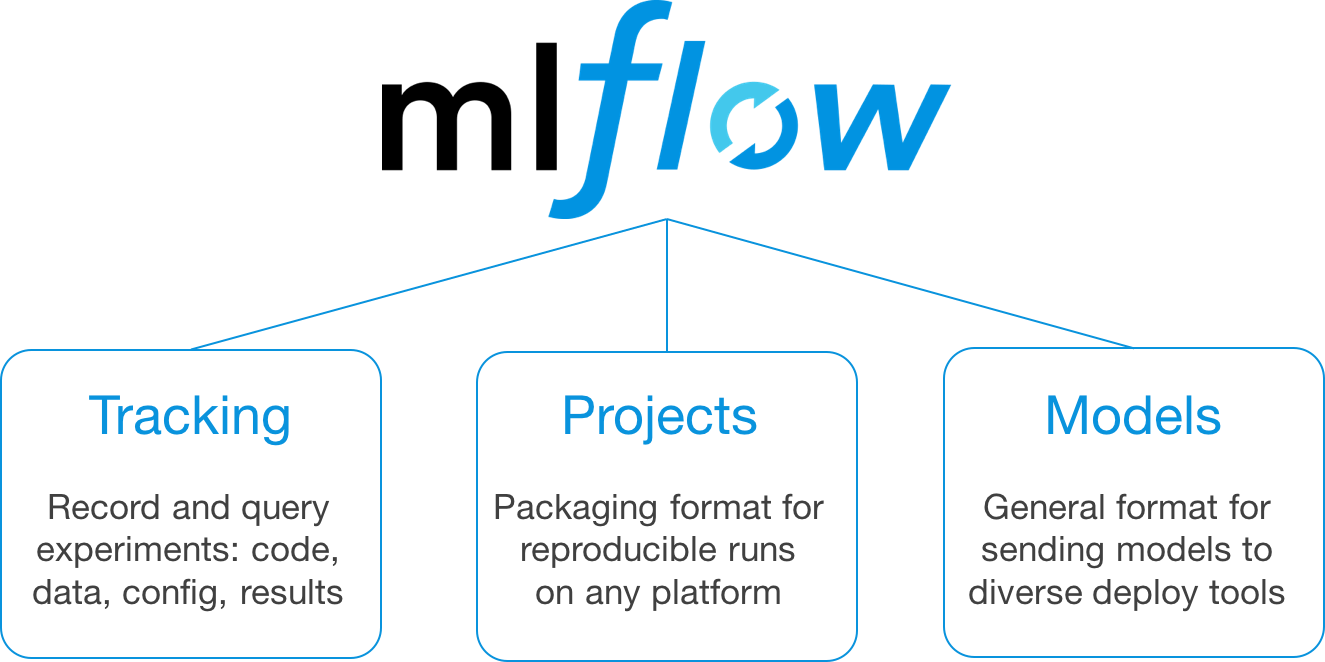
This first, alpha release of MLflow has three components:

MLflow Components

MLflow Tracking

MLflow Tracking is an API and UI for logging parameters, code versions, metrics and output files when running your machine learning code to later visualize them. With a few simple lines of code, you can track parameters, metrics, and artifacts:

import mlflow

# Log parameters (key-value pairs)
mlflow.log_param("num_dimensions", 8)
mlflow.log_param("regularization", 0.1)

# Log a metric; metrics can be updated throughout the run
mlflow.log_metric("accuracy", 0.1)
...
mlflow.log_metric("accuracy", 0.45)

# Log artifacts (output files)
mlflow.log_artifact("roc.png")
mlflow.log_artifact("model.pkl")

You can use MLflow Tracking in any environment (for example, a standalone script or a notebook) to log results to local files or to a server, then compare multiple runs. Using the web UI, you can view and compare the output of multiple runs. Teams can also use the tools to compare results from different users:

MLflow Tracking UI

MLflow Tracking UI

MLflow Projects

MLflow Projects provide a standard format for packaging reusable data science code. Each project is simply a directory with code or a Git repository, and uses a descriptor file to specify its dependencies and how to run the code. A MLflow Project is defined by a simple YAML file called MLproject.

name: My Project
conda_env: conda.yaml
entry_points:
  main:
    parameters:
      data_file: path
      regularization: {type: float, default: 0.1}
    command: "python train.py -r {regularization} {data_file}"
  validate:
    parameters:
      data_file: path
    command: "python validate.py {data_file}"

Projects can specify their dependencies through a Conda environment. A project may also have multiple entry points for invoking runs, with named parameters. You can run projects using the mlflow run command-line tool, either from local files or from a Git repository:

mlflow run example/project -P alpha=0.5

mlflow run git@github.com:databricks/mlflow-example.git -P alpha=0.5

MLflow will automatically set up the right environment for the project and run it. In addition, if you use the MLflow Tracking API in a Project, MLflow will remember the project version executed (that is, the Git commit) and any parameters. You can then easily rerun the exact same code.

The project format makes it easy to share reproducible data science code, whether within your company or in the open source community. Coupled with MLflow Tracking, MLflow Projects provides great tools for reproducibility, extensibility, and experimentation.

MLflow Models

MLflow Models is a convention for packaging machine learning models in multiple formats called “flavors”. MLflow offers a variety of tools to help you deploy different flavors of models. Each MLflow Model is saved as a directory containing arbitrary files and an MLmodel descriptor file that lists the flavors it can be used in.

time_created: 2018-02-21T13:21:34.12
flavors:
  sklearn:
    sklearn_version: 0.19.1
    pickled_model: model.pkl
  python_function:
    loader_module: mlflow.sklearn
    pickled_model: model.pkl

In this example, the model can be used with tools that support either the sklearn or python_function model flavors.

MLflow provides tools to deploy many common model types to diverse platforms. For example, any model supporting the python_function flavor can be deployed to a Docker-based REST server, to cloud platforms such as Azure ML and AWS SageMaker, and as a user-defined function in Apache Spark for batch and streaming inference. If you output MLflow Models as artifacts using the Tracking API, MLflow will also automatically remember which Project and run they came from.

Getting Started with MLflow

To get started with MLflow, follow the instructions at mlflow.org or check out the alpha release code on Github. We are excited to hear your feedback on the concepts and code!

Source: Introducing MLflow: an Open Source Machine Learning Platform – The Databricks Blog

Recent wave of hijacked WhatsApp accounts traced back to voicemail hacking

A wave of reports about hijacked WhatsApp accounts in Israel has forced the government’s cyber-security agency to send out a nation-wide security alert on Tuesday, ZDNet has learned.

The alert, authored by the Israel National Cyber Security Authority, warns about a relatively new method of hijacking WhatsApp accounts using mobile providers’ voicemail systems.

This new hacking method was first documented last year by Ran Bar-Zik, an Israeli web developer at Oath.

The general idea is that users who have voicemail accounts for their phone numbers are at risk if they don’t change that account’s default password, which in most cases tends to be either 0000 or 1234.

The possibility of an account takeover happens when an attacker tries to add a legitimate user’s phone number to a new WhatsApp app installation on his own phone.

Following normal security procedures, the WhatsApp service would then send a one-time code via SMS to that phone number. This would typically alert a user to an ongoing attack, but Bar-Zik argues that a hacker could easily avoid this by carrying out the attack during nighttime or when he is sure the user is away from his phone.

After several failed attempts to validate the one-time code sent via SMS, the WhatsApp service would then prompt the user to perform a “voice verification,” during which the WhatsApp service would call the user’s phone and speak the one-time verification code out loud.

If the attacker has timed his/her attack at the proper time and the user can’t or won’t answer his phone, that message would eventually land in the victim’s voicemail account.

Source: Recent wave of hijacked WhatsApp accounts traced back to voicemail hacking | ZDNet

Netherlands Defence Intelligence and Security Service disrupts Russian cyber operation targeting OPCW

On 13 April 2018, with support from the Netherlands General Intelligence and Security Service and UK counterparts, the Netherlands Defence Intelligence and Security Service (DISS) disrupted a cyber operation being carried out by a Russian military intelligence (GRU) team. The Russian operation had targeted the Organisation for the Prohibition of Chemical Weapons (OPCW) in The Hague.

The 4 Russian intelligence officers at Schiphol Airport.

To conduct their operation, 4 Russian intelligence officers had set up specialised equipment in the vicinity of the OPCW offices and were preparing to hack into OPCW networks. As host country the Netherlands bears responsibility for ensuring the organisation’s security. In order to protect the security of the OPCW it therefore pre-empted the GRU operation and escorted the Russian intelligence officers out of the country. “The cyber operation targeting the OPCW is unacceptable. Our exposure of this Russian operation is intended as an unambiguous message that the Russian Federation must refrain from such actions,” said Defence Minister Ank Bijleveld in her response. “The OPCW is a respected international institution representing 193 nations around the globe and was established to rid the world of chemical weapons. The Netherlands is responsible for protecting international organisations within its borders, and that is what we have done.”

Equipment

The 4 Russian intelligence officers entered the Netherlands via Schiphol Airport, travelling on diplomatic passports. They subsequently hired a car which they positioned in the parking lot of the Marriot Hotel in The Hague, which is adjacent to the OPCW offices.

Equipment was set up in the boot of the car with which the officers intended to hack into wifi networks and which was installed for the purpose of infiltrating the OPCW’s network. The antenna for this equipment lay hidden under a jacket on the rear shelf and the equipment was operational when DISS interrupted the operation.

Source: Netherlands Defence Intelligence and Security Service disrupts Russian cyber operation targeting OPCW

Microsoft announces app mirroring to let you use any Android app on Windows 10

Microsoft announced a new feature for Windows 10 today that will let Android phone users view and use any app on their device from a Windows desktop. The feature, which Microsoft is referring to as app mirroring and shows up in Windows as an app called Your Phone, seems to be work best with Android for now. Although Microsoft did announce the ability to transfer webpages from an iPhone to a Windows 10 desktop so you can pick up where you left off on mobile.

Regardless, the Your Phone app looks to be a significant step in helping bridge Windows 10 and the mobile ecosystem after the demise of Windows Phone. The news was announced at the company’s Surface hardware event in New York City this afternoon.

Source: Microsoft announces app mirroring to let you use any Android app on Windows 10 – The Verge

New Zealand border cops warn travelers that without handing over electronic passwords ‘You shall not pass!’

Customs laws in New Zealand now allow border agents to demand travellers unlock their phones or face an NZ$5,000 (around US$3,300) fine.

The law was passed during 2017 with its provisions coming into effect on October 1. The security conscious of you will also be pleased to know Kiwi officials still need a “reasonable” suspicion that there’s something to find.

As the country’s minister of Justice Andrew Little explained to a parliamentary committee earlier this year:

“The bill provides for that power of search and examination, but in order to exercise that power, a customs officer, first of all, has to be satisfied, or at least to have a reasonable suspicion, that a person in possession of such a device—it would be a cellphone or a laptop or anything else that might be described as an ‘e-device’—has been involved in criminal offending.

That’s somewhat tighter than the rules that apply in America. Border Patrol agents can take a look at phones without giving any reason, but in January this year, a new directive stipulated that a “reasonable suspicion” test applies if the agent wants to copy anything from a phone.

Like the American regulation, New Zealand’s searchers are limited to files held on the phone. A Customs spokesperson told Radio New Zealand “We’re not going into ‘the cloud’. We’ll examine your phone while it’s on flight mode”.

According to Radio NZ, the Council of Civil Liberties criticised the “reasonable cause” protection as inadequate, because someone asked to unlock a device isn’t told what that cause might be, and therefore has no way to challenge the request.

Source: New Zealand border cops warn travelers that without handing over electronic passwords ‘You shall not pass!’ • The Register

UK ruling party’s conference app editable by world+dog, blabs members’ digits

Party chairman Brandon Lewis was planning to sell the “interactive” app – which will allow attendees to give feedback on speeches as they happen – as evidence that the ruling party was embracing tech in a bid to win over the youth vote (another idea was to have the culture secretary appear as a hologram).

But soon after its launch, users took to Twitter to point out that that not only were contact details and personal information visible – they could also be edited.

Particular targets appeared to be Michael Gove, whose picture was changed to that of his former boss Rupert Murdoch, and Boris Johnson, whose name and profile picture were reportedly changed during the incident.

Crowd Comms, the company behind the app, said the error “meant that a third party in possession of a conference attendee’s email address was able, without further authentication, to potentially see data which the attendee had not wished to share – name, email address, phone number, job title and photo”.

Since email addresses are often pretty easy to guess, or – in the case of MPs or other professionals registered on the app – a case of public record, the cock-up had a wide potential impact.

Source: UK ruling party’s conference app editable by world+dog, blabs members’ digits • The Register