The Linkielist

Linking ideas with the world

The Linkielist

What good is investing in space? NASA Spinoff magazine shows you which technologies have trickled down to everyday life

Since 1976, Spinoff has annually profiled an average of 50 commercial technologies with origins in NASA missions and research. Issues of Spinoff published since 1996 can be read online in HTML or downloaded in PDF. Scanned copies of Spinoff are available in PDF for issues published between 1976 and 1995.

Spinoff 2020

Click here to read online (HTML)

Download a copy of Spinoff 2020 (PDF)

Spinoff 2020 Summary Brochure (PDF)

Spinoff 2020 PowerPoint Presentation (PPT)

Source: NASA Spinoff 2020

On the shoulders of giants: recent changes in Internet traffic

As the COVID-19 emergency continues and an increasing number of cities and countries are establishing quarantines or cordons sanitaire, the Internet has become, for many, the primary method to keep in touch with their friends and families. And it’s a vital motor of the global economy as many companies have employees who are now working from home.

Traffic towards video conferencing, streaming services and news, e-commerce websites has surged. We’ve seen growth in traffic from residential broadband networks, and a slowing of traffic from businesses and universities.

The Cloudflare team is fully operational and the Network Operating Center (NOC) is watching the changing traffic patterns in the more than 200 cities in which we operate hardware.

Big changes in Internet traffic aren’t unusual. They often occur around large sporting events like the Olympics or World Cup, cultural events like the Eurovision Song Contest and even during Ramadan at the breaking of the fast each day.

The Internet was built to cope with an ever changing environment. In fact, it was literally created, tested, debugged and designed to deal with changing load patterns.

Over the last few weeks, the Cloudflare Network team has noticed some new patterns and we wanted to share a few of them with you.

Entire countries are watching their leaders

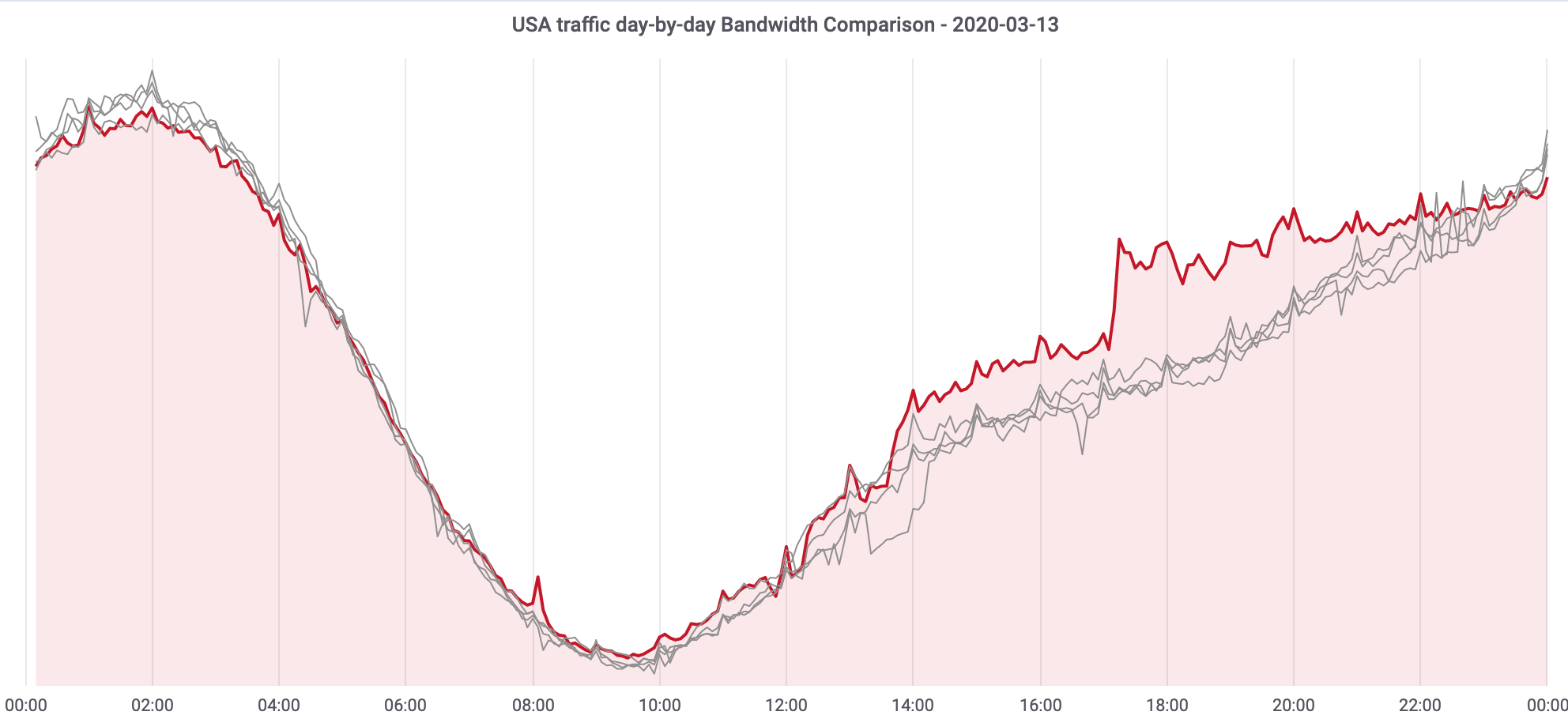
Last Friday evening, the US President announced a State of Emergency in the United States. Not so long after, our US data centers served 20% more traffic than usual. The red line shows Friday, the grey lines the preceding days for comparison.

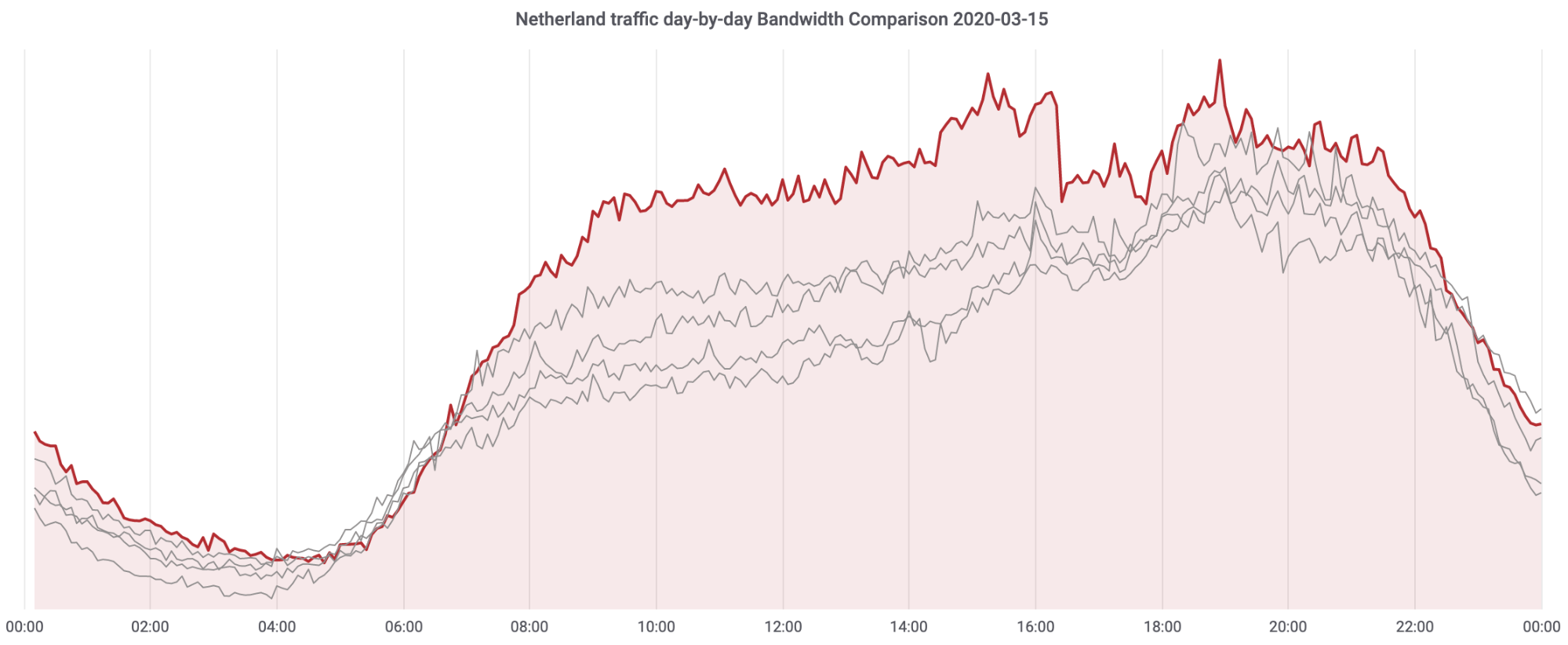
On the Sunday, March 15, the Dutch government announced on the radio at 1730 local time closures of the non-essential business (1630 UTC). A sharp dip in the regular Sunday traffic followed:

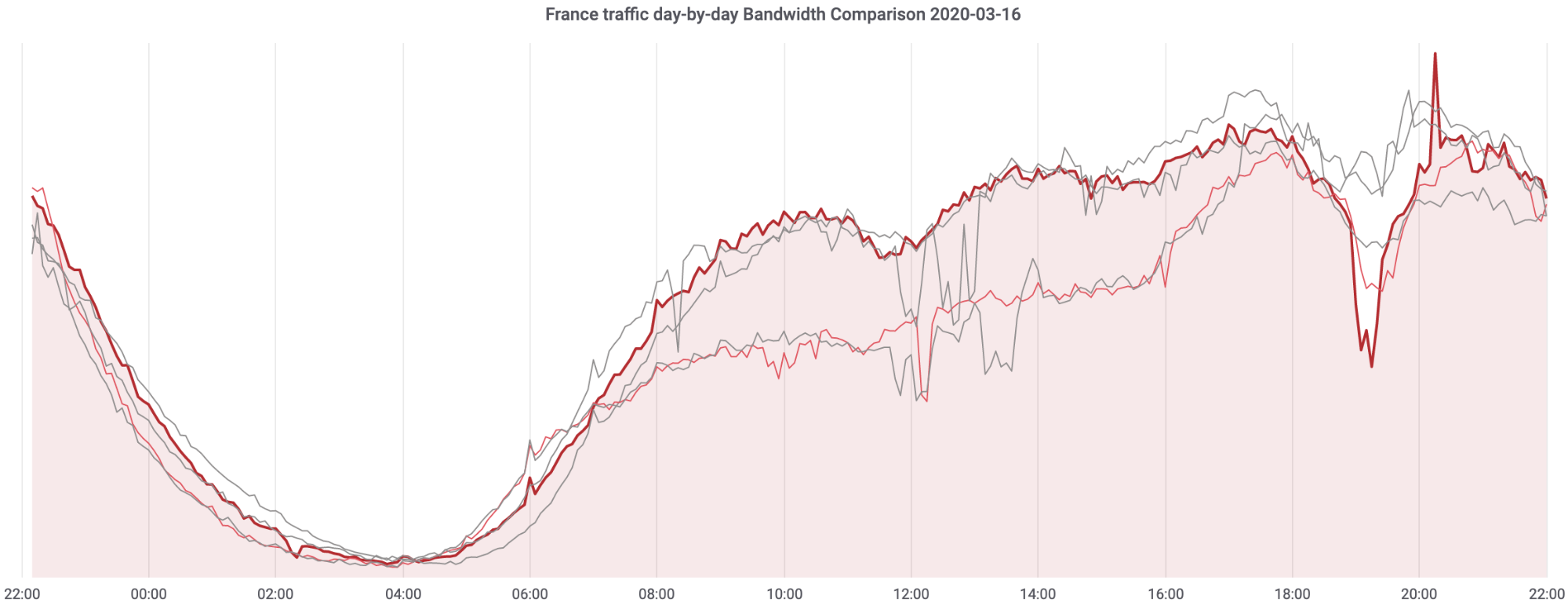
The French president made two national announcements, on March 12 (pink curve) and March 16 (red curve) at 2000 local time (1900 UTC). The lockdown announcement on March 16 caused French traffic to dip by half followed by a spike:

Evolution of traffic in quarantine

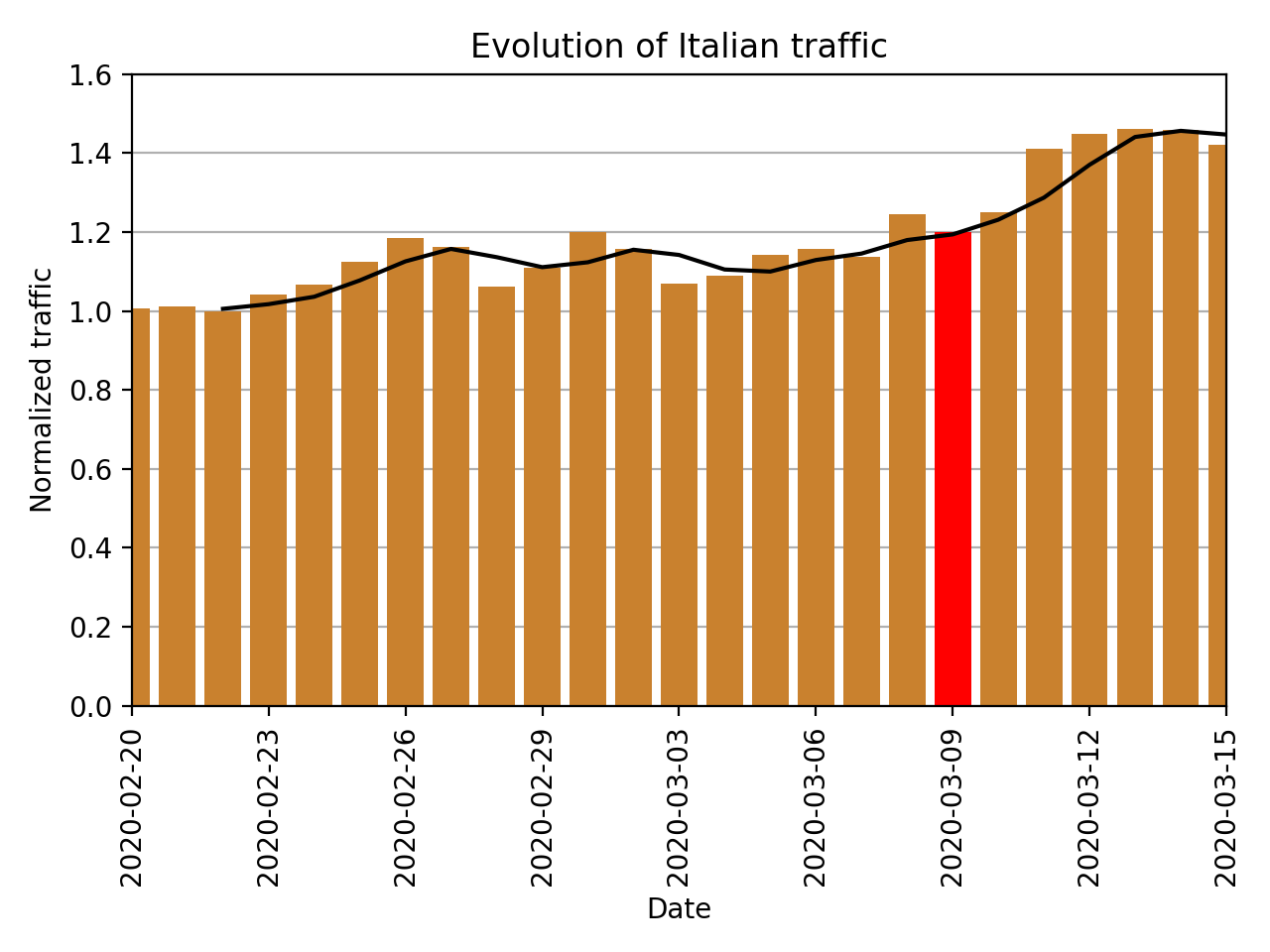
Italy has seen a 20-40% increase in daily traffic since the lockdown:

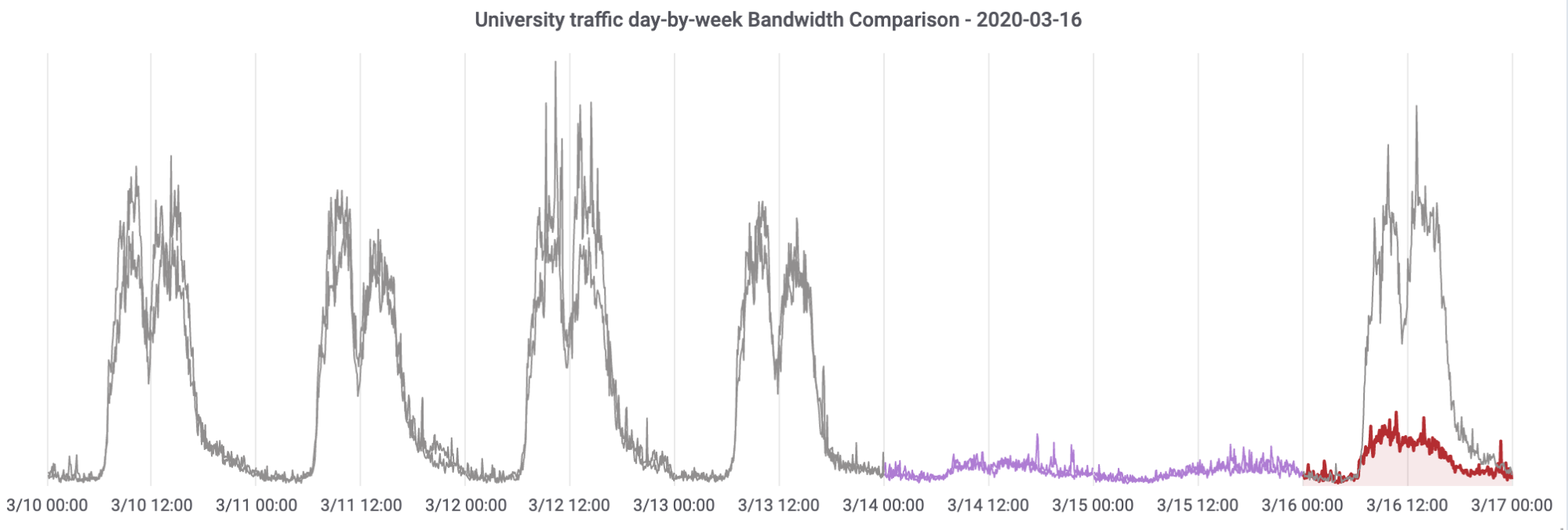
With universities closing, some national research networks are remaining (almost) as quiet as a weekend (in purple). Current day in red and previous days in grey (overlaps with previous week):

The Internet Exchange Points, a key part of the Internet infrastructure, where Internet service providers and content providers can exchange data directly (rather than via a third party) have also seen spikes in traffic. Many provide public traffic graphs.

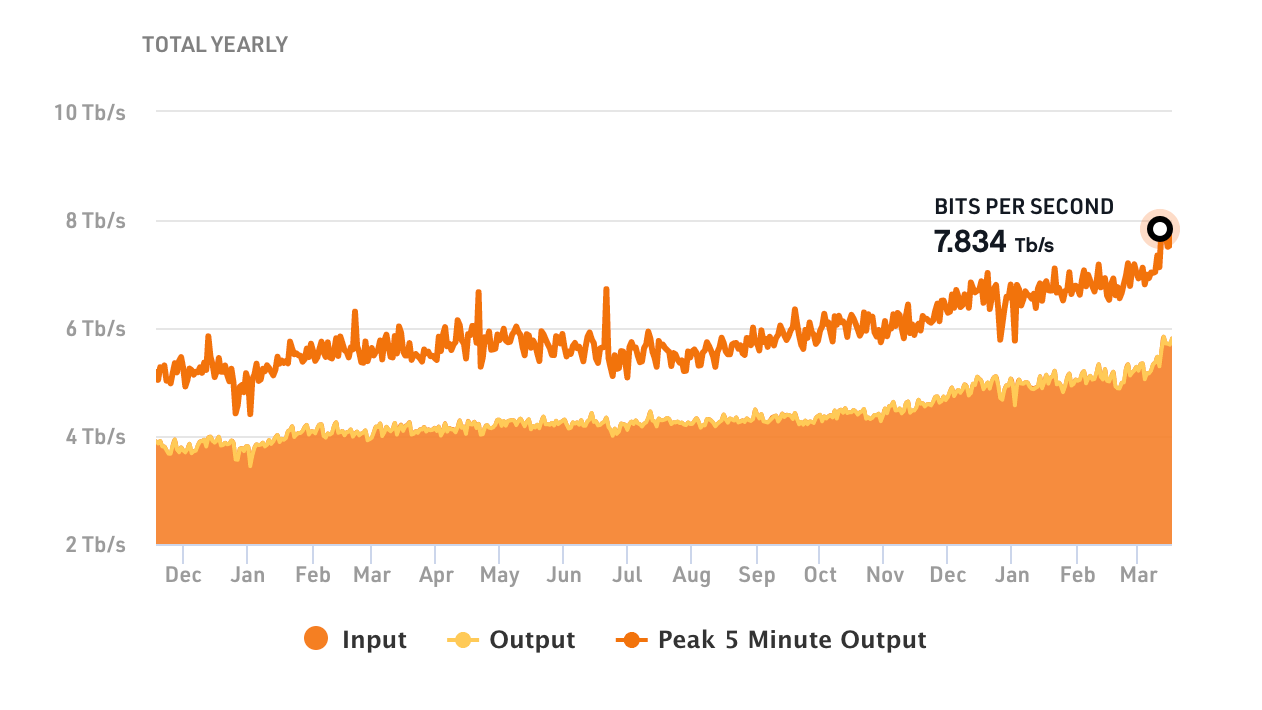
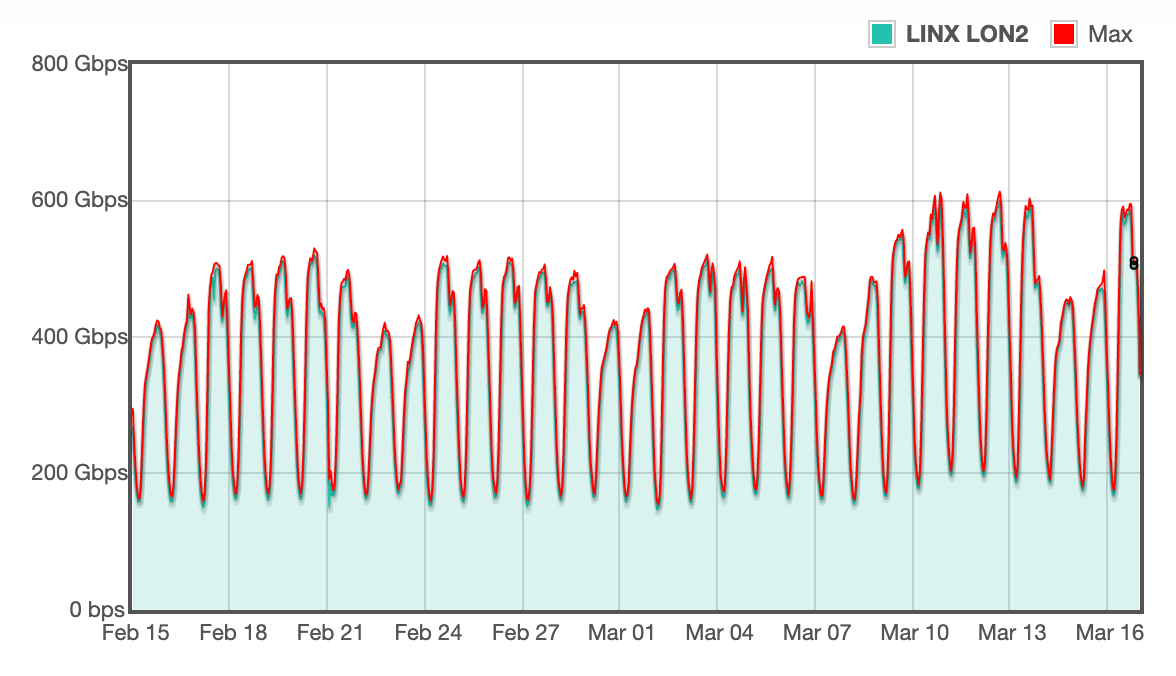
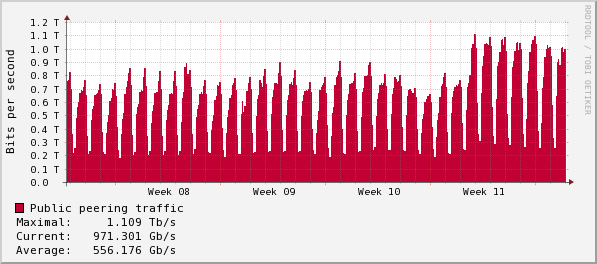
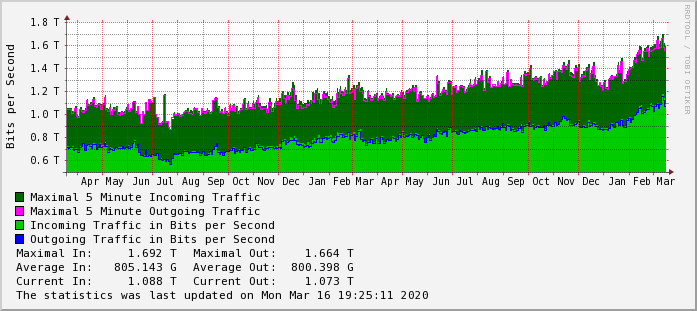
In Amsterdam (AMS-IX), London (LINX) and Frankfurt (DE-CIX), around 10-20% increase is seen around March 9th:

In Milan (MXP-IX), the Exchange point shows a 40% increase on Wednesday, 9th of March 2020, the day of the quarantine:

In Asia, in Hong Kong (HKIX), we can observe a faster increase since the end of January which likely corresponds to the Hubei lockdown on the January 23:

The emergency has a non-negligible impact on Internet services and our lives. Although it is difficult to quantify exactly the increase, we observe numbers from 10% to 40% depending on the region and the state of government action in those regions.

Even though from time to time individual services, such as a web site or an app, have outages the core of the Internet is robust. Traffic is shifting from corporate and university networks to residential broadband, but the Internet was designed for change.

Check back on the Cloudflare blog for further updates and insights.

Source: On the shoulders of giants: recent changes in Internet traffic

Tesla Told Employees to Show Up for Work on Wednesday Despite Shelter-in-Place Order

Electric car company Tesla asked employees to show up to work on Wednesday despite the ongoing coronavirus pandemic, including at its sprawling Fremont, California, production facility, according to emails obtained by CNBC.

[…]

According to CNBC, in an email to workers on Wednesday, Tesla North America HR leader Valerie Workman wrote the company had received “conflicting guidance from different levels of government.” But she suggested that many Tesla jobs are “essential,” mirroring the language of the shelter-in-place order and ignoring a clear directive from the Alameda County Sheriff’s Office that only “minimum basic operations” can continue.

“There are no changes in your normal assignment and you should continue to report to work if you are in an essential function: production, service, deliveries, testing and supporting groups as discussed with your manager,” Workman wrote. She added that Tesla workers would not be penalized for using paid time off if they do not feel well or are “reluctant to come to work.”

According to the Los Angeles Times, Tesla CEO Elon Musk—who is not a doctor or public health expert, but has fought claims of unsafe conditions at Tesla facilities for years—downplayed concerns about the virus in a Monday email to staff. Musk wrote “My frank opinion is that the harm from the coronavirus panic far exceeds that of the virus itself” and stated his belief that covid-19 cases “will not exceed 0.1% of the population.”

“I will personally be at work, but that’s just me,” Musk wrote. “I’d rather you were at home and not stressed, than at work and worried.”

Sgt. Ray Kelly, a spokesman for the Alamedia sheriff, told CNBC that “Our directive was clear” and trying to prevent a slump in production does not constitute an essential service. Many other automakers including General Motors, Ford, and Fiat Chrysler have temporarily suspended U.S. car production on a rotating basis.

According to Bloomberg, an Alameda County spokesperson said that Tesla is preparing to reduce staffing at the facility by 75 percent, though the company didn’t reply to their request for comment.

Update: 3/18/2010 at 9:25 p.m. ET: Per the LA Times, Tesla said it had 2,500 workers on site on Wednesday, about 25 percent of the factory’s normal workforce.

Kelly told the Times that the county “had a good conversation with Tesla today. They understand our position. The county explained they cannot continue their business as usual. They have to go on a minimum operations basis.”

Kelly added that as of Wednesday “it sounds like they’re still making cars,” but that “Tesla is not going to decide what the law is.” If the company continues production despite the workforce reduction the Fremont Police Department may get involved, he added.

Source: Tesla Told Employees to Show Up for Work on Wednesday Despite Shelter-in-Place Order

7.5-Inch E-Ink Display Is Powered Completely By NFC

NFC is usually only used to for quick text transfers, like a tap-and-pay transaction at a register or a quick data transfer from an NFC sticker. A company called “Waveshare” is really pushing the limits of NFC, though, with a 7.5-inch e-ink display that gets its data, and its power, from an NFC transfer. The $70 display doesn’t have a battery and doesn’t need a wired power connection. E-paper (or e-ink) displays have the unique property of not needing power to maintain an image. Once a charge blasts across the display and correctly aligns pixels full of black and white balls, everything will stay where it is when the power turns off, so the image will stick around. You might not have thought about it before, but in addition to data, NFC comes with a tiny wireless power transfer. This display is designed so that NFC provides just enough power to refresh the display during a data transfer, and the e-ink display will hold onto the image afterward.

NFC data transfers max out at a whopping 424 kbit/s. While that’s enough for an instant transfer of credit card data or a URL, the 800×400 image the display needs will take several seconds. Waveshare says the display takes five seconds just to refresh, and that doesn’t count the data transfer, which will vary depending on how complex your image is. The video shows a start-to-finish refresh that takes 10 seconds. If you want to use a phone, an Android app will convert your image into several different black-and-white styles and beam it to the display. Sadly, there’s no iOS app yet. iOS apps didn’t have the ability to write to NFC devices for the longest time. Writing to NFC was added with the launch of iOS 13, which only happened a few months ago.

Source: 7.5-Inch E-Ink Display Is Powered Completely By NFC – Slashdot

HP printers try to send loads of data back to HP about your devices and what you print

NB you can disable outgoing communication in the public network using windows defender by using the instructions here (HP).

They come down to opening windows defender firewall, allowing an app or feature through windows defender firewall, searching for HP and then deselecting the public zone.

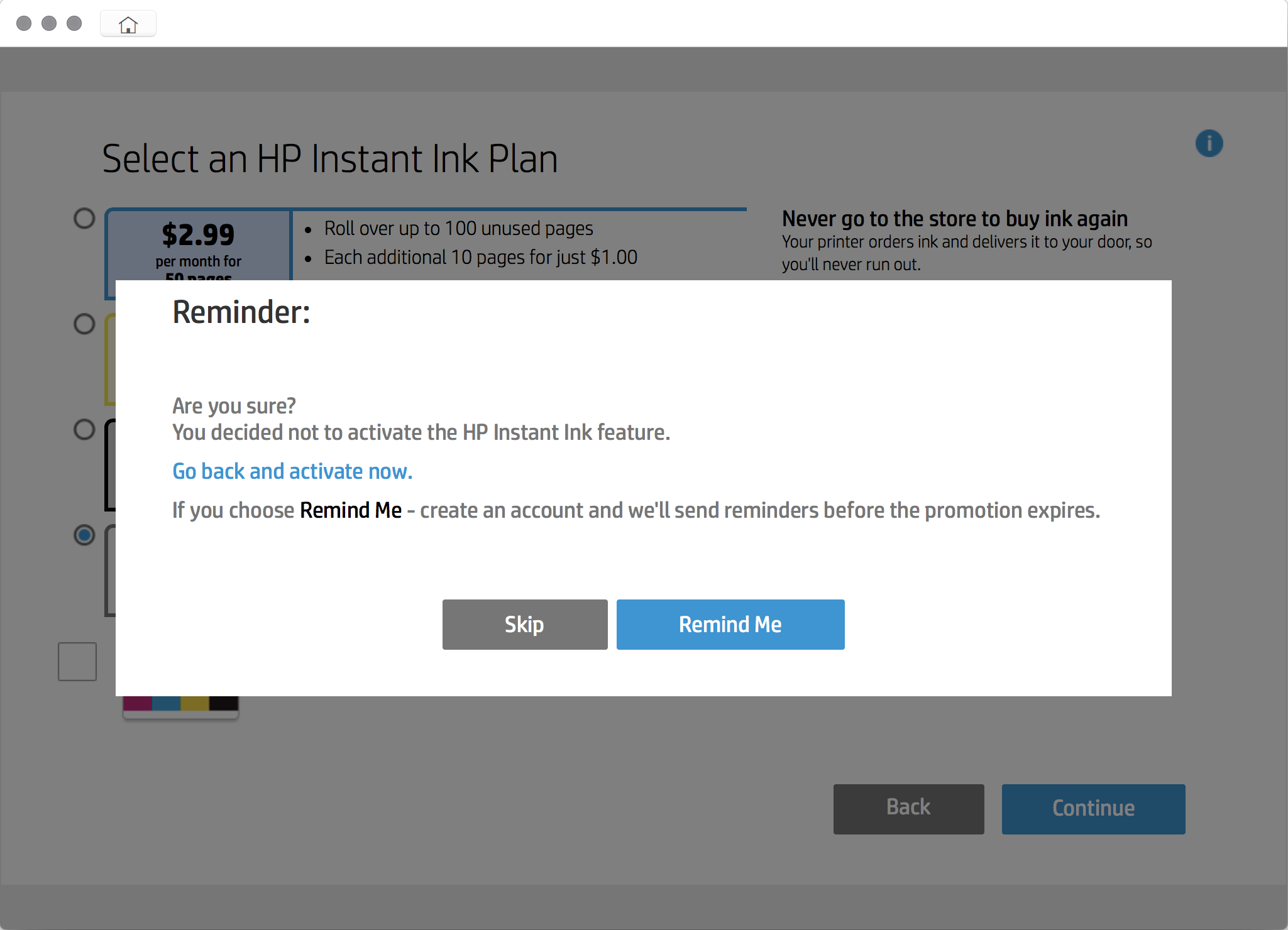
At first the setup process was so simple that even a computer programmer could do it. But then, after I had finished removing pieces of cardboard and blue tape from the various drawers of the machine, I noticed that the final step required the downloading of an app of some sort onto a phone or computer. This set off my crapware detector.

It’s possible that I was being too cynical. I suppose that it was theoretically possible that the app could have been a thoughtfully-constructed wizard, which did nothing more than gently guide non-technical users through the sometimes-harrowing process of installing and testing printer drivers. It was at least conceivable that it could then quietly uninstall itself, satisfied with a simple job well done.

Of course, in reality it was a way to try and get people to sign up for expensive ink subscriptions and/or hand over their email addresses, plus something even more nefarious that we’ll talk about shortly (there were also some instructions for how to download a printer driver tacked onto the end). This was a shame, but not unexpected. I’m sure that the HP ink department is saddled with aggressive sales quotas, and no doubt the only way to hit them is to ruthlessly exploit people who don’t know that third-party cartridges are just as good as HP’s and are much cheaper. Fortunately, the careful user can still emerge unscathed from this phase of the setup process by gingerly navigating the UI patterns that presumably do fool some people who aren’t paying attention.

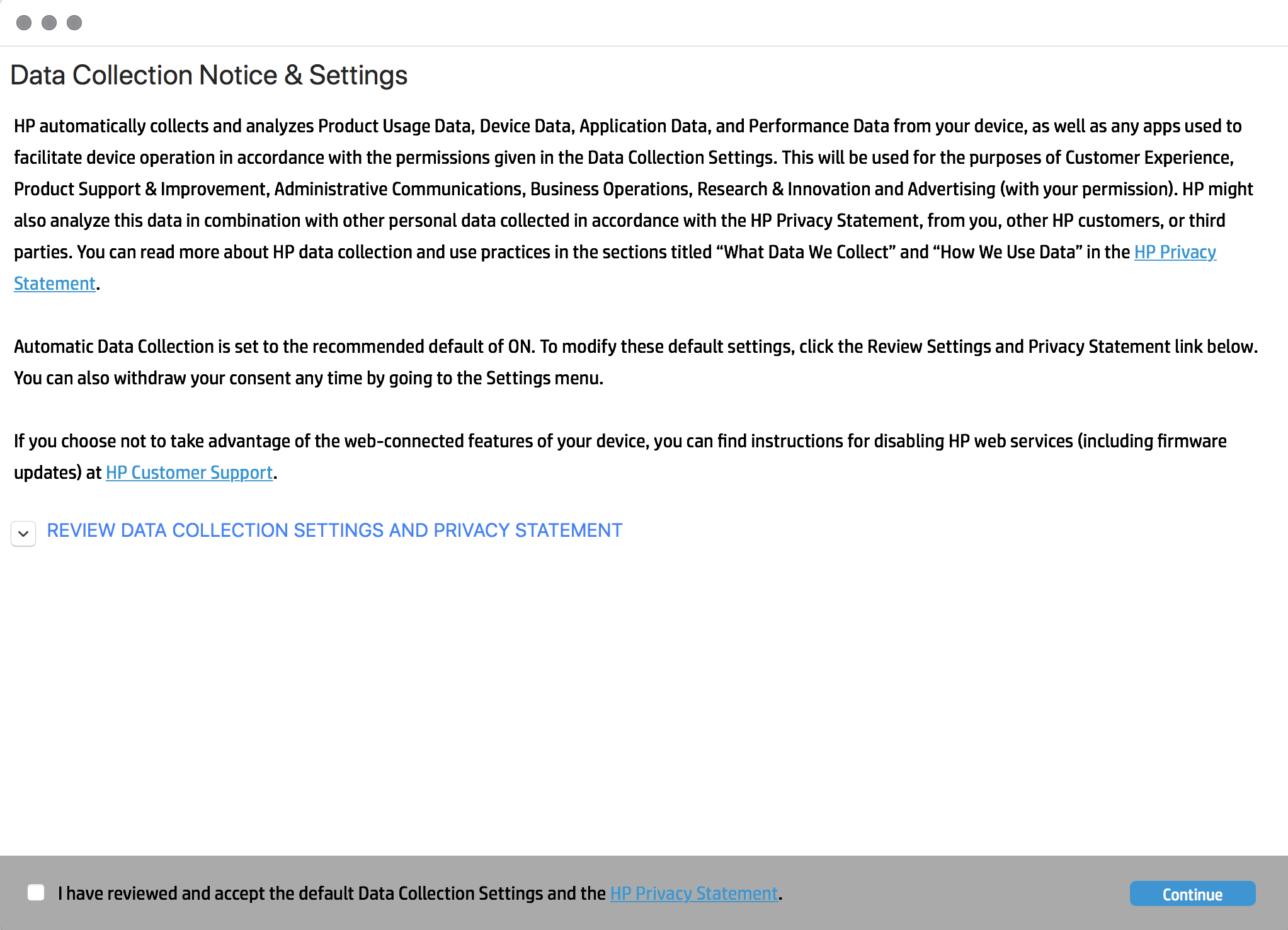
But it is only then, once the user has found the combination of “Next” and “Cancel” buttons that lead out of the swamp of hard sells and bad deals, that they are confronted with their biggest test: the “Data Collection Notice & Settings”.

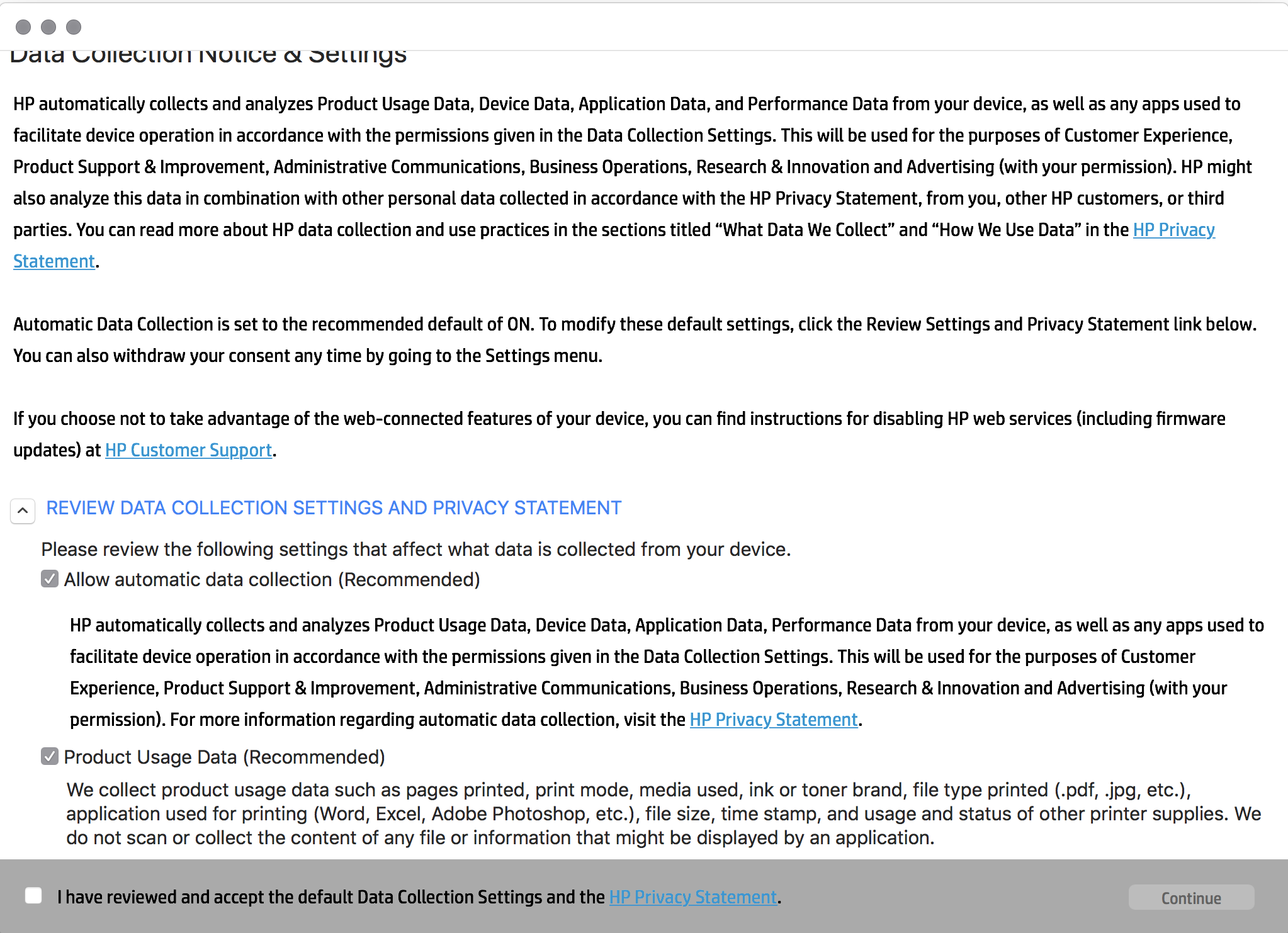
In summary, HP wants its printer to collect all kinds of data that a reasonable person would never expect it to. This includes metadata about your devices, as well as information about all the documents that you print, including timestamps, number of pages, and the application doing the printing (HP state that they do stop short of looking at the contents of your documents). From the HP privacy policy, linked to from the setup program:

Product Usage Data – We collect product usage data such as pages printed, print mode, media used, ink or toner brand, file type printed (.pdf, .jpg, etc.), application used for printing (Word, Excel, Adobe Photoshop, etc.), file size, time stamp, and usage and status of other printer supplies. We do not scan or collect the content of any file or information that might be displayed by an application.

Device Data – We collect information about your computer, printer and/or device such as operating system, firmware, amount of memory, region, language, time zone, model number, first start date, age of device, device manufacture date, browser version, device manufacturer, connection port, warranty status, unique device identifiers, advertising identifiers and additional technical information that varies by product.

HP wants to use the data they collect for a wide range of purposes, the most eyebrow-raising of which is for serving advertising. Note the last column in this “Privacy Matrix”, which states that “Product Usage Data” and “Device Data” (amongst many other types of data) are collected and shared with “service providers” for purposes of advertising.

HP delicately balances short-term profits with reasonable-man-ethics by only half-obscuring the checkboxes and language in this part of the setup.

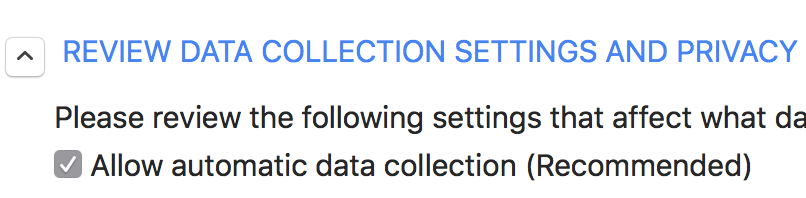
At this point everything has become clear – the job of this setup app is not only to sell expensive ink subscriptions; it’s also to collect what apparently passes for informed consent in a court of law. I clicked the boxes to indicate “Jesus Christ no, obviously not, why would anyone ever knowingly consent to that”, and then spent 5 minutes Googling how to make sure that this setting was disabled. My research suggests that it’s controlled by an item in the settings menu of the printer itself labelled “Store anonymous usage information”. However, I don’t think any reasonable person would think that the meaning of “Store anonymous usage information” includes “send analytics data back to HP’s servers so that it can be used for targeted advertising”, so either HP is being deliberately coy or there’s another option that disables sending your data that I haven’t found yet.

I bet there’s also a vigorous debate to be had over whether HP’s definition of “anonymous” is the same as mine.


I imagine that a user’s data is exfiltrated back to HP by the printer itself, rather than any client-side software. Once HP has a user’s data then I don’t know what they do with it. Maybe if they can see that you are printing documents from Photoshop then they can send you spam for photo paper? I also don’t know anything about how much a user’s data is worth. My guess is that it’s depressingly little. I’d almost prefer it if HP was snatching highly valuable information that was worth making a high-risk, high-reward play for. But I can’t help but feel like they’re just grabbing whatever data is lying around because they might as well, it might be worth a few cents, and they (correctly) don’t anticipate any real risk to their reputation and bottom line from doing so.

Recommended for who?

Source: HP printers try to send data back to HP about your devices and what you print | Robert Heaton

NASA makes their entire media library publicly accessible and copyright free

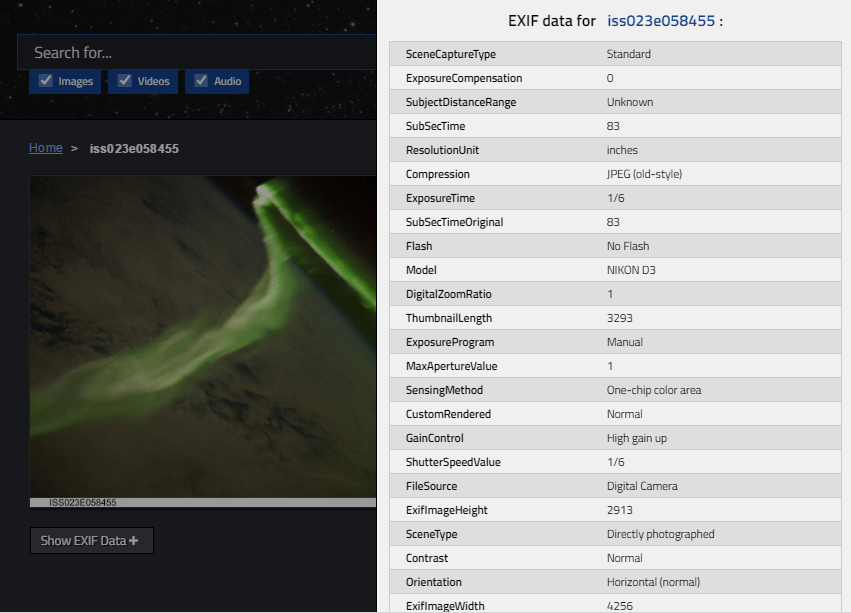
No matter if you enjoy taking or just watching images of space, NASA has a treat for you. They have made their entire collection of images, sounds, and video available and publicly searchable online. It’s 140,000 photos and other resources available for you to see, or even download and use it any way you like.

You can type in the term you want to search for and browse through the database of stunning images of outer space. Additionally, there are also images of astronauts, rocket launches, events at NASA and other interesting stuff. What’s also interesting is that almost every image comes with the EXIF data, which could be useful for astrophotography enthusiasts.

When you browse through the gallery, you can choose to see images, videos or audio. Another cool feature I noticed is that you can narrow down the results by the year. Of course, I used some of my time today to browse through the gallery, and here are some of the space photos you can find:

What I love about NASA is that they make interesting content for average Internet users. They make us feel closer and more familiar with their work and with the secrets of the outer space. For instance, they recently launched a GIPHY account full of awesome animated gifs. It’s also great that photography is an important part of their missions, and so it was even before “pics or it didn’t happen” became the rule. The vast media library they have now published is available to everyone, free of charge and free of copyright. Therefore, you can take a peek at the fascinating mysteries of space, check out what it’s like inside NASA’s premises, or download the images to make something awesome from them. Either way, you’ll enjoy it.

[NASA Image and Video Gallery via SLR Lounge; Credit: NASA/JPL-Caltech]

Source: NASA makes their entire media library publicly accessible and copyright free – DIY Photography

Private By Design: Free and Private Voice Assistants

Science fiction has whetted our imagination for helpful voice assistants. Whether it’s JARVIS from Iron Man, KITT from Knight Rider, or Computer from Star Trek, many of us harbor a desire for a voice assistant to manage the minutiae of our daily lives. Speech recognition and voice technologies have advanced rapidly in recent years, particularly with the adoption of Siri, Alexa, and Google Home.

However, many in the maker community are concerned — rightly — about the privacy implications of using commercial solutions. Just how much data do you give away every time you speak with a proprietary voice assistant? Just what are they storing in the cloud? What free, private, and open source options are available? Is it possible to have a voice stack that doesn’t share data across the internet?

Yes, it is. In this article, I’ll walk you through the options.

WHAT’S IN A VOICE STACK?

Some voice assistants offer a whole stack of software, but you may prefer to pick and choose which layers to use.

» WAKE WORD SPOTTER — This layer is constantly listening until it hears the wake word or hot word, at which point it will activate the speech-to-text layer. “Alexa,” “Jarvis,” and “OK Google” are wake words you may know.

» SPEECH TO TEXT (STT) — Also called automatic speech recognition (ASR). Once activated by the wake word, the job of the STT layer is just that: to recognize what you’re saying and turn it into written form. Your spoken phrase is called an utterance.

» INTENT PARSER — Also called natural language processing (NLP) or natural language understanding (NLU). The job of this layer is to take the text from STT and determine what action you would like to take. It often does this by recognizing entities — such as a time, date, or object — in the utterance.

» SKILL — Once the intent parser has determined what you’d like to do, an application or handler is triggered. This is usually called a skill or application. The computer may also create a reply in human-readable language, using natural language generation (NLG).

» TEXT TO SPEECH — Once the skill has completed its task, the voice assistant may acknowledge or respond using a synthesized voice.

Some layers work on device, meaning they don’t need an internet connection. These are a good option for those concerned about privacy, because they don’t share your data across the internet. Others do require an internet connection because they offload processing to cloud servers; these can be more of a privacy risk.

Before you pick a voice stack for your project you’ll need to ask key questions such as:

• What’s the interface of the software like — how easy is it to install and configure, and what support is available?

• What sort of assurances do you have around the software? How accurate is it? Does it recognize your accent well? Is it well tested? Does it make the right decisions about your intended actions?

• What sort of context, or use case, do you have? Do you want your data going across the internet or being stored on cloud servers? Is your hardware constrained in terms of memory or CPU? Do you need to support languages other than English?

ALL-IN-ONE VOICE SOLUTIONS

If you’re looking for an easy option to start with, you might want to try an all-in-one voice solution. These products often package other software together in a way that’s easy to install. They’ll get your DIY voice project up and running the fastest.

Jasper  is designed from the ground up for makers, and is intended to run on a Raspberry Pi. It’s a great first step for integrating voice into your projects. With Jasper, you choose which software components you want to use, and write your own skills, and it’s possible to configure it so that it doesn’t need an internet connection to function.

Rhasspy also uses a modular framework and can be run without an internet connection. It’s designed to run under Docker and has integrations for NodeRED and for Home Assistant, a popular open source home automation software.

Mycroft is modular too, but by default it requires an internet connection. Skills in Mycroft are easy to develop and are written in Python 3; existing skills include integrations with Home Assistant and Mozilla WebThings. Mycroft also builds open-source hardware voice assistants similar to Amazon Echo and Google Home. And it has a distribution called Picroft specifically for the Raspberry Pi 3B and above.

Almond is a privacy-preserving voice assistant from Stanford that’s available as a web app, for Android, or for the GNOME Linux desktop. Almond is very new on the scene, but already has an integration with Home Assistant. It also has options that allow it to run on the command line, so it could be installed on a Raspberry Pi (with some effort).

The languages supported by all-in-one voice solutions are dependent on what software options are selected, but by default they use English. Other languages require additional configuration.

WAKE WORD SPOTTERS

PocketSphinx is a great option for wake word spotting. It’s available for Linux, Mac, Windows platforms, as well as Android and iOS; however, installation can be involved. PocketSphinx works on-device, by recognizing phonemes, which are the smallest units of sound that make up a word.

For example, hello and world each have four phonemes:

hello H EH L OW

world W ER L D

The downside of PocketSphinx is that its core developers appear to have moved on to a for-profit company, so it’s not clear how long PocketSphinx or its parent CMU Sphinx will be around.

Precise by Mycroft.AI uses a recurrent neural network to learn what are and are not wake words. You can train your own wake words with Precise, but it does take a lot of training to get accurate results.

Snowboy is free for makers to train your own wake word, using Kitt.AI’s (proprietary) training, but also comes with several pre-trained models, and wrappers for several programming languages including Python and Go. Once you’ve got your trained wake word, you no longer need an internet connection. It’s an easier option for beginners than Precise or PocketSphinx, and has a very small CPU footprint, which makes it ideal for embedded electronics. Kitt.AI was acquired by Chinese giant Baidu in 2017, although to date it appears to remain as its own entity.

Porcupine from Picovoice is designed specifically for embedded applications. It comes in two variants: a complete model with higher accuracy, and a compressed model with slightly lower accuracy but a much smaller CPU and memory footprint. It provides examples for integration with several common programming languages. Ada, the voice assistant recently released by Home Assistant, uses Porcupine under the hood.

SPEECH TO TEXT

Kaldi has for years been the go-to open source speech-to-text engine. Models are available for several languages, including Mandarin. It works on-device but is notoriously difficult to set up, not recommended for beginners. You can use Kaldi to train your own speech-to-text model, if you have spoken phrases and recordings, for example in another language. Researchers in the Australian Centre for the Dynamics of Language have recently developed Elpis , a wrapper for Kaldi that makes transcription to text a lot easier. It’s aimed at linguists who need to transcribe lots of recordings.

CMU Sphinx , like its child PocketSphinx, is based on phoneme recognition, works on-device, and is complex for beginners.

DeepSpeech, part of Mozilla’s Common Voice project , is another major player in the open source space that’s been gaining momentum. DeepSpeech comes with a pre-trained English model but can be trained on other data sets — this requires a compatible GPU. Trained models can be exported using TensorFlow Lite for inference, and it’s been tested on an RasPi 4, where it comfortably performs real-time transcriptions. Again, it’s complex for beginners.

INTENT PARSING AND ENTITY RECOGNITION

There are two general approaches to intent parsing and entity recognition: neural networks and slot matching. The neural network is trained on a set of phrases, and can usually match an utterance that “sounds like” an intent that should trigger an action. In the slot matching approach, your utterance needs to closely match a set of predefined “slots,” such as “play the song [songname] using [streaming service].” If you say “play Blur,” the utterance won’t match the intent.

Padatious is Mycroft’s new intent parser, which uses a neural network. They also developed Adapt which uses the slot matching approach.

For those who use Python and want to dig a little deeper into the structure of language, the Natural Language Toolkit is a powerful tool, and can do “parts of speech” tagging — for example recognizing the names of places.

Rasa  is a set of tools for conversational applications, such as chatbots, and includes a robust intent parser. Rasa makes predictions about intent based on the entire context of a conversation. Rasa also has a training tool called Rasa X, which helps you train the conversational agent to your particular context. Rasa X comes in both an open source community edition and a licensed enterprise edition.

Picovoice also has Rhino, which comes with pre-trained intent parsing models for free. However, customization of models — for specific contexts like medical or industrial applications — requires a commercial license.

TEXT TO SPEECH

Just like speech-to-text models need to be “trained” for a particular language or dialect, so too do text-to-speech models. However, text to speech is usually trained on a single voice, such as “British Male” or “American Female.”

eSpeak  is perhaps the best-known open source text-to-speech engine. It supports over 100 languages and accents, although the quality of the voice varies between languages. eSpeak supports the Speech Synthesis Markup Language format, which can be used to add inflection and emphasis to spoken language. It is available for Linux, Windows, Mac, and Android systems, and it works on-device, so it can be used without an internet connection, making it ideal for maker projects.

Festival is now quite dated, and needs to be compiled from source for Linux, but does have around 15 American English voices available. It works on-device. It’s mentioned here out of respect; for over a decade it was considered the premier open source text-to-speech engine.

Mimic2 is a Tacotron fork from Mycroft AI, who have also released the to allow you to build your own text-to-speech voices. To get a high-quality voice requires up to 100 hours of “clean” speech, and Mimic2 is too large to work on-device, so you need to host it on your own server or connect your device to the Mycroft Mimic2 server. Currently it only has a pre-trained voice for American English.

Mycroft’s earlier Mimic TTS can work on-device, even on a Raspberry Pi, and is another good candidate for maker projects. It’s a fork of CMU Flite.

Mary Text to Speech supports several, mainly European languages, and has tools for synthesizing new voices. It runs on Java, so can be complex to install.

So, that’s a map of the current landscape in open source voice assistants and software layers. You can compare all these layers in the chart at the end of this article. Whatever your voice project, you’re likely to find something here that will do the job well — and will keep your voice and your data private from Big Tech.

WHAT’S NEXT FOR OPEN SOURCE VOICE?

As machine learning and natural language processing continue to advance rapidly, we’ve seen the decline of the major open source voice tools. CMU Sphinx, Festival, and eSpeak have become outdated as their supporters have adopted other tools, or maintainers have gone into private industry and startups.

We’re going to see more software that’s free for personal use but requires a commercial license for enterprise, as Rasa and Picovoice do today. And it’s understandable; dealing with voice in an era of machine learning is data intensive, a poor fit for the open source model of volunteer development. Instead, companies are driven to commercialize by monetizing a centralized “platform as a service.”

Another trajectory this might take is some form of value exchange. Training all those neural networks and machine learning models — for STT, intent parsing, and TTS — takes vast volumes of data. More companies may provide software on an open source basis and in return ask users to donate voice samples to improve the data sets.Mozilla’s Common Voice follows this model.

Another trend is voice moving on-device. The newer, machine-learning-driven speech tools originally were too computationally intensive to run on low-end hardware like the Raspberry Pi. But with DeepSpeech now running on a RasPi 4, it’s only a matter of time before the newer TTS tools can too.

We’re also seeing a stronger focus on personalization, with the ability to customize both speech-to-text and text-to-speech software.

WHAT WE STILL NEED

What’s lacking across all these open source tools are user-friendly interfaces to capture recordings and train models. Open source products must continue to improve their UIs to attract both developer and user communities; failure to do so will see more widespread adoption of proprietary and “freemium” tools.

As always in emerging technologies, standards remain elusive. For example, skills have to be rewritten for different voice assistants. Device manufacturers, particularly for smart home appliances, won’t want to develop and maintain integrations for multiple assistants; much of this will fall to an already-stretched open source community until mechanisms for interoperability are found. Mozilla’s WebThings ecosystem (see page 50) may plug the interoperability gap if it can garner enough developer support.

Regardless, the burden rests with the open source community to find ways to connect to proprietary systems (see page 46 for a fun example) because there’s no incentive for manufacturers to do the converse.

The future of open source rests in your hands! Experiment and provide feedback, issues, pull requests, data, ideas, and bugs. With your help, open source can continue to have a strong voice.

click the image to view full size. Alternatively, you can download this data as a spreadsheet by clicking here.

Source: Private By Design: Free and Private Voice Assistants

Avoid taking ibuprofen for COVID-19 symptoms: WHO

The World Health Organization recommended Tuesday that people suffering COVID-19 symptoms avoid taking ibuprofen, after French officials warned that anti-inflammatory drugs could worsen effects of the virus.

The warning by French Health Minister Olivier Veran followed a recent study in The Lancet medical journal that hypothesised that an enzyme boosted by anti-inflammatory drugs such as ibuprofen could facilitate and worsen COVID-19 infections.

Asked about the study, WHO spokesman Christian Lindmeier told reporters in Geneva the UN health agency’s experts were “looking into this to give further guidance.”

“In the meantime, we recommend using rather paracetamol, and do not use ibuprofen as a self-medication. That’s important,” he said.

Source: Avoid taking ibuprofen for COVID-19 symptoms: WHO

Virus Travel Bans Threaten Labor for Global Food Harvests

Across the globe, governments are imposing travel limits in a bid to stem the spread of coronavirus. The unintended consequence is a squeeze on migrant labor that’s a cornerstone of food production.

American produce growers preparing to harvest crops are warning of a devastating impact on fruit and vegetables after the U.S. Embassy in Mexico announced a halt to visa interviews for seasonal farm workers. Slaughterhouses also may face labor shortages.

In Australia, growers say the country may face shortages of some fruits and vegetables because of travel curbs, with the nation traditionally using overseas workers for one third of seasonal farming jobs. Kiwifruit pickers are in short supply in New Zealand. And in Canada, travel limits threaten meat processors that rely on temporary foreign workers to fill chronic labor shortages.

“There won’t be anyone to harvest the crops,” said Robert Guenther, senior vice president for public policy for the United Fresh Produce Association, which represents U.S. growers, distributors, wholesalers and retailers. “It will be devastating to growers and ultimately to the supply chain and consumers. They won’t have the food.”

Vulnerable supply chains

Expectations for a labor crunch reveal how interconnected the world of global agriculture has become, and expose the strains of production and areas of vulnerability to the supply chain. In many key food-making nations, the industry relies heavily on migrant and immigrant workers to fill jobs that middle-class citizens shun. Think of the back-breaking work of tomato pickers, the dangerous conditions at slaughter houses and what many would consider the unpalatable environment of large livestock-feed operations.

The timing for the disruptions in some ways couldn’t be worse. In the Northern Hemisphere, farmers are gearing up for their peak spring and summer growing seasons. Ranchers also tend to sell more animals to slaughter at this time of year.

Source: Virus Travel Bans Threaten Labor for Global Food Harvests | Time

Volunteers 3D-Print Unobtainable $11,000 Valve For $1 To Keep Covid-19 Patients Alive; Original Manufacturer Threatens To Sue

Techdirt has just written about the extraordinary legal action taken against a company producing Covid-19 tests. Sadly, it’s not the only example of some individuals putting profits before people. Here’s a story from Italy, which is currently seeing more new coronavirus cases and deaths than anywhere else in the world. Last Thursday, a hospital in Brescia, in the north of Italy, needed supplies of special valves in order to use breathing equipment to help keep Covid-19 patients alive in intensive care (original in Italian). The manufacturer was unable to provide them because of the demand for this particular valve. The Metro site explains what happened next:

With the help of the editor of a local newspaper Giornale di Brescia and tech expert Massimo Temporelli, doctors launched a search for a 3D printer — a devise that produces three dimensional objects from computer designs.

Word soon reached Fracassi, a pharmaceutical company boss in possession of the coveted machine. He immediately brought his device to the hospital and, in just a few hours, redesigned and then produced the missing piece.

Actually, it wasn’t quite as simple as that suggests. Business Insider Italia explains that even though the original manufacturer was unable to supply the part, it refused to share the relevant 3D file with Fracassi to help him print the valve. It even went so far as to threaten him for patent infringement if he tried to do so on his own. Since lives were at stake, he went ahead anyway, creating the 3D file from scratch. According to the Metro article, he produced an initial batch of ten, and then 100 more, all for free. Fracassi admits that his 3D-printed versions might not be very durable or re-usable. But when it’s possible to make replacements so cheaply — each 3D-printed part costs just one euro, or roughly a dollar — that isn’t a problem. At least it wouldn’t be, except for that threat of legal action, which is also why Fracassi doesn’t dare share his 3D file with other hospitals, despite their desperate need for these valves.

And if you’re wondering why the original manufacturer would risk what is bound to be awful publicity for its actions, over something that only costs one euro to make, a detail in the Business Insider Italia article provides an explanation: the official list price for a single valve is 10,000 euros — about $11,000. This is a perfect example of how granting an intellectual monopoly in the form of a patent allows almost arbitrarily high prices to be charged, and quite legally. That would be bad enough in any situation, but when lives are at stake, and Italian hospitals struggle to buy even basic equipment like face masks, demanding such a sum is even worse. And when a pandemic is raging out of control, for a company to threaten those selflessly trying to save lives in this way is completely beyond the pale.

Source: Volunteers 3D-Print Unobtainable $11,000 Valve For $1 To Keep Covid-19 Patients Alive; Original Manufacturer Threatens To Sue | Techdirt

Tesla’s Removal Of Features On Used Cars Appears To Be In Violation Of Its Own Rules

Last month we reported about Tesla’s occasional practice of removing features like Autopilot and Ludicrous mode from used cars after they’d been purchased by people who bought the cars with those features enabled. While Tesla eventually restored the removed features to the subject of the original story, I’ve been in touch with a number of people with similar stories, and, perhaps even more importantly, with Tesla employees who have confirmed that often Tesla’s actions have been directly counter to the company’s own policies, at least as understood by Service Techs and help center workers.

It’s also worth mentioning that, while I have spoken with Tesla employees at call centers and seen correspondence from service techs about this issue, Tesla corporate has so far not responded to any of my inquiries, not from the previous story, and not from this one.

[…]

I called Tesla’s customer support line at its call center in Draper, Utah. I spoke with two different representatives, and asked each if a feature that was on and available on a used Tesla—I used Ludicrous Mode as an example for one and Autopilot as an example for the other—was a feature that would stay with the car, or if the feature would need to be re-purchased by the next owner.

Both representatives assured me that the features are connected to the car’s VIN, and remained with the car for “the life of the car.” I had them clarify that these features were not subscriptions and were more like installing features in any car, which they confirmed.

I wanted to hear from a Tesla Service Tech as well, right from a Tesla-owned dealership, and I was able to do so when another Tesla owner, Michele, reached out to tell me about issues she had with her purchased-new Model 3, and specifically getting her Autopilot system purchase registered with Tesla’s systems.

I asked her to email her local Tesla dealer (this one was in Santa Barbara) and find out exactly if those features she paid for could be sold with her car if she decided to sell it, and this was the response she got (emphasis mine):

Good Morning Michele,It looks like Tesla did a full-fleet audit of Autopilot which cause this on your vehicle since it was purchased through the service center and not online or the mobile app. Autopilot once purchased stays with the life of the vehicle.

So, we’ve got two very different stories coming from Tesla. On the one side we have what has been actually happening to buyers of used cars. On the other we have the responses I got from call center representatives and an official dealer service advisor are very clear that any feature that was ordered with the car, be it FSD or Autopilot or Ludicrous Mode, stays with that car, keyed to that car’s VIN, for the life of the car.

This fits with how cars have been bought and sold for over a century: the original buyer of the car picks a set of factory-installed options, and if those options are on the car at the time of sale, unless specifically addressed otherwise, those options are considered intergral parts of the car that is being sold.

That means that whatever price was agreed upon for the car is expected to include those options, and if the automaker decides to remove any of those features post-sale, that’s theft.

Again, this is in opposition to what we’ve seen in the examples sent to us directly and appearing in various forums online—Tesla has treated add-on features like FSD and Ludicrous mode as being non-transferable when the car is sold—such as in the cases mentioned here of Alec, Brad, and the used car dealer who bought a Model X for his father.

These both can’t be right. The way that makes the most sense and seems the most fair is to treat these features as any car features like air conditioning or heated seats have been treated. They’re part of the car. When you sell the car, they go with it. Period.

If Tesla does not want to employ this method, it needs to make that absolutely clear to potential buyers of used and new Teslas alike. If you’re buying a used Tesla, the features that need to be re-purchased should not be available on the car when it’s being sold, and if you’re buying a new Tesla, the customer has a right to know they cannot count on those expensive features being part of the car to maintain its resale value.

If Tesla wants to make Autopilot and Ludicrous mode a subscription-type service, then it needs to own up to it and accept its lumps for deciding to do something so craven and greedy. We don’t have to like it, but we’d have to accept it if they made it obvious this was how it worked.

As things are now, it’s confusion. Customers are told one thing very clearly and simply from service centers and help lines—features stay with the car for life—but some customers, without any clear pattern, are told the opposite, in what feels like a brazen attempt to extract thousands of dollars for the company from every Tesla sold used.

I’ve given Tesla plenty of chances to set the record straight here, and if it somehow decides to finally reach out, I’m happy to present its side here, and hopefully bring some clarity to this mess.

As it stands now, though, I’d encourage every Tesla potential buyer, new or used, to get everything clarified and in writing when it comes to your expensive options.

Source: Tesla’s Removal Of Features On Used Cars Appears To Be In Violation Of Its Own Rules

High Court in NL likes monopolies and destroys cusomter oversight decision to open KPN and VodafoneZiggo networks (copper and cable) to 3rd parties

KPN and VodafoneZiggo do not have to open their networks to third parties. That is what the Board of Appeal for Business has decided today.

This means that providers without their own network cannot enforce access to those networks for the provision of services.

The ACM had stipulated that KPN and VodafoneZiggo should both open up their fixed networks to other providers. This was laid down in the wholesale fixed access market analysis decision. This regulation took into consideration on 1 October 2018.

KPN and VodafoneZiggo are very strong in this market and can use that position according to the regulator to raise prices, adjust conditions to their advantage or slow down investments.

However, the CBb considers that ACM has not (sufficiently) proven the existence of such a joint market power. This eliminates the basis for the regulation imposed on KPN and VodafoneZiggo and therefore the access obligations are also lost.

The ACM is ‘disappointed’ by the ruling and is now studying its consequences.

Source: Hoogste rechter vernietigt besluit ACM over openstellen netwerken KPN en VodafoneZiggo – Emerce

Google Translate launches Transcribe for Android in 8 languages

Google Translate today launched Transcribe for Android, a feature that delivers a continual, real-time translation of a conversation. Transcribe will begin by rolling out support for eight languages in the coming days: English, French, German, Hindi, Portuguese, Russian, Spanish and Thai. With Transcribe, Translate is now capable of translating classroom or conference lectures with no time limits, whereas before speech-to-text AI in Translate lasted no longer than a word, phrase, or sentence. Google plans to bring Transcribe to iOS devices at an unspecified date in the future.

Source: Google Translate launches Transcribe for Android in 8 languages | VentureBeat

Theranos vampire lives on: Owner of failed blood-testing biz’s patents sues maker of actual COVID-19-testing kit

Remember Theranos? The blood-testing company worth billions whose CEO Elizabeth Holmes became a celebrity right up until the point when it became clear its revolutionary testing machines didn’t actually work as described?

Well, Theranos is dead, and Holmes is still dealing with the legal repercussions, but her vampire company has come alive again – and in the very worst way: its reincarnation is suing another medical testing company for patent infringement.

It gets worse. While Theranos’ patents, obtained by an outfit called Fortress Investment Group in 2018, do not relate to a testing machine that actually works, they are being used to sue a manufacturer whose medical-testing machine not only works but is being used to detect the presence of the COVID-19 coronavirus.

That’s right: a private-equity-turned-investment group is using patents it picked up from a collapsed testing company – which imploded because its tech didn’t work – to sue a company whose machines actually do work and which is on the front-line of tackling the worst pandemic that the world has known for 100 years.

The lawsuit [PDF] comes by a company called Labrador Diagnostics, which is a part of Fortress, which is itself a part of investment monster Softbank. It’s worth noting that Apple and Intel sued Fortress late last year for stockpiling patents with sole aim of suing other companies.

“Labrador is informed and believes, and on that basis alleges, that Defendants individually and collectively have infringed and, unless enjoined will continue to infringe, one or more claims of the ‘155 [US 8,283,155] Patent, in violation of 35 U.S.C. § 271, by, among other things, making, using, offering to sell, and selling within the United States, and/or supplying or causing to be supplied in or from the United States, without authority or license, the Accused Products for use in an infringing manner,” the lawsuit reads.

The other patent in question is US 10,533,994.

Short life

It’s dense legal language designed solely to extract money out of a legitimate business. And while Labrador Diagnostics may sound like a legitimate testing company, there is no evidence that it exists on anything but paper. It was created as a limited liability company in Delaware literally this month. Within three days of it existing, it sued the testing equipment maker in question: BioFire.

BioFire, meanwhile, is a real company with real people doing actual work. The technology that “Labrador” claims is infringing its patent – which it calls FilmArray technology – is being used to develop three much-needed tests for COVID-19.

Since the lawsuit was filed in America on March 9, Labrador/Fortress has claimed it had no idea BioFire was working on COVID-19 tests; although that claim is questionable given that on March 3 there was an article in the Wall Street Journal specifically identifying BioFire and the fact it was working in two diagnostic tests for the coronavirus.

Faced with a wave of extremely critical commentary from the diagnostics industry, the IP industry, and now the press, Labrador/Fortress put out a statement on Tuesday in which it said it would “offer to grant royalty-free licenses to third parties to use its patented diagnostics technology for use in tests directed to COVID-19.”

But it continues to claim that the “lawsuit was not directed to testing for COVID-19. The lawsuit focuses on activities over the past six years that are not in any way related to COVID-19 testing.” It also claims that as soon as it learned of BioFire’s COVID-19 testing it “promptly wrote to the defendants offering to grant them a royalty-free license for such tests.”

In other words, we’ll give you a free license for COVID-19 testing machines, but the lawsuit against BioFire’s tech in general is still going ahead.

And more depressing news

And if all that wasn’t enough, there is another infringement case that could delay vital medical treatment in COVID-19-slammed Italy. The manufacturer of critical breathing equipment has threatened to sue a man, technician Christian Fracassi, for 3D-printing a valve for the machine after the company said it was unable to provide a replacement due to demand.

The valve normally costs $11,000, but Fracassi was able to reproduce it in plastic using 3D printing for just $1 and get the machines working again. The 3D-printed version is not going to last very long, and may need to be swiftly replaced and discarded, but it will work long enough to keep someone alive until a replacement is delivered. And, according to local reports, his swift actions have already saved 10 people.

But despite hospitals asking for the 3D plans, Fracassi is wary about providing them because the manufacturer has threatened to sue. And has refused to share the blueprints too.

“I am holding my hands because in a world where money matters more than someone’s health, nothing else can be done,” he said, according to UK paper Metro. ®

Bootnote

As noted by tech journalist Mike Masnick, the law firm representing Labrador is Irell & Manella, the same legal eagles who represented the monkey in that obnoxious macaque selfie copyright battle.

Source: Theranos vampire lives on: Owner of failed blood-testing biz’s patents sues maker of actual COVID-19-testing kit • The Register

Wow. What a shining example of how well the patent system doesn’t work.

Pervasive digital locational surveillance of citizens deployed in COVID-19 fight

Pervasive surveillance through digital technologies is the business model of Facebook and Google. And now governments are considering the web giants’ tools to track COVID-19 carriers for the public good.

Among democracies, Israel appears to have gone first: prime minister Benjamin Netanyahu has announced “emergency regulations that will enable the use of digital means in the war on Corona. These means will greatly assist us in locating patients and thereby stop the spread of the virus.”

Speaking elsewhere, Netanyhau said the digital tools are those used by Israeli security agency Shin Bet to observe terrorists. Netanyahu said the tools mean the government “will be able to see who they [people infected with the virus] were with, what happened before and after [they became infected].”

Strict oversight and a thirty-day limit on the use of the tools is promised. But the tools’ use was announced as a fait accompli before Israel’s Parliament or the relevant committee could properly authorise their use. And that during a time of caretaker government!

The idea of using tech to spy on COVID-carriers may now be catching.

The Washington Post has reported that the White House has held talks with Google and Facebook about how the data they hold could contribute to analysis of the virus’ spread. Both companies already share some anonymised location with researchers. The Post suggested anonymised location data be used by government agencies to understand how people are behaving.

Thailand recently added a COVID-19-screening form to the Airports of Thailand app. While the feature is a digital replica of a paper registration form offered to incoming travellers, the app asks for location permission and tries to turn on Bluetooth every time it is activated. The Register has asked the app’s developers to explain the permissions it seeks, but has not received a reply in 48 hours.

Computer Emergency Response Team in Farsi chief incident response officer Nariman Gharib has claimed that the Iranian government’s COVID-diagnosis app tracks its users.

China has admitted it’s using whatever it wants to track its people – the genie has been out of the bottle there for years.

If other nations follow suit, will it be possible to put the genie back in?

Probably not: plenty of us give away our location data to exercise-tracking apps for the sheer fun of it and government agencies gleefully hoover up what they call “open source intelligence

Source: Pervasive digital surveillance of citizens deployed in COVID-19 fight, with rules that send genie back to bottle • The Register

Fake News sites pull in around $72m over the EU in advertising

Research Brief: Ad Tech Fuels Disinformation Sites in Europe – The Numbers and Players

The report shows how adverts for high street brands are inadvertently funding some of the most well-known sites for spreading disinformation in Europe.

Five companies account for 97% of ad revenues paid to EU disinformation sites: Google, Criteo, OpenX, Taboola and Xandr.

Source: Research – GDI

Scientists have discovered the origins of the building blocks of life

Rutgers researchers have discovered the origins of the protein structures responsible for metabolism: simple molecules that powered early life on Earth and serve as chemical signals that NASA could use to search for life on other planets.

Their study, which predicts what the earliest proteins looked like 3.5 billion to 2.5 billion years ago, is published in the journal Proceedings of the National Academy of Sciences.

The scientists retraced, like a many thousand piece puzzle, the evolution of enzymes (proteins) from the present to the deep past. The solution to the puzzle required two missing pieces, and life on Earth could not exist without them. By constructing a network connected by their roles in metabolism, this team discovered the missing pieces.

“We know very little about how life started on our planet. This work allowed us to glimpse deep in time and propose the earliest metabolic proteins,” said co-author Vikas Nanda, a professor of Biochemistry and Molecular Biology at Rutgers Robert Wood Johnson Medical School and a resident faculty member at the Center for Advanced Biotechnology and Medicine. “Our predictions will be tested in the laboratory to better understand the origins of life on Earth and to inform how life may originate elsewhere. We are building models of proteins in the lab and testing whether they can trigger reactions critical for early metabolism.”

[…]

“We think we have found the building blocks of life—the Lego set that led, ultimately, to the evolution of cells, animals and plants.”

The Rutgers team focused on two “folds” that are likely the first structures in early metabolism. They are a ferredoxin fold that binds iron-sulfur compounds, and a “Rossmann” fold, which binds nucleotides (the building blocks of DNA and RNA). These are two pieces of the puzzle that must fit in the evolution of life.

[…]

There is evidence the two folds may have shared a common ancestor and, if true, the ancestor may have been the first metabolic enzyme of life.


Explore further

Scientists identify protein that may have existed when life began


More information: Hagai Raanan el al., “Small protein folds at the root of an ancient metabolic network,” PNAS (2020). www.pnas.org/cgi/doi/10.1073/pnas.1914982117

Source: Scientists have discovered the origins of the building blocks of life

Universal to release movies online while they are in theaters, starting with ‘Trolls World Tour’

With the spreading coronavirus pandemic forcing movie theaters to close, Comcast is breaking with tradition and making a number of new movies available to watch at home.

Universal’s “Trolls World Tour” will be the first movie it will simultaneously debut online and in theaters on April 10. Other films that are currently in theaters, like “The Invisible Man,” “The Hunt” and “Emma” will be available for a 48-hour rental as soon as Friday with the suggested price of $19.99.

Typically, movie studios wait 90 days for a film to run in theaters before putting it out to home viewing, but the company will be releasing new films online while they are still in cinemas.

Notably, Universal has decided to implement this new policy for its low-to-mid-tier budgeted films. The budget for “Trolls World Tour” is half that figure, “Invisible Man” was around $7 million and “The Hunt” was around $14 million.

Meanwhile, the release of the upcoming “F9” was pushed from May 2020 to April 2021. The budget for “F9″ is likely on par of that of its predecessor “The Fate of the Furious,” which cost $250 million to make, excluding marketing.

“NBCUniversal will continue to evaluate the environment as conditions evolve and will determine the best distribution strategy in each market when the current unique situation changes,” Jeff Shell, CEO of NBCUniversal, said in a statement Monday.

“Trolls World Tour” is the sequel to Dreamworks and Universal’s animated hit from 2016 “Trolls.” With schools around the country closing and more people seeking to self-quarantine or being ordered to stay at home, “Trolls World Tour” wasn’t likely to draw big crowds. Many theaters that remain open in the U.S. have capped the number of people who can attend.

Making this kid’s film available online allows parents to keep their kids safe from the transmission of COVID-19, but also entertained.

Source: Universal to release movies online while they are in theaters, starting with ‘Trolls World Tour’

Brave Browser Delivers on Promise, Files GDPR Complaint Against Google

Earlier today, March 16, Brave filed a formal complaint against Google with the lead General Data Protection Regulation (GDPR) enforcer in Europe.

In a February Cointelegraph interview, Dr. Johnny Ryan, Brave’s chief policy and industry relations officer, explained that Google is abusing its power by sharing user data collected by dozens of its distinct services, creating a “free for all” data warehouse. According to Ryan, this was a clear violation of the GDPR.

Aggravated with the situation and the lack of enforcement against the giant, Ryan promised to take Google to court if things don’t change for the better.

Complaint against Google

Now, the complaint is with the Irish Data Protection Commission. It accuses Google of violating Article 5(1)b of the GDPR. Dublin is Google’s European headquarters and, as Dr. Ryan explained to Cointelegraph, the Commission “is responsible for regulating Google’s data protection across the European Economic Area”.

Article 5(1)b of the GDPR requires that data be “collected for specified, explicit and legitimate purposes and not further processed in a manner that is incompatible with those purposes”. According to Dr. Ryan:

“Enforcement of Brave’s GDPR ‘purpose limitation’ complaint against Google would be tantamount to a functional separation, giving everyone the power to decide what parts of Google they chose to reward with their data.”

Google is a “black box”

Dr. Ryan has spent six months trying to elicit a response from Google to a basic question: “What do you do with my data?” to no avail.

Alongside the complaint, Brave released a study called “Inside the Black Box”, that:

“Examines a diverse set of documents written for Google’s business clients, technology partners, developers, lawmakers, and users. It reveals that Google collects personal data from integrations with websites, apps, and operating systems, for hundreds ill-defined processing purposes.”

Brave does not need regulators to compete with Google

Cointelegraph asked Dr. Ryan how Google’s treatment of user data frustrates Brave as a competitor, to which  Dr. Ryan replied:

“The question is not relevant. Brave does not —  as far as I am aware — have direct frustrations with Google. Brave is growing nicely by being a particularly fast, excellent, and private browser. (It doesn’t need regulators to help it grow.)”

A recent privacy study indicated that Brave protects user privacy much better than Google Chrome or any other major browser.

In addition to filing a formal complaint with the Irish Data Protection Commission, Brave has reportedly written to the European Commission, German Bundeskartellamt, UK Competition & Markets Authority, and French Autorité de la concurrence.

If none of these regulatory bodies take action against Google, Brave has suggested that it may take the tech giant to court itself.

Source: Brave Browser Delivers on Promise, Files GDPR Complaint Against Google

Former Refrigerator Manufacturer Says Companies Using Open Source, Royalty-Free Video Technology Must Pay To License 2,000 Patents – wait what?!

Partly in response to this licensing mess, and HEVC’s high per-device cost, the Alliance for Open Media was formed in September 2015:

Seven leading Internet companies today announced formation of the Alliance for Open Media — an open-source project that will develop next-generation media formats, codecs and technologies in the public interest. The Alliance’s founding members are Amazon, Cisco, Google, Intel Corporation, Microsoft, Mozilla and Netflix.

In contrast to the proprietary and expensive H.265, the new video standard, called AOMedia Video 1 (AV1), is open source and royalty-free. Those features, and the backing of many of the top Internet companies, would seem to make it an obvious choice for manufacturers to build into their devices, leading to better-quality video streaming for end users at no extra cost.

Life is never that simple. Back in March last year, Sisvel announced a “patent licensing program” for AV1. Sisvel is an Italian company that began as a manufacturer of white goods, particularly refrigerators, and has morphed into a group that “identifies, evaluates and maximizes the value of IP assets for its partners around the world”. The AOMedia group wrote in response:

AOMedia is aware of the recent third-party announcement attempting to launch a joint patent licensing program for AV1. AOMedia was founded to leave behind the very environment that the announcement endorses — one whose high patent royalty requirements and licensing uncertainty limit the potential of free and open online video technology. By settling patent licensing terms up front with the royalty-free AOMedia Patent License 1.0, AOMedia is confident that AV1 overcomes these challenges to help usher in the next generation of video-oriented experiences.

But refrigerator companies don’t give up that easily. Sisvel has just announced that more companies have added patents to its pool. There are currently 1,050 patents that Sisvel says must be licensed, but in due course it expects that number will rise to around 2,000. The fact that people can claim that there are 2,000 separate patents involved in a video encoding format is an indication of how far the patenting madness has gone. The sheer number claimed for a single technology is an indication of how trivial most of them must be — and thus by definition undeserving of monopoly protection.

According to an article on c|net, Sisvel is “willing to pursue companies that don’t pay its AV1 licensing fees”. This probably means we are in for another few years of utterly pointless legal battles over who “owns” certain ideas. That’s bound to cast a chill over this whole area, and to negate some of the benefits that would otherwise flow from an open source, royalty-free video standard. Companies will waste money paying lawyers, and end users will miss out on exciting applications of the technology. And all “because patents”.

Source: Former Refrigerator Manufacturer Says Companies Using Open Source, Royalty-Free Video Technology Must Pay To License 2,000 Patents | Techdirt

This Clever Trick Embeds Holographic Patterns In Your 3D Prints

Apparently you can use textured sheets on your 3d printer’s print bed to imprint that texture on the first layer of your print. Sounds obvious right? Well, what if that textured sheet is fine enough to give an irridescent or holographic effect? Yup, that works too!

“Kryvian” shared this example where you can clearly see the original sheet they used, and then the resulting effect on prints. Simply stunning. Be sure to click through all 4 videos to see the full results.

In the Reddit thread, they share that they purchased the sheet from “Tectonitor”. After some googling I found this shop, though I can not vouch for the shop itself. Please note that the price is in Taiwanese dollars, so it converts to roughly $20 bucks USD.

Source: This Clever Trick Embeds Holographic Patterns In Your 3D Prints

Apple hit with record-breaking $1.2 billion antitrust price fixing fine in France together with Ingram Micro ($79.2m) and Tech Data ($85m)

Apple has been hit with a record-breaking fine for antitrust practices. French competition authority Autorité de la Concurrence has found Apple and its wholesale distribution partners Ingram Micro and Tech Data guilty of running a cartel for Apple products, and has fined the companies €1.1 billion ($1.2 billion), €62.9 million ($70.2 million) and €76.1 million ($85 million) respectively.According to the authority, Apple and its partners agreed not to compete with one another and to prevent other distributors from competing on price, “thereby sterilizing the wholesale market for Apple products.” This subsequently meant that premium distributors had no choice but to keep prices high to match those of integrated distributors.Finally, the authority says that Apple “abused the economic dependence” of these premium distributors by subjecting them to unfair and unfavorable commercial conditions compared to its network of integrated distributors. The ruling takes into consideration all Apple products — including computers and tablets — except iPhones, which are frequently sold via separate carriers.Isabelle de Silva, president of the authority, said in a statement that “given the strong impact of these practices on competition in the distribution of Apple products via Apple premium resellers, the Authority imposes the highest penalty ever pronounced in a case. It is also the heaviest sanction pronounced against an economic player, in this case Apple, whose extraordinary dimension has been duly taken into account.”The ruling marks the conclusion of a case dating back years, stemming from a complaint by store chain eBizcuss, which prompted the competition authority to raid Apple offices in France back in 2013. Apple is certainly no stranger to antitrust complaints — most recently, France’s Competition and Fraud body fined Apple €25 million ($27.3 million) for intentionally slowing the performance of older iPhones.

Source: Apple hit with record-breaking $1.2 billion antitrust fine in France | Engadget

Nanostructured rubber-like material with optimal properties could replace human tissue

Researchers from Chalmers University of Technology, Sweden, have created a new, rubber-like material with a unique set of properties that could act as a replacement for human tissue in medical procedures. The material has the potential to make a big difference to many people’s lives. The research was recently published in the highly regarded scientific journal ACS Nano.

In the development of medical technology products, there is a great demand for new naturalistic materials suitable for integration with the body. Introducing materials into the body comes with many risks, such as serious infections, among other things. Many of the substances used today, such as Botox, are very toxic. There is a need for new, more adaptable materials.

In the new study, the Chalmers researchers developed a material consisting solely of components that have already been shown to work well in the body.

The foundation of the material is the same as plexiglass, a material used in many medical technology applications. By redesigning its makeup, and through a process called nanostructuring, the researchers gave the material a unique combination of properties. Their initial intention was to produce a hard, bone-like material, but they had unexpected results.

“We were really surprised that the material turned out to be very soft, flexible and extremely elastic. It would not work as a bone replacement material, we concluded. But the new and unexpected properties made our discovery just as exciting,” says Anand Kumar Rajasekharan, Ph.D. in Materials Science and one of the researchers behind the study.

The results showed that the new rubber-like material may be appropriate for many applications that require an uncommon combination of properties—high elasticity, easy processability, and suitability for medical uses.

“The first application we are looking at now is urinary catheters. The material can be constructed in such a way that prevents bacteria from growing on the surface, meaning it is very well suited for medical uses,” says Martin Andersson, research leader for the study and Professor of Chemistry at Chalmers.

The structure of the new nano-rubber material allows its surface to be treated so that it becomes antibacterial, in a natural, non-toxic way. This is achieved by sticking antimicrobial peptides—small proteins that are part of the innate immune system—onto its surface. This can reduce the need for antibiotics, an important contribution to the fight against growing antibiotic resistance.

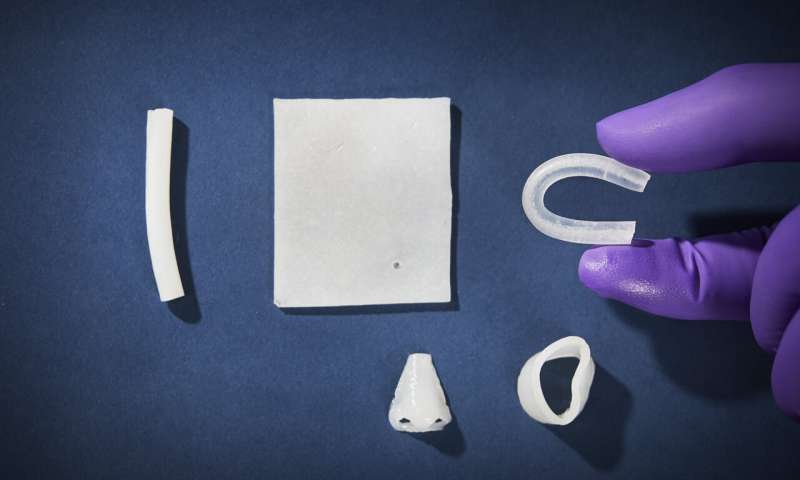
The foundation of the material is the same as plexiglass, a material which is common in medical technology applications. Through redesigning its makeup, and through a process called nanostructuring, they gave the newly patented material a unique combination of properties, incuding high elasticity, as demonstrated in the image. Credit: Anna Lena Lundqvist/Chalmers

Because the new material can be injected and inserted via keyhole surgery, it can also help reduce the need for drastic surgery and operations to rebuild parts of the body. The material can be injected via a standard cannula as a viscous fluid, so that it forms its own elastic structures within the body. Or the material can also be 3-D printed into specific structures as required.

“There are many diseases where the cartilage breaks down and friction results between bones, causing great pain for the affected person. This material could potentially act as a replacement in those cases,” Martin Andersson continues.

A further advantage of the material is that it contains three-dimensionally ordered nanopores. This means it can be loaded with medicine for various therapeutic purposes such as improving healing and reducing inflammation. This allows for localized treatment, avoiding, for example, having to treat the entire with drugs, something that could help reduce problems associated with side effects. Since it is non-toxic, it also works well as a filler—the researchers see plastic surgery therefore as another very interesting potential area of application for the new material.

“I am now working full time with our newly founded company, Amferia, to get the research out to industry. I have been pleased to see a lot of real interest in our material. It’s promising in terms of achieving our goal, which is to provide real societal benefit,” Anand concludes.

Source: Nanostructured rubber-like material with optimal properties could replace human tissue

Data of millions of eBay and Amazon shoppers exposed by VAT analysing 3rd party

Researchers have discovered another big database containing millions of European customer records left unsecured on Amazon Web Services (AWS) for anyone to find using a search engine.

A total of eight million records were involved, collected via marketplace and payment system APIs belonging to companies including Amazon, eBay, Shopify, PayPal, and Stripe.

Discovered by Comparitech’s noted breach hunter Bob Diachenko, the AWS instance containing the MongoDB database became visible on 3 February, where it remained indexable by search engines for five days.

Data in the records included names, shipping addresses, email addresses, phone numbers, items purchased, payments, order IDs, links to Stripe and Shopify invoices, and partially redacted credit cards.

Also included were thousands of Amazon Marketplace Web Services (MWS) queries, an MWS authentication token, and an AWS access key ID.

Because a single customer might generate multiple records, Comparitech wasn’t able to estimate how many customers might be affected.

About half of the customers whose records were leaked are from the UK; as far as we can tell, most if not all of the rest are from elsewhere in Europe.

How did this happen?

According to Comparitech, the unnamed company involved was a third party conducting cross-border value-added tax (VAT) analysis.

That is, a company none of the affected customers would have heard of or have any relationship with:

This exposure exemplifies how, when handing over personal and payment details to a company online, that info often passes through the hands of various third parties contracted to process, organize, and analyze it. Rarely are such tasks handled solely in house.

Amazon queries could be used to query the MWS API, Comparitech said, potentially allowing an attacker to request records from sales databases. For that reason, it recommended that the companies involved should immediately change their passwords and keys.

Watch This SpaceX Rocket Abort Its Launch at the Last Second

A SpaceX Falcon 9 rocket aborted a planned launch on Sunday morning at the last second due to an engine power issue. The event produced confusion at the Kennedy Space Center in Florida, where countdown appeared to be proceeding normally. However, the rocket stayed where it was.

In a video published by SpaceX, you can hear a commentator begin to count down. At this moment, the rocket still looks like it’s getting ready to take off, and no one seems to suspect that something is wrong. Once the commentator gets to zero and says liftoff, they immediately add, “Disregard. We have an abort.”

According to Space.com, apparently, the Falcon 9’s onboard computer aborted the launch just before liftoff because it detected an issue with one of the rocket’s nine Merlin 1D engines. Michael Andrews, a supply chain supervisor at SpaceX, said in the launch commentary that they had a “condition regarding engine power that caused us to abort today’s launch.”

Andrews added that the vehicle appeared to be in good health, but the company would no longer try to launch today.

SpaceX itself weighed in on the matter on Twitter shortly after.

“Standing down today; standard auto-abort triggered due to out of family data during engine power check,” SpaceX said. “Will announce next launch date opportunity once confirmed on the Range.”

SpaceX was planning to launch a batch of 60 new Starlink satellites, part of an initiative to provide low-cost Internet to remote locations worldwide where it’s hard to obtain online services. CEO Elon Musk has said that the Starlink constellation system will be available once 400 satellites are in orbit and activated. He claims that it will achieve “significant operational capacity” with 800 satellites.

Today’s launch was significant because it would have been the first Falcon 9 rocket booster, or first stage, to launch five times. The first time this booster launched was in 2018, per Ars Technica. SpaceX had also announced that it would be reusing the rocket’s payload fairing. Overall, this meant that the only part of this Falcon 9 rocket that was not being reused was the second stage.

SpaceX aims to reduce the price of rocket launches by reusing parts of its rockets. There isn’t any word yet on when the company will try to launch this Falcon 9 rocket again. Even though it’s a small bummer, it’s better safe than sorry when you’re launching an expensive rocket, even if you do plan to reuse it. Better luck next time.

Source: Watch This SpaceX Rocket Abort Its Launch at the Last Second