‘Linusgate’: Namby pamby doesn’t like Linus calling FSF names at debconf, feels cancel cultury about it.

253 emails have been leaked from private (high-level) mailing lists of Debian, in which its representatives vocally complain about the talk Linus Torvalds gave at the most recent DebConf conference. Some people insist that he should be permanently banned from future conferences because the language he uses is inappropriate and infringes on the project’s Code of Conduct. This could set a very bad precedent for the open source community, which has recently seen an influx of various CoC policies applied to a number of high-profile projects mostly after very vocal concerns from the people who barely participate in the open source community. Some observers believe that it’s a plot by Microsoft to destroy the open source movement from the inside.

Source: ‘Linusgate’: Debian Project Leaders Want To Ban Linus Torvalds For His Manners – Slashdot

TCL Announces E Ink Color Display That Can Handle Video

Known for its tablets, TVs, and phones, TCL has this week announced a new technology, NXTPAPER, that could totally change how you think about e ink. E ink displays are known for being great to stare at for hours and perfect for reading books (and sometimes even comics), but the latest color displays from E Ink have low resolution and slow refresh rates, making them unusable for video. TCL claims its new NXTPAPER tech could be a solution.

TCL’s press release is a little confusing, as it appears to compare NXTPAPER both to E Ink’s displays and to traditional LCD displays that you find in most tablets and phones today. But by all accounts, the technology used in NXTPAPER sounds like e ink technology. The press release claims it will be 36% thinner than LCD displays and 65% more power-efficient—which lines up with the gains you get from e ink.

Last week, E Ink told the blog Good Ereader that it had plans to improve its own color E Ink technology. While we adore the first color E Ink devices, they’ve not been without their flaws, including a paltry 100-PPI resolution and slower refresh rates. E Ink promised to at least double the resolution to 200 PPI by 2021, with a goal of hitting 300 PPI—the resolution of high-end LCD and monochrome E Ink displays—at a later date.

We don’t know the exact planned resolution for TCL’s competing NXTPAPER technology, but the company claims it will be full HD, and that the text incorporated will allow it to have 25% higher contrast than traditional e ink devices

TCL also says it will offer a “paper-like visual experience in full color with no flicker and no harmful blue light” and that it will rely on natural light—which, again, sounds like e ink.

Source: TCL Announces E Ink Color Display That Can Handle Video

7 years later, US court deems NSA bulk phone-call snooping illegal, possibly unconstitutional, and probably pointless anyway

The United States Court of Appeals for the Ninth Circuit has ruled [PDF] that the National Security Agency’s phone-call slurping was indeed naughty, seven years after former contractor Edward Snowden blew the whistle on the tawdry affair.

It’s been a long time coming, and while some might view the decision as a slap for officials that defended the practice, the three-judge panel said the part played by the NSA programme wasn’t sufficient to undermine the convictions of four individuals for conspiring to send funds to Somalia in support of a terrorist group.

Snowden made public the existence of the NSA data collection programmes in June 2013, and by June 2015 US Congress had passed the USA FREEDOM Act, “which effectively ended the NSA’s bulk telephony metadata collection program,” according to the panel.

The panel took a long, hard look at the metadata collection programme, which slurped the telephony of millions of Americans (as well as at least one of the defendants) and concluded that not only had the Fourth Amendment of the constitution likely been violated, it certainly flouted section 1861 of the Foreign Intelligence Surveillance Act (FISA), which deals with access to business records in foreign intelligence and international terrorism investigations.

“On the merits,” the ruling said, “the panel held that the metadata collection exceeded the scope of Congress’s authorization in 50 U.S.C. § 1861, which required the government to make a showing of relevance to a particular authorized investigation before collecting the records, and that the program therefore violated that section of FISA.”

So, both illegal and quite possibly unconstitutional.

It isn’t a good look for the intelligence services. The panel was able to study the classified records and noted that “the metadata did not and was not necessary to support the requisite probable cause showing for the FISA Subchapter I warrant application in this case.”

The panel went on to administer a light slapping to those insisting that the metadata programme was an essential element in the case. The evidence, such as it was, “did not taint the evidence introduced by the government at trial,” the panel observed before going on to say: “To the extent the public statements of government officials created a contrary impression, that impression is inconsistent with the contents of the classified record.”

Thus not only illegal, possibly unconstitutional but also not particularly helpful in this instance, no matter what officials might have insisted.

While the American Civil Liberties Union (ACLU) declared the ruling “a victory for our privacy rights”, the process could have a while to run yet, including a trip to America’s Supreme Court

Source: US court deems NSA bulk phone-call snooping illegal, possibly unconstitutional, and probably pointless anyway • The Register

European ISPs report mysterious wave of DDoS attacks

More than a dozen internet service providers (ISPs) across Europe have reported DDoS attacks that targeted their DNS infrastructure.

The list of ISPs that suffered attacks over the past week includes Belgium’s EDP, France’s Bouygues TélécomFDNK-netSFR, and the Netherlands’ CaiwayDeltaFreedomNetOnline.nl, Signet, and Tweak.nl.

Attacks lasted no longer than a day and were all eventually mitigated, but ISP services were down while the DDoS was active.

NBIP, a non-profit founded by Dutch ISPs to collectively fight DDoS attacks and government wiretapping attempts, provided ZDNet with additional insights into the past week’s incidents.

“Multiple attacks were aimed towards routers and DNS infrastructure of Benelux based ISPs,” a spokesperson said. “Most of [the attacks] were DNS amplification and LDAP-type of attacks.”

“Some of the attacks took longer than 4 hours and hit close to 300Gbit/s in volume,” NBIB said.

[…]

Source: European ISPs report mysterious wave of DDoS attacks | ZDNet

These students figured out their tests were graded by AI — and the easy way to cheat – The Verge

Simmons, who is a history professor herself. Then, Lazare clarified that he’d received his grade less than a second after submitting his answers. A teacher couldn’t have read his response in that time, Simmons knew — her son was being graded by an algorithm.

Simmons watched Lazare complete more assignments. She looked at the correct answers, which Edgenuity revealed at the end. She surmised that Edgenuity’s AI was scanning for specific keywords that it expected to see in students’ answers. And she decided to game it.

[…]

Now, for every short-answer question, Lazare writes two long sentences followed by a disjointed list of keywords — anything that seems relevant to the question. “The questions are things like… ‘What was the advantage of Constantinople’s location for the power of the Byzantine empire,’” Simmons says. “So you go through, okay, what are the possible keywords that are associated with this? Wealth, caravan, ship, India, China, Middle East, he just threw all of those words in.”

“I wanted to game it because I felt like it was an easy way to get a good grade,” Lazare told The Verge. He usually digs the keywords out of the article or video the question is based on.

Apparently, that “word salad” is enough to get a perfect grade on any short-answer question in an Edgenuity test.

Edgenuity didn’t respond to repeated requests for comment, but the company’s online help center suggests this may be by design. According to the website, answers to certain questions receive 0% if they include no keywords, and 100% if they include at least one. Other questions earn a certain percentage based on the number of keywords included.

[…]

One student, who told me he wouldn’t have passed his Algebra 2 class without the exploit, said he’s been able to find lists of the exact keywords or sample answers that his short-answer questions are looking for — he says you can find them online “nine times out of ten.” Rather than listing out the terms he finds, though, he tried to work three into each of his answers. (“Any good cheater doesn’t aim for a perfect score,” he explained.)

Source: These students figured out their tests were graded by AI — and the easy way to cheat – The Verge

Bill Barr to destroy antitrust case vs Google by forcing DoJ complaint filed before case is ready but before Trump re-election voting

Several interested parties in the U.S. government have been looking to put Google’s head on a spike, and while undoubtedly there’s been some degree of jockeying between them for which will ultimately get the credit, they’ve been proceeding with care and caution in the interest of building an ironclad case against a particularly canny opponent. Leave it to Bill Barr—who in a better world would instead star in a live-action remake of Droopy Dog— to take all that hard work and piss it away.

Per reporting in the New York Times, “Justice Department officials told lawyers involved in the antitrust inquiry into Alphabet […] to wrap up their work by the end of September.” These lawyers apparently viewed the new, abrupt deadline—against an enormously powerful company with nearly unlimited resources to throw at a comprehensive legal defense—as “arbitrary.”

In all likeliness it’s anything but arbitrary. As we near the general election in November, the Trump camp is looking for a win to hang its hat on. We’ve already seen the president decide—seemingly mid-interview with Axios’s Jonathan Swan—to cut the number of troops deployed in Afghanistan by half, and likewise claim during his keynote speech at the RNC that he will release a covid-19 vaccine. Not coincidentally, both of these miraculous claims are projected (by Trump and seemingly only Trump) to come to fruition around November. Breaking up Google, which is increasingly a source of ire for Republicans and Democrats (albeit for wildly different reasons) appears to be a gambit by Barr to find that win—or at least the appearance of one.

We’ve reached out to Google and the Department of Justice for comment and will update if we hear back.

As mentioned, the DOJ isn’t the only game in town where fining, regulating, or otherwise frustrating Google’s market dominance is concerned. A coalition of 50 state attorneys general is also probing the company, while the FTC, the House’s Antitrust Subcommittee, and the Senate Antitrust Subcommittee have ongoing investigations more broadly into the practices of big tech. All have been gathering evidence for a year or more, which is what makes Barr’s hastiness particularly egregious. Per the Times:

Some lawyers in the department worry that Mr. Barr’s determination to bring a complaint this month could weaken their case and ultimately strengthen Google’s hand, according to interviews with 15 lawyers who worked on the case or were briefed on the department’s strategy […] Many career staff members in the antitrust division, including more than a dozen who were hired during the Trump administration, considered the evidence solid that Google’s search and advertising businesses violated antitrust law. But some told associates that Mr. Barr was forcing them to come up with “half-baked” cases so he could unveil a complaint by Sept. 30.

As is the case with most would-be totalitarians, the appearance of strength for Trump is often pursued at the expense of actually wielding power effectively. If true, Barr’s reported plan to jump the gun on a Google antitrust case is a prime example. By looking the part and going after Google now, he would be likely to undermine the other existing cases against the company. If, say, Google manages to dodge claims by the DOJ of a monopoly on web search advertising (of which it controls more than 90% of the market), that becomes precedent the FTC or House needs to overcome to prove said monopoly exists.

Regulating big tech—and regulating it in a smart and comprehensive way—would be a steep uphill climb in the best of political climates. Leave it to Trump and his lackeys to carve that hill into a sheer cliff face and slather it in grease. Maybe someone else will clean it up.

Source: Report: DOJ Puts to File Google Antitrust Case in September

After Facebook Balks, Apple Delays “Privacy” (ie only Apple spies on you) Feature

In June, Apple unveiled plans for an iOS 14 privacy update that forces developers to gather users’ consent before tracking their activities across third-party apps and websites. Needless to say, giving users more control over how their information is gathered and trafficked is expected to bruise advertisers—especially Facebook, which uses that information to narrow its targeting functions.

As the initial autumn deadline closed in, Facebook protested last week that the change could render Facebook’s Audience Network—its ad service offered to third-party apps—“so ineffective on iOS 14 that it may not make sense to offer it on iOS 14 in the future.” The company claimed that blocking personalization is expected to cut Audience Network revenue by half or more, and that the move would hurt the over 19,000 developers who work with Facebook, many of which are “small businesses that depend on ads to support their livelihood.”

Apple’s messaging to users, as illustrated in the latest promo images for iOS 14, doesn’t give surveillance a nice ring. It will tell you bluntly that such-and-such app “would like permission to track you across apps and websites owned by other companies.” Apple pointed out to Gizmodo that it still embraces in-app advertising and does not prohibit tracking. In fact, Facebook can still gather that data (using Apple’s advertiser ID), if it’s willing to ask iOS users to agree to be tracked (using that scary messaging.) But both Apple and Facebook know that the data collection business operates more smoothly when begging for forgiveness later rather than asking permission now. If not, companies wouldn’t have mastered the art of doublespeak and constructed labyrinthine settings menus.

Apple, on the other hand, will still be able to benefit from gathering your information in various ways without asking permission because Apple doesn’t necessarily need to share or gather your information with data brokers and outside companies—your data is already growing organically within Apple’s walled garden. For example, Apple might show you an ad for a weight loss app in the App Store based on the fact that you read an article from a lifestyle publication in the Apple News app—a function which is automatically enabled, and can be toggled off, under “Apple Advertising.” Similarly, Apple says that developers can use data gained from activity within their own apps through Apple’s vendor-specific identifier. (Apple says that the “tracking” prompt would still show up if Apple-created apps intend to share information beyond Apple.)

But it’s hard to imagine a competing vendor that would have access to such a sprawling network of native data, aside from Google, which has its own devices and browser and advertiser ID. And sticking the notification on Facebook polishes Apple’s self-fashioned reputation a big tech company which values privacy. (It is not.)

[…]

Apple says that now apps won’t need to ask users permission to be tracked until 2021, “to give developers time to make necessary changes.” Apple will also require developers to submit details on the data their apps collect—including “sensitive information” such as race, sexual orientation, disability, and political affiliation—which will be published in the App Store later this year.

Source: After Facebook Balks, Apple Delays Privacy Feature

Facebook finally joins responsible disclosure for bugs they find

Facebook has published its first Vulnerability Disclosure Policy and given itself grounds to blab the existence of bugs to the world if it thinks that’s the right thing to do.

“Facebook may occasionally find critical security bugs or vulnerabilities in third-party code and systems, including open source software,” the company writes. “When that happens, our priority is to see these issues promptly fixed, while making sure that people impacted are informed so that they can protect themselves by deploying a patch or updating their systems.”

The Social Network™ has made itself the arbiter of what needs to be disclosed and when it needs to be disclosed. The company’s policy is to contact “the appropriate responsible party” and give them 21 days to respond.

“Facebook will evaluate based on our interpretation of the risk to people.”

“If we don’t hear back within 21 days after reporting, Facebook reserves the right to disclose the vulnerability,” the policy says, adding: “If within 90 days after reporting there is no fix or update indicating the issue is being addressed in a reasonable manner, Facebook will disclose the vulnerability.”

But the company has also outlined exceptions to those rules, with acceleration of disclosure if a bug is already being exploited and slowing down news “If a project’s release cycle dictates a longer window.”

The third reason is:

“If a fix is ready and has been validated, but the project owner unnecessarily delays rolling out the fix, we might initiate the disclosure prior to the 90-day deadline when the delay might adversely impact the public.”

Facebook “will evaluate each issue on a case-by-case basis based on our interpretation of the risk to people.”

The policy isn’t wildly difficult from that used by Google’s Project Zero, which also discloses bugs after 90 days and also offers extensions under some circumstances.

Source: Facebook to blab bugs it finds if it thinks code owners aren’t fixing fast enough • The Register

The Big Tesla Hack: A hacker gained control over the entire fleet, but fortunately he’s a good guy

In July 2017, Tesla CEO Elon Musk got on stage at the National Governors Association in Rhode Island and confirmed that a “fleet-wide hack” is one of Tesla’s biggest concerns as the automaker moves to autonomous vehicles.

He even presented a strange scenario that could happen in an autonomous future:

“In principle, if someone was able to say hack all the autonomous Teslas, they could say – I mean just as a prank – they could say ‘send them all to Rhode Island’ [laugh] – across the United States… and that would be the end of Tesla and there would be a lot of angry people in Rhode Island.”

What Musk knew that the public didn’t was that Tesla got a taste of that actually happening just a few months prior to his talk.

The Big Tesla Hack

Back in 2017, Jason Hughes was already well known in the Tesla community under his WK057 alias on the forums.

He was an early member of the Tesla “root access” community, a group of Tesla owners who would hack their own cars to get more control over them and even unlock unreleased features.

[…]

After Tesla started to give customers access to more data about Supercharger stations, mainly the ability to see how many chargers were currently available at a specific charging station through its navigation app, Hughes decided to poke around and see if he could expose the data.

He told Electrek:

“I found a hole in the server-side of that mechanism that allowed me to basically get data for every Supercharger worldwide about once every few minutes.”

The hacker shared the data on the Tesla Motors Club forum, and the automaker seemingly wasn’t happy about it.

Someone who appeared to be working at Tesla posted anonymously about how they didn’t want the data out there.

Hughes responded that he would be happy to discuss it with them.

20 minutes later, he was on a conference call with the head of the Supercharger network and the head of software security at Tesla.

They kindly explained to him that they would prefer for him not to share the data, which was technically accessible through the vehicles. Hughes then agreed to stop scraping and sharing the Supercharger data.

After reporting his server exploit through Tesla’s bug reporting service, he received a $5,000 reward for exposing the vulnerability.

With now having more experience with Tesla’s servers and knowing that their network wasn’t the most secure, to say the least, he decided to go hunting for more bug bounties.

After some poking around, he managed to find a bunch of small vulnerabilities.

The hacker told Electrek:

“I realized a few of these things could be chained together, the official term is a bug chain, to gain more access to other things on their network. Eventually, I managed to access a sort of repository of server images on their network, one of which was ‘Mothership’.”

Mothership is the name of Tesla’s home server used to communicate with its customer fleet.

Any kind of remote commands or diagnostic information from the car to Tesla goes through “Mothership.”

After downloading and dissecting the data found in the repository, Hughes started using his car’s VPN connection to poke at Mothership. He eventually landed on a developer network connection.

That’s when he found a bug in Mothership itself that enabled him to authenticate as if it was coming from any car in Tesla’s fleet.

All he needed was a vehicle’s VIN number, and he had access to all of those through Tesla’s “tesladex” database thanks to his complete control of Mothership, and he could get information about any car in the fleet and even send commands to those cars.

At the time, I gave Hughes the VIN number of my own Tesla Model S, and he was able to give me its exact location and any other information about my own vehicle.

[…]

Hughes couldn’t really send Tesla cars driving around everywhere like Tesla’s CEO described in a strange scenario few months later, but he could “Summon” them.

In 2016, Tesla released its Summon feature, which enables Tesla owners to remotely move their cars forward or backward a few dozen feet without anyone in them.

[…]

the automaker awarded him a special $50,000 bug report reward — several times higher than the max official bug reward limit:

Source: The Big Tesla Hack: A hacker gained control over the entire fleet, but fortunately he’s a good guy – Electrek

Academic Study Says Open Source Has Peaked: But Why?

Open source runs the world. That’s for supercomputers, where Linux powers all of the top 500 machines in the world, for smartphones, where Android has a global market share of around 75%, and for everything in between, as Wired points out:

When you stream the latest Netflix show, you fire up servers on Amazon Web Services, most of which run on Linux. When an F-16 fighter takes off, three Kubernetes clusters run to keep the jet’s software running. When you visit a website, any website, chances are it’s run on Node.js. These foundational technologies — Linux, Kubernetes, Node.js — and many others that silently permeate our lives have one thing in common: open source.

Ubiquity can engender complacency: because open source is indispensable for modern digital life, the assumption is that it will always be there, always supported, always developed. That makes new research looking at what the longer-term trends are in open source development welcome. It builds on work carried out by three earlier studies, in 2003, 2007 and 2007, but using a much larger data set:

This study replicates the measurements of project-specific quantities suggested by the three prior studies (lines of code, lifecycle state), but also reproduce the measurements by new measurands (contributors, commits) on an enlarged and updated data set of 180 million commits contributed to more than 224,000 open source projects in the last 25 years. In this way, we evaluate existing growth models and help to mature the knowledge of open source by addressing both internal and external validity.

The new work uses data from Open Hub, which enables the researchers to collect commit information across different source code hosts like GitHub, Gitlab, BitBucket, and SourceForge. Some impressive figures emerge. For example, at the end of 2018, open source projects contained 17,586,490,655 lines of code, made up of 14,588,351,457 lines of source code and 2,998,139,198 lines of comments. In the last 25 years, 224,342 open source projects received 180,937,525 commits in total. Not bad for what began as a ragtag bunch of coders sharing stuff for fun. But there are also some more troubling results. The researchers found that most open source projects are inactive, and that most inactive projects never receive a contribution again.

Looking at the longer-term trends, an initial, transient exponential growth was found until 2009 for commits and contributors, until 2011 for the number of available projects, and until 2013 for available lines of code. Thereafter, all those metrics reached a plateau, or declined. In one sense, that’s hardly a surprise. In the real world, exponential growth has to stop at some point. The real question is whether open source has peaked purely because it has reached its natural limits, or whether they are other problems that could have been avoided.

For example, a widespread concern in the open source community is that companies may have deployed free code in their products with great enthusiasm, but they have worried less about giving back and supporting all the people who write it. Such an approach may work in the short term, but ultimately destroys the software commons they depend on. That’s just as foolish as over-exploiting the environmental commons with no thought for long-term sustainability. As the Wired article mentioned above points out, it’s not just bad for companies and the digital ecosystem, it’s bad for the US too. In the context of the current trade war with China, “the core values of open source — transparency, openness, and collaboration — play to America’s strengths”. The new research might be an indication that the open source community, which has selflessly given so much for decades, is showing signs of altruism fatigue. Now would be a good time for companies to start giving back by supporting open source projects to a much greater degree than they have so far.

Source: Academic Study Says Open Source Has Peaked: But Why? | Techdirt

I spoke of this in 2017

Private Intel Firm Buys Location Data to Track People to their ‘Doorstep’ sourced from innocuous seeming apps

A threat intelligence firm called HYAS, a private company that tries to prevent or investigates hacks against its clients, is buying location data harvested from ordinary apps installed on peoples’ phones around the world, and using it to unmask hackers. The company is a business, not a law enforcement agency, and claims to be able to track people to their “doorstep.”

The news highlights the complex supply chain and sale of location data, traveling from apps whose users are in some cases unaware that the software is selling their location, through to data brokers, and finally to end clients who use the data itself. The news also shows that while some location firms repeatedly reassure the public that their data is focused on the high level, aggregated, pseudonymous tracking of groups of people, some companies do buy and use location data from a largely unregulated market explicitly for the purpose of identifying specific individuals.

HYAS’ location data comes from X-Mode, a company that started with an app named “Drunk Mode,” designed to prevent college students from making drunk phone calls and has since pivoted to selling user data from a wide swath of apps. Apps that mention X-Mode in their privacy policies include Perfect365, a beauty app, and other innocuous looking apps such as an MP3 file converter.

“As a TI [threat intelligence] tool it’s incredible, but ethically it stinks,” a source in the threat intelligence industry who received a demo of HYAS’ product told Motherboard. Motherboard granted the source anonymity as they weren’t authorized by their company to speak to the press.

[…]

HYAS differs in that it provides a concrete example of a company deliberately sourcing mobile phone location data with the intention of identifying and pinpointing particular people and providing that service to its own clients. Independently of Motherboard, the office of Senator Ron Wyden, which has been investigating the location data market, also discovered HYAS was using mobile location data. A Wyden aide said they had spoken with HYAS about the use of the data. HYAS said the mobile location data is used to unmask people who may be using a Virtual Private Network (VPN) to hide their identity, according to the Wyden aide.

In a webinar uploaded to HYAS’ website, Todd Thiemann, VP of marketing at the company, describes how HYAS used location data to track a suspected hacker.

“We found out it was the city of Abuja, and on a city block in an apartment building that you can see down there below,” he says during the webinar. “We found the command and control domain used for the compromised employees, and used this threat actor’s login into the registrar, along with our geolocation granular mobile data to confirm right down to his house. We also got his first and last name, and verified his cellphone with a Nigerian mobile operator.”

hyas-webinar.png

A screenshot of a webinar given by HYAS, in which the company explains how it has used mobile application location data.

On its website, HYAS claims to have some Fortune 25 companies, large tech firms, as well as law enforcement and intelligence agencies as clients.

[…]

Customers can include banks who want to get a heads-up on whether a freshly dumped cache of stolen credit card data belongs to them; a retailer trying to protect themselves from hackers; or a business checking if any of their employees’ login details are being traded by cybercriminals.

Some threat intelligence companies also sell services to government agencies, including the FBI, DHS, and Secret Service. The Department of Justice oftens acknowledges the work of particular threat intelligence companies in the department’s announcement of charges or indictments against hackers and other types of criminals.

But some other members of the threat intelligence industry criticized HYAS’ use of mobile app location data. The CEO of another threat intelligence firm told Motherboard that their company does not use the same sort of information that HYAS does.

The threat intelligence source who originally alerted Motherboard to HYAS recalled “being super shook at how they collected it,” referring to the location data.

A senior employee of a third threat intelligence firm said that location data is not hard to buy.

[…]

Motherboard found several location data companies that list HYAS in their privacy policies. One of those is X-Mode, a company that plants its own code into ordinary smartphone apps to then harvest location information. An X-Mode spokesperson told Motherboard in an email that the company’s data collecting code, or software development kit (SDK), is in over 400 apps and gathers information on 60 million global monthly users on average. X-Mode also develops some of its own apps which use location data, including parental monitoring app PlanC and fitness tracker Burn App.

“Whatever your need, the XDK Visualizer is here to show you that our signature SDK is too legit to quit (literally, it’s always on),” the description for another of X-Code’s own apps, which visualizes the company’s data collection to attract clients, reads.

“They’re like many location trackers but seem more aggressive to be honest,” Will Strafach, founder of the app Guardian, which alerts users to other apps accessing their location data, told Motherboard in an online chat. In January, X-Mode acquired the assets of Location Sciences, another location firm, expanding X-Mode’s dataset.

[…]

Motherboard then identified a number of apps whose own privacy policies mention X-Mode. They included Perfect365, a beauty-focused app that people can use to virtually try on different types of makeup with their device’s camera.

[…]

Various government agencies have bought access to location data from other companies. Last month, Motherboard found that U.S. Customs and Border Protection (CBP) paid $476,000 to a firm that sells phone location data. CBP has used the data to scan parts of the U.S. border, and the Internal Revenue Service (IRS) tried to use the same data to track criminal suspects but was unsuccessful.

Source: Private Intel Firm Buys Location Data to Track People to their ‘Doorstep’

Amazon Prime Air drone delivery fleet gets FAA approval

Amazon received federal approval to operate its fleet of Prime Air delivery drones, the Federal Aviation Administration said Monday, a milestone that allows the company to expand unmanned package delivery.

The approval will give Amazon broad privileges to “safely and efficiently deliver packages to customers,” the agency said. The certification comes under Part 135 of FAA regulations, which gives Amazon the ability to carry property on small drones “beyond the visual line of sight” of the operator.

Amazon said it will use the FAA’s certification to begin testing customer deliveries. The company said it went through rigorous training and submitted detailed evidence that its drone delivery operations are safe, including demonstrating the technology for FAA inspectors.

“This certification is an important step forward for Prime Air and indicates the FAA’s confidence in Amazon’s operating and safety procedures for an autonomous drone delivery service that will one day deliver packages to our customers around the world,” David Carbon, vice president of Prime Air, said in a statement. “We will continue to develop and refine our technology to fully integrate delivery drones into the airspace, and work closely with the FAA and other regulators around the world to realize our vision of 30 minute delivery.”

Amazon added that while the Prime Air fleet isn’t ready to immediately deploy package deliveries at scale, it’s actively flying and testing the technology.

[…]

Source: Amazon Prime Air drone delivery fleet gets FAA approval

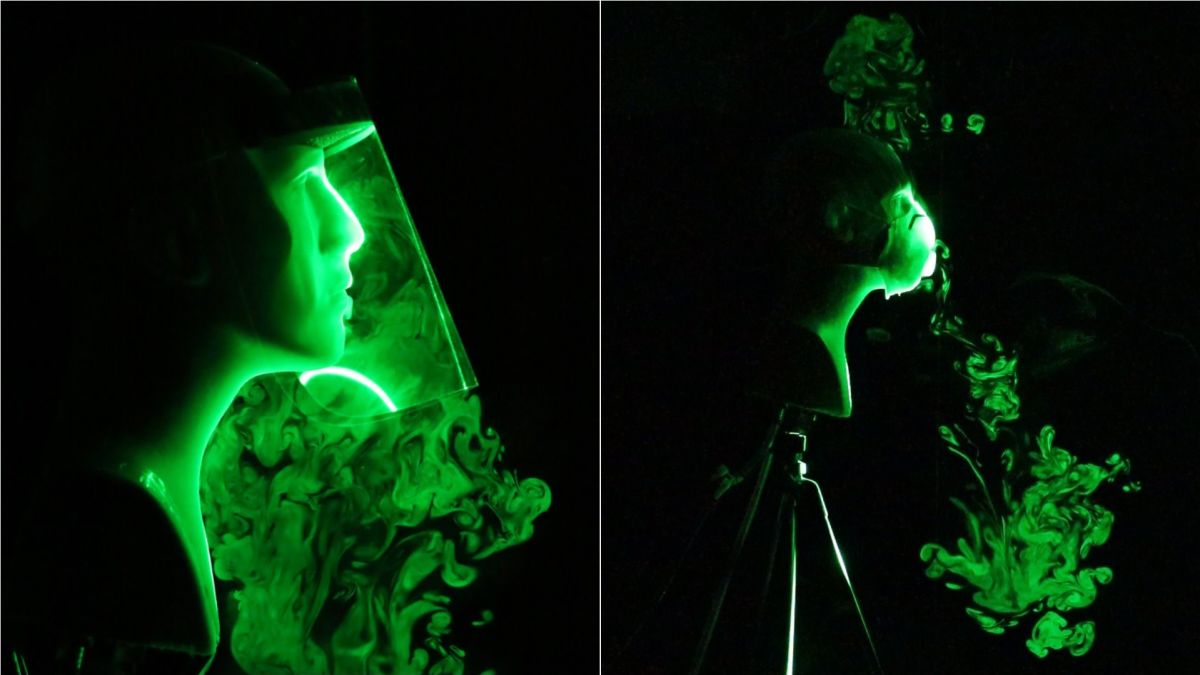
How Face Shields and Valve Masks Fail to Stop Infectious Droplets, as Shown by Lasers

A new study using lasers suggests that face shields and masks outfitted with an exhaust valve aren’t particularly great at protecting others from tiny respiratory droplets containing contagious germs like the coronavirus that causes covid-19. These aerosols can spill through and around these types of face equipment, the study found, weakening their potential to keep users from spreading an infection to others

Mask wearing has been embraced by public health experts as one of the most impactful ways to reduce the chances of someone giving covid-19 to other people. To a lesser extent, masks seem to also lower the risk of wearers catching the coronavirus from others. And despite a noisy contingent of skeptics, particularly in the U.S., much of the public in countries around the world have adapted to wearing masks in situations where they’re around people outside their household.

But there are many different kinds of face coverings that have become popular. Two in particular are plastic face shields and N95-respirator masks that come with exhaust valves. N95 respirators filter inhaled air from the outside, significantly reducing the potential for catching a respiratory infection, while the valves are intended to make breathing out easier. Shields are less cumbersome on the user’s breathing but have large gaps on the bottom and sides that, presumably, would let germs enter and escape fairly easily. Medical professionals typically wear face shields in addition to masks and other protective equipment, as a way to prevent sneezed or coughed droplets from a patient from landing in their eyes and other parts of their face.

In this new study, published Tuesday in the journal Physics of Fluids, both face shields and valve masks were shown to be pretty bad at stopping the flow of aerosols.

Engineers at Florida Atlantic University created a sort of light show to visualize what happens to our exhalations while using these coverings. They lit up the area around a mannequin’s mouth with lasers, outfitted the dummy with either an exhaust-valve mask or face shield, then pumped a mixture of water and glycerin through its mouth, creating a synthetic fog with a similar consistency to the aerosol droplets emitted by a person while coughing and sneezing. In the dark, the lasers were able to eerily illuminate the path of these droplets as they left the mannequin’s mouth.

The results were plain to see. The face shield did blunt the initial forward burst from the mouth, but the aerosolized droplets were then easily dispersed to the sides and even behind the shield in still high concentrations. Though the concentration of droplets dissipated as they moved further from the mannequin’s mouth, they would likely still be able to cover a lot of ground before they evaporated under the right conditions, such as indoor places with little air flow. Exhaust-valve N95 masks were even less effective at blocking the forward movement of droplets, with the valve serving as an easy escape hatch.

The team also tested several brands of surgical and N95 masks. Though these masks weren’t foolproof either at blocking aerosols, with some masks performing worse than others, they were still overall more effective in limiting aerosol concentration than either the shield or valve masks.

The two brands of surgical masks tested out by the group proved more effective at blocking aerosols than either the face shield or valve N95 mask, though Brand A, seen above, was better than Brand B.
Screenshot: Verma, et al/Phys. Fluids

“Overall, the visuals presented here indicate that face shields and masks with exhale valves may not be as effective as regular face masks in restricting the spread of aerosolized droplets,” the authors wrote. “Thus, despite the increased comfort that these alternatives offer, it may be preferable to use well-constructed plain masks.”

Source: How Face Shields and Valve Masks Fail to Stop Infectious Droplets, as Shown by Lasers

NB The study link itself has videos too

Engineers Have Figured Out How to Make Interactive Paper

Engineers at Purdue University have created a printing process by which you can coat paper or cardboard with “highly fluorinated molecules.” This then makes the coated paper dust, oil, and water-repellent, meaning you can then print multiple circuit layers onto the paper without smudging the ink. According to a paper the engineers published in Nano Energy, these “triboelectric areas” are then capable of “self-powered Bluetooth wireless communication.” That’s science-speak to say that paper printed and coated in this way doesn’t require external batteries as it generates electricity from contact with a user’s finger.

You can see a demonstration of how the tech works in these two videos. In the first video, Purdue engineers have a paper keypad that’s been treated with the aforementioned “omniphobic” coating. The paper keypad is then doused in some neon-green solution. In the second video, you can then see a person use the paper keypad to actually type on a laptop with a disabled keyboard.

In a third video, Purdue’s team printed a forward, back, mute, and volume bar on the back of a piece of paper. In it, you can see someone controlling audio playback by dragging their finger along the volume bar, as well as skipping forward and back in the music queue—some real David Blaine street magic-level shit.

While the tech itself is pretty cool, another neat aspect is that because it works on paper and cardboard, it would be relatively inexpensive, flexible, and quick to make. That makes it a good candidate for things like smart packaging.

“I envision this technology to facilitate the user interaction with food packaging, to verify if the food is safe to be consumed, or enabling users to sign the package that arrives at home by dragging their finger over the box to properly identify themselves as the owner of the package,” Ramses Martinez, an assistant professor at Purdue’s School of Industrial Engineering and one of the authors of the paper, said in a statement.

This isn’t the first time engineers have figured out novel uses for paper in electronics. A few months ago, researchers at the University of Missouri also created a paper-and-pencil medical wearable that could monitor things like heart rate, respiratory rate, glucose levels, body temperature, and sweat composition. In 2015, researchers from the University of Michigan created a stretchy conductor made of paper cut using the Japanese art of kirigami.

Purdue’s innovation is particularly interesting as it eliminates the need for external power sources, which makes applications like smart packaging less theoretical. That said, it’ll probably be a while before you can print your own paper Bluetooth keyboard.

Source: Engineers Have Figured Out How to Make Interactive Paper

COVID-19 tracing without an app? Google and Apple will ram it down your throat

Google and Apple have updated their COVID-19 contact-tracing tool to make it possible to notify users of potential exposures to the novel coronavirus without an app.

The new Exposure Notifications Express spec is baked into iOS 13.7, which emerged this week and will appear in an Android update due later this month.

This is not, repeat not, pervasive Bluetooth surveillance. The tool requires users to opt in, although public health authorities can use the tool to send notifications suggesting that residents do so.

Those who choose to participate agree to have their device use Bluetooth to search for other nearby opted-in devices, with an exchange of anonymised identifiers used to track encounters. If a user tests positive, and agrees to notify authorities, other users will be told that they are at risk and should act accordingly.

The update is designed to let health authorities use Bluetooth-powered contact-tracing without having to build their own apps. It’s still non-trivial to play, as the system requires one server to verify test results and another to run both contact-tracing apps and the app-free service.

Apple has published a succinct explainer here and Google has offered up code for notifications server on GitHub.

A couple of dozen US states have signed up for the new tool but other jurisdictions – among them India, Singapore and Australia – are persisting with their own approaches on the basis that the Apple/Google tech makes it harder for their manual contact-tracers to access information.

Source: COVID-19 tracing without an app? There’s an iOS and Android update for that • The Register

Considering the work both companies do with China and other friendly states, it would not surprise me that the “user opt in” feature becomes an “all users opt in without their knowing because the state is the people and the state knows best” feature in some places.

Philips Hue Bridge updates actually kills your old Bridge

Wow, I really really hate that this is a possibility. You spent money on hardware – not some monthly subscription service – where it’s really nice that they add more than just security updates but then: BANG! They kill the hardware, rendering it little more than scrappable junk. Suddenly, it won’t do any of the things it did only yesterday.

From the Bridge Release Notes:

June 22, 2020

Firmware 01043155 (Bridge V1)

With this update, the Hue Bridge v1 will not be supported any longer and continue to work only locally (without internet). This means the following: :

  • The Hue Bridge v1 will no longer receive updates, new features, or security patches.  
  • Away-from-home control and Home & Away will no longer be supported. 
  • Cloud-based voice control will no longer be supported. 
  • Login functionality for your Hue account — which gives you remote access to your lights — will be disabled. 
  • Third-party and partner functionalities, such as Google Voice and IFTTT, that are controlled via the cloud are no longer supported.

This is sick behaviour. If you’re buying into a cloud product, you can expect it if the company goes titsup, but not if this is an offline, local device.