
Reg reader ditches Samsung smart TV after seeing huge UI ads everywhere

A Register reader triggered a kerfuffle for Samsung after asking the electronics biz if he could disable large and intrusive adverts splattered across his new smart TV’s programme guide.

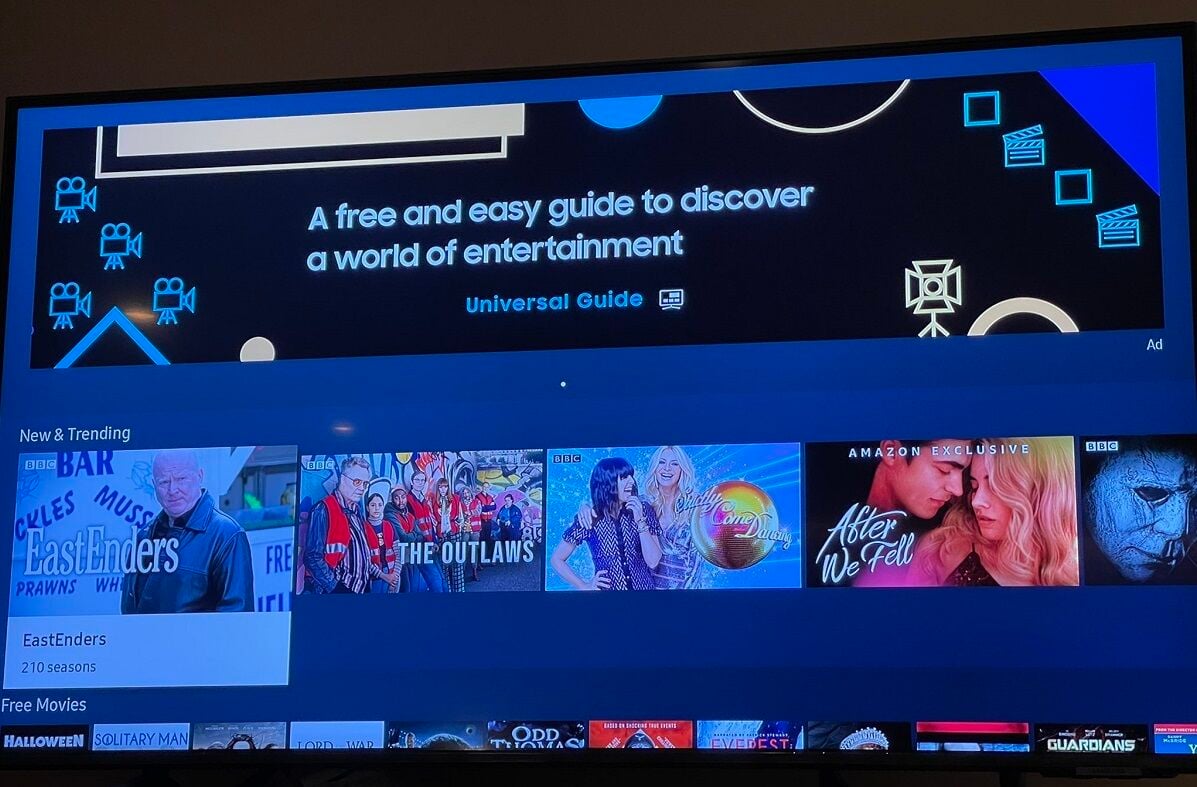
Ross McKillop bought the telly from UK retailer John Lewis but felt distinctly undersold when he turned it on to find the internet-connected device displaying advertising on its electronic programme guide menu.

Reg reader Ross McKillop's Samsung TV displaying smart ads taking up half the screen space

Ross McKillop’s Samsung TV displaying smart ads taking up half the screen space

“If you press the menu button to change between like TV or Netflix or, or whatever, even different sources, there’s an advert panel,” lamented McKillop to The Reg. “It seems that people accept this.”

Irritated by the giant advert for Samsung’s own wares, McKillop took to Twitter to ask the obvious question. The answer was surprisingly blunt.

“The more annoying [advert],” McKillop told us, “is the one that appears on the application menu, on every menu [level].”

Such a problem is, sadly, not new, as we reported about a year ago when other Samsung TV customers began wondering where the giant adverts splattered all over their TVs’ user interfaces had come from.

“I expect Netflix to promote Netflix’s products or Netflix programming on a service I pay for because it’s a service,” stormed McKillop, adding that he didn’t expect to have his TV’s manufacturer insert unavoidable advertising into his new box.

Smart readers (like our man Ross) know that you can kill ads at home with innovations such as the Pi-Hole home network-level adblocker.

Our reader also pointed out that the adverts on his new internet-connected telly were not visible in Samsung’s marketing videos about the product.

We asked Samsung if it wished to comment. The manufacturer failed to respond. McKillop has since returned his TV to retailer John Lewis.

Samsung has been relatively open about what its smart TVs do. A quick look at the “Samsung privacy policy – smart TV supplement” on its UK website reveals that the company hoovers up information about “your TV viewing history” including “information about the networks, channels, websites visited, and programs viewed on your Samsung Smart TV and the amount of time spent viewing them”.

This kind of subtle-but-invasive monitoring was the subject of a warning by an American university professor in 2019 who described it as “a cesspit of surveillance”.

The devices can pose a security risk unless they’re treated like any other internet-connectable device, as the Korean giant itself reminded tellywatchers a couple of years ago (well, they deleted that Twitter missive but El Reg doesn’t forget).

All in all, if you’re buying a Samsung TV, just remember that you’re not only paying for a big panel so you can watch reruns of Friends; you’re also paying to be part of Samsung’s global TV advertising network.
Source: Reg reader ditches Samsung smart TV after seeing huge UI ads • The Register

Kleiman v. Wright: $65 Billion Bitcoin Case Has Started

The civil trial of Ira Kleiman vs. Craig Wright started on Monday in Miami. The estate of David Kleiman is suing Craig Wright, the self declared inventor of bitcoin, for 50% ownership of 1.1 million bitcoins. The estate claims Kleiman was in a partnership with Wright to mine the coins but after Kleiman died in April 2013, Wright denied any partnership. At over $60,000 each per bitcoin, this case is currently worth $65 billion.

Craig Wright has previously claimed he is the inventor of Bitcoin, Satoshi Nakamoto, which has been met with skepticism based on his inability to show any proof. In this case, Wright has made numerous dubious claims. After the case was filed in 2018, Wright claimed he did not have the keys to the coins but that they would be arriving in January 2020 through a “bonded courier.” After January 2020, Wright provided keys to the estate for verification which the estate claims the bitcoins were fake. Expressing skepticism that the courier even existed, the estate asked for more information about the courier. Wright then claimed the identity of the courier and all communications were protected under attorney-client privilege as the courier was an attorney.

Source: Kleiman v. Wright: $65 Billion Bitcoin Case Has Started – Slashdot

Code compiled to WASM may lack standard security defenses

[…]

In a paper titled, The Security Risk of Lacking Compiler Protection in WebAssembly, distributed via ArXiv, the technical trio say that when a C program is compiled to WASM, it may lack anti-exploit defenses that the programmer takes for granted on native architectures.

The reason for this, they explain, is that security protections available in compilers like Clang for x86 builds don’t show up when WASM output is produced.

“We compiled 4,469 C programs with known buffer overflow vulnerabilities to x86 code and to WebAssembly, and observed the outcome of the execution of the generated code to differ for 1,088 programs,” the paper states.

“Through manual inspection, we identified that the root cause for these is the lack of security measures such as stack canaries in the generated WebAssembly: while x86 code crashes upon a stack-based buffer overflow, the corresponding WebAssembly continues to be executed.”

[….]

For those not in the know, a stack is a structure in memory used by programs to store temporary variables and information controlling the operation of the application. A stack canary is a special value stored in the stack. When someone attempts to exploit, say, a buffer overflow vulnerability in an application, and overwrite data on the stack to hijack the program’s execution, they should end up overwriting the canary. Doing so will be detected by the program, allowing it to trap and end the exploitation attempt.

Without these canaries, an exploited WASM program could continue running, albeit at the bidding of whoever attacked it, whereas its x86 counterpart exits for its own protection, and that’s a potential security problem. Stack canaries aren’t a panacea, and they can be bypassed, though not having them at all makes exploitation a lot easier.

And these issues are not necessarily a deal-breaker: WASM bytecode still exists in a sandbox, and has further defenses against control-flow hijacking techniques such as return-oriented programming.

But as the researchers observe, WASM’s documentation insists that stack-smashing protection isn’t necessary for WASM code. The three boffins say their findings indicate security assumptions for x86 binaries should be questioned for WASM builds and should encourage others to explore the consequences of this divergent behavior, as it applies both to stack-based buffer overflows and other common security weaknesses.

[…]

Source: Code compiled to WASM may lack standard security defenses • The Register

Likely Drone Attack On U.S. Power Grid Revealed In New Intelligence Report

U.S. officials believe that a DJI Mavic 2, a small quadcopter-type drone, with a thick copper wire attached underneath it via nylon cords was likely at the center of an attempted attack on a power substation in Pennsylvania last year. An internal U.S. government report that was issued last month says that this is the first time such an incident has been officially assessed as a possible drone attack on energy infrastructure in the United States, but that this is likely to become more commonplace as time goes on. This is a reality The War Zone has sounded the alarm about in the past, including when we were first to report on a still unexplained series of drone flights near the Palo Verde nuclear powerplant in Arizona in 2019.

[…]

“This is the first known instance of a modified UAS [unmanned aerial system] likely being used in the United States to specifically target energy infrastructure,” the JIB states. “We assess that a UAS recovered near an electrical substation was likely intended to disrupt operations by creating a short circuit to cause damage to transformers or distribution lines, based on the design and recovery location.”

ABC and other outlets have reported that the JIB says that this assessment is based in part on other unspecified incidents involving drones dating back to 2017.

[…]

Beyond the copper wire strung up underneath it, the drone reportedly had its camera and internal memory card removed. Efforts were taken to remove any identifying markings, indicating efforts by the operator or operators to conceal the identifies and otherwise make it difficult to trace the drone’s origins.

[…]


Source: Likely Drone Attack On U.S. Power Grid Revealed In New Intelligence Report

US bans trade with security firm NSO Group over Pegasus spyware

Surveillance software developer NSO Group may have a very tough road ahead. The US Commerce Department has added NSO to its Entity List, effectively banning trade with the firm. The move bars American companies from doing business with NSO unless they receive explicit permission. That’s unlikely, too, when the rule doesn’t allow license exceptions for exports and the US will default to rejecting reviews.

NSO and fellow Israeli company Candiru (also on the Entity List) face accusations of enabling hostile spying by authoritarian governments. They’ve allegedly supplied spyware like NSO’s Pegasus to “authoritarian governments” that used the tools to track activists, journalists and other critics in a bid to crush political dissent. This is part of the Biden-Harris administration’s push to make human rights “the center” of American foreign policy, the Commerce Department said.

The latest round of trade bans also affects Russian company Positive Technologies and Singapore’s Computer Security Initiative Consultancy, bot of which were accused of peddling hacking tools.

[…]

Source: US bans trade with security firm NSO Group over Pegasus spyware (updated) | Engadget

UK Schools Normalizing Biometric Collection By Using Facial Recognition For Meal Payments

Subjecting students to surveillance tech is nothing new. Most schools have had cameras installed for years. Moving students from desks to laptops allows schools to monitor internet use, even when students aren’t on campus. Bringing police officers into schools to participate in disciplinary problems allows law enforcement agencies to utilize the same tech and analytics they deploy against the public at large. And if cameras are already in place, it’s often trivial to add facial recognition features.

The same tech that can keep kids from patronizing certain retailers is also being used to keep deadbeat kids from scoring free lunches. While some local governments in the United States are trying to limit the expansion of surveillance tech in their own jurisdictions, governments in the United Kingdom seem less concerned about the mission creep of surveillance technology.

Some students in the UK are now able to pay for their lunch in the school canteen using only their faces. Nine schools in North Ayrshire, Scotland, started taking payments using biometric information gleaned from facial recognition systems on Monday, according to the Financial Times. [alt link]

The technology is being provided by CRB Cunningham, which has installed a system that scans the faces of students and cross-checks them against encrypted faceprint templates stored locally on servers in the schools. It’s being brought in to replace fingerprint scanning and card payments, which have been deemed less safe since the advent of the COVID-19 pandemic.

According to the Financial Times report, 65 schools have already signed up to participate in this program, which has supposedly dropped transaction times at the lunchroom register to less than five seconds per student. I assume that’s an improvement, but it seems fingerprints/cards weren’t all that slow and there are plenty of options for touchless payment if schools need somewhere to spend their cafeteria tech money.

CRB says more than 97% of parents have consented to the collection and use of their children’s biometric info to… um… move kids through the lunch line faster. I guess the sooner you get kids used to having their faces scanned to do mundane things, the less likely they’ll be to complain when demands for info cross over into more private spaces.

The FAQ on the program makes it clear it’s a single-purpose collection governed by a number of laws and data collection policies. Parents can opt out at any time and all data is deleted after opt out or if the student leaves the school. It’s good this is being handled responsibly but, like all facial recognition tech, mistakes can (and will) be made. When these inevitably occur, hopefully the damage will be limited to a missed meal.

The FAQ handles questions specifically about this program. The other flyer published by the North Ayrshire Council explains nothing and implies facial recognition is harmless, accurate, and a positive addition to students’ lives.

We’re introducing Facial Recognition!

This new technology is now available for a contactless meal service!

Following this exciting announcement, the flyer moves on to discussing biometric collections and the tech that makes it all possible. It accomplishes this in seven short “land of contrasts” paragraphs that explain almost nothing and completely ignore the inherent flaws in these systems as well as the collateral damage misidentification can cause.

The section titled “The history of biometrics” contains no history. Instead, it says biometric collections are already omnipresent so why worry about paying for lunch with your face?

Whilst the use of biometric recognition has been steadily growing over the last decade or so, these past couple of years have seen an explosion in development, interest and vendor involvement, particularly in mobile devices where they are commonly used to verify the owner of the device before unlocking or making purchases.

If students want to learn more (or anything) about the history of biometrics, I guess they’ll need to do their own research. Because this is the next (and final) paragraph of the “history of biometrics” section:

We are delighted to offer this fast and secure identification technology to purchase our delicious and nutritious school meals

Time is a flattened circle, I guess. The history of biometrics is the present. And the present is the future of student payment options, of which there are several. But these schools have put their money on facial recognition, which will help them raise a generation of children who’ve never known a life where they weren’t expected to use their bodies to pay for stuff.

Source: UK Schools Normalizing Biometric Collection By Using Facial Recognition For Meal Payments | Techdirt

Nintendo Killed Emulation Sites Then Released Garbage N64 Games For The Switch

[…]

You will recall that a couple of years back, Nintendo opened up a new front on its constant IP wars by going after ROM and emulation sites. That caused plenty of sites to simply shut themselves down, but Nintendo also made a point of getting some scalps to hang on its belt, most famously in the form of RomUniverse. That site, which very clearly had infringing material not only on the site but promoted by the site’s ownership, got slapped around in the courts to the tune of a huge judgement against, which the site owners simply cannot pay.

But all of those are details and don’t answer the real question: why did Nintendo do this? Well, as many expected from the beginning, it did this because the company was planning to release a series of classic consoles, namely the NES mini and SNES mini. But, of course, what about later consoles? Such as the Nintendo 64?

Well, the answer to that is that Nintendo has offered a Nintendo Switch Online service uplift that includes some N64 games that you can play there instead.

After years of “N64 mini” rumors (which have yet to come to fruition), Nintendo announced plans to honor its first fully 3D gaming system late last month in the form of the Nintendo Switch Online Expansion Pack. Pay a bit extra, the company said, and you’d get a select library of N64 classics, emulated by the company that made them, on Switch consoles as part of an active NSO subscription.

One month later, however, Nintendo’s sales proposition grew more sour. That “bit extra” ballooned to $30 more per year, on top of the existing $20/year fee—a 150 percent jump in annual price. Never mind that the price also included an Animal Crossing expansion pack (which retro gaming fans may not want) and Sega Genesis games (which have been mostly released ad nauseam on every gaming system of the past decade). For many interested fans, that price jump was about the N64 collection.

So, a bit of a big price tag and a bunch of extras that are mostly besides the point from the perspective of the buyer. Buy, hey, at least Nintendo fans will finally get some N64 games to play on their Switch consoles, right?

Well, it turns out that Nintendo’s offering cannot come close to matching the quality of the very emulators and ROMs that Nintendo has worked so hard to disappear. The Ars Technica post linked above goes into excruciating details, some of which we’ll discuss for the purpose of giving examples, but here are the categories that Nintendo’s product does worse than an emulator on a PC.


  • Game options, such as visual settings for resolution to fit modern screens
  • Visuals, such as N64’s famous blur settings, and visual changes that expose outdated graphical sprites
  • Controller input lag
  • Controller configuration options
  • Multiplayer lag/stutter


If that seems like a lot of problems compared with emulators that have been around for quite a while, well, ding ding ding! We’ll get into some examples briefly below, but I’ll stipulate that none of the issues in the categories above are incredibly bad. But there are so many of them that they all add up to bad!

[….]

Source: Nintendo Killed Emulation Sites Then Released Garbage N64 Games For The Switch | Techdirt

NFI decrypts Tesla’s hidden driving data

[…] The Netherlands Forensic Institute (NFI) said it discovered a wealth of information about Tesla’s Autopilot, along with data around speed, accelerator pedal positions, steering wheel angle and more. The findings will allow the government to “request more targeted data” to help determine the cause of accidents, the investigators said.

The researchers already knew that Tesla vehicles encrypt and store accident related data, but not which data and how much. As such, they reverse-engineered the system and succeeded in “obtaining data from the models S, Y, X and 3,” which they described in a paper presented at an accident analysis conference.

[….]

With knowledge of how to decrypt the storage, the NFI carried out tests with a Tesla Model S so it could compare the logs with real-world data. It found that the vehicle logs were “very accurate,” with deviations less than 1 km/h (about 0.6 MPH).

[…]

It used to be possible to extract Autopilot data from Tesla EVs, but it’s now encrypted in recent models, the investigators said. Tesla encrypts data for good reason, they acknowledged, including protecting its own IP from other manufacturers and guarding a driver’s privacy. It also noted that the company does provide specific data to authorities and investigators if requested.

However, the team said that the extra data they extracted would allow for more detailed accident investigations, “especially into the role of driver assistance systems.” It added that it would be ideal to know if other manufacturers stored the same level of detail over long periods of time. “If we would know better which data car manufacturers all store, we can also make more targeted claims through the courts or the Public Prosecution Service,” said NFI investigator Frances Hoogendijk. “And ultimately that serves the interest of finding the truth after an accident.”

Source: The Dutch government claims it can decrypt Tesla’s hidden driving data | Engadget

Protecting your IP this way basically means things like not being able to use the data for legitimate reasons – such as investigating accidents – as well as halting advancements. This whole IP thing has gotten way out of hand to the detriment of the human race!

Also, this sounds like non-GDPR compliant data collection