The Air Force was already familiar with the possibilities of the ‘SmartShooter’ smart aiming system. The only thing that was unknown was whether it is also effective in combination with the Colt C7 5.56mm long-range automatic rifle.
Operation
The system uses video analysis. A shooter aims his weapon at the target with the SmartShooter. So far, it is the same as with a normal aiming system. With the SmartShooter, the shooter selects the target by pulling the trigger, and holds the pulled trigger while continuing to aim at the target.
As soon as the system ‘sees’ that the target will be hit, the SmartShooter automatically will fire the weapon. So, it does not work autonomously, and the shooter selects the target, aims and pulls the trigger.
Effective
When the Dutch Army organized a shooting day to experiment with the SmartShooter system, the Air Force joined in to test its effectiveness against drones. A section of the top ten UAS detected by the Air Force in the Netherlands was fired.
The Colt rifle in combination with the SmartShooter system proved to be very effective: all targets were eliminated with a few rounds.
For years, you may recall that we would write about the insane nature of forum shopping for patent trolls, in which the trolls would flock to the federal courts in East Texas. Going back nearly 15 years, we wrote about how East Texas courts became grand central for patent troll cases, leading to all sorts of sketchy behavior. There are a bunch of empty office buildings setup in small Texas cities (mainly Marshall and Tyler) just to “pretend” to have offices there. Companies engaged in many patent cases started to try to suck up to residents of those small cities, in case they might be on a jury. TiVo literally bought a “Grand Champion Steer” just weeks before a jury was set to rule on a massive TiVo trolling case. Samsung threw so much money at the local “Stagecoach Days” event that it was renamed “Samsung Stagecoach Days,” and built a Samsung ice rinkright next to the courthouse in Marshall.
For years, people pressured Congress to fix this mess, but instead, the Supreme Court finally stepped in, with the TC Heartland ruling, and said that the proper jurisdiction should be where defendants actually are incorporated. Of course, this seemed to have the reverse effect — as companies no longer want to be in East Texas. Apple shut down its stores there to avoid the jurisdiction.
Of course, if you thought that the judges would go quietly, you’d be wrong. It’s always felt like a few judges in East Texas loved the reputation they’d built up as being super friendly to patent trolls. For a while it was Judge T. John Ward. And when he left the bench (to become a patent lawyer, natch), Judge Rodney Gilstrap stepped into the gap he left. He even tried to ignore the Supreme Court’s TC Heartland decision (though the Federal Circuit appeals court was not impressed).
However, as Patent Progress notes, there’s a new judge vying to be at the top of the patent troll’s Christmas list, and he’s in West Texas. Judge Alan Albright, a former patent litigator, was appointed to the bench in 2018 — and he literally went on a tour to convince companies to bring patent cases in his court:
U.S. District Judge Alan Albright and attorneys who predicted last year that Waco’s federal court would become a hotbed of patent and intellectual property litigation missed their prediction just a bit.
With Albright traveling the country drumming up business and patent attorneys spreading the word that Waco’s new federal judge, a longtime patent litigator, will provide the expertise to create an efficient and welcoming environment in Waco, the response in the past year actually exceeded those predictions.
Since Albright took office in September 2018, more than 250 patent cases have been filed in the federal Western District of Texas, which includes Waco. That total eclipses the number for the previous four years combined and has made the Western District among the busiest in the country for patent cases.
Amazon-owned smart home appliance maker Ring has won the world record for biggest game of “ding dong ditch” after a software glitch broadcast erroneous doorbell chimes to countless users yesterday.
The global game of Ring and run (as it’s known in the US) coincided with software issues that prevented owners from viewing archived footage or receiving push notifications. Customers in markets including the UK and US were believed to be affected.
The Timely Information Transmission Suffered Unpredictable Ping-time (TITSUP) led some to believe that Ring’s systems were being targeted deliberately by a malicious third party. “Are the Ring doorbells being hacked? Mine are going off non-stop,” tweeted one confused punter.
“You’re [sic] network has been down for hours. Now I am getting phantom ‘rings’ and it’s driving my Great Dane crazy,” complained another.
Your humble hack also experienced the glitch when a random chime from his overpriced doorbell disturbed a post-work nap. More accurately, it startled his dogs, who then leapt onto his chest.
Speaking to El Reg, Ring’s Europe head of communications, Claudia Fellerman, confirmed the problem and said it has since been fixed.
“Our processing infrastructure was running behind which caused some delays in receiving in-app notifications and Chime motion and ding notifications. However, this has been resolved,” she said.
According to Ring’s status page, no user data was lost, and a fix was applied by late evening. The company warned that users may encounter delayed chimes and notifications while the back-end catches up.
Ring also urged punters to check the battery levels on their devices as the outage may have caused a higher-than-usual power drain.
Tokyo’s Stock Exchange (TSE) went offline for most of Thursday, its longest-ever outage and a very unwelcome one as it is the world’s third-largest bourse, when measured by market capitalisation.
The exchange yesterday morning posted news that “a technical glitch occurred to distribution of market data,” and the market therefore stopped all trading. Later in the day the bourse also took down its after-hours trading platform, ToSTNeT, and then issued warnings that some market data distributed to investors was invalid.
The exchange explained the cause of the outage in a statement that said it experienced “hardware failure,” followed by a failure-to-failover.
The statement continued: “the switchover from the failed device to the backup device did not work properly, and as a result, market information could not be distributed.”
Which sounds very like someone hasn’t run a disaster recovery simulation for a while.
While the exchange thought it could replace the hardware and resume trading, doing so would have required a reboot that it felt “would cause confusion for investors and market participants, which would make it difficult to execute smooth trading.”
After talks with stakeholders, it was decided to just give up on the day and resume on Friday. At the time of writing – a few minutes after Friday’s opening bell – that plan appears to have worked.
The exchange has apologised for the outage, and taken responsibility for the situation, and also made it plain that mess was the result of its own mistakes and key technology provider Fujitsu was not at fault.
Fujitsu promotes TSE’s use of “approximately 200” of its Primergy servers and the Primesoft in-memory data management software.
That combo can apparently handle 100 million orders a day, at a rate of 1.4 million order-per-minute, all with transaction time of 300 microseconds apiece. Well, sometimes.
Fujitsu has reportedly apologised for its role in the outage.
The exchange continues to do so at every opportunity, with its notification that it expects normal trading today ending with: “We would like to express our sincerest apologies for the inconvenience caused by the system failure of Tokyo Stock Exchange, and we would like to ask for your continued support and cooperation in the operation of the market.”
The US government’s Department of Justice has won its multi-million-dollar claim to Edward Snowden’s Permanent Record book royalties as well as any future related earnings.
A federal district court in eastern Virginia this week ruled that Uncle Sam was entitled to the proceeds of Snowden’s bestseller, an estimated $5.2m, and “any further monies, royalties, or other financial advantages derived by Snowden from Permanent Record.” It can also grab Snowden’s appearance fees from 56 speeches, thought to exceed $1m.
The court came to this conclusion after deciding Snowden broke his non-disclosure agreements with the NSA and CIA. It noted the super-leaker did not offer up his book for a review by official censors nor did he clear speeches on intelligence matters with the US government as required by his employment contract from the time he worked for Uncle Sam.
“The United States’ lawsuit did not seek to stop or restrict the publication or distribution of Permanent Record,” the Dept of Justice’s spokespeople said on Thursday of the decision.
“Rather, under well-established Supreme Court precedent, Snepp v. United States, the government sought to recover all proceeds earned by Snowden because of his failure to submit his publication for pre-publication review in violation of his alleged contractual and fiduciary obligations.”
That the US government would crack down on Snowden is hardly unexpected. Officials filed suit in September 2019 to claim a cut of Snowden’s public persona on the grounds he broke his agreement with the No Such Agency by going public.
“Edward Snowden violated his legal obligations to the United States, and therefore, his unlawful financial gains must be relinquished to the government,” said Deputy Attorney General Jeffrey Rosen.
“As this case demonstrates, the Department of Justice will not overlook the wrongful actions of those who seek to betray the trust reposed in them and to personally profit from their access to classified national security information.”
Wow, apparently these employment contracts are more like permanent indenture – last I looked, Snowden wasn’t exactly in the employ of the NSA any more… in as much as he was ever as a contractor…
Grindr, one of the world’s largest dating and social networking apps for gay, bi, trans, and queer people, has fixed a security vulnerability that allowed anyone to hijack and take control of any user’s account using only their email address.
Wassime Bouimadaghene, a French security researcher, found the vulnerability and reported the issue to Grindr. When he didn’t hear back, Bouimadaghene shared details of the vulnerability with security expert Troy Hunt to help.
The vulnerability was fixed a short time later.
Hunt tested and confirmed the vulnerability with help from a test account set up by Scott Helme, and shared his findings with TechCrunch.
Bouimadaghene found the vulnerability in how the app handles account password resets.
To reset a password, Grindr sends the user an email with a clickable link containing an account password reset token. Once clicked, the user can change their password and is allowed back into their account.
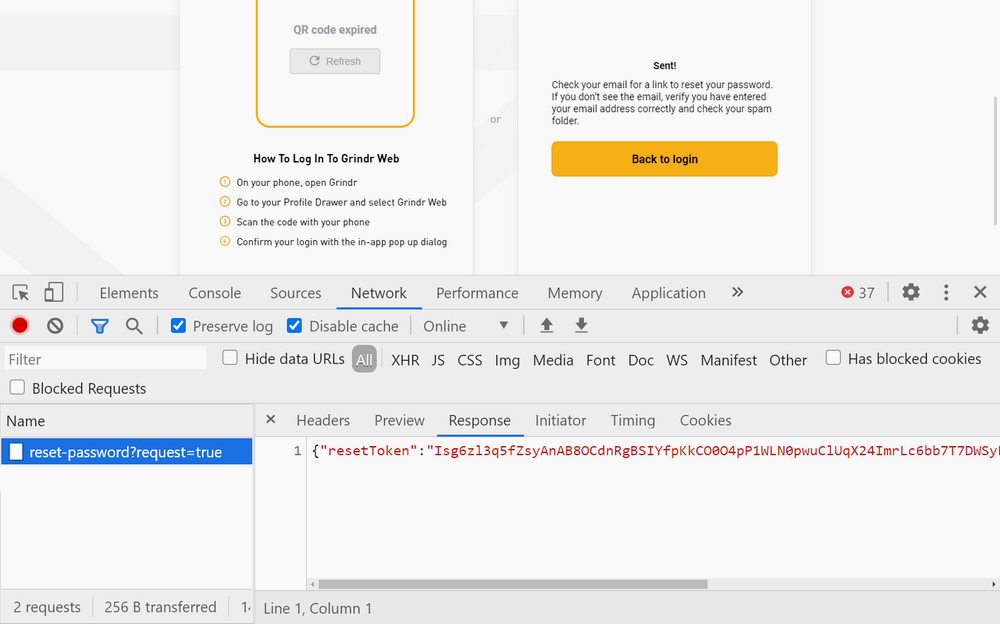
But Bouimadaghene found that Grindr’s password reset page was leaking password reset tokens to the browser. That meant anyone could trigger the password reset who had knowledge of a user’s registered email address, and collect the password reset token from the browser if they knew where to look.
Secret tokens used to reset Grindr account passwords, which are only supposed to be sent to a user’s inbox, were leaking to the browser. (Image: Troy Hunt/supplied)
The clickable link that Grindr generates for a password reset is formatted the same way, meaning a malicious user could easily craft their own clickable password reset link — the same link that was sent to the user’s inbox — using the leaked password reset token from the browser.
With that crafted link, the malicious user can reset the account owner’s password and gain access to their account and the personal data stored within, including account photos, messages, sexual orientation and HIV status and last test date.
“This is one of the most basic account takeover techniques I’ve seen,” Hunt wrote.
We are living in a golden age of flight and space simulation, with Flight Simulator, Star Wars Squadrons just out and Elite Dangerous and No Mans Sky fully established and finally Star Citizen playable to some degree. This means you can take out that old flight stick and throttle and TrackIR 5 that have been gathering dust for the last ten years and get it working again. Or you can buy a new one, together with a set of VR goggles.
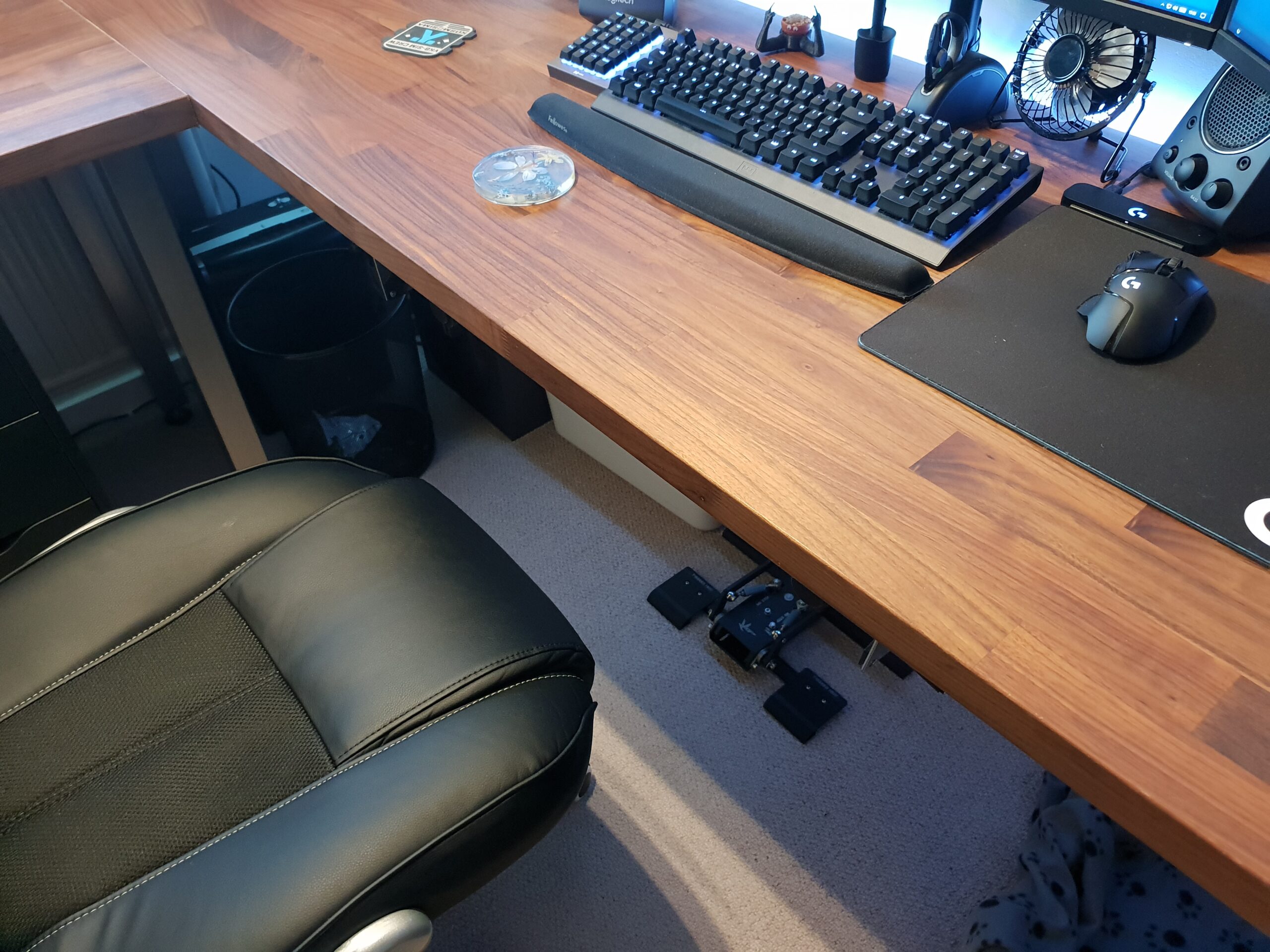
What doesn’t show on the pictures though, is the amount of desk space these things take up and the tangle of wires that comes along with it. Ergonomically, having them on your desk is not the best place to have them as you sit to attention in order the get to them.
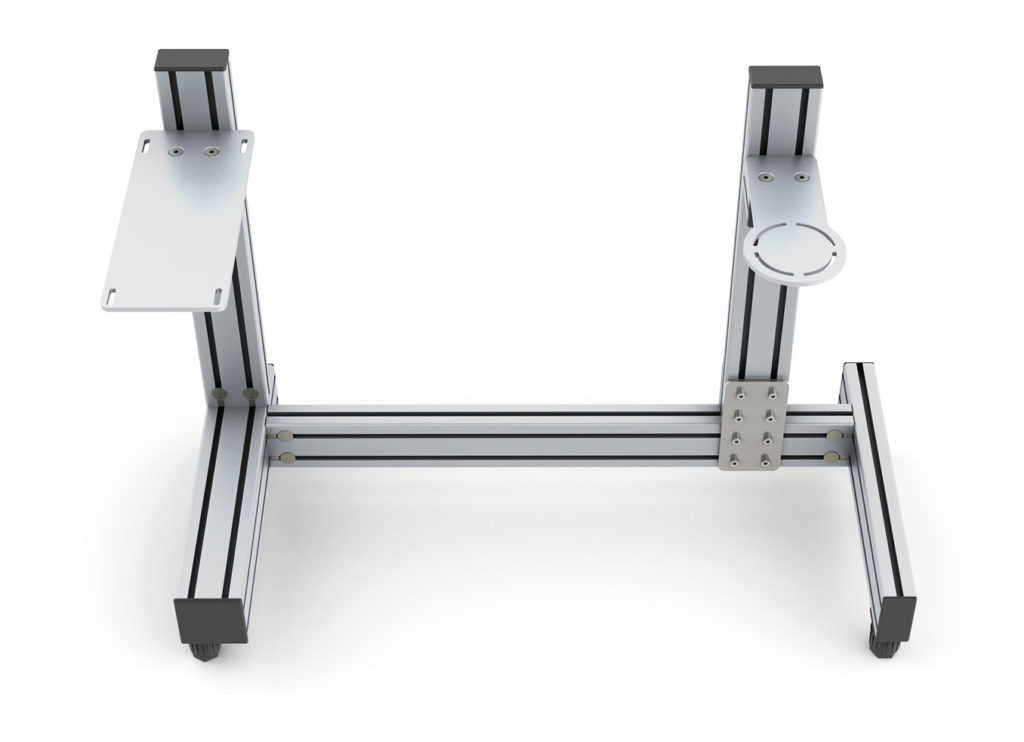
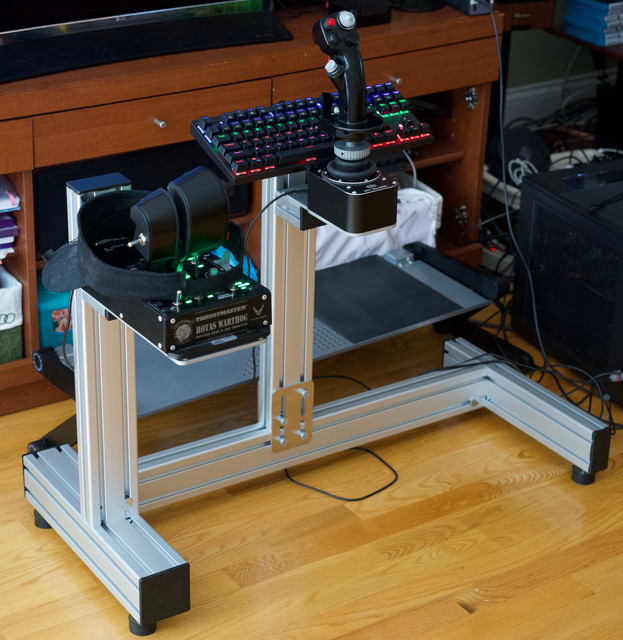
There are basically three philosophies to having a better home HOTAS setup: mounting them on your office chair, mounting them on your table and buying a dedicated chair setup.
Buying a dedicated chair (and not quite going the full cockpit route)
The nicest system I have seen is the Obutto, which is a system of not just chair, keyboard, mouse, joystick and throttle mounts, but also of monitor and speaker mounts. Expect to start at around EUR 900.
Wolf Hardware has blue and Red chairs as well as an armrest kit that will set you back around $375,-
In this category, Monstertech has a stand as well for EUR 255,-
This can be combined with the GT Omega ART Racing Simulator Cockpit RS6 Gaming Console Seat for Logitech G920, G29, G27, G25 Steering Wheel Pedals & Shifter Mount V2 PS4 Xbox One 360 TMX, with Stand & Reclinable for GBP 360,- if you really want to go the cockpit route
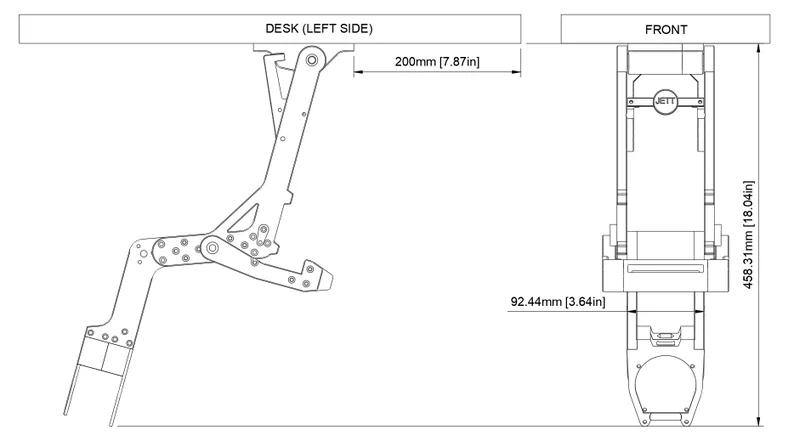
Your stick / throttle manufacturer will sell you under desk mounts but these can be prohibitively large and expensive.
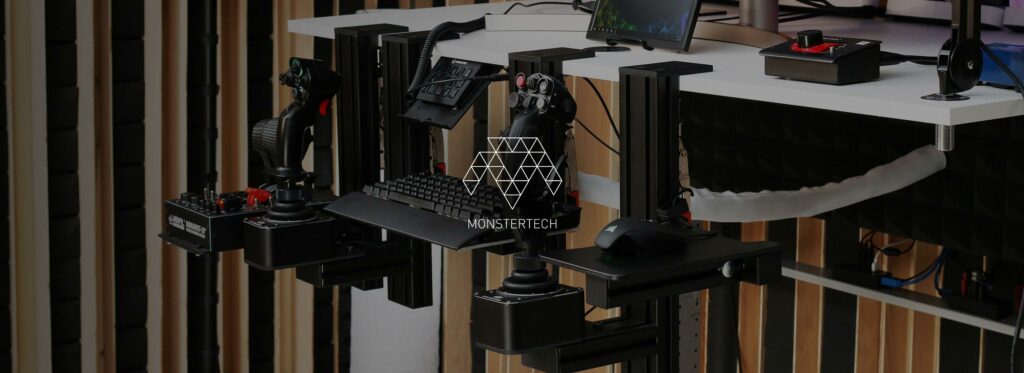
Fortunately there are aftermarket sellers. Undoubtably the main player in this realm is Monstertech. They have attachment arms for your HOTAS but also for your MFD’s and tablets as well as a mount to put up your joystick in the centre position
Their table mounts are sized for the specific joystic / throttle that you have and start at EUR 89,- for silver and EUR 109,- for black.
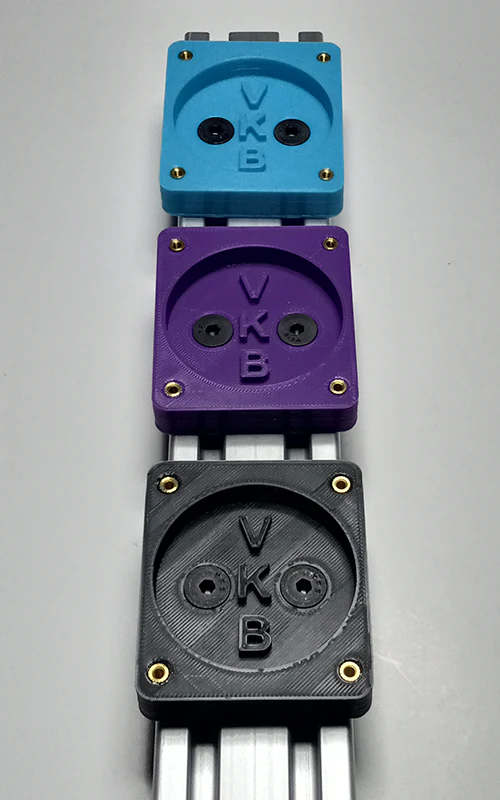
Predator mounts offers a selection of very solid desk mounts with accessories in both silver and black. Plates are ordered custom to the jostick model. They will also sell accessories such as cable clips to keep your cabling nice, as well as an attachment plate for the VKB hanging box (in different colours), so that can be neatly clipped to the back of the mount. To unclip these you push downwards, so you knee won’t accidentally bang into them and assembly is very easy. Edit: Sadly, Predator Mounts has gone into receivership. Do not send money that way any more.
A new player to the game is AlphaBravoTango who offers Stowaway Mounts. These fold away easily under your desk when you are not using them. They are metal where it counts and 3d printed covers. The maker has a reddit thread here and you can buy them on Etsy.
AliExpress has similar mounts going for EUR 50,- a piece though that come with a mousepad
J-PEIN costs around $90 and is supposed to be solid too
There’s a company called Foxxmount which makes mounts that look a lot like the old Predator ones.
Amazon US has the J-PEIN (upgraded) desk mount for $70,-. This is the goto Korean cheaper version. These come with a lot of bolts.
Hikig is another manufacturer that looks like J-PEIN selling for around EUR 80,- on Amazon.
MEZA has a set of two mounts for $179,99 at Amazon, which look a lot like the J-PEIN. You can find the Meza website here. These come with a lot of bolts.
THTL-1v2 Stowable Fold-Away HOTAS Throttle Mount (Qty 1)
€164.12
Reddit user Sessine has an excellent writeup of a DIY HOTAS under desk folding attachment system which can be stowed away easily
Reddit User dlongwing has an alternate method of having a foldaway HOTAS rig under his desk
SciMonster has created a Thingiverse rail which you can 3D print yourself and allows you to slide the hotas to the sides and lock the joystick to the right and in the centre
Mount your Virpil Throttle and Stick to linear rails so you can slide them along your desk. This allows you to move your HOTAS aside when you use the computer for other work. When flying your aircraft or spaceship, a spring-loaded locking meachanism holds your HOTAS securely in place.
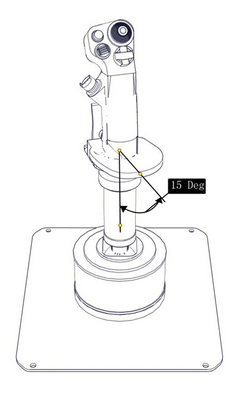
An adapter plate for Virpil Flightsticks (VPC WarBRD Base) is included (with and without a mounting option for the 15 button Elgato Stream Deck (MK.1). MongoosT Base untested.
For around GBP 55 you can buy a generic table bolting system from Amazon
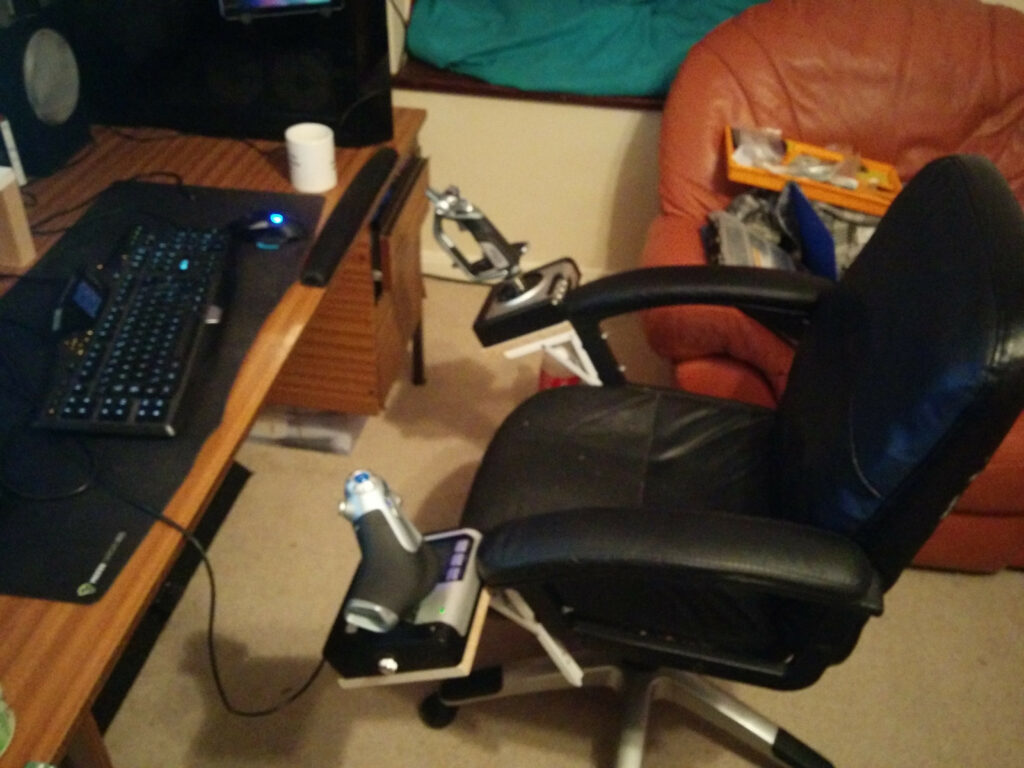
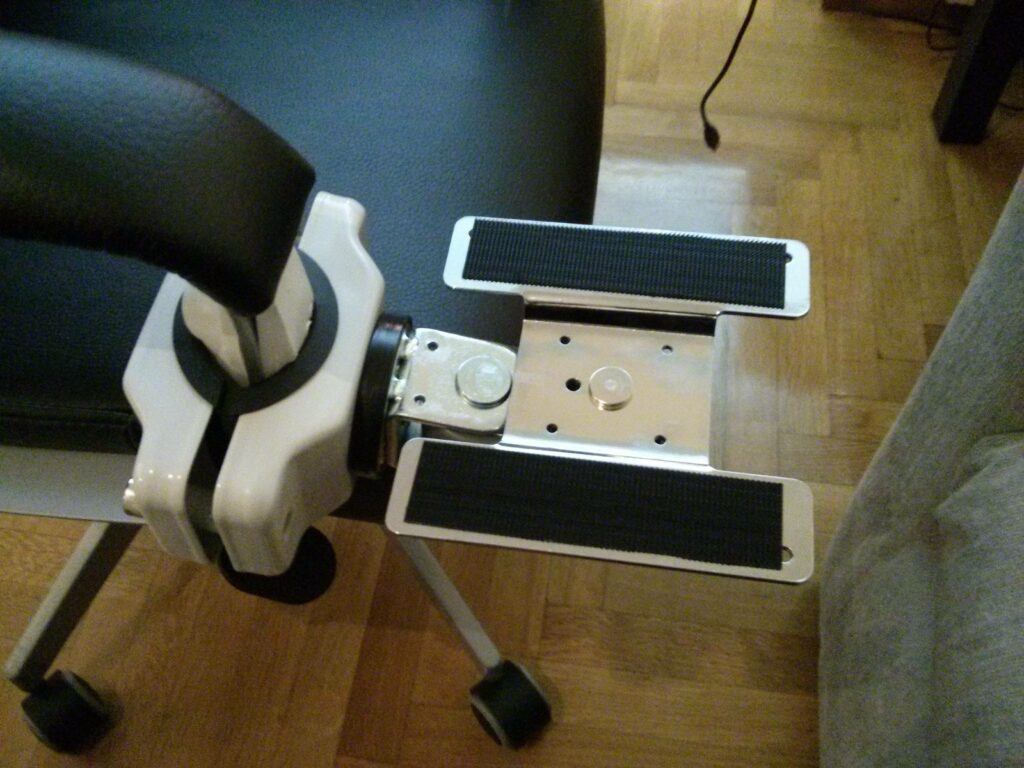
Attaching your throttle and stick to your chair
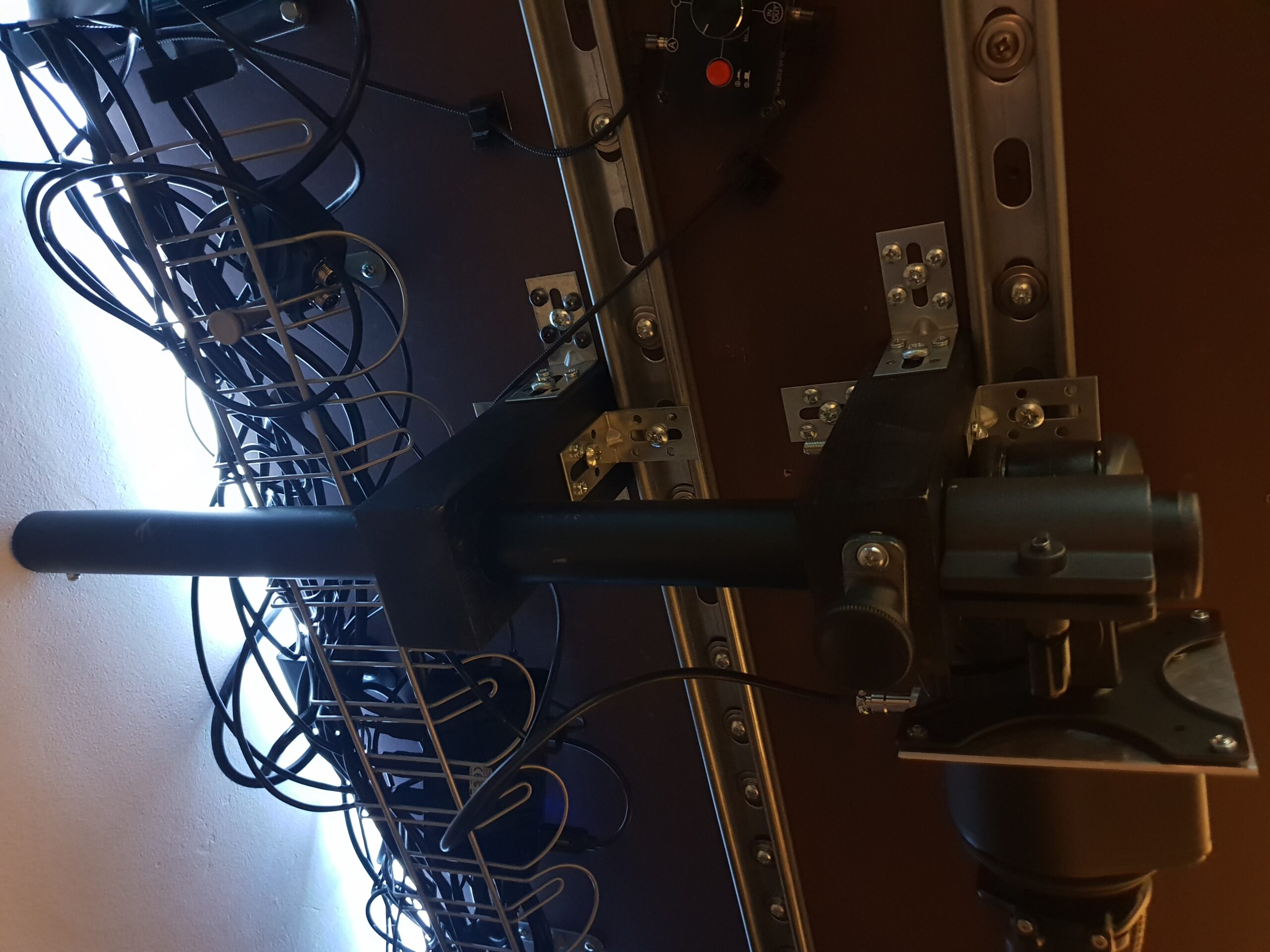
This is the cheapest route which you can do with a fair amount easy of DIY. Although it’s ergonomically very comfortable, the downside, however, is that the wiring moves with your chair and you will always be in a tangle of wires all over the place.
Microsoft’s Exchange Online service fell over in the early hours of this morning.The company’s status orifice initially figured that the problem mainly affected users in India as its engineers noted the wobbling at around 0700 BST. Just under an hour later Microsoft had to admit it was another global outage.It is the latest in what appears to be a battle of who can annoy their users more. Azure suffered a major outage earlier this week. Rival Apple then hit back with its own wobble before Microsoft continued the TITSUP* tit-for-tat this morning.The mystery issue afflicted apps using Exchange Online protocols, including Outlook on the desktop, mobile devices, and “those dependant on REST functionality,” Microsoft said. The company was taking a long hard look at what it might have changed in recent days that might have broken something.
[…]
Microsoft eventually pinned the blame on a “recent configuration update”, rolled it back and, at time of writing, was “monitoring the service” for signs of life.
[…]
Users reported problems sending and receiving mails, accessing folders and attachments, or even being able to log into their services. Some noted difficulty synchronising between Azure Active Directory and Exchange Online while there were also isolated reports of SharePoint and Teams struck by the curse of bork.
More than 150 startups and firms in India are working to form an alliance and toying with the idea of launching an app store to cut their reliance on Google, five people familiar with the matter told TechCrunch. The list of entrepreneurs includes high-profile names, such as Vijay Shekhar Sharma, co-founder and chief executive of Paytm (India’s most valuable startup), Deep Kalra of travel ticketing firm MakeMyTrip, and executives from PolicyBazaar, RazorPay, and Sharechat. The growing list of founders expressed deep concerns about Google’s “monopolistic” hold on India, home to one of the world’s largest startup ecosystems, and discussed what they alleged was unfair and inconsistent enforcement of Play Store’s guidelines in the country. Their effort comes days after a small group of firms including Epic Games, Spotify, Basecamp, Match Group, ProtonMail forged their own coalition to pressure Apple and Google to make changes to their marketplace rules. The conversations in India, which began in recent weeks, escalated on Tuesday after Google said that starting next year developers with an app on Google Play Store must give the company a cut of as much as 30% of several app-related payments. Dozens of executives “from nearly every top startup and firm” in India attended a call on Tuesday to discuss the way forward, some of the people said, requesting anonymity. A 30% cut to Google is simply unfeasible, people on the call unanimously agreed.
. The Transiting Exoplanet Survey Satellite (TESS), which launched in 2018, has snapped hundreds of thousands images of the night sky using its four cameras in the hopes of finding exoplanets. That’s too much data for professional astronomers to pore over, and NASA doesn’t trust computer-vision algorithms to do all the work, so they’ve decided to look to the public for help.
“Automated methods of processing TESS data sometimes fail to catch imposters that look like exoplanets,” said project leader Veselin Kostov, a research scientist at NASA’s Goddard Space Flight Center, and the SETI Institute. “The human eye is extremely good at spotting such imposters, and we need citizen scientists to help us distinguish between the look-alikes and genuine planets.”
[…]
A similar scheme called Planet Hunters TESS, run by the University of Oxford, led to a graduate student finding a binary-star planet at the start of the year.
“Planet Hunters TESS asks volunteers to look at light curves, which are graphs of stars’ brightness over time,” Marc Kuchner, the citizen science officer for NASA’s Science Mission Directorate, noted. “Planet Patrol asks them to look at the TESS image directly, although we plan to also include light curves for those images in the future.”
This piece is very worth reading in its’ entirety. Underneath just the conclusions.
Conclusions and Recommendations
This report reviews some of the research that is relevant to foreign information efforts targeting U.S. elections. It provides a general framework for understanding these efforts and will inform our analysis in future volumes of this series. We focused on efforts by Russia and its proxies because these actors appear to have been the most active in recent years, but we note that other state and nonstate actors also might target the United States. As a result of this work, we reached four general conclusions.
Conclusions
Foreign Interference in U.S. Politics Is Not a New Phenomenon
Foreign influence in U.S. domestic affairs dates back to the founding of this country, and there are several examples in our 244 years of existence.
How the Russians Have Tried to Interfere in Recent U.S. Elections Follows Some Logic
We hypothesize that reflexive control theory—a theoretical research program first developed in the 1960s and used by the Soviet military—is part of the intellectual basis for current Russian efforts. At its core, reflexive control theory assumes that people live in a polarized world defined by either cooperation or conflict and that people make decisions based on these views. We believe that Russia is trying to generate, spread, and amplify falsehoods that distort views of “us” versus “them,” with the desired outcomes of (1) driving people to view each other as either friends or adversaries, or (2) exhausting people to the point that they disengage from civic affairs altogether, with the result of political paralysis.
Russia’s Tactics Aim to Polarize Americans and Paralyze the U.S. Political Process
These tactics consist of attempts at polarizing and disrupting social cohesion. Some tactics aim to exacerbate divisive issues, such as racial inequities or immigration. Others target public confidence in democratic institutions and processes as a way to undermine social trust. Underlying these efforts is a broader tactic of using falsehoods to spread confusion, drive groups of people to extreme positions, and generate collective exhaustion within U.S. society. Finally, there is evidence that Russia has tried—and continues to try—to gain direct influence over the U.S. political decisionmaking process, although we do not know how effective these efforts have been.
Our Sample of Relevant Research Revealed Some Trends for Responding to Falsehoods
Although our sample of studies is not representative of all research on this topic, it does provide some ideas for emerging practices in responding to foreign information efforts. Much of this research is fragmented and cuts across multiple disciplines, causing us to organize it by primary unit of analysis: the production of new falsehoods, the distribution of existing falsehoods, or the consumers of this content.
Research on production largely focused on targeting of falsehoods and the features of this content. For studies on the distribution of existing falsehoods, research focused on the role of social media platforms in preventing the spread of online falsehoods and the role of machine-learning models to mitigate this spread. Finally, research on consumption largely focused on consumer views of content and the impacts of fact-checking.
Recommendations for Responding to Foreign Information Efforts
Democracy depends on citizens finding consensus with people whom they might view as different from them. Foreign adversaries have made attempts at undermining the formation of this consensus and will continue to do so.
Foreign interference has occurred throughout U.S. history and likely will continue in the future. Russia seems to have advanced its information efforts in recent years, and we suspect other countries will try to emulate these practices. We offer three recommendations for how to start designing responses to these existing and emerging threats that target U.S. democracy. In future volumes of this series, we will present results with more-specific recommendations for responding to these foreign information efforts.
A Holistic Strategy Is the Optimal Response to Information Efforts by Foreign Countries
During the Cold War, Secretary of State Lawrence Eagleburger recommended a “balanced approach” to Soviet information efforts that neither ignores the threat nor becomes obsessed with it (Eagleburger, 1983). Our assumption is that reflexive control theory is part of the intellectual basis for Russian efforts targeting U.S. elections. The unit of analysis of this theory is broad, spanning the entirety of U.S. society and any particular piece of online content, social media platform, or individual consumer. We recommend that any defensive strategy account for the complex relationships among the production of falsehoods, how others distribute content (particularly online), and the impacts of this content on consumers.
Any Defense Should Anticipate Those Who Are Likely to Become Targets of These Efforts
We believe that a key goal for information efforts is to alter people’s perceptions to amplify a view of “us versus them,” with political paralysis as the ultimate goal. Social or political issues tied to identities (such as race, gender, social class, or political affiliation) that hold meaning for people are useful starting points because false content tied to these characteristics might elicit strong reactions (Marwick, 2018). We suspect that foreign efforts will likely produce content that plays on these identities in an effort to amplify differences and deepen preexisting fault lines in U.S. society. Thus, we recommend developing strategies that anticipate which subgroups are most vulnerable to such efforts without publicly shaming these groups or targeting specific individuals.
Any Response Should Attempt to Protect Potential Targets Against Foreign Information Efforts
The antidote to manufacturing intergroup conflict is convincing people that they have more in common with those who are different from them than they might believe at first glance. We recommend collecting, analyzing, and evaluating preventative interventions to protect people from reacting to falsehoods meant to divide the country (e.g., public campaigns that emphasize shared interests of Californians, public warnings about broader information efforts by foreign adversaries, or media literacy programs for subgroups that are potential targets).
In conclusion, democracy depends on citizens finding consensus with people whom they might view as different from them. Foreign adversaries have made attempts at undermining the formation of this consensus and will continue to do so. There is a logic to these attempts. The best defense is a holistic approach that accounts for the preexisting fault lines that exist within U.S. society.
Facebook announced today that Messenger and Instagram are, for all intents and purposes, merging. Chat features from Messenger will become available to Instagram users, and folks on either service will be able to reach out to one another without needing to download a separate app.
“Today, we’re announcing an update to Instagram DMs by introducing a new Messenger experience on the app,” wrote Adam Mosseri and Stan Chudnovsky—the respective heads of Instagram and Messenger—in a blog post earlier today.
“People are communicating in private spaces now more than ever. More than a billion people already use Messenger as a place to share, hang out and express themselves with family and friends,” they added. “That’s why we’re connecting the Messenger and Instagram experience to bring some of the best Messenger features to Instagram—so you have access to the best messaging experience, no matter which app you use.”
Samsung brags to advertisers that “first screen ads”, seen by all users of its Smart TVs when they turn on, are 100 per cent viewable, audience targeted, and seen 400 times per TV per month. Some users are not happy.
“Dear Samsung, why are you showing Ads on my Smart TV without my consent? I didn’t agree to this in the privacy settings but I keep on getting this, why?” said a user on Samsung’s TV forum, adding last week that “there is no mention of advertising on any of their brand new boxes”.
As noted by TV site flatpanelshd, a visit to Samsung’s site pitching to advertisers is eye-opening. It is not just that the ads appear, but also that the company continually profiles its customers, using a technology called Automatic Content Recognition (ACR), which works by detecting what kind of content a viewer is watching.
Samsung’s Tom Focetta, VP Ad Sales and Operations in the US, said in an interview: “Our platform is built on the largest source of TV data from more than 50 million smart TVs. And we have amassed over 60 per cent of the US ACR footprint.” Focetta added that ACR data is “not sold, rented or distributed” but used exclusively by Samsung to target advertising.
The first screen ad unit was introduced five years ago, Focetta explained, and the company has since “added video, different types of target audience engagement, different ways to execute in terms of tactics like audience takeovers, roadblocks”. A “roadblock” is defined as “100 per cent ownership of first screen ad impressions across all Samsung TVs”. According to a Samsung support, quoted by flatpanelshd: “In general, the banner cannot be deactivated in the Smart Hub.”
Advertising does not stop there since Samsung also offers TV Plus, “a free ad-supported TV service”. Viewers are familiar with this deal, though, since ad-supported broadcasting is long established. What perturbs them is that when spending a large sum of money on TV hardware, they were unknowingly agreeing to advertising baked into its operating menu, every time they switch on.
The advent of internet-connected TVs means that viewers now divide their time between traditional TV delivered by cable or over the air, and streaming content, with an increasing share going to streaming. Viewers who have cancelled subscription TV services in favour of streaming are known as cord-cutters.
Even viewers who have chosen to watch only ad-free content do not escape. “30 per cent of streamers spend all of their streaming time in non-ad supported apps. This, however, does not mean ‘The Lost 30’ are unreachable,” said Samsung in a paper.
The rivalry between Apple and Microsoft continued last night as the fruity firm’s cloud services took a tumble a mere day after Azure crapped itself.
While Apple has remained silent on what happened (we asked; it did not respond), the vast majority of its services wobbled over a two-hour period early this morning (UK time).
Issues began at around 1am affecting services including Apple TV, iCloud Mail, iWork for iCloud, and the company’s App Store. On its System Status page the company said “Some users were affected”, along with “Users experienced a problem with this service.”
The “problem” being that it simply didn’t work. A glance at social media shows disappointed fanatics wailing about Apple TV stopping midstream, Apple Music hitting the pause button, and iCloud Photos leaping from the nearest ledge.
Apple’s inability to keep its cloud in the air came a day after Microsoft suffered an embarrassing Azure failure, prompting us to ponder if Redmond has a reliability problem.
Unless some late-night (and early morning) fondling was involved, the outage did not cause too much European outrage. Some US users, on the other hand, found themselves at the pointy end of Apple’s issues and unable to express their feelings on the US presidential debate via the medium of iCloud email.
Things appear back to normal this morning, and The Register was heartened to note that fanboi assistant Siri did not appear to be affected.
In marked contrast to the approach taken by Microsoft, Apple has yet to explain what happened, why it happened, and why it will not happen again. We will update should a statement be forthcoming.
In the meantime, we anxiously await Cook & co’s inevitable “you’re using it wrong” retort.
A team of US astrophysicists has produced one of the most precise measurements ever made of the total amount of matter in the Universe, a longtime mystery of the cosmos.
The answer, published in The Astrophysical Journal on Monday, is that matter consists of 31.5 percent—give or take 1.3 percent—of the total amount of matter and energy that make up the Universe.
The remaining 68.5 percent is dark energy, a mysterious force that is causing the expansion of the Universe to accelerate over time, and was first inferred by observations of distant supernovae in the late 1990s.
Put another way, this means the total amount of matter in the observable Universe is equivalent to 66 billion trillion times the mass of our Sun, Mohamed Abdullah, a University of California, Riverside astrophysicist and the paper’s lead author told AFP.
Most of this matter—80 percent—is called dark matter. Its nature is not yet known but it may consist of some as-yet-undiscovered subatomic particle.
[…]
So how exactly do you weigh the Universe?
The team honed a 90-year-old technique that involves observing how galaxies orbit inside galaxy clusters—massive systems that contain thousands of galaxies.
These observations told them how strong each galaxy cluster‘s gravitational pull was, from which its total mass could then be calculated.
Fate of the Universe
In fact, explained Wilson, their technique was originally developed by the pioneering astronomer Fritz Zwicky, who was the first person to suspect the existence of dark matter in galaxy clusters, in the 1930s.
He noticed that the combined gravitational mass of the galaxies he observed in the nearby Coma galaxy cluster was insufficient to prevent those galaxies from flying away from one another, and realized there must be some other invisible matter at play.
The UCR team refined Zwicky’s technique, developing a tool they called GalWeight that determines more accurately which galaxies belong to a given cluster and which do not.
They applied their tool to the Sloan Digital Sky Survey, the most detailed three-dimensional maps of the Universe currently available, measuring the mass of 1,800 galaxy clusters and creating a catalog.
Finally, they compared the number of clusters observed per unit volume in their catalog against a series of computer simulations, each of which was fed a different value for the total matter of the Universe.
Simulations with too little matter had too few clusters, while those with too much matter had too many clusters.
The “Goldilocks” value they found fit the simulations just right.
A study of comet motions indicates that the solar system has a second alignment plane. Analytical investigation of the orbits of long-period comets shows that the aphelia of the comets, the point where they are farthest from the Sun, tend to fall close to either the well-known ecliptic plane where the planets reside or a newly discovered “empty ecliptic.” This has important implications for models of how comets originally formed in the solar system.
In the solar system, the planets and most other bodies move in roughly the same orbital plane, known as the ecliptic, but there are exceptions such as comets. Comets, especially long-period comets taking tens-of-thousands of years to complete each orbit, are not confined to the area near the ecliptic; they are seen coming and going in various directions.
[…]
The solar system does not exist in isolation; the gravitational field of the Milky Way galaxy in which the solar system resides also exerts a small but non-negligible influence
[…]
hen the galactic gravity is taken into account, the aphelia of long-period comets tend to collect around two planes. First the well-known ecliptic, but also a second “empty ecliptic.” The ecliptic is inclined with respect to the disk of the Milky Way by about 60 degrees. The empty ecliptic is also inclined by 60 degrees, but in the opposite direction. Higuchi calls this the “empty ecliptic” based on mathematical nomenclature and because initially it contains no objects, only later being populated with scattered comets.
Today’s the day YouTube is killing its “Community Contributions” feature for videos, which let content creators crowdsource captions and subtitles for their videos. YouTube announced the move back in July, which triggered a community outcry from the deaf, hard of hearing, and fans of foreign media, but it does not sound like the company is relenting. In one of Google’s all-time, poor-timing decisions, YouTube is killing the feature just two days after the International Week of the Deaf, which is the last full week in September.
Once enabled by a channel owner, the Community Contributions feature would let viewers caption or translate a video and submit it to the channel for approval. YouTube currently offers machine-transcribed subtitles that are often full of errors, and if you also need YouTube to take a second pass at the subtitles for machine translation, they’ve probably lost all meaning by the time they hit your screen. The Community Caption feature would load up those machine-written subtitles as a starting point and allow the user to make corrections and add text that the machine transcription doesn’t handle well, like transcribed sound cues for the deaf and hard of hearing.
YouTube says it’s killing crowd-source subtitles due to spam and low usage. “While we hoped Community Contributions would be a wide-scale, community-driven source of quality translations for Creators,” the company wrote, “it’s rarely used and people continue to report spam and abuse.” The community does not seem to agree with this assessment, since a petition immediately popped up asking YouTube to reconsider, and so far a half-million people have signed. “Removing community captions locks so many viewers out of the experience,” the petition reads. “Community captions ensured that many videos were accessible that otherwise would not be.”
In the endlessly escalating war between those striving to create flawless deepfake videos and those developing automated tools that make them easy to spot, the latter camp has found a very clever way to expose videos that have been digitally modified by looking for literal signs of life: a person’s heartbeat.
If you’ve ever had a doctor attach a pulse oximeter to the tip of your finger, then you’ve already experienced a technique known as photoplethysmography where subtle color shifts in your skin as blood is pumped through in waves allows your pulse to be measured. It’s the same technique that the Apple Watch and wearable fitness tracking devices use to measure your heartbeat during exercise, but it’s not just limited to your fingertips and wrists.
Though not apparent to the naked eye, the color of your face exhibits the same phenomenon, subtly shifting in color as your heart endlessly pumps blood through the arteries and veins under your skin, and even a basic webcam can be used to spot the effect and even measure your pulse. The technique has allowed for the development of contactless monitors for infants, simply requiring a non-obtrusive camera to be pointed at them while they sleep, but now is being leveraged to root out fake news.
Researchers from Binghamton University in Binghamton, New York, worked with Intel to develop a tool called FakeCatcher, and their findings were recently published in a paper titled, “FakeCatcher: Detection of Synthetic Portrait Videos using Biological Signals.” Deepfakes are typically created by matching individual frames of a video to a library of headshots, often times containing thousands of images of a particular person, and then subtly adjusting and tweaking the face being swapped in to match the existing one perfectly. Unbeknownst to the naked eye, those images still contain the telltale biological signs of the person having a pulse, but the machine learning tools used to create deepfakes don’t take into account that when the final video is played back, the moving face should still exhibit a measurable pulse. The random way in which a deepfake video is created results in an unstable pulse measurement when photoplethysmography detection techniques are applied to it, making them easier to spot.
From their testing, the researchers found that FakeCatcher was not only able to spot deepfake videos more than 90 percent of the time, but with the same amount of accuracy, it was also able to determine which of four different deepfake tools—Face2Face, NeuralTex, DeepFakes, or FaceSwap—was used to create the deceptive video. Of course, now that the research and the existence of the FakeCatcher tool has been revealed, it will give those developing the deepfake creation tools the opportunity to improve their own software and to ensure that as a deepfake videos are being created, those subtle shifts in skin color are included to fool photoplethysmography tools as well. But this is good while it lasts.
The British Army has reportedly developed AI-equipped killer drones armed with twin-linked shotguns designed for blasting enemies of the Queen hiding inside buildings.
As if that wasn’t terrifying enough, the Army is already looking at strapping a chain gun or rocket launcher to its i9 drone instead of the shotguns, according to The Times.
“It is the UK military’s first weaponised drone to be able to fly inside, using a combination of physics and AI that allow it to overcome ‘wall suck’, which causes drones with heavy payloads to crash because of the way they displace air in small rooms,” the newspaper reported this morning.
The weaponised craft is said to be loaded with “twin stabilised shotguns” as well as making use of “machine vision” to identify its targets. A human operator will have to press a button to actually fire the shotguns, though that is potentially the least of the civilised world’s worries from this thing.
We want weaponised urban drones flying through your house, says UK defence ministry as it waves a fistful of banknotes
Assuming that the drone is genuinely capable of firing a shotgun while hovering or in flight, this would mean the “unnamed British company” behind it has overcome some rather large challenges of physics. Basic Newtonian theory tells us that flinging an ounce of lead forwards at great speed causes an equal and opposite reaction backwards. In ballistics this force is called “recoil”. It takes little imagination to realise that recoil in a confined space is likely to push a drone backwards into a wall, rendering it useless.
[…]
The Ministry of Defence is but four years behind Russia in its armed drone endeavours. Back in 2016 a group of students designed an armed drone which first flew in 2019, though that appears to be an outdoors-only craft. The Belarusian Army also strapped an RPG to a drone in 2018, though footage doesn’t show it actually being fired
Flight Radar spokesman Ian Petchenik told The Register: “At this time we understand this to be a very strong DDoS attack [orchestrated] from a single source. While it is not known why we’re being targeted, multiple flight tracking services have suffered attacks over the past two days.”
It was not immediately obvious which other sites had suffered attacks, though some had used their Twitter accounts to inform followers of planned server upgrades and updates to end-user apps.
Open source researchers claim to have picked up the live flight tracks of drones over Armenia and Azerbaijan, following armed skirmishes between the two nations over the long-disputed Nagorno-Karabakh region. The conflict gained a more international dimension earlier today when a Turkish F-16 fighter jet reportedly shot down an elderly Armenian Su-25 Frogfoot ground attack aircraft.
The use of DDoSes against general-interest websites has fallen out of favour in recent years as the script kiddies behind those types of attacks in days of yore a) grew up and b) realised that ransomware is far more lucrative than crayoning over someone else’s website.
Whatever the cause of the Flight Radar 24 attacks – one knowledgeable source suggested to El Reg that the Nagorno-Karabakh conflict may have triggered a government determined to control what the wider world can see – they serve as a reminder that even one of the oldest online attack methods can still cause chaos today.
Some Microsoft services, including Outlook, Office 365, and Microsoft Teams, experienced a multi-hour outage on Monday, but the issues have been resolved, according to the company.
“We’ve confirmed that the residual issue has been addressed and the incident has been resolved,” Microsoft tweeted at 12AM ET on Tuesday. “Any users still experiencing impact should be mitigated shortly.”
The company first acknowledged issues at 5:44PM ET via the Microsoft 365 Status Twitter account, and said it had rolled back a change thought to be the cause of the issue at 6:36PM ET. But just 13 minutes later, the company tweeted again to say that it was “not observing an increase in successful connections after rolling back a recent change.” Microsoft tweeted that services were mostly back at 10:20PM ET.
Microsoft’s Azure Active Directory service was also experiencing issues on Monday, but the company said those were “now mitigated” as of 11:21PM ET Monday night. Microsoft said the problems were caused by a configuration change to a backend storage layer, which the company rolled back.
Update, September 29th, 11:20AM ET: Updated to confirm Microsoft has resolved the issues. The headline has also been updated to reflect this fact.
The core service affected was Azure Active Directory, which controls login to everything from Outlook email to Teams to the Azure portal, used for managing other cloud services. The five-hour impact was also felt in productivity-stopping annoyances like some installations of Microsoft Office and Visual Studio, even on the desktop, declaring that they could not check their licensing and therefore would not run.
There are claims that the US emergency 911 service was affected, which is not implausible given that the RapidDeploy Nimbus Dispatch systemdescribes itself as “a Microsoft Azure–based Computer Aided Dispatch platform”. If the problem is authentication, even resilient services with failover to other Azure regions may become inaccessible and therefore useless.
The company has yet to provide full details, but a status report today said that “a recent configuration change impacted a backend storage layer, which caused latency to authentication requests”.
[…]
Microsoft seems to have more than its fair share of problems. Gartner noted recently that it “continues to have concerns related to the overall architecture and implementation of Azure, despite resilience-focused efforts and improved service availability metrics during the past year”. The analyst’s reservations were based in part on the low ratio of availability zones to regions, and that “a limited set of services support the availability zone model”.
Gartner’s concerns are valid, but this was not the cause of the recent disruption. Bill Witten, identity architect at Okta, was to the point, commenting: “So, does everyone get why the mono-directory is not a good idea?”
Microsoft has built so much on Azure Active Directory that it is a single point of failure. The company either needs to make it so resilient that failure is near-impossible (which is likely to be its intention), or consider gradually reducing the dependence of so many services.
Source:
With so many cloud services dependent on it, Azure Active Directory has become a single point of failure for Microsoft
To hear many politicians (and, tragically, many academics) tell the story, patents and patent policy are keys to innovation. Indeed, many studies trying to measure innovation use the number of patents as a proxy. For years, we’ve argued that there is little evidence that patents are in any way correlated with innovation. Indeed, in practice, we often see patents get in the way of innovation, rather than being a sign of innovation. If anything, an influx of patents seems to indicate a decline in innovation, because as the saying goes, smart companies innovate, while failed companies litigate. Litigating patents tends to happen when a more established company no longer is able to compete by innovation, and has to bring in the courts to block and stop more nimble competitors.
Indeed, over and over again we seem to see the most innovative companies eschewing the anti-competitive powers that patents give them. I was reminded of this recently with the announcement that payments company Square had agreed to put all of its crypto patents into a new non-profit called the Crypto Open Patent Alliance to help fight off the unfortunate number of crypto patent trolls that are showing up.
Square is putting all of our crypto patents into a new non-profit org we’re calling the Crypto Open Patent Alliance, which will maintain a shared patent library to help the crypto community defend against patent aggressors and trolls. Join us! #bitcoinhttps://t.co/I9VopgtMz9
Of course, we see this throughout the companies generally considered to be the most innovative. A decade ago, Twitter came up with a very clever Innovator’s Patent Agreement, which effectively would block patent trolls from ever being able to use Twitter’s patents, should they somehow fall into trollish hands. A bunch of other top internet companies including Google, Dropbox, Asana, and Newegg launched the License on Transfer network, as a basic poison pill to, again, stop patent trolls.
And, most famously, Elon Musk flat out gave away Tesla’s patents and encouraged anyone else to use them to compete with Tesla, license-free.
If patents really were so vital to innovation, why would all of these innovative companies be so quick to give them up? And why is it so incredibly rare that any of them assert patents against competitors? Instead, so much of the patent litigation we see is against those innovative companies coming from a variety of patent trolls (frequently lawyers who never innovated at all) or also ran companies which may have been innovative in the past but have long since seen their innovative days in the rearview mirror.
It would be nice if policymakers, the media, and academics finally started recognizing the idea that patents are not just a bad proxy for actual innovation, but often antithetical to innovation, and we can see all the evidence we need for that in the fact that the most innovative companies are “devaluing” in their own patents to improve the ecosystem, rather than enforce those patents.
Not only that, but there are whole industries that would be nowhere if patents were enforced rigidly, such as the fashion industry and computer programming.
Tax records obtained by The New York Times appear to show that President Trump reduced his taxable income by treating his eldest daughter, Ivanka Trump, as a consultant, then deducting this as a business expense.
The Times reports that Trump Organization tax records show between 2010 and 2018, President Trump wrote off as business expenses $26 million in “consulting fees.” The consultants are not listed by name, but the Times compared the tax records to financial disclosures Ivanka Trump filed when she started working at the White House in 2017 as a senior adviser to her father. Ivanka Trump reported receiving $747,622 in payments from a consulting company she co-owned — the same exact amount in consulting fees the Trump Organization claimed as tax deductions for hotel projects in Hawaii and Vancouver.
As an executive officer with the Trump Organization, Ivanka Trump managed the Hawaii and Vancouver hotel projects, “meaning she appears to have been treated as a consultant on the same hotel deals that she helped manage as part of her job at her father’s business,” the Times said. Ivanka Trump earned a salary of about $480,000 while serving as an executive with the Trump Organization, and the amount jumped up to $2 million after her father became president, the Times reports; since leaving to work in the White House, she has not received a salary from the company.
The tax filings also show that Trump collected $5 million for a hotel deal in Azerbaijan and reported $1.1 million in consulting fees and made $3 million in Dubai while reporting a $630,000 consulting fee. People with direct knowledge of the deals told the Times they were not aware of any consultants or third parties who would have been paid in connection with the projects.
We’ve already covered what a ridiculous, pathetic grift the Oracle/TikTok deal was. Despite it being premised on a “national security threat” from China, because the app might share some data (all of which is easily buyable from data brokers) with Chinese officials, the final deal cured none of that, left the Chinese firm ByteDance with 80% ownership of TikTok, and gave Trump supporters at Oracle a fat contract — and allowed Trump to pretend he did something.
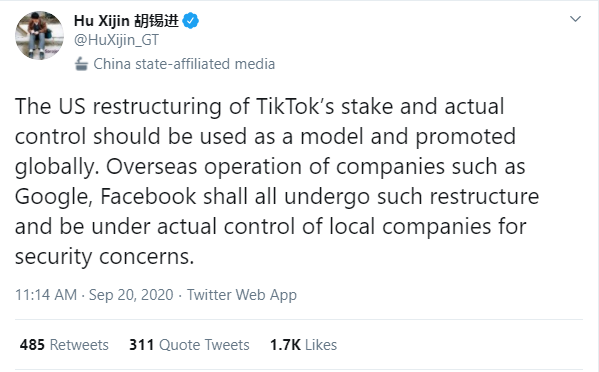
Of course, what he really did was hand China a huge gift. In response to the deal, state media in China is now highlighting how the Chinese government can use this deal as a model for the Chinese to force the restructuring of US tech companies, and force the data to be controlled by local companies in China. This is from the editor-in-chief of The Global Times, a Chinese, state-sponsored newspaper:
That says:
The US restructuring of TikTok’s stake and actual control should be used as a model and promoted globally. Overseas operation of companies such as Google, Facebook shall all undergo such restructure and be under actual control of local companies for security concerns.
So, beyond doing absolutely nothing to solve the “problem” that politicians in the US laid out, the deal works in reverse. It’s given justification for China to mess with American companies in the same way, and push to expose more data to the Chinese government.
Great work, Trump. Hell of a deal.
Meanwhile, the same Twitter feed says that it’s expected that officials in Beijing are going to reject the deal from their end, and seek to negotiate one even more favorable to China’s “national security interests and dignity.”
So, beyond everything else, Trump’s “deal” has probably done more to help China, and harm data privacy and protection, while also handing China a justification playbook to do so: “See, we’re just following your lead!”
The Seychelles-based outfit, founded in 2017, proudly boasts of its venture capital backers who clearly admire its services facilitating trading of “numerous digital assets and cryptocurrencies”. And on Saturday it advised users that it “detected some large withdrawals since September 26, 2020 at 03:05:37 (UTC+8)” and that an internal security audit revealed “part of Bitcoin, ERC-20 and other tokens in KuCoin’s hot wallets were transferred out of the exchange, which contained few parts of our total assets holdings. The assets in our cold wallets are safe and unharmed, and hot wallets have been re-deployed.”
The company also promised that any losses would be covered by insurance, but also advised that deposit and withdrawal services would be suspended pending a security review.
A later update included an FAQ in which customers asked why some of the withdrawals continued even after the first incident notification was posted. KuCoin assured customers it conducted those transactions itself and advised that restoration of withdrawal functions could take a week. In the volatile world of cryptocurrency, a week can be the difference between a win and a bust.
A Monday update, the latest, revealed the scale of the hack as KuCoin identified over $130m of assets. It also describes work among a number of crypto players to identify suspicious transactions, freeze transactions, and even lists some addresses suspected of involvement in the heist.
“KuCoin has been in touch with a growing number of industry partners to take tangible actions, thanks to all of you for your support!,” the statement concluded.
However, the latest statement does not offer any further information on the cause of the incident, remediation steps, or restoration times.
So there you have it, dear reader: a venture-backed startup, based in a tax haven, demonstrating the future of money in all its glory.
And in the background, China deciding that its own digital currency will be run only by its biggest banks with new payment players like Alibaba not allowed anywhere near its innermost workings