Researchers at the University of Sydney and commercial start-up Dewpoint Innovations have created a nano-engineered polymer coating that not only reflects up to 97% of the sun’s rays, but also passively collects water. In tests, it was able to keep indoors up to 6 °C (~11 °F) cooler than the air outside.
That temperature differential results in water vapor condensing on the surface – like the fogging on a cold mirror – producing a steady trickle of droplets.
In trials on the roof of the Sydney Nanoscience Hub, the coating captured dew more than 30% of the year, generating as much as 390 mL of water per square meter (roughly 13 fluid ounces per 10.8 square feet) daily. This might not sound like a lot, but a 12-sq-m (about 129-sq-ft) section of treated roof could produce around 4.7 L (around 1.25 US gallons) of water per day under optimal conditions.
Most houses have a lot more roof than that. “Over an average residential roof,” reads the Dewpoint website, “you can expect enough water per day to cover your basic water needs.” That’s in addition, mind you, to the rainwater you’d be collecting as well, since you do need to have a typical rainwater collection system installed to capture the dew. In Sydney for example, assuming an average annual rainfall around 1 m (3.3 ft), The Tank Factory tells us we could expect to collect somewhere around 6 times more rainwater than condensation – but that equation would certainly look very different in drier areas.
[…]
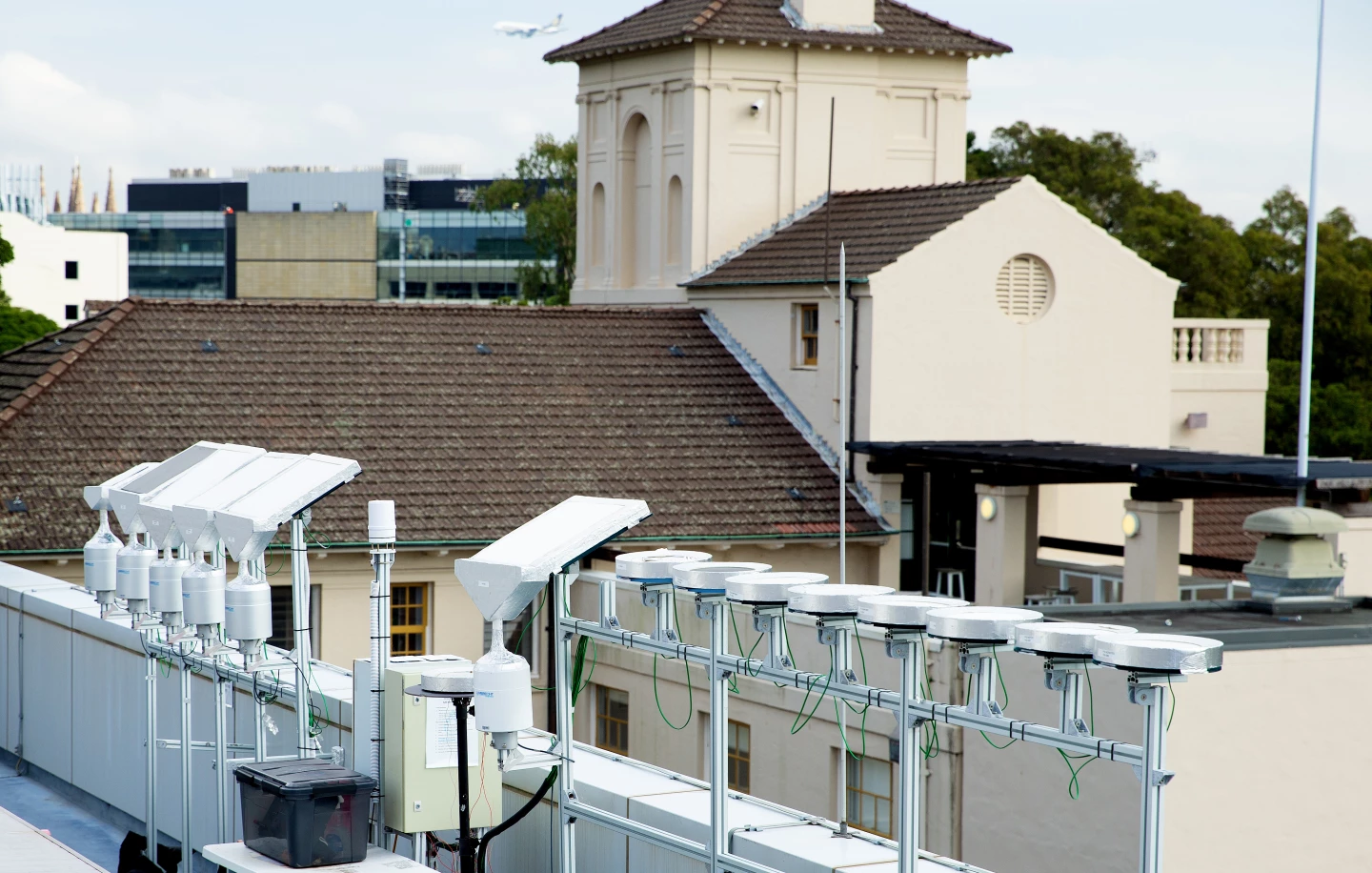
The team has recently finished up a six-month outdoor trial, with panels featuring the polymer paint-like coating set up on the roof of the Sydney Nanoscience Hub building. During this period, minute-by-minute data was collected on the coating’s cooling and water collection abilities, and found that dew could be collected over 32% of the year, suggesting water could be harvested from the air during periods without rain. What’s more, the coating withstood the challenging test of the harsh Australian sun, and showed no signs of degradation over the six months.
Painted tiles being tested on the roof of the Sydney Nanoscience Hub
University of Sydney
Most commercial white paints – especially those designed for exterior walls and roofs – use titanium dioxide as the primary pigment, which reflects UV light. However, while this novel coating may look like white paint on the surface, it gets its sun-shielding power through structure. The porous coating is made of polyvinylidene fluoride-co-hexafluoropropene (PVDF-HFP), so reflects the sun through microscopic pores. Those tiny air pockets scatter sunlight in all directions without glare and without the need of UV-absorbing chemicals that can degrade over time. The result is a self-cooling, weather-resistant film that was able to sustain its high performance throughout the lengthy testing phase.
Scientists have solved a decades-long puzzle and unveiled a near unbreakable substance that could rival diamond as the hardest material on Earth. The research is published in the journal Advanced Materials.
Researchers found that when carbon and nitrogen precursors were subjected to extreme heat and pressure, the resulting materials—known as carbon nitrides—were tougher than cubic boron nitride, the second hardest material after diamond.
The breakthrough opens doors for multifunctional materials to be used for industrial purposes including protective coatings for cars and spaceships, high-endurance cutting tools, solar panels and photodetectors, experts say.
[…]
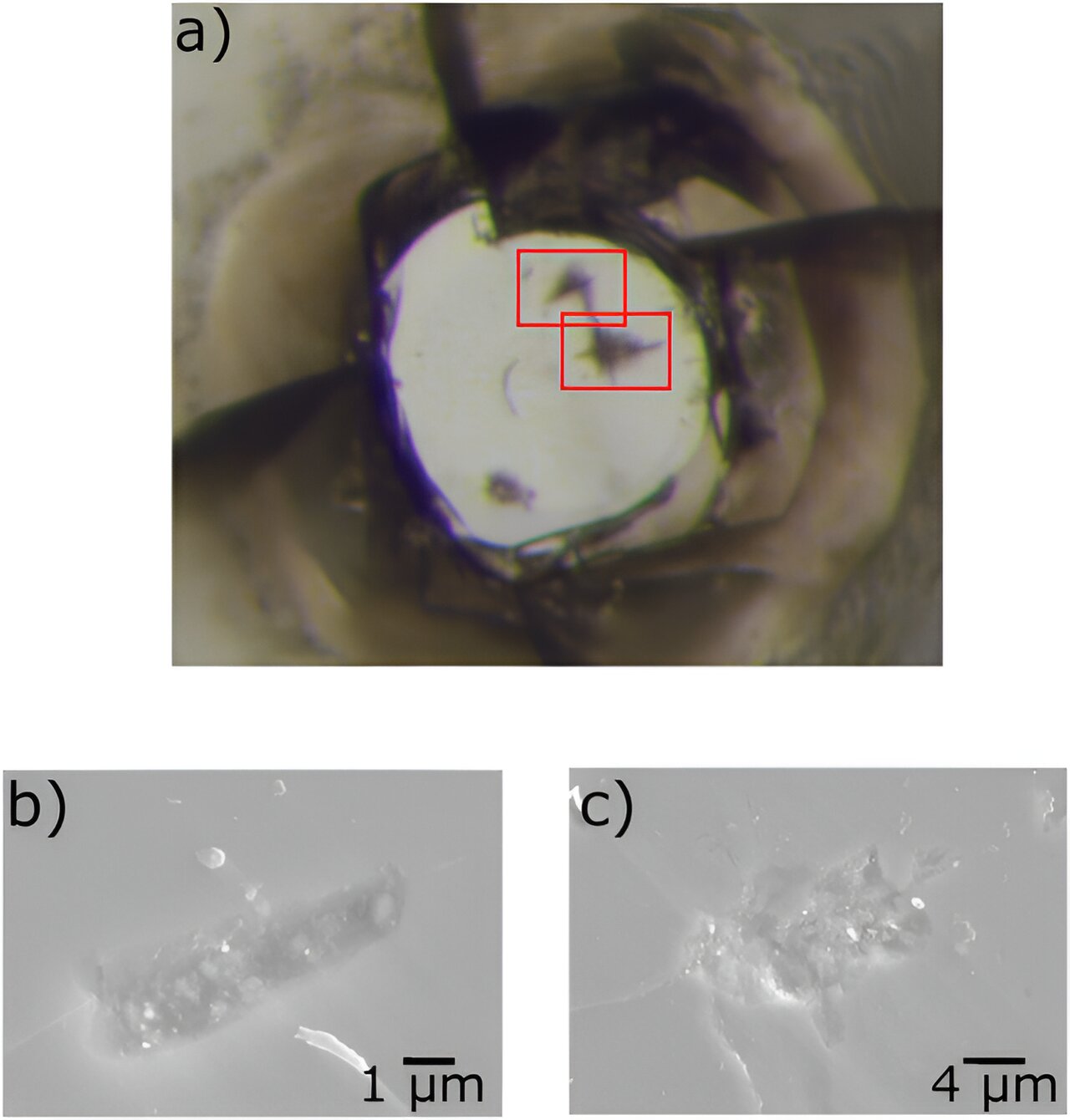
The team subjected various forms of carbon nitrogen precursors to pressures of between 70 and 135 gigapascals—around 1 million times our atmospheric pressure—while heating it to temperatures of more than 1,500°C.
To identify the atomic arrangement of the compounds under these conditions, the samples were illuminated by an intense X-ray beam at three particle accelerators—the European Synchrotron Research Facility in France, the Deutsches Elektronen-Synchrotron in Germany and the Advanced Photon Source based in the United States.
Researchers discovered that three carbon nitride compounds were found to have the necessary building blocks for super-hardness.
Remarkably, all three compounds retained their diamond-like qualities when they returned to ambient pressure and temperature conditions.
Further calculations and experiments suggest the new materials contain additional properties including photoluminescence and high energy density, where a large amount of energy can be stored in a small amount of mass.
[…]
More information: Dominique Laniel et al, Synthesis of Ultra‐Incompressible and Recoverable Carbon Nitrides Featuring CN4 Tetrahedra, Advanced Materials (2023). DOI: 10.1002/adma.202308030
The sources of the stone used to construct Stonehenge around 2500 BCE have been debated for over four centuries. The smaller “bluestones” near the center of the monument have been traced to Wales, but the origins of the sarsen (silcrete) megaliths that form the primary architecture of Stonehenge remain unknown. Here, we use geochemical data to show that 50 of the 52 sarsens at the monument share a consistent chemistry and, by inference, originated from a common source area. We then compare the geochemical signature of a core extracted from Stone 58 at Stonehenge with equivalent data for sarsens from across southern Britain. From this, we identify West Woods, Wiltshire, 25 km north of Stonehenge, as the most probable source area for the majority of sarsens at the monument.
The capital of the world’s fourth most populous country, on the island of Java, is now home to 10 million people and is prone to floods, traffic gridlock and faces the risk of earthquakes.
The as-yet unnamed new capital will straddle the regions of North Penajam Paser and Kutai Kartanegara in Indonesia’s province of East Kalimantan on Borneo, President Joko Widodo told a news conference.
“It is a strategic location at the center of Indonesia, close to growing urban areas,” Widodo said at the presidential palace in Jakarta, adding that planning must start immediately if relocation is to begin in 2024.
The site of the new capital, 2,000 km (1,250 miles) northeast of Jakarta, is one of the regions least prone to the natural disasters that regularly hit the archipelago of 17,000 islands.
There are also economic and political reasons for moving the capital from Java, which Widodo said was home to 54% of Indonesia’s 260 million people and generated 58% of its gross domestic product.
But environmentalists fear the move will hasten the destruction of forests that are home to orangutans, sun bears and long-nosed monkeys, as well as increasing pollution already on the rise from coal mining and palm oil industries.
“The move will have an environmental impact,” said Greenpeace senior forest campaigner Jasmine Puteri. “Jakarta has suffered so many failures from pollution, water crisis, and flooding. We don’t want these problems in the new capital.”
FOREST CITY
Officials say they want the new capital to be “a smart city in the forest” and have set aside 180,000 hectares (445,000 acres) of government land.
Widodo said moving the administrative center would cost just under $33 billion, of which the state would fund 19%, with the rest coming from public-private partnerships and private investment. The price tag includes new government offices and homes for about 1.5 million civil servants.
In the past few minutes, ARIN – the non-profit that oversees the allocation of IP addresses in North America – confirmed the available pool of the 32-bit network addresses is totally depleted. Last night, the team estimated there were just 1,024 IPv4 addresses left in its pool – dregs, in other words. Now that’s all gone.
Now’s the time to move to over to IPv6, ARIN boss tells El Reg
Archaeologists have discovered the remains of a massive stone monument buried under a thick, grassy bank only two miles from Stonehenge.
The hidden arrangement of up to 90 huge standing stones formed part of a C-shaped Neolithic arena that bordered a dry valley and faced directly towards the river Avon.
Researchers used ground-penetrating radar to image about 30 intact stones measuring up to 4.5m tall. The fragments of 60 more buried stones, or the massive foundation pits in which they stood, reveal the full extent of the monument.
Japanese Air Danshin Systems has come up with a system that levitates houses on a 3cm layer of pressurised air during an earthquake. They claim the system is one third of the price of existing anti-earthquake systems and will be installed in 88 houses across Japan.
Preventing fog and steam is simple – just add a small amount of glycerin, or wash with soap and water, and watch your troubles disappear! You can also ensure that all outside ventilation sources in your home are open and flowing, so that moist air can exit.
Streak Free Window Cleaning
Streaks on a freshly cleaned window can be incredibly frustrating. Nobody wants to see their hard cleaning work obscured by an unsightly streak! Fortunately, we’re here to help you prevent those streaks, for a see-through shine.
Wash your glass areas with vertical strokes on one side and horizontal strokes on the other. This will allow you to quickly identify which side of the glass surface the streak is on. Then you can return to the window once the streaks have arrived, and easily dispatch them. This will save you plenty of time identifying where those streaks are!
Using a newspaper to wipe your windows is also a great way to prevent streaking. Newspapers won’t leave behind the same residue and film that paper towels do. Using a small amount of cleaner also helps prevent streaking. If you use more cleaner than necessary, streaks will be left behind.
Since the dykes were built in 1953, the low lands have been saved from flooding, but the water behind the dykes is stagnant, leading to ecological problems in those areas. There are now proposals to allow water through, creating tides in the sea estuaries. This will also allow tidal power to be generated.
The head of Gazprom is building a most luxurious palace in the style of the XVIII century worth $ 50 million
Design documentation for anticipated future residence of the head of Gazprom, Alexei Miller, who looks like a huge palace in the style of the XVIII century.
Impressive, very similar to the mansion in Peterhof, suddenly brought up on the shore of the Istra reservoir palace initially caused a lot of noise in the blogs.
But officially the head of Gazprom, Alexei Miller, who recorded in the real owners of the palace, that he has the attitude toward him, not admitted.
“Our company has no relation to the” Istra Manor “- the spokesman said Gazprom” Sergei Kupriyanov. But at the same time, membership
mansion Miller refused to comment, that is neither confirmed nor denied.
English fail via Google Translate, but you get the idea. Check out the Google Maps images at the bottom of the fishki link.
Pyramids and ziggurats represent an oddly survivable form of architecture. Built by civilizations such as the Egyptians, Mayans and Babylonians, several of these testaments to ancient ingenuity are still standing after thousands of years. Timelinks, a design firm based in Dubai, has unveiled plans to make a pyramid of its own — one that could house a million people, feature an efficient vertically-and-horizontally-running public transportation system, and generate all of the energy it needs.
It may sound like just another concept that’ll never be a reality, but Timelinks already set about patenting the design as well as the technology that would make it possible. The structure, nearly a whole square mile by design, would use a combination of steam, wind, and other alternative energy-gathering methods to keep itself entirely off the grid. There would also be “green spaces” that would provide the pyramidal city with agricultural space, to provide food and green-based commerce.
With so many designs out there for arcologies, it may be just a matter of time before the modern city is replaced by one of these carbon-neutral enclaves. URL Location
There are some big plans underway in Subiya, Kuwait in Madinat al-Hareer, the City of Silk. Not only are they planning to erect the world’s tallest tower, stealing the crown from Dubai, but they’re also planning on creating a hugely ambitious rail network that would link the Middle East with China.
The railway will connect places such as Kuwait, Damascus, Baghdad and Iran with cities in China and in between, with the hub starting in Subiya. The complex around the tower will also include all sorts of recreation and business attractions, including a wildlife sanctuary. It’s all seems kind of hodgepodge, but when it’s all complete after a $132 billion bill, I’m sure it’ll be more than impressive.
If you’re looking for the tallest tower of LEGO in the world, here’s a picture of it right here. This monster was built in the Legoland Windsor theme park in the U.K. of 500,000 LEGO bricks, and stands just shy of 100 feet high. That eclipses the old record of 96.1 feet from August of last year by more than three feet, and has been submitted to the Guinness Book of World Records for authentication.
Notice the stabilizing guy wires, holding the enormous tower of plastic steady as it reaches to the sky. Good thing they had a crane to place the half-millionth piece atop the huge stack. Why all this falderal? Well, if you can believe it, this is the 50th anniversary of LEGO, a half-century ago shoving aside Erector Sets, coonskin caps and Hula Hoops to become one of fave diversions of ersatz builders the world over.
How brave are you? Because from the looks of it, the Sky Bridge in Langkawi, Malaysia will require some guts to gross. That’s because this majestic cable-stayed bridge is supported by only one support column as it wraps its way around a mountain a whopping 2,250 feet above sea level.
Even scarier? The single support column is placed at an angle. Seriously, were they trying to make this thing look precarious? I’m sure it’s perfectly safe, but come on. This bridge is pure terror. Hit the jump to see a video taken from its span.
For your money you’ll get a house that produces more energy than it uses, which will save you money on your monthly utility bills. Not enough to make up for the initial price, but still. It’ll use geothermal heating to get the job done, which is a unique aspect to a private home. But seriously … $15 million?
The Brits are once more taking Singapore by storm, but this time with their snazzy, sustainable architecture. Firm Foster + Partners has plans for an over-1,600,000-square-foot (filling an entire city block), mixed-use structure that’s completely decked out with green-friendly tech.
The design of the structure maximizes the amount of natural light that filters throughout the building, and is studded with solar panels to help power elevators, lights and other amenities. Its slanted facades are designed to help airflow by catching and directing the wind, which’ll also keep things cool. On top of that, it’ll harvest rainwater, use geothermal heating and employ ice-based cooling. Can smart design trump our love of air conditioners and gluttonous electrical needs? When it looks this good, it’s got a good shot.
Check out the gallery below for more views of Singapore’s future skyline.
When asked to design a building for a vacant lot in downtown Manhattan, the designers at Work AC went hog wild. They’re local foodies, you see, which means that they try to avoid buying produce that’s traveled from far-flung places like New Zealand. What better way to eat local than to bring the farm to the city? Their design incorporates residential apartments that are topped by strips of farm land and watered using rain water stored in the tanks on the building’s roof. The staircase-shaped structure is to be propped up by elegant sculptures. The people underneath the structure seem to be shopping at a green market (how appropriate!). And during the years when some of the fields need to lie fallow, they can be used for sportive activities like golfing.
Yes, the design is a bit unrealistic, but we like it a lot better than this alternate proposal for the same space. We hope architecture firms like Work AC keep thinking green, but that they’ll come up with some more realistic plans as well.