The Linkielist

Linking ideas with the world

The Linkielist

Jailbreak app store Cydia files its own antitrust lawsuit against Apple

Cydia, the original app store for jailbroken iPhones, has joined a wave of companies and regulators in targeting Apple over antitrust concerns. In a lawsuit it filed on Thursday, it accused Apple of “anti-competitive acquisition and maintenance of an illegal monopoly over iOS app distribution.”

Were that not the case, Cydia argues, users would “be able to choose how and where to locate and obtain iOS apps, and developers would be able to use the iOS app distributor of their choice.” Apple rejected accusations it has a monopoly and told Motherboard it would review the lawsuit.

Apple launched the App Store in 2008, the year after Cydia arrived. The unofficial store allows users who jailbreak their iPhone and iPad to download apps and add features that Apple hasn’t necessarily approved.

Over time, Apple has made jailbreaking its devices more difficult and Cydia isn’t as prominent or popular as it once was. In 2010, Cydia developer Jay “Saurik” Freeman said 4.5 million users were searching the store for apps.

Like the App Store, Cydia took a cut of app sales and revenue peaked at around $10 million in 2011 and 2012, according to the Washington Post. Freeman ended purchases from Cydia’s store in 2018.

The suit follows a number of high-profile moves against Apple for similar reasons. Back in August, Epic Games sued Apple over its App Store rules after trying to bypass them. A coalition of companies, including Epic and Spotify, has formed to pressure Apple and Google into changing their app store practices. Apple is also under antitrust scrutiny from regulators in Europe and the US.

Source: Jailbreak app store Cydia files its own antitrust lawsuit against Apple | Engadget

France fines Google $120M and Amazon $42M for dropping tracking cookies without consent

France’s data protection agency, the CNIL, has slapped Google and Amazon with fines for dropping tracking cookies without consent.

Google has been hit with a total of €100 million ($120 million) for dropping cookies on Google.fr and Amazon €35 million (~$42 million) for doing so on the Amazon .fr domain under the penalty notices issued today.

The regulator carried out investigations of the websites over the past year and found tracking cookies were automatically dropped when a user visited the domains in breach of the country’s Data Protection Act.

In Google’s case the CNIL has found three consent violations related to dropping non-essential cookies.

“As this type of cookies cannot be deposited without the user having expressed his consent, the restricted committee considered that the companies had not complied with the requirement provided for by article 82 of the Data Protection Act and the prior collection of the consent before the deposit of non-essential cookies,” it writes in the penalty notice [which we’ve translated from French].

Amazon was found to have made two violations, per the CNIL penalty notice.

CNIL also found that the information about the cookies provided to site visitors was inadequate — noting that a banner displayed by Google did not provide specific information about the tracking cookies the Google.fr site had already dropped.

Under local French (and European) law, site users should have been clearly informed before the cookies were dropped and asked for their consent.

In Amazon’s case its French site displayed a banner informing arriving visitors that they agreed to its use of cookies. CNIL said this did not comply with transparency or consent requirements — since it was not clear to users that the tech giant was using cookies for ad tracking. Nor were users given the opportunity to consent.

The law on tracking cookie consent has been clear in Europe for years. But in October 2019 a CJEU ruling further clarified that consent must be obtained prior to storing or accessing non-essential cookies. As we reported at the time, sites that failed to ask for consent to track were risking a big fine under EU privacy laws.

Source: France fines Google $120M and Amazon $42M for dropping tracking cookies without consent | TechCrunch

Facebook crushed rivals to maintain an illegal monopoly, the entire United States yells in Zuckerberg’s face

Facebook illegally crushed its competition and continues to do so to this day to maintain its monopoly, according to a lawsuit filed on Wednesday by the attorneys general of no fewer than 46 US states plus Guam and DC.

The lawsuit alleges that the social media giant “illegally acquired competitors in a predatory manner and cut services to smaller threats – depriving users from the benefits of competition and reducing privacy protections and services along the way – all in an effort to boost its bottom line through increased advertising revenue.”

America’s consumer watchdog the FTC is also suing the antisocial network in a parallel action, and making the same basic allegations: that Facebook has been “illegally maintaining its personal social networking monopoly through a years-long course of anticompetitive conduct.”

It’s been a long time coming but the, as alleged, privacy-invading, competition-crushing Zuckerberg spin machine that is Facebook has finally been taken on by the United States.

The action is being led by New York’s Attorney General Letitia James, and she wasn’t holding back in her declaration of legal war. “For nearly a decade, Facebook has used its dominance and monopoly power to crush smaller rivals and snuff out competition, all at the expense of everyday users,” she said. “Today, we are taking action to stand up for the millions of consumers and many small businesses that have been harmed by Facebook’s illegal behavior.”

She also highlighted the biggest complaint against Facebook by its users, a complaint that has been commonplace for nearly a decade, that it has made “billions by converting personal data into a cash cow.”

[…]

The 123-page lawsuit [PDF] dives into how what was once just a website among many others became an online monster devouring anything in its path. “Facebook illegally maintains that monopoly power by deploying a buy-or-bury strategy that thwarts competition and harms both users and advertisers. Facebook’s illegal course of conduct has been driven, in part, by fear that the company has fallen behind in important new segments and that emerging firms were ‘building networks that were competitive with’ Facebook’s and could be ‘very disruptive to’ the company’s dominance,” the lawsuit stated.

It quotes CEO Mark Zuckerberg directly and notes that the Silicon Valley goliath would ruthlessly buy up companies in order to “build a competitive moat” or “neutralize a competitor” in its bid for dominance. And notes that Facebook has “coupled its acquisition strategy with exclusionary tactics that snuffed out competitive threats and sent the message to technology firms that, in the words of one participant, if you stepped into Facebook’s turf or resisted pressure to sell, Zuckerberg would go into ‘destroy mode’ subjecting your business to the ‘wrath of Mark.’ As a result, Facebook has chilled innovation, deterred investment, and forestalled competition in the markets in which it operates, and it continues to do so.”

The lawsuit is a much tighter and angrier indictment of Facebook than a similar one lodged against Google in October by the Department of Justice. It still relies on traditional antitrust arguments, however, rather than trying to break new ground to deal with the modern internet era.

[…]

Source: Facebook crushed rivals to maintain an illegal monopoly, the entire United States yells in Zuckerberg’s face • The Register

I have been talking about this since the beginning of 2019 and it’s wonderful to see the tsunami of action happening now

Wall Street Begins Trading Water Futures as a Commodity

Wall Street has begun trading water as a commodity, like gold or oil. The country’s first water market launched on the Chicago Mercantile Exchange this week with $1.1 billion in contracts tied to water prices in California, Bloomberg News reported.

The market allows farmers, hedge funds, and municipalities to hedge bets on the future price of water and water availability in the American West. The new trading scheme was announced in September, prompted by the region’s worsening heat, drought, and wildfires fueled by climate change. There were two trades when the market went live Monday.

“Climate change, droughts, population growth, and pollution are likely to make water scarcity issues and pricing a hot topic for years to come,” RBC Capital Markets managing director and analyst Deane Dray told Bloomberg. “We are definitely going to watch how this new water futures contract develops.”

[…]

Source: Wall Street Begins Trading Water Futures as a Commodity – Yale E360

GM launches OnStar Insurance Services – uses your driving data to calculate insurance rate

Andrew Rose, president of OnStar Insurance Services commented: “OnStar Insurance will promote safety, security and peace of mind. We aim to be an industry leader, offering insurance in an innovative way.

“GM customers who have subscribed to OnStar and connected services will be eligible to receive discounts, while also receiving fully-integrated services from OnStar Insurance Services.”

The service has been developed to improve the experience for policyholders who have an OnStar Safety & Security plan, as Automatic Crash Response has been designed to notify an OnStar Emergency-certified Advisor who can send for help.

The service is currently working with its insurance carrier partners to remove biased insurance plans by focusing on factors within the customer’s control, which includes individual vehicle usage and rewarding smart driving habits that benefit road safety.

OnStar Insurance Services plans to provide customers with personalised vehicle care and promote safer driving habits, along with a data-backed analysis of driving behaviour.

Source: General Motors launches OnStar Insurance Services – Reinsurance News

What it doesn’t say is whether it could raise insurances or deny them entirely, how transparent the reward system will be or what else they will be doing with your data.

Struggling electric jet startup Zunum sues Boeing for fraud, misuse of trade secrets, poaching talent

In 2017, Zunum Aero was flying high. The Kirkland, Washington-based aviation startup came out of stealth mode with bold plans to build a fleet of 12-seat hybrid electric jets for short, regional hops between cities. The company, which had received millions of dollars from the venture arms of Boeing and JetBlue, said it would be ready to fly by 2022.

Not long after, those dreams came crashing down to earth. In 2018, Zunum ran out of cash, forcing it to lay off nearly all of its employees and vacate its headquarters. It struggled to raise additional funds that it needed to get its plans back in motion. And now, Zunum is striking back at one of its former investors. The company filed a lawsuit in Washington Superior Court this week accusing aerospace giant Boeing of fraud, technology theft, breach of contract, and misappropriation of trade secrets.

Zunum said that Boeing “colluded with other key aerospace manufacturers and funders” to sabotage its efforts to raise additional cash and tried to poach Zunum’s engineers during the process. The startup claims that Boeing saw its superior technology and potential to disrupt air travel as a threat to its own dominance in the aviation world and sought to undermine it. Using its due diligence as an investor as subtext, Zunum said Boeing gained access to its business plan and proprietary technology, and “exploited” Zunum for its own benefit.

“Boeing saw an innovative venture, with a dramatically improved path to the future, and presented itself as interested in investing and partnering with Zunum,” the company claims in court filings. “But instead, Boeing stole Zunum’s technology and intentionally hobbled the upstart entrant in order to maintain its dominant position in commercial aviation by stifling competition.”

It’s rare that a startup would sue one of its investors after failing to deliver on its promises. But Zunum said its setbacks weren’t because of bad technology or a faulty business plan. Rather, the company claims it was sabotaged by Boeing, which misused its position as an investor to pillage its talent and patents before eventually scuttling the company’s ability to continue to raise money.

Zunum also names HorizonX, Boeing’s venture capital arm, and French engine supplier Safran as co-defendants. The company is seeking compensatory and punitive damages. A spokesperson for Boeing said the lawsuit was without merit and that the company would “vigorously” contest it in court.

[…]

Zunum puts the blame on Boeing. The Chicago-based company repeatedly reneged on promises for additional funds and dissuaded other investors from putting money in, the lawsuit alleges.

“Boeing also kept Zunum beholden to it for much-needed capital and market validation, stringing Zunum along with the prospects of an anchor investment and providing leadership on further fundraising,” the lawsuit says. “Although Zunum also sought investments elsewhere, Boeing actively interfered with and undermined those business relationships while inducing Zunum to continue its reliance on Boeing by holding out the prospect of a strategic partnership or merger.”

[…]

“Zunum discovered that Boeing was secretly developing a replica prototype of Zunum’s flagship aircraft design, staffed by the very same engineers and other professionals whom Boeing had assigned to conduct extensive due diligence on Zunum, under non-disclosure and non-use obligations,” the lawsuit reads.

Source: Struggling electric jet startup Zunum sues Boeing for fraud and misuse of trade secrets – The Verge

YouTube will run ads on smaller creators’ videos without paying them

Don’t be surprised if you start seeing ads on videos made by smaller YouTube creators. The video-sharing website has updated its Terms of Service, and it includes a new section that gives it the right to monetize videos from channels not big enough to be part of its Partner Program. That doesn’t mean new creators can start earning from their videos right away, though — YouTube said in a forum post explaining the changes to its ToS that non-YPP members won’t be getting a cut from those ads.

To become eligible for the YouTube Partner Program, a creator has to be living in a country where it’s active, has to have 4,000 public watch hours in the last 12 months and has to have over 1,000 subscribers. YouTube only used to run ads on videos from channels that don’t meet those criteria under special circumstances, such as if the channel was previously a YPP member. Going forward, though, the website can monetize any video, so long as it meets its ad-friendly guidelines.

Source: YouTube will run ads on smaller creators’ videos without paying them | Engadget

Apple braces for antitrust woes by letting users select and install third-party apps during setup of iOS 14.3

iOS 14.3 will prompt some users to install selected third-party applications during setup, in what is likely an attempt to stifle any allegations of anticompetitive behaviour from regulators.

The feature, which is buried deep within the beta version of the upcoming iOS release and was first spotted by 9to5Mac, is believed to be activated depending on the location of the user, and states: “In compliance with regional legal requirements, continue to view available apps to download.”

Although iOS is not the most widely installed mobile operating system (that particular crown belongs to Android), it is unique insofar as the control exerted by Apple on the ecosystem, famously dubbed the Walled Garden. This limits where users can download third-party software – exclusively the App Store – and forces developers to use Apple’s payment processing methods, which take a 30 per cent cut of all transactions. Moreover, until recently, users were unable to select third-party products for their default browser and email apps.

This has prompted antitrust investigations in several jurisdictions, including the US, Japan, and the EU, often prompted by the complaints of competitors, such as Spotify and Rakuten. This is in addition to the legal action taken by Epic Games, which has claimed Apple deliberately tries to disadvantage third-party developers through its app store policies.

[…]

Source: Apple braces for antitrust woes by letting users select and install third-party apps during setup of iOS 14.3 • The Register


This is something I have been talking about since early 2019 and it’s good to see action happening on it

European Commission charges Amazon over misuse of seller data to make copy cat products

The European Union is serving formal antitrust charges to Amazon, saying that the retailer has misused its position to compete against third-party businesses using its platform. Officials, led by competition chief Margrethe Vestager, believe there is enough evidence to charge the company for this misuse. This data, so the claim goes, was used by Amazon to build copycat products to undercut these independent businesses, especially in large markets like France and Germany.

At the same time, regulators have opened a second investigation into favorable treatment around the “Buy Box” and the “Prime Label.” Officials suspect that independent sellers that use Amazon’s own logistics network are able to use features that those with their own logistics networks do not. Vestager said that they want those independents to be able to “compete on the merits” rather than on any sort of lock-in.

Amazon, very broadly, is a retailer itself, but it’s also a retail platform that lets third parties sell their wares side by side with Amazon’s own. These independent, unaffiliated companies can even piggyback on Amazon’s vast logistics and warehousing network. But there’s a catch: If a small seller makes a surprisingly popular product, Amazon can see that sales data on its own system. There could be the temptation for Amazon to make a similar product and direct sales toward itself.

This isn’t a hypothetical, and The Wall Street Journal published a report in April claiming the company was doing this very thing. Former employees have claimed that Amazon can not only identify hot trends but also use that data to price their own products competitively. In one example, the makers of a popular car trunk organizer found that, a while after, Amazon launched a very similar product as part of its private label offering.

Now, Amazon has said that using third-party seller data in this manner is against its own policies and affirmed that position in Congress. Amazon has also said that the practice of producing “private label” goods is used by every major retailer, and isn’t a threat to the independent brands they sell. But regulators in both the US and Europe aren’t satisfied with that answer and are pushing for more information. In July 2019, the EU opened a formal investigation to see if what Amazon was doing violated local competition rules, with today’s charges the result of that procedure.

[…]


Source: European Commission charges Amazon over misuse of seller data | Engadget

I have been talking about this since early 2019, it’s good to see action on this!

Uncle Sam’s legal eagles hope to get their claws on $1bn in Bitcoin ‘stolen by hacker’ from dark-web souk Silk Road

The US Department of Justice on Thursday filed a legal request to formally take control of more than $1bn in Bitcoin (BTC) generated from the sales of illicit goods at Silk Road.

It is believed the crypto-coins were stolen from the dark-web market at some point, and now the Feds want to take ownership of the haul.

Between 2011 and 2013, Silk Road sold a variety of illegal drugs and services online, until it was shut down by US law enforcement. In 2015, the site’s operator, Ross Ulbricht, was sentenced to life in prison without the possibility of parole. Now the Feds say they have an agreement to get a billion-dollar payday with Bitcoins used on the site.

In that brief period, the site racked up total revenue of more than 9.5m BTC resulting in about 600K BTC of sales commissions, according to the DoJ’s forfeiture filing.

When Ulbricht was arrested in October, 2013, the FBI said it had seized 144,336 BTC from Ulbricht’s hardware, plus 29,655 BTC from a prior seizure, totaling 173,991 BTC, which was worth about $33.6m at the time or about $2.6bn at the current exchange rate.

Prior to that, in May, 2012, according to Tom Robinson, chief scientist and co-founder of cryptocurrency analytics biz Elliptic, about 70,000 BTC left Silk Road’s digital wallet before being moved to a Bitcoin wallet with the address 1HQ3Go3ggs8pFnXuHVHRytPCq5fGG8Hbhx in 2013.

Since then, there have been a few transactions between BTC addresses related to the Silk Road funds that have remained beyond the reach of US authorities. According to a Dept of Justice court filing [PDF] today, law enforcement officers earlier this year worked with a third-party Bitcoin attribution company to analyze unattributed transactions and noticed an unusual pattern among some of them.

“These 54 transactions were not noted in the Silk Road database as a vendor withdrawal or a Silk Road employee withdrawal and therefore appear to represent Bitcoin that was stolen from Silk Road,” the court filing explained, noting that they amounted to 70,411.46 BTC. Worth about $354,000 at the time of the transfers, the value of that digital currency has skyrocketed to over $1bn today.

Investigators managed to link an unidentified individual with these transactions and the Bitcoin wallet identified above that begins 1HQ3.

“According to the investigation, Individual X was able to hack into Silk Road and gain unauthorized and illegal access to Silk Road and thereby steal the illicit cryptocurrency from Silk Road and move it into wallets that Individual X controlled,” the filing claimed. “…Ulbricht became aware of Individual X’s online identity and threatened Individual X for return of the cryptocurrency to Ulbricht.”

The government contends that Individual X failed to return the funds and kept the cryptocurrency without spending it. The complaint goes on to state that on Tuesday, Individual X signed an agreement with the US Attorney’s Office in Northern California to surrender the hacked funds.

Also on Tuesday, the 1HQ3 wallet shows a transfer of 69,369 BTC, worth about $1bn – presumably this represents Individual X providing the government with access to the funds it hopes to formally seize.

The Register has asked the Department of Justice to confirm that it controls the receiving digital wallet but we’ve not heard back.

The DoJ legal filing signals to the court that the government will present evidence that the cited property can be lawfully forfeited. If the court approves the forfeiture, the Feds will officially gain control of the funds

Source: Uncle Sam’s legal eagles hope to get their claws on $1bn in Bitcoin ‘stolen by hacker’ from dark-web souk Silk Road • The Register

The Department of Justice sues Google over antitrust concerns | Engadget

We all knew it was coming. Today, the US government’s Department of Justice filed an antitrust lawsuit against Google. The company, which is a part of Alphabet, is accused of having an unfair monopoly over search and search-related advertising. In addition, the department disagrees with the terms around Android, the most widely-used mobile operating system, that forces phone manufacturers to pre-load Google applications and set Google as the default search engine. That decision stops rival search providers from gaining traction and, as a consequence, ensures that Google continues to make enormous amounts of cash via search-related advertising.

“Google pays billions of dollars each year to distributors—including popular-device manufacturers such as Apple, LG, Motorola, and Samsung; major U.S. wireless carriers such as AT&T, T-Mobile, and Verizon; and browser developers such as Mozilla, Opera, and UCWeb— to secure default status for its general search engine and, in many cases, to specifically prohibit Google’s counterparties from dealing with Google’s competitors,” the lawsuit filing reads.

[…]

Walker also argued that Google competes with platforms such as Twitter, Expedia and OpenTable, which let you search for news, flights and restaurant reservations respectively.” Every day, Americans choose to use all these services and thousands more,” he said.

Some of Google’s rivals feel differently. “We’re pleased the DOJ has taken this key step in holding Google accountable for the ways it has blocked competition, locked people into using its products, and achieved a market position so dominant they refuse to even talk about it out loud,” Gabriel Weinberg, CEO of search engine provider DuckDuckGo said in a Twitter thread. “While Google’s anti-competitive practices hurt companies like us, the negative impact on society and democracy wrought by their surveillance business model is far worse. People should be able to opt out in one click.”

As the Wall Street Journal explains, the Justice Department has been preparing to launch this case for over a year. “Over the course of the last 16 months, the Antitrust Division collected convincing evidence that Google no longer competes only on the merits but instead uses its monopoly power – and billions in monopoly profits – to lock up key pathways to search on mobile phones, browsers, and next generation devices, depriving rivals of distribution and scale,” the Department said in a statement today.

[…]

Today’s lawsuit is arguably the biggest antitrust move since the government’s case against Microsoft in 1998. Back then, the technology company was accused of using its Windows monopoly to push Microsoft-made software such as Internet Explorer. A judge eventually ordered Microsoft to break up into two separate companies. The technology giant appealed, however, and by the end of 2001 it had reached a settlement with the department. “Back then, Google claimed Microsoft’s practices were anticompetitive, and yet, now, Google deploys the same playbook to sustain its own monopolies,” the Justice Department argues in today’s lawsuit filing.

Source: The Department of Justice sues Google over antitrust concerns | Engadget

The timing of this is not coincidental. The DoJ was apparently pushed into this before it was ready in order to look good for the elections.

I have been talking about this since early 2019 and it’s great to see how this has been gaining traction since then


Amazon’s Stops Pretending and launches anticompetitive New Panel Program

After spending years promising Congress that the data it collected from third-party sellers wasn’t used to beef up its private-label products, today Amazon decided to roll out a product meant to do exactly that. The Amazon Shopper Panel, as it’s called, promises to pay Amazon customers that offer intel to the ecommerce giant about where they shop when they’re not shopping on Amazon dot com.

Here’s how the Shopper Panel works: After getting an IRL or e-receipt from any business that isn’t owned by Amazon (so Whole Foods or Four Star locations are not eligible), panelists can either submit a picture of that receipt through the app, or in the case of digital copies, forward their emailed details to a panel-specific email address. According to the Panel website, folks that upload “at least” 10 receipts per month can either cash that in for $10 in Amazon credit or $10 donated to their charity of choice. Along with that baseline payout, the app will also dole out additional earnings to panelists who answer the occasional survey about certain brands or products within the app.

Not every receipt counts toward this program. Per Amazon, receipts from grocery stores, drug stores, restaurants, and movie theaters—along with just about any other “retailer” or “entertainment outlet”—are fair game. Receipts from casinos, gun stores, transit fare, tuition or apartment rentals aren’t.

While the program is invite-only for now, any curious Amazon customer based in the U.S. can download the Panel app from the iOS App Store or the Google Play Store if they want to put their name on the waitlist.

[…]

nder the Amazon Panel site’s “Privacy” tab, the company notes that any receipts that you share will go toward “[helping] brands offer better products and [making] ads more relevant on Amazon.” The company also notes any data gleaned from these receipts or surveys might also be used to “ improve the product selection on Amazon.com and affiliate stores such as Whole Foods Market,” and to “improve the content offered through Amazon services such as Prime Video.”

That’s why this rollout is a particularly gutsy move for Amazon to take right now. Recent months have seen the company come under an increasing barrage of regulatory fire from authorities both in the U.S. and in Europe over a scandal that largely revolved around tracking consumers’ purchase data—not unlike the data pulled from the average receipt—on its platform. This past spring, an investigation from the Wall Street Journal revealed that Amazon had spent years surveilling the purchases earned by the platform’s third party sellers specifically to create its own competing products under the Amazon private label. This story came out barely a year after Amazon’s associate general council, Nate Sutton, told Congress that the company didn’t use “individual seller data” to do just that.

[…]

Source: Amazon’s New Panel Program Is An Anticompetitive Nightmare

Trying to change the Dutch home copy tax

The representatives of producers and importers of consumer electronics (NLdigital, NLconnect, TechniekNederland, FIAR CE and STOBI) have asked Minister Dekker to take a closer look at the current home copying system. The trade associations believe that the protection of copyright through this regulation is increasingly out of step with the technical and economic reality.

NLdigital asks Minister Dekker to evaluate the current regulation for the private copying compensation as soon as possible and to revise it in time for the decision-making on tariffs for the period 2023-2026. Part of the evaluation is the question whether European legislation is still in line with the current media use of consumers, whether the total revenues from the private copying tax are still in proportion to the actual damage suffered and what the impact is of new techniques and forms of distribution now and the near future.

[…]
technology has eliminated the need for home copying. Making music or series available offline through online (music and video services) is not the same as an old-fashioned copy. The offline music or video is part of the contract with the provider.

In the worst case, you pay three times: once for the subscription to your streaming service, one charge on the smartphone with which you stream and then extra storage because that smartphone automatically makes a backup in the cloud. That has nothing to do with damage suffered. It seems to be looking for ways to continue to collect money while the damage is no longer as great as it used to be, the organizations say.

[…]
Under the leadership of NLconnect, those obliged to pay have turned against this proposal. After all, legally, this function does not involve a private copy: the package provider makes a master copy that is streamed to various subscribers. Rightholders can already exercise the prohibition right for this functionality and a private copying levy would therefore mean a double payment by the consumer. The parties obliged to pay conclude that SONT has rightly excluded the nPVR functionality from the decision.


Source: Weer ophef over Thuiskopievergoeding – Emerce

British Airways fined £20m over data breach

British Airways has been fined £20m ($26m) by the Information Commissioner’s Office (ICO) for a data breach which affected more than 400,000 customers.

The breach took place in 2018 and affected both personal and credit card data.

The fine is considerably smaller than the £183m that the ICO originally said it intended to issue back in 2019.

It said “the economic impact of Covid-19” had been taken into account.

However, it is still the largest penalty issued by the ICO to date.

The incident took place when BA’s systems were compromised by its attackers, and then modified to harvest customers’ details as they were input.

It was two months before BA was made aware of it by a security researcher, and then notified the ICO.

The data stolen included log in, payment card and travel booking details as well name and address information.

A subsequent investigation concluded that sufficient security measures, such as multi-factor authentication, were not in place at the time.

The ICO noted that some of these measures were available on the Microsoft operating system that BA was using at the time.

“When organisations take poor decisions around people’s personal data, that can have a real impact on people’s lives. The law now gives us the tools to encourage businesses to make better decisions about data, including investing in up-to-date security,” said Information Commissioner Elizabeth Denman.

British Airways said it had alerted customers as soon as it had found out about the attack on its systems.

“We are pleased the ICO recognises that we have made considerable improvements to the security of our systems since the attack and that we fully co-operated with its investigation,” said a spokesman.

Data protection officer Carl Gottlieb said that in the current climate, £20m was a “massive” fine.

“It shows the ICO means business and is not letting struggling companies off the hook for their data protection failures,” he said.

The company breached data protection law and failed to protect themselves from preventable cyber attack. It then failed to detect the hack until the damage was done to hundreds of thousands of customers.

The lag between incident and fine has raised eyebrows in privacy circles but I understand the Information Commissioner’s Office has been working methodically to get it right. This is the commissioner’s first major fine under the EU data regulation GDPR and was being watched closely by the rest of Europe as a potential landmark decision.

The final figure of £20m has come as a shock to many who were expecting it to be closer to the eye-watering £183m initially proposed but it is still a significant moment for data privacy and GDPR. Other companies will look at the fine as a shape of things to come if they also fail to protect customers.

Source: British Airways fined £20m over data breach – BBC News

Come on, Amazon: If you’re going to copy open-source code for a new product, at least credit the creator – FOSS problems

On Thursday, Amazon Web Services launched CloudWatch Synthetics Recorder, a Chrome browser extension for recording browser interactions that it copied from the Headless Recorder project created by developer Tim Nolet.

It broke no law in doing so – the software is published under the permissive Apache License v2 – and developers expect such open-source projects will be copied forked. But Amazon’s move didn’t win any fans for failing to publicly acknowledge the code’s creator.

There is a mention buried in the NOTICE.txt file bundled with the CloudWatch extension that credits Headless Recorder, under its previous name “puppeteer-recorder,” as required by the license. But there’s an expectation among open source developers that biz as big as AWS should show more courtesy.

“The core of the problem here (for me at least) is not the letter of the license, it’s the spirit,” said Nolet in a message to The Register.

“It’s the fact that no one inside of AWS cared enough to stop and think ‘is this a dick move? Is this something I would want to have happen to me?’ Hence the current PR damage control campaign. They know it’s wrong. Not illegal, but wrong. Someone just had to tell them that.”

Nolet runs a software monitoring service called Checkly and developed the Headless Recorder browser extension as a tool for his company and customers. He said he hadn’t given the license for Headless Recorder a lot of thought because it’s just a browser extension full of client-side code – meaning it’s visible to anyone familiar with browser development tools.

“Amazon should have opened a PR [pull request] and proposed ‘let’s add this feature to your code. Or they could have simply kept their fork open source,” he said.

“In the least, they could have mentioned that their work was based on my work. I do this in the README.md of the project itself where I acknowledge the creators of an old project by segment.io that I used as inspiration.”

This is not the first time AWS has taken the work of open source developers and turned it into an AWS product. Last year, it launched Open Distro for Elasticsearch, to the dismay of Elasticsearch, a company formed to make a business out of the Elasticsearch open source project. And earlier that year it released DocumentDB, based on an outdated version of the open source MongoDB code.

Many popular open source licenses allow this, but because AWS brings billions in infrastructure assets into the competition, smaller companies trying to commercialize open source projects find the challenge difficult to deal with.

Source: Come on, Amazon: If you’re going to copy open-source code for a new product, at least credit the creator

Part of the problem is that open source zealots make a point of refusing any kind of money for FOSS licensed projects, which is fine for the zealots as they are paid by a university or foundation. Developers themselves, meanwhile have to contend with other people monetising their work and having to accept it. Projects are hijacked and closed and the original impetus and community around that are killed by large companies.

This is something I have been talking about since 2017 in my talk Open Source XOR Money

Robinhood Users Says There’s No One To Call When Accounts Are Hacked

It took Soraya Bagheri a day to learn that 450 shares of Moderna Inc. had been liquidated in her Robinhood account and that $10,000 in withdrawals were pending. But after alerting the online brokerage to what she believed was a theft in progress, she received a frustrating email.

The firm wrote it would investigate and respond within “a few weeks.” Now her money is gone

Bagheri is among five Robinhood customers who recounted similar experiences to Bloomberg News, saying they’ve been left in limbo in recent weeks after someone sold their investments and withdrew funds. Because the wildly popular app has no emergency phone number, some said they tried in vain to intervene, only to watch helplessly as their money vanished.

“A limited number of customers appear to have had their Robinhood account targeted by cyber criminals because of their personal email account (that which is associated with their Robinhood account) being compromised outside of Robinhood,” a spokesman for the company said in an email. “We’re actively working with those impacted to secure their accounts.”

[…]

Bagheri, a Washington attorney, and three other Robinhood users said they also contacted authorities including the Securities and Exchange Commission and the Financial Industry Regulatory Authority. Two of those customers said they have heard back from an official at the SEC seeking more information.

Finra and the SEC declined to comment.

[…]

Now, even though the firm said this year that it has more than doubled its customer-service team, clients complain they’re struggling to get quick help when their funds are disappearing.

“They don’t have a customer service line, which I’m quite shocked about,” Bagheri said.

[…]

Rao showed Bloomberg the same emailed response from Robinhood that Bagheri received. “We understand the sensitivity of your situation and will be escalating the matter to our fraud investigations team,” Robinhood customer service agents wrote them. “Please be aware that this process may take a few weeks, and the team working on your case won’t be able to provide constant updates.”

Rao said he had previously set up two-factor authentication to access his account, and Bagheri said she’s certain her Robinhood password is unique from all others, including her email. Neither believed they had been duped by phishing scams or malware. Both said they use the same email for Robinhood and other accounts, and that only Robinhood has been affected.

[…]

They also said Robinhood’s online portal showed their money went to a recipient at Revolut, another popular financial-technology startup. London-based Revolut, which offers a money transfer and exchange app, expanded to the U.S. this year.

“Revolut has been made aware of the issue and is investigating urgently,” a company spokesman said Friday in an email.

Bill Hurley, who owns a metal-fabrication shop in Windsor, Connecticut, said he received notifications that stock and Bitcoin had been sold from his account on Sept. 21, and that $5,000 was transferred to Revolut accounts in two transactions. He said he emailed Robinhood for assistance while the transactions were pending but received none.

“They’ve had more than enough time to deal with this,” he said.

Source: Robinhood Users Says There’s No One To Call When Accounts Are Hacked – Bloomberg

Apple made ProtonMail add in-app purchases, even though it had been free for years – this App store shakedown has a long scared list of victims

one app developer revealed to Congress that it — just like WordPress — had been forced to monetize a largely free app. That developer testified that Apple had demanded in-app purchases (IAP), even though Apple had approved its app without them two years earlier — and that when the dev dared send an email to customers notifying them of the change, Apple threatened to remove the app and blocked all updates.

That developer was ProtonMail, makers of an encrypted email app, and CEO Andy Yen had some fiery words for Apple in an interview with The Verge this week.

We’ve known for months that WordPress and Hey weren’t alone in being strong-armed by the most valuable company in the world, ever since Stratechery’s Ben Thompson reported that 21 different app developers quietly told him they’d been pushed to retroactively add IAP in the wake of those two controversies. But until now, we hadn’t heard of many devs willing to publicly admit it. They were scared.

And they’re still scared, says Yen. Even though Apple changed its rules on September 11th to exempt “free apps acting as a stand-alone companion to a paid web based tool” from the IAP requirement — Apple explicitly said email apps are exempt — ProtonMail still hasn’t removed its own in-app purchases because it fears retaliation from Apple, he says.

He claims other developers feel the same way: “There’s a lot of fear in the space right now; people are completely petrified to say anything.”

He might know. ProtonMail is one of the founding partners of the Coalition for App Fairness, a group that also includes Epic Games, Spotify, Tile, Match, and others who banded together to protest Apple’s rules after having those rules used against them. It’s a group that tried to pull together as many developers as it could to form a united front, but some weren’t as ready to risk Apple’s wrath.

That’s clearly not the case for Yen, though — in our interview, he compares Apple’s tactics to a Mafia protection racket.

“For the first two years we were in the App Store, that was fine, no issues there,” he says. (They’d launched on iOS in 2016.) “But a common practice we see … as you start getting significant uptake in uploads and downloads, they start looking at your situation more carefully, and then as any good Mafia extortion goes, they come to shake you down for some money.”

“We didn’t offer a paid version in the App Store, it was free to download … it wasn’t like Epic where you had an alternative payment option, you couldn’t pay at all,” he relates.

Yen says Apple’s demand came suddenly in 2018. “Out of the blue, one day they said you have to add in-app purchase to stay in the App Store,” he says. “They stumbled upon something in the app that mentioned there were paid plans, they went to the website and saw there was a subscription you could purchase, and then turned around and demanded we add IAP.”

“There’s nothing you can say to that. They are judge, jury, and executioner on their platform, and you can take it or leave it. You can’t get any sort of fair hearing to determine whether it’s justifiable or not justifiable, anything they say goes.”

[…]

Source: Apple made ProtonMail add in-app purchases, even though it had been free for years – The Verge

This is what monopolies will do for you. I have been talking about how big tech is involved in this since 2019 and it’s good to see it finally really coming out of the woodwork

Apple, Facebook, Google, Amazon Are Monopolies: Antitrust Committee

Just as you suspected, Big Tech is dominated by monopolies, a House Judiciary antitrust subcommittee found.

After more than a year of investigating Apple, Facebook, Google, and Amazon’s behavior, lawmakers released a 449-page report with their findings on Tuesday, complete with recommendations that the four companies be broken up to make the market more competitive.

The committee found that each company dominated its respective markets—Facebook in social networking, Google in general online search and search advertising, Amazon in online retail, and Apple in mobile operating systems—to such an extent as to be anticompetitive. The companies “abuse their power by charging exorbitant fees, imposing oppressive contract terms, and extracting valuable data from the people who rely on them,” the Democratic-led committee’s report outlined.

The report goes on to eviscerate the four companies: “To put it simply, companies that once were scrappy, underdog startups that challenged the status quo have become the kinds of monopolies we last saw in the era of oil barons and railroad tycoons. Although these firms have delivered clear benefits to society, the dominance of Amazon, Apple, Facebook, and Google has come at a price. These firms typically run the marketplace while also competing in it — a position that enables them to write one set of rules for others, while they play by another, or to engage in a form of their own private quasi regulation that is unaccountable to anyone but themselves.”

Not only do those companies acquire smaller ones, either to hire their talent or to kill or incorporate their products, but their mere existence chills potential investment to start-ups that may be considered competitive, the committee found.

The committee also noted that Big Tech’s acquisitions haven’t been closely vetted by regulators. For example, Facebook has snatched up nearly 100 smaller companies over the years, and just one, its deal to acquire Instagram in 2012, received scrutiny from the Federal Trade Commission.

That lack of oversight, according to the findings, has degraded the user experience in many cases because tech companies don’t have any competition to do better—particularly when it comes to privacy.

“In the absence of adequate privacy guardrails in the United States, the persistent collection and misuse of consumer data is an indicator of market power online,” the committee noted. “Online platforms rarely charge consumers a monetary price—products appear to be ‘free’ but are monetized through people’s attention or with their data. In the absence of genuine competitive threats, dominant firms offer fewer privacy protections than they otherwise would, and the quality of these services has deteriorated over time. As a result, consumers are forced to either use a service with poor privacy safeguards or forego the service altogether.”

In addition to recommending that the companies effectively be broken up, the committee recommended that antitrust laws and federal antitrust agencies be restored “to full strength.” Specifically, the committee advised that strengthening Section 7 of the Clayton Act and Section 2 of the Sherman Act would go a long way toward giving antitrust legislation more teeth.

Of course, the Big Four aren’t going to take this lying down. Amazon released a lengthy statement in which it argued that being a big company doesn’t necessarily make it an anticompetitive one, and that it comprises just 4% of the U.S. retail market. (Frankly, I am not at all sure how it arrived at that number—the antitrust committee pegged Amazon as controlling more than 40% of all online U.S. retail sales.) The company also argued that it helps consumers find low prices and small businesses find new markets. The committee noted that 37% of all third-party sellers on Amazon rely on the platform exclusively for income.

Source: Apple, Facebook, Google, Amazon Are Monopolies: Antitrust Committee

I have been talking about exactly this since the beginning of 2019 – it’s good to see others agree with me!

They are effectively accountable to no one and as a result “wield their dominance in ways that erode entrepreneurship, degrade Americans’ privacy online, and undermine the vibrancy of the free and diverse press. The result is less innovation, fewer choices for consumers, and a weakened democracy.”

[…]

It uses Facebook’s internal documents to argue that its “monopoly power is firmly entrenched and unlikely to be eroded by competitive pressure from new entrants or existing firms.” And it attacks the social network, arguing that “in the absence of competition, Facebook’s quality has deteriorated over time, resulting in worse privacy protections for its users and a dramatic rise in misinformation on its platform.”

Google, it says upfront, “has a monopoly in the markets for general online search and search advertising.” And, it finds, it has “maintained its monopoly over general search through a series of anti-competitive tactics,” including undermining other search providers, stealing content “to boost Google’s own inferior vertical offerings,” and penalizing competitors.

By growing into ever more services and connecting them together, Google “increasingly functions as an ecosystem of interlocking monopolies,” the report states.

Amazon has “engaged in extensive anti-competitive conduct in its treatment of third-party sellers” and has abused its role as both seller and marketplace controller, the report states. Both its Alexa digital assistant and Amazon Web Services (AWS) are identified as potential targets of antitrust activity and possible diversification.

And Apple “exerts monopoly power in the mobile app store market, controlling access to more than 100 million iPhones and iPads in the US.”

The reports notes: “In the absence of competition, Apple’s monopoly power over software distribution to iOS devices has resulted in harms to competitors and competition, reducing quality and innovation among app developers, and increasing prices and reducing choices for consumers.”

The report is also heavy on the impact of these monopolies: it accuses Facebook and Google of being a significant factor in “the decline of trustworthy sources of news, which is essential to our democracy.”

It argues that collectively the tech giants have “materially weakened innovation and entrepreneurship in the US economy.” And that they have undermined Americans’ basic right to privacy by developing and driving business models that work by selling personal data rather than accepting payment directly.

Give me liberty or give me… the FTC

And, in a final punch to the face, the report accuses them of “undermining both political and economic liberties” by instilling fear through the use of their “unaccountable and arbitrary power,” and using their massive resources to direct and influence policy-making “further shaping how they are governed and regulated.”

In order to counteract all these negative impacts, the report makes a long series of recommendations, including, most significantly, “structural separations and prohibitions of certain dominant platforms from operating in adjacent lines of business.” In other words, breaking up companies.

[…]

And it wants the Big Four to feel the force of the US legal system by “strengthening private enforcement, through eliminating obstacles such as forced arbitration clauses, limits on class action formation, judicially created standards constraining what constitutes an antitrust injury, and unduly high pleading standards.”

What now?

In short, the report is everything that Apple, Amazon, Facebook and Google feared it would be; the only surprise however is that what had become obviously during the committee’s investigations was watered down significantly in the final report.

Of course, there is still a long way to go before any of the report’s recommendations become a reality. Even within the committee, there is not unanimity, with some Republican members expressing concerns over breaking up companies in particular. Republicans will also be more ideologically opposed to adding regulations or removing companies’ ability to arbitrate disputes themselves, rather than through the courts.

And then of course there is the enormous collective power of Apple, Amazon, Facebook and Google – some of the world’s largest and richest corporations – who will be willing and able to do anything to protect their markets and profits.

Source: Big Tech to face its Ma Bell moment? US House Dems demand break-up of ‘monopolists’ Apple, Amazon, Facebook, Google

Indian Startups Explore Alliance and Alternative App Store To Fight Google’s Monopoly

More than 150 startups and firms in India are working to form an alliance and toying with the idea of launching an app store to cut their reliance on Google, five people familiar with the matter told TechCrunch. The list of entrepreneurs includes high-profile names, such as Vijay Shekhar Sharma, co-founder and chief executive of Paytm (India’s most valuable startup), Deep Kalra of travel ticketing firm MakeMyTrip, and executives from PolicyBazaar, RazorPay, and Sharechat. The growing list of founders expressed deep concerns about Google’s “monopolistic” hold on India, home to one of the world’s largest startup ecosystems, and discussed what they alleged was unfair and inconsistent enforcement of Play Store’s guidelines in the country. Their effort comes days after a small group of firms including Epic Games, Spotify, Basecamp, Match Group, ProtonMail forged their own coalition to pressure Apple and Google to make changes to their marketplace rules. The conversations in India, which began in recent weeks, escalated on Tuesday after Google said that starting next year developers with an app on Google Play Store must give the company a cut of as much as 30% of several app-related payments. Dozens of executives “from nearly every top startup and firm” in India attended a call on Tuesday to discuss the way forward, some of the people said, requesting anonymity. A 30% cut to Google is simply unfeasible, people on the call unanimously agreed.

Source: Indian Startups Explore Alliance and Alternative App Store To Fight Google’s ‘Monopoly’ – Slashdot

I spoke about this in 2019 and it’s interesting to see where this is going

Report: Financial records appear to show Ivanka Trump got ‘consulting fees’ to reduce father’s tax bill

Tax records obtained by The New York Times appear to show that President Trump reduced his taxable income by treating his eldest daughter, Ivanka Trump, as a consultant, then deducting this as a business expense.

The Times reports that Trump Organization tax records show between 2010 and 2018, President Trump wrote off as business expenses $26 million in “consulting fees.” The consultants are not listed by name, but the Times compared the tax records to financial disclosures Ivanka Trump filed when she started working at the White House in 2017 as a senior adviser to her father. Ivanka Trump reported receiving $747,622 in payments from a consulting company she co-owned — the same exact amount in consulting fees the Trump Organization claimed as tax deductions for hotel projects in Hawaii and Vancouver.

As an executive officer with the Trump Organization, Ivanka Trump managed the Hawaii and Vancouver hotel projects, “meaning she appears to have been treated as a consultant on the same hotel deals that she helped manage as part of her job at her father’s business,” the Times said. Ivanka Trump earned a salary of about $480,000 while serving as an executive with the Trump Organization, and the amount jumped up to $2 million after her father became president, the Times reports; since leaving to work in the White House, she has not received a salary from the company.

The tax filings also show that Trump collected $5 million for a hotel deal in Azerbaijan and reported $1.1 million in consulting fees and made $3 million in Dubai while reporting a $630,000 consulting fee. People with direct knowledge of the deals told the Times they were not aware of any consultants or third parties who would have been paid in connection with the projects.

Source: Report: Financial records appear to show Ivanka Trump got ‘consulting fees’ to reduce father’s tax bill

Blowback Time: China Says TikTok Deal Is A Model For How It Should Deal With US Companies In China

We’ve already covered what a ridiculous, pathetic grift the Oracle/TikTok deal was. Despite it being premised on a “national security threat” from China, because the app might share some data (all of which is easily buyable from data brokers) with Chinese officials, the final deal cured none of that, left the Chinese firm ByteDance with 80% ownership of TikTok, and gave Trump supporters at Oracle a fat contract — and allowed Trump to pretend he did something.

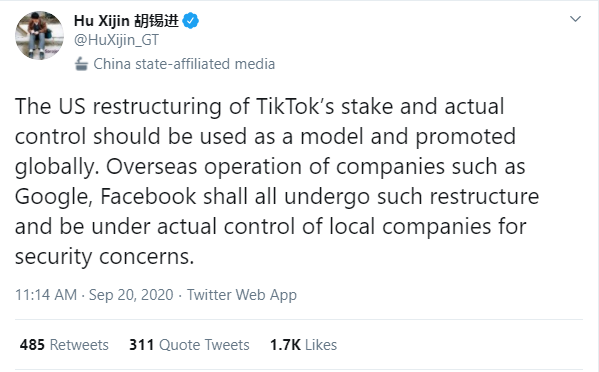
Of course, what he really did was hand China a huge gift. In response to the deal, state media in China is now highlighting how the Chinese government can use this deal as a model for the Chinese to force the restructuring of US tech companies, and force the data to be controlled by local companies in China. This is from the editor-in-chief of The Global Times, a Chinese, state-sponsored newspaper:

That says:

The US restructuring of TikTok’s stake and actual control should be used as a model and promoted globally. Overseas operation of companies such as Google, Facebook shall all undergo such restructure and be under actual control of local companies for security concerns.

So, beyond doing absolutely nothing to solve the “problem” that politicians in the US laid out, the deal works in reverse. It’s given justification for China to mess with American companies in the same way, and push to expose more data to the Chinese government.

Great work, Trump. Hell of a deal.

Meanwhile, the same Twitter feed says that it’s expected that officials in Beijing are going to reject the deal from their end, and seek to negotiate one even more favorable to China’s “national security interests and dignity.”

So, beyond everything else, Trump’s “deal” has probably done more to help China, and harm data privacy and protection, while also handing China a justification playbook to do so: “See, we’re just following your lead!”

Source: Blowback Time: China Says TikTok Deal Is A Model For How It Should Deal With US Companies In China | Techdirt

Kukooin Crypto exchange cracked, $130m in Bitcoin burgled

A cryptocurrency exchange called KuCoin says it has been cracked, with over $100m of assets misappropriated.

The Register last covered KuCoin when it was mentioned by the Bitcoin-burgling cybercrooks who hacked a bunch of prominent Twitter users.

The Seychelles-based outfit, founded in 2017, proudly boasts of its venture capital backers who clearly admire its services facilitating trading of “numerous digital assets and cryptocurrencies”. And on Saturday it advised users that it “detected some large withdrawals since September 26, 2020 at 03:05:37 (UTC+8)” and that an internal security audit revealed “part of Bitcoin, ERC-20 and other tokens in KuCoin’s hot wallets were transferred out of the exchange, which contained few parts of our total assets holdings. The assets in our cold wallets are safe and unharmed, and hot wallets have been re-deployed.”

The company also promised that any losses would be covered by insurance, but also advised that deposit and withdrawal services would be suspended pending a security review.

A later update included an FAQ in which customers asked why some of the withdrawals continued even after the first incident notification was posted. KuCoin assured customers it conducted those transactions itself and advised that restoration of withdrawal functions could take a week. In the volatile world of cryptocurrency, a week can be the difference between a win and a bust.

A Monday update, the latest, revealed the scale of the hack as KuCoin identified over $130m of assets. It also describes work among a number of crypto players to identify suspicious transactions, freeze transactions, and even lists some addresses suspected of involvement in the heist.

“KuCoin has been in touch with a growing number of industry partners to take tangible actions, thanks to all of you for your support!,” the statement concluded.

However, the latest statement does not offer any further information on the cause of the incident, remediation steps, or restoration times.

So there you have it, dear reader: a venture-backed startup, based in a tax haven, demonstrating the future of money in all its glory.

And in the background, China deciding that its own digital currency will be run only by its biggest banks with new payment players like Alibaba not allowed anywhere near its innermost workings

Source: Stop us if you’ve heard this one before: Crypto exchange cracked, Bitcoin burgled • The Register

Trump Paid $750 in Income Tax in 2016 and 2017

President Donald Trump paid just $750 in federal income taxes the year he ran for president and in his first year in the White House, according to a report Sunday in The New York Times.

Trump, who has fiercely guarded his tax filings and is the only president in modern times not to make them public, paid no federal income taxes in 10 of the past 15 years.

The details of the tax filings complicate Trump’s description of himself as a shrewd and patriotic businessman, revealing instead a series of financial losses and income from abroad that could come into conflict with his responsibilities as president. The president’s financial disclosures indicated he earned at least $434.9 million in 2018, but the tax filings reported a $47.4 million loss.

The tax filings also illustrate how a reputed billionaire could pay little to nothing in taxes, while someone in the middle class could pay substantially more than him. Nearly half of Americans pay no income taxes, primarily because of how their low incomes are. But IRS figures indicate that the average tax filer paid roughly $12,200 in 2017, about 16 times more than what the president paid.

The disclosure, which the Times said comes from tax return data it obtained extending over two decades, comes at a pivotal moment ahead of the first presidential debate Tuesday and weeks before a divisive election against Democrat Joe Biden.

Speaking at a news conference Sunday at the White House, Trump dismissed the report as “fake news” and maintained he has paid taxes, though he gave no specifics. He also vowed that information about his taxes “will all be revealed,” but he offered no timeline for the disclosure and made similar promises during the 2016 campaign on which he never followed through.

In fact, the president has fielded court challenges against those seeking access to his returns, including the U.S. House, which is suing for access to Trump’s tax returns as part of congressional oversight.

During his first two years as president, Trump received $73 million from foreign operations, which in addition to his golf properties in Scotland and Ireland included $3 million from the Philippines, $2.3 million from India and $1 million from Turkey, among other nations. The president in 2017 paid $145,400 in taxes in India and $156,824 in the Philippines, compared to just $750 in U.S. income taxes. The Times said the tax records did not reveal any unreported connections to Russia.

Trump found multiple ways to reduce his tax bills. He has taken tax deductions on personal expenses such as housing, aircraft and $70,000 to style his hair while he filmed “The Apprentice.” Losses in the property businesses solely owned and managed by Trump appear to have offset income from his stake in “The Apprentice” and other entities with multiple owners.

During the first two years of his presidency, Trump relied on business tax credits to reduce his tax obligations. The Times said $9.7 million worth of business investment credits that were submitted after Trump requested an extension to file his taxes allowed him to reduce his income and pay just $750 each in 2016 and 2017.

Income tax payments help finance the military and domestic programs.

Trump, starting in 2010, claimed and received an income tax refund that totaled $72.9 million, which the Times said was at the core of an ongoing audit by the IRS. The Times said a ruling against Trump could cost him $100 million or more. He also has more than $300 million in loans due to be repaid in the next four years.

Richard Neal, D-Mass., the chair of the House Ways and Means Committee who has tried unsuccessfully to obtain Trump’s tax records, said the Times report makes it even more essential for his committee to get the documents.

“It appears that the President has gamed the tax code to his advantage and used legal fights to delay or avoid paying what he owes,” Neal wrote in a statement. “Now, Donald Trump is the boss of the agency he considers an adversary. It is essential that the IRS’s presidential audit program remain free of interference.”

A lawyer for the Trump Organization, Alan Garten, and a spokesperson for the Trump Organization did not immediately respond to a request for comment from The Associated Press on the report.

Garten told the Times that “most, if not all, of the facts appear to be inaccurate.”

He said in a statement to the news organization that the president “has paid tens of millions of dollars in personal taxes to the federal government, including paying millions in personal taxes since announcing his candidacy in 2015.”

The New York Times said it declined to provide Garten with the tax filings in order to protect its sources, but it said its sources had legal access to the records.

During his first general election debate against Democrat Hillary Clinton in 2016, Clinton said that perhaps Trump wasn’t releasing his tax returns because he had paid nothing in federal taxes.

Trump interrupted her to say, “That makes me smart.”

Source: Trump Paid $750 in Income Tax in 2016 and 2017: Report | Time

US judge temporarily blocks Trump shakedown order banning TikTok app store downloads

A judge in Washington has temporarily blocked a Trump administration order banning Apple and Google from offering Chinese-owned app TikTok for download that was set to take effect at 11:59pm on Sunday.

US district judge Carl Nichols granted a preliminary injunction sought by TikTok’s owner, ByteDance, to allow the app to remain available at US app stores, but declined “at this time” to block additional commerce department restrictions that are set to take effect on 12 November that TikTok has said would have the impact of making the app impossible to use in the United States.

Nichols’ detailed written opinion is expected to be released as soon as Monday.

The Commerce Department said in a statement it “will comply with the injunction and has taken immediate steps to do so.” The statement, which defended the TikTok order and Trump’s executive order demanding owner ByteDance divest its TikTok US operations within 90 days, did not specify whether the government would appeal.

TikTok said it was pleased with the injunction and added it “will also maintain our ongoing dialogue with the government to turn our proposal, which the president gave his preliminary approval to last week, into an agreement.”

The company’s lawyer John Hall had said a ban would be “punitive” and close off a public forum used by tens of millions of Americans.

In a written brief filed ahead of the hearing, TikTok lawyers said the ban was “arbitrary and capricious” and “would undermine data security” by blocking updates and fixes to the app used by some 100 million Americans.

The company also said the ban was unnecessary because negotiations were already underway to restructure the ownership of TikTok to address national security issues raised by the administration.

TikTok has an estimated 100 million users in the US and 700 million worldwide, making it one of the largest operators in the social media space.

Government lawyers argued the president had a right to take national security actions, and said the ban was needed because of TikTok’s links to the Chinese government through its parent firm ByteDance.

A government brief called ByteDance “a mouthpiece” for the Chinese Communist Party and said it was “committed to promoting the CCP’s agenda and messaging.”

ByteDance said on 20 September it had struck a preliminary deal for Walmart Inc and Oracle Corp to take stakes in a new company, TikTok Global, that would oversee US operations after Trump said he had given the deal his “blessing.” Negotiations continue over the terms of the agreement and to resolve concerns from Washington and Beijing.

The deal is still to be reviewed by the US government’s Committee on Foreign Investment in the United States (CFIUS).

Source: US judge temporarily blocks Trump order banning TikTok app store downloads | Technology | The Guardian

Apple backs down on taking 30% cut of paid online events on Facebook – for a few months

Facebook has temporarily shamed Apple out of taking a 30 percent cut of paid online events organized by small businesses and hosted on Facebook—things like cooking classes, workout sessions, and happy hours. Demand for these kinds of online events has soared during the COVID-19 pandemic.

Apple says that it has a longstanding policy that digital products must be purchased using Apple’s in-app payments system—and hence pay Apple’s 30 percent tax. In contrast, companies selling physical goods and services are not only allowed but required to use other payment methods (options here include Apple Pay, which doesn’t take such a big cut).

For example, an in-person cooking class is not a digital product, so a business selling cooking class tickets via an iPhone app wouldn’t have to give Apple a 30 percent cut. But if the same business offers a virtual cooking class, Apple considers that to be a digital product and demands a 30 percent cut—at least if the customer pays for the class using an iOS device.

Last month, Facebook announced it would start offering a new feature for small businesses to host paid online events. Facebook has waived any fees for the first year, allowing small businesses to pocket 100 percent of the revenue. But Apple refused to budge on its 30 percent take.

The issue came to a head in late August when Facebook revealed that Apple wouldn’t even allow Facebook to inform users about Apple’s 30 percent take. Facebook wanted to have a message on the checkout screen that said “Apple takes 30 percent of this purchase.” But Apple deemed this message “irrelevant” and forced Facebook to remove it before approving Facebook’s update.

The reprieve is only temporary. Apple says it has given Facebook until the end of the year to switch from Facebook Pay to in-app purchases—and hence start paying Apple 30 percent—for online events. Apple is extending the same courtesy to Airbnb and ClassPass.

However, this grace period isn’t available for Gaming Creators, which Apple argues are not brick-and-mortar businesses that have been affected by COVID-19.

Source: Apple backs down on taking 30% cut of paid online events on Facebook | Ars Technica

Yay! Monopolies bitch slapping each other a little bit