A Student In Iceland May Have Just Saved The Planet

The answer to our world’s plastic pollution problem is here.[…]To show Ari doesn’t just talk a big game, he started studying the strengths and weaknesses of certain substances, eventually landing on a solution to our plastic problem made from algae.[…]If the bottle remains full of water it will keep its shape, as soon as it’s empty it starts to decompose – you couldn’t ask for a better alternative.

Source: A Student In Iceland May Have Just Saved The Planet

Study finds relationship between knowing you’re under surveillance and the views you post online

Instead, it attenuates the relationship between the opinion climate and voicing opinions except among a small number of participants who believe surveillance is not justified. Those who firmly believe that the govern-ment’s monitoring programs are unacceptable decide whether to share their views entirely independently of both perceived surveillance and the opinion climate. […]Although not directly measured, the individuals who comprise this group may very well be members of the avant-garde who are highly educated and vocal about their views regardless of circumstances, and individuals who are so turned off by sur-veillance that they are unwilling to ever share political beliefs online. In support of this speculation, a post hoc OLS regression predicting unjustified surveillance atti-tudes revealed that greater political knowledge (β = .30, p < .001) and low willing-ness to self-censor (β = −.16, p < .10) were significant and marginally significant predictors. [...] For the remainder—and majority—of participants, being primed of government surveillance significantly reduced the likelihood of speaking out in hostile opinion climates. [...]Theoretically, it adds a new layer of chilling effects to the spiral of silence[...] the participants in this study who were the most susceptible to conformist behavior were those who supported these controversial surveillance policies. These individuals expressed that surveillance was necessary for maintaining national security and they have nothing to hide. However, when these individuals perceive they are being monitored, they readily conform their behavior—expressing opinions when they are in the majority, and suppressing them when they’re not.[...] those holding the dominant opinion eagerly volunteered their ideas (over 6 on a 7-point scale), but the “nothing to hide” group seemed to experience some degree of dissonance when their views were in the minority, as they were inclined to “hide” them.

Source: Under Surveillance – 1077699016630255.full.pdf

From Under Surveillance: Examining Facebook’s Spiral of Silence Effects in the Wake of NSA Internet Monitoring
by
Elizabeth Stoycheff

Important stuff if you want to run a democracy.

The size of your pupil shows which letter you are reading

We present a new human-computer interface that is based on decoding of attention through pupillometry. Our method builds on the recent finding that covert visual attention affects the pupillary light response: Your pupil constricts when you covertly (without looking at it) attend to a bright, compared to a dark, stimulus. In our method, participants covertly attend to one of several letters with oscillating brightness. Pupil size reflects the brightness of the selected letter, which allows us–with high accuracy and in real time–to determine which letter the participant intends to select. The performance of our method is comparable to the best covert-attention brain-computer interfaces to date, and has several advantages: no movement other than pupil-size change is required; no physical contact is required (i.e. no electrodes); it is easy to use; and it is reliable. Potential applications include: communication with totally locked-in patients, training of sustained attention, and ultra-secure password input.

Source: The Mind-Writing Pupil: A Human-Computer Interface Based on Decoding of Covert Attention through Pupillometry

Winning a competition predicts dishonest behavior

Winning a competition engenders subsequent unrelated unethical behavior. Five studies reveal that after a competition has taken place winners behave more dishonestly than competition losers. Studies 1 and 2 demonstrate that winning a competition increases the likelihood of winners to steal money from their counterparts in a subsequent unrelated task. Studies 3a and 3b demonstrate that the effect holds only when winning means performing better than others (i.e., determined in reference to others) but not when success is determined by chance or in reference to a personal goal. Finally, study 4 demonstrates that a possible mechanism underlying the effect is an enhanced sense of entitlement among competition winners.

Source: Winning a competition predicts dishonest behavior

Brain – Computer interfaces could be built from graphene: shown to safely interact with neurons in the brain

Researchers have successfully demonstrated how it is possible to interface graphene – a two-dimensional form of carbon – with neurons, or nerve cells, while maintaining the integrity of these vital cells. The work may be used to build graphene-based electrodes that can safely be implanted in the brain, offering promise for the restoration of sensory functions for amputee or paralysed patients, or for individuals with motor disorders such as epilepsy or Parkinson’s disease.

Source: Graphene shown to safely interact with neurons in the brain

Why people think total nonsense is really deep

The precise reasons that people see profundity in vague buzzwords or syntactic but completely random sentences are unknown. Some people might not realize the reason they don’t understand something is simply because there is nothing to understand. Or they might just approach things they hear and read less skeptically.

There are also a few characteristics that seem to correlate with those who are more prone to pseudo-profound language. Specifically, the researchers tested willingness to accept pseudo profound statements along with a host of other personality characteristics. As they describe:

Those more receptive to bull**** are less reflective, lower in cognitive ability (i.e., verbal and fluid intelligence, numeracy), are more prone to ontological confusions [beliefs in things for which there is no empirical evidence (i.e. that prayers have the ability to heal)] and conspiratorial ideation, are more likely to hold religious and paranormal beliefs, and are more likely to endorse complementary and alternative medicine.

Source: Why people think total nonsense is really deep – The Washington Post

Study finds honesty varies significantly between countries

Beliefs about honesty seem to be driven by psychological features, such as self-projection. Surprisingly, people were more pessimistic about the honesty of people in their own country than of people in other countries. One explanation for this could be that people are more exposed to news stories about dishonesty taking place in their own country than in others

Source: Study finds honesty varies significantly between countries

To make persuasive political arguments, couple your argument to the opposing moral values

Stanford sociologist Robb Willer finds that an effective way to persuade people in politics is to reframe arguments to appeal to the moral values of those holding opposing positions.[…]Conservative participants were ultimately persuaded by a patriotism-based argument that “same-sex couples are proud and patriotic Americans … [who] contribute to the American economy and society.”[…]”Moral reframing is not intuitive to people,” Willer said. “When asked to make moral political arguments, people tend to make the ones they believe in and not that of an opposing audience – but the research finds this type of argument unpersuasive.”

Source: New research shows how to make effective political arguments, Stanford sociologist says

Recruiters think of you as smarter, would prefer to hire you when they hear your pitch than when they read it.

In comparison with those who read the transcripts, the evaluators who heard pitches judged the candidates to have greater intellect (to be more rational, thoughtful, and intelligent), on average. They also liked the individuals more, had a more positive overall impression, and — perhaps most important — were more interested in hiring the candidates. Evaluators who saw the videos appeared to be even more favorably impressed, but there was no statistically significant difference between the evaluations of video and audio.

Source: The Science of Sounding Smart

Prosthetic hands can now feel

A 28-year-old who has been paralyzed for more than a decade as a result of a spinal cord injury has become the first person to be able to “feel” physical sensations through a prosthetic hand directly connected to his brain, and even identify which mechanical finger is being gently touched.The advance, made possible by sophisticated neural technologies developed under DARPA’s Revolutionizing Prosthetics points to a future in which people living with paralyzed or missing limbs will not only be able to manipulate objects by sending signals from their brain to robotic devices, but also be able to sense precisely what those devices are touching.“We’ve completed the circuit,” said DARPA program manager Justin Sanchez. “Prosthetic limbs that can be controlled by thoughts are showing great promise, but without feedback from signals traveling back to the brain it can be difficult to achieve the level of control needed to perform precise movements. By wiring a sense of touch from a mechanical hand directly into the brain, this work shows the potential for seamless bio-technological restoration of near-natural function.

Apply Magic Sauce – Cambridge University Prediction API that takes your Facebook likes and creates a predictive psych-demographic profile

his is a prediction of your psycho-demographic profile based on your Facebook Likes. It uses a snapshot of your digital footprint to visualise how others perceive you online and therefore may not be an entirely accurate picture of who you really are. You could take more psychometric tests as well and compare the results!

Source: Apply Magic Sauce – Prediction API – Test

How Ashley Madison Hid Its Fembot Con From Users and Investigators

The developers at Ashley Madison created their first artificial woman sometime in early 2002. Her nickname was Sensuous Kitten, and she is listed as the tenth member of Ashley Madison in the company’s leaked user database. On her profile, she announces: “I’m having trouble with my computer … send a message!”

Source: How Ashley Madison Hid Its Fembot Con From Users and Investigators

AI starts here!

Robot surgeons kill 144 patients, hurt 1,391, malfunction 8,061 times / 1.7 million

A team of university eggheads have counted up the number of medical cockups in America reported to the US Food and Drug Administration (FDA) from 2000 to 2013, and found there were 144 deaths during robot-assisted surgery, 1,391 injuries, and 8,061 counts of device malfunctions.

If that sounds terrible, consider that 1.7 million robo-operations were carried out between 2007 and 2013. Whether you’re impressed or appalled, the number of errors has the experts mildly concerned, and they want better safety mechanisms.

Taking Blue Screen of Death to another level

Source: Robot surgeons kill 144 patients, hurt 1,391, malfunction 8,061 times • The Register

It’s tricky to compare these robo-op figures to the error rate of pure-human surgeries for various dull reasons; one being that when mistakes are made, they’re often settled out of court and are never admitted. With a machine involved, someone can blame the hardware.


A Review on Night Enhancement Eyedrops Using Chlorin e6

it seems fair to say that this technique is successful in it claims for low light amplification in the human eye. These findings are subjective experiences. Subject experienced no adverse effects following administration. Preliminary testing seems to indicate this increase in dim light vision to be occurring

via A Review on Night Enhancement Eyedrops Using Chlorin e6 | Science for the Masses.

Homeopathy not effective for any medical condition

After a years-long review of hundreds of studies, Australia’s top medical research agency has concluded that homeopathy is essentially useless for treating any medical condition.

Researchers with the National Health and Medical Research Council conducted a review of published studies on homeopathy and report that they could not find any good quality evidence to support the claim that homeopathy works any better than a placebo or sugar pill.

Homeopathy is a centuries-old form of alternative medicine that has been dismissed as pseudoscience by many skeptics. It’s based on a premise that "like cures like." Practitioners believe that herbs and extracts that cause symptoms such as headaches in healthy people will also cure headaches if they are given in highly diluted forms.

via Homeopathy not effective for any medical condition: review | CTV News.

This Map Shows Where the Happiest and Unhappiest People Live in the US

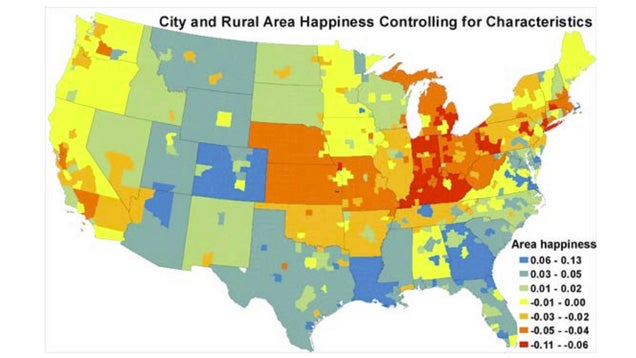
All other things being equal, the south, parts of the west, and upper midwest are the happiest places in the United States according to a recent study.

Researchers from Harvard University and the University of British Columbia took data from the Centers for Disease Control and Prevention which asked 300,000 individuals to report on their life satisfaction each year between 2005 and 2009. The analysts took this data and other demographic variables to compare differences in happiness across regions, while controlling for things like employment status and income.

via This Map Shows Where the Happiest and Unhappiest People Live in the US.

People Can Be Convinced They Committed a Crime That Never Happened

Evidence from some wrongful-conviction cases suggests that suspects can be questioned in ways that lead them to falsely believe in and confess to committing crimes they didn’t actually commit. New research provides lab-based evidence for this phenomenon, showing that innocent adult participants can be convinced, over the course of a few hours, that they had perpetrated crimes as serious as assault with a weapon in their teenage years.

[…]

All participants need to generate a richly detailed false memory is 3 hours in a friendly interview environment, where the interviewer introduces a few wrong details and uses poor memory-retrieval techniques.”

via People Can Be Convinced They Committed a Crime That Never Happened – Association for Psychological Science.

Besides Lifestyle and Inherited Genes, Cancer Risk Also 66% Tied to Bad Luck

The researchers, from the Johns Hopkins University School of Medicine in Baltimore, analyzed published scientific papers to identify the number of stem cells, and the rate of stem-cell division, among 31 tissue types, though not for breast and prostate tissue, which they excluded from the analysis. Then they compared the total number of lifetime stem-cell divisions in each tissue against a person’s lifetime risk of developing cancer in that tissue in the U.S.

The correlation between these parameters suggests that two-thirds of the difference in cancer risk among various tissue types can be blamed on random, or “stochastic,” mutations in DNA occurring during stem-cell division, and only one-third on hereditary or environmental factors like smoking, the researchers conclude. “Thus, the stochastic effects of DNA replication appear to be the major contributor to cancer in humans,” they wrote.

via Besides Lifestyle and Inherited Genes, Cancer Risk Also Tied to Bad Luck – WSJ.