Clear These Recalled Cancer Causing Antiperspirants From Your Home

If you’re a fan of aerosol spray antiperspirants and deodorants, you’re going to want to check to see whether the one you use is part of a voluntary recall issued by Procter & Gamble (P&G).

The recall comes after a citizen’s petition filed with the U.S. Food and Drug Administration (FDA) last month that claims more than half of the batches of antiperspirant and deodorant sprays they tested contained benzene—a chemical that, when found at high levels, can cause cancer. Here’s what you need to know.

[…]

They found that out of the 108 batches of products tested, 59 (or 54%) of them had levels of benzene exceeding the 2 parts per million permitted by the FDA.

[…]

Valisure’s tests included 30 different brands, but according to CNN, P&G is the only company to issue a recall for its products containing benzene; specifically, the recall covers 17 types of Old Spice and Secret antiperspirant.

The full list of products Valisure tested and found to contain more than 2 parts per million of benzene can be found on the company’s petition to the FDA. Examples include products from other familiar brands like Tag, Sure, Equate, Suave, Right Guard, Brut, Summer’s Eve, Right Guard, Power Stick, Soft & Dri, and Victoria’s Secret.

If you have purchased any of the Old Spice or Secret products included in P&G’s recall, the company instructs consumers to stop using them, throw them out, and contact their customer care team (at 888-339-7689 from Monday – Friday from 9 a.m. – 6 p.m. EST) to learn how to be reimbursed for eligible products.

Source: Clear These Recalled Antiperspirants From Your Home

Short of Suspension: How Suspension Warnings Can Reduce Hate Speech on Twitter

Debates around the effectiveness of high-profile Twitter account suspensions and similar bans on abusive users across social media platforms abound. Yet we know little about the effectiveness of warning a user about the possibility of suspending their account as opposed to outright suspensions in reducing hate speech. With a pre-registered experiment, we provide causal evidence that a warning message can reduce the use of hateful language on Twitter, at least in the short term. We design our messages based on the literature on deterrence, and test versions that emphasize the legitimacy of the sender, the credibility of the message, and the costliness of being suspended. We find that the act of warning a user of the potential consequences of their behavior can significantly reduce their hateful language for one week. We also find that warning messages that aim to appear legitimate in the eyes of the target user seem to be the most effective. In light of these findings, we consider the policy implications of platforms adopting a more aggressive approach to warning users that their accounts may be suspended as a tool for reducing hateful speech online.

[…]

we test whether warning users of their potential suspension if they continue using hateful language might be able to reduce online hate speech. To do so, we implemented a pre-registered experiment on Twitter in order to test the ability of “warning messages” about the possibility of future suspensions to reduce hateful language online. More specifically, we identify users who are candidates for suspension in the future based on their prior tweets and download their follower lists before the suspension takes place. After a user gets suspended, we randomly assign some of their followers who have also used hateful language to receive a warning that they, too, may be suspended for the same reason.

Since our tweets aim to deter users from using hateful language, we design them relying on the three mechanisms that the literature on deterrence deems as most effective in reducing deviation behavior: costliness, legitimacy, and credibility. In other words, our experiment allows us to manipulate the degree to which users perceive their suspension as costly, legitimate, and credible.

[…]

Our study provides causal evidence that the act of sending a warning message to a user can significantly decrease their use of hateful language as measured by their ratio of hateful tweets over their total number of tweets. Although we do not find strong evidence that distinguishes between warnings that are high versus low in legitimacy, credibility, or costliness, the high legitimacy messages seem to be the most effective of all the messages tested.

[…]

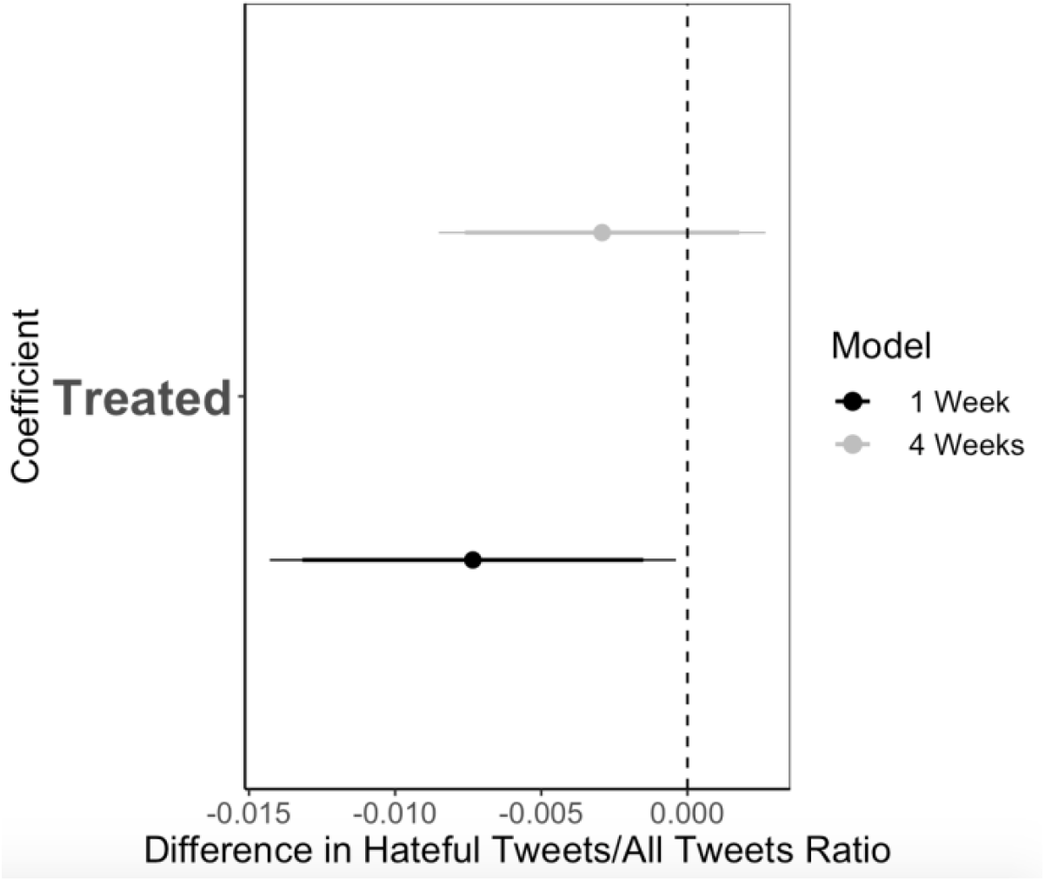
he coefficient plot in figure 4 shows the effect of sending any type of warning tweet on the ratio of tweets with hateful language over the tweets that a user tweets. The outcome variable is the ratio of hateful tweets over the total number of tweets that a user posted over the week and month following the treatment. The effects thus show the change in this ratio as a result of the treatment.

Figure 4 The effect of sending a warning tweet on reducing hateful language

Note: See table G1 in online appendix G for more details on sample size and control coefficients.

We find support for our first hypothesis: a tweet that warns a user of a potential suspension will lead that user to decrease their ratio of hateful tweets by 0.007 for a week after the treatment. Considering the fact that the average pre-treatment hateful tweet ratio is 0.07 in our sample, this means that a single warning tweet from a user with 100 followers reduced the use of hateful language by 10%.

[…]

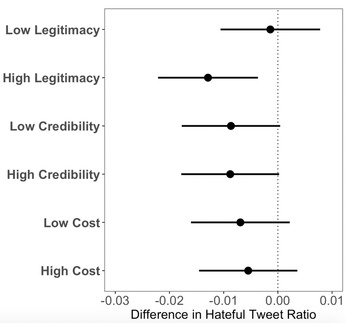
The coefficient plot in figure 5 shows the effect of each treatment on the ratio of tweets with hateful language over the tweets that a user tweets. Although the differences across types are minor and thus caveats are warranted, the most effective treatment seems to be the high legitimacy tweet; the legitimacy category also has by far the largest difference between the high- and low-level versions of the three categories of treatment we assessed. Interestingly, the tweets emphasizing the cost of being suspended appear to be the least effective of the three categories; although the effects are in the correctly predicted direction, neither of the cost treatments alone are statistically distinguishable from null effects.

Figure 5 Reduction in hate speech by treatment type

Note: See table G2 in online appendix G for more details on sample size and control coefficients.

An alternative mechanism that could explain the similarity of effects across treatments—as well as the costliness channel apparently being the least effective—is that perhaps instead of deterring people, the warnings might have made them more reflective and attentive about their language use.

[…]

ur results show that only one warning tweet sent by an account with no more than 100 followers can decrease the ratio of tweets with hateful language by up to 10%, with some types of tweets (high legitimacy, emphasizing the legitimacy of the account sending the tweet) suggesting decreases of perhaps as high as 15%–20% in the week following treatment. Considering that we sent our tweets from accounts that have no more than 100 followers, the effects that we report here are conservative estimates, and could be more effective when sent from more popular accounts (Munger Reference Munger2017).

[…]

A recently burgeoning literature shows that online interventions can also decrease behaviors that could harm the other groups by tracking subjects’ behavior over social media. These works rely on online messages on Twitter that sanction the harmful behavior, and succeed in reducing hateful language (Munger Reference Munger2017; Siegel and Badaan Reference Siegel and Badaan2020), and mostly draw on identity politics when designing their sanctioning messages (Charnysh et al. Reference Charnysh, Lucas and Singh2015). We contribute to this recent line of research by showing that warning messages that are designed based on the literature of deterrence can lead to a meaningful decrease in the use of hateful language without leveraging identity dynamics.

[…]

Two options are worthy of discussion: relying on civil society or relying on Twitter. Our experiment was designed to mimic the former option, with our warnings mimicking non-Twitter employees acting on their own with the goal of reducing hate speech/protecting users from being suspended

[…]

hile it is certainly possible that an NGO or a similar entity could try to implement such a program, the more obvious solution would be to have Twitter itself implement the warnings.

[…]

the company reported “testing prompts in 2020 that encouraged people to pause and reconsider a potentially harmful or offensive reply—such as insults, strong language, or hateful remarks—before Tweeting it. Once prompted, people had an opportunity to take a moment and make edits, delete, or send the reply as is.”Footnote 15 This appears to result in 34% of those prompted electing either to review the Tweet before sending, or not to send the Tweet at all.

We note three differences from this endeavor. First, in our warnings, we try to reduce people’s hateful language after they employ hateful language, which is not the same thing as warning people before they employ hateful language. This is a noteworthy difference, which can be a topic for future research in terms of whether the dynamics of retrospective versus prospective warnings significantly differ from each other. Second, Twitter does not inform their users of the examples of suspensions that took place among the people that these users used to follow. Finally, we are making our data publicly available for re-analysis.

We stop short, however, of unambiguously recommending that Twitter simply implement the system we tested without further study because of two important caveats. First, one interesting feature of our findings is that across all of our tests (one week versus four weeks, different versions of the warning—figures 2 (in text) and A1(in the online appendix)) we never once get a positive effect for hate speech usage in the treatment group, let alone a statistically significant positive coefficient, which would have suggested a potential backlash effect whereby the warnings led people to become more hateful. We are reassured by this finding but do think it is an open question whether a warning from Twitter—a large powerful corporation and the owner of the platform—might provoke a different reaction. We obviously could not test for this possibility on our own, and thus we would urge Twitter to conduct its own testing to confirm that our finding about the lack of a backlash continues to hold when the message comes from the platform itself.Footnote 16

The second caveat concerns the possibility of Twitter making mistakes when implementing its suspension policies.

[…]

Despite these caveats, our findings suggest that hate-speech moderations can be effective without priming the salience of the target users’ identity. Explicitly testing the effectiveness of identity versus non-identity motivated interventions will be an important subject for future research.

Source: Short of Suspension: How Suspension Warnings Can Reduce Hate Speech on Twitter | Perspectives on Politics | Cambridge Core

The Good Guy/Bad Guy Myth

The first time we see Darth Vader doing more than heavy breathing in Star Wars (1977), he’s strangling a man to death. A few scenes later, he’s blowing up a planet. He kills his subordinates, chokes people with his mind, does all kinds of things a good guy would never do. But then the nature of a bad guy is that he does things a good guy would never do. Good guys don’t just fight for personal gain: they fight for what’s right – their values.

This moral physics underlies not just Star Wars, but also film series such as The Lord of the Rings (2001-3) and X-Men (2000-), as well as most Disney cartoons. Virtually all our mass-culture narratives based on folklore have the same structure: good guys battle bad guys for the moral future of society. These tropes are all over our movies and comic books, in Narnia and at Hogwarts, and yet they don’t exist in any folktales, myths or ancient epics. In Marvel comics, Thor has to be worthy of his hammer, and he proves his worth with moral qualities. But in ancient myth, Thor is a god with powers and motives beyond any such idea as ‘worthiness’.

In old folktales, no one fights for values. Individual stories might show the virtues of honesty or hospitality, but there’s no agreement among folktales about which actions are good or bad. When characters get their comeuppance for disobeying advice, for example, there is likely another similar story in which the protagonist survives only because he disobeys advice. Defending a consistent set of values is so central to the logic of newer plots that the stories themselves are often reshaped to create values for characters such as Thor and Loki – who in the 16th-century Icelandic Edda had personalities rather than consistent moral orientations.

Stories from an oral tradition never have anything like a modern good guy or bad guy in them,  despite their reputation for being moralising. In stories such as Jack and the Beanstalk or Sleeping Beauty, just who is the good guy? Jack is the protagonist we’re meant to root for, yet he has no ethical justification for stealing the giant’s things. Does Sleeping Beauty care about goodness? Does anyone fight crime? Even tales that can be made to seem like they are about good versus evil, such as the story of Cinderella, do not hinge on so simple a moral dichotomy. In traditional oral versions, Cinderella merely needs to be beautiful to make the story work. In the Three Little Pigs, neither pigs nor wolf deploy tactics that the other side wouldn’t stoop to. It’s just a question of who gets dinner first, not good versus evil.

The situation is more complex in epics such as The Iliad, which does have two ‘teams’, as well as characters who wrestle with moral meanings. But the teams don’t represent the clash of two sets of values in the same way that modern good guys and bad guys do. Neither Achilles nor Hector stands for values that the other side cannot abide, nor are they fighting to protect the world from the other team. They don’t symbolise anything but themselves and, though they talk about war often, they never cite their values as the reason to fight the good fight. The ostensibly moral face-off between good and evil is a recent invention that evolved in concert with modern nationalism – and, ultimately, it gives voice to a political vision not an ethical one.

Most folklore scholarship since the Second World War has been concerned with archetypes or commonalities among folktales, the implicit drive being that if the myths and stories of all nations had more in common than divided them, then people of all nations could likewise have more in common than divides us. It was a radical idea, when earlier folktales had been published specifically to show how people in one nation were unlike those in another.

In her study of folklore From the Beast to the Blonde (1995), the English author and critic Marina Warner rejects a reading of folktales, popularised by the American child psychologist Bruno Bettelheim, as a set of analogies for our psychological and developmental struggles. Warner argues instead that external circumstances make these stories resonate with readers and listeners through the centuries. Still, both scholars want to trace the common tropes of folktales and fairytales insofar as they stay the same, or similar, through the centuries.

Novelists and filmmakers who base their work on folklore also seem to focus on commonalities. George Lucas very explicitly based Star Wars on Joseph Campbell’s book The Hero with a Thousand Faces (1949), which describes the journey of a figure such as Luke Skywalker as a human universal. J R R Tolkien used his scholarship of Old English epics to recast the stories in an alternative, timeless landscape; and many comic books explicitly or implicitly recycle the ancient myths and legends, keeping alive story threads shared by stories new and old, or that old stories from different societies around the world share with each other.

Less discussed is the historic shift that altered the nature of so many of our modern retellings of folklore, to wit: the idea that people on opposite sides of conflicts have different moral qualities, and fight over their values. That shift lies in the good guy/bad guy dichotomy, where people no longer fight over who gets dinner, or who gets Helen of Troy, but over who gets to change or improve society’s values. Good guys stand up for what they believe in, and are willing to die for a cause. This trope is so omnipresent in our modern stories, movies, books, even our political metaphors, that it is sometimes difficult to see how new it is, or how bizarre it looks, considered in light of either ethics or storytelling.

When the Grimm brothers wrote down their local folktales in the 19th century, their aim was to use them to define the German Volk, and unite the German people into a modern nation. The Grimms were students of the philosophy of Johann Gottfried von Herder, who emphasised the role of language and folk traditions in defining values. In his Treatise on the Origin of Language (1772), von Herder argued that language was ‘a natural organ of the understanding’, and that the German patriotic spirit resided in the way that the nation’s language and history developed over time. Von Herder and the Grimms were proponents of the then-new idea that the citizens of a nation should be bound by a common set of values, not by kinship or land use. For the Grimms, stories such as Godfather Death, or the Knapsack, the Hat and the Horn, revealed the pure form of thought that arose from their language.

The corollary of uniting the Volk through a storified set of essential characteristics and values is that those outside the culture were seen as lacking the values Germans considered their own. Von Herder might have understood the potential for mass violence in this idea, because he praised the wonderful variety of human cultures: specifically, he believed that German Jews should have equal rights to German Christians. Still, the nationalist potential of the Grimm brothers’ project was gradually amplified as its influence spread across Europe, and folklorists began writing books of national folklore specifically to define their own national character. Not least, many modern nations went on to realise the explosive possibilities for abuse in a mode of thinking that casts ‘the other’ as a kind of moral monster.

In her book The Hard Facts of the Grimms’ Fairy Tales (1987), the American scholar Maria Tatar remarks on the way that Wilhelm Grimm would slip in, say, adages about the importance of keeping promises. She argued that: ‘Rather than coming to terms with the absence of a moral order … he persisted in adding moral pronouncements even where there was no moral.’ Such additions established the idea that it was values (not just dinner) at stake in the conflicts that these stories dramatised. No doubt the Grimms’ additions influenced Bettelheim, Campbell and other folklorists who argued for the inherent morality of folktales, even if they had not always been told as moral fables.

As part of this new nationalist consciousness, other authors started changing the old stories to make a moral distinction between, for example, Robin Hood and the Sheriff of Nottingham. Before Joseph Ritson’s 1795 retelling of these legends, earlier written stories about the outlaw mostly showed him carousing in the forest with his merry men. He didn’t rob from the rich to give to the poor until Ritson’s version – written to inspire a British populist uprising after the French Revolution. Ritson’s rendering was so popular that modern retellings of Robin Hood, such as Disney’s 1973 cartoon or the film Prince of Thieves (1991) are more centrally about outlaw moral obligations than outlaw hijinks. The Sheriff of Nottingham was transformed from a simple antagonist to someone who symbolised the abuses of power against the powerless. Even within a single nation (Robin Hood), or a single household (Cinderella), every scale of conflict was restaged as a conflict of values.

Or consider the legend of King Arthur. In the 12th century, poets writing about him were often French, like Chrétien de Troyes, because King Arthur wasn’t yet closely associated with the soul of Britain. What’s more, his adversaries were often, literally, monsters, rather than people who symbolised moral weaknesses. By the early 19th century, when Tennyson wrote Idylls of the King, King Arthur becomes an ideal of a specifically British manhood, and he battles human characters who represent moral frailties. By the 20th century, the word ‘Camelot’ came to mean a kingdom too idealistic to survive on Earth.

Once the idea of national values entered our storytelling, the peculiar moral physics underlying the phenomenon of good guys versus bad guys has been remarkably consistent. One telling feature is that characters frequently change sides in conflicts: if a character’s identity resides in his values, then when he changes his mind about a moral question, he is essentially swapping sides, or defecting. This is not always acknowledged. For example, when in the PBS series Power of Myth (1988) the journalist Bill Moyers discussed with Campbell how many ancient tropes Star Wars deployed, they didn’t consider how bizarre it would have seemed to the ancient storytellers had Darth Vader changed his mind about anger and hatred, and switched sides in his war with Luke and the Rebels. Contrast this with The Iliad, where Achilles doesn’t become Trojan when he is angry at Agamemnon. Neither the Greeks nor the Trojans stand for some set of human strengths or frailties. Since their conflict is not a metaphor for some internal battle of anger versus love, switching sides because of a transport of feeling would be incoherent. In Star Wars, the opposing teams each represent a set of human properties. What side Darth Vader fights on is therefore absolutely dependent on whether anger or love is foremost in his heart.

Bad guys change their minds and become good in exactly the same way in countless, ostensibly folkloric, modern stories: The Lord of the Rings, Buffy the Vampire Slayer (1997-2003), the Harry Potter series (1997-2007). When a bad character has a change of heart, it’s always a cathartic emotional moment – since what’s at stake for a character is losing the central part of his identity. Another peculiarity in the moral physics of good guys versus bad is that bad guys have no loyalty and routinely punish their own; whether it’s the Sheriff of Nottingham starving his own people or Darth Vader killing his subordinates, bad guys are cavalier with human life, and they rebuke their allies for petty transgressions. This has been true since the earliest modern bad guys, though it scarcely exists among older adversaries who might be hungry for human flesh, but don’t kill their own.

Good guys, on the other hand, accept all applicants into the fold, and prove their loyalty even when their teammates transgress. Consider Friar Tuck getting drunk on ale while Robin Hood looks the other way. Or Luke Skywalker welcoming the roguish Han Solo on side. Good guys work with rogues, oddballs and ex-bad guys, plus their battles often hinge on someone who was treated badly by the bad guys crossing over and becoming a good guy. Forgiving characters their wicked deeds is an emotional climax in many good guy/bad guy stories. Indeed, it’s essential that the good side is a motley crew that will never, ever reject a fellow footsoldier.

Again, this is a point of pride that seems incoherent in the context of pre-modern storytelling. Not only do people in ancient stories not switch sides in fights but Achilles, say, would never win because his army was composed of the rejects from the Trojans’. In old stories, great warriors aren’t scrappy recruits, there for the moral education: they’re experts.

Stories about good guys and bad guys that are implicitly moral – in the sense that they invest an individual’s entire social identity in him not changing his mind about a moral issue – perversely end up discouraging any moral deliberation. Instead of anguishing over multidimensional characters in conflict – as we find in The Iliad, or the Mahabharata or Hamlet – such stories rigidly categorise people according to the values they symbolise, flattening all the deliberation and imagination of ethical action into a single thumbs up or thumbs down. Either a person is acceptable for Team Good, or he belongs to Team Evil.

Good guy/bad guy narratives might not possess any moral sophistication, but they do promote social stability, and they’re useful for getting people to sign up for armies and fight in wars with other nations. Their values feel like morality, and the association with folklore and mythology lends them a patina of legitimacy, but still, they don’t arise from a moral vision. They are rooted instead in a political vision, which is why they don’t help us deliberate, or think more deeply about the meanings of our actions. Like the original Grimm stories, they’re a political tool designed to bind nations together.

It’s no coincidence that good guy/bad guy movies, comic books and games have large, impassioned and volatile fandoms – even the word ‘fandom’ suggests the idea of a nation, or kingdom. What’s more, the moral physics of these stories about superheroes fighting the good fight, or battling to save the world, does not commend genuine empowerment. The one thing the good guys teach us is that people on the other team aren’t like us. In fact, they’re so bad, and the stakes are so high, that we have to forgive every transgression by our own team in order to win.

When I talked with Andrea Pitzer, the author of One Long Night: A Global History of Concentration Camps (2017), about the rise of the idea that people on opposite sides of conflicts have different moral qualities, she told me: ‘Three inventions collided to make concentration camps possible: barbed wire, automatic weapons, and the belief that whole categories of people should be locked up.’ When we read, watch and tell stories of good guys warring against bad guys, we are essentially persuading ourselves that our opponents would not be fighting us, indeed they would not be on the other team at all, if they had any loyalty or valued human life. In short, we are rehearsing the idea that moral qualities belong to categories of people rather than individuals. It is the Grimms’ and von Herder’s vision taken to its logical nationalist conclusion that implies that ‘categories of people should be locked up’.

Watching Wonder Woman at the end of the 2017 movie give a speech about preemptively forgiving ‘humanity’ for all the inevitable offences of the Second World War, I was reminded yet again that stories of good guys and bad guys actively make a virtue of letting the home team in a conflict get away with any expedient atrocity.

Source: The Good Guy/Bad Guy Myth

Something Awful Founder Richard Lowtax Kyanka Has Reportedly Died

A GoFundMe is collecting money to put toward the wellbeing of the three daughters Kyanka left behind. Here is the corresponding thread on Something Awful. Original story continues below.


Longtime Something Awful forum administrator Fragmaster posted that site founder Richard “Lowtax” Kyanka has died. “I guess I should preface this by saying this isn’t a joke especially since I’m posting for like the first time in 10 years or something, but I got the bad news today directly from Rich’s family,” wrote Fragmaster. “Lowtax has passed away.”

“I didn’t ask for details,” Fragmaster continued. “I don’t know details. I don’t know what the current opinion of Rich here is. Not here to answer questions, I’m sharing the news. I really hate to share this news. But there you go.”

Considering all the shit that Something Awful has gotten up to over the years, some have wondered if this were a hoax. “Is this for real?” wondered one forum member. Some expressed shock at the news, while others offered their condolences to his children.

Kyanka’s second wife, who posts on SA under the name LadyAmbien, has confirmed her husband’s death, in a very angry post about his treatment of her and their children.

Below is the SA admin’s eulogy for the site’s founder, which was originally posted in a thread titled “itt a tribute to our late founder, farewell, deer richard.”

In 1999, Kyanka created Something Awful, and today, it’s hard to understate the site’s influence. It also spawned endless, classic memes, such as, “All your base are belong to us,” and was even the launching pad for what became 4chan. Our colleagues at Gizmodo listed it at number 89 in the 100 websites that shaped the internet today, writing the following:

While Something Awful had its moments as a host for various bits of comedy, rants, and reviews, SA’s community is its real legacy. From its forums, Something Awful members gave birth to the legend of Slenderman, an entire new genre of videos in Let’s Plays, and thanks to offshoots like the Goonswarm, SA was indirectly responsible for some of the most massive (and costly) space battles ever witnessed in video game history. It was also, uh, actually awful.

“The Something Awful forums spawned a great many things in its multiple decades of existence,” said Fragmaster in his YouTube eulogy. “Some things horrible and unfortunate, many things just unintelligible and a huge waste of time. But ultimately, Rich created a community where interesting things happened and people connected.”

In October 2020, Kyanka sold the site, writing on Facebook, “I just signed away the rights to Something Awful, goodbye, good riddance.”

[…]

Source: Something Awful Founder Richard Kyanka Has Reportedly Died

5-Day Brain Stimulation Treatment Highly Effective Against Depression, Stanford Researchers Find

Stanford researchers think they’ve devised an effective and quick-acting way to treat difficult cases of depression, by improving on an already approved form of brain stimulation. In a new trial published this week, the researchers found that almost 80% of patients improved after going through treatment—a far higher rate than those who were given a sham placebo.

Brain stimulation has emerged as a promising avenue for depression, particularly depression that hasn’t responded to other treatments. The basic concept behind it is to use electrical impulses to balance out the erratic brain activity associated with neurological or psychiatric disorders. There are different forms of stimulation, which vary in intensity and how they interact with the body. Some require permanent implants in the brain, while others can be used noninvasively, like repetitive transcranial magnetic stimulation (rTMS). As the name suggests, rTMS relies on magnetic fields that are temporarily applied to the head.

[…]

the Stanford neuromodulation therapy (SNT), relies on higher-dose magnetic pulses delivered over a quicker, five-day schedule, meant to mimic about seven months of standard rTMS treatment. The treatment is also personalized to each patient, with MRI scans used beforehand to pick out the best possible locations along the brain to deliver these pulses.

[…]

Last year, Williams and his team published a small study of 21 patients who were given SNT, showing that 90% of people severely affected by their depression experienced remission—in other words, that they no longer met the criteria for an acute depressive episode. Moreover, people’s feelings of suicidal ideation went away as well. The study was open label, though, meaning that patients and doctors knew what treatment was being given. Confirming that any drug or treatment actually works requires more rigorous tests, such as a double-blinded and placebo-controlled experiment. And that’s what the team has done now, publishing the results of their new trial in the American Journal of Psychiatry.

[…]

This time, about 78% of patients given genuine SNT experienced remission, based on standard diagnostic tests, compared to about 13% of the sham group. There were no serious side effects, with the most common being a short-lasting headache. And when participants were asked to guess which treatment they took, neither group did better than chance, indicating that the blinding worked.

[…]

Source: 5-Day Brain Stimulation Treatment Highly Effective Against Depression, Stanford Researchers Find

Missouri governor demands prosecution for data breach report – in HTML source code of state website

A Missouri politician has been relentlessly mocked on Twitter after demanding the prosecution of a journalist who found and responsibly reported a vulnerability in a state website.

Mike Parson, governor of Missouri, described reporters for local newspaper the St Louis Post Dispatch (SLPD) as “hackers” after they discovered a web app for the state’s Department of Elementary and Secondary Education was leaking teachers’ private information.

Around 100,000 social security numbers were able to be exposed when the web app was loaded in a user’s browser. The public-facing app was intended to be used by local schools to check teachers’ professional registration status. So users could tell between different teachers of the same name, it would accept the last four digits of a teacher’s social security number as a valid search string.

It appears that in the background, the app was retrieving the entire social security number and exposing it to the end user.

The SLPD discovered this by viewing a search results page’s source code. “View source” has been a common feature of web browsers for years, typically available by right-clicking anywhere on a webpage and selecting it from a menu.

SLPD reporters told the Missouri Department of Education about the flaw and held off publicising it so officials could fix it – but that wasn’t good enough for the governor.

“The state is committed to bring to justice anyone who hacked our system and anyone who aided and abetted them to do so,” Parson said, according to the Missouri Independent news website. He justified his bizarre outburst by saying the SLPD was “attempting to embarrass the state and sell headlines for their news outlet.”

[…]

Source: Missouri governor demands prosecution for data breach report • The Register

The Beauty Of Dance, Seen Through The Power Of Touch

It’s nothing short of amazing what trained dancers can do with their bodies, and a real shame that visually-impaired people can’t enjoy the experience of, say, ballet. For this year’s Hackaday Prize, [Shi Yun] is working on a way for visually-impaired people to experience dance performances via haptic feedback on a special device.

This platform, which is called Kinetic Soul, uses Posenet computer vision to track a dancer’s movements. Posenet detects the dancer’s joints and creates a point map to determine what body parts are moving where, and at what speed. Then the system translates and transmits the movements to the 32 pins on the surface, creating a touchable picture of what’s going on. Each 3D-printed pin is controlled with a solenoid, all of which are driven by a single Arduino.

We think it’s interesting that Kinetic Soul can speak to the user in two different languages. The first is more about the overall flow of a dance, and the second delves into the deconstructed details. Both methods allow for dances to be enjoyed in real time, or via video recording. So how does one deconstruct dance? [Shi Yun] turned to Laban Movement Analysis, which breaks up human locomotion into four broad categories: the body in relation to itself, the effort expended to move, the shapes assumed, and the space used.

[Shi Yun] has been user-testing their ideas at dance workshops for the visually impaired throughout the entire process — this is how they arrived at having two haptic languages instead of one. They plan to continue getting input as they work to fortify the prototype, improve the touch experience, and refine the haptic languages. Check out the brief demonstration video after the break.

Yes indeed, dance is a majestic way of expressing all kinds of things. Think you have no use for interpretive dance? Think again — it can help you understand protein synthesis in an amusing way.


Source: The Beauty Of Dance, Seen Through The Power Of Touch | Hackaday

Texas abortion: Judge temporarily blocks enforcement of law

A US judge has temporarily blocked a new law in Texas that effectively bans women from having an abortion.

District Judge Robert Pitman granted a request by the Biden administration to prevent any enforcement of the law while its legality is being challenged.

The law, which prohibits women in Texas from obtaining an abortion after six weeks of pregnancy, was drafted and approved by Republican politicians.

The White House praised the latest ruling as an important step.

“The fight has only just begun, both in Texas and in many states across this country where women’s rights are currently under attack,” White House Press Secretary Jen Psaki said.

Texan officials immediately appealed against the ruling, setting the stage for further court battles.

Judge Pitman, of Austin, wrote in an 113-page opinion that, from the moment the law came into effect on 1 September, “women have been unlawfully prevented from exercising control over their lives in ways that are protected by the Constitution”.

“This court will not sanction one more day of this offensive deprivation of such an important right,” he said on Wednesday.

Whole Woman’s Health, which runs a number of clinics in Texas, said it was making plans to resume abortions “as soon as possible”.

But the anti-abortion group Texas Right to Life, accused judges of “catering to the abortion industry” and called for a “fair hearing” at the next stage.

[…]

Source: Texas abortion: Judge temporarily blocks enforcement of law – BBC News

Just How Much Time Do We Spend On Our Phones?

Just How Much Time Do We Spend On Our Phones?

Phones have become so essential that it’s become tough to imagine our lives without them. What’s funny about this is that most people alive today can remember a time when we didn’t have cell phones, let alone smartphones. Even so, it’s difficult to recall exactly how we lived back then.

However, while we all know that our phones have become a big part of our lives, many of us aren’t aware of just how much time we spend looking at these devices. If you had to make a guess, you’d probably say “a lot.” However, that answer isn’t good enough for us. We want to know what’s really going on.

Below you will find a lot of data about how much time we spend on our phones, how this impacts us, both positive and negative, and some tips on developing healthy screen habits and ensuring our phones are having a positive impact on our lives.

How Much Time Do We Spend on Our Phones?

Let’s dive right in with some cold, hard numbers.

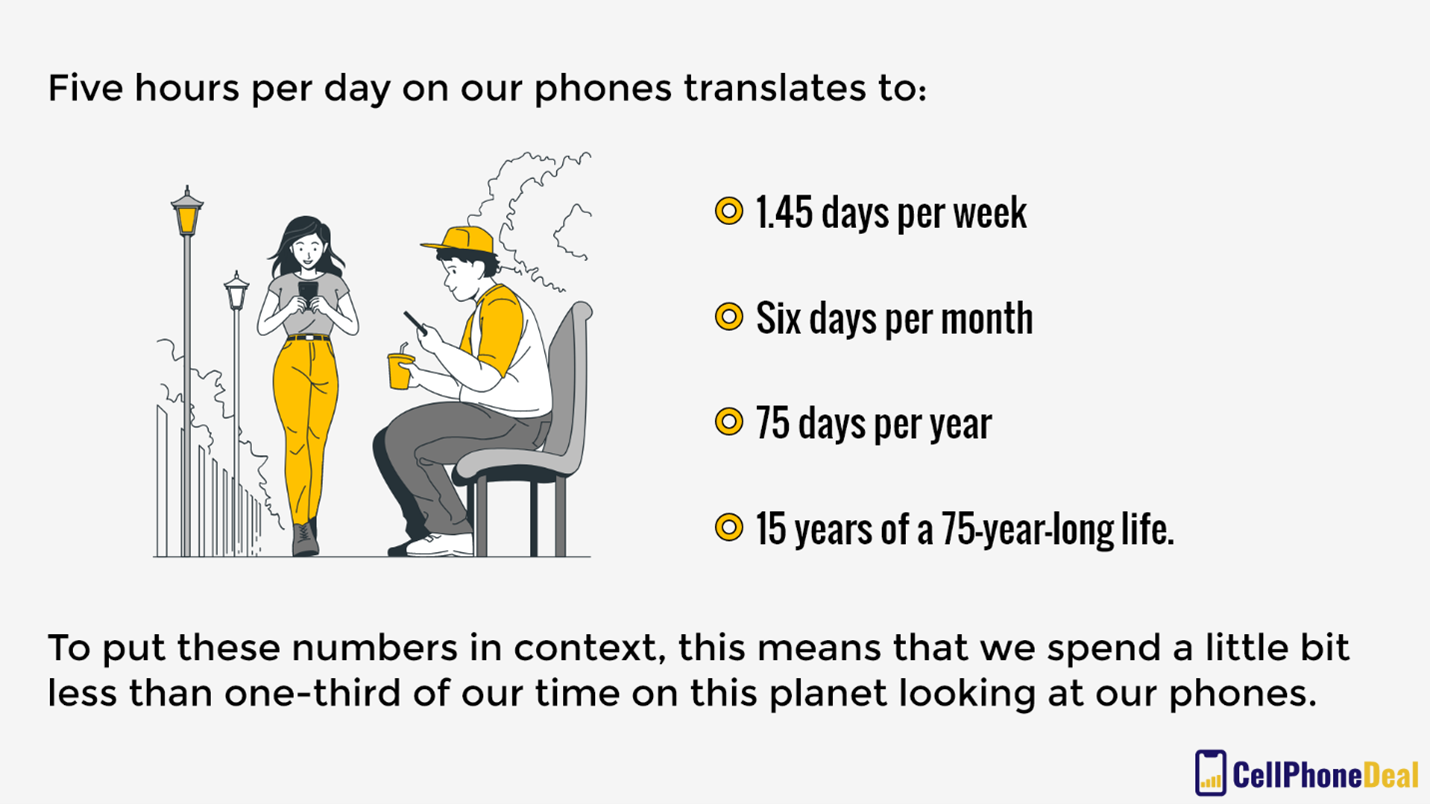
In total, we spend around five hours per day looking at our phones.

Yes, this seems like a lot, but if we stop to think about all the time we spend texting, scrolling through social media, watching YouTube videos, streaming Netflix, getting directions, and more, it’s easy to see how this can quickly add up to five hours. Of course, this is an average, so many people spend less, but others spend more.

No matter what, this is a pretty large number, and if we extrapolate it out, here’s how much time we really spend looking at our smartphones:

To put these numbers in context, this means that we spend a little bit less than one-third of our time on this planet looking at our phones, an astronomical number when you stop to think about it. Sure, presenting the numbers like this seems pretty dramatic. Still, if we live to be 75-years-old, we will have spent 15 of those years on our phones.

Is this a good or bad thing? Well, that depends on how you use your phone. Scrolling through social media for hours and hours probably isn’t the best idea, but watching educational YouTube videos doesn’t seem to be quite as bad. Again, it all depends on your perspective. Later on, we’ll discuss some of the potential impacts of too much screen time. For now, sit with the fact that you spend more time looking at your phone than you do going to school as a kid…

Other Phone Usage Statistics

Learning that we spend so much of our lives on our phones begs the question: what are we doing with all this time? Here are some stats that help shed some light on what we’re doing while we’re spending a third of our waking hours on our phones:

More Than Half of All Web Traffic Comes from Phones and Mobile Devices

This stat tells us that one of the biggest things we’re doing when we’re on our phones is searching the web. This could include shopping, social media, reading the news, etc. For some, it might come as a surprise that mobile phones make up such a large portion of overall internet traffic, but if we stop to think how far things have come, it makes sense.

For example, when smartphones first came out, their web browsers were terrible. That is no longer the case, in part because website developers are now forced to make sure a website is mobile-friendly. Also, mobile networks have improved considerably. The prevalence of apps has also helped usher in this mobile revolution.

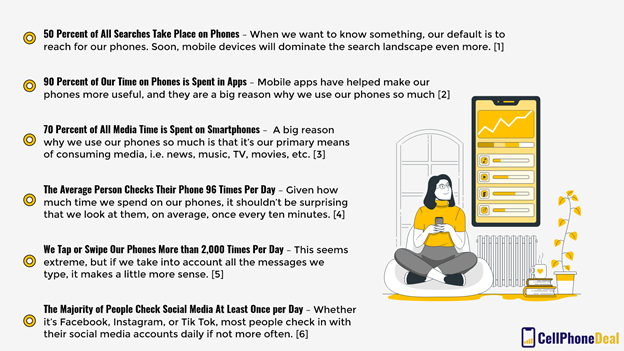
Here are some other stats that we should all know:

 [1], [2], [3], [4], [5], [6]

Nomophobia: Our Phone Addiction

Given how much we use our phones, it’s normal to wonder: are we addicted?

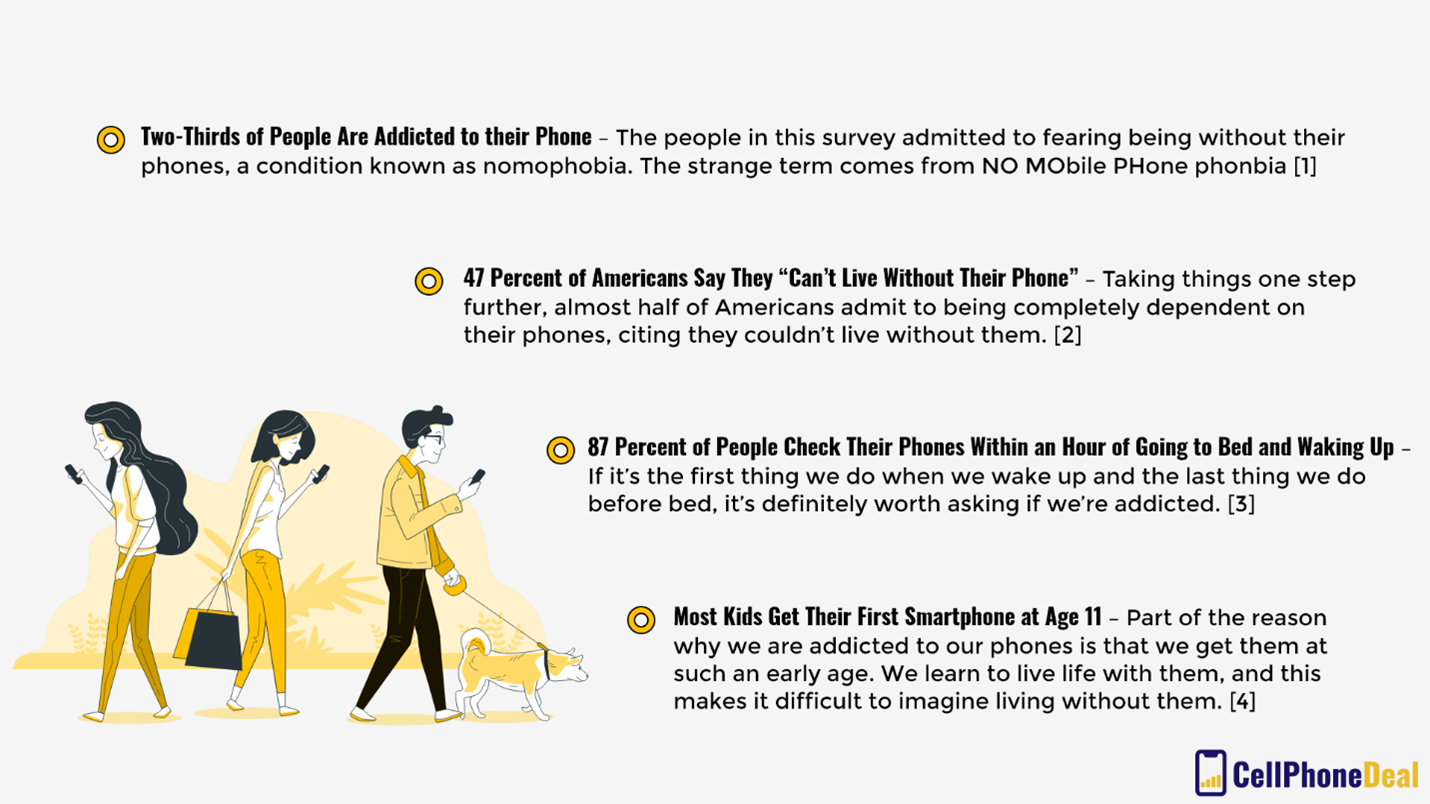
If this is indeed your question, it turns out you’re not the only one to ask it. Several studies have looked into this very issue, and here’s what they found:

 [1], [2], [3], [4]

The Risks of Too Much Screen Time

Based on the numbers we’ve presented so far, it’s fair to wonder if all this screen time is good for us. At the moment, we don’t know the impact of screen time, though we have some indications.

Below are a few of the complications that can arise if you spend too much time looking at your phone:

Weight Gain/Obesity

No, there is nothing about your phone itself that will make you gain weight. Instead, it’s what we’re doing when we use our phones, mainly sitting down.

Of course, a phone is small enough where you could be doing something physical while looking at it, such as watching a show while running on a treadmill. Still, the vast majority of the time we spend looking at our phones, we spend sitting down contributing to our already sedentary lifestyles.

Obesity is the major public health issue in the United States, and while poor diet and lifestyle habits are to blame, the amount of time we spend sitting and consuming media also plays a role. Therefore, if you’re going to spend this much time on your phone, make sure you’re also making time to move your body and ward off the problems that can come from sitting so much.

Poor Sleep

Because of all our phones can do, it’s common to use them in some capacity before bed. As we saw earlier, the vast majority of people use their phones an hour before they go to bed and an hour after they awake.

Looking at your phone first thing in the morning isn’t going to impact your sleep, though it can take a toll on our mental health if it means we’re not making time for ourselves. Instead, excessive phone time before bed is much more harmful.

This is because our phone screens emit blue light. Our brains can’t distinguish this light from that which shines during the day, so looking at your phone, or any screen for that matter, can mess up your body’s internal clock and disrupt the natural processes that induce sleep.

Many phones now come with blue light filter settings to help deal with this, and while they are effective, they don’t completely solve the problem. Even without the light, looking at your phone before you go to bed means you’re mentally engaged with something at a time when you should be winding down and relaxing for bed. The best thing to do is try and limit the amount of time you look at your phone in the hour leading up to your bedtime.

Eye/Neck Strain and Headaches

Looking at screens for a long time can produce eye strain and headaches, primarily because of the light and because focusing on such a tiny screen for a long time can put undue stress on our eyes.

In addition to this, spending too much time on a phone can also lead to neck pain. When we use our phones, our necks are usually bent down, a posture that puts considerable stress on our spinal cord.

You may not realize this is happening at first, but if you are spending lots and lots of time on your phone, eventually, you will start to experience these pains. When this happens, put the phone down and take a break. Moving forward, pay attention to how you’ve positioned your body when you’re using your phone.

Stress

While our phones are meant to be useful and fun, for some, they can also be quite stressful. This is particularly the case if you use your personal phone for work. You’ll likely get messages at all hours of the day, and this can easily make it feel like you’re always working or that you should be. This is no fun for anyone.

Most of us also use our phones to check the news and social media, two realms that have become, shall we say, a bit negative. Constantly consuming this media is not a good idea, especially if you’re trying to relax. Try to set some limits and some ground rules so that you’re not exposing yourself to too much negativity.

We place a lot of expectations around phone use. For example, it’s become the norm to respond to text messages as soon as we receive and see them. However, this isn’t always ideal. If we don’t set proper boundaries, then our phones can easily overwhelm us. It might begin to feel like people are always trying to reach you and that you must always be available.

To combat this, try to manage expectations. You do not need to respond to messages right away, and if people demand that from you and you don’t want to meet that demand, you have a right to say something. It might take some time to train yourself that not every message or alert you receive is a command to respond, but if you manage to do this, then it’s likely your life will get a bit better.

Communication Breakdown

Lastly, and this is definitely a debatable point, but so much time on our phones has impacted how we communicate. Not only has it dramatically reduced our exposure to all-important non-verbal communication, but it has also started to interfere with our interpersonal interactions. How many times have you been at a social gathering where everyone has their phone out on the table or is actively looking at them while everyone is socializing.

Again, this isn’t necessarily a bad thing, but it is concerning. In-person communication is the best form, and it requires effort and energy. Consider making an effort to keep the phone stashed away while in the presence of others, or at the very least, limit how much you check it during social gatherings.

Some might argue that phones have made us better at communicating since we can do it more often and across long distances, but with the good comes the bad. At the end of the day, the best thing we can do is strive for balance.

How to Use Your Phone Responsibly

We’ve already mentioned some things you can do to make sure you’re using your phone responsibly, but here are a few other things you can do to help you develop a positive relationship with your device.

Take Breaks

Get in the habit of taking breaks from your phone. This has lots of benefits, but one of the most significant is that it gives us the chance to focus. If you’re working on something and are constantly checking your phone, each distraction breaks your attention and slows you down. One time might not be a big deal, but if you do this frequently, it will eat into your productivity and start causing problems in your life.

Make use of the “do not disturb” mode. This blocks all notifications so that you can’t get distracted. Another option is to just simply put your phone in airplane mode from time to time. This might be weird at first, but once you get used to it, you’ll see that it’s a straightforward way to stop yourself from reaching for your phone.

Use Timers

Another option is to use a timer app. These programs allow you to set time limits for specific apps, so you don’t use them as much. Many people put this in place for social media since it’s so easy to get sucked into the vortex and lose lots of time.

Flora is a good app for this, and every time you set a timer, the company plants a tree, which is nice! Another solid option is Space. This app has you take a small quiz when you first download it so that it can find out about your screen habits and develop a plan that’s going to be the most effective at helping you limit screen time.

There are many other apps you could use, so if you’re serious about reducing phone time, spend some time trying a few out to see which one works best for you.

Set Up a Cutoff Time

One simple trick is setting a time in the evening when you stop looking at your phone. If you struggle to do this, there’s a simple solution: turn the phone off!

Voluntarily turning your phone off in this day and age is not exactly a normal thing to do, but you’d be surprised how positive the impact can be. There’s something about having to turn it on to look at it that gets us to stop and think twice before checking the device.

At first, you may experience a bit of anxiety, but after a few times, you’ll likely find that the peace is welcome.

Don’t Sleep With Your Phone

Lastly, a surprising number of people sleep with their phones either in their beds or right next to them. If you want to cut back on how much you use it, then consider breaking this habit. Having it so close to you makes it all too tempting to use it right until the moment you decide to go to bed, which we all know can have some negative consequences. It also encourages you to reach for it the moment you wake up, which can induce stress.

Find a Good Balance

In the end, the phones themselves are neutral. It’s how we choose to use them that can be problematic. This article’s point was to shed some light on just how connected to our phones we’ve become and offer some guidance on how you can achieve a better balance. If you’re someone who uses their phone all the time, making a change might be challenging, but stick with it. You’ll likely experience some benefits. Ultimately, it’s all up to you, and if you’re happy with your phone usage, then we’re happy too!

Source: https://www.cellphonedeal.com/blog/just-how-much-time-do-we-spend-on-our-phones

Edit: https://www.cablecompare.com/blog/children-and-screen-time also has a good reading on this for children

China to have insight into and regulate web giants’ algorithms using governance model

China’s authorities have called for internet companies to create a governance system for their algorithms.

A set of guiding opinions on algorithms, issued overnight by nine government agencies, explains that algorithms play a big role in disseminating information online and enabling growth of the digital economy. But the guiding opinions also point out that algorithms employed online can also impact society, and financial markets.

[…]

To achieve its aims, Beijing expects that algo-wielding organisations will create algorithm governance teams to assess their code and detect any security or ethical flaws. Self-regulation is expected, as is continuous revision and self-improvement.

Chinese authorities will watch those efforts and will be unsparing when they find either harmful algorithms, or less-than-comprehensive compliance efforts. Citizen reports of erroneous algos will inform some regulatory actions.

Organisations have been given three years to get this done, with further guidance to come from Beijing.

[…]

Requiring oversight of algorithms suggests that Beijing is worried on two fronts. First, it’s concerned about how automation is already playing out on China’s internet. Second, it has observed that western web giants have used algorithms to increase user engagement in ways that amplify misinformation and that have clearly caused considerable real-world harm.

The new regulations are further evidence that Beijing wants to exercise control over what Chinese citizens can see online. That desire has already seen China crack down on depictions of effeminate men, warn fan clubs not to turn mean, ban racy online content aimed at kids, and crack down on computer games – including those that aren’t historically accurate – and even advise on what songs make for acceptable karaoke.

Source: China to regulate -may censor – web giants’ algorithms • The Register

Facebook Documents Show It Fumbled the Fight Over Vaccines

he Wall Street Journal has had something of a banner week tearing down Facebook. Its series on a trove of internal company documents obtained by the paper has unveiled Facebook’s secret system for treating certain users as above the rules, company research showing how harmful Instagram is for young girls, how the site’s algorithmic solutions to toxic content have backfired, and that Facebook executives are slow to respond to reports of organized criminal activity. On Friday, it published another article detailing how badly Facebook has fumbled fighting anti-vax content and CEO Mark Zuckerberg’s campaign to get users vaccinated.

[…]

One big problem was that Facebook users were brigading any content addressing vaccination with anti-vax comments. Company researchers, according to the Journal, warned executives that comments on vaccine-related content were flooded with anti-vax propaganda, pseudo-scientific claims, and other false information and lies about the virus and the vaccines.

Global health institutions such as the World Health Organization (WHO) and Unicef had registered their concern with Facebook, with one internal company memo warning of “anti-vaccine commenters that swarm their Pages,” while another internal report in early 2021 made an initial estimate that up to 41% of comments on vaccine-related posts appeared to risk discouraging people from getting vaccinated (referred to within the company “barrier to vaccination” content). That’s out of a pool of around 775 million vaccine-related comments seen by users daily.

[…]

Facebook had promised in 2019 to crack down on antivax content and summoned WHO reps to meet with tech leaders in February 2020. Zuckerberg personally got in contact with National Institute of Allergy and Infectious Diseases director Dr. Anthony Fauci to discuss funding vaccine trials, offer ad space and user data for government-run vaccination campaigns, and arrange a live Q&A between the two on the site. Facebook had also made adjustments to its content-ranking algorithm that a June 2020 memo claimed reduced health misinformation by 6.7% to 9.9%, the Journal wrote.

But by summer 2020, BS claims about the coronavirus and vaccines were going viral on the site, including the viral “Plandemic” video, a press conference staged by a group of right-wing weirdos calling themselves “America’s Frontline Doctors,” and a handful of anti-vax accounts such as Robert F. Kennedy Jr.’s that advocacy group Avaaz later identified as responsible for a wildly disproportionate share of the offending content. According to the Journal, Facebook was well aware that the phenomenon was being driven by a relatively small but determined and prolific segment of posters and group admins:

As the rollout of the vaccine began early this year, antivaccine activists took advantage of that stance. A later analysis found that a small number of “big whales” were behind many antivaccine posts and groups on the platform. Out of nearly 150,000 posters in Facebook Groups disabled for Covid misinformation, 5% were producing half of all posts, and around 1,400 users were responsible for inviting half the groups’ new members, according to one document.

“We found, like many problems at FB, this is a head-heavy problem with a relatively few number of actors creating a large percentage of the content and growth,” Facebook researchers would write in May, likening the movement to QAnon and efforts to undermine elections.

Zuckerberg waffled and suggested that Facebook shouldn’t be in the business of censoring anti-vax posts in an interview with Axios in September 2020, saying “If someone is pointing out a case where a vaccine caused harm or that they’re worried about it —you know, that’s a difficult thing to say from my perspective that you shouldn’t be allowed to express at all.” This was a deeply incorrect assessment of the problem, as Facebook was well aware that a small group of bad actors was actively and intentionally pushing the anti-vax content.

Another internal assessment conducted earlier this year by a Facebook employee, the Journal wrote, found that two-thirds of randomly sampled comments “were anti-vax” (though the sample size was just 110 comments). In their analysis, the staffer noted one poll that showed actual anti-vaccine sentiment in the general population was 40% lower.

[…]

The Journal reported that one integrity worker flagged a post with 53,000 shares and three million views that asserted vaccines are “all experimental & you are in the experiment.” Facebook’s automated moderation tools had ignored it after somehow concluding it was written in the Romanian language. By late February, researchers came up with a hasty method to scan for “vaccine hesitant” comments, but according to the Journal their report mentioned the anti-vax comment problem was “rampant” and Facebook’s ability to fight it was “bad in English, and basically non-existent elsewhere.”

[…]


Source: Facebook Documents Show It Fumbled the Fight Over Vaccines

Facebook’s 2018 Algorithm Change ‘Rewarded Outrage’. Zuck Resisted Fixes

Internal memos show how a big 2018 change rewarded outrage and that CEO Mark Zuckerberg resisted proposed fixes

In the fall of 2018, Jonah Peretti, chief executive of online publisher BuzzFeed, emailed a top official at Facebook Inc. The most divisive content that publishers produced was going viral on the platform, he said, creating an incentive to produce more of it.

He pointed to the success of a BuzzFeed post titled “21 Things That Almost All White People are Guilty of Saying,” which received 13,000 shares and 16,000 comments on Facebook, many from people criticizing BuzzFeed for writing it, and arguing with each other about race. Other content the company produced, from news videos to articles on self-care and animals, had trouble breaking through, he said.

Mr. Peretti blamed a major overhaul Facebook had given to its News Feed algorithm earlier that year to boost “meaningful social interactions,” or MSI, between friends and family, according to internal Facebook documents reviewed by The Wall Street Journal that quote the email.

BuzzFeed built its business on making content that would go viral on Facebook and other social media, so it had a vested interest in any algorithm changes that hurt its distribution. Still, Mr. Peretti’s email touched a nerve.

Facebook’s chief executive, Mark Zuckerberg, said the aim of the algorithm change was to strengthen bonds between users and to improve their well-being. Facebook would encourage people to interact more with friends and family and spend less time passively consuming professionally produced content, which research suggested was harmful to their mental health.

Within the company, though, staffers warned the change was having the opposite effect, the documents show. It was making Facebook’s platform an angrier place.

Company researchers discovered that publishers and political parties were reorienting their posts toward outrage and sensationalism. That tactic produced high levels of comments and reactions that translated into success on Facebook.

“Our approach has had unhealthy side effects on important slices of public content, such as politics and news,” wrote a team of data scientists, flagging Mr. Peretti’s complaints, in a memo reviewed by the Journal. “This is an increasing liability,” one of them wrote in a later memo.

They concluded that the new algorithm’s heavy weighting of reshared material in its News Feed made the angry voices louder. “Misinformation, toxicity, and violent content are inordinately prevalent among reshares,” researchers noted in internal memos.

Some political parties in Europe told Facebook the algorithm had made them shift their policy positions so they resonated more on the platform, according to the documents.

“Many parties, including those that have shifted to the negative, worry about the long term effects on democracy,” read one internal Facebook report, which didn’t name specific parties.

Facebook employees also discussed the company’s other, less publicized motive for making the change: Users had begun to interact less with the platform, a worrisome trend, the documents show.

The email and memos are part of an extensive array of internal company communications reviewed by the Journal. They offer an unparalleled look at how much Facebook knows about the flaws in its platform and how it often lacks the will or the ability to address them. This is the third in a series of articles based on that information.

[…]

Anna Stepanov, who led a team addressing those issues, presented Mr. Zuckerberg with several proposed changes meant to address the proliferation of false and divisive content on the platform, according to an April 2020 internal memo she wrote about the briefing. One such change would have taken away a boost the algorithm gave to content most likely to be reshared by long chains of users.

“Mark doesn’t think we could go broad” with the change, she wrote to colleagues after the meeting. Mr. Zuckerberg said he was open to testing the approach, she said, but “We wouldn’t launch if there was a material tradeoff with MSI impact.”

Last month, nearly a year and a half after Ms. Stepanov said Mr. Zuckerberg nixed the idea of broadly incorporating a similar fix, Facebook announced it was “gradually expanding some tests to put less emphasis on signals such as how likely someone is to comment or share political content.” The move is part of a broader push, spurred by user surveys, to reduce the amount of political content on Facebook after the company came under criticism for the way election protesters used the platform to question the results and organize protests that led to the Jan. 6 riot at the Capitol in Washington.

[…]

“MSI ranking isn’t actually rewarding content that drives meaningful social interactions,” Mr. Peretti wrote in his email to the Facebook official, adding that his staff felt “pressure to make bad content or underperform.”

It wasn’t just material that exploited racial divisions, he wrote, but also “fad/junky science,” “extremely disturbing news” and gross images.

Political effect

In Poland, the changes made political debate on the platform nastier, Polish political parties told the company, according to the documents. The documents don’t specify which parties.

“One party’s social media management team estimates that they have shifted the proportion of their posts from 50/50 positive/negative to 80% negative, explicitly as a function of the change to the algorithm,” wrote two Facebook researchers in an April 2019 internal report.

Nina Jankowicz, who studies social media and democracy in Central and Eastern Europe as a fellow at the Woodrow Wilson Center in Washington, said she has heard complaints from many political parties in that region that the algorithm change made direct communication with their supporters through Facebook pages more difficult. They now have an incentive, she said, to create posts that rack up comments and shares—often by tapping into anger—to get exposure in users’ feeds.

The Facebook researchers, wrote in their report that in Spain, political parties run sophisticated operations to make Facebook posts travel as far and fast as possible.

“They have learnt that harsh attacks on their opponents net the highest engagement,” they wrote. “They claim that they ‘try not to,’ but ultimately ‘you use what works.’ ”

In the 15 months following fall 2017 clashes in Spain over Catalan separatism, the percentage of insults and threats on public Facebook pages related to social and political debate in Spain increased by 43%, according to research conducted by Constella Intelligence, a Spanish digital risk protection firm.

[…]

Early tests showed how reducing that aspect of the algorithm for civic and health information helped reduce the proliferation of false content. Facebook made the change for those categories in the spring of 2020.

When Ms. Stepanov presented Mr. Zuckerberg with the integrity team’s proposal to expand that change beyond civic and health content—and a few countries such as Ethiopia and Myanmar where changes were already being made—Mr. Zuckerberg said he didn’t want to pursue it if it reduced user engagement, according to the documents.

[…]

Source: Facebook tried to make its platform a healthier place. It got angrier instead

Scientists can now assemble entire genomes on their personal computers in minutes

Scientists at the Massachusetts Institute of Technology (MIT) and the Institut Pasteur in France have developed a technique for reconstructing whole genomes, including the human genome, on a personal computer. This technique is about a hundred times faster than current state-of-the-art approaches and uses one-fifth the resources. The study, published September 14 in the journal Cell Systems, allows for a more compact representation of genome data inspired by the way in which words, rather than letters, offer condensed building blocks for language models.

“We can quickly assemble entire genomes and metagenomes, including microbial genomes, on a modest laptop computer,” says Bonnie Berger, the Simons Professor of Mathematics at the Computer Science and AI Lab at MIT and an author of the study. “This ability is essential in assessing changes in the gut microbiome linked to disease and bacterial infections, such as sepsis, so that we can more rapidly treat them and save lives.”

[…]

To approach genome assembly more efficiently than current techniques, which involve making pairwise comparisons between all possible pairs of reads, Berger and colleagues turned to language models. Building from the concept of a de Bruijn graph, a simple, efficient data structure used for genome assembly, the researchers developed a minimizer-space de Bruin graph (mdBG), which uses short sequences of nucleotides called minimizers instead of single nucleotides.

“Our minimizer-space de Bruijn graphs store only a small fraction of the total nucleotides, while preserving the overall genome structure, enabling them to be orders of magnitude more efficient than classical de Bruijn graphs,” says Berger.

[…]

Berger and colleagues used their method to construct an index for a collection of 661,406 bacterial genomes, the largest collection of its kind to date. They found that the novel technique could search the entire collection for antimicrobial resistance genes in 13 minutes—a process that took 7 hours using standard sequence alignment.

[…]

“We can also handle sequencing data with up to 4% error rates,” adds Berger. “With long-read sequencers with differing error rates rapidly dropping in price, this ability opens the door to the democratization of sequencing data analysis.”

Berger notes that while the method currently performs best when processing PacBio HiFi reads, which fall well below a 1% error rate, it may soon be compatible with ultra-long reads from Oxford Nanopore, which currently has 5-12% error rates but may soon offer reads at 4%.

[…]

Source: Scientists can now assemble entire genomes on their personal computers in minutes

Simple Mathematical Law Predicts Movement in Cities around the World

The people who happen to be in a city center at any given moment may seem like a random collection of individuals. But new research featuring a simple mathematical law shows that urban travel patterns worldwide are, in fact, remarkably predictable regardless of location—an insight that could enhance models of disease spread and help to optimize city planning.

Studying anonymized cell-phone data, researchers discovered what is known as an inverse square relation between the number of people in a given urban location and the distance they traveled to get there, as well as how frequently they made the trip. It may seem intuitive that people visit nearby locations frequently and distant ones less so, but the newly discovered relation puts the concept into specific numerical terms. It accurately predicts, for instance, that the number of people coming from two kilometers away five times per week will be the same as the number coming from five kilometers twice a week. The researchers’ new visitation law, and a versatile model of individuals’ movements within cities based on it, was reported in Nature.

[…]

The researchers analyzed data from about eight million people between 2006 and 2013 in six urban locations: Boston, Singapore, Lisbon and Porto in Portugal, Dakar in Senegal, and Abidjan in Ivory Coast. Previous analyses have used cell-phone data to study individuals’ travel paths; this study focused instead on locations and examined how many people were visiting, from how far and how frequently. The researchers found that all the unique choices people make—from dropping kids at school to shopping or commuting—obey this inverse square law when considered in aggregate. “The result is very simple but quite startling,” says Geoffrey West, an urban scaling theorist at the Santa Fe Institute and one of the paper’s senior authors.

[…]

“Those organizational patterns have really profound implications on how COVID will spread,” Scarpino says. In a smaller rural location, where many people regularly go to the same church or grocery store, the entire town will experience sharp peaks of infections as the virus sweeps through the community. But in a bigger city, the propagation takes longer, he explains, because mini epidemics can occur in each neighborhood somewhat separately.

Stewart adds: “The authors demonstrate that their visitation law—that takes into account both travel distance and frequency of visits in a way that other models do not—outperforms gravity models when it comes to predicting flows between locations.”

Source: Simple Mathematical Law Predicts Movement in Cities around the World – Scientific American

Your sense of smell may be the key to a balanced diet

[…]

according to a new study, the food you ate just before your walk past the bakery may impact your likelihood of stopping in for a sweet treat—and not just because you’re full.

Scientists at Northwestern University found that people became less sensitive to food odors based on the meal they had eaten just before. So, if you were snacking on baked goods from a coworker before your walk, for example, you may be less likely to stop into that sweet-smelling bakery.

The study, “Olfactory perceptual decision-making is biased by motivational state,” will be published August 26 in the journal PLOS Biology.

Smell regulates what we eat, and vice versa

The study found that participants who had just eaten a meal of either cinnamon buns or pizza were less likely to perceive “meal-matched” odors, but not non-matched odors. The findings were then corroborated with that showed in parts of the brain that process odors was altered in a similar way.

These findings show that just as smell regulates what we eat, what we eat—in turn—regulates our sense of smell.

[…]

To conduct the study, the team developed a novel task in which participants were presented with a smell that was a mixture between a food and a non-food odor (either “pizza and pine” or “cinnamon bun and cedar”—odors that “pair well” and are distinct from each other). The ratio of food and non-food odor varied in each mixture, from pure food to pure non-food. After a mixture was presented, participants were asked whether the food or the non-food odor was dominant.

Participants completed the task twice inside an MRI scanner: First, when they were hungry, then, after they’d eaten a meal that matched one of the two odors.

“In parallel with the first part of the experiment running in the MRI scanner, I was preparing the meal in another room,” Shanahan said. “We wanted everything fresh and ready and warm because we wanted the participant to eat as much as they could until they were very full.”

The team then computed how much food odor was required in the mixture in each session for the participant to perceive the food odor as dominant. The team found when participants were hungry, they needed a lower percentage of food odor in a mixture to perceive it as dominant—for example, a hungry participant may require a 50 percent cinnamon bun-to-cedar mixture when hungry, but 80 percent when full of cinnamon buns.

Through brain imaging, the team provided further evidence for the hypothesis. Brain scans from the MRI demonstrated a parallel change occurring in the part of the brain that processes odors after a meal. The brain’s response to a meal-matched odor was less “food-like” than responses to a non-matched meal .

[…]

Source: Your sense of smell may be the key to a balanced diet

Online product displays can shape your buying behavior

[…]

items that come from the same category as the target product, such as a board game matched with other , enhance the chances of a target product’s purchase. In contrast, consumers are less likely to buy the target product if it is mismatched with products from different categories, for example, a board game displayed with kitchen knives.

The study utilized eye-tracking—a sensor technology that makes it possible to know where a person is looking—to examine how different types of displays influenced visual attention. Participants in the study looked at their target product for the same amount of time when it was paired with similar items or with items from different categories; however, shoppers spent more time looking at the mismatched products, even though they were only supposed to be there “for display.”

“What is surprising is that when I asked people how much they liked the target products, their preferences didn’t change between display settings,” Karmarkar said. “The findings show that it is not about how much you like or dislike the item you’re looking at, it’s about your process for buying the item. The surrounding display items don’t seem to change how much attention you give the target product, but they can influence your decision whether to buy it or not.”

Karmarkar, who holds Ph.D.s in and neuroscience, says the findings suggests that seeing similar options on the page reinforces the idea to consumers that they’re making the right kind of decision to purchase an item that fits the category on display.

[…]

Source: Online product displays can shape your buying behavior

Parkour: The Ultimate Guide For Beginners

[…]

Parkour is rooted in French military history, and more specifically escape and evasion tactics using only the human body, trained using “parcours du combattant”; an obstacle course based training method.

Whilst sharing common features, it should not be confused with freerunning, which places less of an emphasis on efficiency, allowing for more acrobatic movements.

[…]

Experienced traceurs do not seek the adrenaline rush which can often be part and parcel of engaging in the riskier aspects of the activity. Instead they seek to challenge themselves to overcome the shackles of their inhibitions. Their training allows practitioners to learn to manage risk rather than seek it.

[…]

# The basics:

1. Balancing

The ability to balance is a vital aspect of parkour. Practitioners spend a decent amount of time jumping onto and walking along narrow railings and walls.

2. Running

Parkour involves both explosive sprinting and endurance running so be sure to add in some middle distance as well as short sharp sprint sessions into your training regime to ensure you are parkour fit.

3. Jumping and Dropping

Whether it’s to bridge gaps or scale heights, jumping plays a significant role in parkour movement patterns. Dropping involves moving from areas of high ground to low, and requires a proper understanding of how to land safely, which will be discussed below.

4. Landing

Landing properly after jumping or dropping is an essential skill which will enable you not only to engage in parkour safely but also allows for efficient transition between movements and obstacles. The way in which you choose depends on a number of factors:

  • The height from which you are landing;
  • The landing area;
  • The distance of the jump

Landing on two feet should always be your preference as this will limit the amount of stress you place on your joints. The objective should be land as softly as possible, which means bending at the knees on contact with the surface. If your dropping from a particularly high level or landing with significant forward momentum then you may want to sink at the hips too and use your hands and arms to absorb some of the force.

Rolling on landing is a really useful way of dissipating the force you experience on making contact with the ground across more of your body. This is definitely something to add to your repertoire when you start to drop from levels higher than head height or when jumping with a lot of forward momentum. It’s a vital skill to help you remain safe and injury free whilst partaking in parkour.

5. Vaulting

A maneuver to help you negotiate those obstacles which are to high to jump over but don’t require climbing, the vault is probably one of the most iconic aspects of parkour. It normally involves you using your hands to propel yourself over an obstacle a little bit like a monkey. There are numerous ways in which you can achieve this basic principle. The below video takes you through a step by step guide to 10 different ways suitable for beginners.

6. Climbing

When taking the most direct (efficient route), a cornerstone of the parkour philosophy, it is inevitable that you’re going to be required to climb in order to scale obstacles which are too high to jump or vault over. This is where climbing comes to the fore. There are a number of different ways in which to climb, largely depending on the height you are required to scale.

Undoubtedly one of the most useful techniques in parkour generally has to be the ‘wall run’. This skill will enable you to climb over walls which would ordinarily be way out of reach. Check out the video below for a quick tutorial.

A slight variation on the wall run, known as the ‘tic tac’ can be a great way of using adjacent surfaces to help you generate the required momentum to climb your target wall.

The ‘cat leap’ is a combination of jumping and climbing. Particularly useful when you are attempting to traverse a gap which is too wide for you be able to land on the target area on your feet. Instead you must aim to land with your feet on the front face of the wall fractionally before gripping the top of the wall with your hands.

7. Swinging (Lache)

Just like when you were a kid swinging from tree branches. This can be a particularly useful method of passing through an obstacle or even dropping from a height which would ordinarily be too high. Traceurs will also use this technique to traverse gaps between bars, where gripping the bar and hanging rather than landing on your feet is more preferable.

The below tutorial takes you through a step by step guide in how to introduce yourself to the skill of lache.

Top Training Exercises To Get You On Your Way

There are some great ways in which you can prepare yourself for parkour before you even turn up for your first meet or join one of the new age parkour specific gyms.

Here are 10 of the best to get you started:

1. Forward walking lunge:

The strength and stability built from lunges is directly transferable to many of the movements which make up parkour. Jumping or landing from one foot, wall runs and tic tacs all require unilateral strength. The best way of developing such strength is by completing single leg weight bearing exercises, of which the forward lunge is a particularly good example. The intensity of the exercise can easily be increased by adding dumbbells or a barbell.

2. Wall handstand:

Parkour has numerous similarities to gymnastics, and it doesn’t get much more acrobatic (for beginners that is) than handstands. Mastering this type of exercise is a great way of developing upper body strength (a key component of climbing and swinging), as well as spatial awareness and balance. By practising against a wall you can negate some of the potential danger associated with the traditional handstand.

3. Overhead barbell press:

A fundamental exercise for developing upper body strength,the overhead press translates perfectly into actions such as vaulting. If you just starting out use an unloaded barbell to ascertain how much load is appropriate for your relative strength. Standing with your feet around hip width apart, hold the bar with an overhand grip just in front of your collar bones with your elbows pointing towards the ground. Push the bar upwards in front of your face, finishing above your head with your arms straight, locked out at the shoulders and elbows. Once you have reached the top of the range, pause momentarily before returning the bar slowly to the start position and repeating.

4. Broad jump:

This is probably one of the most important exercises to include in your parkour preparation training. The most fundamental of movements, involved in every jump you make from obstacle to obstacle. This is a great way of developing the power you will be sure to need in order to get the most out of your foundation parkour movements.

There will be plenty of occasions when parkour requires you to jump and land on just one of your legs so why not add in single leg jumps too. Mix up taking off and landing on the same foot and taking off and landing on opposite feet.

5. Back Squat:

There’s no getting away from the back squat. It is such a fundamental movement pattern which can be applied to so many different every day as well as athletic pursuits. Consequently, it is a must do exercise if you’re looking to get into parkour. There are few gym movements which are better at building general lower limb strength and will help pretty much with every aspect of parkour, including jumping, landing, and wall running.

6. Wall dip:

A slight variation on the traditional dip exercise you will see regularly in the gym, this is a perfect upper body exercise which has excellent cross-over with a common feature in movement such as the vault and the second phase of a climb.

Find a wall or equivalent surface which is between hip and shoulder height. Place your palms flat on top of the surface fingers pointing forwards. In the start position, your arms should be straight, completely holding your body weight off the ground. Lower your legs towards the ground by bending at the elbow in the same way as if you were performing a standard push up, lowering your chest towards the top of the wall. Once your elbows are bent to around 90 degrees, push against the surface through your palms and lift your body weight, extending your arms until straight. Repeat the movement.

7. The monkey plant:

These are a great exercise for building upper body strength in a more parkour specific training environment. Stand in front of a wall which is approximately hip height with one foot slightly in front of the other and both hands in contact with the top of the wall. Using both your legs and your upper body, propel yourself forwards and upwards so that you finish on top of the wall on both feet.

The monkey plant is also a great stepping stone to more advanced parkour exercises like vaulting.

8. Pull ups:

One of the most fundamental upper body strength exercises going, the pull up will help you generate the necessary strength to haul your body weight up walls with your upper body alone. Pretty useful then. Once you’ve mastered the bodyweight pull up for a decent number of sets and reps (3 x10 for instance) why not increase the intensity by adding extra weight using dumbbells or discs.

9. Bear crawl:

This exercise is a great full body workout generating stress on both the lower and upper body. It is a particularly appropriate form of training for parkour as there will often be times when you are required to move on all fours, whether it be to squeeze under low obstacles, or to provide a little extra stability when traversing obstacles at significant heights.

10. Vertical jump:

Along with the broad jump, this is also one of the most fundamentally applicable exercises to parkour. A great way of converting the strength you build in your legs using exercises such as the back squat and forward lunge into power, one of the most important assets to have if you are going to traverse those gaps or run those walls.

To make the exercise even more parkour specific, be sure to land softly each repetitions, bending at the knees and folding at the hips (making contact with the ground with your hands) in order to practice dissipating the force you will experience when you drop from considerable heights.

Source: Parkour: The Ultimate Guide For Beginners – Sport Fitness Advisor

Researchers Trained People to Echolocate in Just 10 Weeks

Scientists in the UK say the same sort of echolocation practiced by bats may also help people living with blindness better navigate the world. In a new study, they found that blind and sighted participants who took part in a 10-week training program were able to learn how to perform echolocation, and the blind participants largely reported that it seemed to improve their mobility and ability to live independently afterward.

[…]

In this new research, published in PLOS One, Thaler and her team wanted to test if inexperienced people, both with and without sight, could be taught how to echolocate in a relatively short period of time and if this skill would then actually help people with blindness.

They recruited 14 sighted people and 12 people who became blind early in life for the experiment, which involved 20 training sessions conducted over 10 weeks. The volunteers were between the ages of 21 and 79, and none had regularly used echolocation in their lives beforehand (two of the blind individuals did have some experience, but everyone else had none). To validate their tests and set a benchmark, they also enlisted the help of seven people who had been practicing echolocation for at least a decade.

Overall, the team found that all of the individuals noticeably improved their performance on tests of echolocation over the 10-week period. These tests would involve situations like being able to recognize the relative location and size of nearby objects or being able to navigate through a natural environment outside of the lab without sight. These improvements didn’t seem to be influenced by the age or degree of blindness among participants. A few people even performed as well as expert echolocators on certain tasks, while some sighted people did better than some blind people.

Blind volunteers were also surveyed three months later about how the training may have affected their lives. They all reported experiencing improvements in their mobility as a result of the training, while 83% also reported feeling more independent. The findings, according to Thaler, suggest that this training can be easily adopted by many people—and that it can help blind people with everyday activities.

[…]

Source: Researchers Trained People to Echolocate in Just 10 Weeks

Parents outraged after Florida high school edits girls’ yearbook pictures to make clothes more conservative

According to Action News Jax, Bartram Trail High School altered 80 different yearbook photos – all of them of girls. In many of them, crudely photoshopped rectangles in the colour of the girls’ clothing can be seen covering up their chests.

Many of those students have expressed outrage.

“I felt confident that day and I looked good, in dress code,” ninth grader Zoe Iannone told Action News Jax. “When I sent it to my mom and all of us saw it, I felt very sexualized, like that was what they were worrying about.”

Parents are furious as well.

“Our daughters of Bartram deserve an apology,” one anonymous mother told the station. “They are making them feel embarrassed about who they are.”

[…]

Source: Parents outraged after Florida high school edits girls’ yearbook pictures to make clothes more conservative

I thought this was the land of the free?!

Driving Simulator Lets a Player Feel a Car’s Motions by Short-Circuiting Their Sense of Balance

[…]

It turns out a process called galvanic vestibular stimulation—also known as GVS—can be used to alter a human’s sense of balance by electrically stimulating a nerve in the ear using electrodes. Researchers haven’t quite figured out the best uses of the technology—medical, military, and entertainment companies are all investigating it—but when used properly it can convince a person that they need to move their bodies to the left or right to maintain balance, which the body will automatically do all on its own, even if they’re standing perfectly still. As a result there’s a peculiar side effect of GVS: the technology can be used to partially control a human’s movements as if they were being operated remotely.

That’s exactly what Mean Gene Hacks is doing here. Using about $50 worth of external hardware (plus the cost of a gaming PC) they’ve made BeamNG.drive, a highly realistic physics-based driving simulator—interface with GVS hardware. Custom code translates an in-game vehicle’s motions into the electrical signals that alter a player’s balance, which are delivered to a player’s nerve endings through a pair of adhesive electrodes that attach to the neck just behind the earlobes. The resulting effect has the player uncontrollably leaning to the left or to the right while playing, as if effected by the same G-forces the car in the game is experiencing.

[…]

Source: Terrifying Driving Simulator Lets a Player Feel a Car’s Motions by Short-Circuiting Their Sense of Balance

New Treatment Makes Teeth Grow Back

A new experimental treatment could someday give people a way to grow missing teeth, if early research on lab animals holds up.

Scientists at Japan’s Kyoto University and the University of Fukui developed a monoclonal antibody treatment that seems to trigger the body to grow new teeth, according to research published last month in the journal Science Advances. If upcoming experiments continue to work, it could eventually give us a way to regrow teeth lost in adulthood or those that were missing since childhood due to congenital conditions.

[…]

eventually the team found that blocking a gene called USAG-1 led to increased activity of Bone Morphogenic Protein (BMP), a molecule that determines how many teeth will grow in the first place, and allowed adult mice to regrow any that they were missing.

The experiment also worked on ferrets, which the researchers say is important because their teeth are far more humanlike than mouse teeth are.

“Ferrets are diphyodont animals with similar dental patterns to humans,” Kyoto researcher and lead study author Katsu Takahashi said in the press release. “Our next plan is to test the antibodies on other animals such as pigs and dogs.”

There’s still a long way to go before they reach human trials, but continued success in those upcoming trials would be a promising sign for the future of a clinical treatment that lets us naturally regrow our missing teeth.

Source: New Treatment Makes Teeth Grow Back

Feature bloat: Psychology boffins find people tend to add elements to solve a problem rather than take things away

Scientists working on the psychology of problem solving may have hit upon why things always seem to get more complicated.

A newly uncovered heuristic – a mental shortcut or rule of thumb – shows bias towards adding features to find a solution, rather than subtracting existing features.

A simple experiment in Lego has provided some insight into the phenomenon.

A team led by Gabrielle Adams, assistant professor of public policy and psychology at the University of Virginia, presented 197 participants with a Lego tower, four Duplo blocks high, six-by-six nodules on the horizontal plane. Above the tower was an 8×8 flat roof supported in the corner by a single 2×2 block.

The objective was to stabilise the roof so it would not fall onto a figure below when a brick was placed on top of it.

All the participants were told they could alter the structure however they wanted to. A control group was told “each piece that you add costs ten cents” while a “subtraction-cue condition” group was told “each piece that you add costs 10 cents but removing pieces is free.”

The simplest and cheapest solution was to remove the single block supporting the roof and attach it directly to the tower. But only 41 per cent of participants went with this solution. The remainder decided to add three bricks to support the roof. However, for the group given the subtraction-cue condition, 61 per cent of participants took the first option.

Adams and team also studied how participants make a 10×10 grid of green and white boxes symmetrical on a computer screen. They found people tend to add green boxes to the emptier half of the grid rather than removing them from the fuller half, even when doing the latter would have been more efficient.

The researcher also studied how people completed this task under “cognitive load.” While working on the task, they were asked to press the “F” key whenever they saw a 5 in a string of numerals passing across the top of the screen. The result was that people systematically default to searching for additive transformations, and consequently overlook subtractive transformations.

[P]eople are biased towards creating solutions by adding features rather than taking them away…. A study also observed the tendency at an organisational level

The researchers seem to have discovered a heuristic that people are biased towards creating solutions by adding features rather than taking them away. A study also observed the tendency at an organisational level.

For example, looking at university archives, they found that an incoming president had requested suggestions for changes that would allow the institution to better serve its students and community. Only 11 per cent of the responses involved removing an existing regulation, practice or programme.

corner of a building. When a brick is placed on top, the roof will collapse onto the figurine. The researchers asked study participants to stabilise the structure so that it would support the brick above the figurine, and analysed the ways in which participants solved the problem.

Click to enlarge

The research, published in Nature, argued that the discovery could have far-reaching ramifications.

“As with many heuristics, it is possible that defaulting to a search for additive ideas often serves its users well,” the paper said. “However, the tendency to overlook subtraction may be implicated in a variety of costly modern trends, including overburdened minds and schedules, increasing red tape in institutions and humanity’s encroachment on the safe operating conditions for life on Earth.

“If people default to adequate additive transformations – without considering comparable (and sometimes superior) subtractive alternatives – they may be missing opportunities to make their lives more fulfilling, their institutions more effective and their planet more liveable.” ®

Source: Feature bloat: Psychology boffins find people tend to add elements to solve a problem rather than take things away • The Register

Real-time dialogue between experimenters and dreamers during REM sleep

 Here we show that individuals who are asleep and in the midst of a lucid dream (aware of the fact that they are currently dreaming) can perceive questions from an experimenter and provide answers using electrophysiological signals. We implemented our procedures for two-way communication during polysomnographically verified rapid-eye-movement (REM) sleep in 36 individuals. Some had minimal prior experience with lucid dreaming, others were frequent lucid dreamers, and one was a patient with narcolepsy who had frequent lucid dreams. During REM sleep, these individuals exhibited various capabilities, including performing veridical perceptual analysis of novel information, maintaining information in working memory, computing simple answers, and expressing volitional replies. Their responses included distinctive eye movements and selective facial muscle contractions, constituting correctly answered questions on 29 occasions across 6 of the individuals tested. These repeated observations of interactive dreaming, documented by four independent laboratory groups, demonstrate that phenomenological and cognitive characteristics of dreaming can be interrogated in real time.

Source: (PDF) Real-time dialogue between experimenters and dreamers during REM sleep

Scientists Implant and Then Reverse False Memories in People

now, for the first time ever, scientists have evidence showing they can reverse false memories, according to a study published in the journal Proceedings of the National Academy of Sciences.

“The same way that you can suggest false memories, you can reverse them by giving people a different framing,” the lead researcher of the paper, Aileen Oeberst, head of the Department of Media Psychology at the University of Hagen, told Gizmodo. “It’s interesting, scary even.”

[…]

“As the field of memory research has developed, it’s become very clear that our memories are not ‘recordings’ of the past that can be played back but rather are reconstructions, closer to imaginings informed by seeds of true experiences,” Christopher Madan, a memory researcher at the University of Nottingham who was not involved in the new study, told Gizmodo

[…]

Building off of that, Oeberst’s lab recently implanted false memories in 52 people by using suggestive interviewing techniques. First, they had the participants’ parents privately answer a questionnaire and come up with some real childhood memories and two plausible, but fake, ones—all negative in nature, such as how their pet died or when they lost their toy. Then they had researchers ask the participants to recall these made-up events in a detailed manner, including specifics about what happened. For example, “Your parents told us that when you were 12 years old during a holiday in Italy with your family you got lost. Can you tell me more about it?”

The test subjects met their interviewer three times, once every two weeks, and by the third session most participants believed these anecdotes were true, and over half (56%) developed and recollected actual false memories—a significantly higher percentage than most studies in this area of research.

These findings reveal the depth of false memory and fit closely with prior research in the field, according to Robert Nash, a psychologist at Aston University who was not involved in the study. “Such as the fact that some of the false memories arose almost immediately, even in the first interview, the fact that they increased in richness and frequency with each successive interview, and the fact that more suggestive techniques led to much higher levels of false remembering and believing,” Nash told Gizmodo.

According to Henry Otgaar, a false memory researcher at Maastricht University who was a reviewer of this study, there’s been an increase in people thinking that it’s difficult to implant false memories. This work is important in showing the relative ease by which people can form such false memories, he told Gizmodo.

“Actually, what we see in lab experiments is highly likely underestimation of what we see in real-world cases, in which, for example, a police officer or a therapist, suggestively is dredging for people’s memories that perhaps are not there for weeks, for months, in a highly suggestive fashion,” he said, suggesting this is what happens in some cases of false confessions.

But researchers, to some extent, already knew how easy it is to trick our memories. Oeberst’s study is innovative in suggesting that it’s equally as easy to reverse those false memories. And knowing the base truth about what actually happened isn’t even necessary to revert the fake recollections.

In the experiment, Oeberst had another interviewer ask participants to identify whether any of their memories could be false, by simply thinking critically about them. The scientists used two “sensitization” techniques: One, source sensitization, where they asked participants to recall the exact source of the memory (what is leading you to remember this; what specific recollection do you, yourself, have?). And two, false memory sensitization, where they explained to the subjects that sometimes being pressured to recall something can elicit false memories.

“And they worked, they worked!” Oeberst said, adding that of course not every single participant was persuaded that their memory was false.

Particularly with the false memory sensitization strategy, participants seemed to regain their trust in their initial gut feeling of what they did and didn’t remember, as if empowered to trust their own recollection more. “I don’t recollect this and maybe it’s not my fault, maybe it’s actually my parents who made something up or they were wrong,” Oeberst said, mimicking the participants’ thought process. “Basically, it’s a different solution to the same riddle.” According to Oeberst, the technique by which false memories are implanted is the same used to reverse them, “just from a different angle, the opposite angle.”

The memories didn’t completely vanish for everybody; 15% to 25% of the participants still believed their false memories were real, and this is roughly the same amount of people who accepted false memories right after the first interview. A year later, 74% of all participants still recognized which were false memories or didn’t remember them at all.

“Up until now, we didn’t have any way to reject or reverse false memory formation,” said Otgaar, who has published over 100 studies on false memory. “But it’s very simple, and with such a simple manipulation that this can already lead to quite strong effects. That’s really interesting.”

The researchers also suggest reframing thinking about false memories in terms of “false remembering,” an action determined by information and context, rather than “false memories,” as if memories were stable files in a computer.

“This is especially important, I think, insofar that remembering is always contextual. It’s less helpful for us to think about whether or not people ‘have’ a false memory and more helpful to think of the circumstances in which people are more or less likely to believe they are remembering,” said Nash.

[…]

Source: Scientists Implant and Then Reverse False Memories in People

Venus Flytraps Have Magnetic Fields Like the Human Brain

[…]

a group of mavericks out of Switzerland have detected a magnetic signal in a plant. Using a highly sensitive magnetometer, an interdisciplinary team of researchers have measured signals from a Venus flytrap of up to .5 picotesla. To make matters even more mind-blowing, this signal is roughly equivalent to the biomagnetic field strength of the human brain. The full report is here.

The findings shine a light on a whole new world of plant communications we never knew was there and paves the path for new approaches to diagnose and treat plant diseases. It’s a parade-worthy “I told you so” for champions of plant intelligence, and a new dawn for how we live in harmony with the green kingdom.

[…]

So, why does it matter that a plant has a detectable biomagnetic signal? Well,  bioelectromagnetism is the amount of magnetic signal given off by a living thing,

[…]

The Venus flytrap boasts three trigger hairs that serve as mechanosensors. When a prey insect touches a trigger hair, an Action Potential is generated and travels along both trap lobes. If a second touch-induced Action Potential is fired within 30 seconds, the energy stored in the open trap is released and the capture organ closes. This is the plant-insect equivalent of a repeat offender. Imprisonment ensues.

Crucial to making these findings was the fact that this electrical activity doesn’t carry into the stalk of traps, which allowed the researchers to isolate the lobe by slicing it from the rest of the plant. Biologically intact, it was then placed on to a sensor.

Venus Flytraps Have Magnetic Fields Like the Human Brain


[…]

The readings returned pretty much identical results four times in a row.

Venus Flytraps Have Magnetic Fields Like the Human Brain

The discovery is as huge for biomagnetism in plants as it is for electro-physiology in general. We now have proof of a pathway for long-distance signal propagation between plant cells. Talk amongst your cells.

Both signal a new era of understanding plant systems we are only just coming to grips with.

https___bucketeer-e05bbc84-baa3-437e-9518-adb32be77984.s3.amazonaws.com_public_images_186597a2-8314-4f7d-8901-cbd3c80dbcce_1000x483.jpg

A 2017 study published in ‘Frontiers in Plant Science’ looked at the photosynthetic properties of pale green leaf rice. Image: Gu, et. al.

Now what?

The report’s introduction ponders, “in the future, magnetometry may be used to study long-distance electrical signaling in a variety of plant species, and to develop noninvasive diagnostics of plant stress and disease.”

With the help of this current research, crops could be scanned for temperature shifts, chemical changes, or pests without having to damage the plants themselves.

[…]

Perhaps our best next step is looking at how other species interact with these magnetic fields. Since these fields exist, they may serve some practical purpose. “Plants and insects have co-evolved for millions of years,” explained Crutsinger. “The trap is getting prey. But insects could leverage that to their own benefit as well. They’re super sensitive and they have antennas. How might they cue in on the magn

[…]

Source: Venus Flytraps Have Magnetic Fields Like the Human Brain