Too Good To Go app – anti supermarket food wastage, in 9 EU countries, including NL

Supermarkets create cheap “magic boxes” with end of life food in them. You can see where to pick them up on the app. Jumbo NL has started a pilot in 13 shops.


Het van oorsprong Deense initiatief Too Good To Go heeft na één jaar in Nederland meer dan 200.000 maaltijden gered van de vuilnisbak. De gelijknamige app heeft ondertussen al meer dan 250.000 geregistreerde gebruikers en meer dan 1000 partners met dekking in alle provincies in Nederland.

Op de kaart of in de lijst in de app kunnen consumenten bekijken welke locaties iets lekkers voor ze klaar hebben liggen tegen sluitingstijd. Vervolgens bestellen en betalen zij direct in de app.

Sinds gisteren is bij Jumbo een pilot met Too Goo To Go in 13 winkels gestart. De pilot duurt een maand en is de eerste stap op weg naar een mogelijke landelijke uitrol.

Gebruikers zien in de Too Good To Go app welke Jumbo winkels een Magic Box aanbieden. Ze rekenen deze vervolgens af via de app en kunnen de verrassingsbox binnen een afgesproken tijdsslot ophalen in de winkel. De prijs is altijd een derde van de daadwerkelijke waarde: een box met een waarde van 15 euro kost dus slechts 5 euro.

Deelnemers aan de pilot zijn elf winkels in Amsterdam – waaronder de City winkels – en Foodmarkt Amsterdam en een City in Groningen.

Winkels bepalen zelf hoe ze de box samenstellen, waarbij beschikbaarheid en variatie belangrijke criteria zijn.

Vanaf vandaag is de stad Wageningen ook als locatie toegevoegd aan de app. Om de impact van de app van Too Good To Go op het consumentengedrag te meten en om te bepalen wat de volgende stukjes van de puzzel moeten worden, start Too Good To Go in samenwerking met Wageningen University & Research een onderzoek naar de verandering in bewustwording en het gedrag rond voedselverspilling.

Too Good To Go is al actief in negen Europese landen.

Source: 250.000 gebruikers voor app Too Good To Go – Emerce
DNS flag day – 1/2/19

The current DNS is unnecessarily slow and suffers from inability to deploy new features. To remediate these problems, vendors of DNS software and also big public DNS providers are going to remove certain workarounds on February 1st, 2019.

This change affects only sites which operate software which is not following published standards.

[…]

On or around Feb 1st, 2019, major open source resolver vendors will release updates that implement stricter EDNS handling. Specifically, the following versions introduce this change:

  • BIND 9.13.3 (development) and 9.14.0 (production)
  • Knot Resolver already implemented stricter EDNS handling in all current versions
  • PowerDNS Recursor 4.2.0
  • Unbound 1.9.0

Also public DNS providers listed below will disable workarounds.

[…]

Minimal working setup which will allow your domain to survive 2019 DNS flag day must not have timeout result in any of plain DNS and EDNS version 0 tests implemented in ednscomp tool. Please note that this minimal setup is still not standards compliant and will cause other issues sooner or later. For this reason we strongly recommend you to get full EDNS compliance (all tests ok) instead of doing just minimal cleanup otherwise you will have to face new issues later on.

[…]

Firewalls must not drop DNS packets with EDNS extensions, including unknown extensions. Modern DNS software may deploy new extensions (e.g. DNS cookies to protect from DoS attacks). Firewalls which drop DNS packets with such extensions are making the situation worse for everyone, including worsening DoS attacks and inducing higher latency for DNS traffic.

DNS software developers

The main change is that DNS software from vendors named above will interpret timeouts as sign of a network or server problem. Starting February 1st, 2019 there will be no attempt to disable EDNS as reaction to a DNS query timeout.

This effectively means that all DNS servers which do not respond at all to EDNS queries are going to be treated as dead.

Source: DNS flag day

NSA to release a free reverse engineering tool GHIDRA

The US National Security Agency will release a free reverse engineering tool at the upcoming RSA security conference that will be held at the start of March, in San Francisco.

The software’s name is GHIDRA and in technical terms, is a disassembler, a piece of software that breaks down executable files into assembly code that can then be analyzed by humans.

The NSA developed GHIDRA at the start of the 2000s, and for the past few years, it’s been sharing it with other US government agencies that have cyber teams who need to look at the inner workings of malware strains or suspicious software.

GHIDRA’s existence was never a state secret, but the rest of the world learned about it in March 2017 when WikiLeaks published Vault7, a collection of internal documentation files that were allegedly stolen from the CIA’s internal network. Those documents showed that the CIA was one of the agencies that had access to the tool.

According to these documents, GHIDRA is coded in Java, has a graphical user interface (GUI), and works on Windows, Mac, and Linux.

GHIDRA can also analyze binaries for all major operating systems, such as Windows, Mac, Linux, Android, and iOS, and a modular architecture allows users to add packages in case they need extra features.

According to GHIDRA’s description in the RSA conference session intro, the tool “includes all the features expected in high-end commercial tools, with new and expanded functionality NSA uniquely developed.”

US government workers to whom ZDNet has spoken today said the tool is well-known and liked, and generally used by operators in defensive roles, who normally analyze malware found on government networks.

Some people who know and used the tool and have shared opinions on social media, such as HackerNews, Reddit, and Twitter, have compared GHIDRA with IDA, a well-known reverse engineering tool -but also very expensive, with licenses priced in the range of thousands of dollars.

Most users say that GHIDRA is slower and buggier than IDA, but by open-sourcing it, the NSA will benefit from free maintenance from the open source community, allowing GHIDRA to quickly catch up and maybe surpass IDA.

The news of the NSA open-sourcing one of its internal tools should not surprise you. The NSA has open-sourced all sorts of tools over the past few years, with the most successful of them being Apache NiFi, a project for automating large data transfers between web apps, and which has become a favorite on the cloud computing scene.

In total, the NSA has open-sourced 32 projects as part of its Technology Transfer Program (TTP) so far and has most recently even opened an official GitHub account.

GHIDRA will be demoed at the RSA conference on March 5 and is expected to be released soon after on the agency’s Code page and GitHub account.

Source: NSA to release a free reverse engineering tool | ZDNet

HTTP-over-QUIC to be renamed HTTP/3

The HTTP-over-QUIC experimental protocol will be renamed to HTTP/3 and is expected to become the third official version of the HTTP protocol, officials at the Internet Engineering Task Force (IETF) have revealed.

This will become the second Google-developed experimental technology to become an official HTTP protocol upgrade after Google’s SPDY technology became the base of HTTP/2.

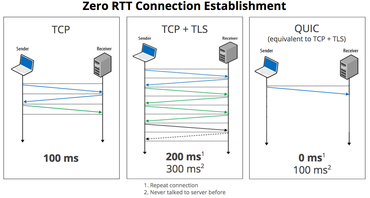
HTTP-over-QUIC is a rewrite of the HTTP protocol that uses Google’s QUIC instead of TCP (Transmission Control Protocol) as its base technology.

QUIC stands for “Quick UDP Internet Connections” and is, itself, Google’s attempt at rewriting the TCP protocol as an improved technology that combines HTTP/2, TCP, UDP, and TLS (for encryption), among many other things.

Google wants QUIC to slowly replace both TCP and UDP as the new protocol of choice for moving binary data across the Internet, and for good reasons, as test have proven that QUIC is both faster and more secure because of its encrypted-by-default implementation (current HTTP-over-QUIC protocol draft uses the newly released TLS 1.3 protocol).

0rtt-graphic.png
Image: Google

QUIC was proposed as a draft standard at the IETF in 2015, and HTTP-over-QUIC, a re-write of HTTP on top of QUIC instead of TCP, was proposed a year later, in July 2016.

Since then, HTTP-over-QUIC support was added inside Chrome 29 and Opera 16, but also in LiteSpeed web servers. While initially, only Google’s servers supported HTTP-over-QUIC connections, this year, Facebook also started adopting the technology.

In a mailing list discussion last month, Mark Nottingham, Chair of the IETF HTTP and QUIC Working Group, made the official request to rename HTTP-over-QUIC as HTTP/3, and pass it’s development from the QUIC Working Group to the HTTP Working Group.

In the subsequent discussions that followed and stretched over several days, Nottingham’s proposal was accepted by fellow IETF members, who gave their official seal of approval that HTTP-over-QUIC become HTTP/3, the next major iteration of the HTTP protocol, the technology that underpins today’s World Wide Web.

According to web statistics portal W3Techs, as of November 2018, 31.2 percent of the top 10 million websites support HTTP/2, while only 1.2 percent support QUIC.

Source: HTTP-over-QUIC to be renamed HTTP/3 | ZDNet

Microsoft announces app mirroring to let you use any Android app on Windows 10

Microsoft announced a new feature for Windows 10 today that will let Android phone users view and use any app on their device from a Windows desktop. The feature, which Microsoft is referring to as app mirroring and shows up in Windows as an app called Your Phone, seems to be work best with Android for now. Although Microsoft did announce the ability to transfer webpages from an iPhone to a Windows 10 desktop so you can pick up where you left off on mobile.

Regardless, the Your Phone app looks to be a significant step in helping bridge Windows 10 and the mobile ecosystem after the demise of Windows Phone. The news was announced at the company’s Surface hardware event in New York City this afternoon.

Source: Microsoft announces app mirroring to let you use any Android app on Windows 10 – The Verge

Amazon Alexa outage: Voice-activated devices are down in UK and beyond – yay cloud services!

Amazon Alexa devices stopped working in the UK and reportedly in parts of continental Europe this morning, with some users still complaining of intermittent outages at the time of writing.

The digital blackout began at around 0800 UK time and though it appeared to be recovering by 09.30, some folk – including Reg staffers – were still experiencing service failures at the time of writing.

The creepy always-on audio surveillance device voice-activated home assistant relies on a constant connection to Amazon’s servers to function.

Source: Amazon Alexa outage: Voice-activated devices are down in UK and beyond • The Register

Outlook, Skype ‘throttle’ users amid storm cloud drama, can’t login. Yay cloud!

Folks around the planet are today unable to use Microsoft Skype and Office 365’s Outlook due to a baffling “Throttled” error message.

The weird text box pops up in the chat software and cloud-backed email client, preventing people from sending messages, and talking to contacts.

This is, according to Microsoft, due to a botched update to Azure’s backend authentication systems. The internal upgrade was introduced as its engineers brought servers knocked out by storms in Texas back online, and promptly broke Outlook and Skype. Outlook Web Access is said to be unaffected.

Source: Ever wanted to strangle Microsoft? Now Outlook, Skype ‘throttle’ users amid storm cloud drama • The Register

Python creator Guido van Rossum sys.exit()s as language overlord

Guido van Rossum – who created the Python programming language in 1989, was jokingly styled as its “benevolent dictator for life”, and ushered it to global ubiquity – has stepped down, and won’t appoint a successor.

In a mailing list post on Thursday titled, “Transfer of Power,” he wrote: “Now that PEP 572 is done, I don’t ever want to have to fight so hard for a PEP and find that so many people despise my decisions.”

A PEP is a Python Enhancement Proposal, and it’s the process by which Python evolves with new features or adjacent standards.

In his friendly dictatorial role, Van Rossum signed off on each of proposal personally, an approach that contrasts strongly with comparable projects, such as PHP, that put such matters to a vote.

[…]

“I’ll still be there for a while as an ordinary core dev, and I’ll still be available to mentor people – possibly more available,” he added. “But I’m basically giving myself a permanent vacation from being BDFL, and you all will be on your own.”

He’s left behind no governing principles or a successor, but said a debate on those issues was coming anyway, citing the potential for him to be hit by a bus and the fact that “I’m not getting younger… (I’ll spare you the list of medical issues.)”

“So what are you all going to do?” he asked the python-committers mailing list. “Create a democracy? Anarchy? A dictatorship? A federation? We may be able to write up processes for these things as PEPs (maybe those PEPs will form a kind of constitution). But here’s the catch. I’m going to try and let you all (the current committers) figure it out for yourselves.

“I’ll still be here, but I’m trying to let you all figure something out for yourselves.”

Van Rossum’s achievements are hard to overstate: Python is among the most-used languages in the world. It’s advanced as an ideal beginners’ language, and has also been used in heavyweight enterprise apps. The likes of YouTube, Instagram, and Dropbox (van Rossum’s day job) all use it.

CodingDojo recently rated it the second-most-in-demand skill in job ads for developers. Stack Overflow’s 2018 developer survey ranked Python as the seventh-most popular “Programming, Scripting, and Markup Language”, ahead of C#, Ruby and PHP.

Source: Python creator Guido van Rossum sys.exit()s as language overlord • The Register

Why you should not use Google Cloud – it just turns your project off with no warning and no customer support!

We have a project running in production on Google Cloud (GCP) that is used to monitor hundreds of wind turbines and scores of solar plants scattered across 8 countries. We have control centers with wall-to-wall screens with dashboards full of metrics that are monitored 24/7. Asset Managers use this system to monitor the health of individual wind turbines and solar strings in real time and take immediate corrective maintenance. Development and Forecasting teams use the system to run algorithms on data in BigQuery. All these actions translate directly to revenue. We deal in a ‘wind/solar energy’ — a perishable commodity. If we over produce, we cannot store and sell later. If we under produce, there are penalties to be paid. For this reason assets need to be monitored 24/7 to keep up/down with the needs of the power grid and the power purchase agreements made.

What happened.

Early today morning (28 June 2018) i receive an alert from Uptime Robot telling me my entire site is down. I receive a barrage of emails from Google saying there is some ‘potential suspicious activity’ and all my systems have been turned off. EVERYTHING IS OFF. THE MACHINE HAS PULLED THE PLUG WITH NO WARNING.

[…]

Customer service chat is off. There’s no phone to call. I have an email asking me to fill in a form and upload a picture of the credit card and a government issued photo id of the card holder. Great, let’s wake up the CFO who happens to be the card holder.

We will delete project within 3 business days.

“We will delete your project unless the billing owner corrects the violation by filling out the Account Verification Form within three business days. This form verifies your identity and ownership of the payment instrument. Failure to provide the requested documents may result in permanent account closure.”

What if the card holder is on leave and is unreachable for three days? We would have lost everything — years of work — millions of dollars in lost revenue.

I fill in the form with the details and thankfully within 20 minutes all the services started coming alive. The first time this happened, we were down for a few hours. In all we lost everything for about an hour. An automated email arrives apologizing for ‘inconvenience’ caused. Unfortunately The Machine has no understanding of the ‘quantum of inconvenience’ caused.

[…]

This is the first project we built entirely on the Google Cloud. All our previous works were built on AWS. In our experience AWS handles billing issues in a much more humane way. They warn you about suspicious activity and give you time to explain and sort things out. They don’t kick you down the stairs.

I hope GCP team is listening and changes things for better. Until then i’m never building any project on GCP.

Source: Why you should not use Google Cloud. – Punch a Server – Medium

Per 1 juli 2018: Besluit digitale toegankelijkheid websites en apps overheid

In 2016 is een Europese richtlijn voor digitale toegankelijkheid in werking getreden. Nederland is verplicht om Europese richtlijnen om te zetten in nationale wetgeving. Deze richtlijn is omgezet in een Algemene Maatregel van Bestuur: het Tijdelijk besluit digitale toegankelijkheid overheid.Europese richtlijn digitale toegankelijkheidOp 22 december 2016 trad de EU-richtlijn voor de toegankelijkheid van websites en mobiele applicaties van overheidsinstanties in werking.De richtlijn verplicht lidstaten om te waarborgen dat digitale kanalen van organisaties in de publieke sector toegankelijk zijn. De verplichting geldt voor: websites; mobiele applicaties (apps); intranetten en extranetten die live gaan of substantieel aangepast worden na inwerkingtreding van de nieuwe regels.De richtlijn moet uiterlijk 23 september 2018 in nationale wetgeving zijn omgezet.

Source: Per 1 juli 2018: Besluit digitale toegankelijkheid | Beleid in Nederland | Digitoegankelijk.nl

‘R2D2’ stops disk-wipe malware before it executes evil commands

Purdue University researchers reckon they’ve cracked how to protect data against “disk-wipe” malware.

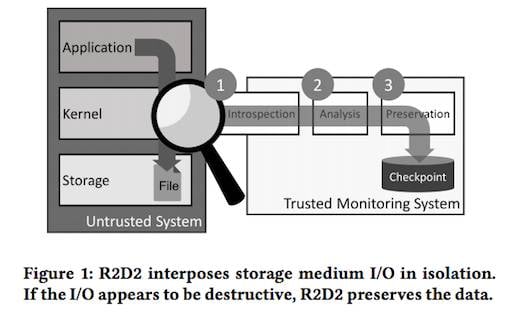
Led by Christopher Gutierrez, the team has created a shim of software that analyses write buffers before they reach storage, and if the write is destructive, it steps in to preserve the data targeted for destruction.

Dubbed R2D2 – “Reactive Redundancy for Data Destruction Protection” – their work will be published in the May issue of the journal Computers & Security.

In this [PDF] pre-press version of the paper, the researchers explained their technique. The inspection is implemented in the virtual machine monitor (VMM) using virtual machine introspection (VMI).

“This has the benefit that it does not rely on the entire OS as a root of trust”, they wrote, and they claimed a latency penalty of between 1 and 4 per cent for batch tasks, and 9 to 20 per cent for interactive tasks.

'R2D2' architecture

Click to enlarge

The system has been tested against various secure delete tools and malware like Shamoon and Stonedrill, and they claim complete success against “all the wiper malware samples in the wild that we experimented with”.

R2D2 intercepts the open file and write file system calls on a guest VM. When it detects an open file request, it checks “all open system calls” to see if the file is already open for writing.

“If the system call requests a write permission, a policy determines if the file should be protected based on a blacklist or whitelist,” they wrote.

Whitelisted files are those not protected; if a blacklisted file is requested, “If the file is on the blacklist, we take a snapshot of the file system because the file is considered critical to system stability.”

If the attacker tries to open a file on neither list, “R2D2 takes a temporary checkpoint of the file system, and subsequent write system calls are analysed, according to analysis policy, to determine if the write is suspect”.

Source: ‘R2D2’ stops disk-wipe malware before it executes evil commands • The Register

Microsoft updates its Quantum Development Kit and adds support for Linux and Mac

Today we’re announcing updates to our Quantum Development Kit, including support for macOS and Linux, additional open source libraries, and interoperability with Python. These updates will bring the power of quantum computing to even more developers on more platforms. At Microsoft, we believe quantum computing holds the promise of solving many of today’s unsolvable problems and we want to make it possible for the broadest set of developers to code new quantum applications.When we released the Quantum Development Kit last December, we were excited about the possibilities that might result from opening the world of quantum programming to more people. We delivered a new quantum programming language – Q#, rich integration with Visual Studio, and extensive libraries and samples. Since then, thousands of developers have explored the Quantum Development Kit and experienced the world of quantum computing, including students, professors, researchers, algorithm designers, and people new to quantum development who are using these tools to gain knowledge.

Source: Microsoft updates its Quantum Development Kit and adds support for Linux and Mac – Microsoft Quantum

Apple Is Rushing to Fix the Telugu Bug as Assholes Use It to ‘Bomb’ People’s iPhones and Macs

While many bugs are relatively benign, often getting patched before the user knows anything is wrong, the latest plague to hit Apple devices is already wreaking havoc on internet.

The issue, which has become known as the Telugu bug, gives people the ability to crash a wide range of iPhone, Mac, and iPad apps just by sending a single character from the third most spoken language in India.

To help address the situation, Apple says its already working on a patch that will fix the bug, which should arrive in the form of an intermediary update before iOS 11.3 (which is currently in beta) gets officially released.

However, in the meantime, some more mean-spirited users have taken to using the Telugu symbol to “bomb” other peoples devices. Motherboard has reported that by adding the symbol to a user’s Twitter name, you can crash the iOS Twitter app simply by liking someone’s tweet. And while it’s possible to address the issue by uninstalling and reinstalling the Twitter app, there’s not much stopping the same person from liking another tweet and causing the app to go haywire again.

Others have gotten even more devious, such as a security researcher who added the symbol to his Uber handle, which would crash the app anytime a driver with an iPhone tried to pick them up. And then there’s Darren Martyn, who posted a video on Twitter where he crashes people’s Mac networking app after he added the Telugu symbol to the name of a Wi-Fi network.

Source: Apple Is Rushing to Fix the Telugu Bug as Assholes Use It to ‘Bomb’ People’s iPhones and Macs

macOS may lose data on APFS-formatted disk images

This week we reported to Apple a serious flaw in macOS that can lead to data loss when using an APFS-formatted disk image. Until Apple issues a macOS update that resolves this problem, we’re dropping support for APFS-formatted disk images.

Note: What I describe below applies to APFS sparse disk images only — ordinary APFS volumes (e.g. your SSD startup disk) are not affected by this problem. While the underlying problem here is very serious, this is not likely to be a widespread problem, and will be most applicable to a small subset of backups. Disk images are not used for most backup task activity, they are generally only applicable when making backups to network volumes. If you make backups to network volumes, read on to learn more.
[…]
Earlier this week I noticed that an APFS-formatted sparsebundle disk image volume showed ample free space, despite that the underlying disk was completely full. Curious, I copied a video file to the disk image volume to see what would happen. The whole file copied without error! I opened the file, verified that the video played back start to finish, checksummed the file – as far as I could tell, the file was intact and whole on the disk image. When I unmounted and remounted the disk image, however, the video was corrupted.

Source: macOS may lose data on APFS-formatted disk images | Carbon Copy Cloner | Bombich Software

Can’t login to Skype? You’re not alone. Chat app’s been a bit crap for five days now

A bunch of Skype users are unhappy that they’re been unable to sign into the VoIP service for several days.The yakkity-yak app has fallen flat since January 24, leaving a number of punters with two-factor authentication enabled unable to get back into the software after signing out.”Skype users who are signed in are not affected,” Reg reader C. F. Heyns told us today. “Anyone signing out has almost no chance of getting back in.”

Source: Can’t login to Skype? You’re not alone. Chat app’s been a bit crap for five days now • The Register

Auto like Instagram pics Bot

Bot to automatically like your friends’ Instagram posts, and notify you on your Slack channel.

This script runs Instagram API every 15mins (cronjob) and checks for any new Instagram post for a paticular user_id. If a new a post is found it likes the post and sends a notification to your configured Slack channel using Slack Webhooks.

Github

Companies overlook risks in open source software: compliance and policy

Open source code helps software suppliers to be nimble and build products faster, but a new report reveals hidden software supply chain risks of open source that all software suppliers and IoT manufacturers should know about.
[…]
“We can’t lose sight that open source is indeed a clear win. Ready-to-go code gets products out the door faster, which is important given the lightning pace of the software space,” says Jeff Luszcz, vice president of product management at Flexera. “However, most software engineers don’t track open source use, and most software executives don’t realize there’s a gap and a security/compliance risk.”

Flexera surveyed 400 software suppliers, Internet of Things manufacturers and in-house development teams. It finds only 37 percent of respondents to the survey have an open source acquisition or usage policy, while 63 percent say either their companies either don’t have a policy, or they don’t know if one exists. Worryingly, of the 63 percent who say their companies don’t have an open source acquisition or usage policy, 43 percent say they contribute to open source projects.

There is an issue over who takes charge of open source software too. No one within their company is responsible for open source compliance, or they don’t know who is, according to 39 percent of respondents.

“Open source processes protect products and brand reputation. But, most software and IoT vendors don’t realize there is a problem, so they’re not protecting themselves and their customers,” adds Luszcz. “This endangers the entire software supply chain – for the vendors whose products are exposed to compliance and vulnerability risk. And also for their customers who most likely don’t even know they’re running open source and other third-party software, or that it may contain software vulnerabilities.”

Source: Companies overlook risks in open source software

It’s long beyond time the FOSS community grows up and understands the necessity of compliance to professional corporations. Likewise, these corporations should understand that FOSS is subject to the same compliance and security update policies as their commercial software.

NSA opens Github repo

THE TECHNOLOGIES LISTED BELOW were developed within the National Security Agency (NSA) and are now available to the public via Open Source Software (OSS). The NSA Technology Transfer Program (TTP) works with agency innovators who wish to use this collaborative model for transferring their technology to the commercial marketplace. OSS invites cooperative development of technology, encouraging broad use and adoption. The public benefits by adopting, enhancing, adapting, or commercializing the software. The government benefits from the open source community’s enhancements to the technology.

here

Mozilla Fathom – framework for classifying the web semantically

Fathom is a JavaScript framework for extracting meaning from web pages, identifying parts like Previous/Next buttons, address forms, and the main textual content—or classifying a page as a whole. Essentially, it scores DOM nodes and extracts them based on conditions you specify. A Prolog-inspired system of types and annotations expresses dependencies between scoring steps and keeps state under control. It also provides the freedom to extend existing sets of scoring rules without editing them directly, so multiple third-party refinements can be mixed together.

Mozilla’s github

I like the semantic web idea, but it never really picked up. Maybe this will work.

Windows is Bloated, Thanks to Adobe’s Extensible Metadata Platform – Thurrott.com

I put together a tool that scans files for PNG images containing Adobe metadata and was surprised that Windows is host to a lot of this gunk.
[…]
Windows Explorer, for example, is a critical Shell component in the startup hot path. But despite its importance, it’s comprised of ~20% pure garbage. ApplicationFrame.dll, responsible for Windows app title bars and frame gizmos, is ~41% garbage. Twinui, imageres, and other related components scored with much lower numbers but couldn’t fully escape Adobe XMP.

Source: Windows is Bloated, Thanks to Adobe’s Extensible Metadata Platform – Thurrott.com

Ouch!

Guacamole – Logmein alternative

Apache Guacamole is a clientless remote desktop gateway. It supports standard protocols like VNC, RDP, and SSH.We call it clientless because no plugins or client software are required.Thanks to HTML5, once Guacamole is installed on a server, all you need to access your desktops is a web browser.

Source: Apache Guacamole (incubating)

You set up your own server, then deploy clients on your desktops. Don’t know how well it streams video though…

New smartphone app looks inside objects, shows what else is in there

A new app from Fraunhofer development engineers looks directly inside objects and displays specific constituents. It has numerous uses: For instance, apples can be scanned for pesticide residues. Applications will be added successively following the Wikipedia principle.
[…]
Such scans usually require a special hyperspectral camera: It adjusts to different colored light each time and ascertains how much of a color’s light is reflected by an object, thus generating a complete spectral fingerprint of the object. The development engineers use a mathematical model to extract just about any information on an object, e.g. its constituents, from its spectral fingerprint. “Since hyperspectral cameras aren’t integrated in smartphones, we simply reversed this principle,” explains Seiffert. “The camera gives us a broadband three-channel sensor, that is, one that scans every wavelength and illuminates an object with different colored light.” This means that, instead of the camera measuring luminous intensity in different colors, the display successively illuminates the object with a series of different colors for fractions of a second. Thus, if the display casts only red light on the object, the object can only reflect red light – and the camera can only measure red light. Intelligent analysis algorithms enable the app to compensate a smartphone’s limited computing performance as well as the limited performance of the camera and display.

Source: New smartphone app looks inside objects

google/glazier: A tool for automating the installation of the Microsoft Windows operating system on various device platforms.

Glazier

Glazier is a tool for automating the installation of the Microsoft Windows operating system on various device platforms.

Why Glazier?

Glazier was created with certain principles in mind.

Text-based & Code-driven

With Glazier, imaging is configured entirely via text files. This allows technicians to leverage source control systems to maintain and develop their imaging platform. By keeping imaging configs in source control, we gain peer review, change history, rollback/forward, and all the other benefits normally reserved for writing code.

Reuse and templating allows for config sharing across multiple image types.

Configs can be consumed by unit tests, build simulators, and other helper infrastructure to build a robust, automated imaging pipeline.

Source controlled text makes it easy to integrate configs across multiple branches, making it easy to QA new changes before releasing them to the general population.

Scalability

Glazier distributes all data over HTTPS, which means you can use as simple or as advanced of a distribution platform as you need. Run it from a simple free web server or a large cloud-based CDN.

Proxies make it easy to accelerate image deployment to remote sites.

Extensible

Glazier makes it simple to extend the installer by writing a bit of Python or Powershell code.

Source: GitHub – google/glazier: A tool for automating the installation of the Microsoft Windows operating system on various device platforms.